
Active Smoking is Associated with Higher Rates of
- Slides: 1
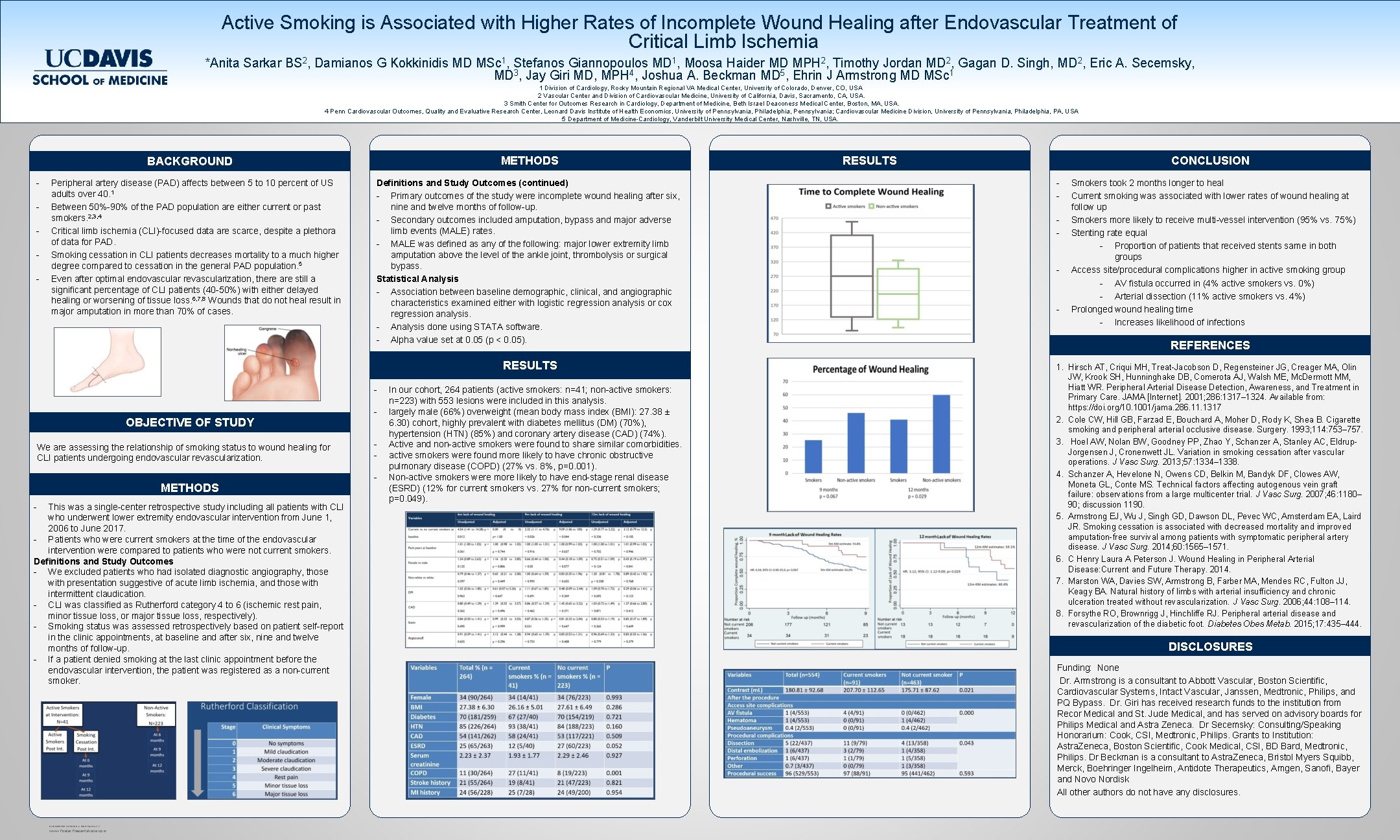
Active Smoking is Associated with Higher Rates of Incomplete Wound Healing after Endovascular Treatment of Critical Limb Ischemia *Anita Sarkar BS 2, Damianos G Kokkinidis MD MSc 1, Stefanos Giannopoulos MD 1, Moosa Haider MD MPH 2, Timothy Jordan MD 2, Gagan D. Singh, MD 2, Eric A. Secemsky, MD 3, Jay Giri MD, MPH 4, Joshua A. Beckman MD 5, Ehrin J Armstrong MD MSc 1 1 Division of Cardiology, Rocky Mountain Regional VA Medical Center, University of Colorado, Denver, CO, USA 2 Vascular Center and Division of Cardiovascular Medicine, University of California, Davis, Sacramento, CA, USA. 3 Smith Center for Outcomes Research in Cardiology, Department of Medicine, Beth Israel Deaconess Medical Center, Boston, MA, USA. 4 Penn Cardiovascular Outcomes, Quality and Evaluative Research Center, Leonard Davis Institute of Health Economics, University of Pennsylvania, Philadelphia, Pennsylvania; Cardiovascular Medicine Division, University of Pennsylvania, Philadelphia, PA, USA 5 Department of Medicine-Cardiology, Vanderbilt University Medical Center, Nashville, TN, USA. METHODS BACKGROUND - Peripheral artery disease (PAD) affects between 5 to 10 percent of US adults over 40. 1 Between 50%-90% of the PAD population are either current or past smokers. 2, 3, 4 Critical limb ischemia (CLI)-focused data are scarce, despite a plethora of data for PAD. Smoking cessation in CLI patients decreases mortality to a much higher degree compared to cessation in the general PAD population. 5 Even after optimal endovascular revascularization, there are still a significant percentage of CLI patients (40 -50%) with either delayed healing or worsening of tissue loss. 6, 7, 8 Wounds that do not heal result in major amputation in more than 70% of cases. Definitions and Study Outcomes (continued) - Primary outcomes of the study were incomplete wound healing after six, nine and twelve months of follow-up. - Secondary outcomes included amputation, bypass and major adverse limb events (MALE) rates. - MALE was defined as any of the following: major lower extremity limb amputation above the level of the ankle joint, thrombolysis or surgical bypass. Statistical Analysis - Association between baseline demographic, clinical, and angiographic characteristics examined either with logistic regression analysis or cox regression analysis. - Analysis done using STATA software. - Alpha value set at 0. 05 (p < 0. 05). RESULTS - OBJECTIVE OF STUDY We are assessing the relationship of smoking status to wound healing for CLI patients undergoing endovascular revascularization. METHODS - This was a single-center retrospective study including all patients with CLI who underwent lower extremity endovascular intervention from June 1, 2006 to June 2017. - Patients who were current smokers at the time of the endovascular intervention were compared to patients who were not current smokers. Definitions and Study Outcomes - We excluded patients who had isolated diagnostic angiography, those with presentation suggestive of acute limb ischemia, and those with intermittent claudication. - CLI was classified as Rutherford category 4 to 6 (ischemic rest pain, minor tissue loss, or major tissue loss, respectively). - Smoking status was assessed retrospectively based on patient self-report in the clinic appointments, at baseline and after six, nine and twelve months of follow-up. - If a patient denied smoking at the last clinic appointment before the endovascular intervention, the patient was registered as a non-current smoker. RESEARCH POSTER PRESENTATION DESIGN © 2012 www. Poster. Presentations. com - In our cohort, 264 patients (active smokers: n=41; non-active smokers: n=223) with 553 lesions were included in this analysis. largely male (66%) overweight (mean body mass index (BMI): 27. 38 ± 6. 30) cohort, highly prevalent with diabetes mellitus (DM) (70%), hypertension (HTN) (85%) and coronary artery disease (CAD) (74%). Active and non-active smokers were found to share similar comorbidities. active smokers were found more likely to have chronic obstructive pulmonary disease (COPD) (27% vs. 8%, p=0. 001). Non-active smokers were more likely to have end-stage renal disease (ESRD) (12% for current smokers vs. 27% for non-current smokers; p=0. 049). RESULTS CONCLUSION - - - Smokers took 2 months longer to heal Current smoking was associated with lower rates of wound healing at follow up Smokers more likely to receive multi-vessel intervention (95% vs. 75%) Stenting rate equal - Proportion of patients that received stents same in both groups Access site/procedural complications higher in active smoking group - AV fistula occurred in (4% active smokers vs. 0%) - Arterial dissection (11% active smokers vs. 4%) Prolonged wound healing time - Increases likelihood of infections REFERENCES 1. Hirsch AT, Criqui MH, Treat-Jacobson D, Regensteiner JG, Creager MA, Olin JW, Krook SH, Hunninghake DB, Comerota AJ, Walsh ME, Mc. Dermott MM, Hiatt WR. Peripheral Arterial Disease Detection, Awareness, and Treatment in Primary Care. JAMA [Internet]. 2001; 286: 1317– 1324. Available from: https: //doi. org/10. 1001/jama. 286. 11. 1317 2. Cole CW, Hill GB, Farzad E, Bouchard A, Moher D, Rody K, Shea B. Cigarette smoking and peripheral arterial occlusive disease. Surgery. 1993; 114: 753– 757. 3. Hoel AW, Nolan BW, Goodney PP, Zhao Y, Schanzer A, Stanley AC, Eldrup. Jorgensen J, Cronenwett JL. Variation in smoking cessation after vascular operations. J Vasc Surg. 2013; 57: 1334– 1338. 4. Schanzer A, Hevelone N, Owens CD, Belkin M, Bandyk DF, Clowes AW, Moneta GL, Conte MS. Technical factors affecting autogenous vein graft failure: observations from a large multicenter trial. J Vasc Surg. 2007; 46: 1180– 90; discussion 1190. 5. Armstrong EJ, Wu J, Singh GD, Dawson DL, Pevec WC, Amsterdam EA, Laird JR. Smoking cessation is associated with decreased mortality and improved amputation-free survival among patients with symptomatic peripheral artery disease. J Vasc Surg. 2014; 60: 1565– 1571. 6. C Henry Laura A Peterson J. Wound Healing in Peripheral Arterial Disease: Current and Future Therapy. 2014. 7. Marston WA, Davies SW, Armstrong B, Farber MA, Mendes RC, Fulton JJ, Keagy BA. Natural history of limbs with arterial insufficiency and chronic ulceration treated without revascularization. J Vasc Surg. 2006; 44: 108– 114. 8. Forsythe RO, Brownrigg J, Hinchliffe RJ. Peripheral arterial disease and revascularization of the diabetic foot. Diabetes Obes Metab. 2015; 17: 435– 444. DISCLOSURES Funding: None Dr. Armstrong is a consultant to Abbott Vascular, Boston Scientific, Cardiovascular Systems, Intact Vascular, Janssen, Medtronic, Philips, and PQ Bypass. Dr. Giri has received research funds to the institution from Recor Medical and St. Jude Medical, and has served on advisory boards for Philips Medical and Astra Zeneca. Dr Secemsky: Consulting/Speaking Honorarium: Cook, CSI, Medtronic, Philips. Grants to Institution: Astra. Zeneca, Boston Scientific, Cook Medical, CSI, BD Bard, Medtronic, Philips. Dr Beckman is a consultant to Astra. Zeneca, Bristol Myers Squibb, Merck, Boehringer Ingelheim, Antidote Therapeutics, Amgen, Sanofi, Bayer and Novo Nordisk All other authors do not have any disclosures.