
Active Passive Transportation of Nutrients SUMMARY Active Transport
- Slides: 12
Active & Passive Transportation of Nutrients SUMMARY -Active Transport -Passive Transport -Transpiration pull Theory
Nutrient • Nutrients is the food or any substance that supplies the body with elements, necessary for metabolism. • Plants need nutrients in lager, smaller or may in trace amount. • These macronutrients contributes 95% of plants entire biomass. Your Logo or Name Here 2
• Mostly plants are autotrophic & made their own food. • Some are heterotrophic, unable are synthesize their own food. • How plants requires micronutrients from SOIL. Uptake of Mineral Nutrients from the Soil ü This process carried out by root hair which are extensions of root epidermal tissues that result in the increase of the surface area to absorb water & minerals. ü Not all ions are equally present in the soil, depending on property of soil. The clay is negatively charged so +ve ions are present in clay rich soil will remain bounded tightly. Your Logo or Name Here 3
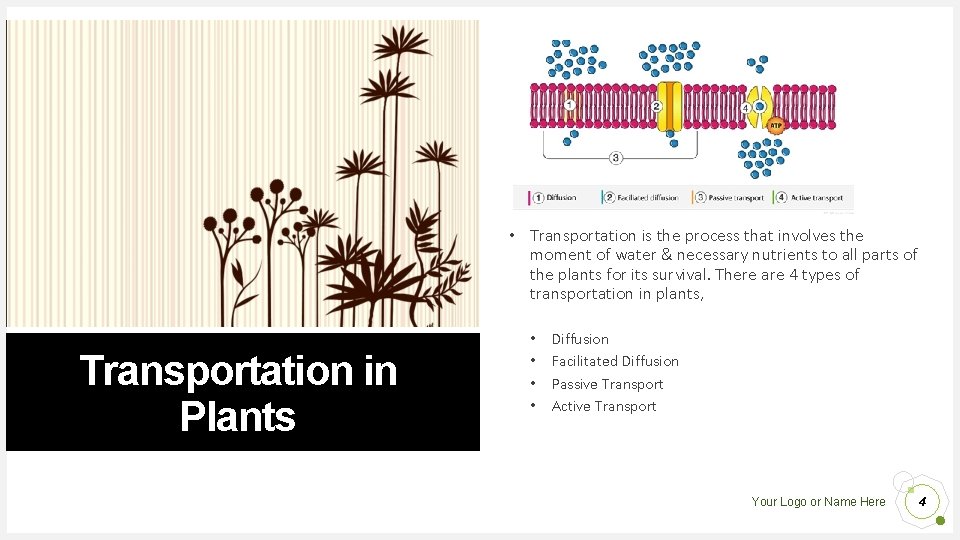
• Transportation is the process that involves the moment of water & necessary nutrients to all parts of the plants for its survival. There are 4 types of transportation in plants, Transportation in Plants • • Diffusion Facilitated Diffusion Passive Transport Active Transport Your Logo or Name Here 4
• Transportation occur in 3 level in case of plant. Transportation in Plants • Transportation of substance from 1 cell to another. • Long distance transport of SAP with xylem & phloem. • The release & update of solute and water by individual cells. Your Logo or Name Here 5
Diffusion • This is a process that involve passive moment of a substance from cell to cell or from 1 part of plant to the cell they don’t involve in the moment of molecules takes place in random fashion & expenditure of energy. Your Logo or Name Here 6
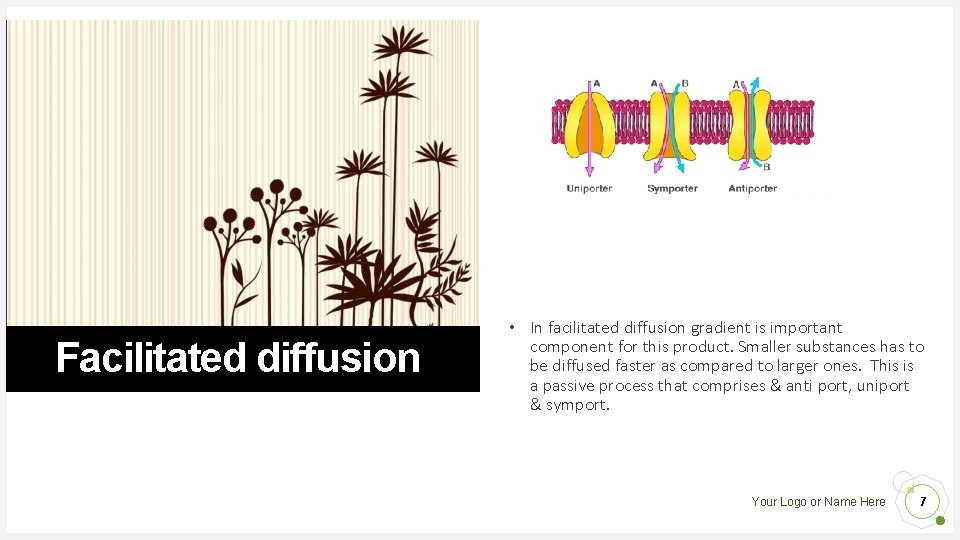
Facilitated diffusion • In facilitated diffusion gradient is important component for this product. Smaller substances has to be diffused faster as compared to larger ones. This is a passive process that comprises & anti port, uniport & symport. Your Logo or Name Here 7
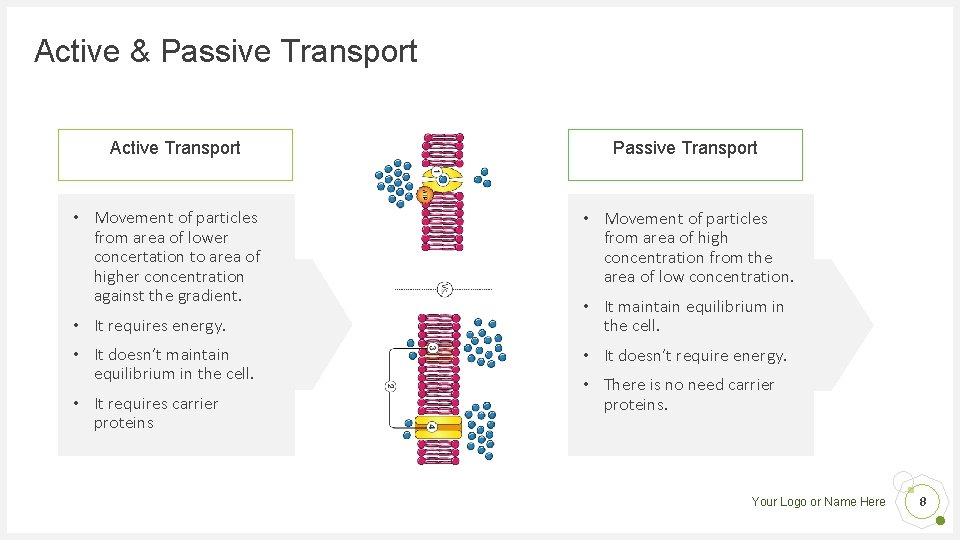
Active & Passive Transport Active Transport • Movement of particles from area of lower concertation to area of higher concentration against the gradient. Passive Transport • Movement of particles from area of high concentration from the area of low concentration. • It requires energy. • It maintain equilibrium in the cell. • It doesn’t require energy. • It requires carrier proteins • There is no need carrier proteins. Your Logo or Name Here 8
Ascent of SAP • The moment of water and dissolved mineral passed through the cortex and endodermis and reach xylem & roots in the water and dissolved minerals are carried or pulled upward towards the leaves through xylem tissue, this is called ascent of SAP. This may involve following processes, • Root Pressure Theory • Transpiration Pull Theory Your Logo or Name Here 9
Root Pressure Force is involved in the movement of water and dissolved minerals up in the xylem tissue is the root pressure. Root pressure is created by active secretion of salutes & other salutes from the other cells into xylem SAP. This lowers the water potential of xylem SAP. Water enters the xylem cells by OSMOSIS, thus increasing the level of SAP in xylem cells. Your Logo or Name Here 10
Transportation Pull Theory • • This theory was proposed by DIXON. It flows water upward to the leaves. Comprises of 3 major theories • Cohesion Tension Theory • Adhesion Theory Your Logo or Name Here 11
Mechanism of Transpiration Pull Theory • Water is pulled from xylem cells. This pull also causes water to move down its concertation gradient transversally from the root epidermis to cortex by endosmosis and to pericycle. This pulling force is called transpiration pull. Your Logo or Name Here 12