
Active Listening Techniques Overview of Presentation n What
- Slides: 10
Active Listening Techniques
Overview of Presentation n What is active listening? n Why do we practice it? n How do we practice it?
What is active listening? Active listening involves: n communicating verbally and nonverbally n practicing “uninterrupted” listening n restating the message n observing the sender’s nonverbal signals
Why practice active listening? n Helps us understand others better n Show others we respect them n Allows us to receive accurate messages n Enables us to respond appropriately
How to practice active listening n Physical environment n Attending posture: SOLER n Listening skills n Questioning skills
Physical environment n Ensure privacy n Minimize interruptions n Eliminate barriers
Attending posture Nonverbal skill = SOLER n S= squarely face person n O= use open posture n L= lean toward the person n E= use eye contact n R= relax, keep it natural n According to Gerald Egan, author of the supplement you read from the “Skilled Helper: A Problem-Management Approach to Helping
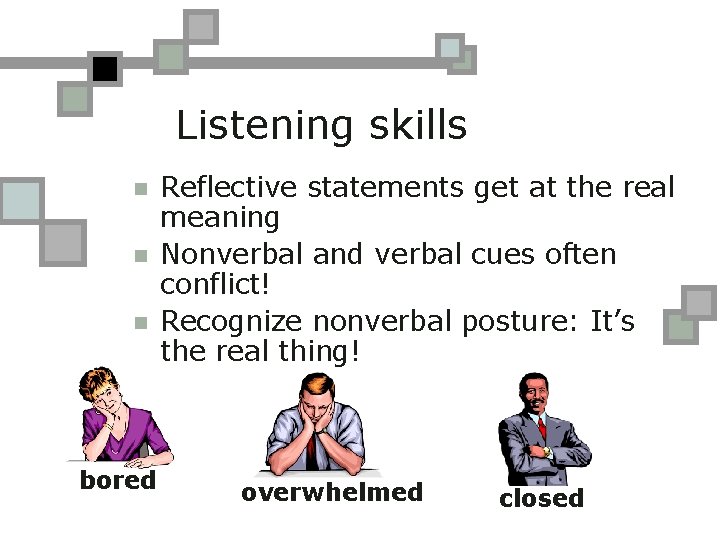
Listening skills n n n bored Reflective statements get at the real meaning Nonverbal and verbal cues often conflict! Recognize nonverbal posture: It’s the real thing! overwhelmed closed
Questions skills n Ask questions…not too many n Avoid “why” questions n Ask open-end questions
Summary of Presentation n What is active listening? n Why do we practice it? n How do we practice it?