
ACTIVE LISTENING for LAW ENFORCEMENT Gerald R ADAMS
![What is communication? 1. 0 Com·mu·ni·ca·tion - [ kə my�ni káysh'n ] 1. 1](https://slidetodoc.com/presentation_image_h/0bf0461f7f55e7827f07ac2d3a4c967a/image-4.jpg "What is communication? 1. 0 Com·mu·ni·ca·tion - [ kə my�ni káysh'n ] 1. 1")





- Slides: 26
ACTIVE LISTENING for LAW ENFORCEMENT Gerald R. ADAMS and Associates, LLC
PRESENTER • • • Name: Current status/position (Background) Duty Assignments/Experience Law Enforcement Training Education
LEARNING OBJECTIVES 1. 2. 3. 4. What is communication? How do we communicate? What is active Listening? What are systemic problems in communication (Listening)? 5. How can we improve our Listening skills? 6. How can we become better active listeners?
What is communication? 1. 0 Com·mu·ni·ca·tion - [ kə my�ni káysh'n ] 1. 1 exchange of information: 1. 2 message: 1. 3 act of communicating 1. 4 Synonyms:
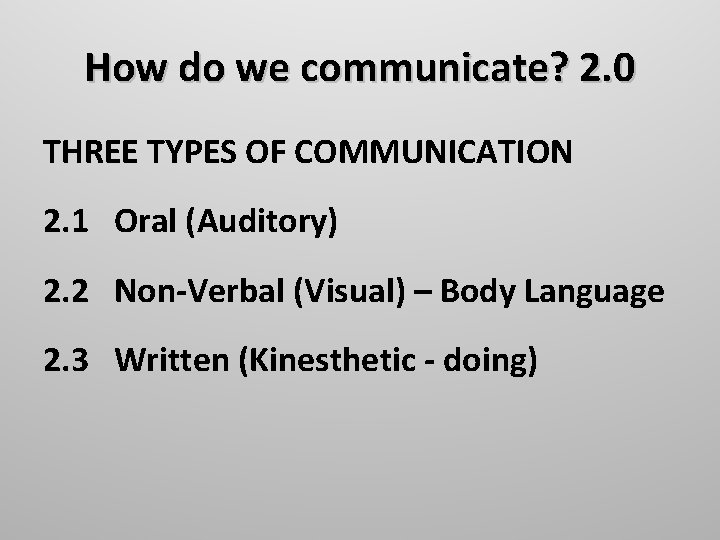
How do we communicate? 2. 0 THREE TYPES OF COMMUNICATION 2. 1 Oral (Auditory) 2. 2 Non-Verbal (Visual) – Body Language 2. 3 Written (Kinesthetic - doing)
Oral (Auditory) 2 -1
Non-Verbal (Visual) – Body Language 2. 2
Non-Verbal (Visual) Example • Insert dueling banjo video
Written (Kinesthetic - doing) 2. 3
What is active Listening?
What are systemic problems in communication (Listening)? 4. 0 • Perpetrator(s) want to “TALK” get it off their chest (conscience). 4. 1 • Perpetrator(s) will be misleading – give misinformation. 4. 2 • Perpetrator(s) will be deliberately deceptive to try and get you to refocus off of them to something (or someone) else. 4. 3
How can we improve our Listening skills? 5. 0 KNOW THE BARRIERS to effective Communication. 5. 1 Physical barriers: 5. 2 System design: 5. 3 Attitudinal barriers: 5. 4 Ambiguity of Words/Phrases: 5. 5 Individual linguistic ability 5. 6 Physiological barriers: 5. 7 Presentation of information:
Physical Barriers 5. 1
System Design 5. 2
Attitudinal Barriers 5. 3
Ambiguity of Words/Phrases 5. 4
Individual linguistic ability 5. 5
Physiological Barriers 5. 6
Presentation of Information 5. 7
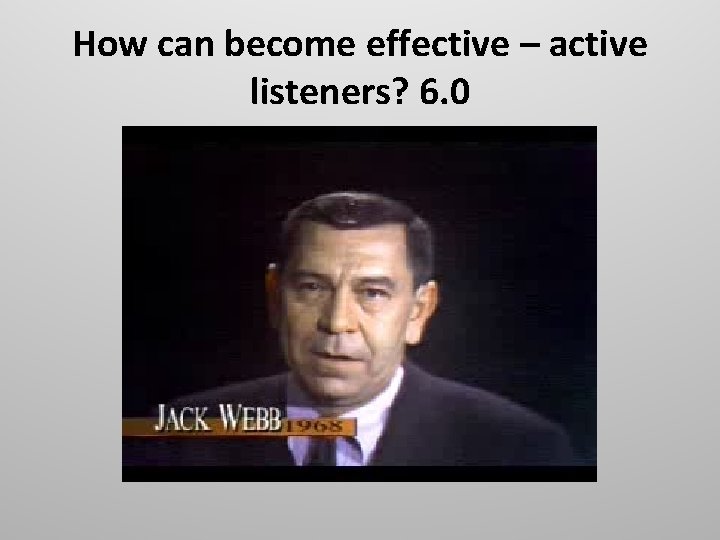
How can become effective – active listeners? 6. 0
DEFINE & PROCESS • Scenario (Practical Application)
SUMMARY (Review)
QUESTIONS
SOURCES - RESOURCES
THANKS FOR YOUR LISTENING
Presenter George D. Little, C. C. P. S. Masters Criminology & Counter-Terrorism, BS & BA Criminal Justice, Social Work Services and Human Resources AS & AA Licensed Master, Advanced, Intermediate, Basic Peace Officer License and Instructor Certifications with the Texas Commission on Law Enforcement Officer Standards in Education (TCLEOSE) • (210) 379 -4919 glittle 1@satx. rr. com • •