
Active learning Strategies A pedagogical perspective Prof B
Active learning Strategies A pedagogical perspective Prof. B. V. Appa Rao Teaching-Learning Centre NIT Warangal
Traditional Lecturing Method • Most of the time, students are passive listeners • Deep learning and learning at higher cognitive levels do not take place
• Student-Centered learning and learning by the active participation of students promote deep learning and learning at higher cognitive levels
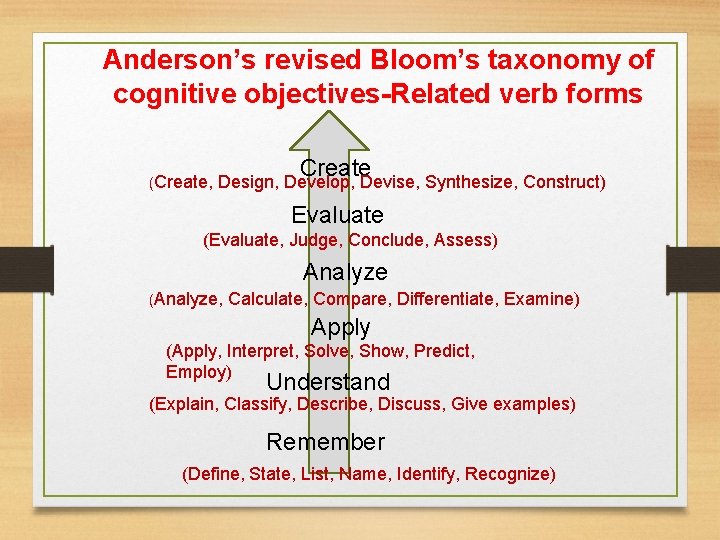
Anderson’s revised Bloom’s taxonomy of cognitive objectives-Related verb forms (Create, Create Design, Develop, Devise, Synthesize, Construct) Evaluate (Evaluate, Judge, Conclude, Assess) Analyze (Analyze, Calculate, Compare, Differentiate, Examine) Apply (Apply, Interpret, Solve, Show, Predict, Employ) Understand (Explain, Classify, Describe, Discuss, Give examples) Remember (Define, State, List, Name, Identify, Recognize)
In order to facilitate the learning outcomes among students as per the course objectives, the teacher has to equip himself with • Subject Knowledge(Mastery) • Pedagogy(Appropriate teaching methods) • Technology (Appropriate) in Teaching Ultimately, the students have to achieve the expected learning outcomes.
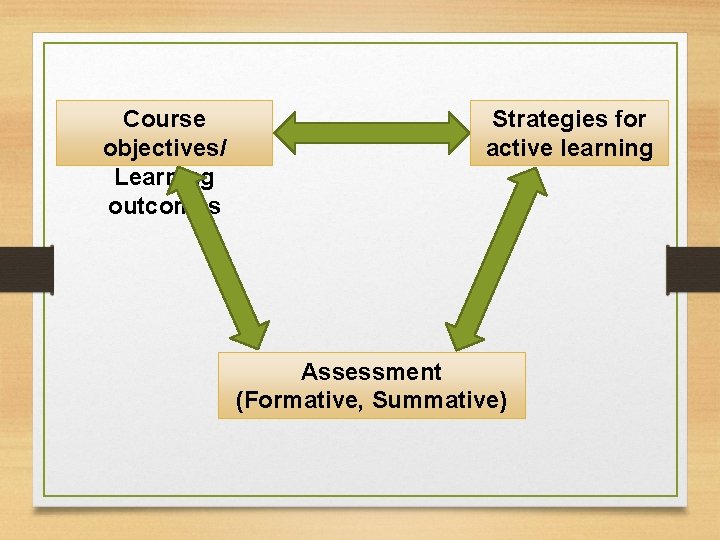
Course objectives/ Learning outcomes Strategies for active learning Assessment (Formative, Summative)
Active Learning Phase Active Learning : Definition ‘Active learning is defined as any instructional method that engages students in the learning process. In short, active learning requires students to do meaningful learning activities and think about what they are doing’ (Ref: Bonwell, C. C and J. A. Eison, “ Active Learning: creating excitement in the class room”, ASHEERIC Higher Education Report No. 1, George Washington University, Washington, DC, 1991)
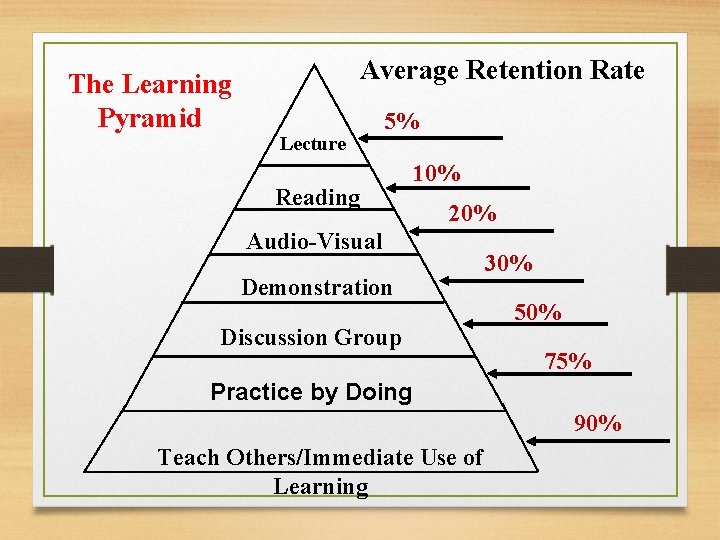
The Learning Pyramid Average Retention Rate Lecture 5% Reading 10% 20% Audio-Visual Demonstration Discussion Group 30% 50% 75% Practice by Doing 90% Teach Others/Immediate Use of Learning
Appropriate combination of different teaching strategies promotes effective learning among students
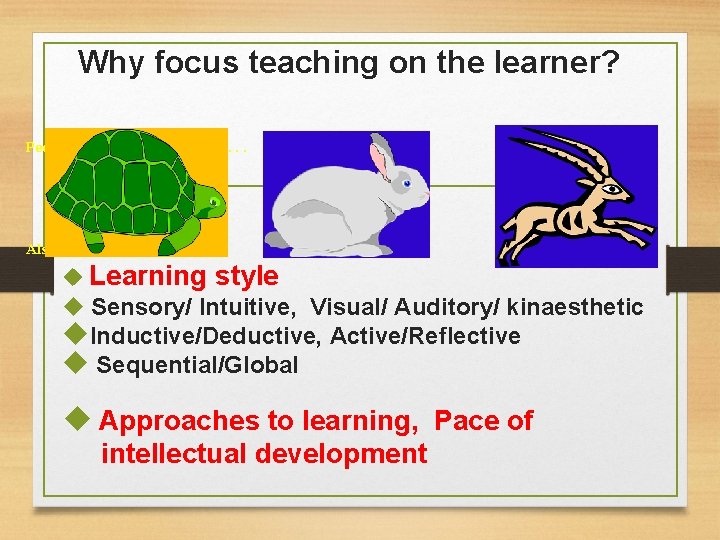
Why focus teaching on the learner? People learn at different rates. . Also, nts differ in their: u Learning style u Sensory/ Intuitive, Visual/ Auditory/ kinaesthetic u. Inductive/Deductive, Active/Reflective u Sequential/Global u Approaches to learning, Pace of intellectual development
Appropriate use of Active Learning Strategies is likely to promote learning in all types of learners
Famous mathematician G. Polya in his book (1944), ”How to solve it - A new aspect of mathematical method” wrote “A great discovery solves a great problem. But, there is a grain of discovery in the solution of ANY problem. Your problem may be modest; but if it challenges your curiosity and brings into play your inventive faculties, and if you solve it by your own means, you may experience the tension and enjoy the triumph of discovery. Such experiences at a susceptible age may create a taste for mental work and leave their imprint on mind and character for a lifetime. ”
Some of the active learning strategies • Learning by doing • Learning through discussion among the peer group • Learning through analysing Case Studies • Group Projects, Engineering Projects in Community Service (EPICS)
• Experiential Learning • Reflective Learning • One Minute Paper during the classroom interaction • Open ended questions by teacher • Open ended questions from students
• Question Bowl taken around the class by the teacher or one of the students • Preparation of question bank by students at various cognitive levels

Learning by Doing • Use of Free and Open Source Software (FOSS) Spoken Tutorials of IIT Bombay(Web site: www. spoken-tutorial. org)
• Given the paradigmatic shifts that a true revolution in machine learning could bring, it’s important to maintain tech’s devotion to open-source. • These kinds of scientific advancement don’t belong to any one company or corporation, but to the whole world. Making ML open and evenly distributed means everyone can join in this revolution.
A Few Open Source Tools • OPENAI • Tensor. Flow • Paddle • CNTK

Free and Open Source – Big Data Processing Tools • Apache Storm • Apache Hadoop • Apache Samoa
For 3 D modeling: Free. CAD is the most important free and open source alternative in place of commercial softwares (ref. : University of Alaska, MIT, Virginia Tech, Harward university, California Institute of Technology etc. ) • Octave is the Linux-community solution for MATLAB. • Sci. Lab is another alternative for MATLAB, very strongly advocated by IIT Bombay and other Institutions. • Free. Mat Provides environment similar to MATLAB for data processing and analysis
Case Study as Active learning Strategy • Can be used in all subjects • Social sciences, management, Sciences, Engineering • For learning at higher cognitive levels
Small Group Projects for Cooperative Learning • Such projects done by the students promote active learning and many other inter personal skills. Scaffolding of the slow learners by the peers is also possible. • Interdisciplinary and multidisciplinary projects related to real time problems lead to innovations.
Learning through discussion 1. Think- Pair- Share Activity (TPS) Q 1 : Unknown Problem on a topic in the given course is to be given by the teacher
Think Phase: Suggested duration -3 minutes § Teacher’s activity: Teacher will pose the above problem and ask every student to think and analyse the problem. § Students’ activity: Every student thinks, analyses the problem.
Pair phase: suggested duration -5 min. § Teacher’s activity: Teacher will ask the students to pair up and have exchange of their ideas and finally write their analysis of the problem and also plausible solution. § Students’ activity: Students discuss in pairs and each pair writes the analysis of the problem and the possible solution.
Share Phase: Suggested duration - 10 min. § Teacher’s activity: The teacher will ask each pair to present the solutions. He/she will write different answers in brief on the board, encourages further questions from the students, facilitates discussion and leads the students toward deep learning. § Students’ activity: Students share their ideas, ask challenging questions, come out with original ideas and lead the entire class toward deep learning.
At the end of this strategy, § teacher and students experience that new knowledge is constructed in the class room by the students. § Teacher plays the role of motivator and facilitator toward deep learning.
Learning through discussion 2. Team Pair Solo Activity (Te. PS) Problem 2 : The teacher constructs a different type of problem with different learning outcomes and organizes the Team-Pair-Solo activity, as the active learning strategy
Team Activity phase: Suggested duration - 10 minutes § Teacher’s activity: Teacher divides students into teams of five members each and asks them to analyze the problem through discussion in the team. Every member is asked to think and share his/her analysis with other members of the team. § Students’ activity: Every student in the team thinks independently, contributes to the analysis of the problem. Finally the team comes out with its broad analysis of the problem. It is possible that there may be more than one kind of analysis.
Pair Activity phase: Suggested duration - 5 min § Teacher’s activity: Teacher asks each student to pair up with the student of another team and discuss the problem again and come out with fresh analysis of the case in greater detail. § Students’ activity: Students in each pair discuss the case and converge their thinking toward more probable analysis of the problem in greater detail.
Solo Activity phase: Suggested duration - 5 min Each student prepares the analysis of the problem and solution independently and submits the final report to the teacher. After solving a difficult problem in this strategy, the teacher will give another complex problem to be solved by the students in pairs. By now all the students will have achieved deeper understanding of the concept. Finally the teacher will give another complex problem, to be worked out by each student independently.
Scaffolding Technique
To Conclude A Teacher, who facilitates active learning among students, becomes an active learner himself. He experiences grains of discoveries in many projects. He mentors generations of students, who can become innovators, entrepreneurs, leaders, administrators and teachers. My tributes are to such great teachers
35
- Slides: 35