
Active Learning Promotes Information Retention Xiaopeng Gong Julie
- Slides: 1
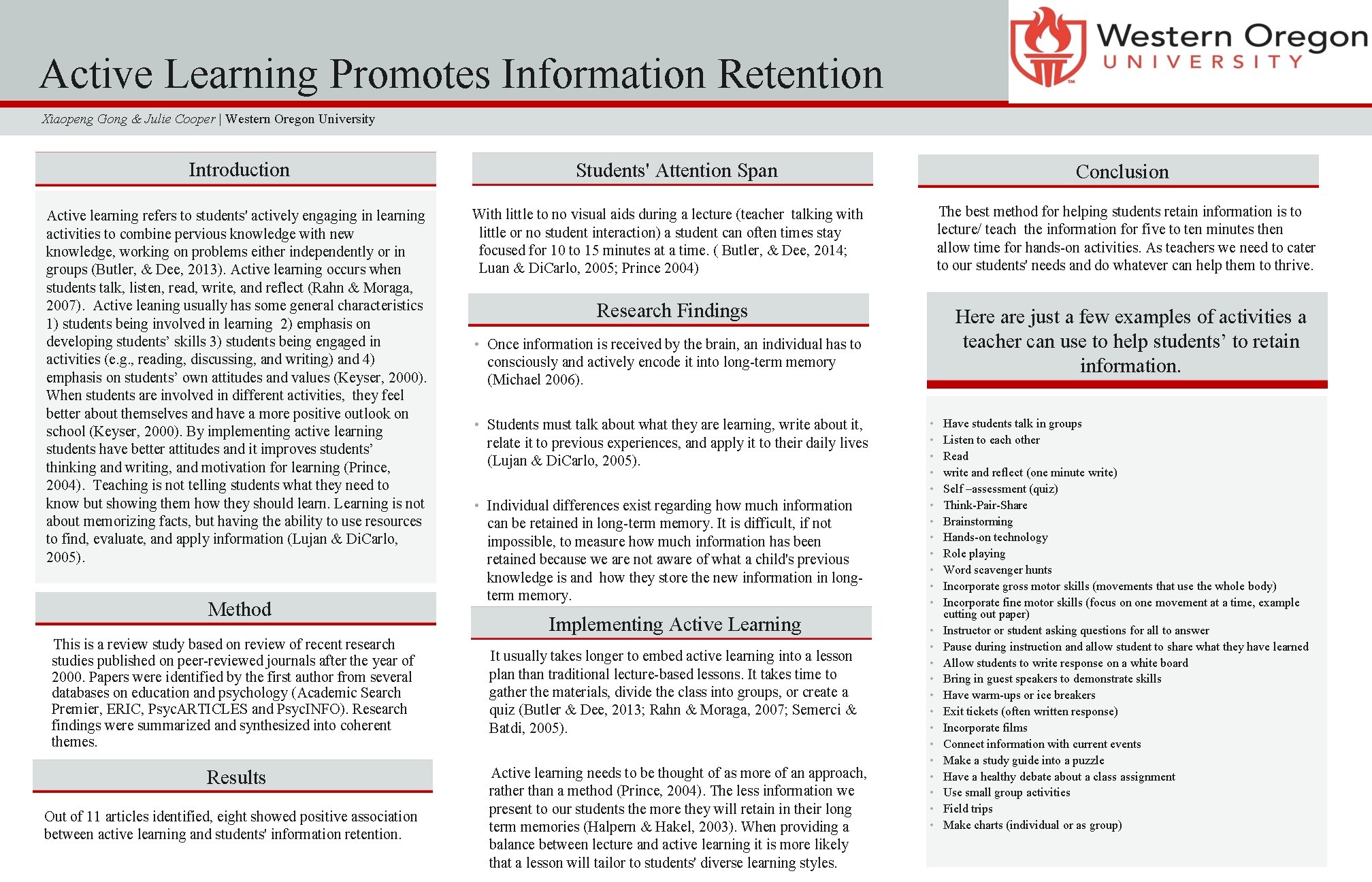
Active Learning Promotes Information Retention Xiaopeng Gong & Julie Cooper | Western Oregon University Introduction Active learning refers to students' actively engaging in learning activities to combine pervious knowledge with new knowledge, working on problems either independently or in groups (Butler, & Dee, 2013). Active learning occurs when students talk, listen, read, write, and reflect (Rahn & Moraga, 2007). Active leaning usually has some general characteristics 1) students being involved in learning 2) emphasis on developing students’ skills 3) students being engaged in activities (e. g. , reading, discussing, and writing) and 4) emphasis on students’ own attitudes and values (Keyser, 2000). When students are involved in different activities, they feel better about themselves and have a more positive outlook on school (Keyser, 2000). By implementing active learning students have better attitudes and it improves students’ thinking and writing, and motivation for learning (Prince, 2004). Teaching is not telling students what they need to know but showing them how they should learn. Learning is not about memorizing facts, but having the ability to use resources to find, evaluate, and apply information (Lujan & Di. Carlo, 2005). Method This is a review study based on review of recent research studies published on peer-reviewed journals after the year of 2000. Papers were identified by the first author from several databases on education and psychology (Academic Search Premier, ERIC, Psyc. ARTICLES and Psyc. INFO). Research findings were summarized and synthesized into coherent themes. Results Out of 11 articles identified, eight showed positive association between active learning and students' information retention. Students' Attention Span Conclusion The best method for helping students retain information is to lecture/ teach the information for five to ten minutes then allow time for hands-on activities. As teachers we need to cater to our students' needs and do whatever can help them to thrive. With little to no visual aids during a lecture (teacher talking with little or no student interaction) a student can often times stay focused for 10 to 15 minutes at a time. ( Butler, & Dee, 2014; Luan & Di. Carlo, 2005; Prince 2004) Research Findings Here are just a few examples of activities a teacher can use to help students’ to retain information. • Once information is received by the brain, an individual has to consciously and actively encode it into long-term memory (Michael 2006). • Students must talk about what they are learning, write about it, relate it to previous experiences, and apply it to their daily lives (Lujan & Di. Carlo, 2005). • Individual differences exist regarding how much information can be retained in long-term memory. It is difficult, if not impossible, to measure how much information has been retained because we are not aware of what a child's previous knowledge is and how they store the new information in longterm memory. Implementing Active Learning It usually takes longer to embed active learning into a lesson plan than traditional lecture-based lessons. It takes time to gather the materials, divide the class into groups, or create a quiz (Butler & Dee, 2013; Rahn & Moraga, 2007; Semerci & Batdi, 2005). Active learning needs to be thought of as more of an approach, rather than a method (Prince, 2004). The less information we present to our students the more they will retain in their long term memories (Halpern & Hakel, 2003). When providing a balance between lecture and active learning it is more likely that a lesson will tailor to students' diverse learning styles. • • • • • • • Have students talk in groups Listen to each other Read write and reflect (one minute write) Self –assessment (quiz) Think-Pair-Share Brainstorming Hands-on technology Role playing Word scavenger hunts Incorporate gross motor skills (movements that use the whole body) Incorporate fine motor skills (focus on one movement at a time, example cutting out paper) Instructor or student asking questions for all to answer Pause during instruction and allow student to share what they have learned Allow students to write response on a white board Bring in guest speakers to demonstrate skills Have warm-ups or ice breakers Exit tickets (often written response) Incorporate films Connect information with current events Make a study guide into a puzzle Have a healthy debate about a class assignment Use small group activities Field trips Make charts (individual or as group)