
Active Immunization Active immunity develops naturally in response
- Slides: 23
Active Immunization • Active immunity develops naturally in response to an infection. • It can also develop following/ from immunization, also called vaccination. • In immunization, a nonpathogenic form of a microbe or part of a microbe elicits an immune response to an immunological memory. Copyright © 2008 Pearson Education, Inc. , publishing as Pearson Benjamin Cummings
Passive Immunity • Passive immunity provides immediate, shortterm protection. • It is conferred naturally when Ig. G crosses the placenta from mother to fetus or when Ig. A passes from mother to infant in breast milk. • It can also be conferred artificially by injecting antibodies into a nonimmune person. Copyright © 2008 Pearson Education, Inc. , publishing as Pearson Benjamin Cummings
Immune Rejection • Cells transferred from one person to another can be attacked by immune defenses. • This complicates blood transfusions or the transplant of tissues or organs. • MHC molecules are different among genetically nonidentical individuals. • Differences in MHC molecules stimulate rejection of tissue grafts and organ transplants. Copyright © 2008 Pearson Education, Inc. , publishing as Pearson Benjamin Cummings
• Chances of successful transplantation increase if donor and recipient MHC tissue types are well matched. • Immunosuppressive drugs facilitate transplantation. • Lymphocytes in bone marrow transplants may cause the donor tissue to reject the recipient. Copyright © 2008 Pearson Education, Inc. , publishing as Pearson Benjamin Cummings
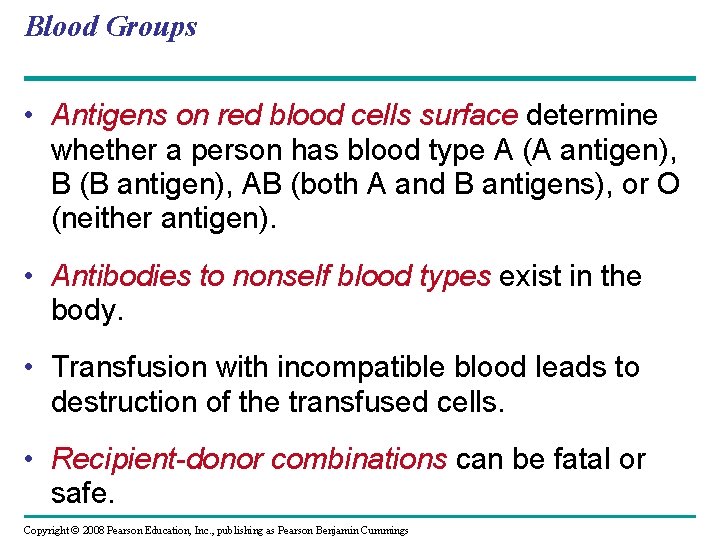
Blood Groups • Antigens on red blood cells surface determine whether a person has blood type A (A antigen), B (B antigen), AB (both A and B antigens), or O (neither antigen). • Antibodies to nonself blood types exist in the body. • Transfusion with incompatible blood leads to destruction of the transfused cells. • Recipient-donor combinations can be fatal or safe. Copyright © 2008 Pearson Education, Inc. , publishing as Pearson Benjamin Cummings
Disruption in immune system function can elicit or exacerbate disease • Some pathogens have evolved to diminish the effectiveness of host immune responses. • If the delicate balance of the immune system is disrupted, effects range from minor to often fatal. Copyright © 2008 Pearson Education, Inc. , publishing as Pearson Benjamin Cummings
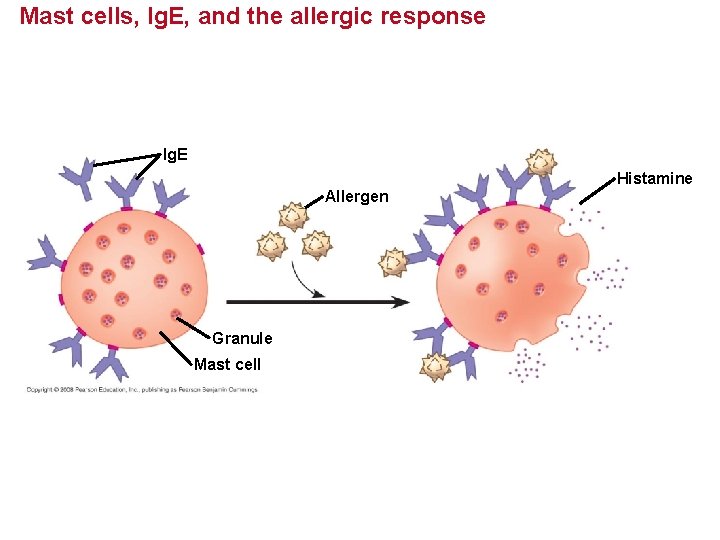
Allergies • Allergies are exaggerated (hypersensitive) responses to antigens called allergens. • In localized allergies such as hay fever, Ig. E antibodies produced after first exposure to an allergen attach to receptors on mast cells. Copyright © 2008 Pearson Education, Inc. , publishing as Pearson Benjamin Cummings
Mast cells, Ig. E, and the allergic response Ig. E Allergen Granule Mast cell Histamine
• The next time the allergen enters the body, it binds to mast cell–associated Ig. E molecules. • Mast cells release histamine and other mediators that cause vascular changes leading to typical allergy symptoms. • An acute allergic response can lead to anaphylactic shock, a life-threatening reaction that can occur within seconds of allergen exposure. Copyright © 2008 Pearson Education, Inc. , publishing as Pearson Benjamin Cummings
Autoimmune Diseases • In individuals with autoimmune diseases, the immune system loses tolerance for self and turns against certain molecules of the body. • Autoimmune diseases include systemic lupus erythematosus, rheumatoid arthritis, insulindependent diabetes mellitus, and multiple sclerosis. Copyright © 2008 Pearson Education, Inc. , publishing as Pearson Benjamin Cummings
Exertion, Stress, and the Immune System • Moderate exercise improves immune system function. • Psychological stress has been shown to disrupt hormonal, nervous, and immune systems. Copyright © 2008 Pearson Education, Inc. , publishing as Pearson Benjamin Cummings
Immunodeficiency Diseases • Inborn immunodeficiency results from hereditary or developmental defects that prevent proper functioning of innate, humoral, and/or cell-mediated defenses. • Acquired immunodeficiency results from exposure to chemical and biological agents. • Acquired immunodeficiency syndrome (AIDS) is caused by a virus. Copyright © 2008 Pearson Education, Inc. , publishing as Pearson Benjamin Cummings
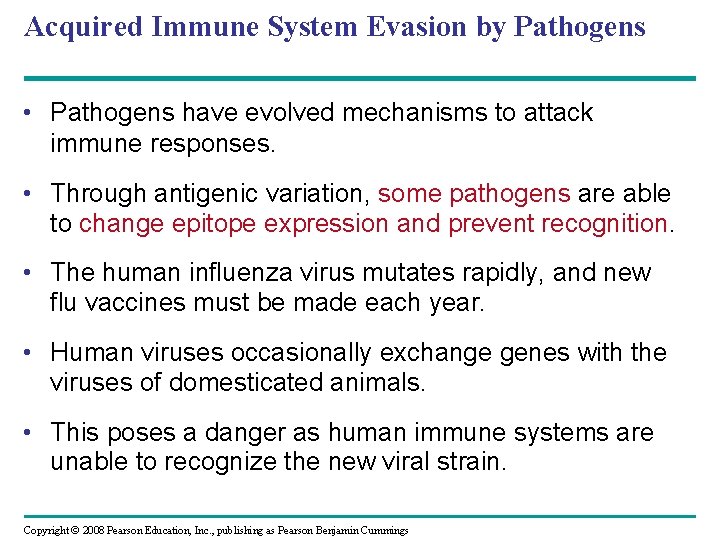
Acquired Immune System Evasion by Pathogens • Pathogens have evolved mechanisms to attack immune responses. • Through antigenic variation, some pathogens are able to change epitope expression and prevent recognition. • The human influenza virus mutates rapidly, and new flu vaccines must be made each year. • Human viruses occasionally exchange genes with the viruses of domesticated animals. • This poses a danger as human immune systems are unable to recognize the new viral strain. Copyright © 2008 Pearson Education, Inc. , publishing as Pearson Benjamin Cummings
Latency • Some viruses may remain in a host in an inactive state called latency. • Herpes simplex viruses can be present in a human host without causing symptoms. Copyright © 2008 Pearson Education, Inc. , publishing as Pearson Benjamin Cummings
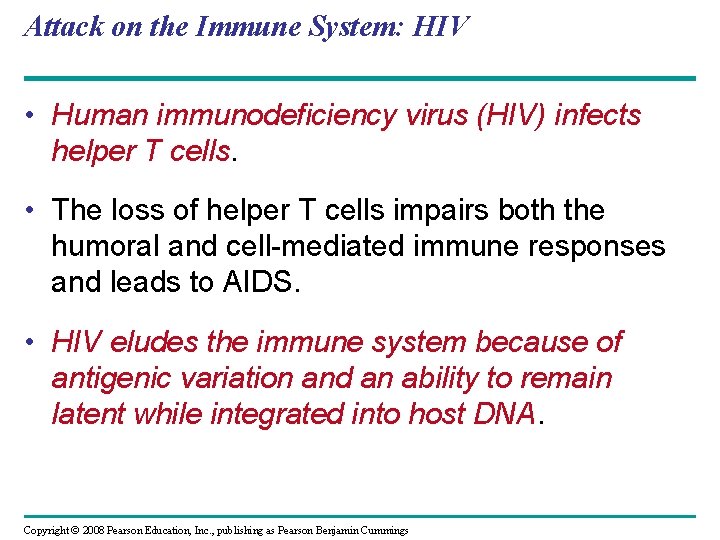
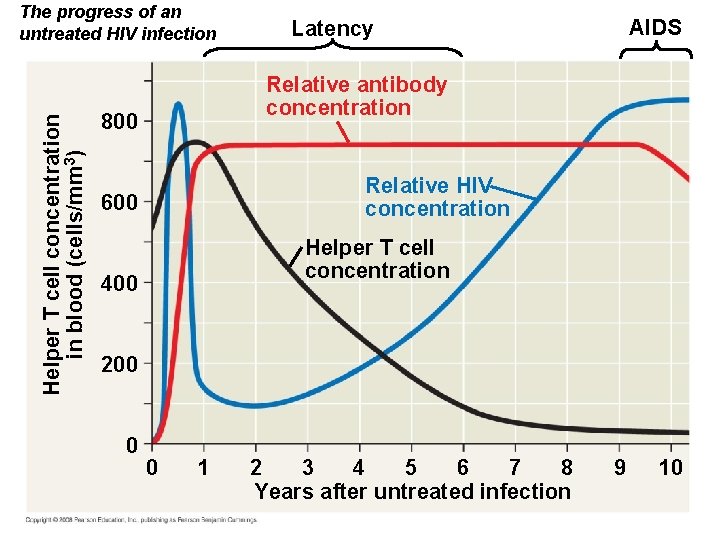
Attack on the Immune System: HIV • Human immunodeficiency virus (HIV) infects helper T cells. • The loss of helper T cells impairs both the humoral and cell-mediated immune responses and leads to AIDS. • HIV eludes the immune system because of antigenic variation and an ability to remain latent while integrated into host DNA. Copyright © 2008 Pearson Education, Inc. , publishing as Pearson Benjamin Cummings
Helper T cell concentration in blood (cells/mm 3) The progress of an untreated HIV infection AIDS Latency Relative antibody concentration 800 Relative HIV concentration 600 Helper T cell concentration 400 200 0 0 1 2 3 4 5 6 7 8 Years after untreated infection 9 10
• People with AIDS are highly susceptible to opportunistic infections and cancers that take advantage of an immune system in collapse. • The spread of HIV is a worldwide problem. • The best approach for slowing this spread is education about practices that transmit the virus. Copyright © 2008 Pearson Education, Inc. , publishing as Pearson Benjamin Cummings
Cancer and Immunity • The frequency of certain cancers increases when the immune response is impaired. • Two suggested explanations are – Immune system normally suppresses cancerous cells – Increased inflammation increases the risk of cancer Copyright © 2008 Pearson Education, Inc. , publishing as Pearson Benjamin Cummings
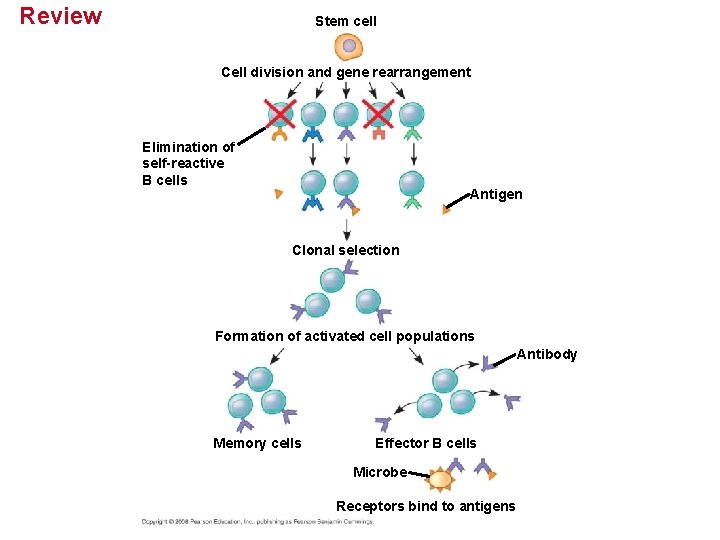
Review Stem cell Cell division and gene rearrangement Elimination of self-reactive B cells Antigen Clonal selection Formation of activated cell populations Antibody Memory cells Effector B cells Microbe Receptors bind to antigens
You should now be able to: 1. Distinguish between innate and acquired immunity. 2. Name and describe four types of phagocytic cells. 3. Describe the inflammation response. Copyright © 2008 Pearson Education, Inc. , publishing as Pearson Benjamin Cummings
4. Distinguish between the following pairs of terms: antigens and antibodies; antigen and epitope; B lymphocytes and T lymphocytes; antibodies and B cell receptors; primary and secondary immune responses; humoral and cell-mediated response; active and passive immunity. 5. Explain how B lymphocytes and T lymphocytes recognize specific antigens. 6. Explain why the antigen receptors of lymphocytes are tested for self-reactivity. Copyright © 2008 Pearson Education, Inc. , publishing as Pearson Benjamin Cummings
7. Describe clonal selection and distinguish between effector cells and memory cells. 8. Describe the cellular basis for immunological memory. 9. Explain how a single antigen can provoke a robust humoral response. 10. Compare the processes of neutralization and opsonization. Copyright © 2008 Pearson Education, Inc. , publishing as Pearson Benjamin Cummings
11. Describe the role of MHC in the rejection of tissue transplants. 12. Describe an allergic reaction, including the roles of Ig. E, mast cells, and histamine. 13. Describe some of the mechanisms that pathogens have evolved to thwart the immune response of their hosts. 14. List strategies that can reduce the risk of HIV transmission. Copyright © 2008 Pearson Education, Inc. , publishing as Pearson Benjamin Cummings