
Active Directory Domain Services ADDS Active Directory Domain
- Slides: 15
Active Directory Domain Services (ADDS)
Active Directory Domain Services (ADDS) Networking Concepts Overview • Two different security models used in Windows environments • Workgroup • Domain • Four roles for a Windows Server system in a network • • Standalone server Member server Domain controller Read Only Domain Controller
Workgroups • A workgroup is a logical group of computers • Characterized by a decentralized security and administration model • Authentication provided by a local account database – Security Accounts Manager (SAM) • Limitations • Users need unique accounts on each workstation • Users manage their own accounts (security issues) • Not very scalable
Domains • A domain is a logical group of computers • Characterized by centralized authentication and administration • Authentication provided through centralized Active Directory • Active Directory database can be physically distributed across domain controllers • Requires at least one system configured as a domain controller
Member Servers • A member server • Has an account in a domain • Is not configured as a domain controller • Typically used for file, print, application, and host network services • All 4 Windows Server Editions can be configured as member servers
Domain Controllers • Explicitly configured to store a copy of Active Directory • Service user authentication requests • Service queries about domain objects • May be a dedicated server but is not required to be Read Only Domain Controllers • Same as Domain Controllers but only allows reading for authentication purposes
What is Active Directory Domain Services (ADDS) • Think of it as a Database - central point for storing and managing network objects • Central point for administration of objects and resources • Logon and authentication services and delegation of administration • Stored on domain controllers in the network • Changes made to any Active Directory will be replicated across all domain controllers • Uses Domain Name Service (DNS) conventions for network resources
What is an ADDS (continue) • A Database has an index – Active Directory has an index called Global Catalog (GC) • Information in GC gets replicated to Domain Controllers • The Schema defines how objects look in AC • The Lightweight Directory Access Protocol (LDAP) is used to query or update Active Directory database directly
Active Directory Logical Structure and Components • Active Directory comprises components that: • Enable design and administration of a network structure • Logical • Hierarchical • Components include: • Domains and organizational units • Trees and forests • A global catalog
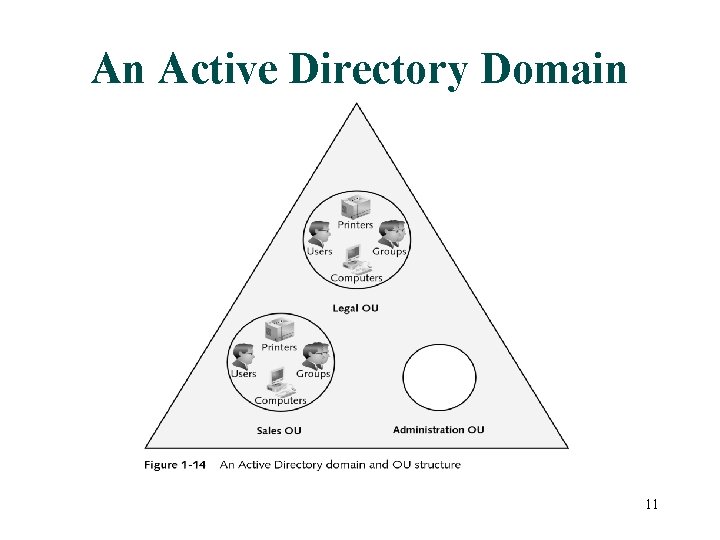
Domains and Organizational Units • Domain • Has a unique name • Is organized in hierarchical levels • Has an Active Directory replicated across its domain controllers • Organizational unit (OU) • • A logical container used to organize domain objects Makes it easy to locate and manage objects Allows you to apply Group Policy settings Allows delegation of administrative control
An Active Directory Domain and OU Structure 11
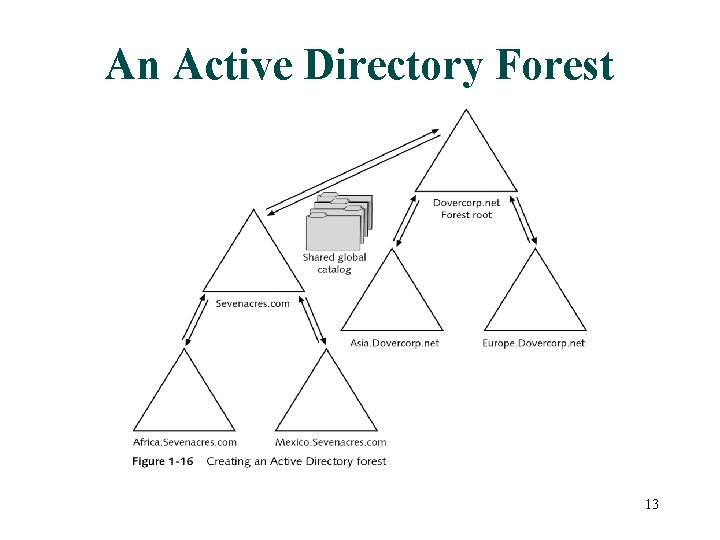
Trees and Forests • Sometimes necessary to create multiple domains within an organization • First Active Directory domain is the forest root domain • A tree is a hierarchical collection of domains that share a contiguous DNS naming structure • A forest is a collection of trees that do not share a contiguous DNS naming structure • Transitive trust relationships exist among domains in trees and, optionally, in and across forests
An Active Directory Forest 13
Active Directory Physical Structure • Physical structure distinct from logical structure • Important to consider the effect of Active Directory traffic and authentication requests on physical resources • A site is a combination of 1+ Internet Protocol (IP) subnets connected by a high-speed connection • A site link is a configurable object that represents a connection between sites
Summary • Windows Server network administration goals: • Make network resources available to users as permitted • Secure the network from unauthorized access • Several editions of Windows Server with different features and costs • Native directory service is Active Directory • • Objects and schema Domains, organizational units and controllers Trees and forests Sites and site links