
Active 3 D Scanning Theory and Case Studies












- Slides: 51
(Active) 3 D Scanning Theory and Case Studies
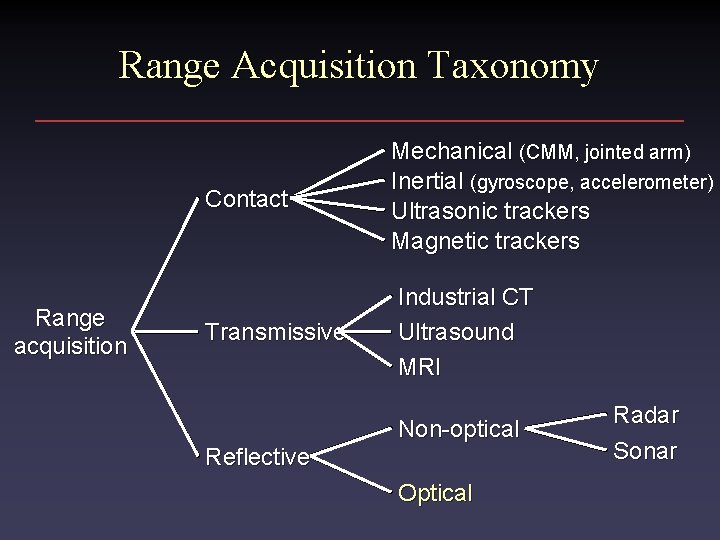
Range Acquisition Taxonomy Range acquisition Contact Mechanical (CMM, jointed arm) Inertial (gyroscope, accelerometer) Ultrasonic trackers Magnetic trackers Transmissive Industrial CT Ultrasound MRI Reflective Non-optical Optical Radar Sonar
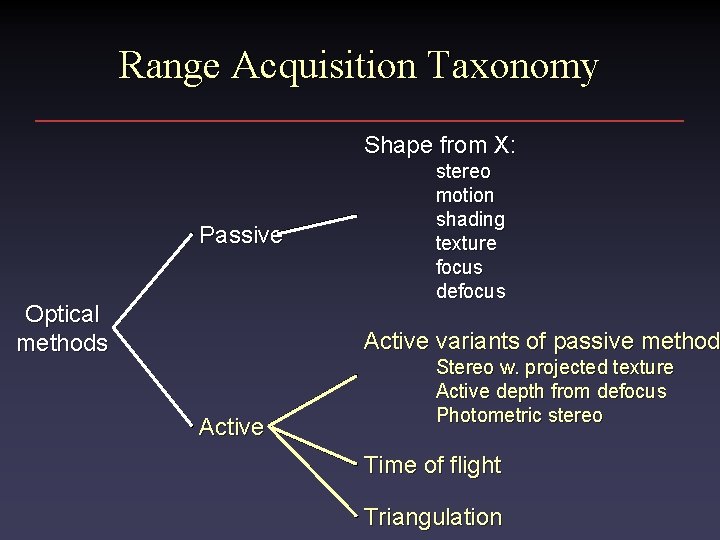
Range Acquisition Taxonomy Shape from X: Passive Optical methods stereo motion shading texture focus defocus Active variants of passive method Active Stereo w. projected texture Active depth from defocus Photometric stereo Time of flight Triangulation
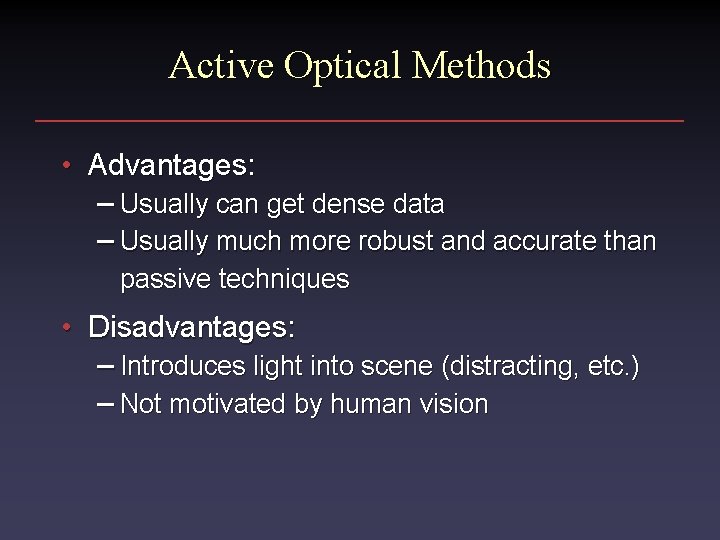
Active Optical Methods • Advantages: – Usually can get dense data – Usually much more robust and accurate than passive techniques • Disadvantages: – Introduces light into scene (distracting, etc. ) – Not motivated by human vision
Active Variants of Passive Techniques • Regular stereo with projected texture – Provides features for correspondence • Active depth from defocus – Known pattern helps to estimate defocus • Photometric stereo – Shape from shading with multiple known lights
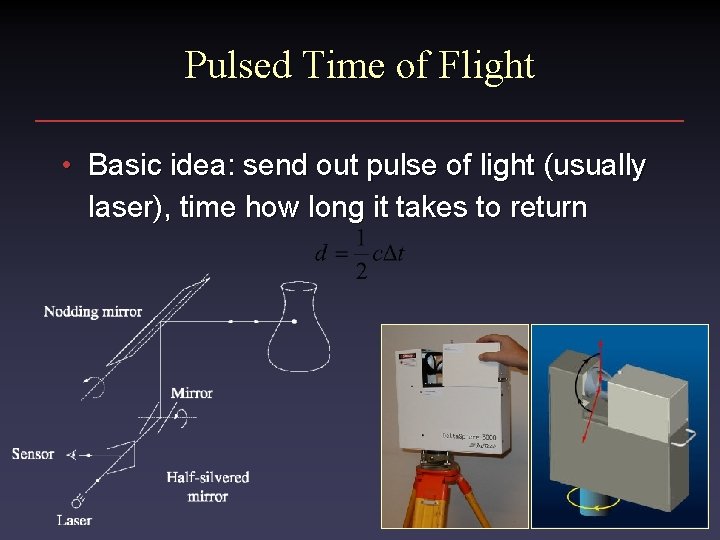
Pulsed Time of Flight • Basic idea: send out pulse of light (usually laser), time how long it takes to return
Pulsed Time of Flight • Advantages: – Large working volume (up to 100 m. ) • Disadvantages: – Not-so-great accuracy (at best ~5 mm. ) • Requires getting timing to ~30 picoseconds • Does not scale with working volume • Often used for scanning buildings, rooms, archeological sites, etc.
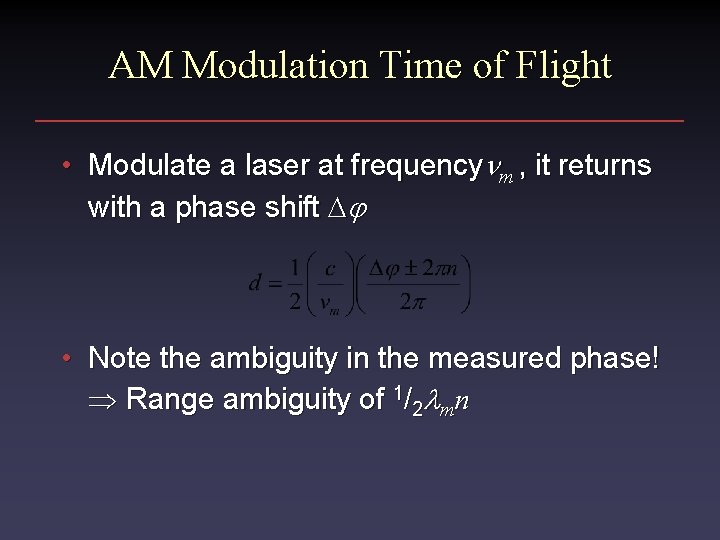
AM Modulation Time of Flight • Modulate a laser at frequency m , it returns with a phase shift • Note the ambiguity in the measured phase! Range ambiguity of 1/2 mn
AM Modulation Time of Flight • Accuracy / working volume tradeoff (e. g. , noise ~ 1/500 working volume) • In practice, often used for room-sized environments (cheaper, more accurate than pulsed time of flight)
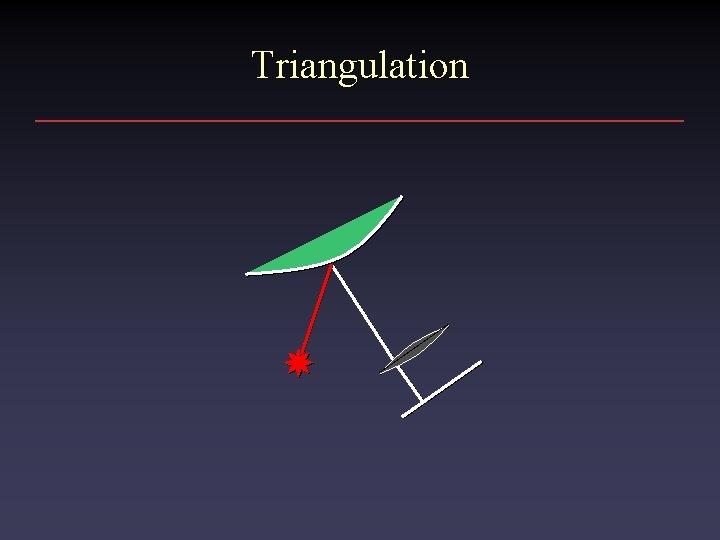
Triangulation
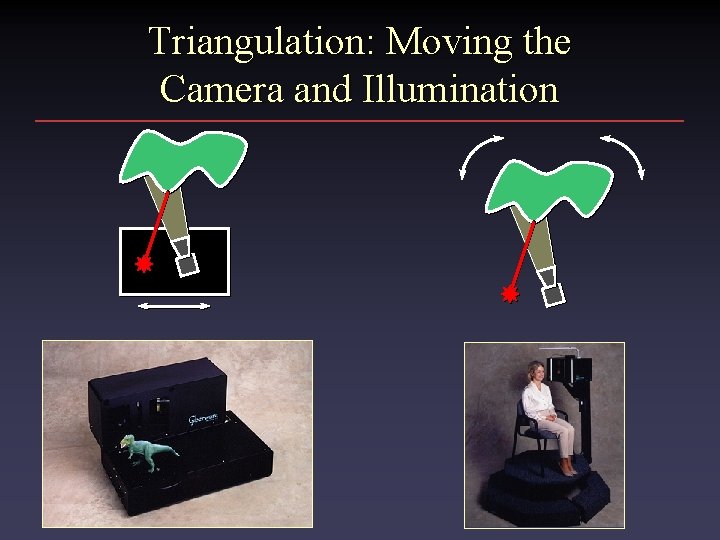
Triangulation: Moving the Camera and Illumination • Moving independently leads to problems with focus, resolution • Most scanners mount camera and light source rigidly, move them as a unit
Triangulation: Moving the Camera and Illumination
Triangulation: Moving the Camera and Illumination
Triangulation: Extending to 3 D • Possibility #1: add another mirror (flying spot) • Possibility #2: project a stripe, not a dot Object Laser Camera
Triangulation Scanner Issues • Accuracy proportional to working volume (typical is ~1000: 1) • Scales down to small working volume (e. g. 5 cm. working volume, 50 m. accuracy) • Does not scale up (baseline too large…) • Two-line-of-sight problem (shadowing from either camera or laser) • Triangulation angle: non-uniform resolution if too small, shadowing if too big (useful range: 15 30 )
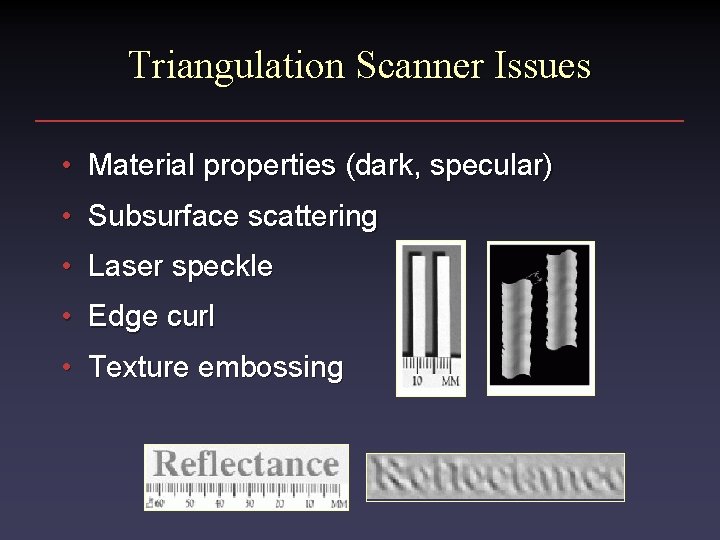
Triangulation Scanner Issues • Material properties (dark, specular) • Subsurface scattering • Laser speckle • Edge curl • Texture embossing
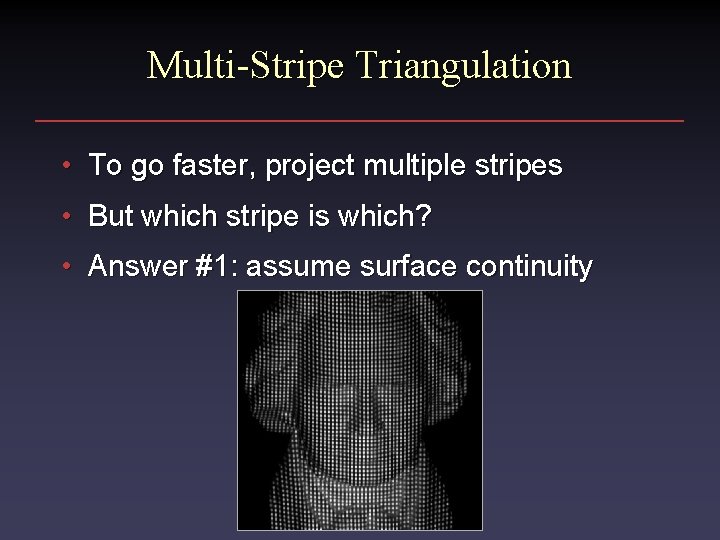
Multi-Stripe Triangulation • To go faster, project multiple stripes • But which stripe is which? • Answer #1: assume surface continuity
Multi-Stripe Triangulation • To go faster, project multiple stripes • But which stripe is which? • Answer #2: colored stripes (or dots)
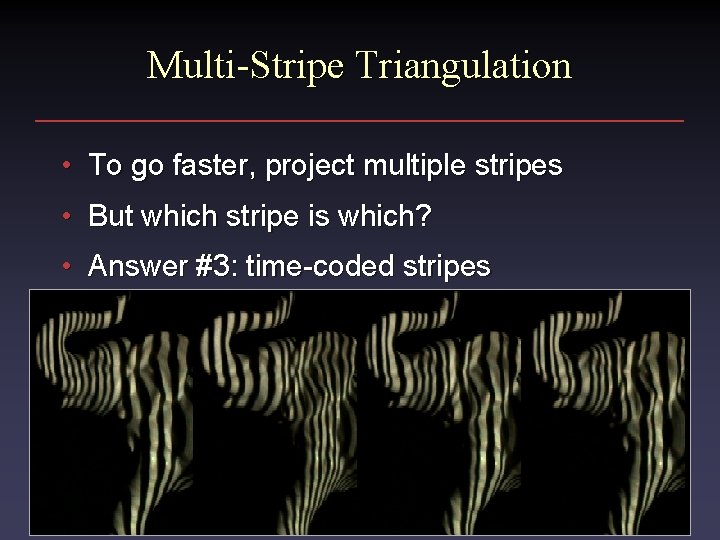
Multi-Stripe Triangulation • To go faster, project multiple stripes • But which stripe is which? • Answer #3: time-coded stripes
Time-Coded Light Patterns • Assign each stripe a unique illumination code over time [Posdamer 82] Time Space
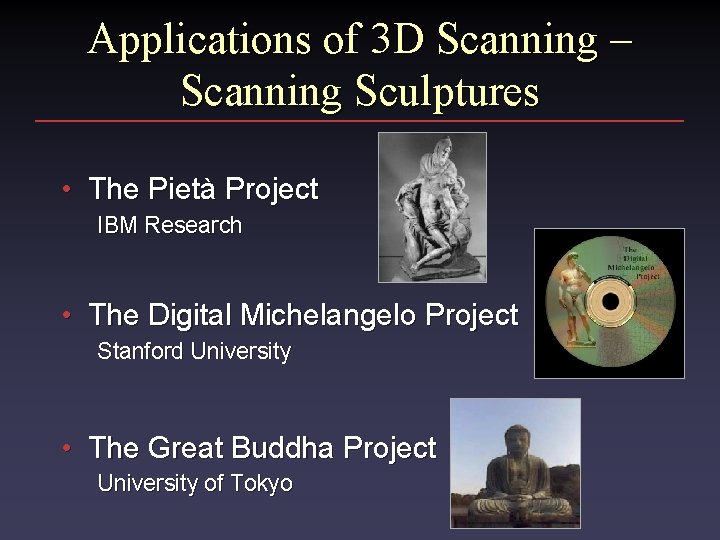
Applications of 3 D Scanning – Scanning Sculptures • The Pietà Project IBM Research • The Digital Michelangelo Project Stanford University • The Great Buddha Project University of Tokyo
Why Scan Sculptures? • Sculptures interesting objects to look at • Introduce scanning to new disciplines – Art: studying working techniques – Art history – Cultural heritage preservation – Archeology • High-visibility projects
Why Scan Sculptures? • Challenging – High detail, large areas – Large data sets – Field conditions – Pushing hardware, software technology • But not too challenging – Simple topology – Possible to scan most of surface
Issues Addressed • Resolution • Coverage – Theoretical: limits of scanning technologies – Practical: physical access, time • Type of data – High-res 3 D data vs. coarse 3 D + normal maps – Influenced by eventual application • Intellectual Property
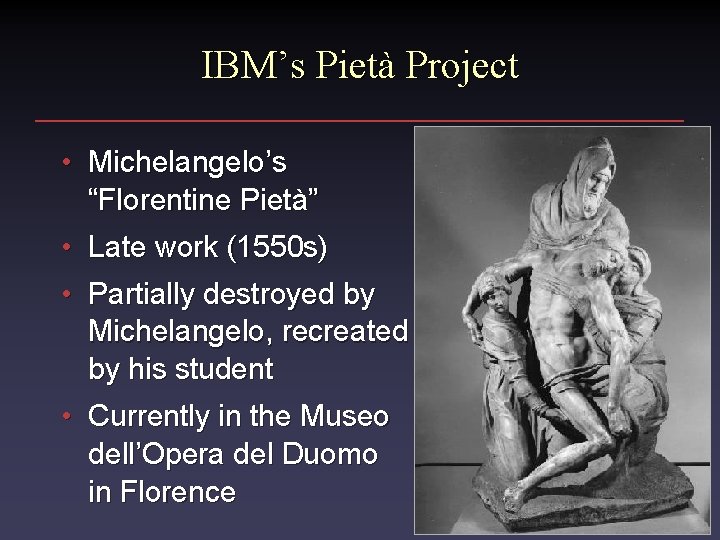
IBM’s Pietà Project • Michelangelo’s “Florentine Pietà” • Late work (1550 s) • Partially destroyed by Michelangelo, recreated by his student • Currently in the Museo dell’Opera del Duomo in Florence
Who? • Dr. Jack Wasserman, professor emeritus of art history at Temple University • Visual and Geometric Computing group @ IBM Research: Fausto Bernardini Holly Rushmeier Ioana Martin Joshua Mittleman Gabriel Taubin Andre Gueziec Claudio Silva
Scanner • Visual Interface “Virtuoso” • Active multibaseline stereo • Projector (stripe pattern), 6 B&W cameras, 1 color camera • Augmented with 5 extra “point” light sources for photometric stereo (active shape from shading)
Data • Range data has 2 mm spacing, 0. 1 mm noise • Each range image: 10, 000 points, 20 20 cm • Color data: 5 images with controlled lighting, 1280 960, 0. 5 mm resolution • Total of 770 scans, 7. 2 million points
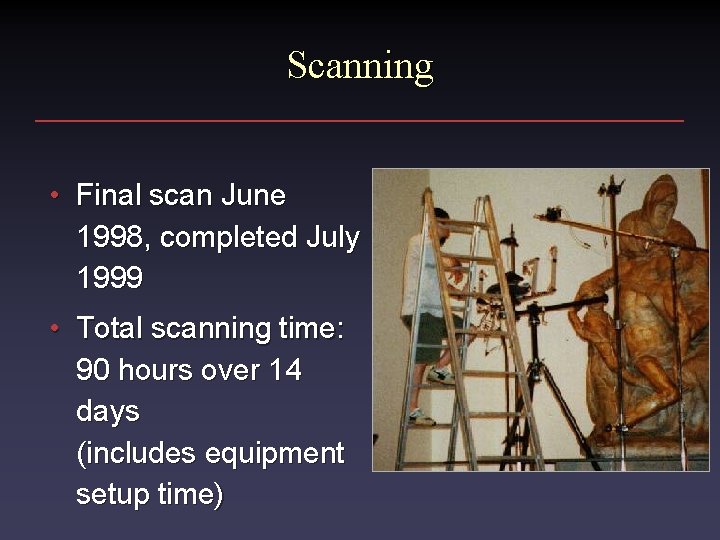
Scanning • Final scan June 1998, completed July 1999 • Total scanning time: 90 hours over 14 days (includes equipment setup time)
Postprocessing • Use 11 11 grid of projected laser dots to help with pairwise alignment • Align all scans to each other, then apply nonrigid “conformance smoothing” • Reconstruct surface using BPA • Compute normal and albedo maps, align to geometry
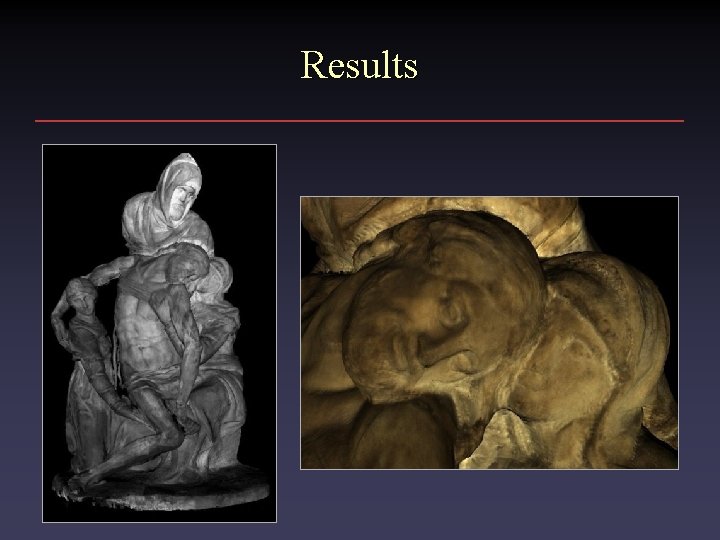
Results
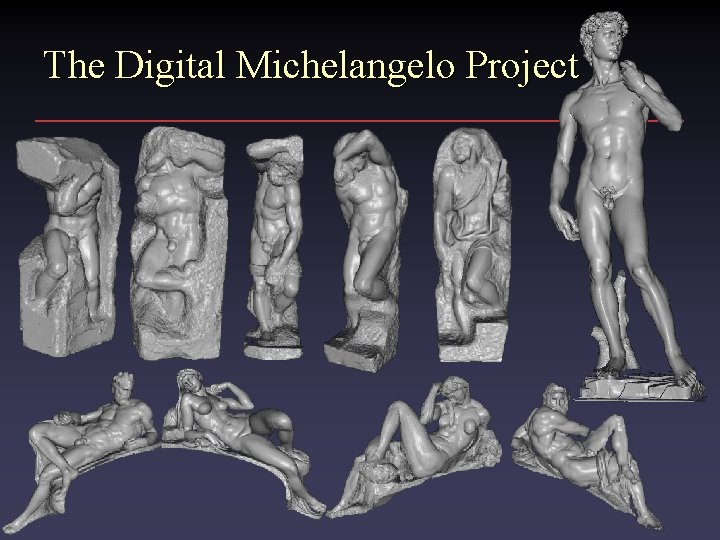
The Digital Michelangelo Project
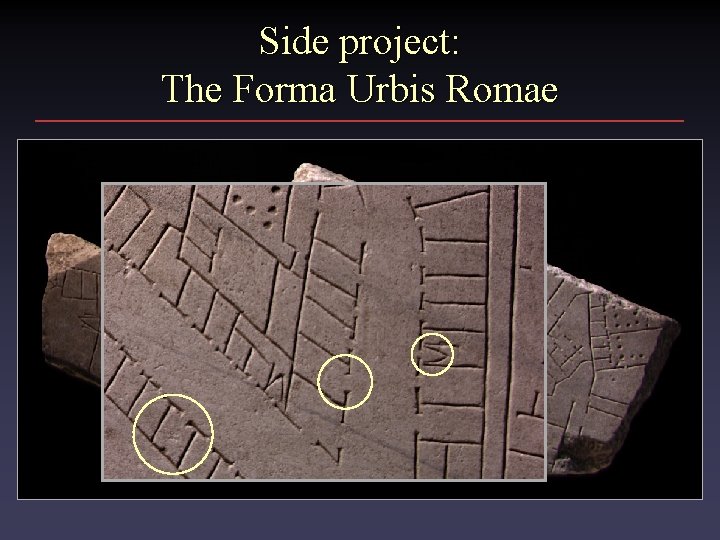
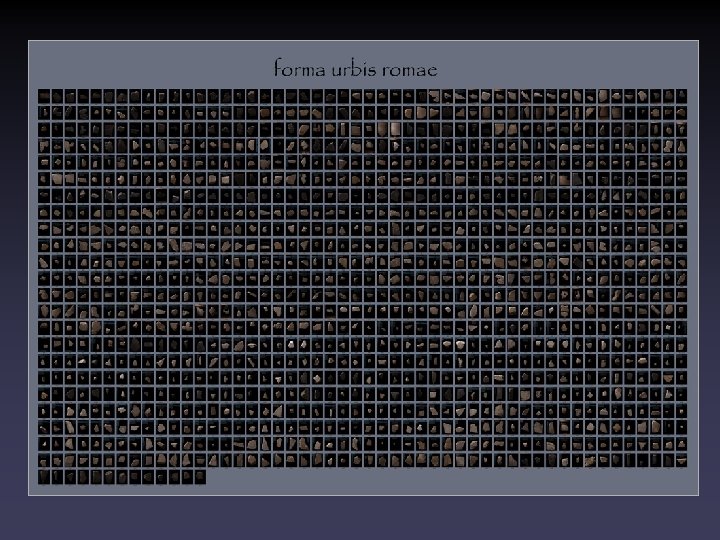
Goals • Scan 10 sculptures by Michelangelo • High-resolution (“quarter-millimeter”) geometry • Side projects: architectural scanning (Accademia and Medici chapel), scanning fragments of Forma Urbis Romae
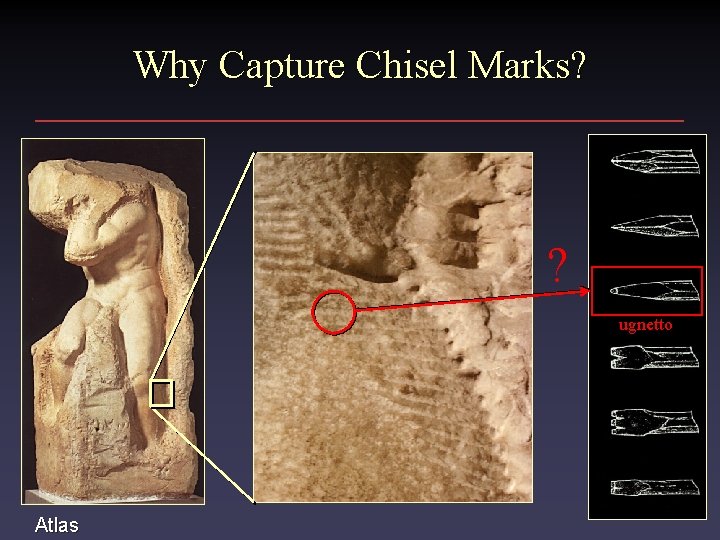
Why Capture Chisel Marks? ? ugnetto Atlas
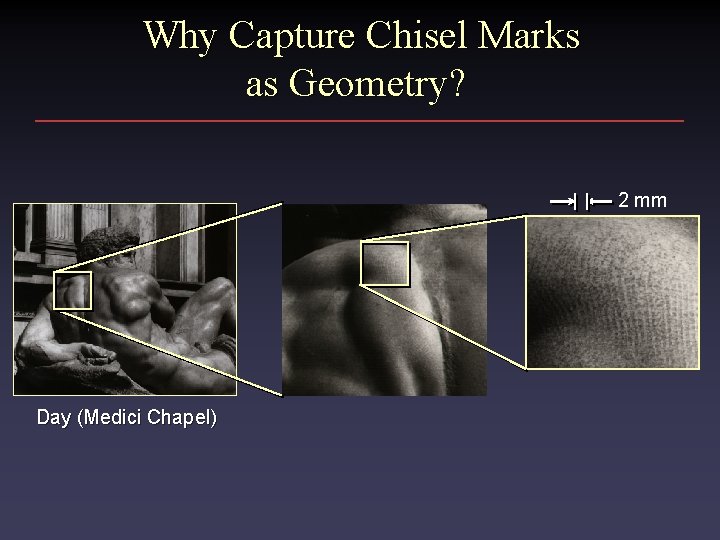
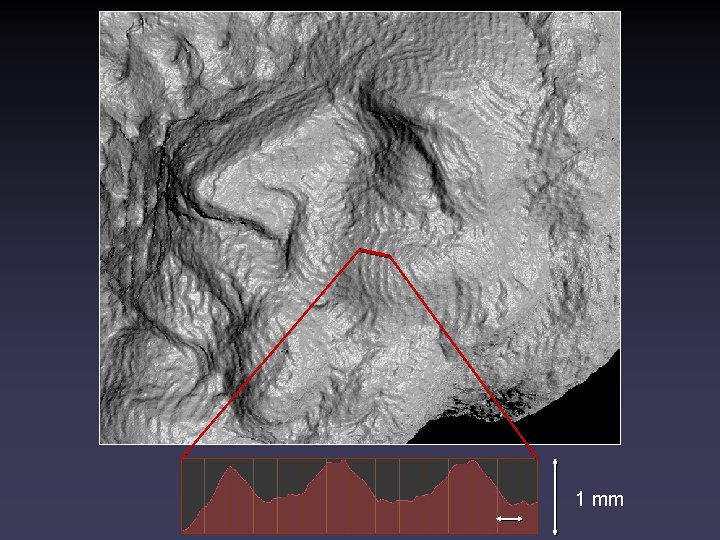
Why Capture Chisel Marks as Geometry? 2 mm Day (Medici Chapel)
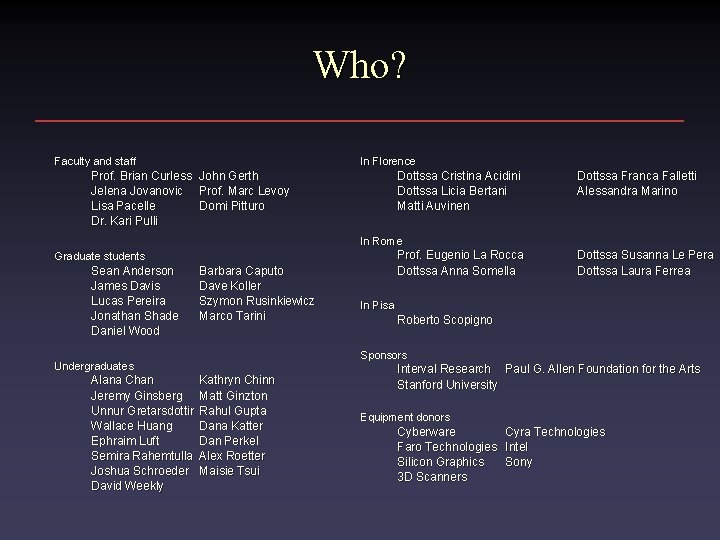
Who? Faculty and staff Prof. Brian Curless Jelena Jovanovic Lisa Pacelle Dr. Kari Pulli In Florence John Gerth Prof. Marc Levoy Domi Pitturo Dottssa Cristina Acidini Dottssa Licia Bertani Matti Auvinen Dottssa Franca Falletti Alessandra Marino In Rome Prof. Eugenio La Rocca Dottssa Anna Somella Graduate students Sean Anderson James Davis Lucas Pereira Jonathan Shade Daniel Wood Barbara Caputo Dave Koller Szymon Rusinkiewicz Marco Tarini In Pisa Roberto Scopigno Sponsors Undergraduates Alana Chan Jeremy Ginsberg Unnur Gretarsdottir Wallace Huang Ephraim Luft Semira Rahemtulla Joshua Schroeder David Weekly Dottssa Susanna Le Pera Dottssa Laura Ferrea Kathryn Chinn Matt Ginzton Rahul Gupta Dana Katter Dan Perkel Alex Roetter Maisie Tsui Interval Research Paul G. Allen Foundation for the Arts Stanford University Equipment donors Cyberware Faro Technologies Silicon Graphics 3 D Scanners Cyra Technologies Intel Sony
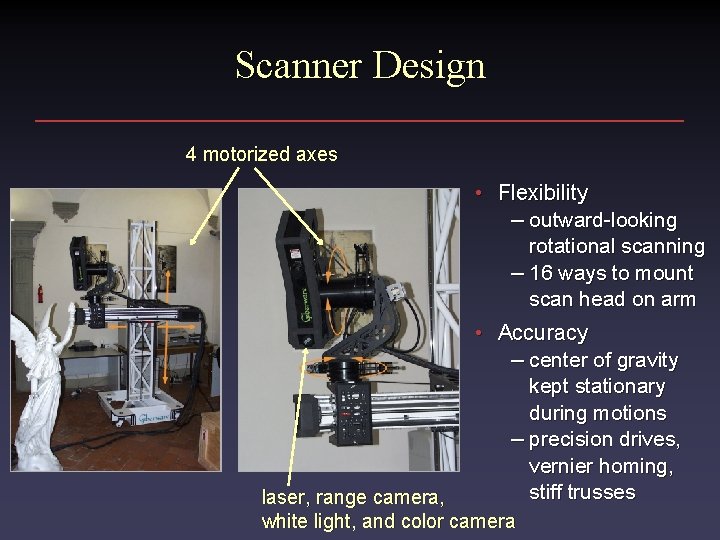
Scanner Design 4 motorized axes • Flexibility – outward-looking rotational scanning – 16 ways to mount scan head on arm • Accuracy – center of gravity kept stationary during motions – precision drives, vernier homing, stiff trusses laser, range camera, white light, and color camera
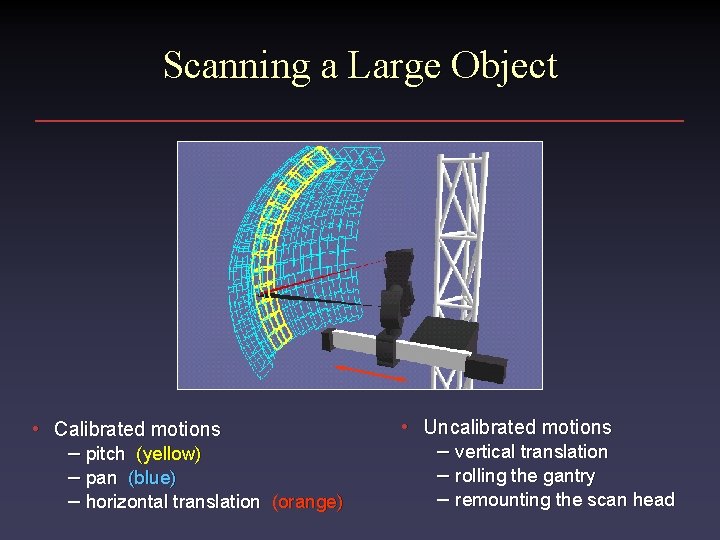
Scanning a Large Object • Calibrated motions – pitch (yellow) – pan (blue) – horizontal translation (orange) • Uncalibrated motions – vertical translation – rolling the gantry – remounting the scan head
Single Scan of St. Matthew 1 mm
Postprocessing • Manual initial alignment • Pairwise ICP, then global registration • VRIP (parallelized across subvolumes) • Use high-res geometry to discard bad color data, perform inverse lighting calculations
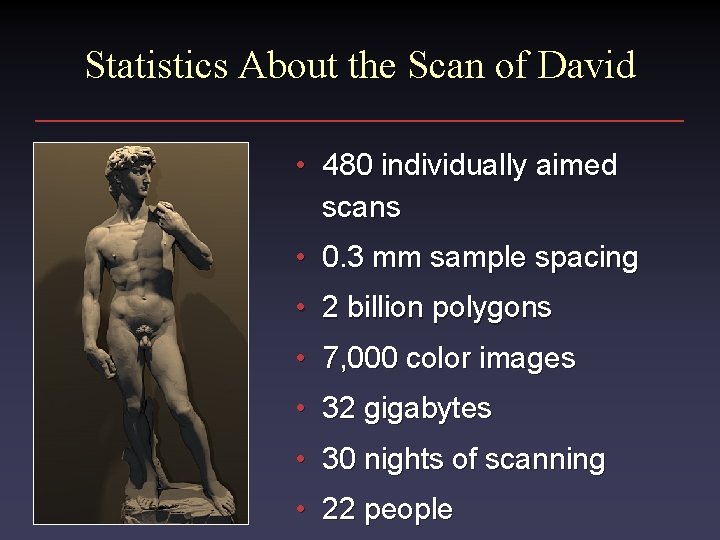
Statistics About the Scan of David • 480 individually aimed scans • 0. 3 mm sample spacing • 2 billion polygons • 7, 000 color images • 32 gigabytes • 30 nights of scanning • 22 people
Head of Michelangelo’s David Photograph 1. 0 mm computer model
Side project: The Forma Urbis Romae
Forma Urbis Romae Fragment side face
Hard Problems • Keeping scanner calibrated is hard in the lab, really hard in the museum • Dealing with large data sets is painful • Filling all the holes converges only asymptotically (if it converges at all…)
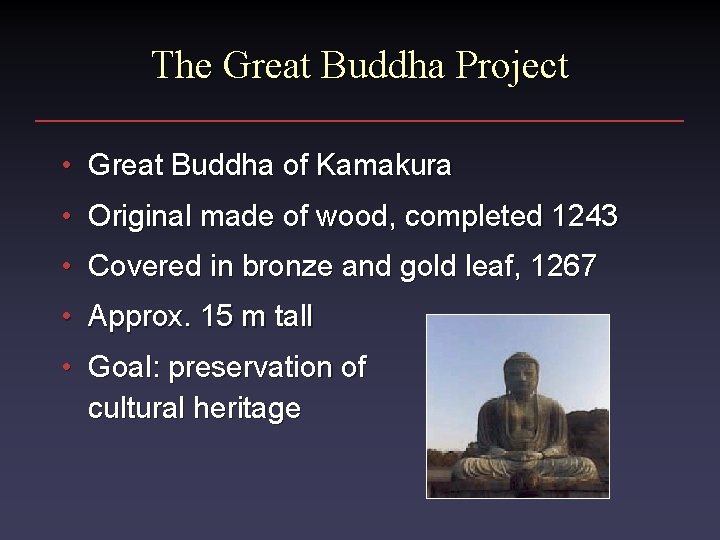
The Great Buddha Project • Great Buddha of Kamakura • Original made of wood, completed 1243 • Covered in bronze and gold leaf, 1267 • Approx. 15 m tall • Goal: preservation of cultural heritage
Who? • Institute of Industrial Science, University of Tokyo Daisuke Miyazaki Takeshi Ooishi Taku Nishikawa Ryusuke Sagawa Ko Nishino Takashi Tomomatsu Yutaka Takase Katsushi Ikeuchi
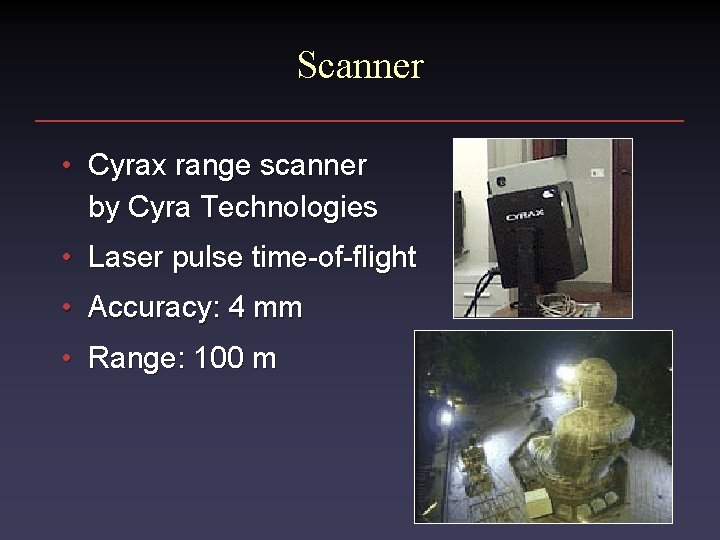
Scanner • Cyrax range scanner by Cyra Technologies • Laser pulse time-of-flight • Accuracy: 4 mm • Range: 100 m
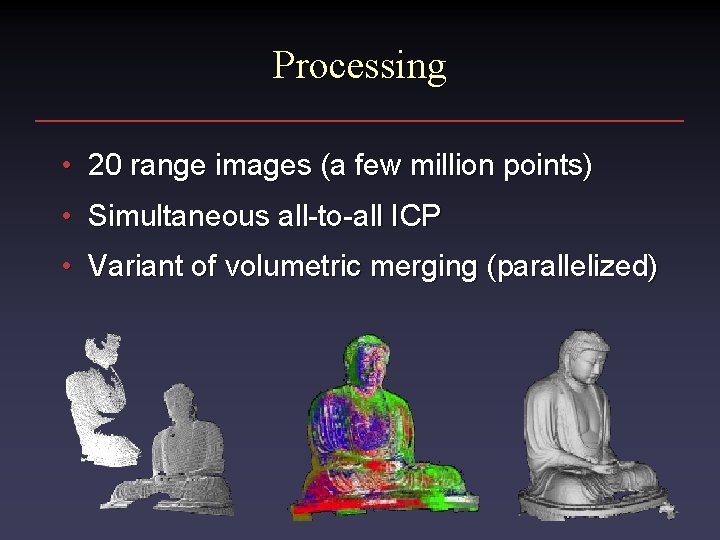
Processing • 20 range images (a few million points) • Simultaneous all-to-all ICP • Variant of volumetric merging (parallelized)
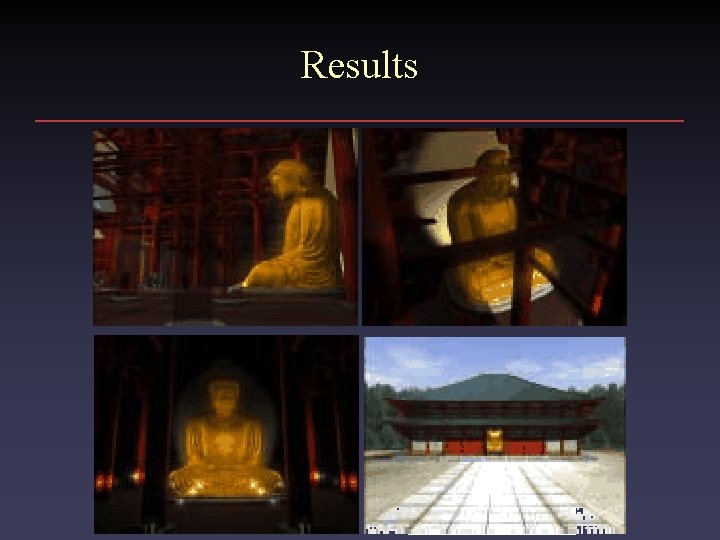
Results