
Activation Records CS 671 February 7 2008 The
Activation Records CS 671 February 7, 2008
The Compiler So Far Lexical analysis • Detects inputs with illegal tokens Syntactic analysis • Detects inputs with ill-formed parse trees Semantic analysis • Tries to catch all remaining errors 1 CS 671 – Spring 2008
Goals of a Semantic Analyzer • Find remaining errors that would make program invalid – undefined variables, types – type errors that can be caught statically • Figure out useful information for later phases – types of all expressions – data layout Terminology Static checks – done by the compiler Dynamic checks – done at run time 2 CS 671 – Spring 2008
Scoping The scope rules of a language • Determine which declaration of a named object corresponds to each use of the object C++ and Java use static scoping • Mapping from uses to declarations at compile time Lisp, APL, and Snobol use dynamic scoping • Mapping from uses to declarations at run time 3 CS 671 – Spring 2008
Symbol Tables Purpose • keep track of names declared in the program Symbol table entry • associates a name with a set of attributes – kind of name (variable, class, field, method, …) – type (int, float, …) – nesting level – mem location (where will it be found at runtime) 4 CS 671 – Spring 2008
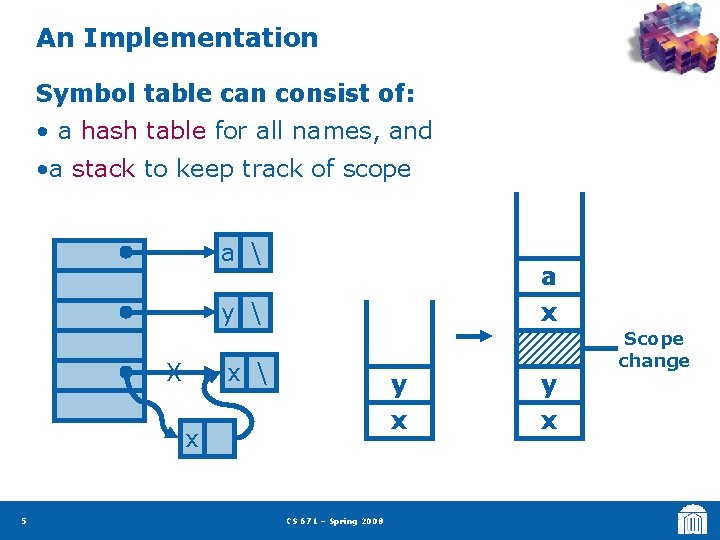
An Implementation Symbol table can consist of: • a hash table for all names, and • a stack to keep track of scope a a x y X x y x x 5 CS 671 – Spring 2008 y x Scope change
Type Systems A language’s type system specifies which operations are valid for which types • A set of values • A set of operations allowed on those values The goal of type checking is to ensure that operations are used with the correct types • Enforces intended interpretation of values Type inference is the process of filling in missing type information 6 CS 671 – Spring 2008
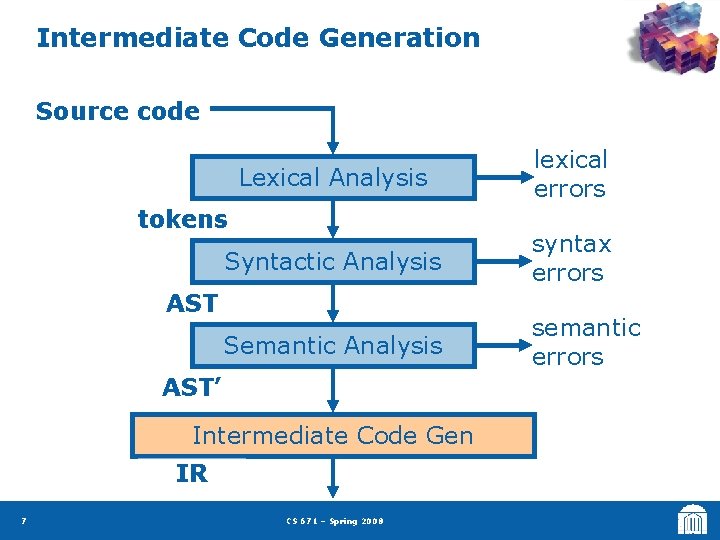
Intermediate Code Generation Source code Lexical Analysis lexical errors Syntactic Analysis syntax errors Semantic Analysis semantic errors tokens AST’ Intermediate Code Gen IR 7 CS 671 – Spring 2008
Run time vs. Compile time The compiler must generate code to handle issues that arise at run time • Representation of various data types • Procedure linkage • Storage organization Big issue #1: Allow separate compilation • Without it we can't build large systems • Saves compile time • Saves development time • We must establish conventions on memory layout, calling sequences, procedure entries and exits, interfaces, etc. 8 CS 671 – Spring 2008
Activation Records A procedure is a control abstraction • it associates a name with a chunk of code • that piece of code is regarded in terms of its purpose and not of its implementation A procedure creates its own name space • It can declare local variables • Local declarations may hide non-local ones • Local names cannot be seen from outside 9 CS 671 – Spring 2008
Control Abstraction Procedures must have a well defined call mechanism In many languages: • a call creates an instance (activation) of the procedure • on exit, control returns to the call site, to the point right after the call. Use a call graph to see set of potential calls 10 CS 671 – Spring 2008
Handling Control Abstractions Generated code must be able to • preserve current state – save variables that cannot be saved in registers – save specific register values • establish procedure environment on entry – map actual to formal parameters – create storage for locals • restore previous state on exit 11 CS 671 – Spring 2008
Local Variables • Functions have local variables – created upon entry • Several invocations may exist • Each invocation has an instantiation • Local variables are (often) destroyed upon function exit • Happens in a LIFO manner • What else operates in a LIFO manner? 12 CS 671 – Spring 2008
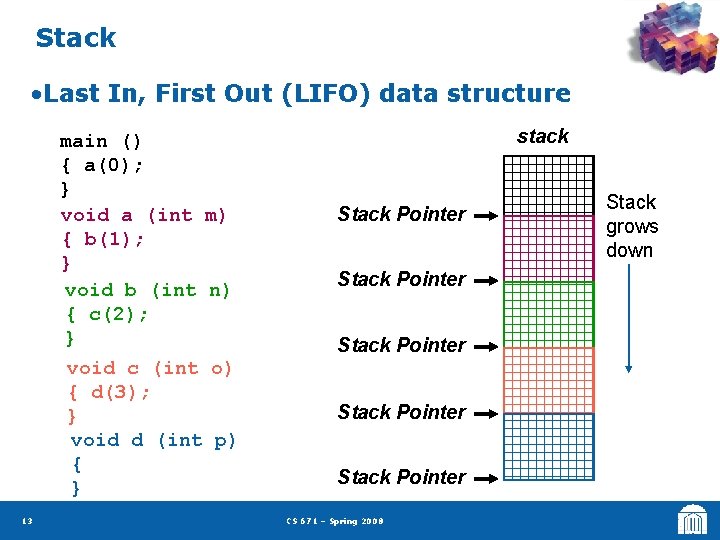
Stack • Last In, First Out (LIFO) data structure main () { a(0); } void a (int m) { b(1); } void b (int n) { c(2); } void c (int o) { d(3); } void d (int p) { } 13 stack Stack Pointer Stack Pointer CS 671 – Spring 2008 Stack grows down
Stack Frames Basic operations: push, pop Happens too frequently! Local variables can be pushed/popped in large batches (on function entry/exit) Instead, use a big array with a stack pointer • Garbage beyond the end of the sp A frame pointer indicates the start (for this procedure) 14 CS 671 – Spring 2008

Stack Frames Activation record or stack frame stores: • local vars • parameters • return address • temporaries • (…etc) fp (Frame size not known until late in the compilation process) sp 15 CS 671 – Spring 2008 Arg n … Arg 2 Arg 1 Static link Local vars Ret address Temporaries Saved regs Arg m … Arg 1 Static link previous frame current frame next frame
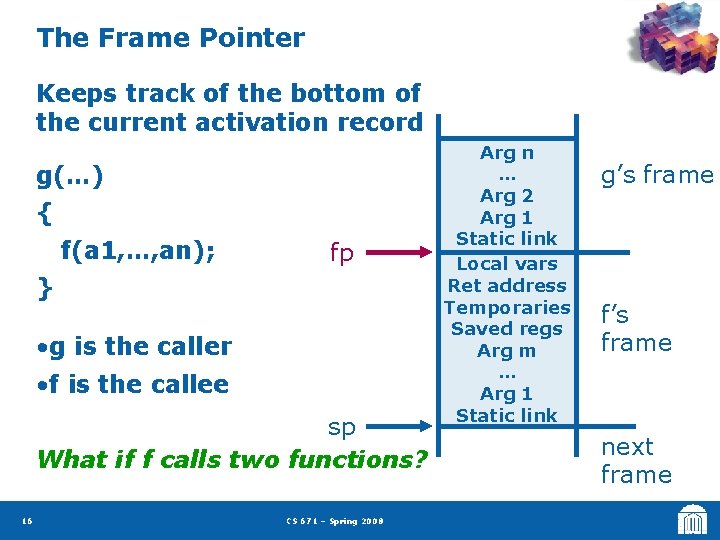
The Frame Pointer Keeps track of the bottom of the current activation record g(…) { f(a 1, …, an); fp } • g is the caller • f is the callee sp What if f calls two functions? 16 CS 671 – Spring 2008 Arg n … Arg 2 Arg 1 Static link Local vars Ret address Temporaries Saved regs Arg m … Arg 1 Static link g’s frame f’s frame next frame
Stacks Work languages with nested functions • Functions declared inside other functions • Inner functions can use outer function’s local vars • Doesn’t happen in C • Does happen in Pascal Work with languages that support function pointers ML, Scheme have higher-order functions: • nested functions AND • functions as returnable values (ML, Scheme cannot use stacks for local vars!) 17 CS 671 – Spring 2008
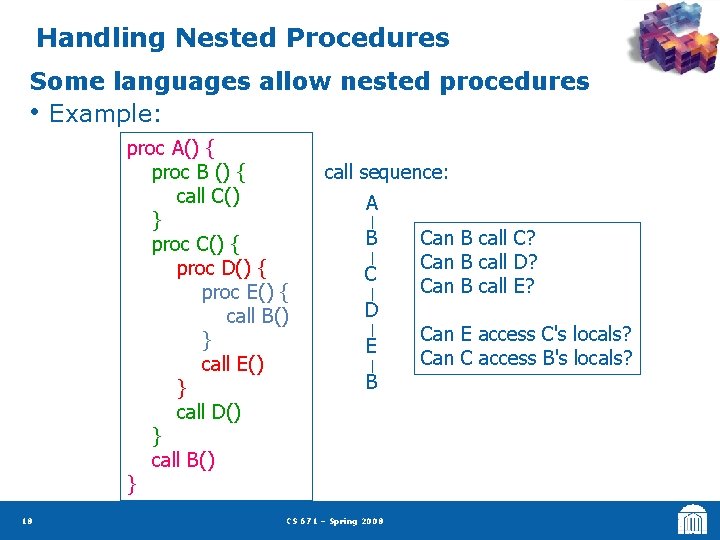
Handling Nested Procedures Some languages allow nested procedures • Example: proc A() { proc B () { call C() } proc C() { proc D() { proc E() { call B() } call E() } call D() } call B() } 18 call sequence: A B C D E B CS 671 – Spring 2008 Can B call C? Can B call D? Can B call E? Can E access C's locals? Can C access B's locals?
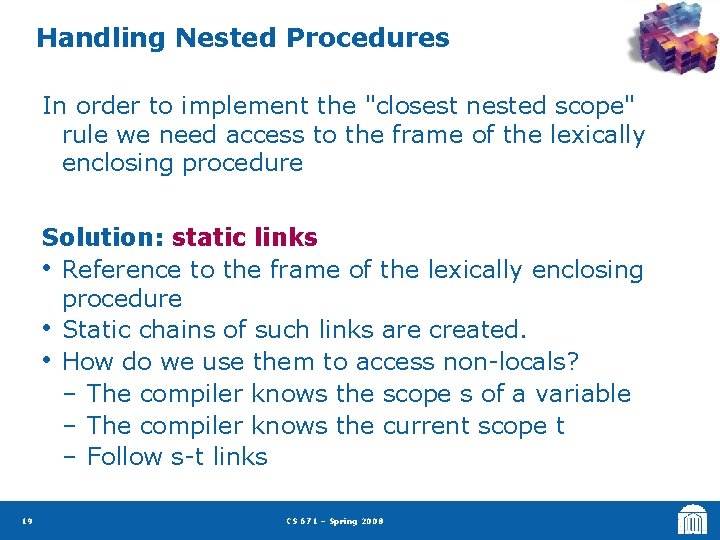
Handling Nested Procedures In order to implement the "closest nested scope" rule we need access to the frame of the lexically enclosing procedure Solution: static links • Reference to the frame of the lexically enclosing procedure • Static chains of such links are created. • How do we use them to access non-locals? – The compiler knows the scope s of a variable – The compiler knows the current scope t – Follow s-t links 19 CS 671 – Spring 2008
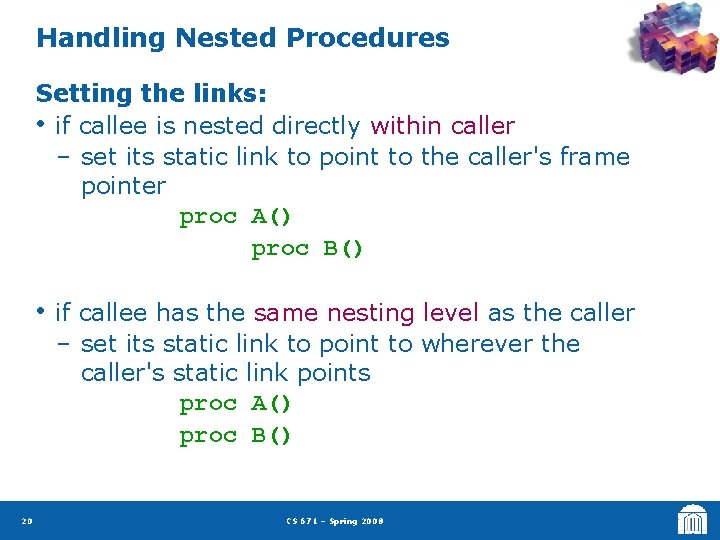
Handling Nested Procedures Setting the links: • if callee is nested directly within caller – set its static link to point to the caller's frame pointer proc A() proc B() • if callee has the same nesting level as the caller – set its static link to point to wherever the caller's static link points proc A() proc B() 20 CS 671 – Spring 2008
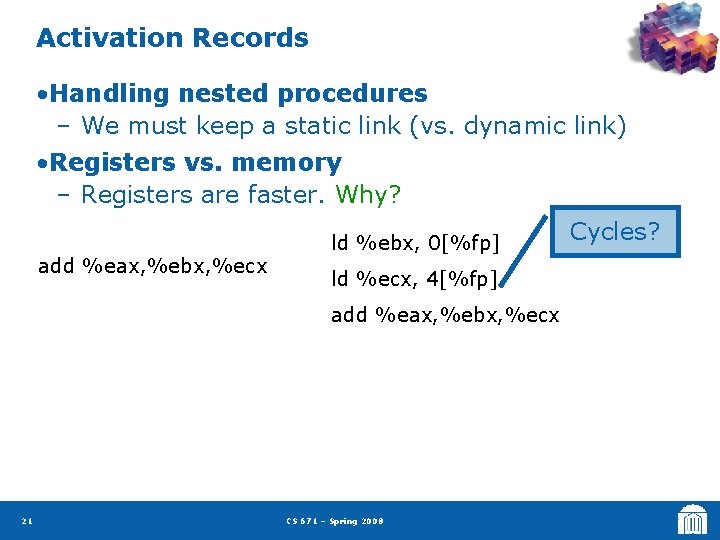
Activation Records • Handling nested procedures – We must keep a static link (vs. dynamic link) • Registers vs. memory – Registers are faster. Why? add %eax, %ebx, %ecx ld %ebx, 0[%fp] ld %ecx, 4[%fp] add %eax, %ebx, %ecx 21 CS 671 – Spring 2008 Cycles?
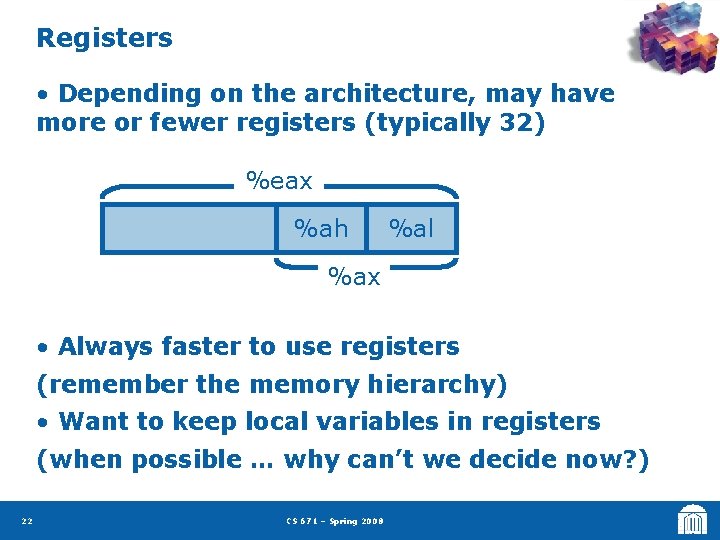
Registers • Depending on the architecture, may have more or fewer registers (typically 32) %eax %ah %al %ax • Always faster to use registers (remember the memory hierarchy) • Want to keep local variables in registers (when possible … why can’t we decide now? ) 22 CS 671 – Spring 2008
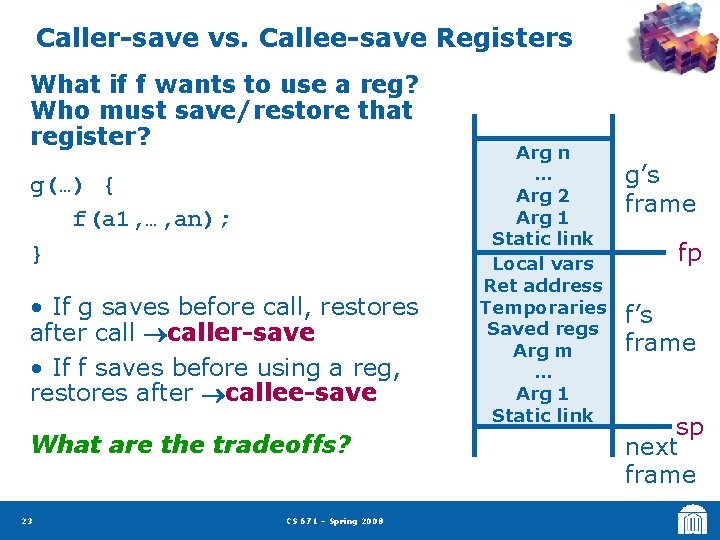
Caller-save vs. Callee-save Registers What if f wants to use a reg? Who must save/restore that register? g(…) { f(a 1, …, an); } • If g saves before call, restores after caller-save • If f saves before using a reg, restores after callee-save What are the tradeoffs? 23 CS 671 – Spring 2008 Arg n … Arg 2 Arg 1 Static link Local vars Ret address Temporaries Saved regs Arg m … Arg 1 Static link g’s frame fp f’s frame sp next frame
Caller-save vs. Callee-save Registers Usually – some registers are marked caller save and some are marked callee save e. g. MIPS: r 16 -23 callee save all others caller save Optimization – if g knows it will not need a value after a call, it may put it in a caller-save register, but not save it Deciding on the register will be the task of the register allocator (still a hot research area). 24 CS 671 – Spring 2008
Parameter Passing By value • actual parameter is copied By reference • address of actual parameter is stored By value-result • call by value, AND • the values of the formal parameters are copied back into the actual parameters Typical Convention – Usually 4 parameters placed in registers – Rest on stack – Why? 25 CS 671 – Spring 2008
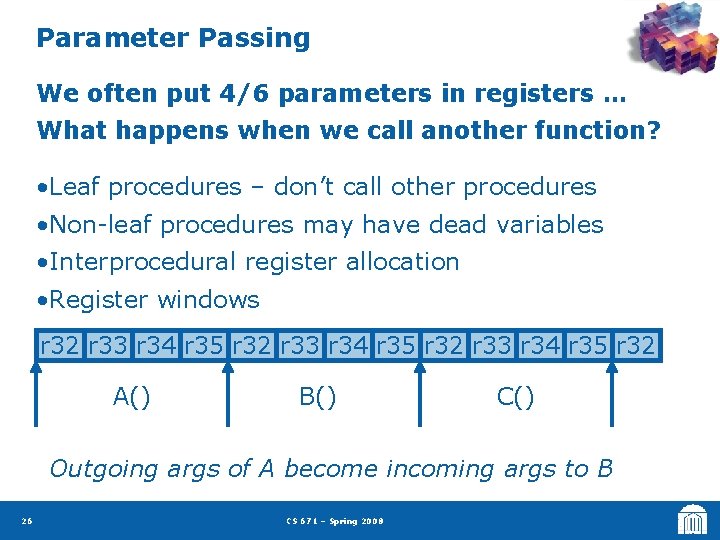
Parameter Passing We often put 4/6 parameters in registers … What happens when we call another function? • Leaf procedures – don’t call other procedures • Non-leaf procedures may have dead variables • Interprocedural register allocation • Register windows r 32 r 33 r 34 r 35 r 32 r 33 1 r 34 1 r 35 1 r 32 r 33 r 34 r 35 r 32 A() B() C() Outgoing args of A become incoming args to B 26 CS 671 – Spring 2008
Return Address Return address - after f calls g, we must know where to return ØOld machines – return address always pushed on the stack ØNewer machines – return address is placed in a special register (often called the link register %lr) automatically during the call instruction Non-leaf procedures must save %lr on the stack Sidenote: Itanium has 8 “branch registers” 27 CS 671 – Spring 2008
Stack Maintenance Calling sequence : • code executed by the caller before and after a call • code executed by the callee at the beginning • code executed by the callee at the end 28 CS 671 – Spring 2008
Stack Maintenance A typical calling sequence : 1. Caller assembles arguments and transfers control – evaluate arguments – place arguments in stack frame and/or registers – save caller-saved registers – save return address – jump to callee's first instruction 29 CS 671 – Spring 2008
Stack Maintenance A typical calling sequence : 2. Callee saves info on entry – allocate memory for stack frame, update stack pointer – save callee-saved registers – save old frame pointer – update frame pointer 3. Callee executes 30 CS 671 – Spring 2008
Stack Maintenance A typical calling sequence : 4. Callee restores info on exit and returns control – place return value in appropriate location – restore callee-saved registers – restore frame pointer – pop the stack frame – jump to return address 5. Caller restores info – restore caller-saved registers 31 CS 671 – Spring 2008
Handling Variable Storage Static allocation • object is allocated an address at compile time • location is retained during execution Stack allocation • objects are allocated in LIFO order Heap allocation • objects may be allocated and deallocated at any time. 32 CS 671 – Spring 2008
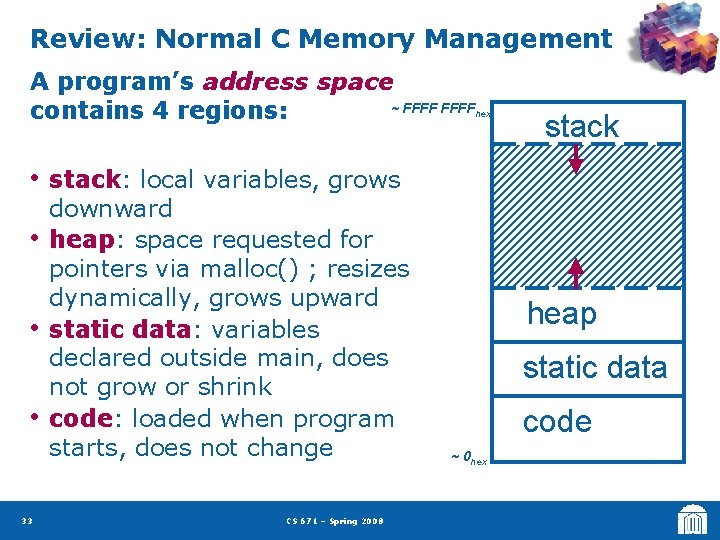
Review: Normal C Memory Management A program’s address space ~ FFFF contains 4 regions: hex stack • stack: local variables, grows • • • 33 downward heap: space requested for pointers via malloc() ; resizes dynamically, grows upward static data: variables declared outside main, does not grow or shrink code: loaded when program starts, does not change CS 671 – Spring 2008 heap static data code ~ 0 hex
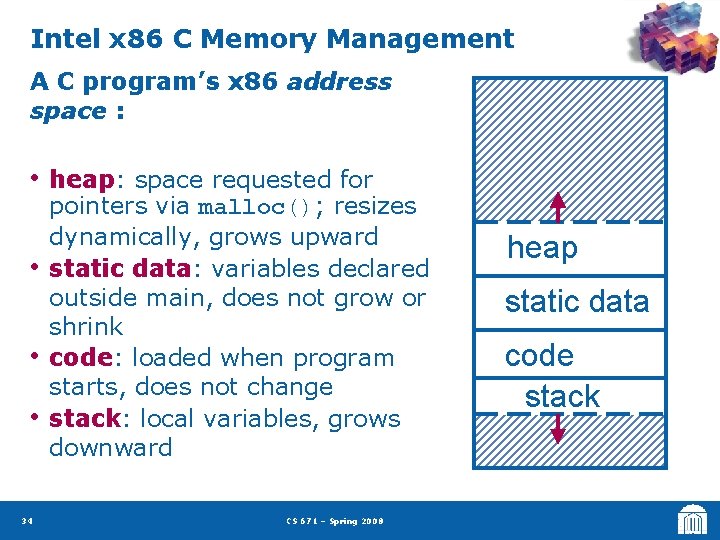
Intel x 86 C Memory Management A C program’s x 86 address space : • heap: space requested for • • • 34 pointers via malloc(); resizes dynamically, grows upward static data: variables declared outside main, does not grow or shrink code: loaded when program starts, does not change stack: local variables, grows downward CS 671 – Spring 2008 heap static data code stack
Static Allocation Objects that are allocated statically include: • globals • explicitly declared static variables • instructions • string literals • compiler-generated tables used during run time 35 CS 671 – Spring 2008
Stack Allocation Follows stack model for procedure activation What can we determine at compile time? • We cannot determine the address of the stack frame • But we can determine the size of the stack frame and the offsets of various objects within a frame 36 CS 671 – Spring 2008
Heap Allocation Used for dynamically allocated/resized objects Managed by special algorithms General model • maintain list of free blocks • allocate block of appropriate size • handle fragmentation • handle garbage collection 37 CS 671 – Spring 2008
Summary • Stack frames – Keep track of run-time data – Define the interface between procedures • Both language and architectural features will affect the stack frame layout and contents • Started to see hints of the back-end optimizer, register allocator, etc. • Next week: Intermediate Representations 38 CS 671 – Spring 2008
- Slides: 39