
Activating Activity Match each Vocabulary word to their
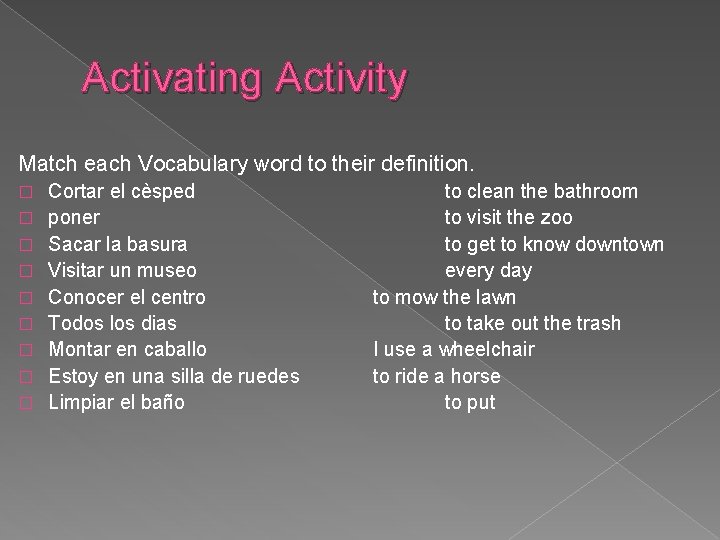
Activating Activity Match each Vocabulary word to their definition. � � � � � Cortar el cèsped poner Sacar la basura Visitar un museo Conocer el centro Todos los dias Montar en caballo Estoy en una silla de ruedes Limpiar el baño to clean the bathroom to visit the zoo to get to know downtown every day to mow the lawn to take out the trash I use a wheelchair to ride a horse to put

1. 2 The Present Progressive and Direct Object Pronouns Spanish 2 Chapter 1 Section 2
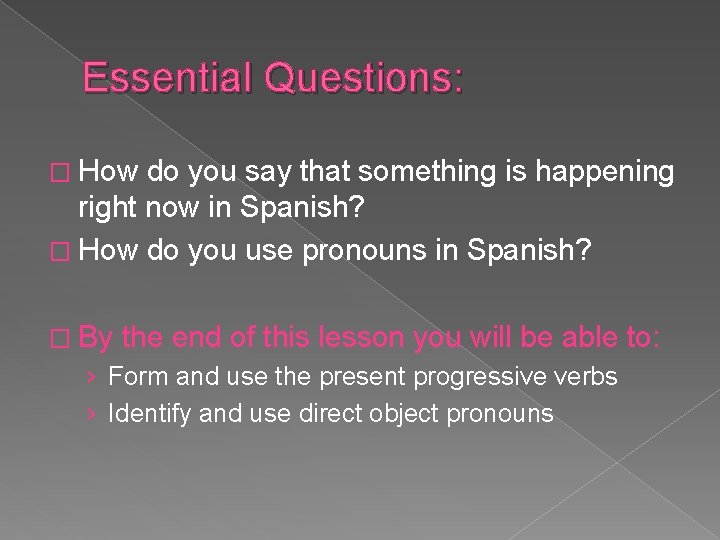
Essential Questions: � How do you say that something is happening right now in Spanish? � How do you use pronouns in Spanish? � By the end of this lesson you will be able to: › Form and use the present progressive verbs › Identify and use direct object pronouns
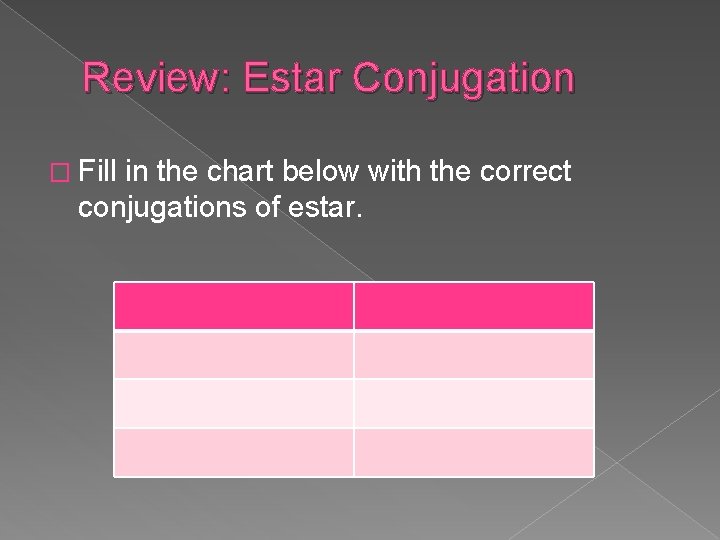
Review: Estar Conjugation � Fill in the chart below with the correct conjugations of estar.
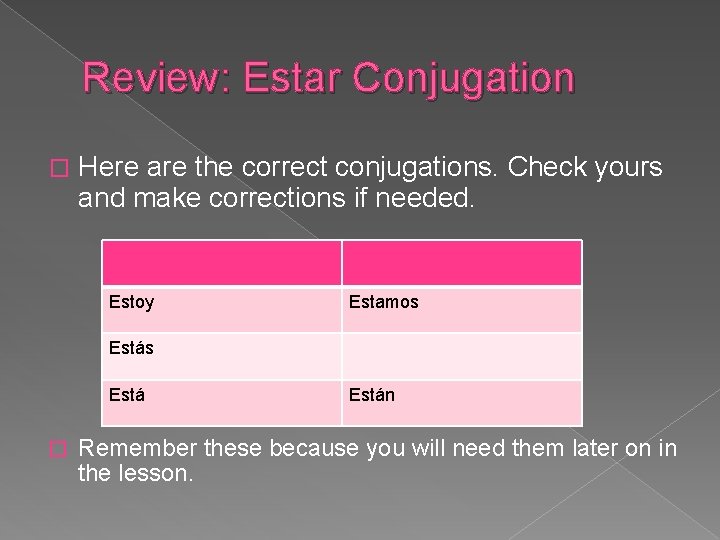
Review: Estar Conjugation � Here are the correct conjugations. Check yours and make corrections if needed. Estoy Estamos Está � Están Remember these because you will need them later on in the lesson.
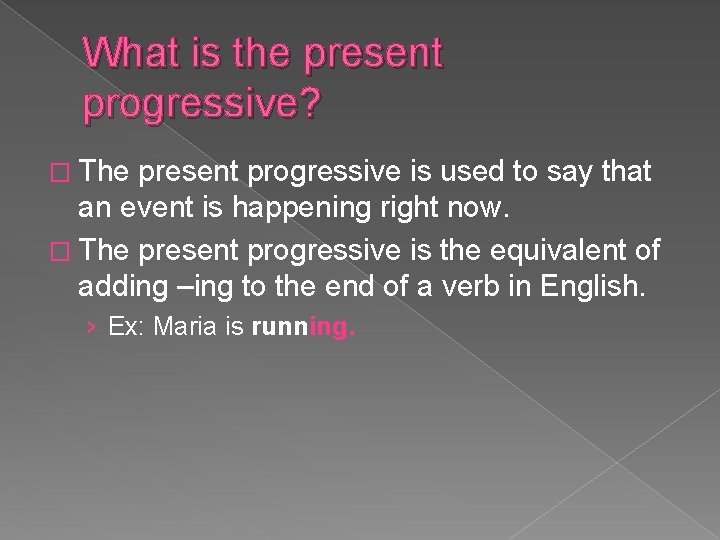
What is the present progressive? � The present progressive is used to say that an event is happening right now. � The present progressive is the equivalent of adding –ing to the end of a verb in English. › Ex: Maria is running.
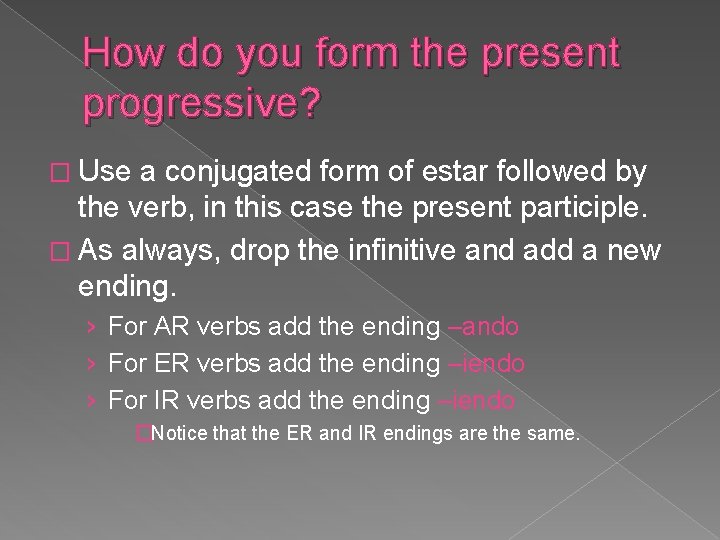
How do you form the present progressive? � Use a conjugated form of estar followed by the verb, in this case the present participle. � As always, drop the infinitive and add a new ending. › For AR verbs add the ending –ando › For ER verbs add the ending –iendo › For IR verbs add the ending –iendo �Notice that the ER and IR endings are the same.
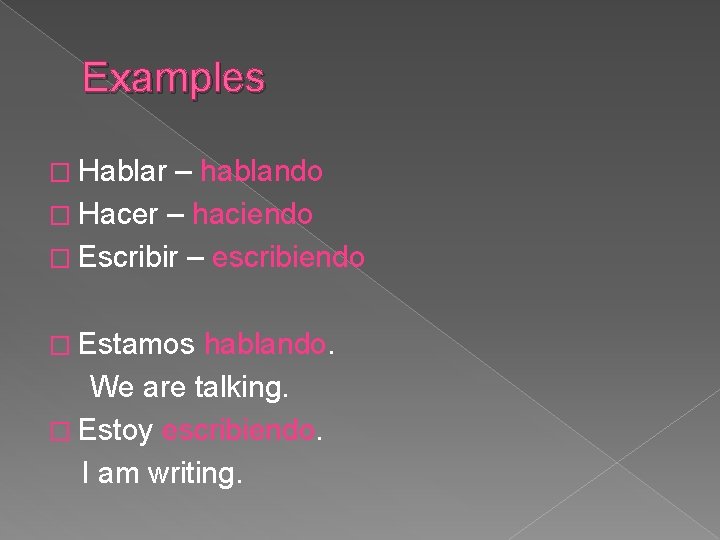
Examples � Hablar – hablando � Hacer – haciendo � Escribir – escribiendo � Estamos hablando. We are talking. � Estoy escribiendo. I am writing.
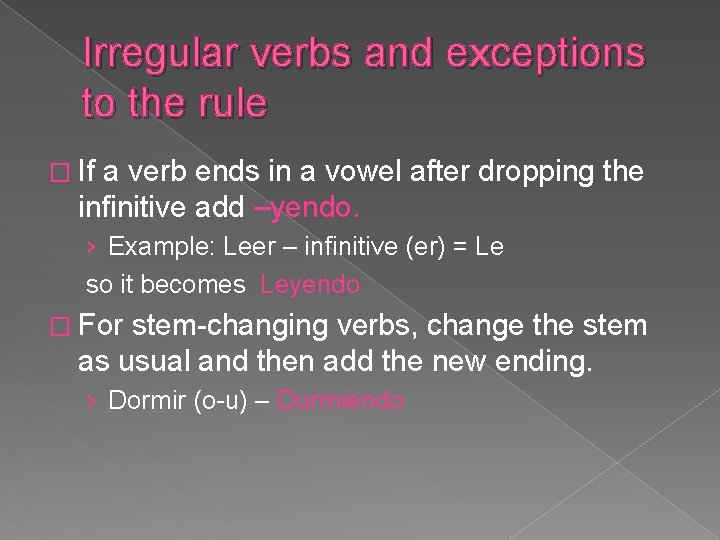
Irregular verbs and exceptions to the rule � If a verb ends in a vowel after dropping the infinitive add –yendo. › Example: Leer – infinitive (er) = Le so it becomes Leyendo � For stem-changing verbs, change the stem as usual and then add the new ending. › Dormir (o-u) – Durmiendo
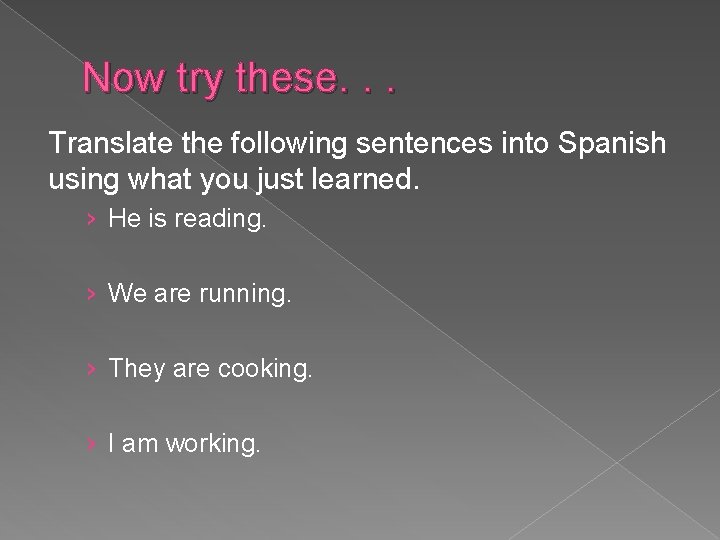
Now try these. . . Translate the following sentences into Spanish using what you just learned. › He is reading. › We are running. › They are cooking. › I am working.
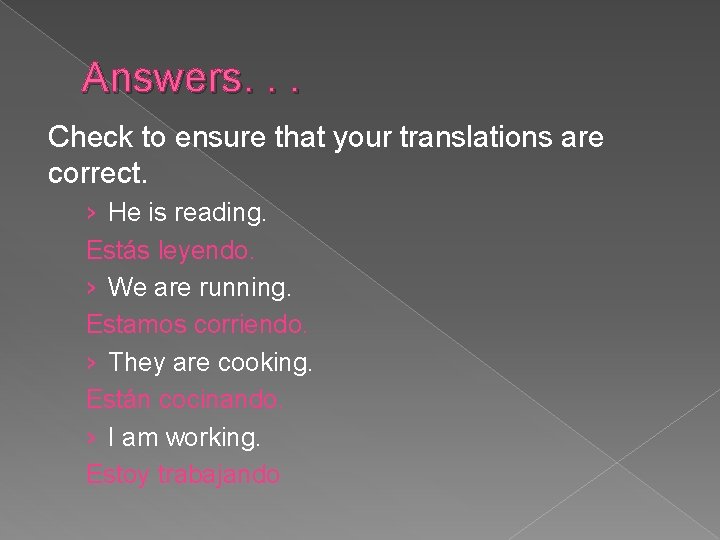
Answers. . . Check to ensure that your translations are correct. › He is reading. Estás leyendo. › We are running. Estamos corriendo. › They are cooking. Están cocinando. › I am working. Estoy trabajando
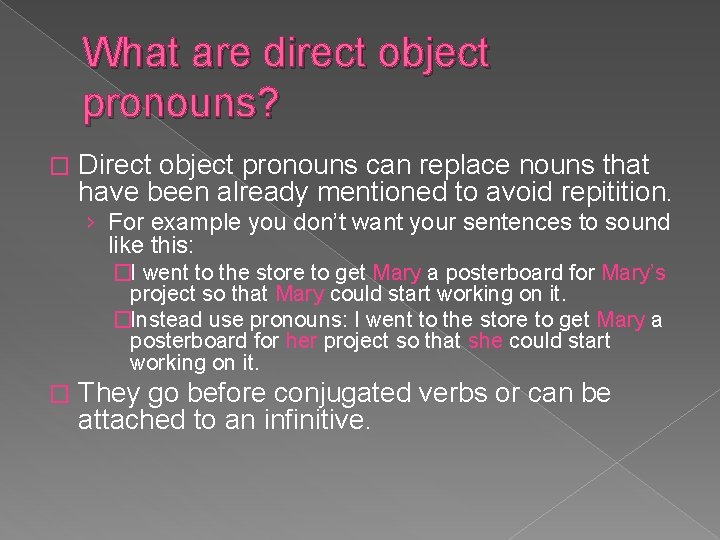
What are direct object pronouns? � Direct object pronouns can replace nouns that have been already mentioned to avoid repitition. › For example you don’t want your sentences to sound like this: �I went to the store to get Mary a posterboard for Mary’s project so that Mary could start working on it. �Instead use pronouns: I went to the store to get Mary a posterboard for her project so that she could start working on it. � They go before conjugated verbs or can be attached to an infinitive.
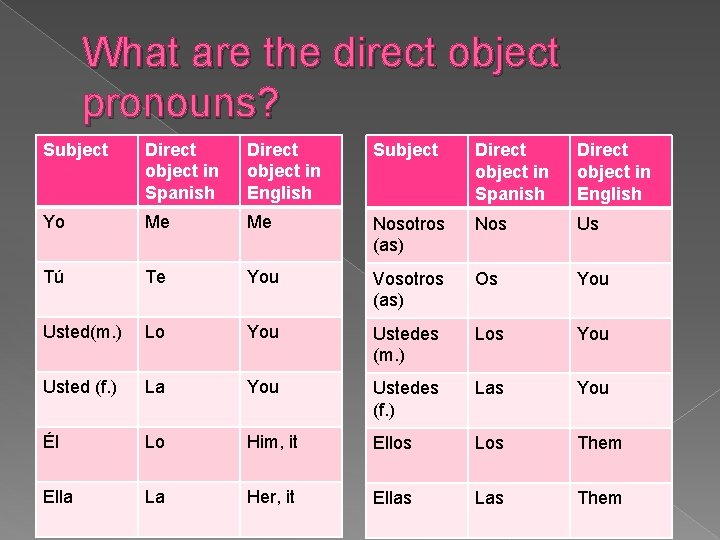
What are the direct object pronouns? Subject Direct object in Spanish Direct object in English Yo Me Me Nosotros (as) Nos Us Tú Te You Vosotros (as) Os You Usted(m. ) Lo You Ustedes (m. ) Los You Usted (f. ) La You Ustedes (f. ) Las You Él Lo Him, it Ellos Los Them Ella La Her, it Ellas Las Them
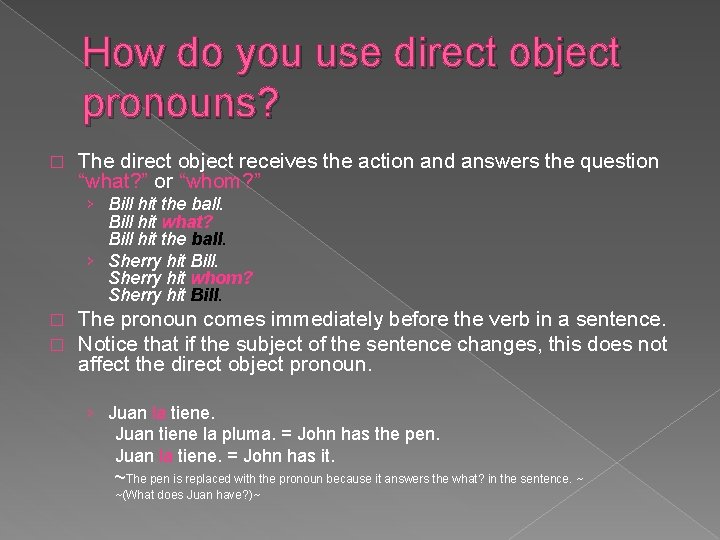
How do you use direct object pronouns? � The direct object receives the action and answers the question “what? ” or “whom? ” › Bill hit the ball. Bill hit what? Bill hit the ball. › Sherry hit Bill. Sherry hit whom? Sherry hit Bill. � � The pronoun comes immediately before the verb in a sentence. Notice that if the subject of the sentence changes, this does not affect the direct object pronoun. › Juan la tiene. Juan tiene la pluma. = John has the pen. Juan la tiene. = John has it. ~The pen is replaced with the pronoun because it answers the what? in the sentence. ~ ~(What does Juan have? )~
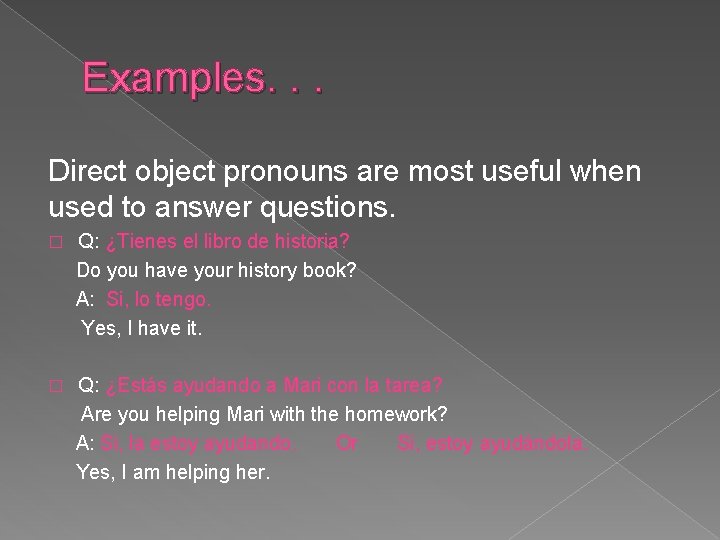
Examples. . . Direct object pronouns are most useful when used to answer questions. � Q: ¿Tienes el libro de historia? Do you have your history book? A: Si, lo tengo. Yes, I have it. � Q: ¿Estás ayudando a Mari con la tarea? Are you helping Mari with the homework? A: Si, la estoy ayudando. Or Si, estoy ayudándola. Yes, I am helping her.
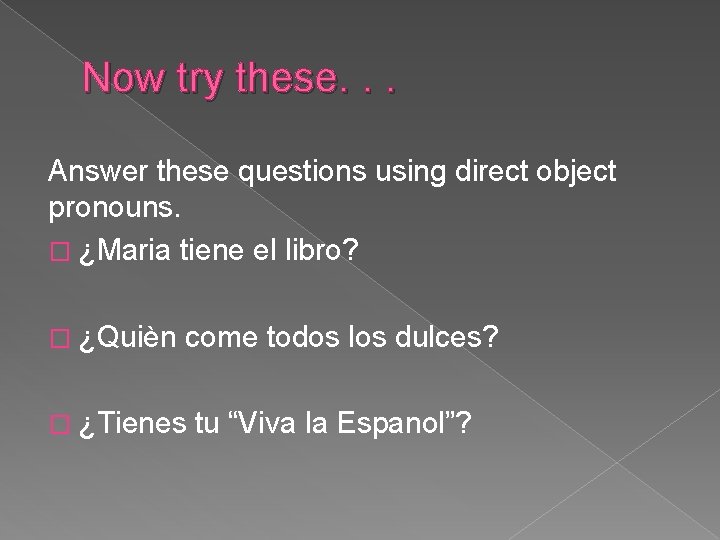
Now try these. . . Answer these questions using direct object pronouns. � ¿Maria tiene el libro? � ¿Quièn come todos los dulces? � ¿Tienes tu “Viva la Espanol”?
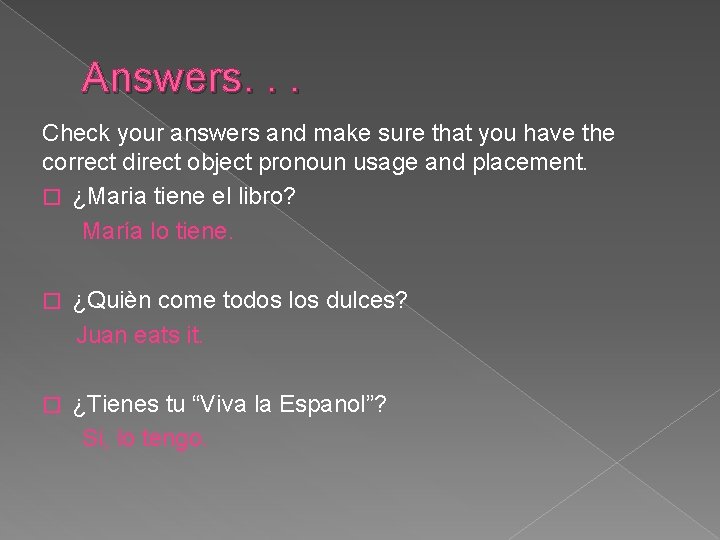
Answers. . . Check your answers and make sure that you have the correct direct object pronoun usage and placement. � ¿Maria tiene el libro? María lo tiene. � ¿Quièn come todos los dulces? Juan eats it. � ¿Tienes tu “Viva la Espanol”? Si, lo tengo.
GAME TIME!! � El Juego de Correr Directions: Split into two teams and give each player a number. We will call out a verb in English and then a number. There will be two markers at the smart board. The player from each team who is assigned the number we call will run up to the board and write the verb conjugated in the present progressive tense. First one done receives a point for their team. � First team to 10 points wins! �
- Slides: 18