
Action Research Using Quizlet for Mobile Vocabulary Learning
Action Research: Using Quizlet for Mobile Vocabulary Learning and Retention URL for this presentation: http: //tesolpresent. pbworks. com/Action-Research-Quizlet Christine Bauer-Ramazani Saint Michael's College Colchester, Vermont
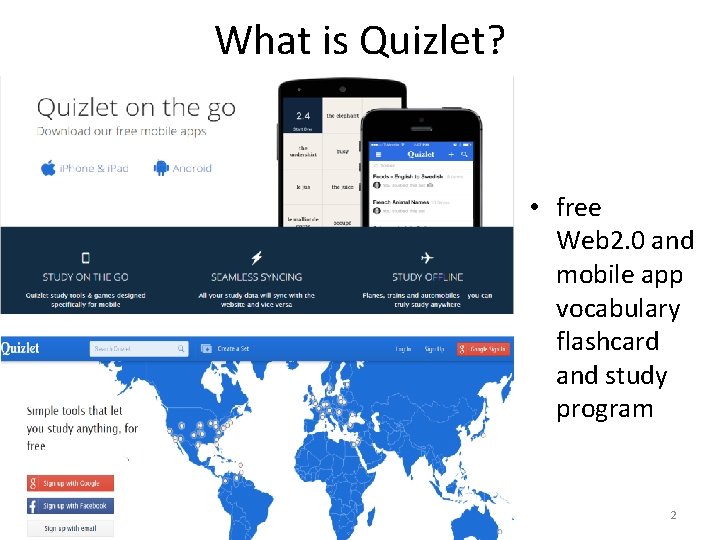
What is Quizlet? • free Web 2. 0 and mobile app vocabulary flashcard and study program 2
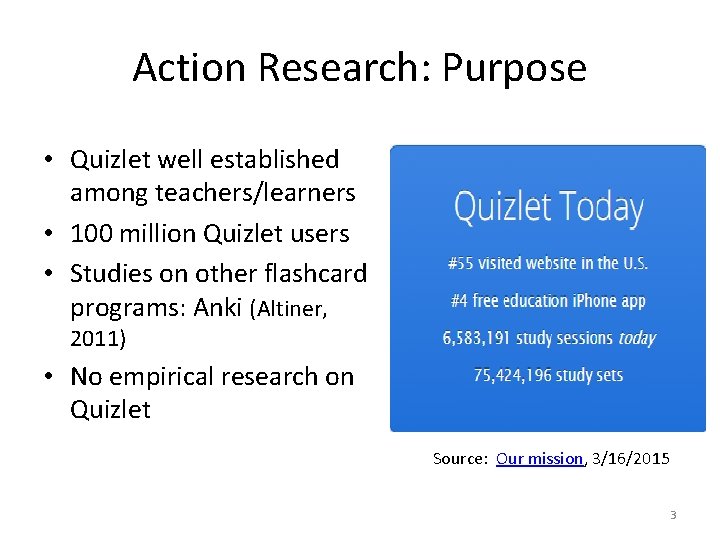
Action Research: Purpose • Quizlet well established among teachers/learners • 100 million Quizlet users • Studies on other flashcard programs: Anki (Altiner, 2011) • No empirical research on Quizlet Source: Our mission, 3/16/2015 3
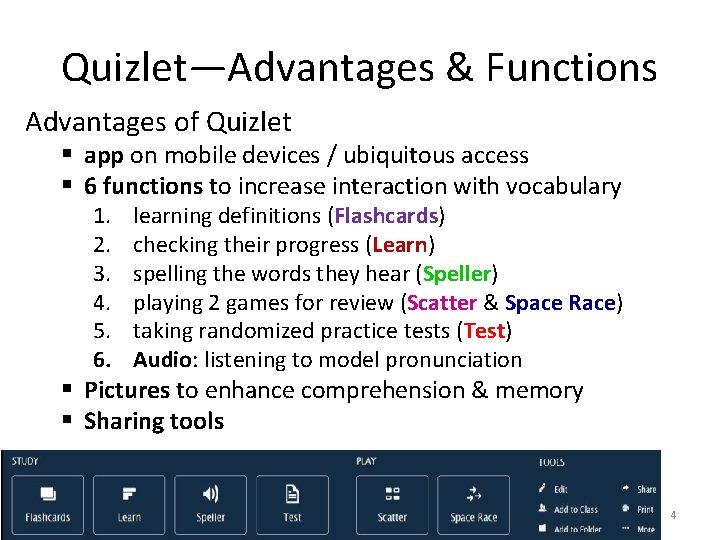
Quizlet—Advantages & Functions Advantages of Quizlet § app on mobile devices / ubiquitous access § 6 functions to increase interaction with vocabulary 1. 2. 3. 4. 5. 6. learning definitions (Flashcards) checking their progress (Learn) spelling the words they hear (Speller) playing 2 games for review (Scatter & Space Race) taking randomized practice tests (Test) Audio: listening to model pronunciation § Pictures to enhance comprehension & memory § Sharing tools 4
Hypothesis • Increased exposure to vocabulary via the 6 functions of Quizlet will increase retention. 5
Action Research: Purpose 1. use a spaced interval protocol (Nation, 2011; Loucky, 2010) with Quizlet quizzes 2. measure retention rates 3. document the students’ attitude toward vocabulary learning with Quizlet (Likert-style questionnaire) 6
Outline • • Methodology of the action research project Discussion of results Suggested effective classroom applications Recommendations for further research 7
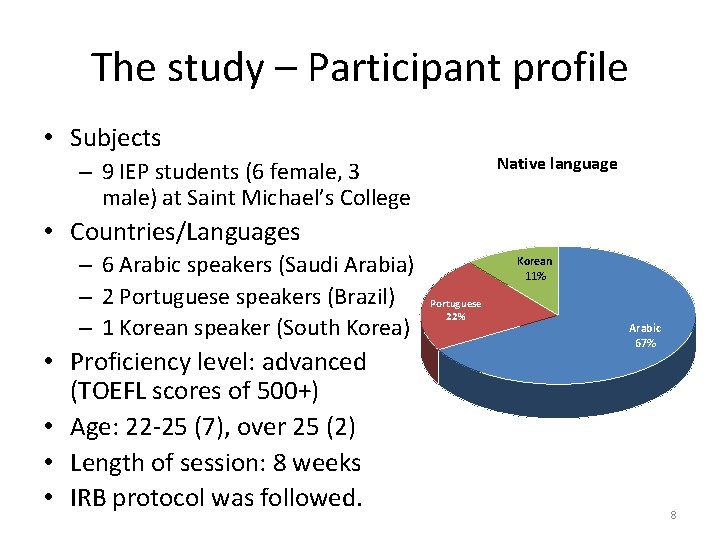
The study – Participant profile • Subjects Native language – 9 IEP students (6 female, 3 male) at Saint Michael’s College • Countries/Languages – 6 Arabic speakers (Saudi Arabia) – 2 Portuguese speakers (Brazil) – 1 Korean speaker (South Korea) • Proficiency level: advanced (TOEFL scores of 500+) • Age: 22 -25 (7), over 25 (2) • Length of session: 8 weeks • IRB protocol was followed. Korean 11% Portuguese 22% Arabic 67% 8
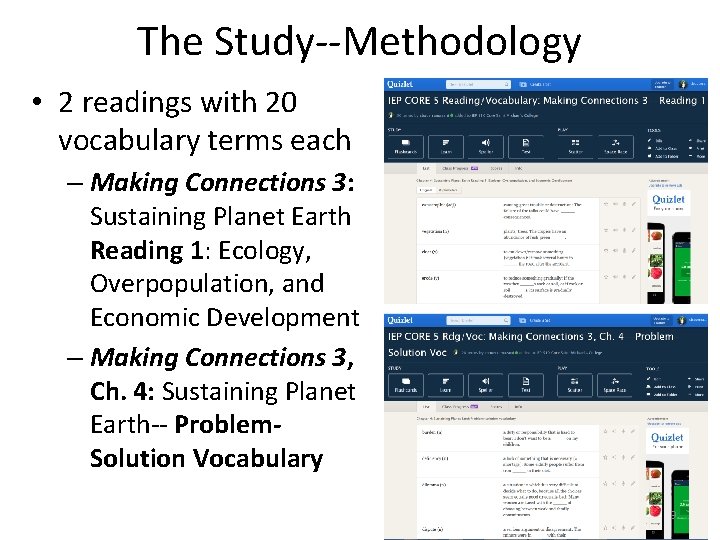
The Study--Methodology • 2 readings with 20 vocabulary terms each – Making Connections 3: Sustaining Planet Earth Reading 1: Ecology, Overpopulation, and Economic Development – Making Connections 3, Ch. 4: Sustaining Planet Earth-- Problem. Solution Vocabulary 9
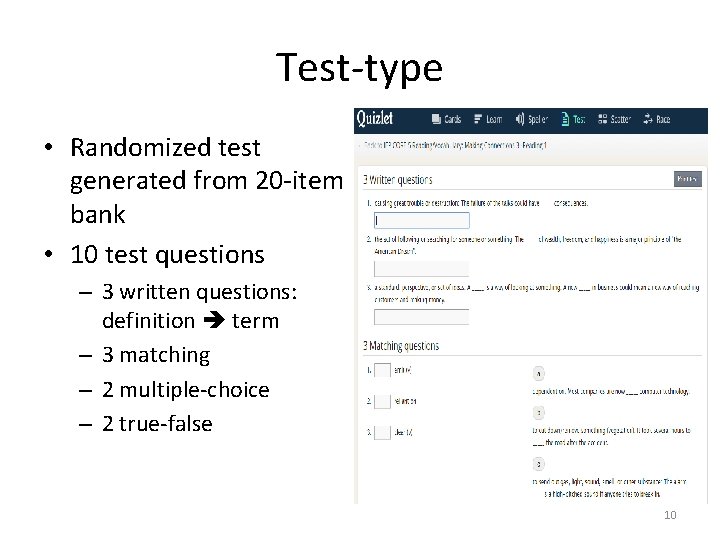
Test-type • Randomized test generated from 20 -item bank • 10 test questions – 3 written questions: definition term – 3 matching – 2 multiple-choice – 2 true-false 10
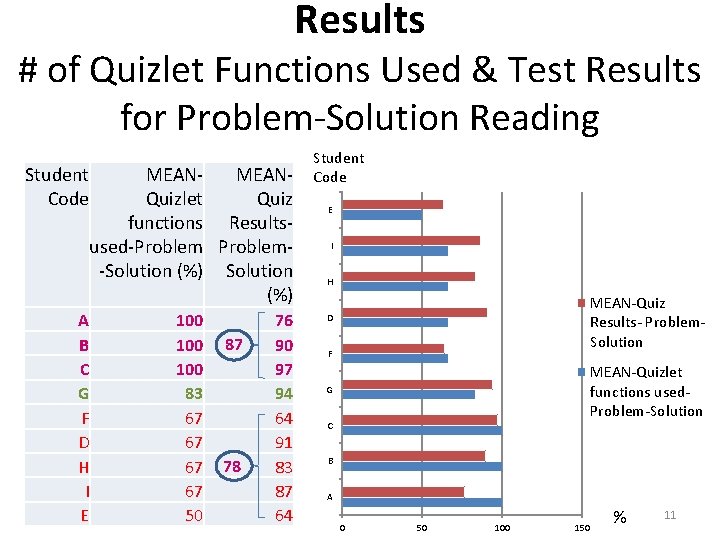
Results # of Quizlet Functions Used & Test Results for Problem-Solution Reading Student Code MEANQuizlet Quiz functions Results- used-Problem-Solution (%) A B C G F D H I E 100 87 100 83 67 67 67 78 67 50 76 90 97 94 64 91 83 87 64 Student Code E I H MEAN-Quiz Results- Problem. Solution D F MEAN-Quizlet functions used. Problem-Solution G C B A 0 50 100 150 % 11
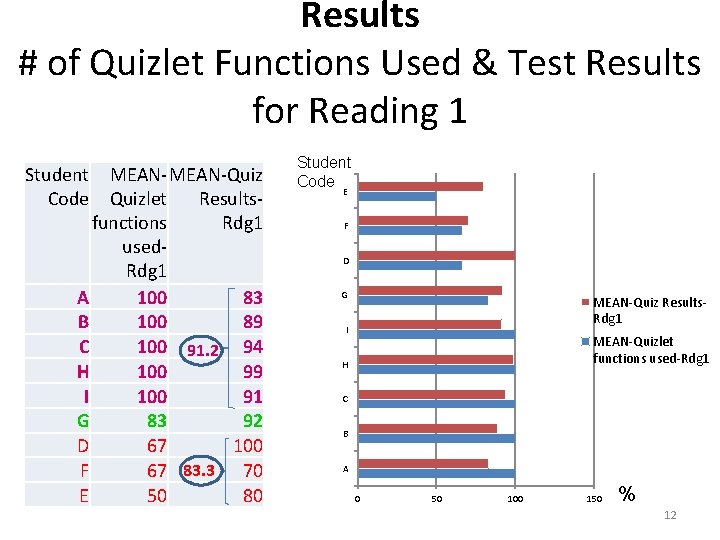
Results # of Quizlet Functions Used & Test Results for Reading 1 Student MEAN-Quiz Code Quizlet Resultsfunctions Rdg 1 used. Rdg 1 A 100 83 B 100 89 C 100 91. 2 94 H 100 99 I 100 91 G 83 92 D 67 100 F 67 83. 3 70 E 50 80 Student Code E F D G MEAN-Quiz Results. Rdg 1 I MEAN-Quizlet functions used-Rdg 1 H C B A 0 50 100 150 % 12
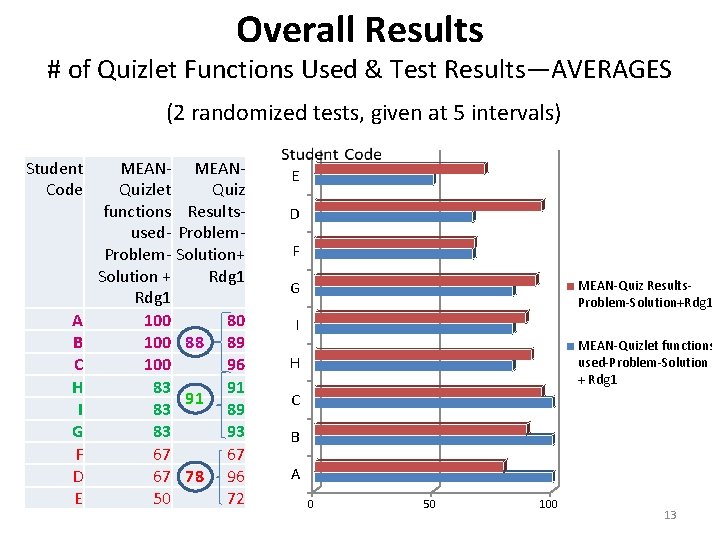
Overall Results # of Quizlet Functions Used & Test Results—AVERAGES (2 randomized tests, given at 5 intervals) Student Code A B C H I G F D E MEAN- MEANQuizlet Quiz functions Resultsused- Problem- Solution+ Solution + Rdg 1 100 80 100 88 89 100 96 83 91 91 83 89 83 93 67 67 67 78 96 50 72 E D F MEAN-Quiz Results. Problem-Solution+Rdg 1 G I MEAN-Quizlet functions used-Problem-Solution + Rdg 1 H C B A 0 50 100 13
Results Questionnaire • Google Form • Likert-scale Survey: Using Quizlet to Learn Vocabulary (http: //goo. gl/forms/o 4 Yjw. Waz. Cc) • Purpose – measure the students’ attitudes towards Quizlet and their uses of it 14
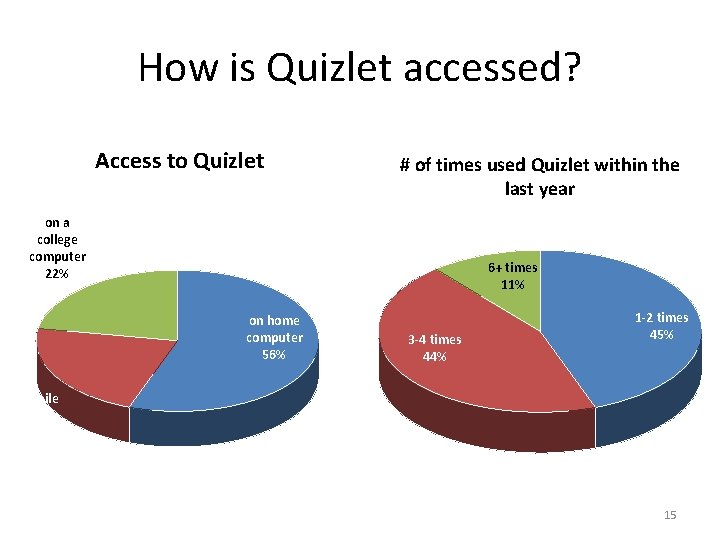
How is Quizlet accessed? Access to Quizlet # of times used Quizlet within the last year on a college computer 22% 6+ times 11% on home computer 56% 3 -4 times 44% 1 -2 times 45% on mobile device 22% 15
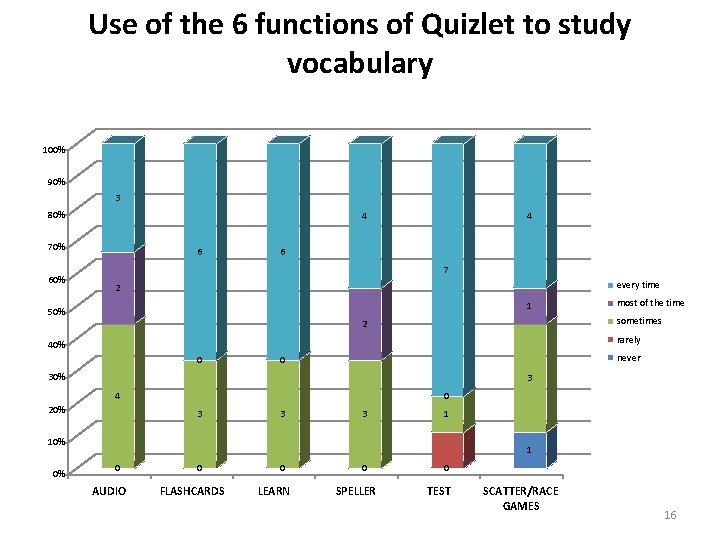
Use of the 6 functions of Quizlet to study vocabulary 100% 90% 3 80% 4 70% 6 4 6 7 every time 2 1 50% sometimes 2 rarely 40% 0 never 0 30% 3 4 20% 0 3 3 3 1 10% 0% most of the time 1 0 AUDIO 0 FLASHCARDS 0 LEARN 0 SPELLER 0 TEST SCATTER/RACE GAMES 16
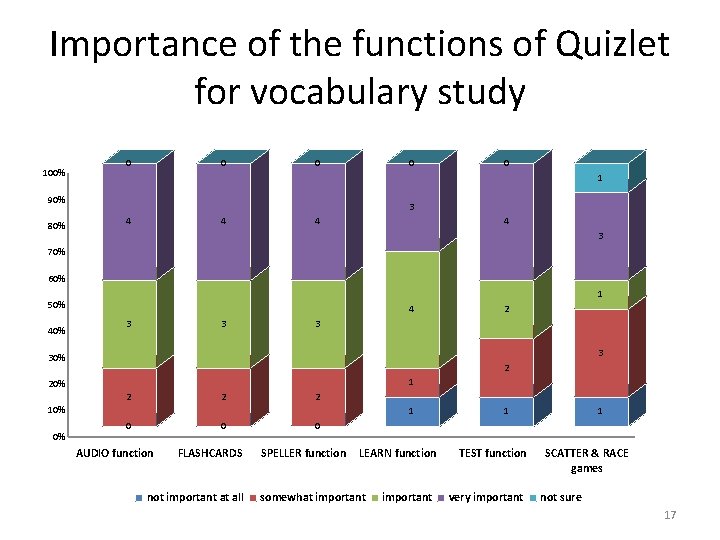
Importance of the functions of Quizlet for vocabulary study 100% 0 0 1 90% 80% 0 3 4 4 3 70% 60% 1 50% 4 3 30% 2 1 20% 2 2 2 10% 0% 2 3 1 0 0 AUDIO function FLASHCARDS not important at all 1 1 0 SPELLER function LEARN function somewhat important TEST function very important SCATTER & RACE games not sure 17
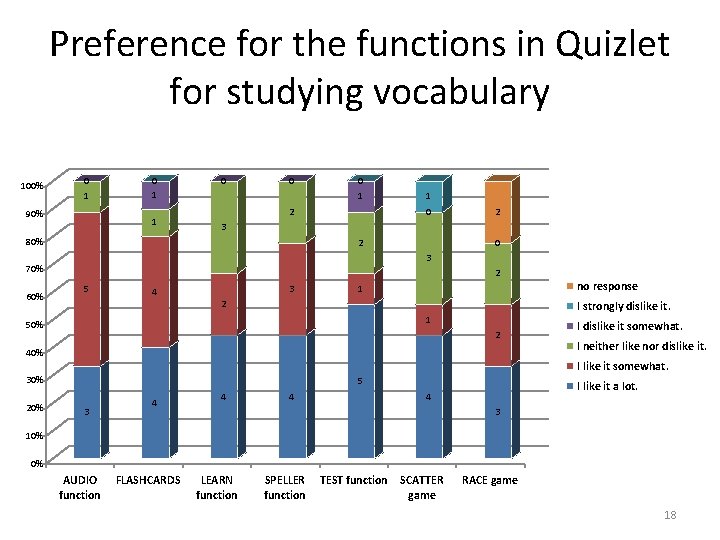
Preference for the functions in Quizlet for studying vocabulary 100% 0 1 90% 0 1 1 0 0 0 1 2 0 2 3 80% 2 0 3 70% 60% 1 2 5 4 3 1 2 I strongly dislike it. 1 50% 2 40% I dislike it somewhat. I neither like nor dislike it. I like it somewhat. 30% 20% no response 5 3 4 4 4 I like it a lot. 4 3 10% 0% AUDIO function FLASHCARDS LEARN function SPELLER function TEST function SCATTER game RACE game 18
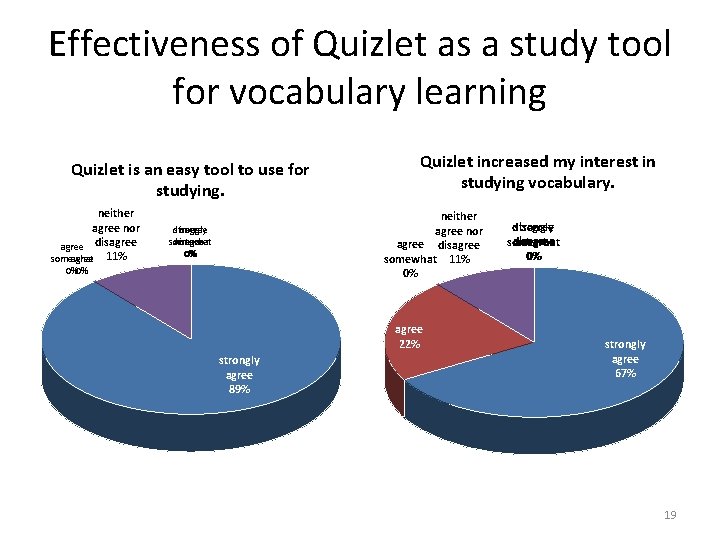
Effectiveness of Quizlet as a study tool for vocabulary learning Quizlet is an easy tool to use for studying. neither agree nor agree disagree 11% somewhat Quizlet increased my interest in studying vocabulary. neither agree nor agree disagree somewhat 11% 0% disagree strongly not sure somewhat disagree 0% 0%0% agree 22% strongly agree 89% disagree strongly not sure somewhat disagree 0% strongly agree 67% 19
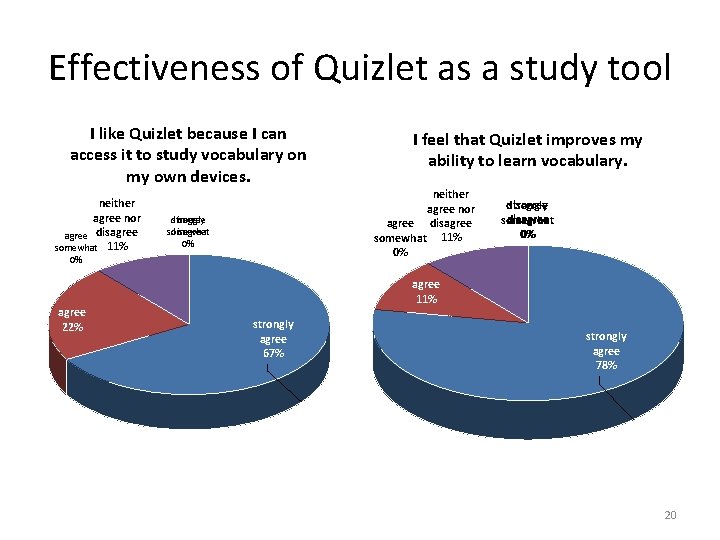
Effectiveness of Quizlet as a study tool I like Quizlet because I can access it to study vocabulary on my own devices. neither agree nor agree disagree somewhat 11% disagree strongly somewhat disagree 0% 0% agree 22% I feel that Quizlet improves my ability to learn vocabulary. neither agree nor agree disagree somewhat 11% 0% disagree strongly somewhat disagree 0% agree 11% strongly agree 67% strongly agree 78% 20
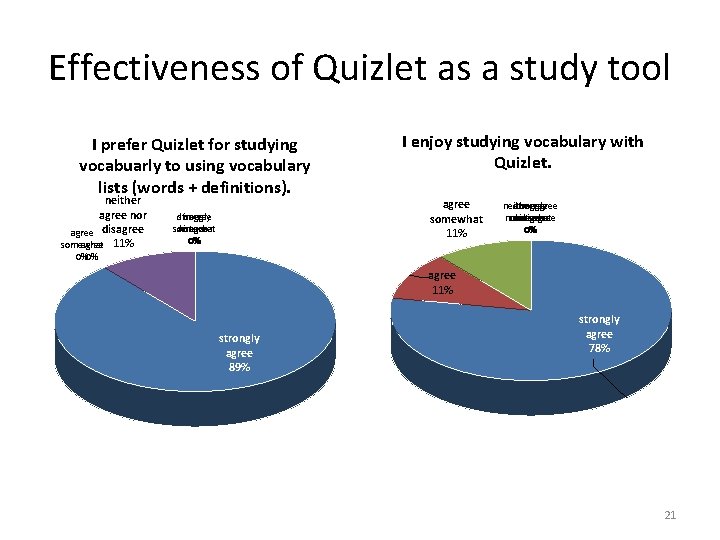
Effectiveness of Quizlet as a study tool I prefer Quizlet for studying vocabuarly to using vocabulary lists (words + definitions). neither agree nor agree disagree 11% somewhat disagree strongly not sure somewhat disagree 0% I enjoy studying vocabulary with Quizlet. agree somewhat 11% neither agree disagree strongly not sure nor disagree somewhat disagree 0% 0%0% agree 11% strongly agree 89% strongly agree 78% 21
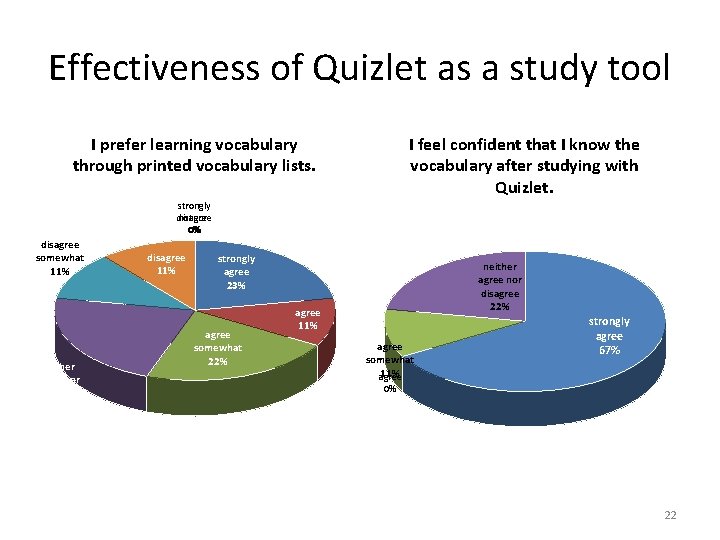
Effectiveness of Quizlet as a study tool I prefer learning vocabulary through printed vocabulary lists. I feel confident that I know the vocabulary after studying with Quizlet. strongly not sure disagree 0% disagree somewhat 11% neither agree nor disagree 22% disagree 11% strongly agree 23% agree somewhat 22% neither agree nor disagree 22% agree 11% agree somewhat 11% agree strongly agree 67% 0% 22
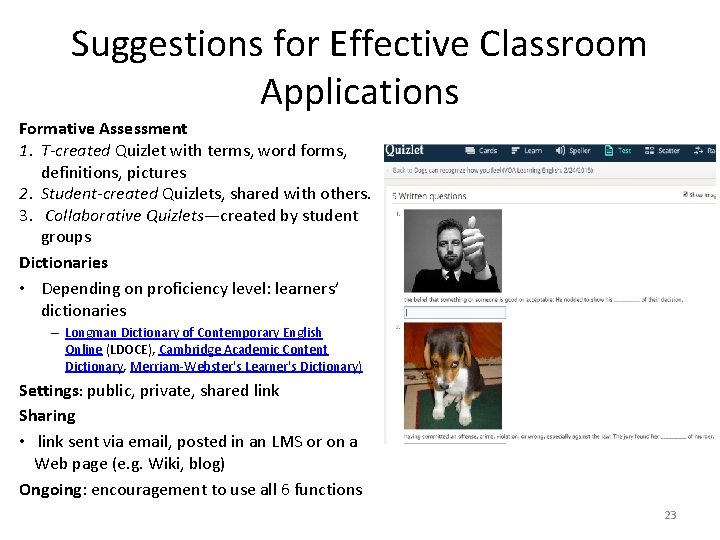
Suggestions for Effective Classroom Applications Formative Assessment 1. T-created Quizlet with terms, word forms, definitions, pictures 2. Student-created Quizlets, shared with others. 3. Collaborative Quizlets—created by student groups Dictionaries • Depending on proficiency level: learners’ dictionaries – Longman Dictionary of Contemporary English Online (LDOCE), Cambridge Academic Content Dictionary, Merriam-Webster's Learner's Dictionary) Settings: public, private, shared link Sharing • link sent via email, posted in an LMS or on a Web page (e. g. Wiki, blog) Ongoing: encouragement to use all 6 functions 23
Recommendations for further research • Large-scale research on the effectiveness of Quizlet • Empirical research on Quizlet vs. traditional vocabulary study methods • Quizlet vs. Vocabulary-in-context tests – Testing students’ ability to produce words learned through Quizlet in a fill-in-the blank vocabulary test with context • Expand time horizon – Semester (16 -week) period 24
References • Altiner, C. (2011). Integrating a computer-based flashcard program into academic vocabulary learning. MA thesis, Iowa State University. • Fitzpatrick, T. , Al-Qarni, I. , & Meara, P. (2008). Intensive vocabulary learning: A case study. Language Learning Journal, 36(2), 239248. doi: 10. 1080/ 09571730802390759 • Folse, K. (2004). Myths about teaching and learning second language vocabulary: What • recent research says. TESL Reporter, 37(2), 1 -13. • Foster, H. (2009). Building learner-generated vocabulary logs with Quizlet. The Language Teacher , 33(12). • Gu, P. (2003). Vocabulary learning in a second language: Person, task, context • and strategies. TESL-EJ 7(2). • Loucky, J. P. (2010). Maximizing vocabulary development by systematically using a depth of lexical processing taxonomy, CALL resources, and effective strategies. CALICO Journal, 23 (2), 363 -399. • Nakata, T. (2011). Computer-assisted second language vocabulary learning in a pairedassociate paradigm: a critical investigation of flashcard software. Computer Assisted Language Learning, 24(1), 17 -38. http: //dx. doi. org/10. 1080/09588221. 2010. 520675 • Nation, I. S. P. (1990). Teaching and learning vocabulary. New York: Newbury House. • Nation, I. S. P. (2001). Learning vocabulary in another language. New York: Cambridge University Press. • Nation, I. S. P. (2011). Research into practice: Vocabulary. Language Teaching, 44 (4), 529 -539. doi: 10. 1017/S 0261444811000267 • Schmitt, N. (2000). Vocabulary in Language Teaching. Cambridge. U. K: Cambridge University 25 Press.
Questions? Thank you for your participation! Christine Bauer-Ramazani Applied Linguistics Department Saint Michael’s College Contact: cbauer-ramazani@smcvt. edu http: //academics. smcvt. edu/cbauer-ramazani
- Slides: 26