
Action Research Presentation Educ 602 Education Research Raymond


- Slides: 17
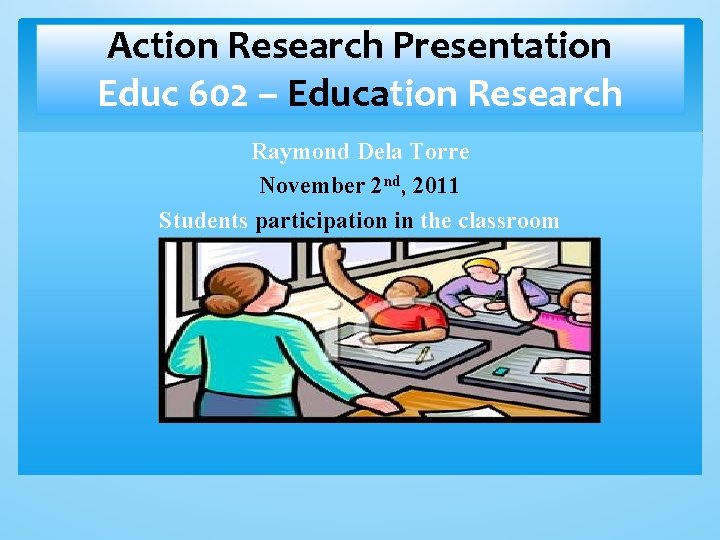
Action Research Presentation Educ 602 – Education Research Raymond Dela Torre November 2 nd, 2011 Students participation in the classroom
I. Statement of the Problem • A percentage of students in my fifth grade class are not participating enough. • Students seem to be uneasy in trying to answer questions posed to them or during discussion. • It seems to be the same seven to ten students always trying to answer questions.
I. Statement of the Problem • This is a problem because seeing the students participate helps me know where the students are besides using formal assessments. • Participation can be used as a gauge of sorts. • The issue is the getting the other eighteen or so students to participate in class on a regular basis.
II. Preliminary Research • Prior research indicates that preparation for and frequency of participation is positively related to students’ comfort participating. (Elise J Dallimore, Julie H. Hertenstein, and Majorie B. Platt, 2010) • Student comfort level with class discussion, in turn, is positively related to two pre factors( typical frequency of participation in prior courses and liking the class discussion. . . (Elise J Dallimore, Julie H. Hertenstein, and Majorie B. Platt, 2010)
II. Preliminary Research • Enabling children and young people to act as researchers is increasingly viewed as useful in supporting their increased “ participation”. . . (Debbie Burton, Margaret Smith, and Kevin Woods, 2010) • The potential benefits of developing pupil-led action research. . . , including the promotion of: 1. pupils' understanding about why having a voice is important. 2. Pupils' beliefs that their voices will be heard, and taken seriously, and acted upon. (Debbie Burton, Margaret Smith, and Kevin Woods, 2010)
II. Preliminary Research • Past research has emphasized the importance of active classroom participation in student learning. ( Karl G. Nelson, 2010) • Class participation can help students perform better in school. ( e. g. , Jalongo, Twiest, Gerlack, and Skoner, 1998)
III. Research Plan • Use of popsicle sticks to call on all the students. • Put students into groups that will force them into active participation. • Have the students participate in think pair-share types of activities. • Monitor the rate of times each student answers a question for one week.
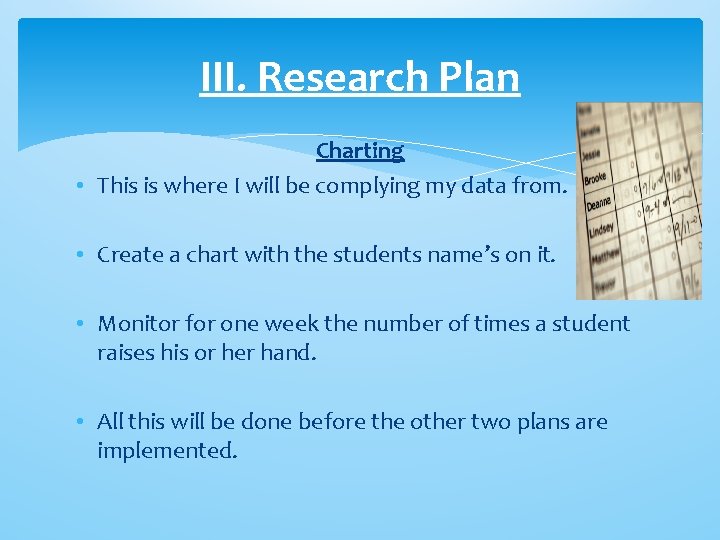
III. Research Plan Charting • This is where I will be complying my data from. • Create a chart with the students name’s on it. • Monitor for one week the number of times a student raises his or her hand. • All this will be done before the other two plans are implemented.
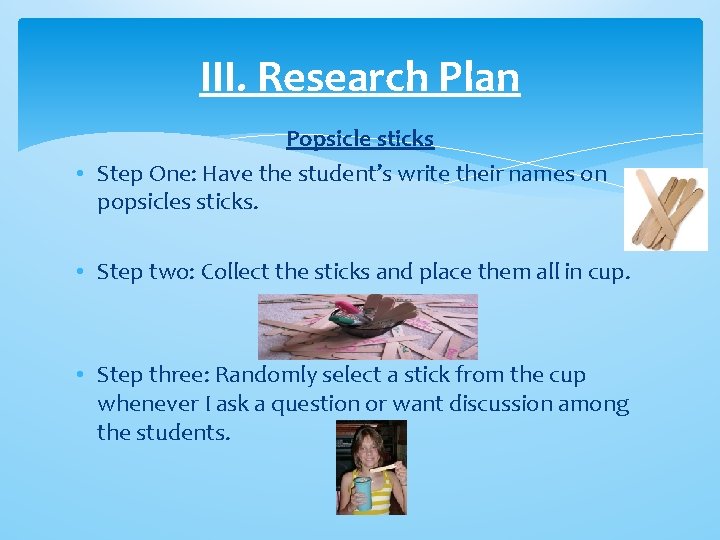
III. Research Plan Popsicle sticks • Step One: Have the student’s write their names on popsicles sticks. • Step two: Collect the sticks and place them all in cup. • Step three: Randomly select a stick from the cup whenever I ask a question or want discussion among the students.
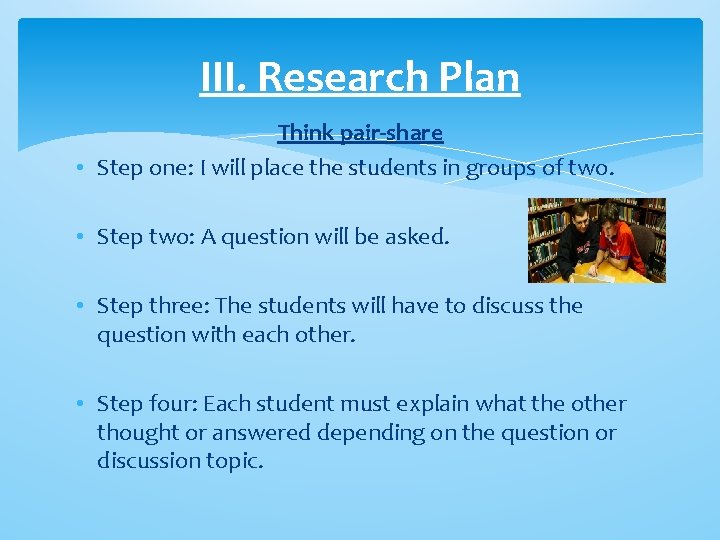
III. Research Plan Think pair-share • Step one: I will place the students in groups of two. • Step two: A question will be asked. • Step three: The students will have to discuss the question with each other. • Step four: Each student must explain what the other thought or answered depending on the question or discussion topic.
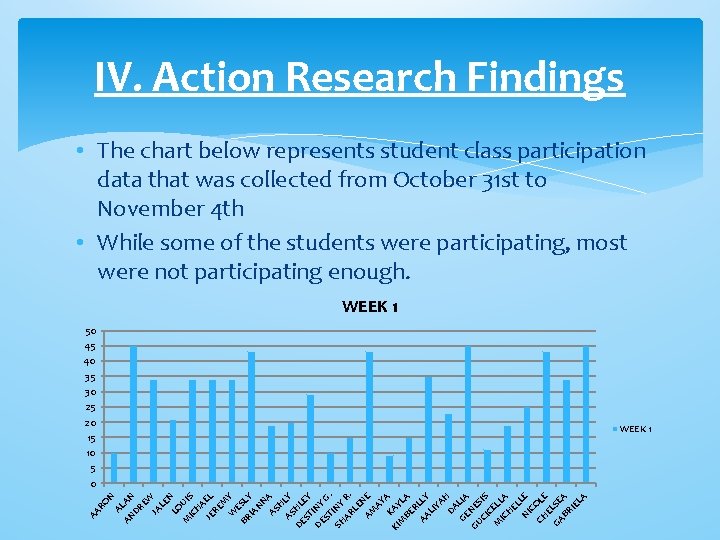
IV. Action Research Findings • The chart below represents student class participation data that was collected from October 31 st to November 4 th • While some of the students were participating, most were not participating enough. WEEK 1 50 45 40 35 30 25 20 WEEK 1 15 10 5 AA R ON AL AN AN DR EW JA LE N LO U M IC IS HA JE EL RE M W Y E BR SLY IA NN AS A H AS LY DE HL ST EY DE INY ST G. SH INY AR R. LE N AM E AY A K KI AY M BE LA R AA LLY LI YA H DA L GE IA GU NES CI IS C M ELL IC A HE L NI LE CO CH LE E GA LSE BR A IE LA 0
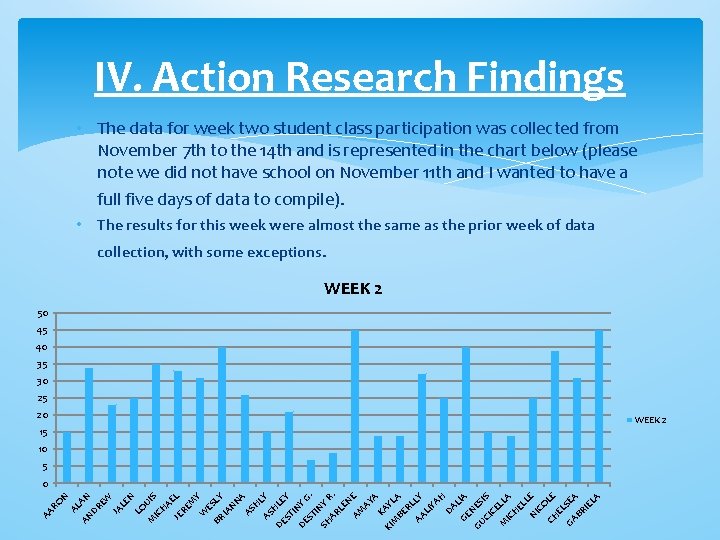
IV. Action Research Findings • The data for week two student class participation was collected from November 7 th to the 14 th and is represented in the chart below (please note we did not have school on November 11 th and I wanted to have a full five days of data to compile). • The results for this week were almost the same as the prior week of data collection, with some exceptions. WEEK 2 50 45 40 35 30 25 20 WEEK 2 15 10 5 AA R ON AL AN AN DR EW JA LE N LO M UIS IC HA JE EL RE M Y W ES BR LY IA NN A AS HL AS Y DE HLE ST Y I DE NY ST G. IN SH Y AR R. LE N AM E AY A KA KI M YLA BE RL AA LY LI YA H DA L GE IA NE GU S CI IS CE M LLA IC HE LL NI E CO CH LE EL GA SEA BR IE LA 0
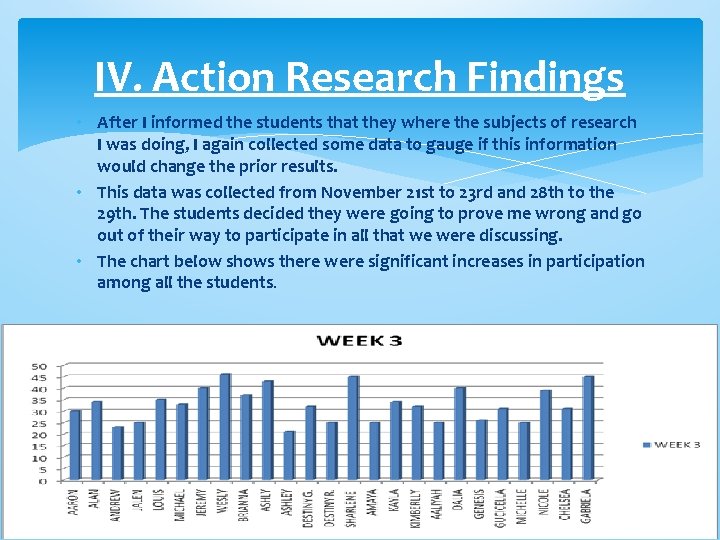
IV. Action Research Findings • After I informed the students that they where the subjects of research I was doing, I again collected some data to gauge if this information would change the prior results. • This data was collected from November 21 st to 23 rd and 28 th to the 29 th. The students decided they were going to prove me wrong and go out of their way to participate in all that we were discussing. • The chart below shows there were significant increases in participation among all the students.
V. Recommendations for Further Research • Over the course of the semester, the class has taught me a lot about data collection in relation to education. • One of the trends I noticed among the students during this experiment was that the students both liked and welcomed the challenge of actually being involved in teaching a lesson. • Students no longer like waiting on the sidelines; rather, they want to be right in the middle of the action as it pertains to them. • During the course of my data collecting there were a lot of other factors that I did not take into account.
V. Recommendations for Further Research • I think this was definitely a worth while experience. • However, the only thing I would have done differently is focus on one subject rather than on the whole day’s worth of participation (with all the subjects included). • Teaching, in and of itself, is time consuming. Imagine trying to teach and administer an experiment at the same time as you collect the data. It can become overwhelming for the instructor.
V. Recommendations for Further Research • So, here a few suggestions that may help you along your way as you do your research on participation in your very own classroom: • Be specific. Choose a subject or lesson that you want to see an increase in participation, and let that be your guide. • Take into consideration how the student’s day started: Did h/she have breakfest? Did the student wake up late? Was the student prepared with proper tools and books for class? Etc. • Is this research feasible and why are you doing it? • The types of questions you ask—are they converging or diverging? • Make sure your lessons are as colorful and as interesting as they can be. Students will participate more often when they feel engaged, despite knowing an answer or not. When the students feel bored, you see them shut down, in terms of their lack of participation. • Are your students special ed or esl students. The approach for this students will definitely be different compared to that of my own classroom.
The End