
ACTION RESEARCH DESIGNS 1 2 3 4 OUR


- Slides: 23
ACTION RESEARCH DESIGNS
1) 2) 3) 4) OUR PRESENTATION TODAY: Chapter Summary a) What is ARD? What makes it different? b) What are the types of ARD? c) Key Characteristics d) Ethical Issues with ARD Our thoughts on ARD Examples of ARD Using ARD - an activity and a discussion
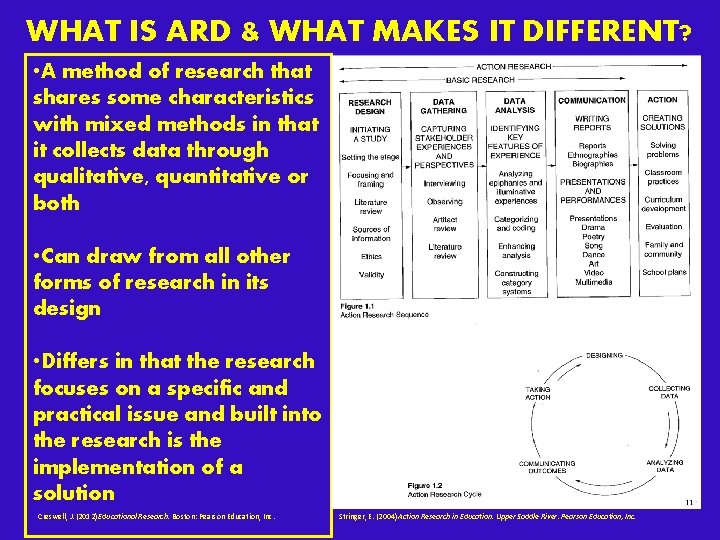
WHAT IS ARD & WHAT MAKES IT DIFFERENT? • A method of research that shares some characteristics with mixed methods in that it collects data through qualitative, quantitative or both • Can draw from all other forms of research in its design • Differs in that the research focuses on a specific and practical issue and built into the research is the implementation of a solution Creswell, J. (2012) Educational Research. Boston: Pearson Education, Inc. Stringer, E. (2004) Action Research in Education. Upper Saddle River: Pearson Education, Inc.
WHAT IS ARD & WHAT MAKES IT DIFFERENT? • Starts with practitioners and always works within the settings where the problems exist (collaborators vs. participants) • Seeks to: 1) address local, practical problems OR 2) empower, transform and emancipate individuals from situations that limit their selfdevelopment and selfdetermination • More participatory and collaborative approach to research Creswell, J. (2012) Educational Research. Boston: Pearson Education, Inc. www. enchanted maths. ca
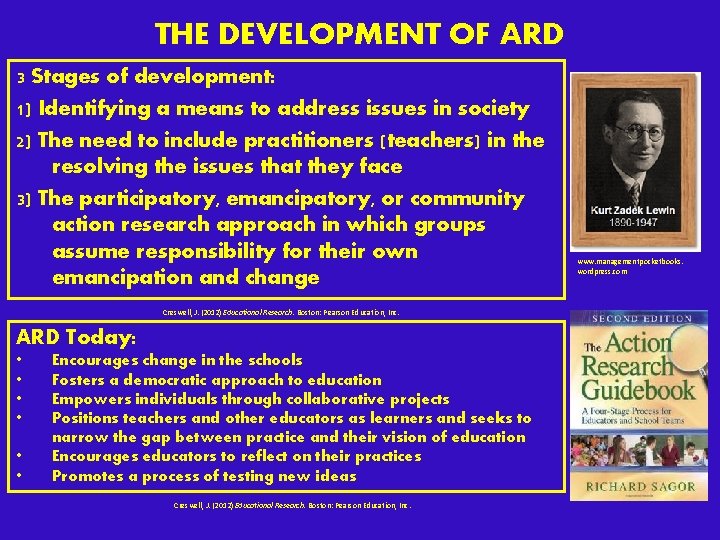
THE DEVELOPMENT OF ARD 3 Stages of development: 1) Identifying a means to address issues in society 2) The need to include practitioners (teachers) in the resolving the issues that they face 3) The participatory, emancipatory, or community action research approach in which groups assume responsibility for their own emancipation and change Creswell, J. (2012) Educational Research. Boston: Pearson Education, Inc. ARD Today: • • • Encourages change in the schools Fosters a democratic approach to education Empowers individuals through collaborative projects Positions teachers and other educators as learners and seeks to narrow the gap between practice and their vision of education Encourages educators to reflect on their practices Promotes a process of testing new ideas Creswell, J. (2012) Educational Research. Boston: Pearson Education, Inc. www. managementpocketbooks. wordpress. com
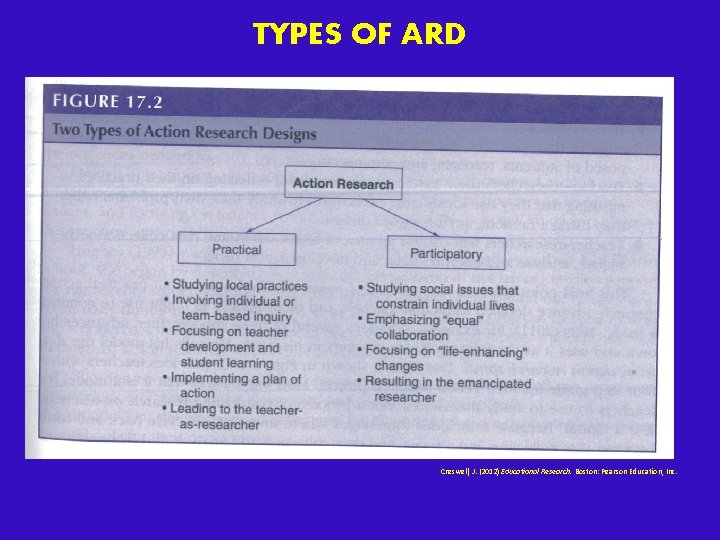
TYPES OF ARD Creswell, J. (2012) Educational Research. Boston: Pearson Education, Inc.
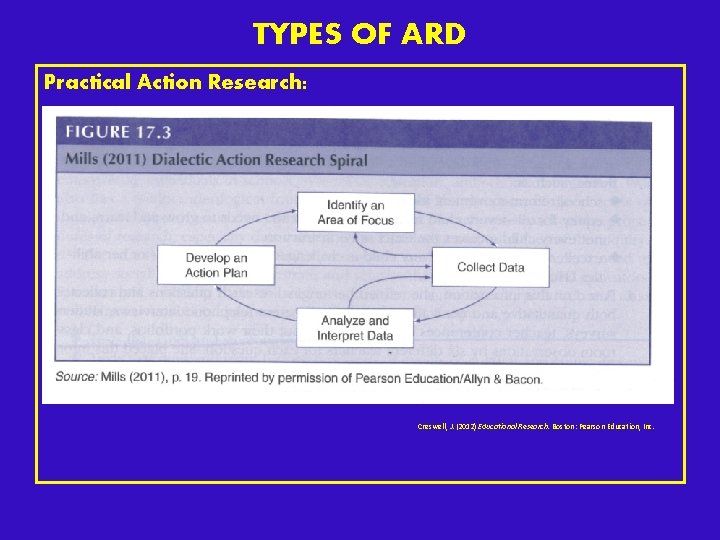
TYPES OF ARD Practical Action Research: Creswell, J. (2012) Educational Research. Boston: Pearson Education, Inc.
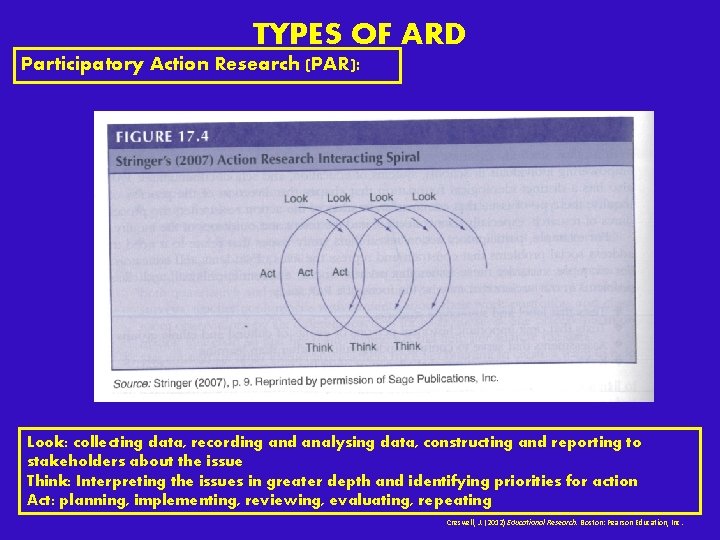
TYPES OF ARD Participatory Action Research (PAR): Look: collecting data, recording and analysing data, constructing and reporting to stakeholders about the issue Think: Interpreting the issues in greater depth and identifying priorities for action Act: planning, implementing, reviewing, evaluating, repeating Creswell, J. (2012) Educational Research. Boston: Pearson Education, Inc.
TYPES OF ARD Participatory Action Research (PAR): • Focuses on research for emancipation or change in society through looking at issues within a community or societal context as opposed to specific/practical problems – (ie. Paulo Freire, Pedagogy of the Oppressed) Creswell, J. (2012) Educational Research. Boston: Pearson Education, Inc.
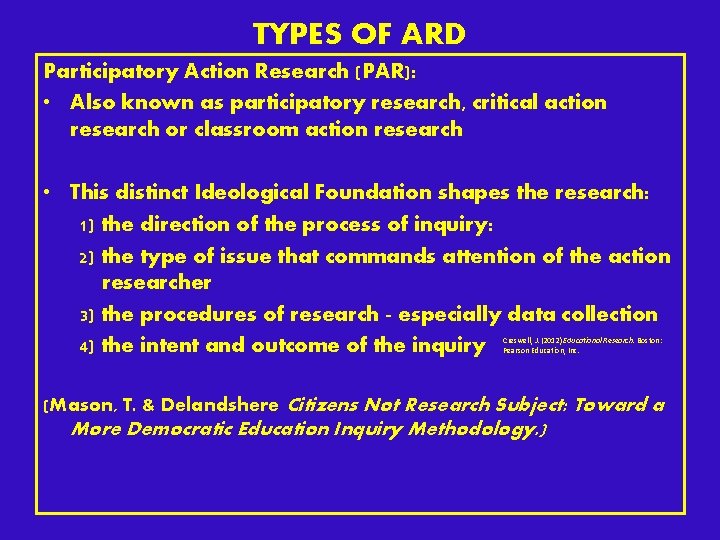
TYPES OF ARD Participatory Action Research (PAR): • Also known as participatory research, critical action research or classroom action research • This distinct Ideological Foundation shapes the research: 1) the direction of the process of inquiry: 2) the type of issue that commands attention of the action researcher 3) the procedures of research - especially data collection 4) the intent and outcome of the inquiry Creswell, J. (2012) Educational Research. Boston: Pearson Education, Inc. (Mason, T. & Delandshere Citizens Not Research Subject: Toward a More Democratic Education Inquiry Methodology. )
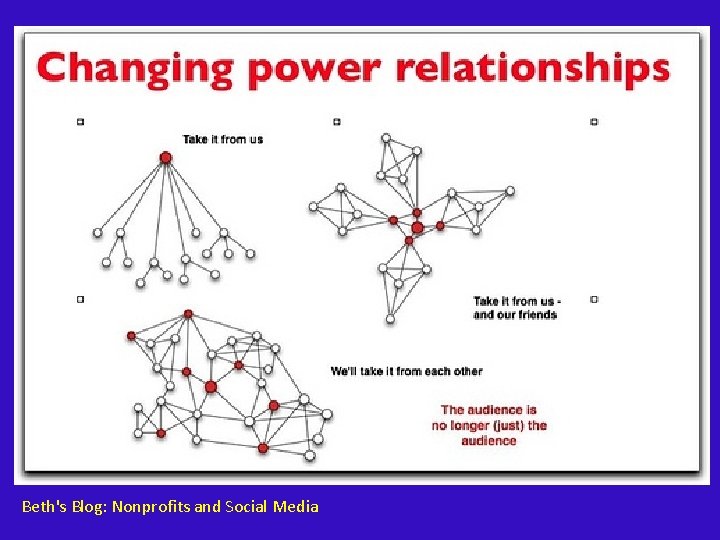
Beth's Blog: Nonprofits and Social Media
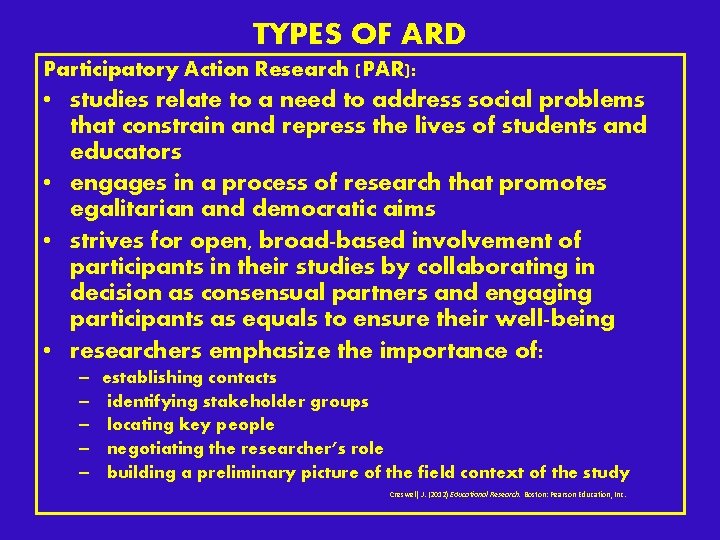
TYPES OF ARD Participatory Action Research (PAR): • studies relate to a need to address social problems that constrain and repress the lives of students and educators • engages in a process of research that promotes egalitarian and democratic aims • strives for open, broad-based involvement of participants in their studies by collaborating in decision as consensual partners and engaging participants as equals to ensure their well-being • researchers emphasize the importance of: – – – establishing contacts identifying stakeholder groups locating key people negotiating the researcher’s role building a preliminary picture of the field context of the study Creswell, J. (2012) Educational Research. Boston: Pearson Education, Inc.
Cartoon © Simon Kneebone and Yoland Wadsworth – from What is Participatory Action Research? Action Research International online journal, 1998
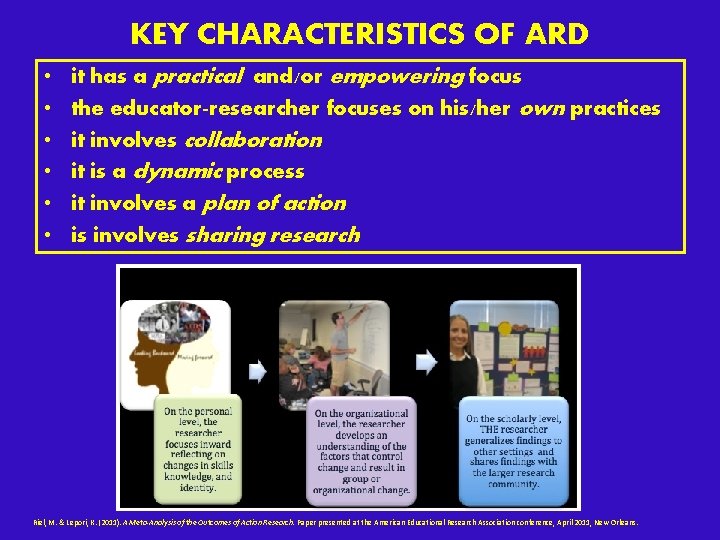
KEY CHARACTERISTICS OF ARD • • • it has a practical and/or empowering focus the educator-researcher focuses on his/her own practices it involves collaboration it is a dynamic process it involves a plan of action is involves sharing research Riel, M. & Lepori, K. (2011). A Meta-Analysis of the Outcomes of Action Research. Paper presented at the American Educational Research Association conference, April 2011, New Orleans.
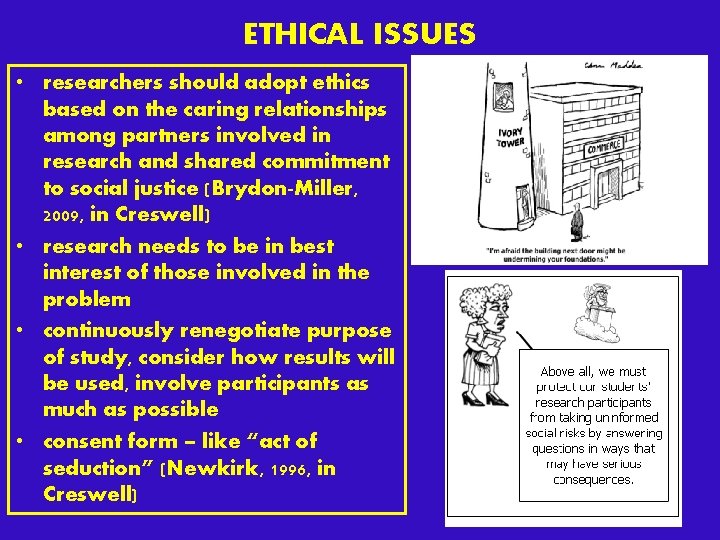
ETHICAL ISSUES • researchers should adopt ethics based on the caring relationships among partners involved in research and shared commitment to social justice (Brydon-Miller, 2009, in Creswell) • research needs to be in best interest of those involved in the problem • continuously renegotiate purpose of study, consider how results will be used, involve participants as much as possible • consent form – like “act of seduction” (Newkirk, 1996, in Creswell)
EVALUATING AN ARD STUDY The researcher: q Identifies a practical issue or a societal/community issue q Uses multiple sources of data: qualitative/quantitative q Works with others to achieve the best outcomes q Creates working relationships whereby all are equal partners as opposed to participants q Comes up with and implements an action plan to address an issue q Reflective component for the initiating researcher q Seeks to empower by solving a problem or facilitating individuals’ ability to solve their own problems q Reporting is done in a way that is has utility for those practitioners Creswell, J. (2012) Educational Research. Boston: Pearson Education, Inc.
OUR THOUGHTS ON ARD Gabrielle: • Efficient way for teachers to implement change in their own classroom (practical action research) • Cost-effective, time-saving – research is done directly with the people, and in the location, it will affect • Small-scale research project, with a specific focus, undertaken directly in the school community • A viable alternative to traditional types of research; more appropriate type of research for the classroom/school environment
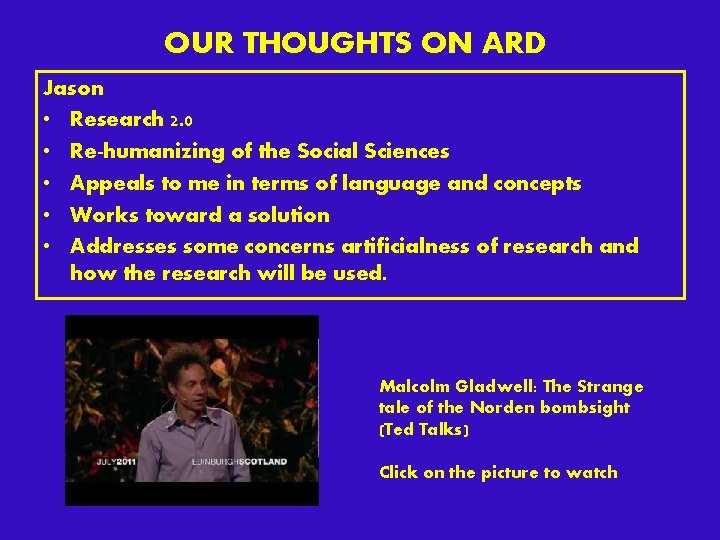
OUR THOUGHTS ON ARD Jason • Research 2. 0 • Re-humanizing of the Social Sciences • Appeals to me in terms of language and concepts • Works toward a solution • Addresses some concerns artificialness of research and how the research will be used. Malcolm Gladwell: The Strange tale of the Norden bombsight (Ted Talks) Click on the picture to watch
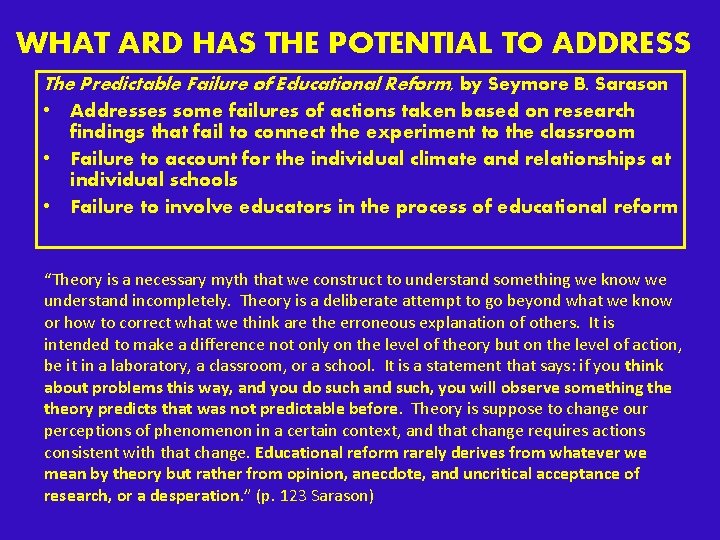
WHAT ARD HAS THE POTENTIAL TO ADDRESS The Predictable Failure of Educational Reform, by Seymore B. Sarason • Addresses some failures of actions taken based on research findings that fail to connect the experiment to the classroom • Failure to account for the individual climate and relationships at individual schools • Failure to involve educators in the process of educational reform “Theory is a necessary myth that we construct to understand something we know we understand incompletely. Theory is a deliberate attempt to go beyond what we know or how to correct what we think are the erroneous explanation of others. It is intended to make a difference not only on the level of theory but on the level of action, be it in a laboratory, a classroom, or a school. It is a statement that says: if you think about problems this way, and you do such and such, you will observe something theory predicts that was not predictable before. Theory is suppose to change our perceptions of phenomenon in a certain context, and that change requires actions consistent with that change. Educational reform rarely derives from whatever we mean by theory but rather from opinion, anecdote, and uncritical acceptance of research, or a desperation. ” (p. 123 Sarason)
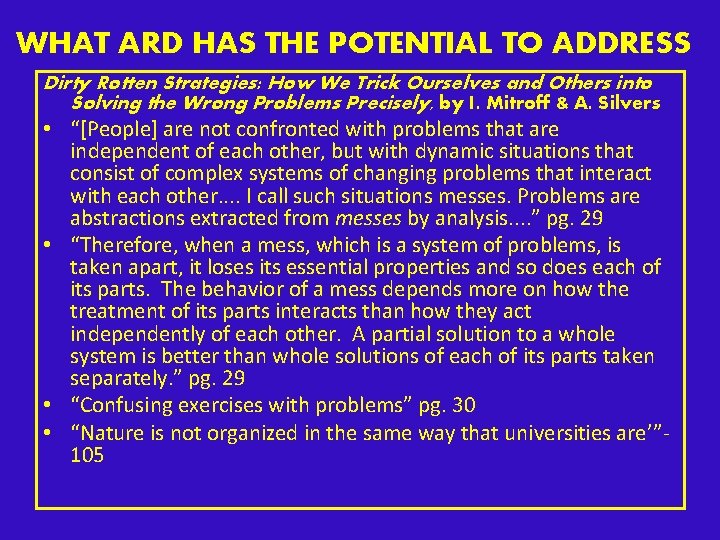
WHAT ARD HAS THE POTENTIAL TO ADDRESS Dirty Rotten Strategies: How We Trick Ourselves and Others into Solving the Wrong Problems Precisely, by I. Mitroff & A. Silvers • “[People] are not confronted with problems that are independent of each other, but with dynamic situations that consist of complex systems of changing problems that interact with each other. . I call such situations messes. Problems are abstractions extracted from messes by analysis. . ” pg. 29 • “Therefore, when a mess, which is a system of problems, is taken apart, it loses its essential properties and so does each of its parts. The behavior of a mess depends more on how the treatment of its parts interacts than how they act independently of each other. A partial solution to a whole system is better than whole solutions of each of its parts taken separately. ” pg. 29 • “Confusing exercises with problems” pg. 30 • “Nature is not organized in the same way that universities are’” 105
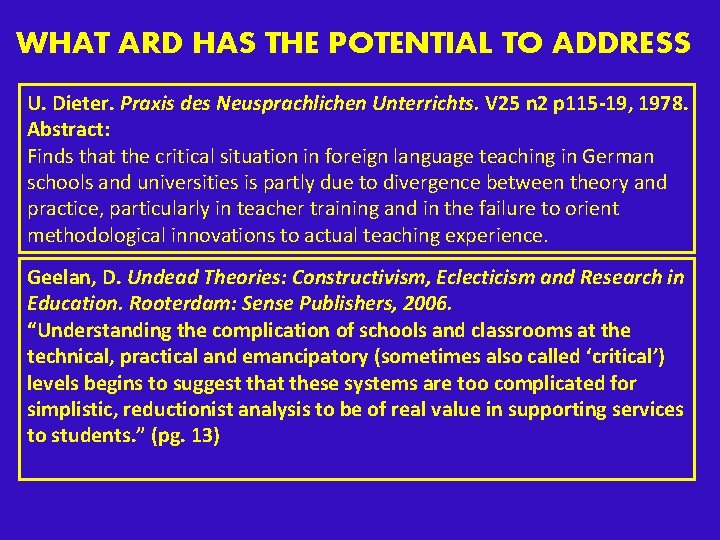
WHAT ARD HAS THE POTENTIAL TO ADDRESS U. Dieter. Praxis des Neusprachlichen Unterrichts. V 25 n 2 p 115 -19, 1978. Abstract: Finds that the critical situation in foreign language teaching in German schools and universities is partly due to divergence between theory and practice, particularly in teacher training and in the failure to orient methodological innovations to actual teaching experience. Geelan, D. Undead Theories: Constructivism, Eclecticism and Research in Education. Rooterdam: Sense Publishers, 2006. “Understanding the complication of schools and classrooms at the technical, practical and emancipatory (sometimes also called ‘critical’) levels begins to suggest that these systems are too complicated for simplistic, reductionist analysis to be of real value in supporting services to students. ” (pg. 13)
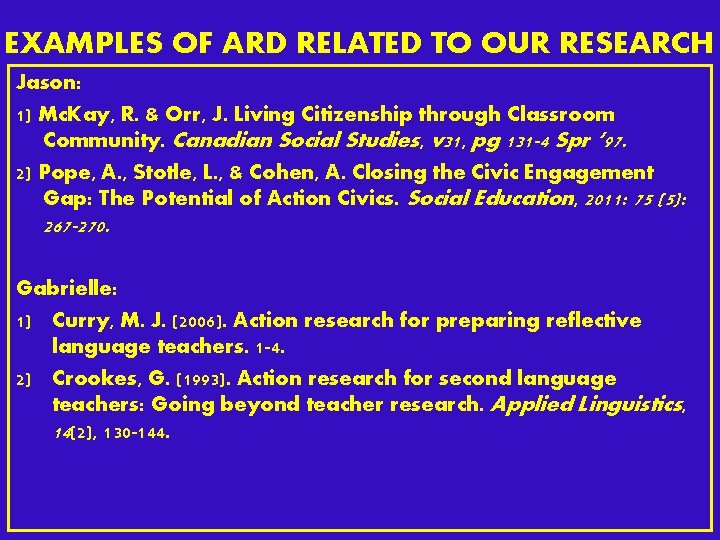
EXAMPLES OF ARD RELATED TO OUR RESEARCH Jason: 1) Mc. Kay, R. & Orr, J. Living Citizenship through Classroom Community. Canadian Social Studies, v 31, pg 131 -4 Spr ‘ 97. 2) Pope, A. , Stotle, L. , & Cohen, A. Closing the Civic Engagement Gap: The Potential of Action Civics. Social Education, 2011: 75 (5): 267 -270. Gabrielle: 1) Curry, M. J. (2006). Action research for preparing reflective language teachers. 1 -4. 2) Crookes, G. (1993). Action research for second language teachers: Going beyond teacher research. Applied Linguistics, 14(2), 130 -144.
DISCUSSION & ACTIVITY: (PICK ONE GROUP MEMBER’S RESEARCH AREA) 1. What are some practical issues in education or societal/community problems that prevent teachers/students from being empowered as they relate to your area of research? 2. If you were to use ARD methodology to address the problem related to your current research interest what would that look like? How would it differ from what you are currently planning? 3. What would the strengths and weaknesses of using ARD methodology to research your area of interest? 4. What ideas from ARD could you incorporate into your existing research plan?