
Action Preparation Task and Situation Characteristics Influencing Preparation
- Slides: 17
Action Preparation
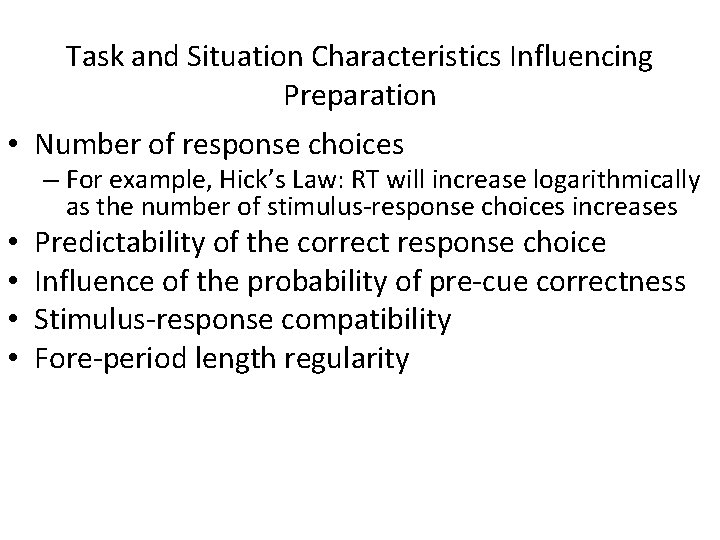
Task and Situation Characteristics Influencing Preparation • Number of response choices – For example, Hick’s Law: RT will increase logarithmically as the number of stimulus-response choices increases • • Predictability of the correct response choice Influence of the probability of pre-cue correctness Stimulus-response compatibility Fore-period length regularity
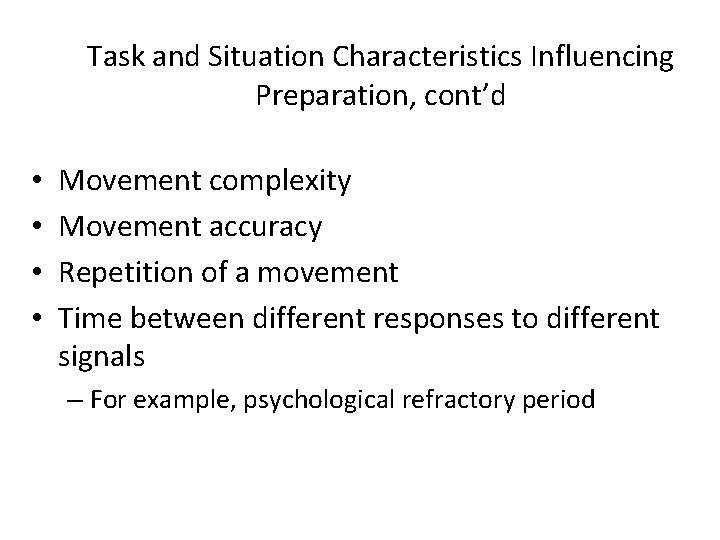
Task and Situation Characteristics Influencing Preparation, cont’d • • Movement complexity Movement accuracy Repetition of a movement Time between different responses to different signals – For example, psychological refractory period
Performer Characteristics Influencing Preparation • Factors that influence the process of action preparation – Alertness of the performer – Attention focused on the signal vs. the movement
What Occurs During Preparation? • Motor control activities that occur during the preparation of action are: – Postural organization – Limb performance characteristics – Object control characteristics
What Occurs During Preparation? , cont’d • Motor control activities that occur during the preparation of action are: – Sequences of simple movements – Spatial coding – Movement rhythmicity
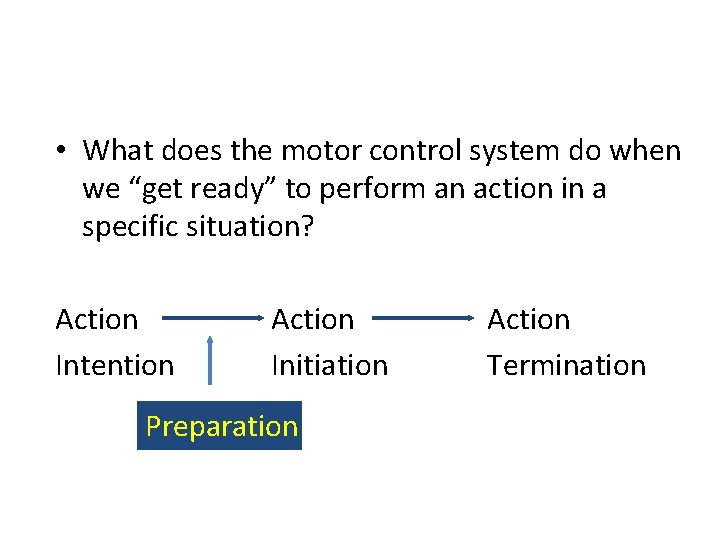
• What does the motor control system do when we “get ready” to perform an action in a specific situation? Action Intention Action Initiation Preparation Action Termination
Action Preparation Requires Time • Donders (1868), Dutch physician, began the research that demonstrated the need for time for the motor control system to prepare to produce an intended action • RT (reaction time) is the commonly used index of the preparation time required to produce action – Based on findings showing that RT is influenced by many performance situation and performer characteristics
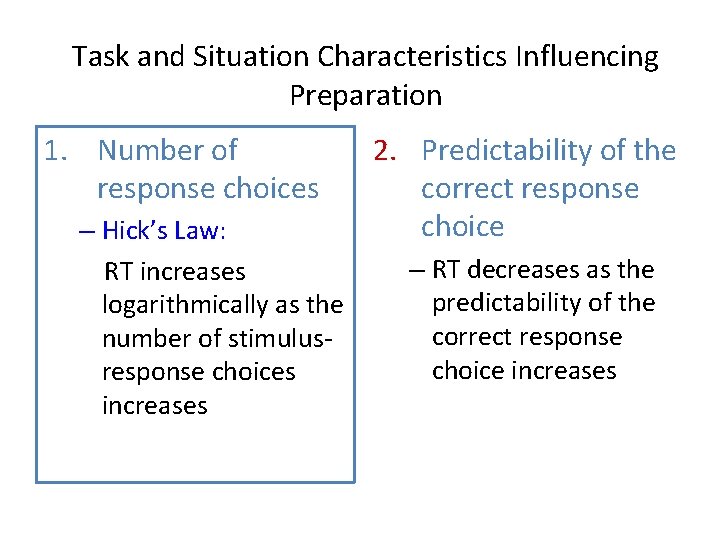
Task and Situation Characteristics Influencing Preparation 1. Number of response choices – Hick’s Law: RT increases logarithmically as the number of stimulusresponse choices increases 2. Predictability of the correct response choice – RT decreases as the predictability of the correct response choice increases
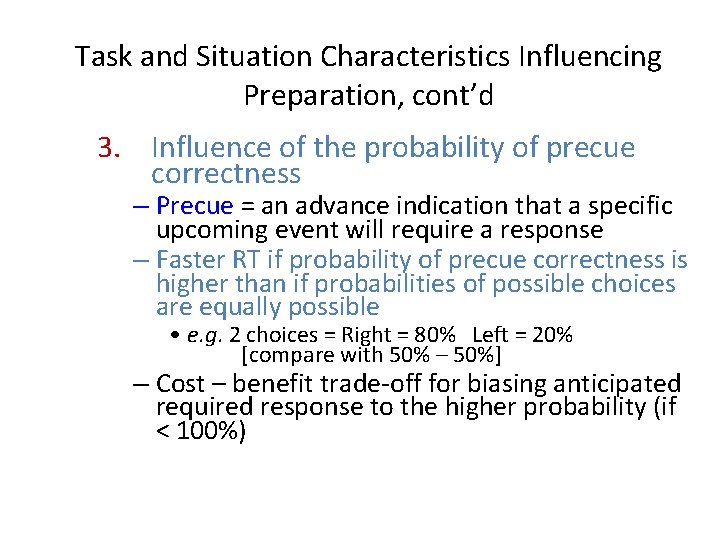
Task and Situation Characteristics Influencing Preparation, cont’d 3. Influence of the probability of precue correctness – Precue = an advance indication that a specific upcoming event will require a response – Faster RT if probability of precue correctness is higher than if probabilities of possible choices are equally possible • e. g. 2 choices = Right = 80% Left = 20% [compare with 50% – 50%] – Cost – benefit trade-off for biasing anticipated required response to the higher probability (if < 100%)
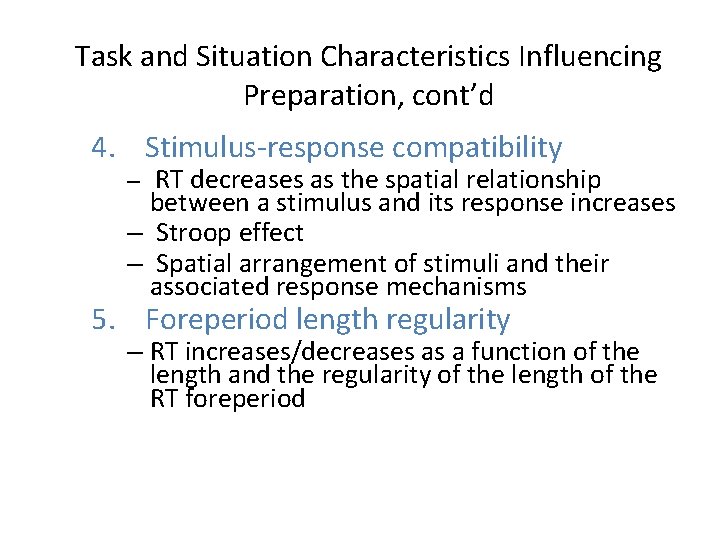
Task and Situation Characteristics Influencing Preparation, cont’d 4. Stimulus-response compatibility – RT decreases as the spatial relationship between a stimulus and its response increases – Stroop effect – Spatial arrangement of stimuli and their associated response mechanisms 5. Foreperiod length regularity – RT increases/decreases as a function of the length and the regularity of the length of the RT foreperiod
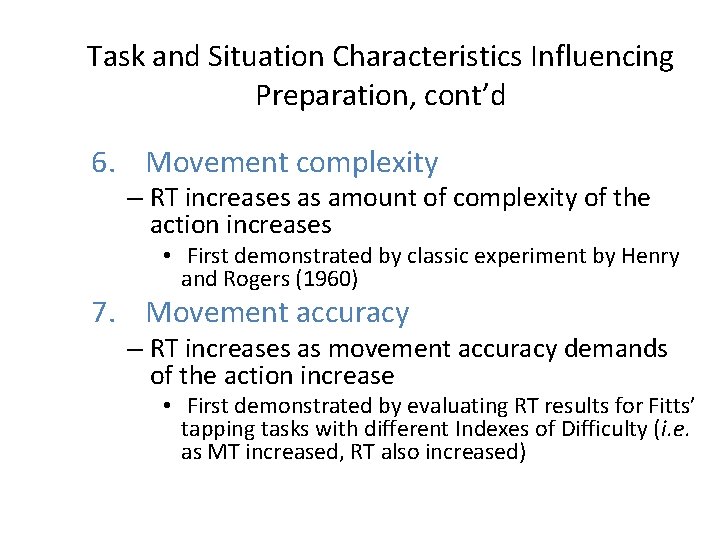
Task and Situation Characteristics Influencing Preparation, cont’d 6. Movement complexity – RT increases as amount of complexity of the action increases • First demonstrated by classic experiment by Henry and Rogers (1960) 7. Movement accuracy – RT increases as movement accuracy demands of the action increase • First demonstrated by evaluating RT results for Fitts’ tapping tasks with different Indexes of Difficulty (i. e. as MT increased, RT also increased)
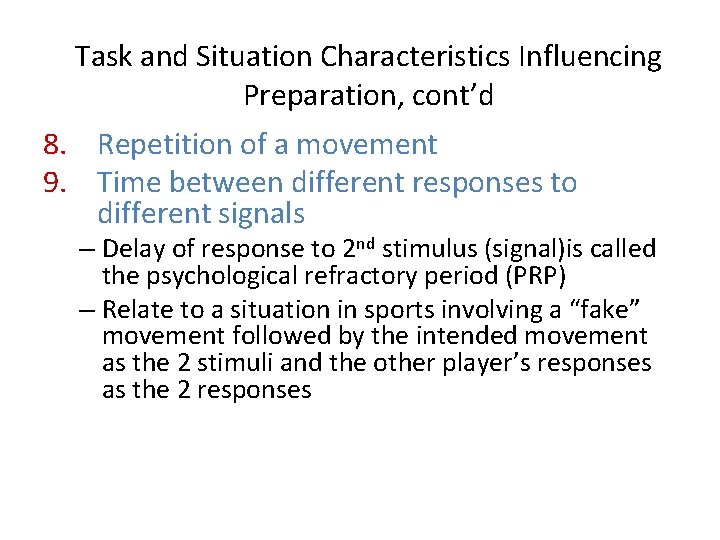
Task and Situation Characteristics Influencing Preparation, cont’d 8. Repetition of a movement 9. Time between different responses to different signals – Delay of response to 2 nd stimulus (signal)is called the psychological refractory period (PRP) – Relate to a situation in sports involving a “fake” movement followed by the intended movement as the 2 stimuli and the other player’s responses as the 2 responses
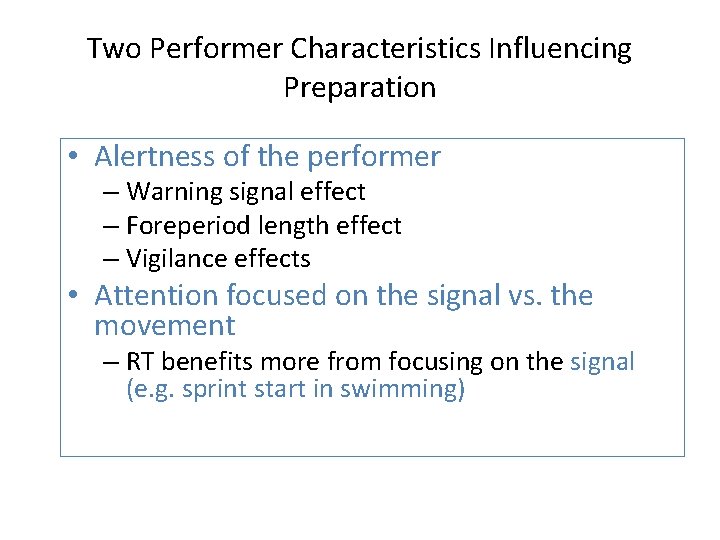
Two Performer Characteristics Influencing Preparation • Alertness of the performer – Warning signal effect – Foreperiod length effect – Vigilance effects • Attention focused on the signal vs. the movement – RT benefits more from focusing on the signal (e. g. sprint start in swimming)
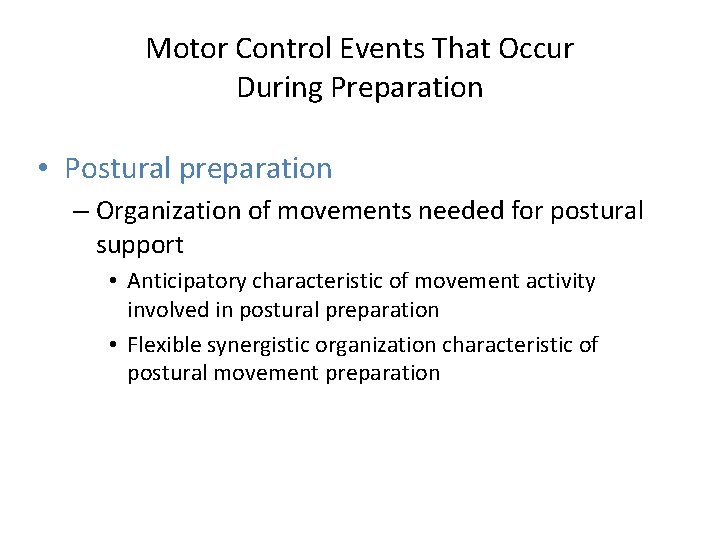
Motor Control Events That Occur During Preparation • Postural preparation – Organization of movements needed for postural support • Anticipatory characteristic of movement activity involved in postural preparation • Flexible synergistic organization characteristic of postural movement preparation
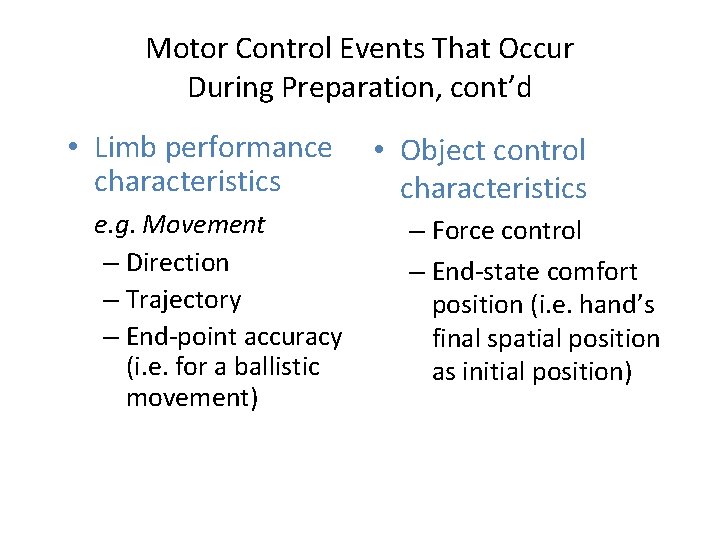
Motor Control Events That Occur During Preparation, cont’d • Limb performance characteristics e. g. Movement – Direction – Trajectory – End-point accuracy (i. e. for a ballistic movement) • Object control characteristics – Force control – End-state comfort position (i. e. hand’s final spatial position as initial position)
Motor Control Events That Occur During Preparation, cont’d • Sequences of movements • Rhythmicity preparation • Spatial coding – Evidence from S-R compatibility research