
Action potential nerve conduction By Dr Mahmoud Elshazly
Action potential & nerve conduction By Dr. Mahmoud El-shazly Lecturer of physical therapy South valley university
BASIC ELECTROPHYSIOLOGICAL TERMS Excitability: The ability of the cell to generate the action potential Excitable cells: Cells that generate action potential during excitation. in excitable cells (muscle, nerve, secretery cells), the action potential is the marker of excitation.
Stimulus: a sudden change of the (internal or external) environmental condition of the cell. includes physical and chemical stimulus. The electrical stimulus is often used for the physiological research.

Threshold (intensity): the lowest or minimal intensity of stimulus to elicit an action potential (Three factors of the stimulation: intensity, duration, rate of intensity change

Types of stimulus: Threshold stimulus: The stimulus with the intensity equal to threshold Subthreshold stimulus: The stimulus with the intensity weaker than the threshold Suprathreshold stimulus: The stimulus with the intensity greater than the threshold.
Functions of action potentials Action potentials support two important functions in different cells: they convey (propagate) information between and along excitable cells – a process known as conduction they initiate cellular events
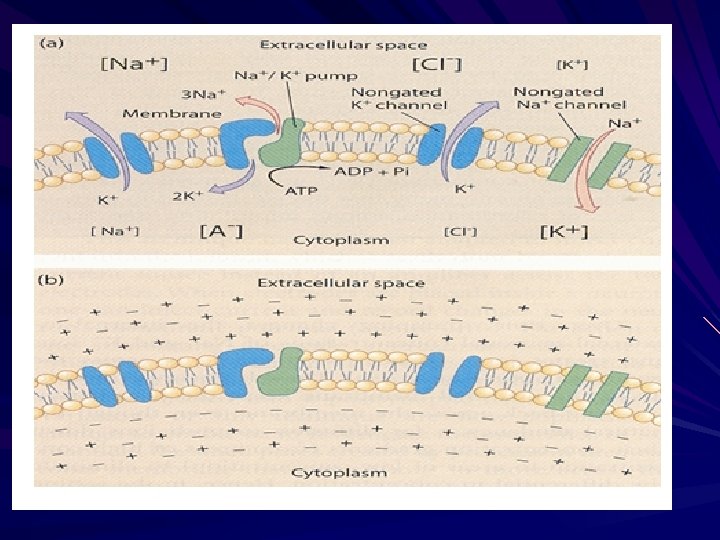
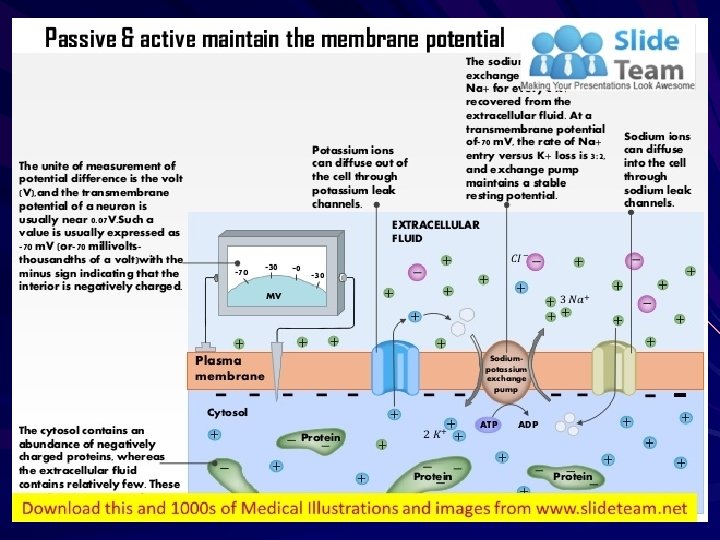
Resting membrane potential Definition It is membrane potential during rest. This achieved by : 1 - selective permeability. 2 - Active Na-K pump.
Resting membrane potential
Selective permeability of the membrane -It a passive process. -It contribute to -86 mv of RMP. - Ions: Main ions inside the nerve : K, protein, organic PO 4, SO 4 Main ions outside the nerve: Na. Cl & HCO 3
Potassium- sodium leak channels It is protein in nature. Non gated channel. 100 times more permeable to K than to Na Rowe JW, Kahn RL (1997). "Successful ageing". Gerontologist 37 (4): 433– 40.
Movement of ions across channels K ions: • Move from inside to outside by concentration gradient. • Move from outside to inside by electrical gradient. So K ions continues until the +ve charges on the outer surface prevent further efflux of K ions and a state of equilibrium is reached. • Strawbridge WJ, Wallhagen MI, Cohen RD (2002). "Successful ageing and well-being: self-rated compared with Rowe and Kahn". Gerontologist 42 (6): 727– 33
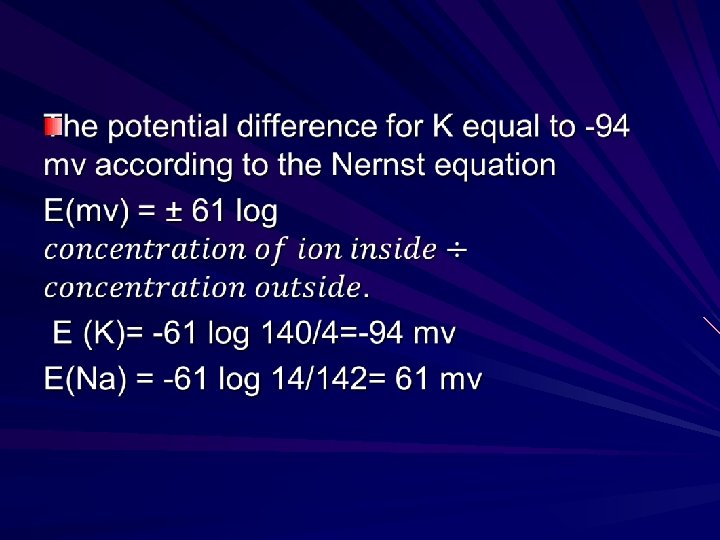
Because the K concentration is great inside a nerve fiber membrane but very low outside the membrane. Let us assume that the membrane in this instance is permeable to K ions but not to any other ions. So, there is a strong tendency for extra numbers of K ions to diffuse outward through the membrane. Within a millisecond the difference between the inside and out side called diffusion potential, become great enough to block further K diffusion to the exterior, despite the high K ion concentration gradient.
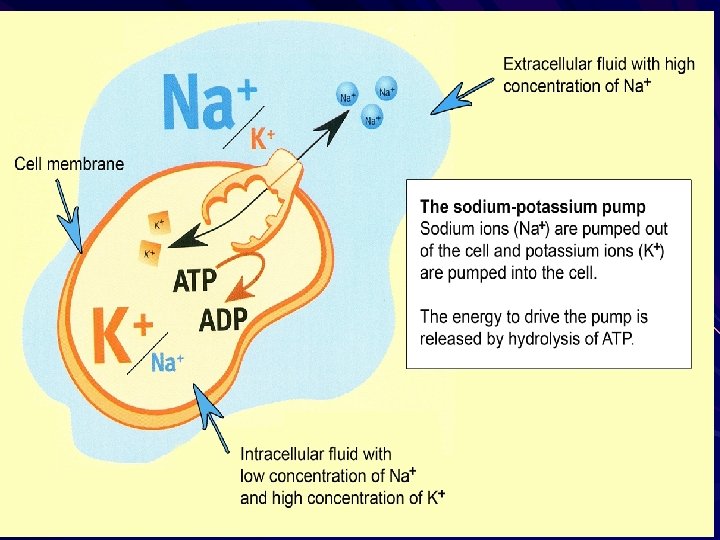
2 - Na-K pump - Active process - It contribute -4 m. V of RMP - Na ions which enter the nerve fiber pumped out against concentration and electrical gradient. - K ions which pass out the nerve fibers are pumped in against concentration gradient. AM J Public Health 2007; 97: 330 -6 Clin Rehabil 2005; 19; 677
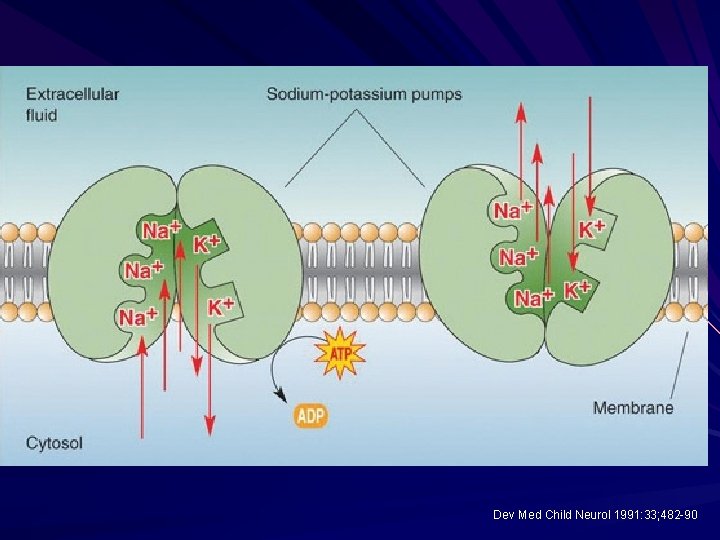
Mechanism of Na-K pump It needs a protein carrier which has 3 characters: 1 - 3 binding sites for Na ions on the inner side. 2 - two binding sites for K ions on the outer side. 3 - inner part has got an ATPase activity. When all binding sites are saturated, the ATPase is activated and energy is liberated which causes in the shape of the carrier protein so Na is pumped out and K pumped in.
Importance of Na-K pump 1 - it keep Na ions outside & K ions inside the cell. 2 - RMP it help to make the outer surface more +ve Dev Med Child Neurol 1991: 33; 482 -90
Dev Med Child Neurol 1991: 33; 482 -90
Dev Med Child Neurol 1991: 33; 482 -90
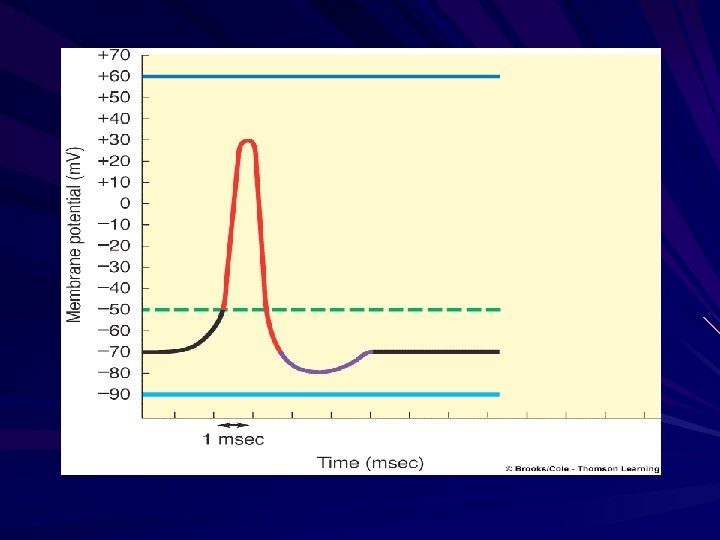
Action Potential Gating Mechanisms Depolarization : During the rising phase, the nerve cell membrane becomes more permeable to sodium; as a consequence, the membrane potential begins to shift more toward the equilibrium potential for sodium. However, before the membrane potential reaches ENa, sodium permeability begins to decrease and potassium permeability increases
When the membrane is depolarized, these channels begin to open. The Na channel quickly opens its activation gate and allows Na ions to flow into the cell. The influx of positively charged Na ions causes the membrane to depolarize. In fact, the membrane potential actually reverses, with the inside becoming positive; this is called the overshoot.
In the initial stage of the action potential, more Na than K channels are opened because the K channels open more slowly in response to depolarization. This increase in Na permeability compared to that of K causes the membrane potential to move toward the equilibrium potential for Na.
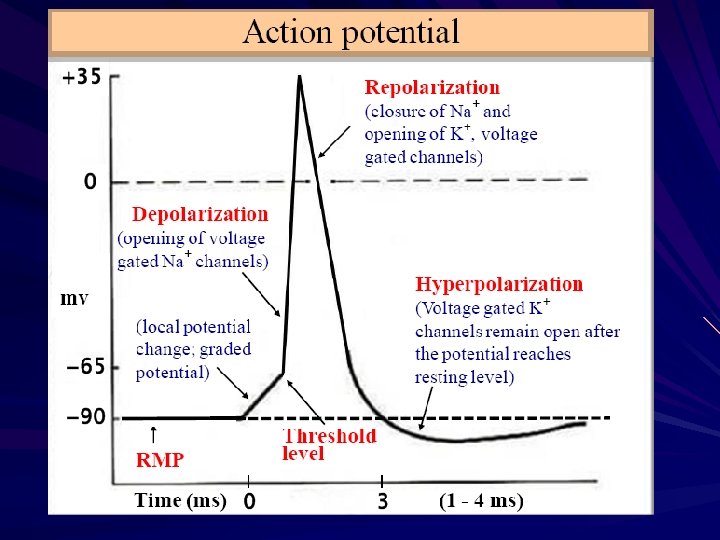
Repolarization At the peak of the action potential, the sodium conductance begins to fall as an inactivation gate closes. Also, more K channels open, allowing more positively charged K ions to leave the neuron. The net effect of inactivating Na channels and opening additional K channels is the repolarization of the membrane.
afterhyperpolarization As the membrane continues to repolarize, the membrane potential becomes more negative than its resting level. This afterhyperpolarization is a result of K channels remaining open, allowing the continued efflux of K ions. Another way to think about afterhyperpolarization is that the membrane’s permeability to K is higher than when the neuron is at rest. Consequently, the membrane potential is driven even more toward the K equilibrium potential.
Summary The changes in membrane potential during an action potential result from selective alterations in membrane conductance (see Fig. 3. 4 B). These membrane conductance changes reflect the summated activity of individual voltage- gated sodium and potassium ion channels. From the temporal relationship of the action potential and the membrane conductance changes, the depolarization and rising phase of the action potential can be attributed to the increase in sodium ion conductance, the repolarization phases to both the decrease in sodium conductance and the increase in potassium conductance, and afterhyperpolarization to the sustained increase of potassium conductance.
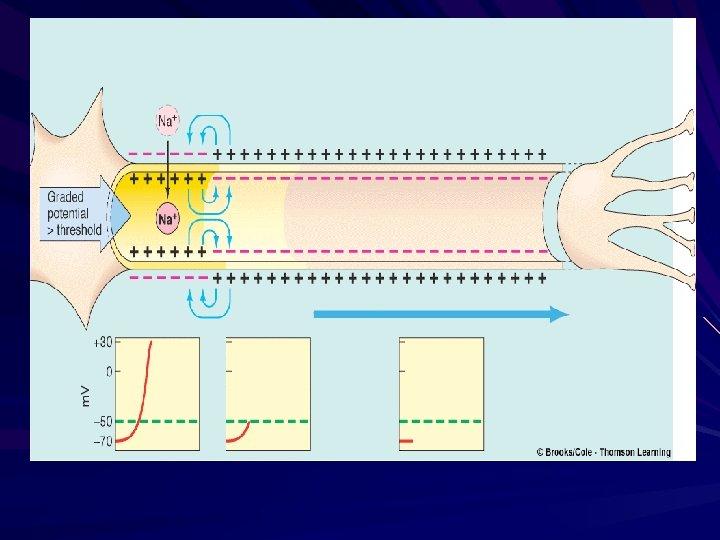
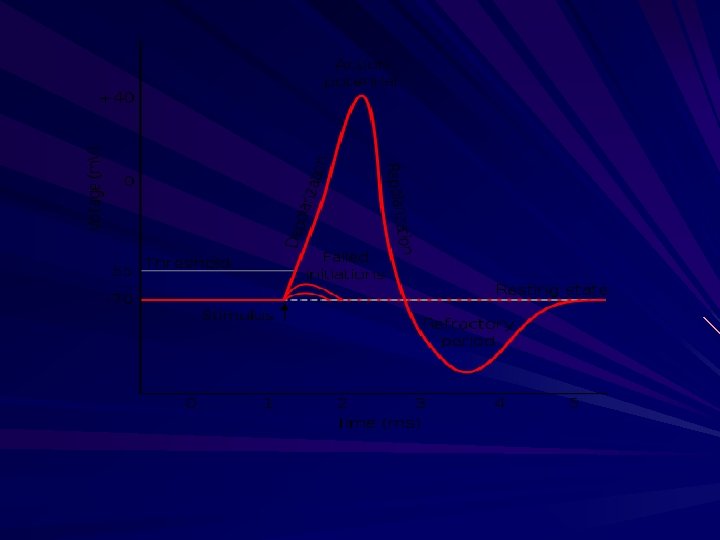

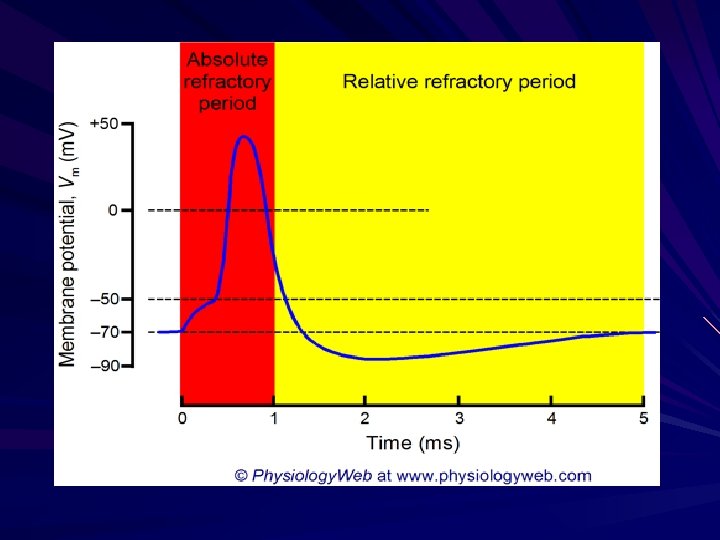
Refractory period Refractory Periods. After the start of an action potential, there are periods when the initiation of additional action potentials requires a greater degree of depolarization and when action potentials cannot be initiated at all. These are called the relative and absolute refractory periods, respectively. The inability of a neuronal membrane to generate an action potential during the absolute refractory period is primarily due to the state of the voltage-gated Na channel. After the inactivation gate closes during the repolarization phase of an action potential, it remains closed for some time; therefore, another action potential cannot be generated no matter how much the membrane is depolarized.
The importance of the absolute refractory period is that it limits the rate of firing of action potentials. The absolute refractory period also prevents action potentials from traveling in the wrong direction along the axon.
In the relative refractory period, the inactivation gate of a portion of the voltagegated Na channels is open. Since these channels have returned to their initial resting state, they can now respond to depolarizations of the membrane The K channels are maintained in the open state during the relative refractory period, leading to membrane hyperpolarization. By these two mechanisms, the action potential threshold is increasedduring the relative refractory period.
Absolute and relative refractory periods. Immediately after the start of an action potential, a nerve cell is incapable of generating another impulse. This is the absolute refractory period. With time, the neuron can generate another action potential, but only at higher levels of depolarization. The period of increased threshold for impulse initiation is the relative refractory period. Note that action potentials initiated during the relative refractory period have lowerthannormal amplitude.

- Slides: 36