
Action Planning Goal Setting KEY PRINCIPLES Best Practice
Action Planning & Goal Setting KEY PRINCIPLES
Best Practice – Action Planning Keys From scores to colleague experiences and emotions. From selecting questions and committing actions to choosing desired actions and linking them back to the questions. From one time creation to continuous creation and feedback process.
Effective Action Planning & Goal Setting Key Principles Cascade from strategic plan (integration) Determine priorities Define what success looks like Set reasonable goals with dialogue Recognize this is a ‘living’ process and not a ‘one and done’ activity
Action Planning & Goal Setting Key Principles Provide adequate time and space Start with the end in mind Involve stakeholders and share ideas Set reasonable expectations Listen
Action Planning & Goal Setting THREE IMPORTANT STEPS
Action Planning & Goal Setting STEP ONE: EXPLORING THE SCORECARD
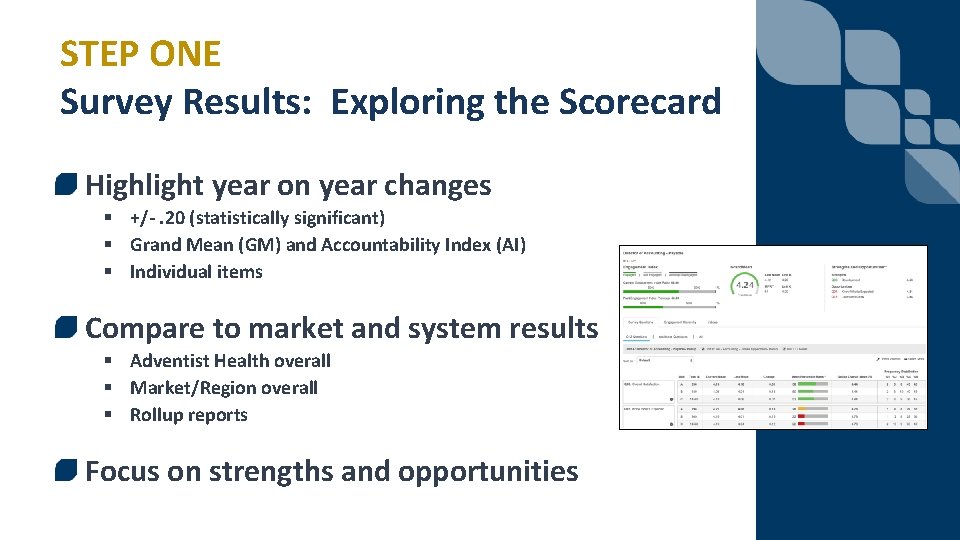
STEP ONE Survey Results: Exploring the Scorecard Highlight year on year changes § +/-. 20 (statistically significant) § Grand Mean (GM) and Accountability Index (AI) § Individual items Compare to market and system results § Adventist Health overall § Market/Region overall § Rollup reports Focus on strengths and opportunities
Action Planning & Goal Setting STEP TWO: ACTION PLANNING PROCESS
STEP TWO Team Meeting: Action Planning Process Identify team 30 -90 day priorities § What is the most important priority? § What challenge or issue need to be addressed if team is going to meet its priority? Create priority list. Link priority(ies) to Q 12 Item § Based on survey results, what item is most relevant to chosen priority? § What one action will the team do to address the challenge to improve the most relevant item? Document action. Every 2 -3 weeks, have a quick check-in: § § What did we do? Did it make any difference? What should be celebrate? What is our next step?
Root Cause Issues for Each Item • Teams can take too simplistic an approach to action planning. • Each of the survey items tends to have 3 -4 underlying, root cause issues that contribute to low scores on that item. • Teams can go through the list for each item and see which root cause issue(s) applies most to them – and then develop their action plan accordingly. • The lists are not meant to be exhaustive. Teams can always identify issues and action steps that are not referenced in this document.
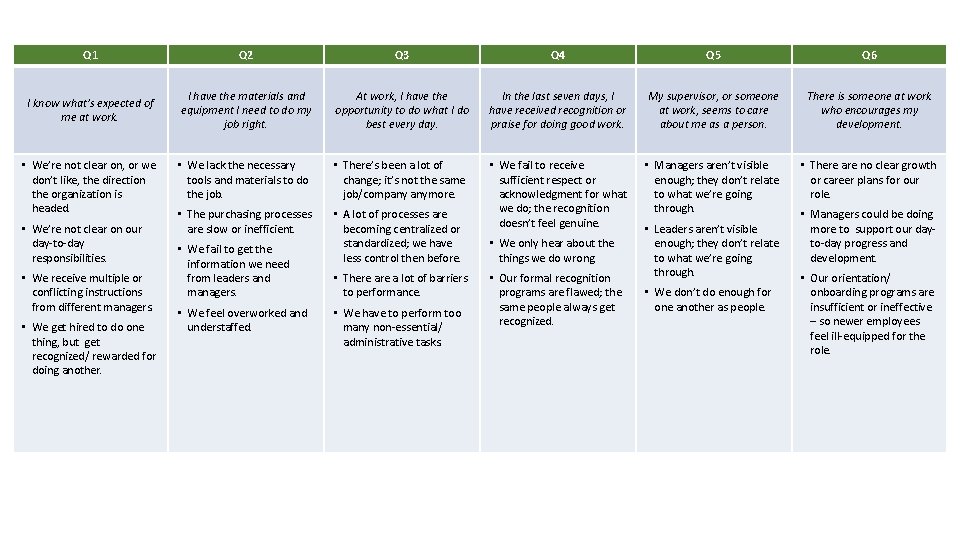
Q 1 Q 2 Q 3 Q 4 Q 5 Q 6 I know what’s expected of me at work. I have the materials and equipment I need to do my job right. At work, I have the opportunity to do what I do best every day. In the last seven days, I have received recognition or praise for doing good work. My supervisor, or someone at work, seems to care about me as a person. There is someone at work who encourages my development. • We lack the necessary tools and materials to do the job. • There’s been a lot of change; it’s not the same job/company anymore. • A lot of processes are becoming centralized or standardized; we have less control then before. • Managers aren’t visible enough; they don’t relate to what we’re going through. • There are no clear growth or career plans for our role. • The purchasing processes are slow or inefficient. • We fail to receive sufficient respect or acknowledgment for what we do; the recognition doesn’t feel genuine. • We’re not clear on, or we don’t like, the direction the organization is headed. Root Cause Issues for each item • We’re not clear on our day-to-day responsibilities. • We receive multiple or conflicting instructions from different managers. • We get hired to do one thing, but get recognized/ rewarded for doing another. • We fail to get the information we need from leaders and managers. • We feel overworked and understaffed. • There a lot of barriers to performance. • We have to perform too many non-essential/ administrative tasks. • We only hear about the things we do wrong. • Our formal recognition programs are flawed; the same people always get recognized. • Leaders aren’t visible enough; they don’t relate to what we’re going through. • We don’t do enough for one another as people. • Managers could be doing more to support our dayto-day progress and development. • Our orientation/ onboarding programs are insufficient or ineffective – so newer employees feel ill-equipped for the role.
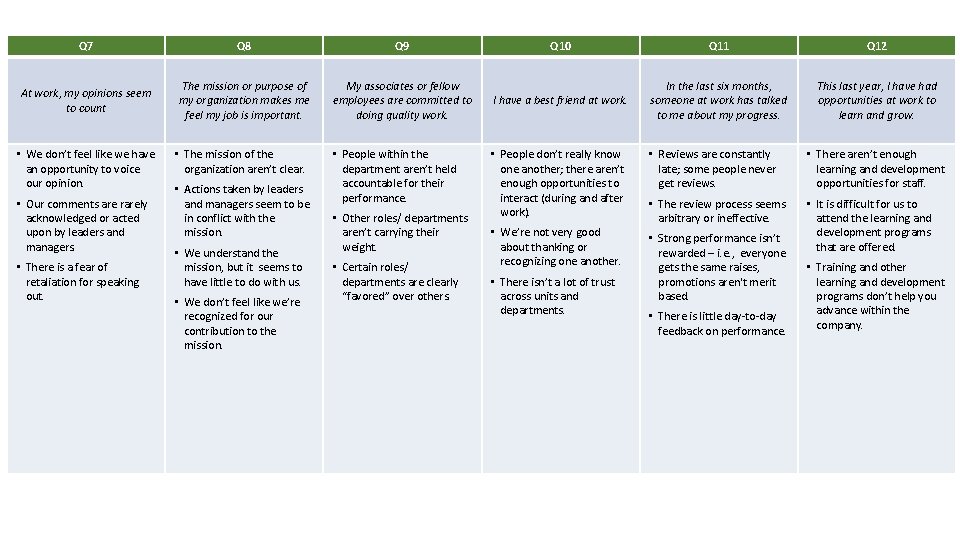
Q 7 Q 8 Q 9 At work, my opinions seem to count The mission or purpose of my organization makes me feel my job is important. My associates or fellow employees are committed to doing quality work. • We don’t feel like we have an opportunity to voice our opinion. • Our comments are rarely acknowledged or acted upon by leaders and managers. • The mission of the organization aren’t clear. • Actions taken by leaders and managers seem to be in conflict with the mission. • People within the department aren’t held accountable for their performance. Q 10 Q 11 Q 12 I have a best friend at work. In the last six months, someone at work has talked to me about my progress. This last year, I have had opportunities at work to learn and grow. • People don’t really know one another; there aren’t enough opportunities to interact (during and after work). • Reviews are constantly late; some people never get reviews. • There aren’t enough learning and development opportunities for staff. • We’re not very good about thanking or recognizing one another. • The review process seems arbitrary or ineffective. • Strong performance isn’t rewarded – i. e. , everyone gets the same raises, promotions aren't merit based. • It is difficult for us to attend the learning and development programs that are offered. Root Cause Issues for each item • There is a fear of retaliation for speaking out. • We understand the mission, but it seems to have little to do with us. • We don’t feel like we’re recognized for our contribution to the mission. • Other roles/ departments aren’t carrying their weight. • Certain roles/ departments are clearly “favored” over others. • There isn’t a lot of trust across units and departments. • There is little day-to-day feedback on performance. • Training and other learning and development programs don’t help you advance within the company.
Action Planning & Goal Setting STEP THREE: Key Leadership Actions
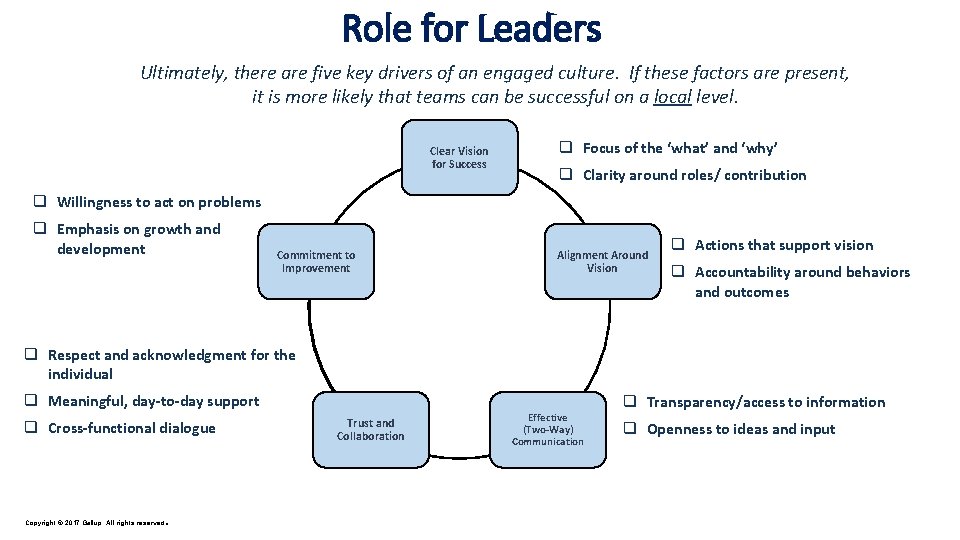
Role for Leaders Ultimately, there are five key drivers of an engaged culture. If these factors are present, it is more likely that teams can be successful on a local level. Clear Vision for Success q Focus of the ‘what’ and ‘why’ q Clarity around roles/ contribution q Willingness to act on problems q Emphasis on growth and development Commitment to Improvement Alignment Around Vision q Actions that support vision q Accountability around behaviors and outcomes q Respect and acknowledgment for the individual q Meaningful, day-to-day support q Cross-functional dialogue Copyright © 2017 Gallup. All rights reserved. Trust and Collaboration Effective (Two-Way) Communication q Transparency/access to information q Openness to ideas and input
Leaders Know Their Team Members What are his or her strengths? What are the triggers that activate those strengths? What is his/her learning styles? How does he/she like to be recognized?
Leaders Connect With Team Members Discuss position and expectations Define performance excellence Explore challenges employee is facing Provide feedback and discuss goals Talk about growth opportunities
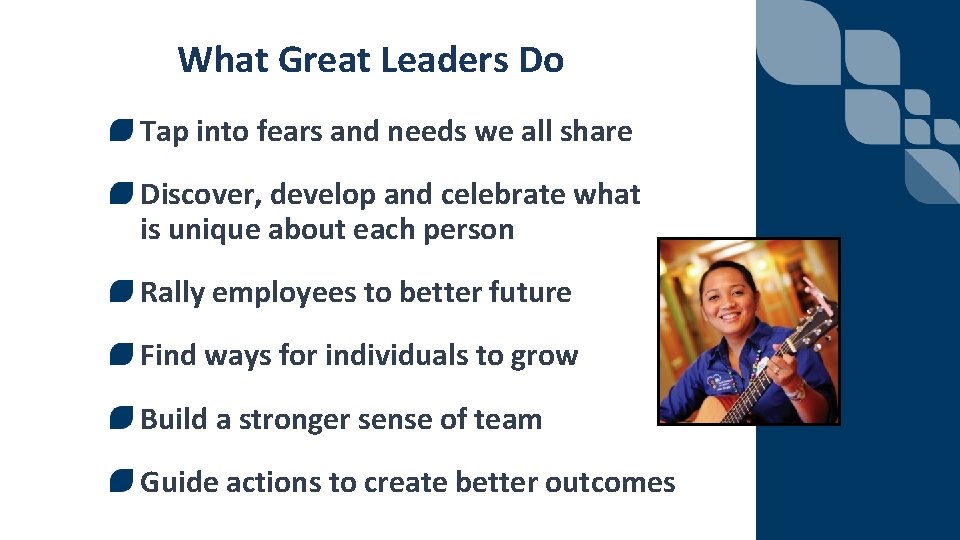
What Great Leaders Do Tap into fears and needs we all share Discover, develop and celebrate what is unique about each person Rally employees to better future Find ways for individuals to grow Build a stronger sense of team Guide actions to create better outcomes
Action Planning & Goal Setting Important Questions Who is the best at communicating/driving action plans? Are the action plans SMART (Specific, Measurable, Attainable, Relevant and Time Bound) and meaningful? Are leaders reviewing and holding people accountable for plans? Are action plans being followed through?
Questions for Leaders To Ask Team Members What does engagement look like in our workgroup? What is affecting our engagement? What initiatives are affecting our engagement? What may I do to help?
Best Practice Model Look At Scorecard Data Results Note Trends and Highs and Lows Hold Regular Team Meetings That Have Engagement Component Create Opportunities to Dialogue About Issues (Move Away From Rote Item Discussions) Implement Continuous Feedback Process
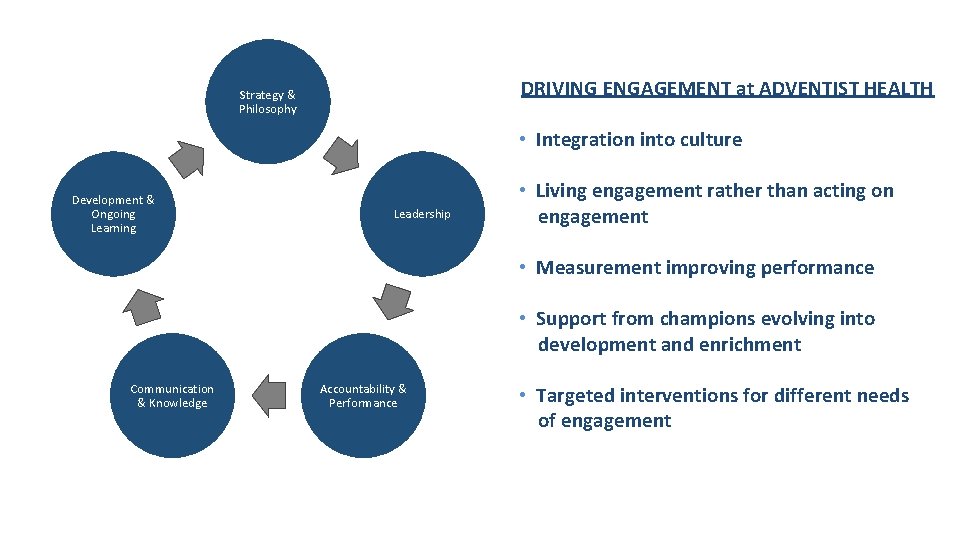
DRIVING ENGAGEMENT at ADVENTIST HEALTH Strategy & Philosophy • Integration into culture Development & Ongoing Learning Leadership • Living engagement rather than acting on engagement • Measurement improving performance • Support from champions evolving into development and enrichment Communication & Knowledge Accountability & Performance • Targeted interventions for different needs of engagement
- Slides: 21