
Action Plan An Example Information Scan for Needs


- Slides: 13
Action Plan An Example
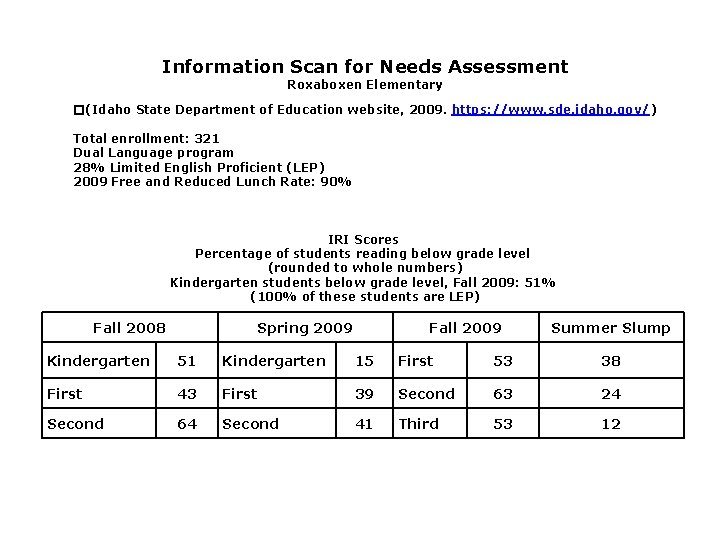
Information Scan for Needs Assessment Roxaboxen Elementary �(Idaho State Department of Education website, 2009. https: //www. sde. idaho. gov/) Total enrollment: 321 Dual Language program 28% Limited English Proficient (LEP) 2009 Free and Reduced Lunch Rate: 90% IRI Scores Percentage of students reading below grade level (rounded to whole numbers) Kindergarten students below grade level, Fall 2009: 51% (100% of these students are LEP) Fall 2008 Spring 2009 Fall 2009 Summer Slump Kindergarten 51 Kindergarten 15 First 53 38 First 43 First 39 Second 63 24 Second 64 Second 41 Third 53 12
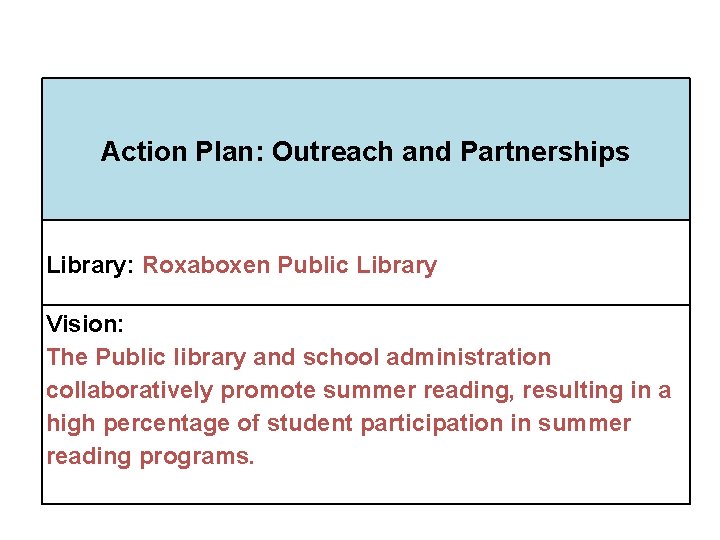
Action Plan: Outreach and Partnerships Library: Roxaboxen Public Library Vision: The Public library and school administration collaboratively promote summer reading, resulting in a high percentage of student participation in summer reading programs.
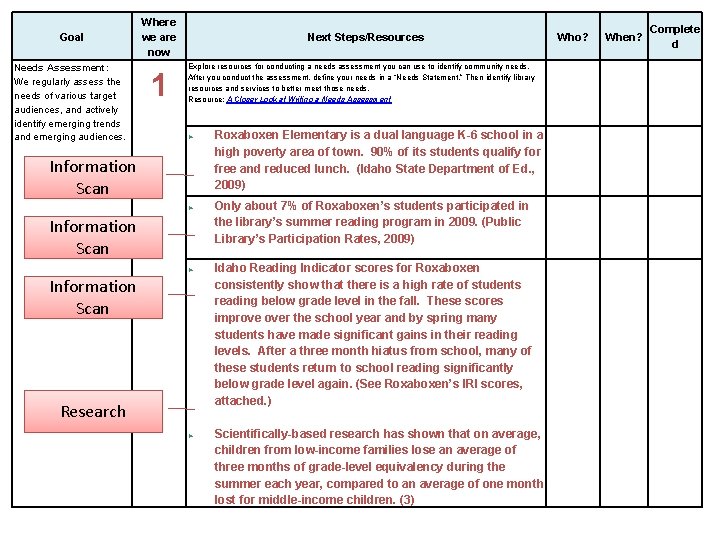
Goal Needs Assessment: We regularly assess the needs of various target audiences, and actively identify emerging trends and emerging audiences. Where we are now 1 Next Steps/Resources Explore resources for conducting a needs assessment you can use to identify community needs. After you conduct the assessment, define your needs in a “Needs Statement. ” Then identify library resources and services to better meet those needs. Resource: A Closer Look at Writing a Needs Assessment ► Information Scan Research ► Roxaboxen Elementary is a dual language K-6 school in a high poverty area of town. 90% of its students qualify for free and reduced lunch. (Idaho State Department of Ed. , 2009) Only about 7% of Roxaboxen’s students participated in the library’s summer reading program in 2009. (Public Library’s Participation Rates, 2009) Idaho Reading Indicator scores for Roxaboxen consistently show that there is a high rate of students reading below grade level in the fall. These scores improve over the school year and by spring many students have made significant gains in their reading levels. After a three month hiatus from school, many of these students return to school reading significantly below grade level again. (See Roxaboxen’s IRI scores, attached. ) Scientifically-based research has shown that on average, children from low-income families lose an average of three months of grade-level equivalency during the summer each year, compared to an average of one month lost for middle-income children. (3) Who? When? Complete d
Needs Assessment Statements Continued… ► Research Resources/Services The academic gap between rich and poor children, as measured by test scores, increases throughout the elementary school years. Summer losses in achievement add up year by year and seem to be the major reason why the academic gap between low- and high-income children grows throughout the elementary school years. Since the losses are largest in the summers of the first three to four years of school, preventing these losses, particularly over the first few summers, could make the gap much smaller. (5) [Note: This age group is the primary target audience of public library summer reading programs, having the most attendance and appeal. In Idaho’s statewide summer reading program, all age groups, from preschool to teenagers are included, but elementary aged children make up the most enthusiastic and easy-to-reach population. ] (5) Suggestions for effective ways to reach the neediest youth include: Form partnerships with the schools Form partnerships with community groups and services that reach the disadvantaged Make programs accessible and convenient for parents Involve the parents Involve volunteers Make learning fun for everyone. (5) ► Library resources: Library’s Summer Reading program; ICFL’s Bright Futures opportunities: School Visits, Underserved and Read for Your Library; Library Staff for
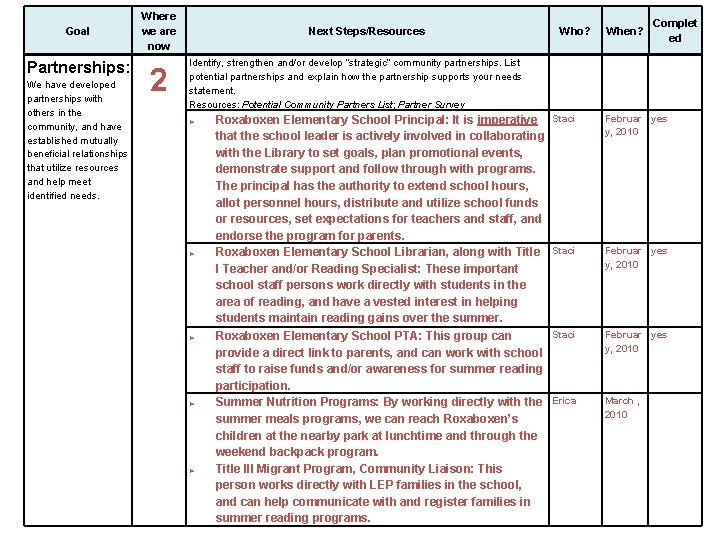
Goal Partnerships: We have developed partnerships with others in the community, and have established mutually beneficial relationships that utilize resources and help meet identified needs. Where we are now 2 Next Steps/Resources Who? When? Complet ed Identify, strengthen and/or develop “strategic” community partnerships. List potential partnerships and explain how the partnership supports your needs statement. Resources: Potential Community Partners List; Partner Survey ► ► ► Roxaboxen Elementary School Principal: It is imperative that the school leader is actively involved in collaborating with the Library to set goals, plan promotional events, demonstrate support and follow through with programs. The principal has the authority to extend school hours, allot personnel hours, distribute and utilize school funds or resources, set expectations for teachers and staff, and endorse the program for parents. Roxaboxen Elementary School Librarian, along with Title I Teacher and/or Reading Specialist: These important school staff persons work directly with students in the area of reading, and have a vested interest in helping students maintain reading gains over the summer. Roxaboxen Elementary School PTA: This group can provide a direct link to parents, and can work with school staff to raise funds and/or awareness for summer reading participation. Summer Nutrition Programs: By working directly with the summer meals programs, we can reach Roxaboxen’s children at the nearby park at lunchtime and through the weekend backpack program. Title III Migrant Program, Community Liaison: This person works directly with LEP families in the school, and can help communicate with and register families in summer reading programs. Staci Februar yes y, 2010 Erica March , 2010
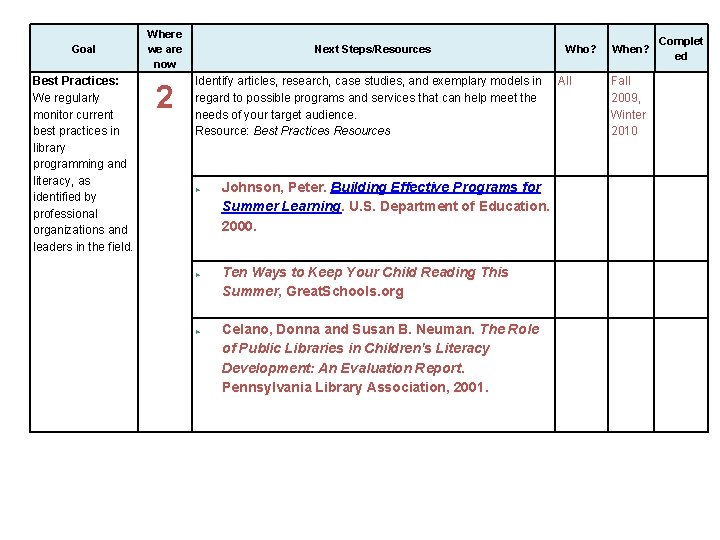
Goal Best Practices: We regularly monitor current best practices in library programming and literacy, as identified by professional organizations and leaders in the field. Where we are now 2 Next Steps/Resources Identify articles, research, case studies, and exemplary models in regard to possible programs and services that can help meet the needs of your target audience. Resource: Best Practices Resources ► ► ► Johnson, Peter. Building Effective Programs for Summer Learning. U. S. Department of Education. 2000. Ten Ways to Keep Your Child Reading This Summer, Great. Schools. org Celano, Donna and Susan B. Neuman. The Role of Public Libraries in Children's Literacy Development: An Evaluation Report. Pennsylvania Library Association, 2001. Who? All When? Fall 2009, Winter 2010 Complet ed
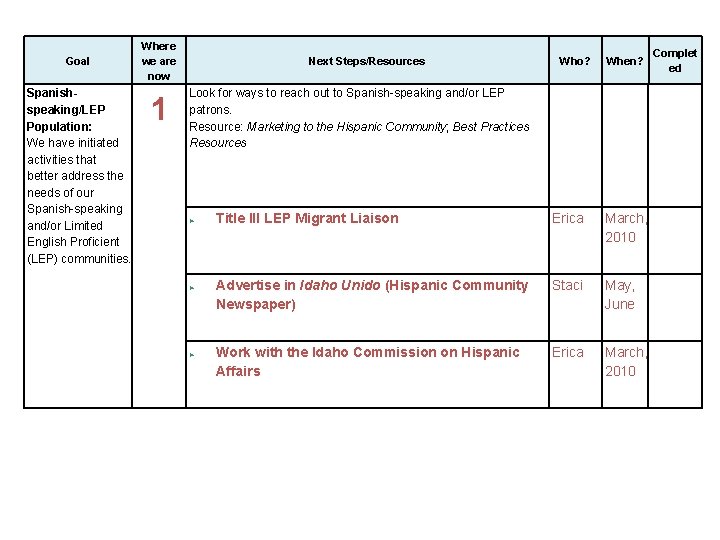
Goal Spanishspeaking/LEP Population: We have initiated activities that better address the needs of our Spanish-speaking and/or Limited English Proficient (LEP) communities. Where we are now 1 Next Steps/Resources Who? When? Look for ways to reach out to Spanish-speaking and/or LEP patrons. Resource: Marketing to the Hispanic Community; Best Practices Resources ► ► ► Title III LEP Migrant Liaison Erica March, 2010 Advertise in Idaho Unido (Hispanic Community Newspaper) Staci May, June Work with the Idaho Commission on Hispanic Affairs Erica March, 2010 Complet ed
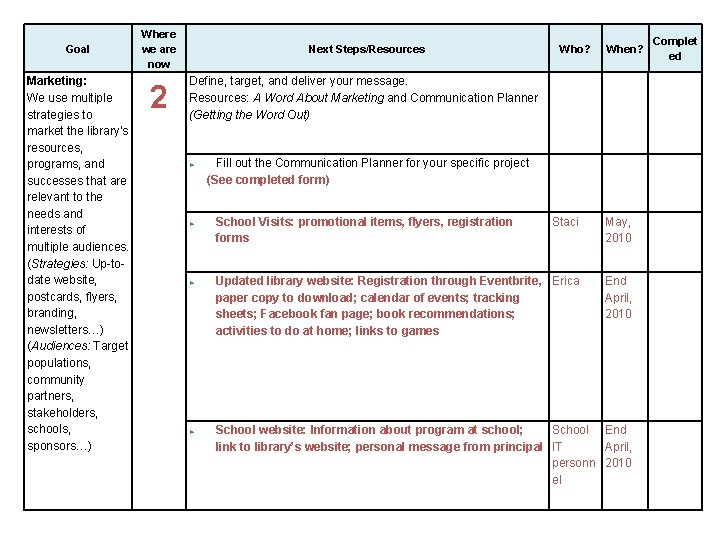
Goal Marketing: We use multiple strategies to market the library’s resources, programs, and successes that are relevant to the needs and interests of multiple audiences. (Strategies: Up-todate website, postcards, flyers, branding, newsletters…) (Audiences: Target populations, community partners, stakeholders, schools, sponsors…) Where we are now 2 Next Steps/Resources Who? When? Define, target, and deliver your message. Resources: A Word About Marketing and Communication Planner (Getting the Word Out) ► ► Fill out the Communication Planner for your specific project (See completed form) School Visits: promotional items, flyers, registration forms Staci May, 2010 Updated library website: Registration through Eventbrite, Erica paper copy to download; calendar of events; tracking sheets; Facebook fan page; book recommendations; activities to do at home; links to games End April, 2010 School website: Information about program at school; School End link to library’s website; personal message from principal IT April, personn 2010 el Complet ed
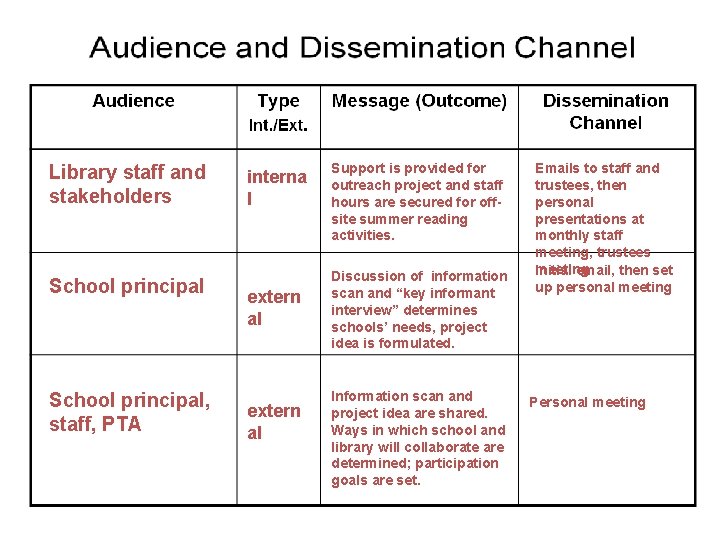
Library staff and stakeholders School principal, staff, PTA interna l extern al Support is provided for outreach project and staff hours are secured for offsite summer reading activities. Discussion of information scan and “key informant interview” determines schools’ needs, project idea is formulated. Information scan and project idea are shared. Ways in which school and library will collaborate are determined; participation goals are set. Emails to staff and trustees, then personal presentations at monthly staff meeting, trustees meeting Initial email, then set up personal meeting Personal meeting
Marketing Continued… Roxaboxen families and children Community Stakeholders extern al More families register and participate in summer reading program. extern al Recognition of summer reading grant project sponsor (if awarded), importance of summer reading is conveyed. Interna l/exter nal Stakeholders are provided with data from the project that show the project was successful. School newsletter, Family Liaison, on-site registration during school event, Idaho Unido, school library website Press release, possible PR event at school Personal presentation to trustees, press release
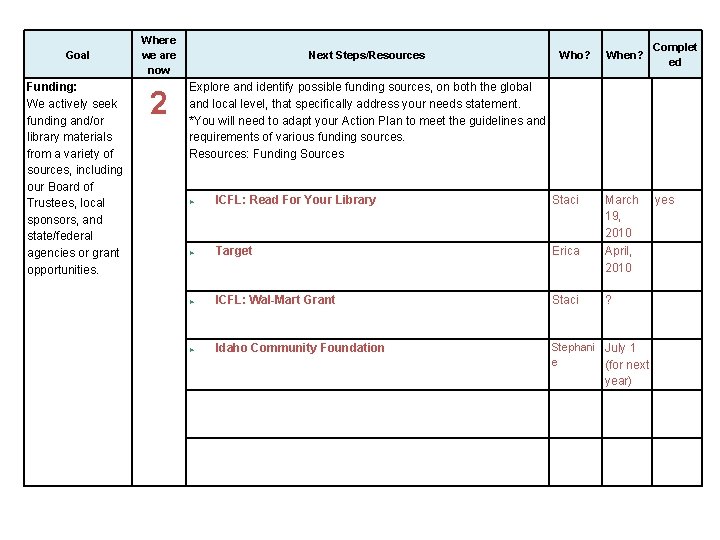
Goal Funding: We actively seek funding and/or library materials from a variety of sources, including our Board of Trustees, local sponsors, and state/federal agencies or grant opportunities. Where we are now 2 Next Steps/Resources Who? When? Complet ed Explore and identify possible funding sources, on both the global and local level, that specifically address your needs statement. *You will need to adapt your Action Plan to meet the guidelines and requirements of various funding sources. Resources: Funding Sources ► ICFL: Read For Your Library Staci March 19, 2010 ► Target Erica April, 2010 ► ICFL: Wal-Mart Grant Staci ? ► Idaho Community Foundation Stephani July 1 e (for next year) yes
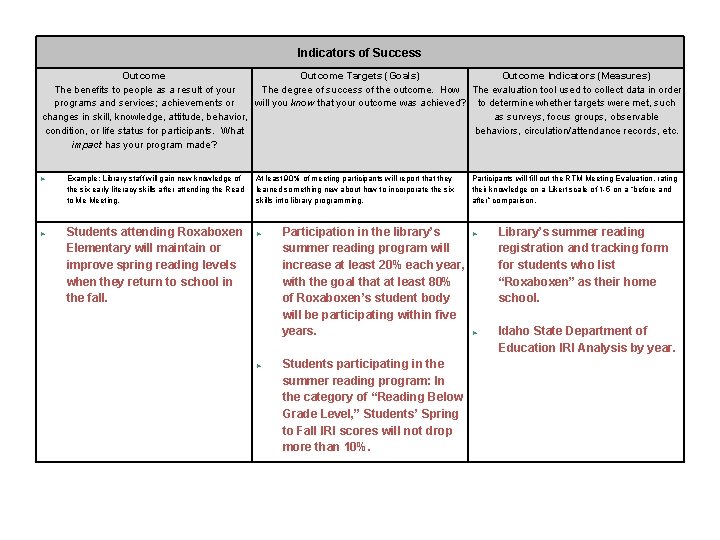
Indicators of Success Outcome Targets (Goals) Outcome Indicators (Measures) The benefits to people as a result of your The degree of success of the outcome. How The evaluation tool used to collect data in order programs and services; achievements or will you know that your outcome was achieved? to determine whether targets were met, such changes in skill, knowledge, attitude, behavior, as surveys, focus groups, observable condition, or life status for participants. What behaviors, circulation/attendance records, etc. impact has your program made? ► ► Example: Library staff will gain new knowledge of the six early literacy skills after attending the Read to Me Meeting. Students attending Roxaboxen Elementary will maintain or improve spring reading levels when they return to school in the fall. At least 90% of meeting participants will report that they learned something new about how to incorporate the six skills into library programming. ► ► Participation in the library’s summer reading program will increase at least 20% each year, with the goal that at least 80% of Roxaboxen’s student body will be participating within five years. Students participating in the summer reading program: In the category of “Reading Below Grade Level, ” Students’ Spring to Fall IRI scores will not drop more than 10%. Participants will fill out the RTM Meeting Evaluation, rating their knowledge on a Likert scale of 1 -5 on a “before and after” comparison. ► ► Library’s summer reading registration and tracking form for students who list “Roxaboxen” as their home school. Idaho State Department of Education IRI Analysis by year.