
Acting Planning and Learning Using Hierarchical Operational Models

![References [10] Sunandita Patra, James Mason, Amit Kumar, Malik Ghallab, Dana Nau, Paolo Traverso.](https://slidetodoc.com/presentation_image_h2/a52cce1c0fe03b7443dc2d1dd681c63c/image-55.jpg "References [10] Sunandita Patra, James Mason, Amit Kumar, Malik Ghallab, Dana Nau, Paolo Traverso.")
- Slides: 55
Acting, Planning, and Learning Using Hierarchical Operational Models Invited talk: NSWC, IHD December 3, 2020 Sunandita Patra Post-Doctoral Researcher University of Maryland, College Park Collaborators: Dana Nau, Malik Ghallab, Paolo Traverso, James Mason, Amit Kumar 1/54
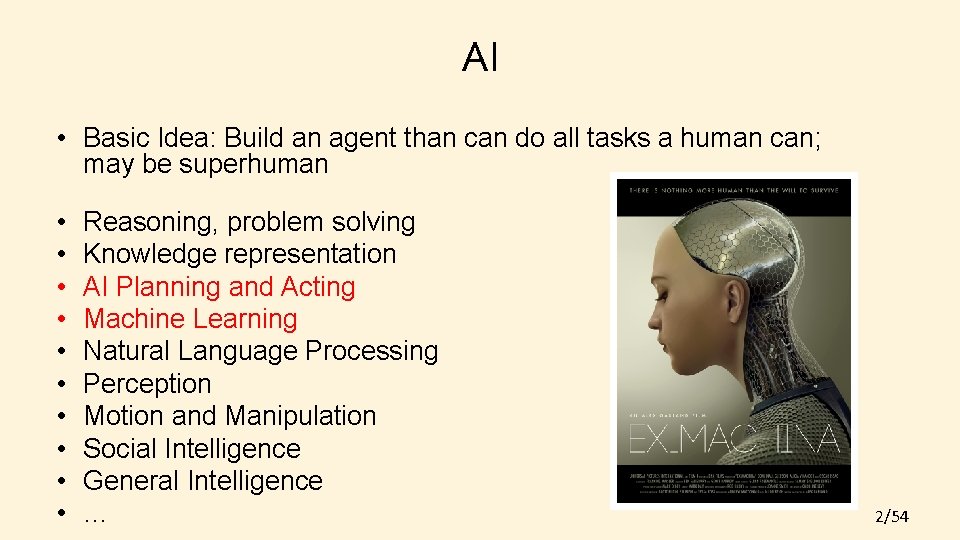
AI • Basic Idea: Build an agent than can do all tasks a human can; may be superhuman • • • Reasoning, problem solving Knowledge representation AI Planning and Acting Machine Learning Natural Language Processing Perception Motion and Manipulation Social Intelligence General Intelligence … 2/54
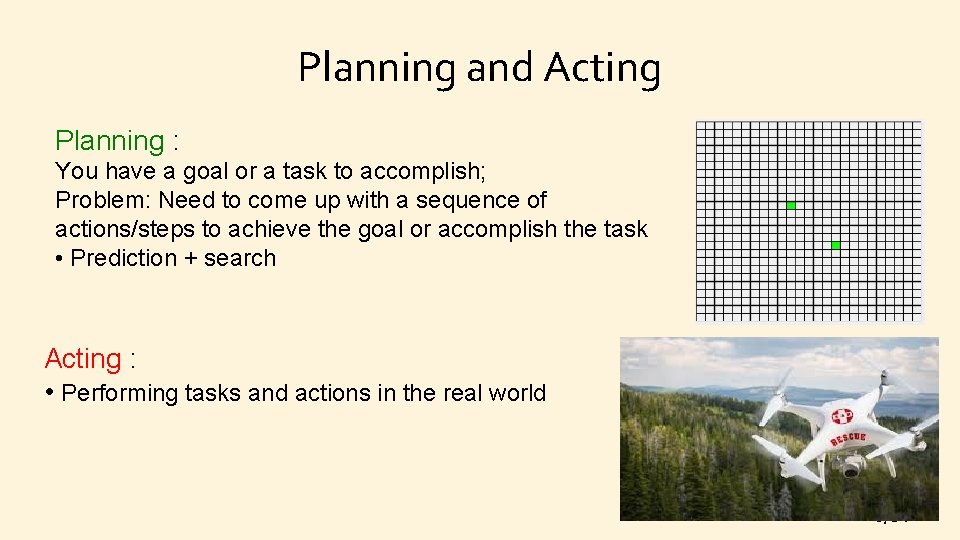
Planning and Acting Planning : You have a goal or a task to accomplish; Problem: Need to come up with a sequence of actions/steps to achieve the goal or accomplish the task • Prediction + search Acting : • Performing tasks and actions in the real world 3/54
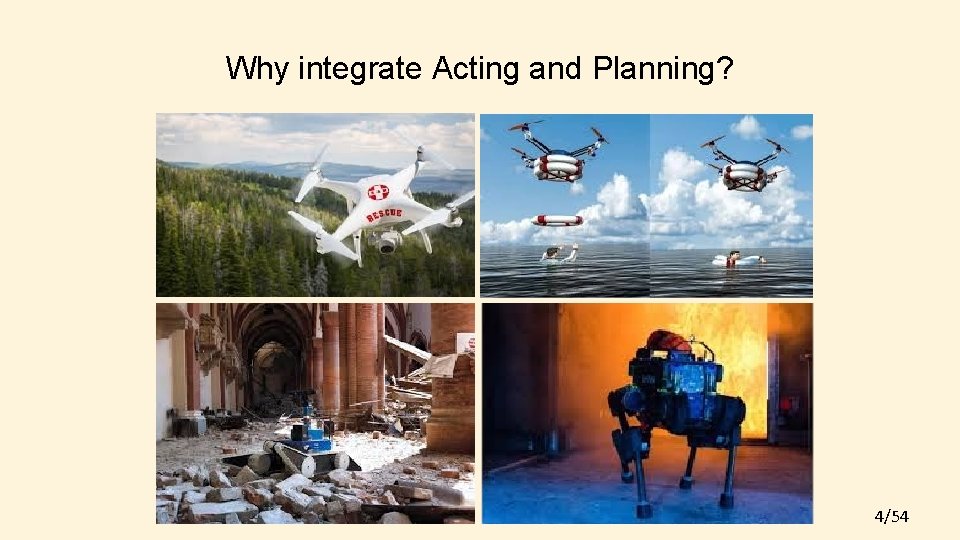
Why integrate Acting and Planning? 4/54
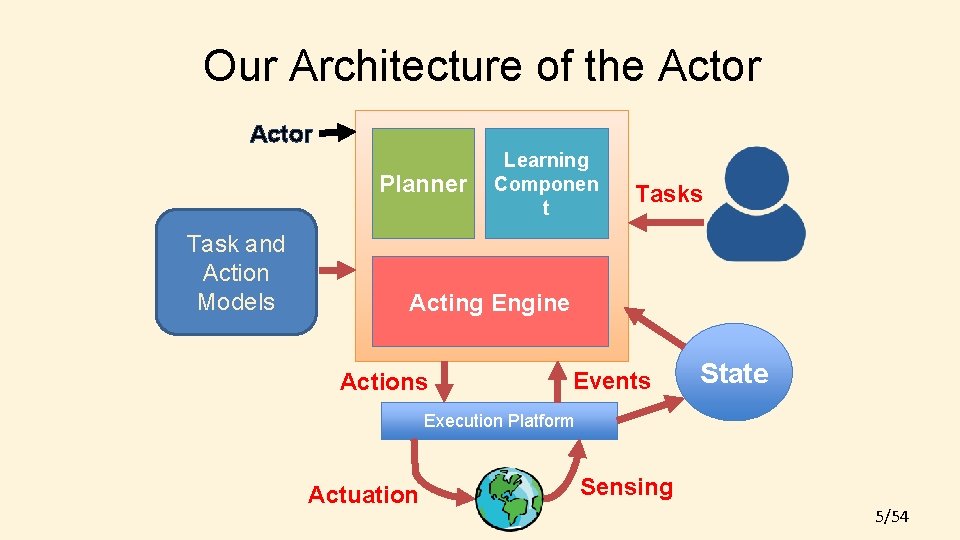
Our Architecture of the Actor Planner Task and Action Models Learning Componen t Tasks Acting Engine Actions Events State Execution Platform Actuation Sensing 5/54
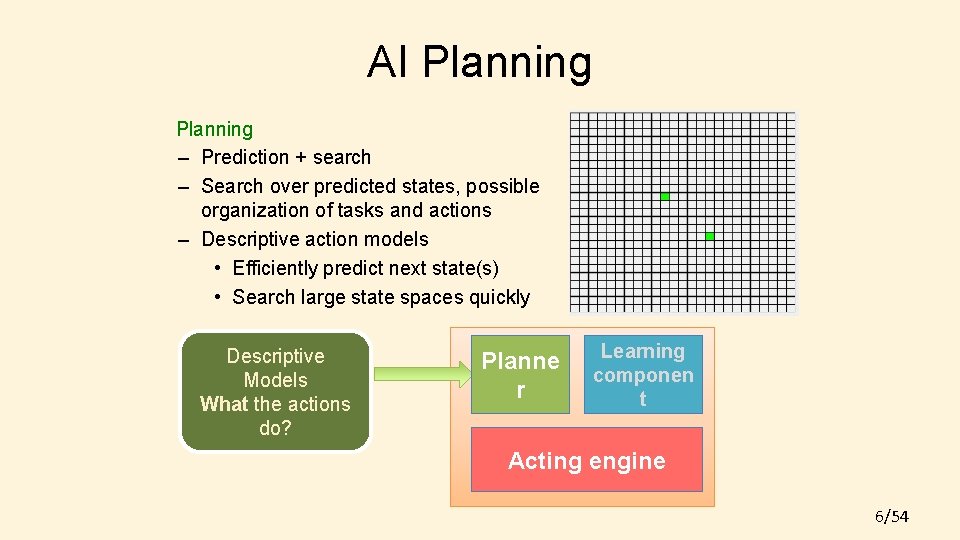
AI Planning – Prediction + search – Search over predicted states, possible organization of tasks and actions – Descriptive action models • Efficiently predict next state(s) • Search large state spaces quickly Descriptive Models What the actions do? Planne r Learning componen t Acting engine 6/54
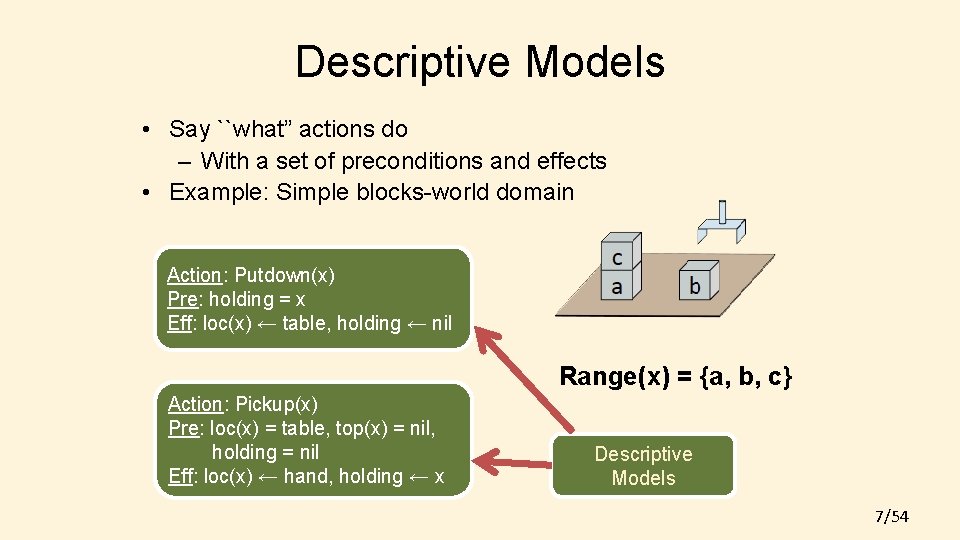
Descriptive Models • Say ``what” actions do – With a set of preconditions and effects • Example: Simple blocks-world domain Action: Putdown(x) Pre: holding = x Eff: loc(x) ← table, holding ← nil Range(x) = {a, b, c} Action: Pickup(x) Pre: loc(x) = table, top(x) = nil, holding = nil Eff: loc(x) ← hand, holding ← x Descriptive Models 7/54
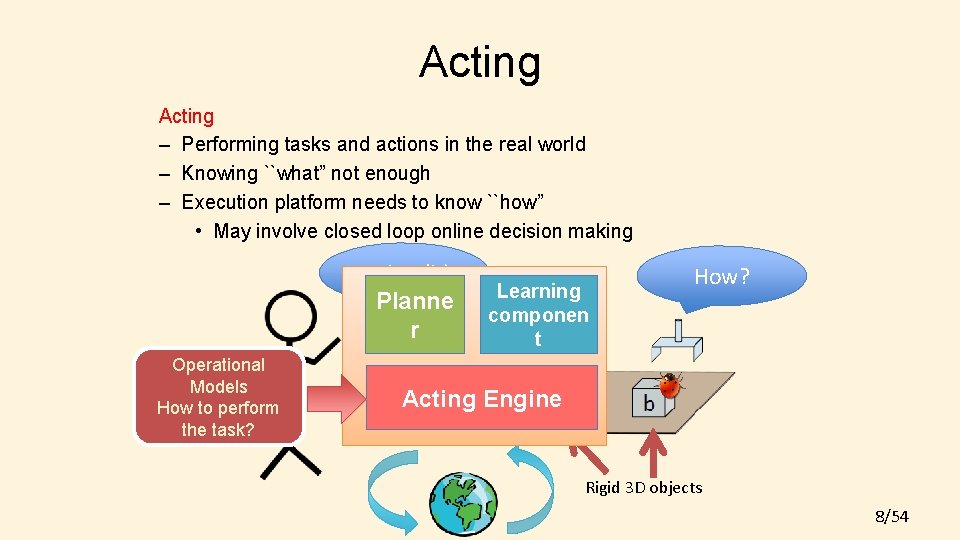
Acting – Performing tasks and actions in the real world – Knowing ``what” not enough – Execution platform needs to know ``how” • May involve closed loop online decision making pickup(b) Planne r Operational Models How to perform the task? Learning componen t How? Acting Engine Rigid 3 D objects 8/54
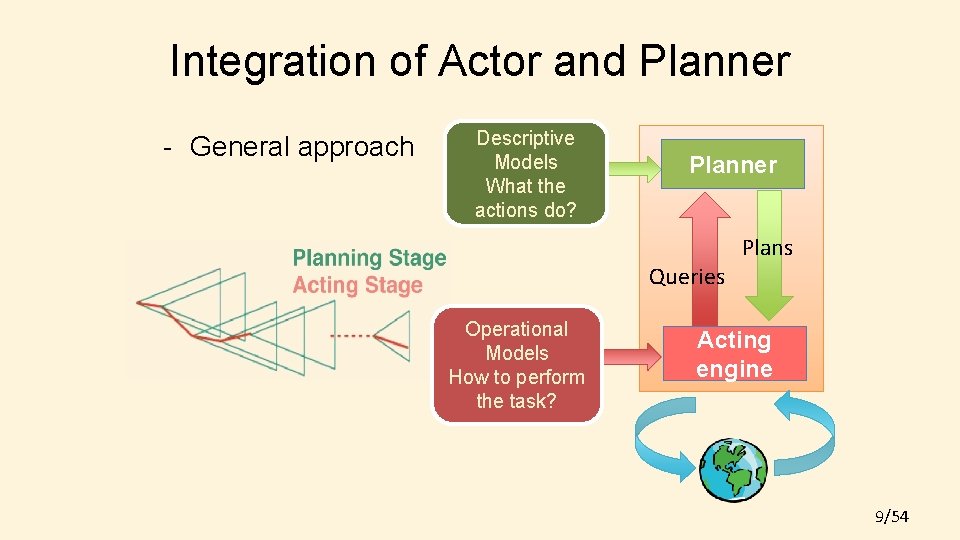
Integration of Actor and Planner - General approach Descriptive Models What the actions do? Planner Queries Operational Models How to perform the task? Plans Acting engine 9/54
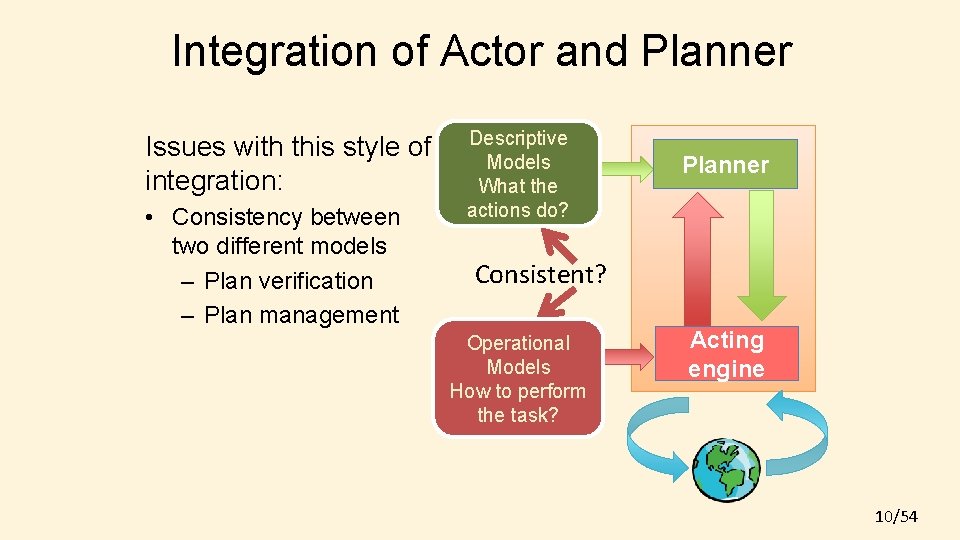
Integration of Actor and Planner Issues with this style of integration: • Consistency between two different models – Plan verification – Plan management Descriptive Models What the actions do? Planner Consistent? Operational Models How to perform the task? Acting engine 10/54
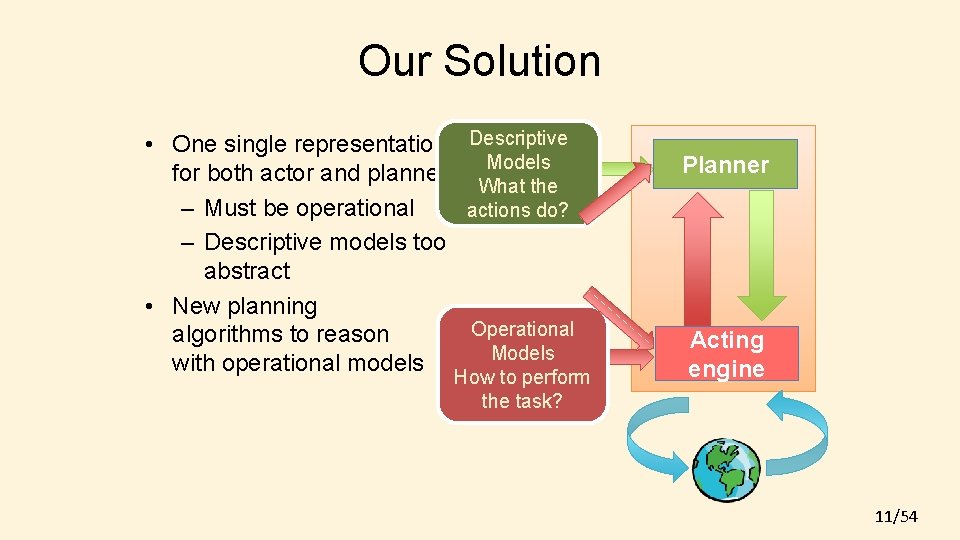
Our Solution • One single representation Descriptive Models for both actor and planner What the – Must be operational actions do? – Descriptive models too abstract • New planning Operational algorithms to reason Models with operational models How to perform the task? Planner Acting engine 11/54
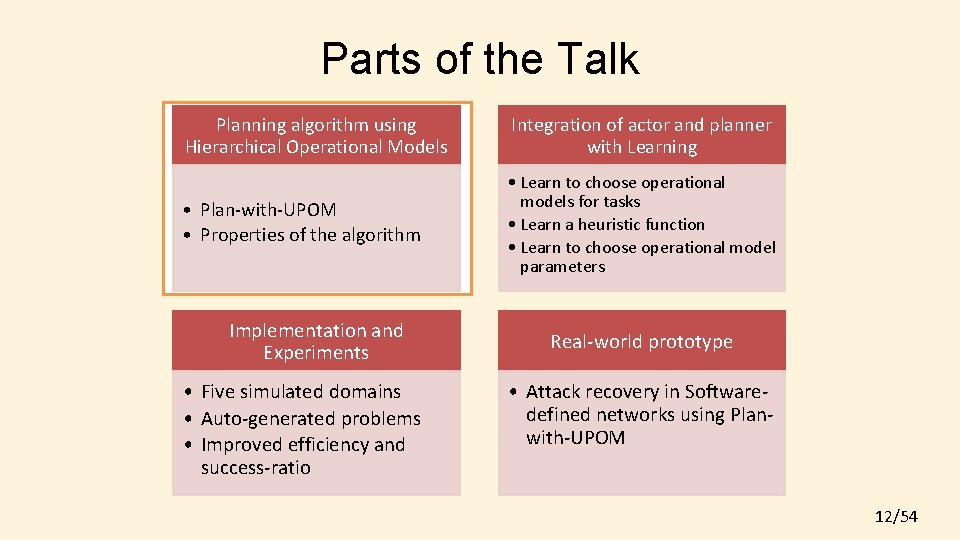
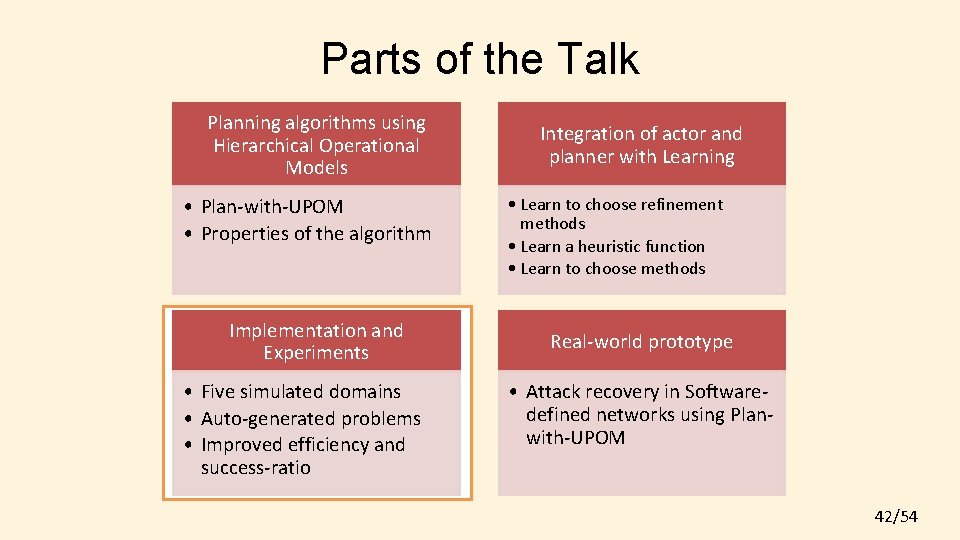
Parts of the Talk Planning algorithm using Hierarchical Operational Models Integration of actor and planner with Learning • Plan-with-UPOM • Properties of the algorithm • Learn to choose operational models for tasks • Learn a heuristic function • Learn to choose operational model parameters Implementation and Experiments • Five simulated domains • Auto-generated problems • Improved efficiency and success-ratio Real-world prototype • Attack recovery in Softwaredefined networks using Planwith-UPOM 12/54
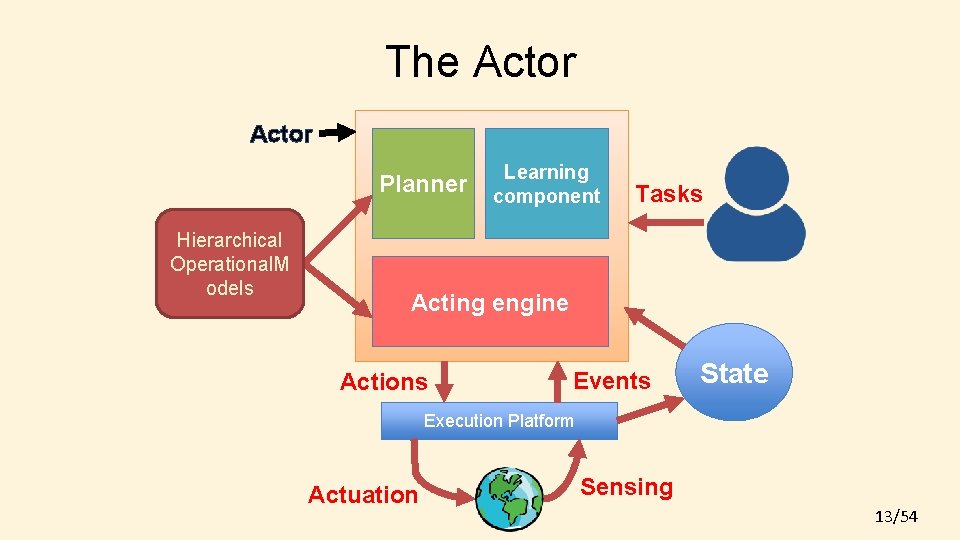
The Actor Planner Hierarchical Operational. M odels Learning component Tasks Acting engine Actions Events State Execution Platform Actuation Sensing 13/54
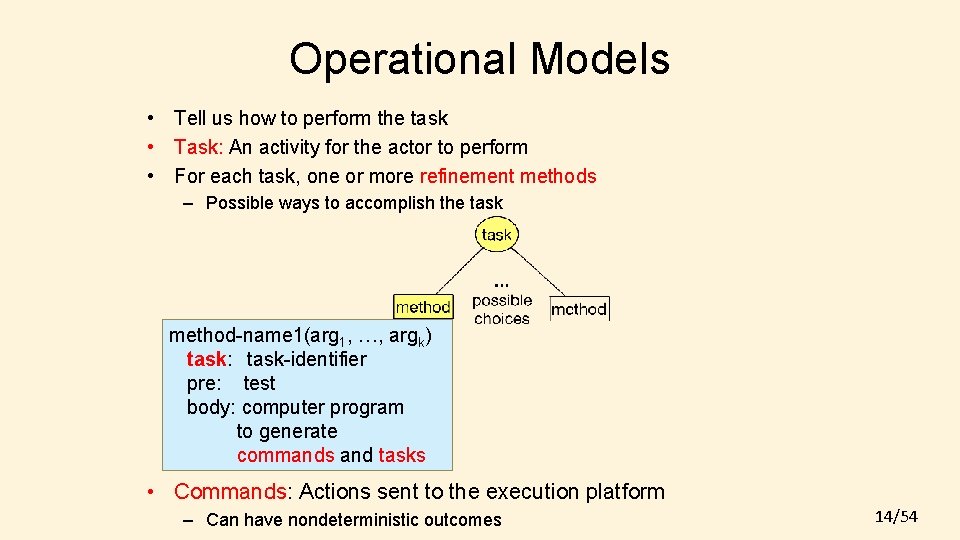
Operational Models • Tell us how to perform the task • Task: An activity for the actor to perform • For each task, one or more refinement methods – Possible ways to accomplish the task method-name 1(arg 1, …, argk) task: task-identifier pre: test body: computer program to generate commands and tasks • Commands: Actions sent to the execution platform – Can have nondeterministic outcomes 14/54
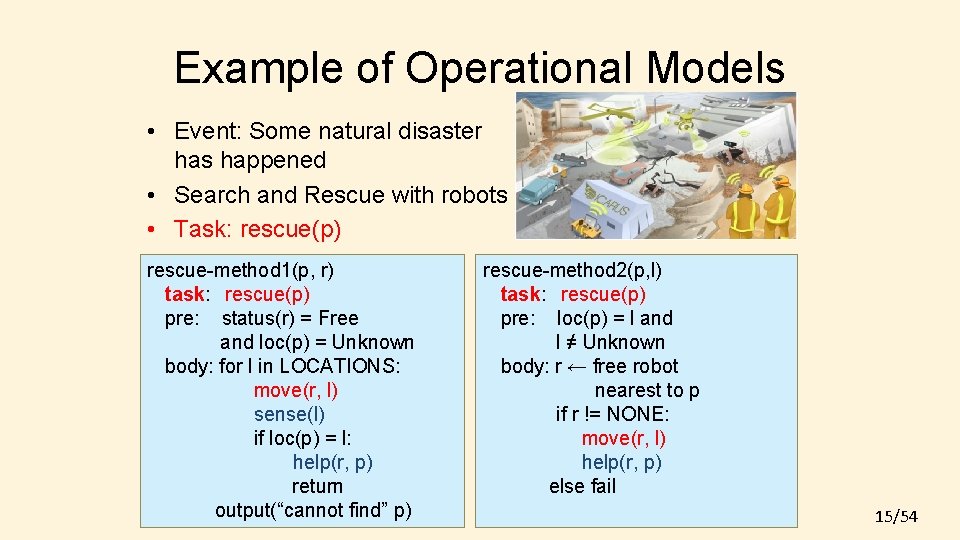
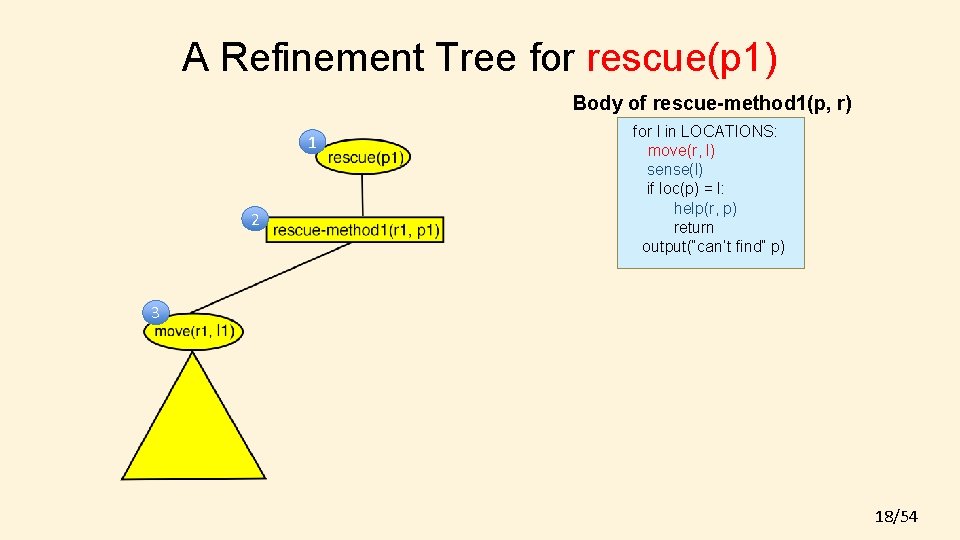
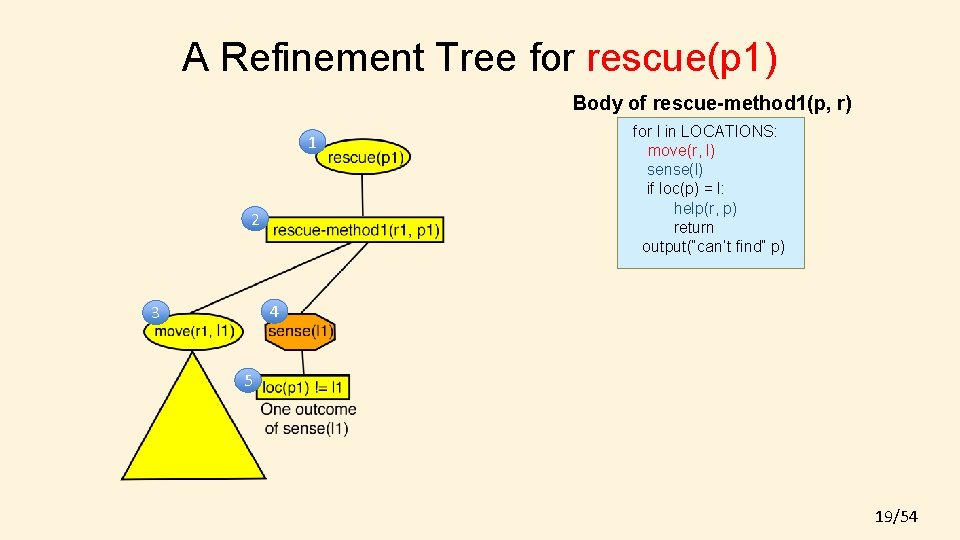
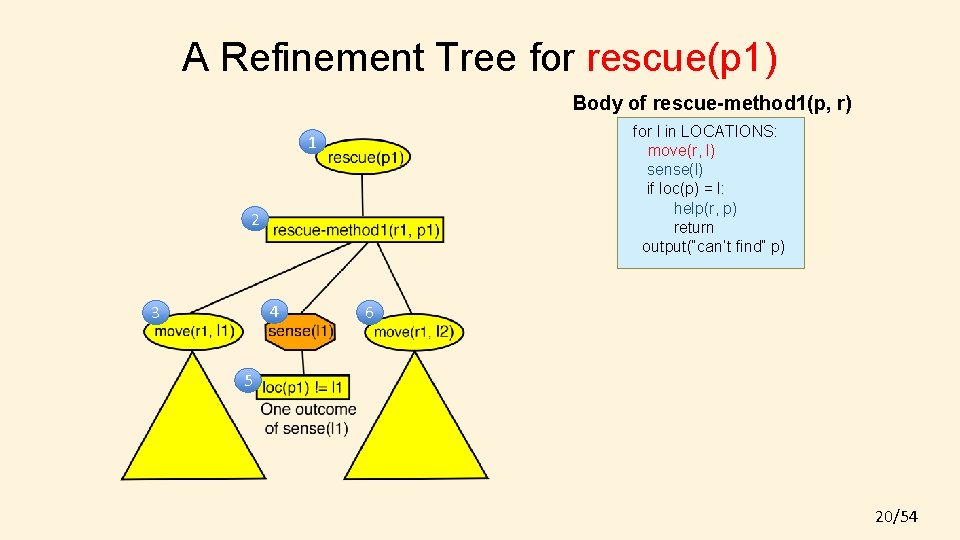
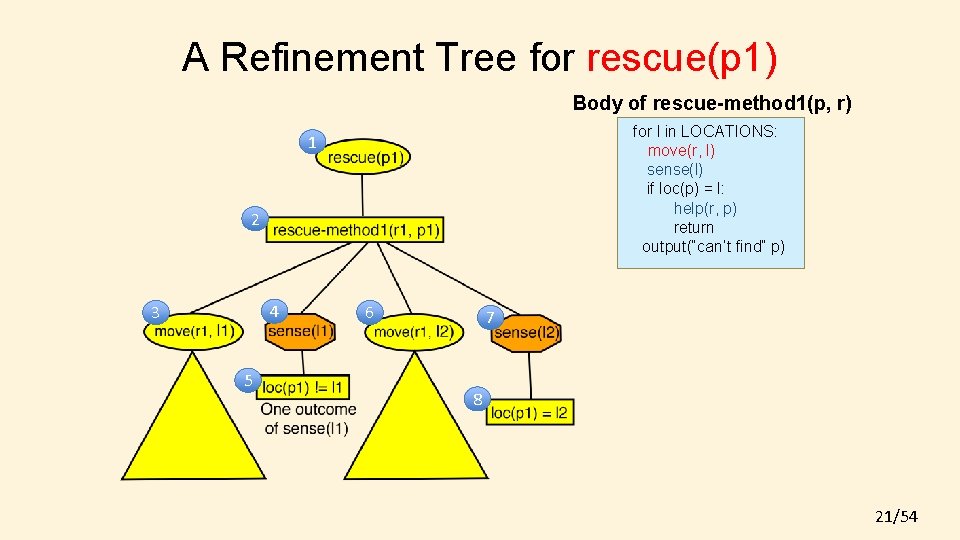
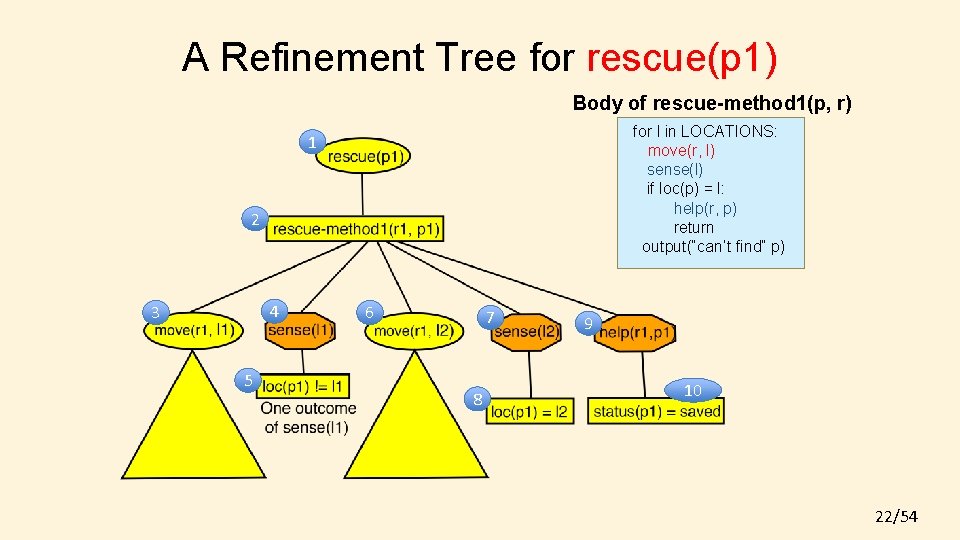
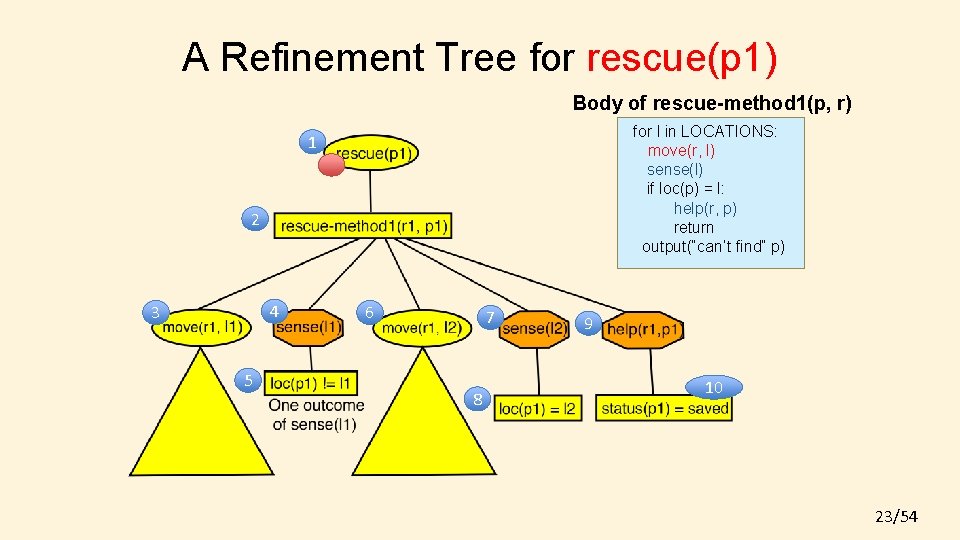
Example of Operational Models • Event: Some natural disaster has happened • Search and Rescue with robots • Task: rescue(p) rescue-method 1(p, r) task: rescue(p) pre: status(r) = Free and loc(p) = Unknown body: for l in LOCATIONS: move(r, l) sense(l) if loc(p) = l: help(r, p) return output(“cannot find” p) rescue-method 2(p, l) task: rescue(p) pre: loc(p) = l and l ≠ Unknown body: r ← free robot nearest to p if r != NONE: move(r, l) help(r, p) else fail 15/54
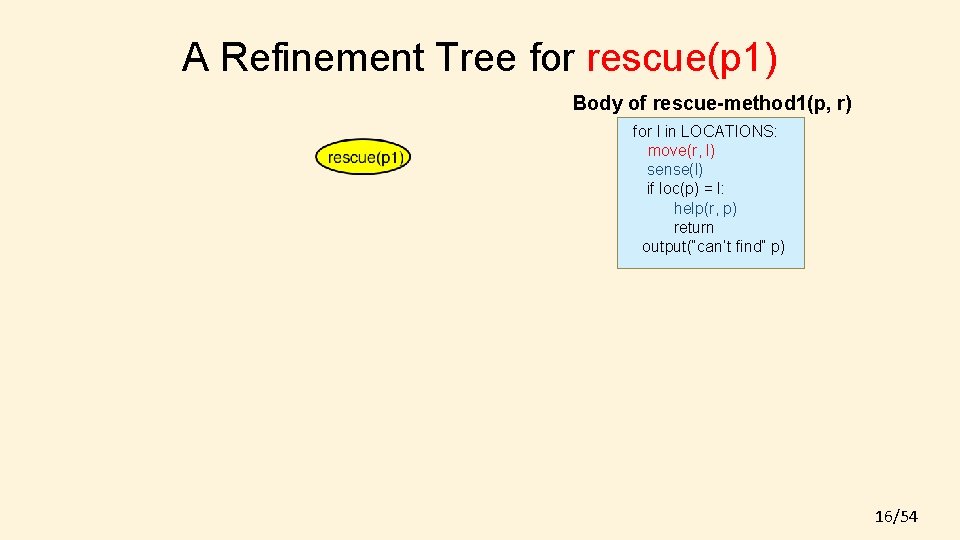
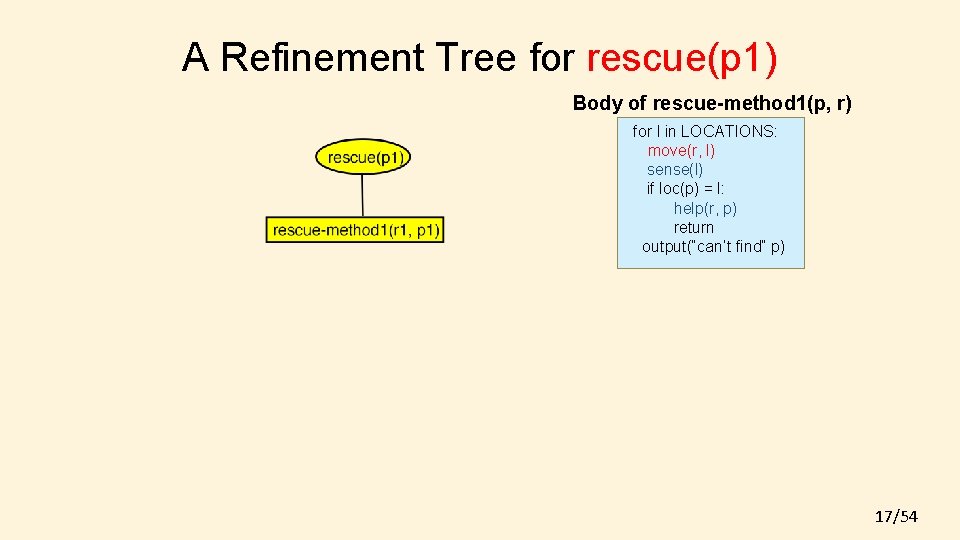
A Refinement Tree for rescue(p 1) Body of rescue-method 1(p, r) for l in LOCATIONS: move(r, l) sense(l) if loc(p) = l: help(r, p) return output(“can’t find” p) 16/54
A Refinement Tree for rescue(p 1) Body of rescue-method 1(p, r) for l in LOCATIONS: move(r, l) sense(l) if loc(p) = l: help(r, p) return output(“can’t find” p) 17/54
A Refinement Tree for rescue(p 1) Body of rescue-method 1(p, r) 1 2 for l in LOCATIONS: move(r, l) sense(l) if loc(p) = l: help(r, p) return output(“can’t find” p) 3 18/54
A Refinement Tree for rescue(p 1) Body of rescue-method 1(p, r) 1 2 for l in LOCATIONS: move(r, l) sense(l) if loc(p) = l: help(r, p) return output(“can’t find” p) 4 3 5 19/54
A Refinement Tree for rescue(p 1) Body of rescue-method 1(p, r) for l in LOCATIONS: move(r, l) sense(l) if loc(p) = l: help(r, p) return output(“can’t find” p) 1 2 4 3 6 5 20/54
A Refinement Tree for rescue(p 1) Body of rescue-method 1(p, r) for l in LOCATIONS: move(r, l) sense(l) if loc(p) = l: help(r, p) return output(“can’t find” p) 1 2 4 3 5 6 7 8 21/54
A Refinement Tree for rescue(p 1) Body of rescue-method 1(p, r) for l in LOCATIONS: move(r, l) sense(l) if loc(p) = l: help(r, p) return output(“can’t find” p) 1 2 4 3 5 6 7 8 9 10 22/54
A Refinement Tree for rescue(p 1) Body of rescue-method 1(p, r) for l in LOCATIONS: move(r, l) sense(l) if loc(p) = l: help(r, p) return output(“can’t find” p) 1 2 4 3 5 6 7 8 9 10 23/54
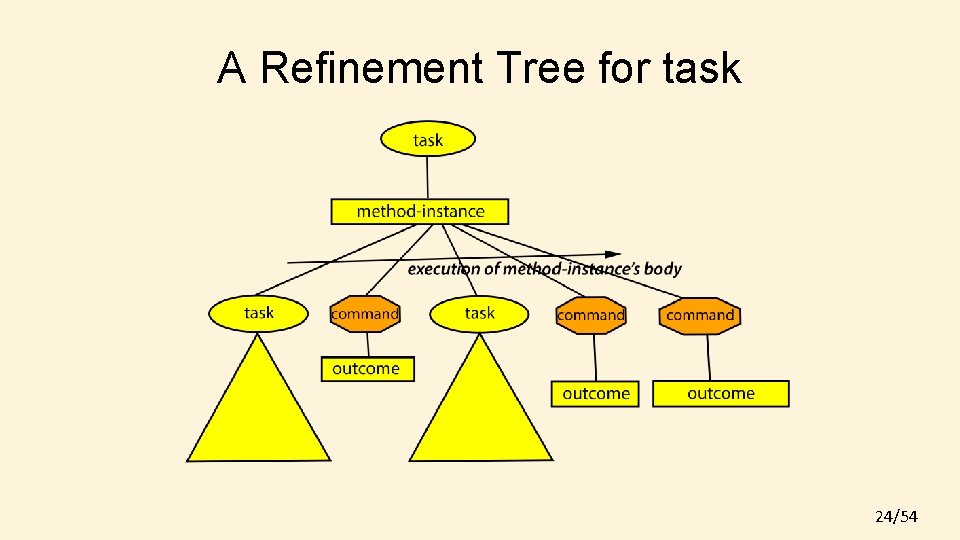
A Refinement Tree for task 24/54
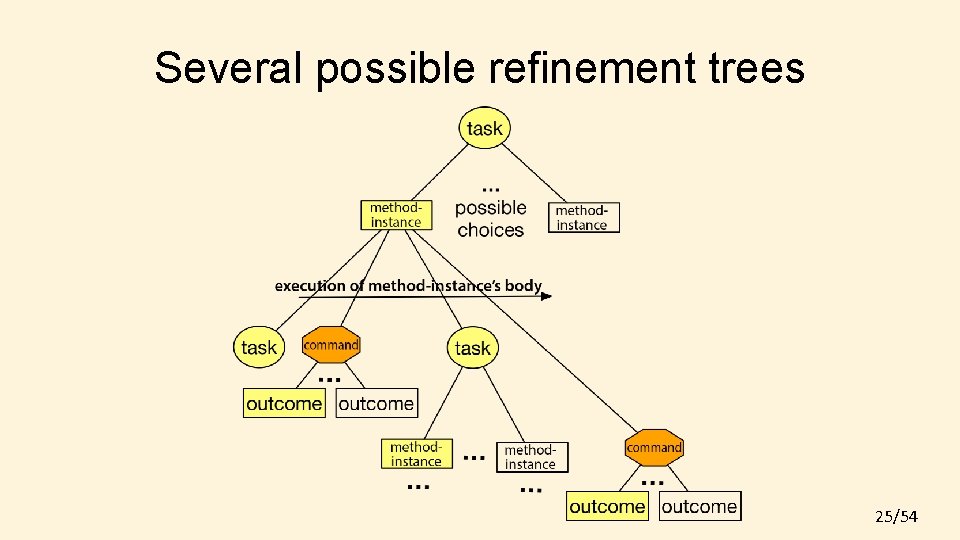
Several possible refinement trees 25/54
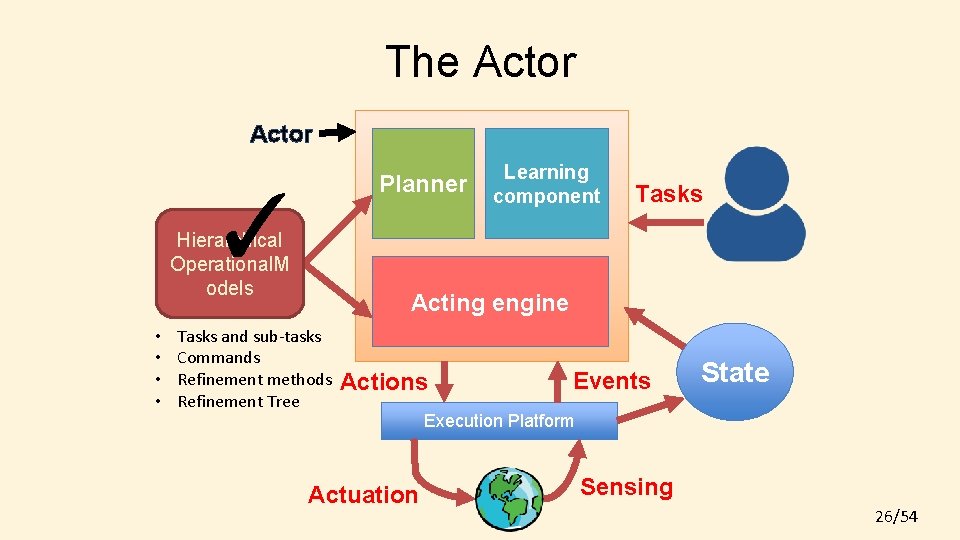
The Actor Planner ✓ Hierarchical Operational. M odels • • Learning component Tasks Acting engine Tasks and sub-tasks Commands Refinement methods Refinement Tree Actions Actuation Events State Execution Platform Sensing 26/54
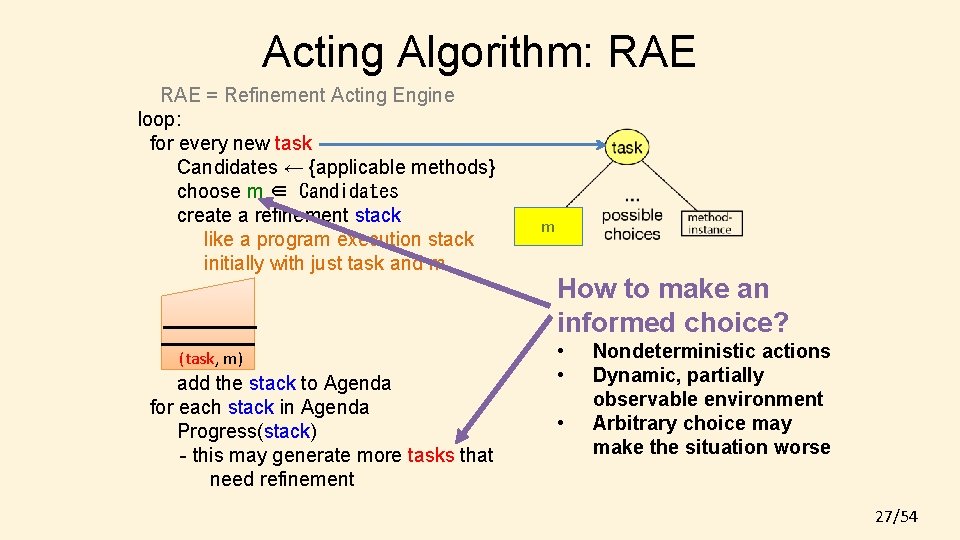
Acting Algorithm: RAE = Refinement Acting Engine loop: for every new task Candidates ← {applicable methods} choose m ∈ Candidates create a refinement stack like a program execution stack initially with just task and m (task, m) add the stack to Agenda for each stack in Agenda Progress(stack) - this may generate more tasks that need refinement m How to make an informed choice? • • • Nondeterministic actions Dynamic, partially observable environment Arbitrary choice may make the situation worse 27/54
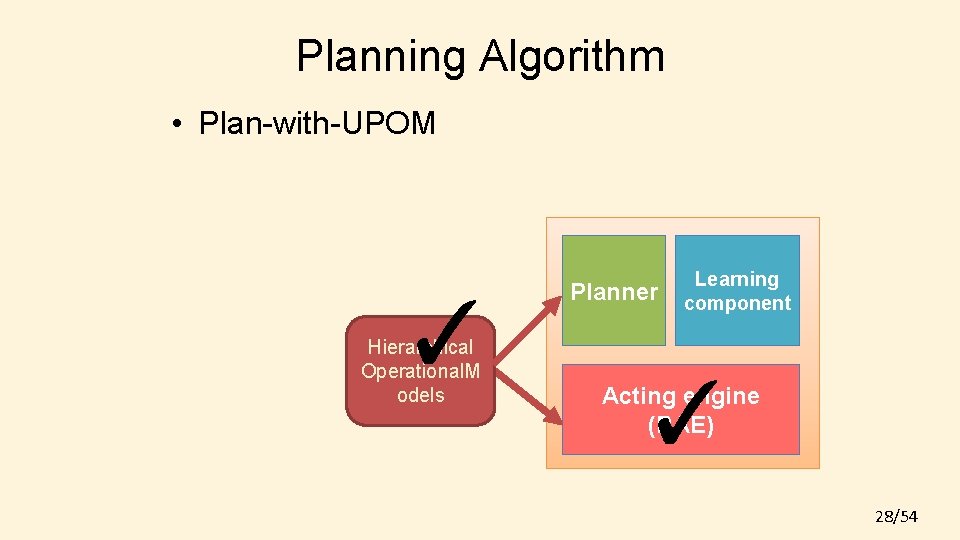
Planning Algorithm • Plan-with-UPOM ✓ Hierarchical Operational. M odels Planner Learning component ✓ Acting engine (RAE) 28/54
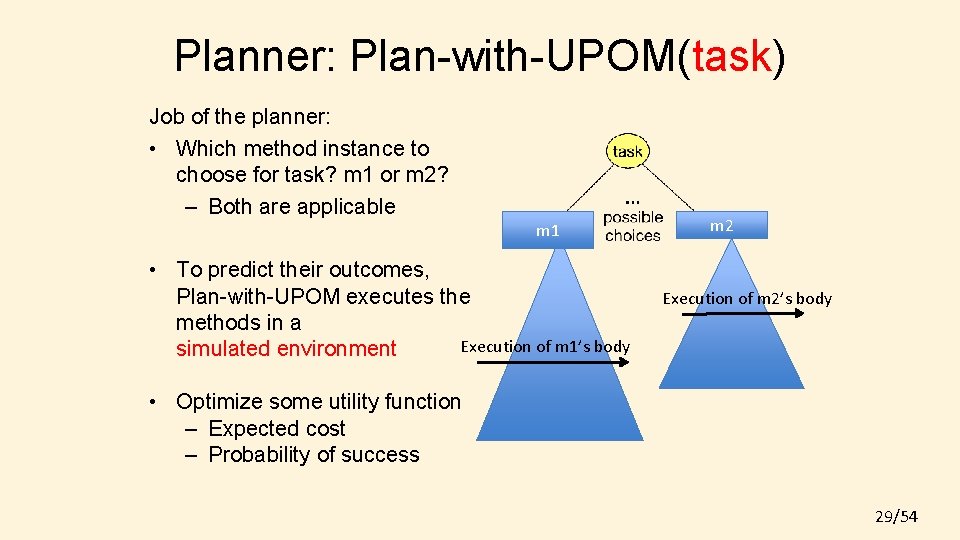
Planner: Plan-with-UPOM(task) Job of the planner: • Which method instance to choose for task? m 1 or m 2? – Both are applicable m 1 • To predict their outcomes, Plan-with-UPOM executes the methods in a Execution of m 1’s body simulated environment m 2 Execution of m 2’s body • Optimize some utility function – Expected cost – Probability of success 29/54
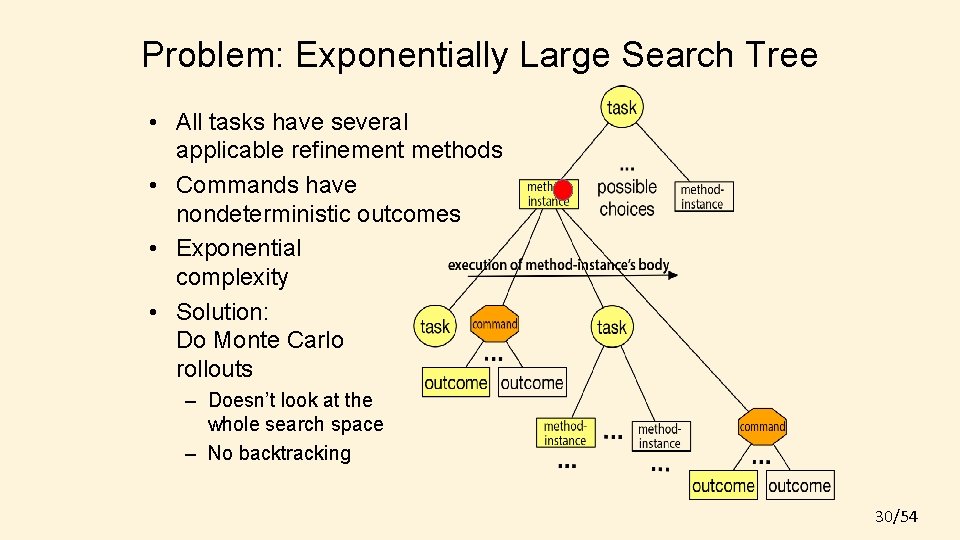
Problem: Exponentially Large Search Tree • All tasks have several applicable refinement methods • Commands have nondeterministic outcomes • Exponential complexity • Solution: Do Monte Carlo rollouts – Doesn’t look at the whole search space – No backtracking 30/54
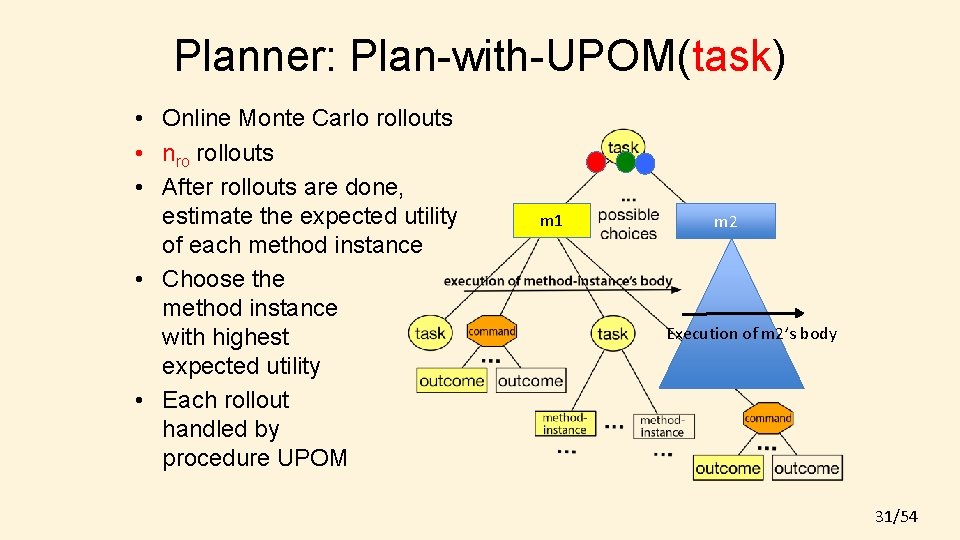
Planner: Plan-with-UPOM(task) • Online Monte Carlo rollouts • nro rollouts • After rollouts are done, estimate the expected utility of each method instance • Choose the method instance with highest expected utility • Each rollout handled by procedure UPOM m 1 m 2 Execution of m 2’s body 31/54
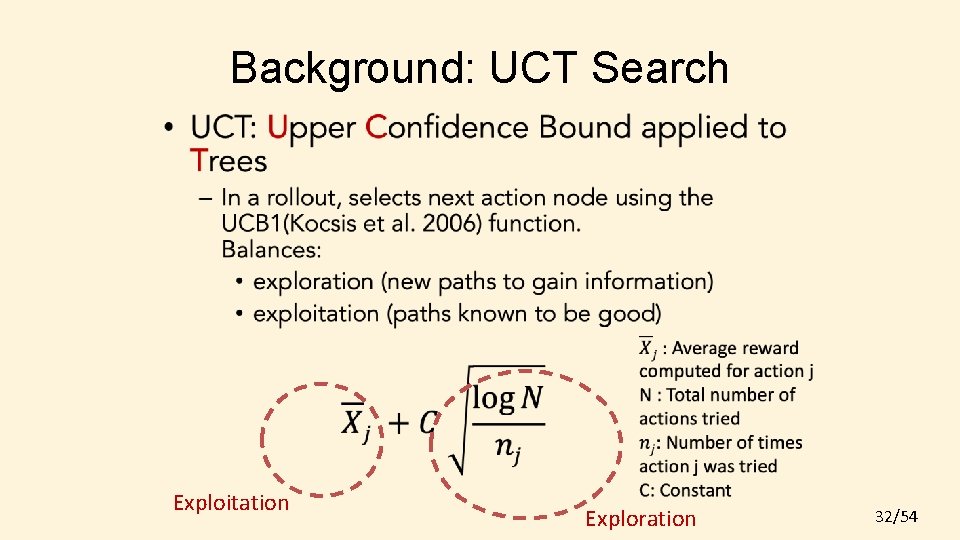
Background: UCT Search • Exploitation Exploration 32/54
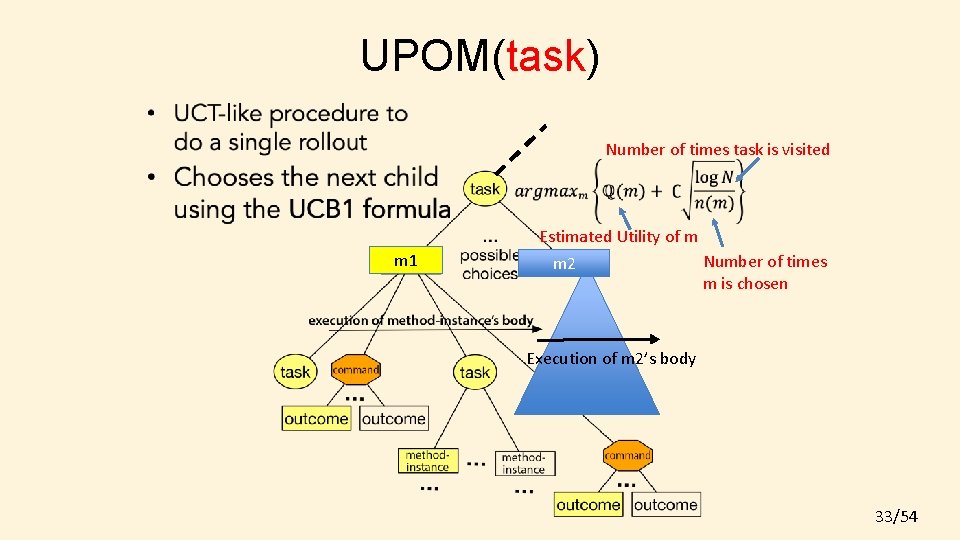
UPOM(task) Number of times task is visited Estimated Utility of m m 1 m 2 Number of times m is chosen Execution of m 2’s body 33/54
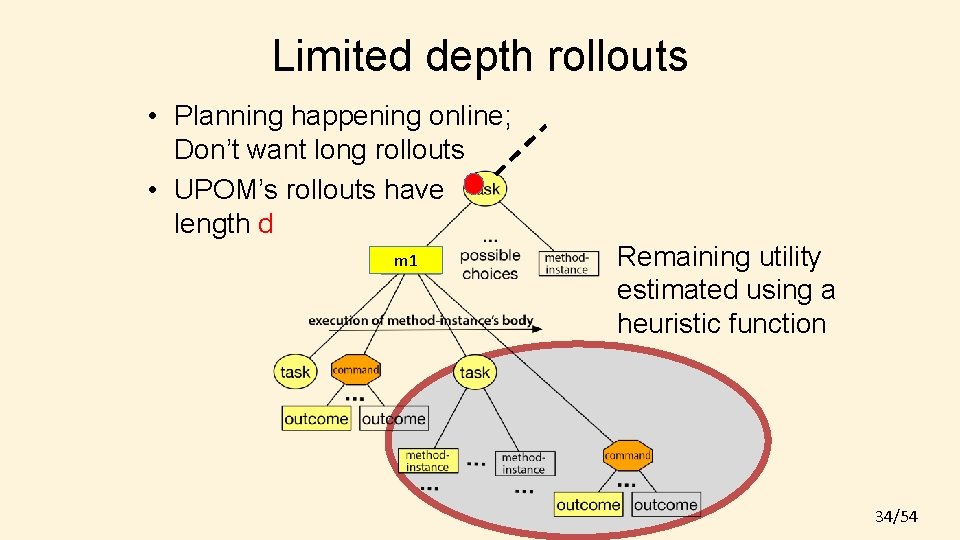
Limited depth rollouts • Planning happening online; Don’t want long rollouts • UPOM’s rollouts have length d m 1 Remaining utility estimated using a heuristic function 34/54
Properties of Plan-with-UPOM • Time and space complexities linear in nro (number of rollouts) and d (rollout length) • In a static environment (no dynamic events), – The refinement planning domain can be mapped to an MDP • UCT search converges for an MDP as the number of rollouts approaches infinite 35/54
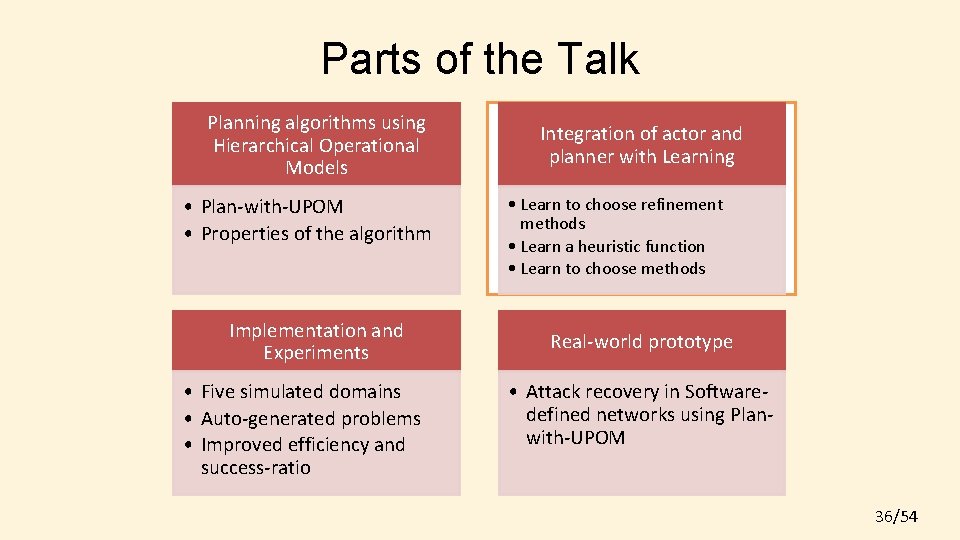
Parts of the Talk Planning algorithms using Hierarchical Operational Models • Plan-with-UPOM • Properties of the algorithm Implementation and Experiments • Five simulated domains • Auto-generated problems • Improved efficiency and success-ratio Integration of actor and planner with Learning • Learn to choose refinement methods • Learn a heuristic function • Learn to choose methods Real-world prototype • Attack recovery in Softwaredefined networks using Planwith-UPOM 36/54
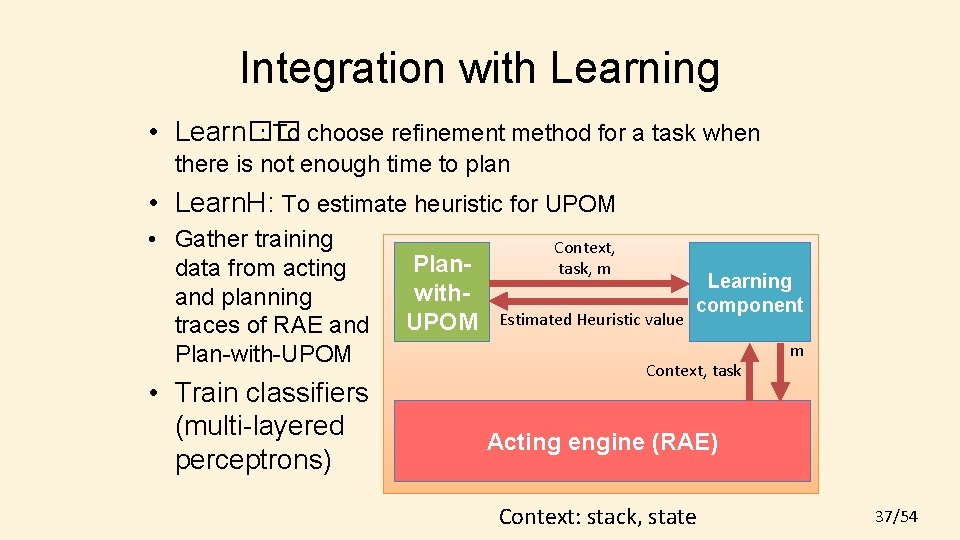
Integration with Learning • Learn�� : To choose refinement method for a task when there is not enough time to plan • Learn. H: To estimate heuristic for UPOM • Gather training data from acting and planning traces of RAE and Plan-with-UPOM • Train classifiers (multi-layered perceptrons) Planwith. UPOM Context, task, m Estimated Heuristic value Learning component Context, task m Acting engine (RAE) Context: stack, state 37/54
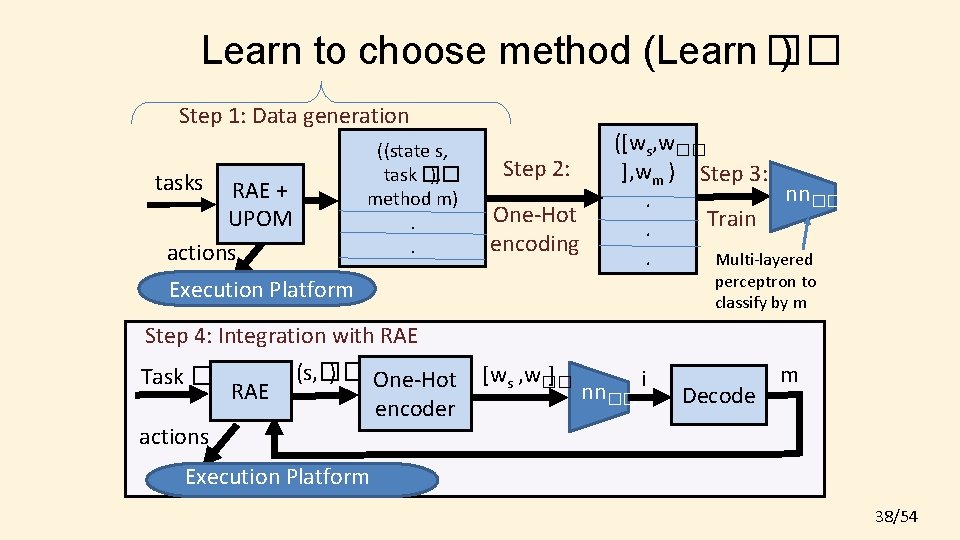
Learn to choose method (Learn �� ) Step 1: Data generation ((state s, task �� ), method m). . tasks RAE + UPOM actions Step 2: One-Hot encoding ([ws, w�� ], wm ) Step 3: nn��. Train. . Multi-layered perceptron to classify by m Execution Platform Step 4: Integration with RAE Task �� RAE actions (s, �� ) One-Hot encoder [ws , w�� ] nn�� i Decode m Execution Platform 38/54
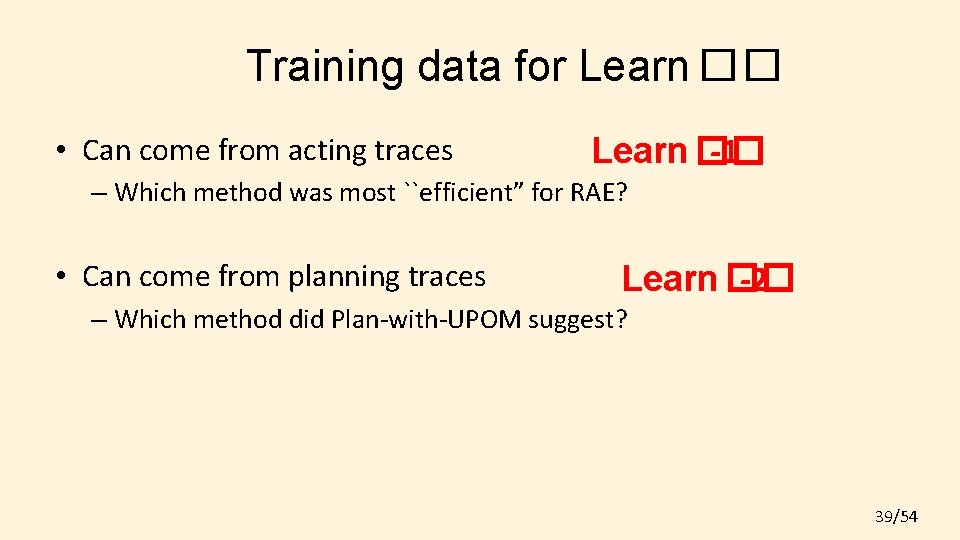
Training data for Learn �� • Can come from acting traces Learn �� -1 – Which method was most ``efficient” for RAE? • Can come from planning traces Learn �� -2 – Which method did Plan-with-UPOM suggest? 39/54
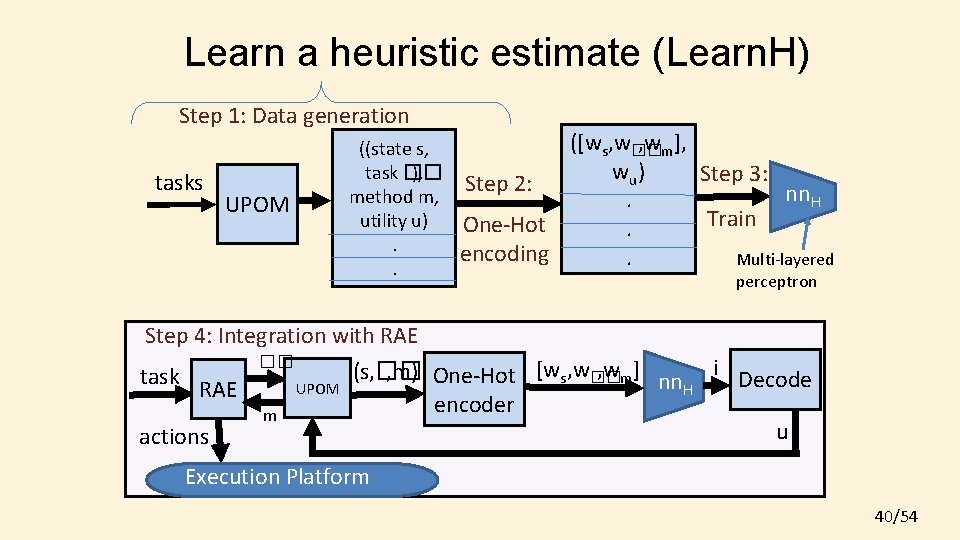
Learn a heuristic estimate (Learn. H) Step 1: Data generation tasks UPOM ((state s, task �� ), method m, utility u). . ([ws, w�� , wm], w u) Step 3: Step 2: nn. H. Train One-Hot. encoding. Multi-layered perceptron Step 4: Integration with RAE �� i , wm] (s, �� , m) One-Hot [ws, w�� task Decode nn. H UPOM RAE encoder m u actions Execution Platform 40/54
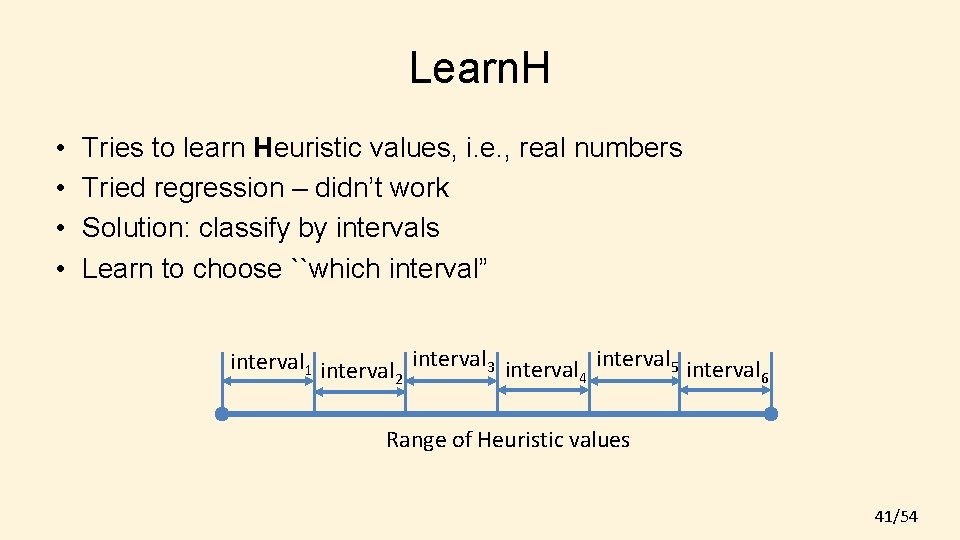
Learn. H • • Tries to learn Heuristic values, i. e. , real numbers Tried regression – didn’t work Solution: classify by intervals Learn to choose ``which interval” interval 1 interval 3 interval 5 interval 4 6 2 Range of Heuristic values 41/54
Parts of the Talk Planning algorithms using Hierarchical Operational Models • Plan-with-UPOM • Properties of the algorithm Implementation and Experiments • Five simulated domains • Auto-generated problems • Improved efficiency and success-ratio Integration of actor and planner with Learning • Learn to choose refinement methods • Learn a heuristic function • Learn to choose methods Real-world prototype • Attack recovery in Softwaredefined networks using Planwith-UPOM 42/54
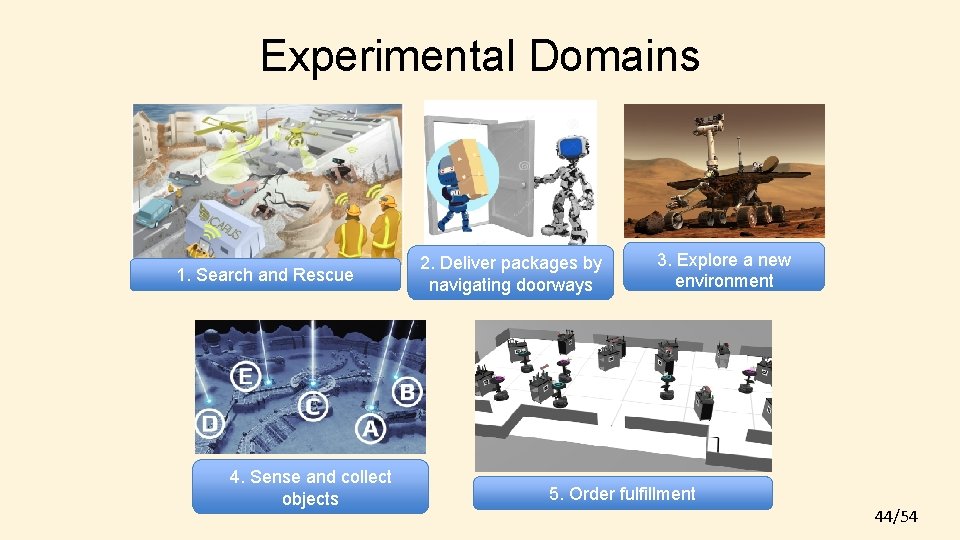
Experimental Domains • Domain characteristics we want to examine – Dynamic Events – Concurrent tasks – Dead ends – Multiple agents under central control – Actors have sensors to acquire information about the world • We designed simulated domains to cover these characteristics • Open source code available: https: //bitbucket. org/sunandita/rae/src/master 43/54
Experimental Domains 1. Search and Rescue 4. Sense and collect objects 2. Deliver packages by navigating doorways 3. Explore a new environment 5. Order fulfillment 44/54
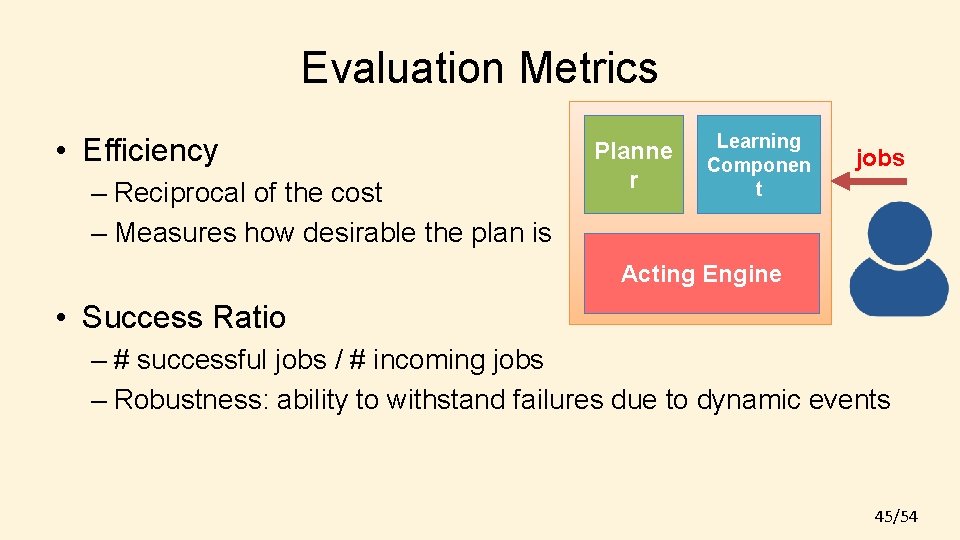
Evaluation Metrics • Efficiency – Reciprocal of the cost – Measures how desirable the plan is Planne r Learning Componen t jobs Acting Engine • Success Ratio – # successful jobs / # incoming jobs – Robustness: ability to withstand failures due to dynamic events 45/54
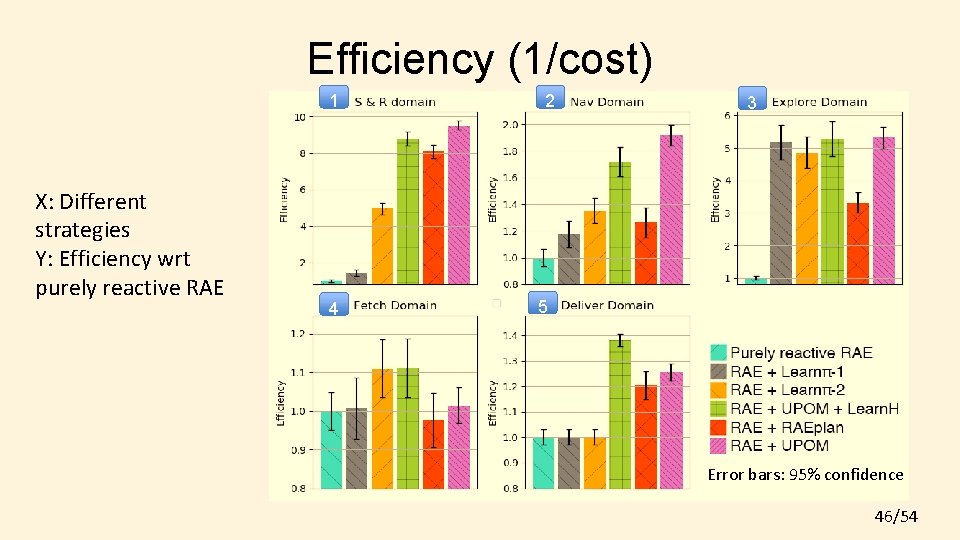
Efficiency (1/cost) 1 X: Different strategies Y: Efficiency wrt purely reactive RAE 4 2 3 5 Error bars: 95% confidence 46/54
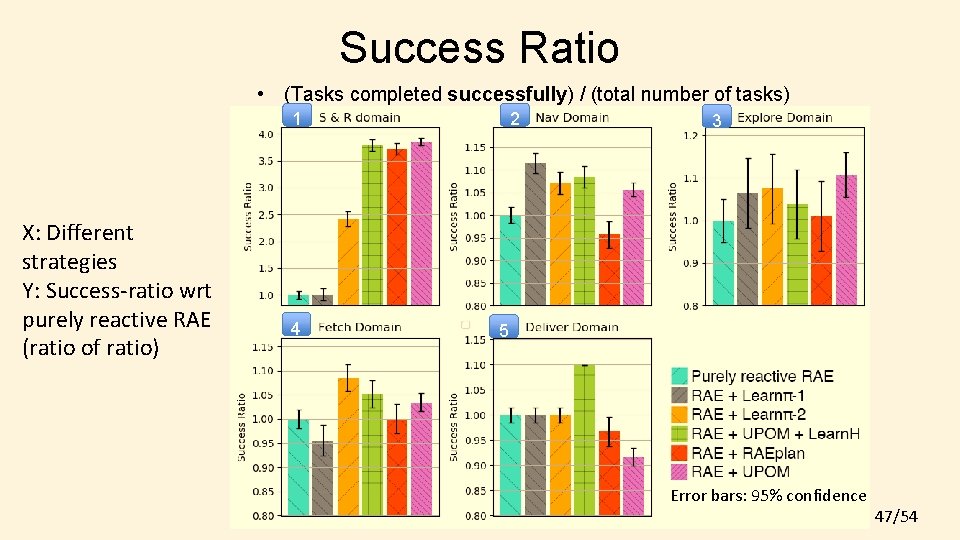
Success Ratio • (Tasks completed successfully) / (total number of tasks) 1 X: Different strategies Y: Success-ratio wrt purely reactive RAE (ratio of ratio) 4 2 3 5 Error bars: 95% confidence 47/54
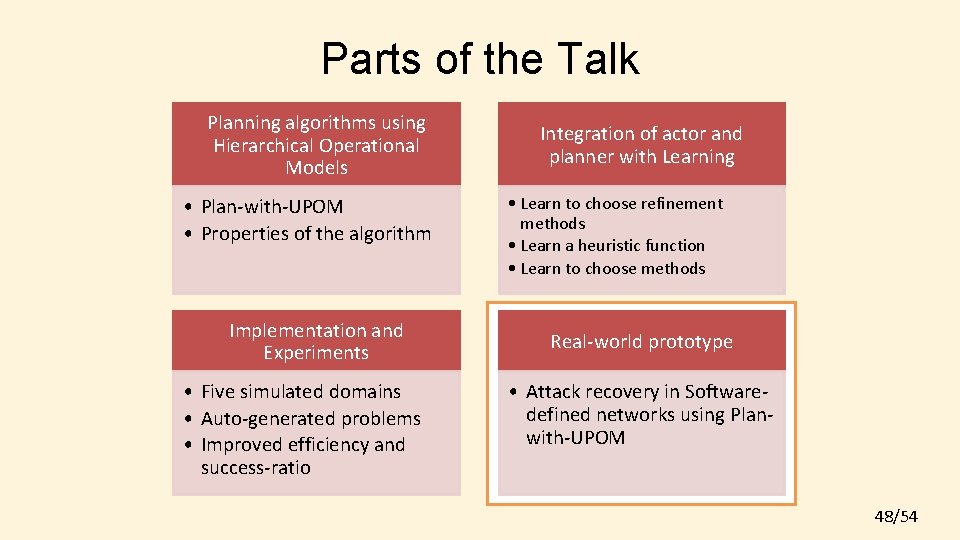
Parts of the Talk Planning algorithms using Hierarchical Operational Models • Plan-with-UPOM • Properties of the algorithm Implementation and Experiments • Five simulated domains • Auto-generated problems • Improved efficiency and success-ratio Integration of actor and planner with Learning • Learn to choose refinement methods • Learn a heuristic function • Learn to choose methods Real-world prototype • Attack recovery in Softwaredefined networks using Planwith-UPOM 48/54
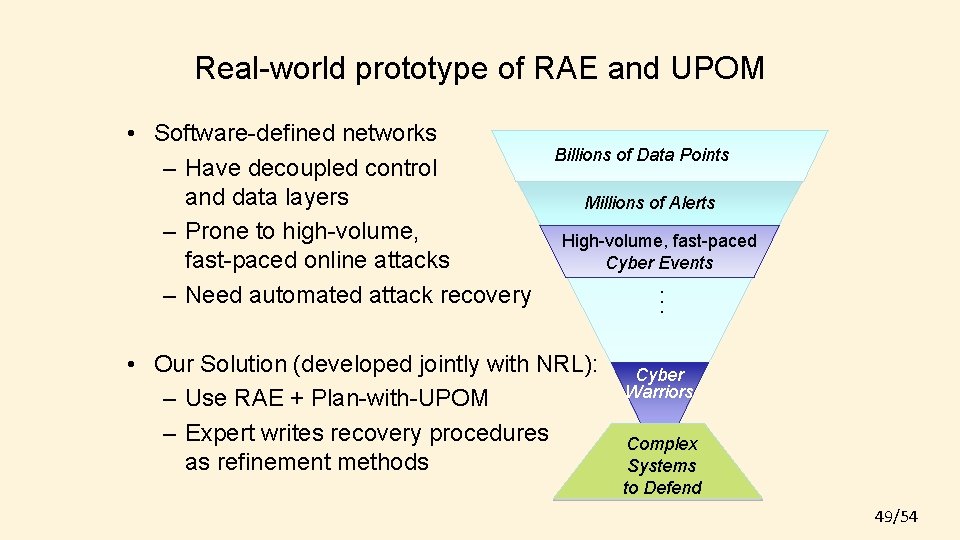
Real-world prototype of RAE and UPOM Billions of Data Points Millions of Alerts High-volume, fast-paced Cyber Events • Our Solution (developed jointly with NRL): – Use RAE + Plan-with-UPOM – Expert writes recovery procedures as refinement methods . . . • Software-defined networks – Have decoupled control and data layers – Prone to high-volume, fast-paced online attacks – Need automated attack recovery Cyber Warriors Complex Systems to Defend 49/54
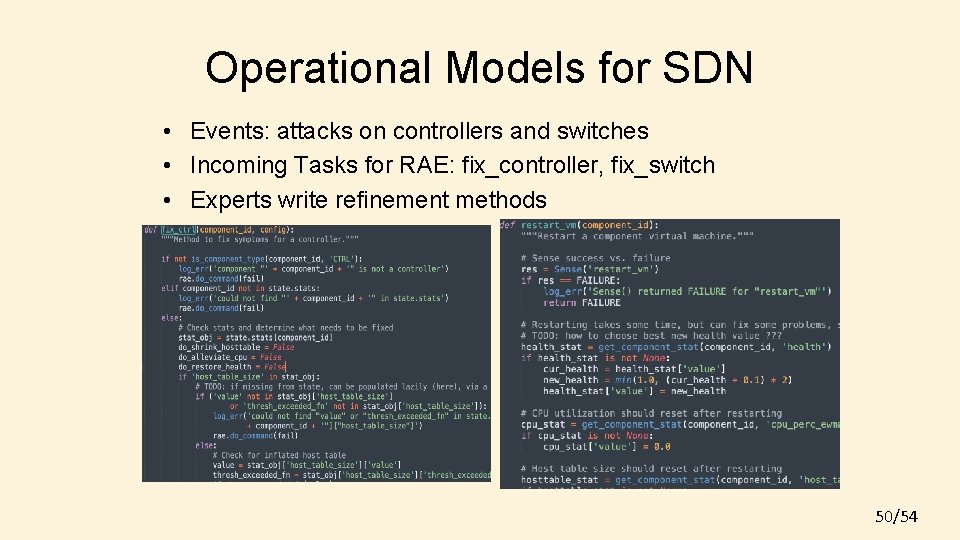
Operational Models for SDN • Events: attacks on controllers and switches • Incoming Tasks for RAE: fix_controller, fix_switch • Experts write refinement methods 50/54
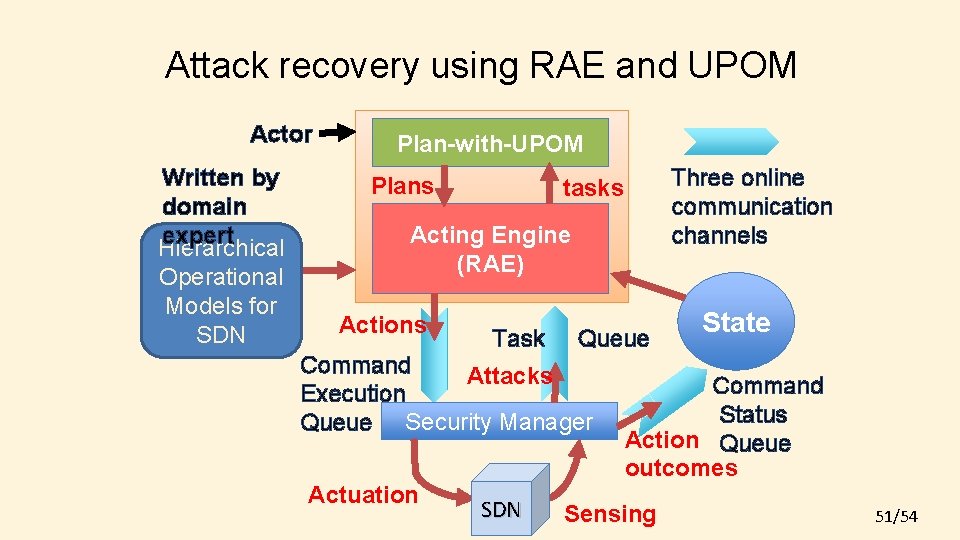
Attack recovery using RAE and UPOM Actor Written by domain expert Hierarchical Operational Models for SDN Plan-with-UPOM Plans Three online communication channels tasks Acting Engine (RAE) Actions Task Queue Command Attacks Execution Queue Security Manager Actuation SDN State Command Status Action Queue outcomes Sensing 51/54
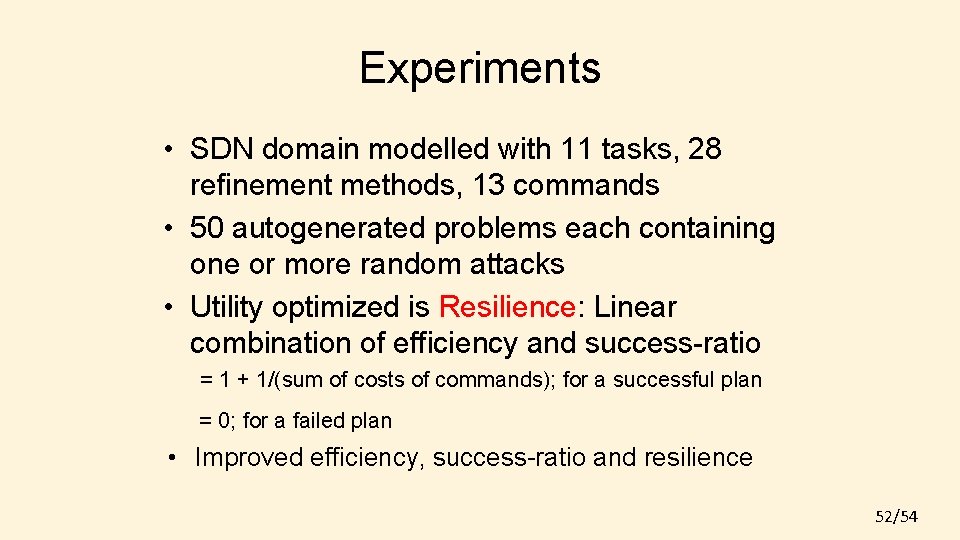
Experiments • SDN domain modelled with 11 tasks, 28 refinement methods, 13 commands • 50 autogenerated problems each containing one or more random attacks • Utility optimized is Resilience: Linear combination of efficiency and success-ratio = 1 + 1/(sum of costs of commands); for a successful plan = 0; for a failed plan • Improved efficiency, success-ratio and resilience 52/54
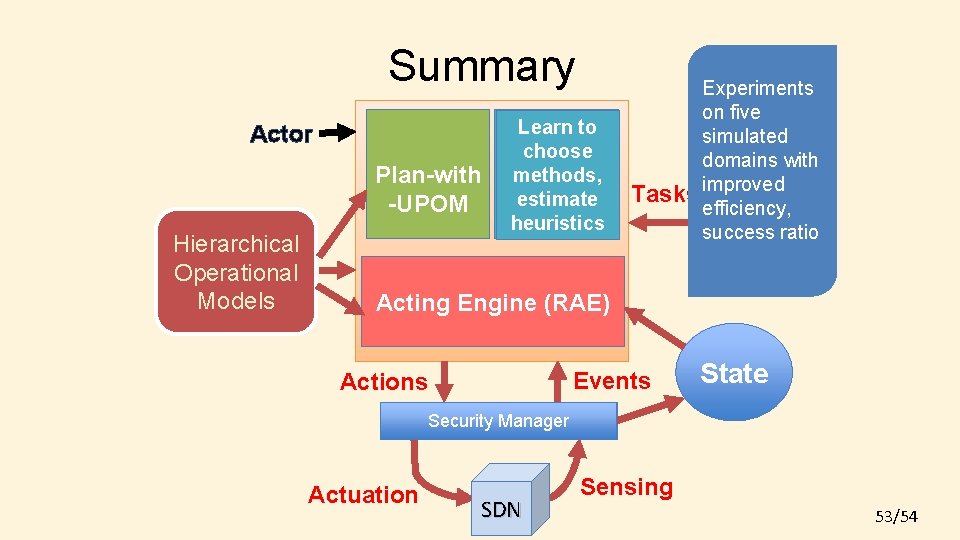
Summary Actor Plan-with Planner -UPOM Hierarchical Task and Operational Action Models Learn to Learning choose Componen methods, t estimate heuristics Experiments on five simulated domains with Tasks improved efficiency, success ratio Acting Engine (RAE) Events Actions State Execution Security Manager Platform Actuation SDN Sensing 53/54
Thank you 54/54
References [10] Sunandita Patra, James Mason, Amit Kumar, Malik Ghallab, Dana Nau, Paolo Traverso. Integrating Acting, Planning, and Learning in Hierarchical Operational Models. Accepted at IJCAI 2020 Monte Carlo Search Workshop. [9] Sunandita Patra, James Mason, Amit Kumar, Malik Ghallab, Dana Nau, Paolo Traverso. Integrating Acting, Planning, and Learning in Hierarchical Operational Models. Accepted for publication at ICAPS 2020. Best Student Paper Honorable Mention Award. [link] [8] Sunandita Patra, Malik Ghallab, Dana Nau, Paolo Traverso. Interleaving Acting and Planning Using Operational Models. ICAPS 2019 Workshop on Integrated Planning, Acting and Execution (Int. Ex). [link] [7] Sunandita Patra, Malik Ghallab, Dana Nau, Paolo Traverso. Acting and Planning Using Operational Models. AAAI 2019. [link] [6] Sunandita Patra, Malik Ghallab, Dana Nau and Paolo Traverso. APE: An Acting and Planning Engine. Conference on Advances in Cognitive Systems, 2018. [link] [5] Sunandita Patra, Malik Ghallab, Dana Nau and Paolo Traverso. Using Operational Models to Integrate Acting and Planning, ICAPS 2018 Workshop on Integrated Planning, Acting and Execution (Int. Ex). [link] [4] Sunandita Patra, Malik Ghallab, Dana Nau and Paolo Traverso. Planning and Acting with Hierarchical Input/Output Automata. Conference of Advances in Cognitive Systems, 2018. [link] [3] Sunandita Patra, Malik Ghallab, Dana Nau and Paolo Traverso. APE: An Acting and Planning Engine. Journal of Advances in Cognitive Systems, 2018. [link] [2] Sunandita Patra, Paolo Traverso, Malik Ghallab and Dana Nau. Planning and Acting with Hierarchical Input/Output Automata, ICAPS 2017 Workshop on Generalized Planning (Gen. Plan). [link] [1] Sunandita Patra, Satya Gautam Vadlamudi, and Partha Pratim Chakrabarti. Anytime contract search. SGAI International Conference on Innovative Techniques and Applications of Artificial Intelligence 2013. [link] 55/54