
Acting Fire Evacuation Officer Emergency Folder tion Evacua


- Slides: 22
Acting Fire Evacuation Officer Emergency Folder tion Evacua st Checkli FIRE EVACUATIO N OFFICER
Introduction Please familiarise yourself with the role of the Fire Warden / Acting Fire Warden before completing this presentation.
Introduction The Evacuation Officer is an essential role in any fire evacuation plan. This presentation is designed to give you the basic knowledge to understand carry out the role of the Acting Fire Evacuation Officer when members of the normal evacuation team may be reduced during Covid 19 phased return. Please go through the slides and complete the quiz at the end, once you have successfully answered all the questions you can form part of the evacuation team as an Acting Fire Evacuation Officer. Thank you for your help
The Evacuation Team Each building has an evacuation team consisting of Fire Wardens and an Evacuation Officer. In the event of a fire alarm activation the Fire Wardens will sweep designated areas ensuring all people have left and the Evacuation Officer coordinates the evacuation and liaises with Security and the Fire Service Incident Commander should the Fire Service attend. Security will always attend to investigate the cause of the fire alarm activation however the Fire Service will only attend if a 999 call is made confirming there is a fire. If you have not been notified of a fire alarm test, regardless of what you believe has happened, please follow these procedures.
The Evacuation Procedure In the event of an unplanned fire alarm activation as an Acting Fire Evacuation Officer you will be expected to: - 1. Immediately make your way to the fire alarm control panel and collect the Emergency Folder and Evacuation Officer pack. 2. Gather information from Fire Wardens using the Evacuation Checklist. 3. Liaise with Security and the Fire Service on their arrival. 4. Liaise with Fire Wardens and those at the Fire Assembly Point. Each task is covered in more detail in the following slides.
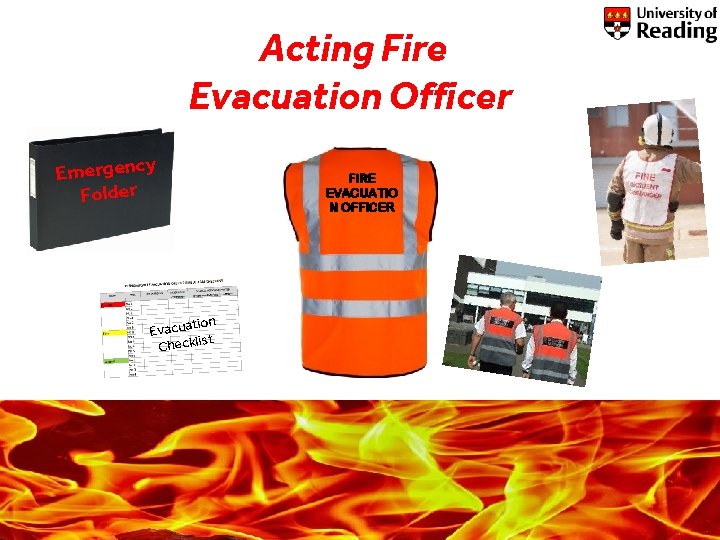
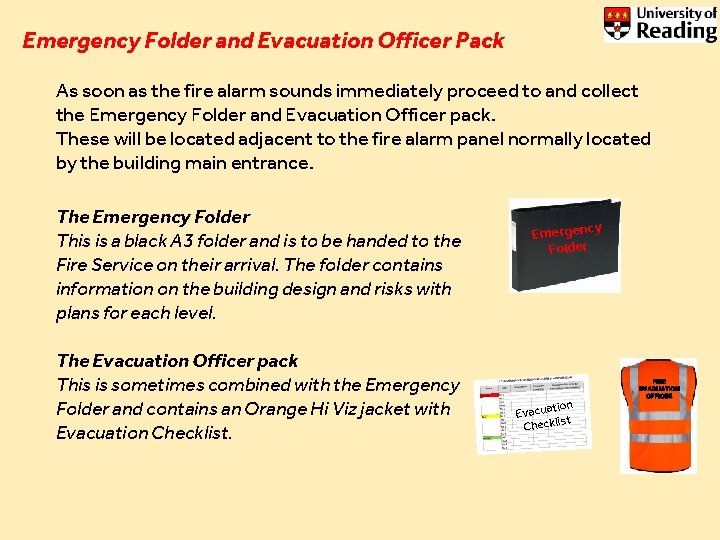
Emergency Folder and Evacuation Officer Pack As soon as the fire alarm sounds immediately proceed to and collect the Emergency Folder and Evacuation Officer pack. These will be located adjacent to the fire alarm panel normally located by the building main entrance. The Emergency Folder This is a black A 3 folder and is to be handed to the Fire Service on their arrival. The folder contains information on the building design and risks with plans for each level. The Evacuation Officer pack This is sometimes combined with the Emergency Folder and contains an Orange Hi Viz jacket with Evacuation Checklist. Emergency Folder tion Evacua st Checkli FIRE EVACUATION OFFICER
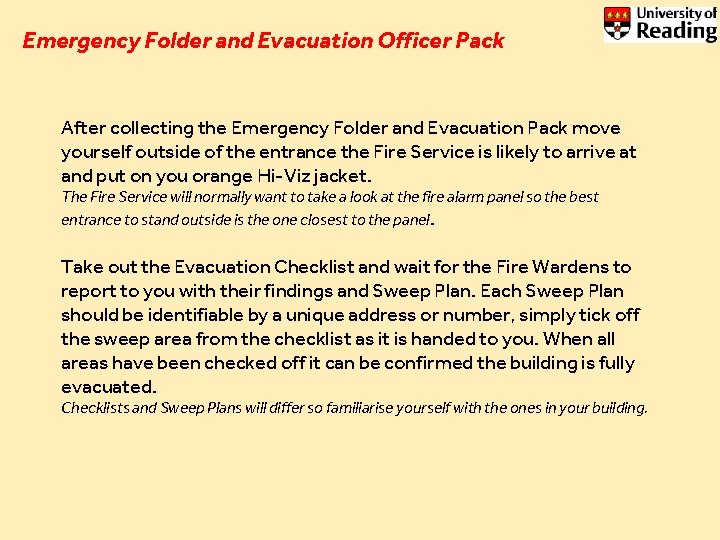
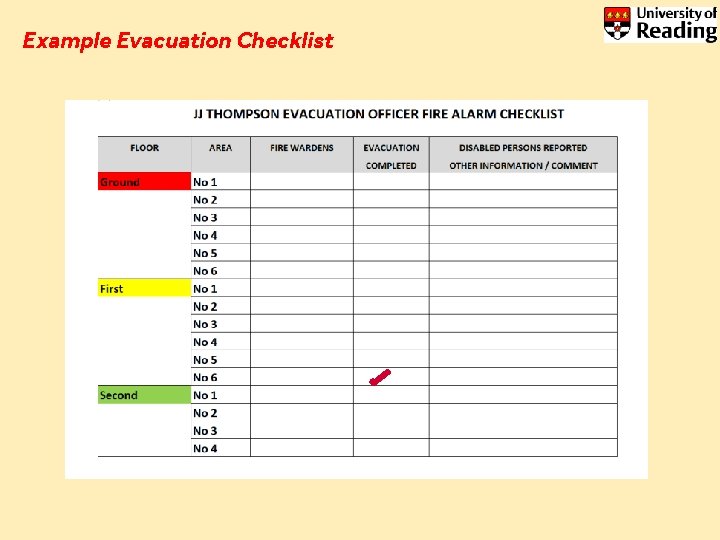
Emergency Folder and Evacuation Officer Pack After collecting the Emergency Folder and Evacuation Pack move yourself outside of the entrance the Fire Service is likely to arrive at and put on you orange Hi-Viz jacket. The Fire Service will normally want to take a look at the fire alarm panel so the best entrance to stand outside is the one closest to the panel. Take out the Evacuation Checklist and wait for the Fire Wardens to report to you with their findings and Sweep Plan. Each Sweep Plan should be identifiable by a unique address or number, simply tick off the sweep area from the checklist as it is handed to you. When all areas have been checked off it can be confirmed the building is fully evacuated. Checklists and Sweep Plans will differ so familiarise yourself with the ones in your building.
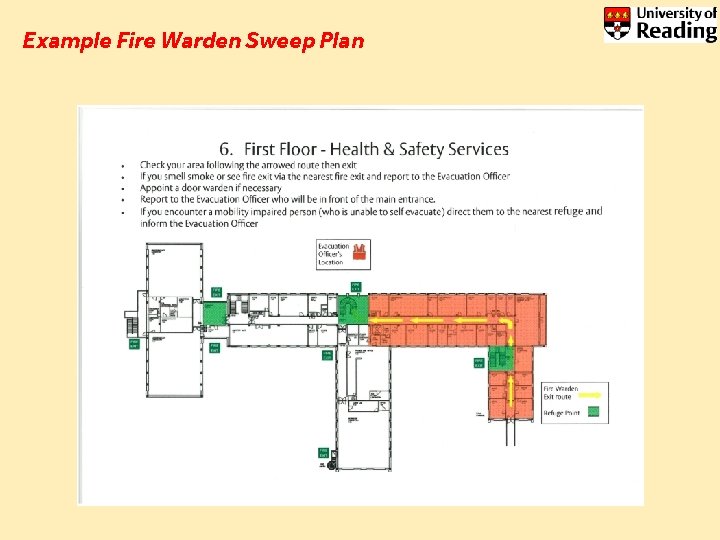
Example Fire Warden Sweep Plan
Example Evacuation Checklist
Other information from Fire Wardens The Fire Wardens are also asked to gather other information during their sweep and report this to the Evacuation Officer, this may include: - 1. The location of people unable to use the stairs remaining within a safe Refuge area. 2. The location of people refusing to leave. 3. Information regarding the location and type of fire. There should be space on the Evacuation Checklist to write this additional information down, it is important this information is passed to Security and/or Fire Service when they arrive.
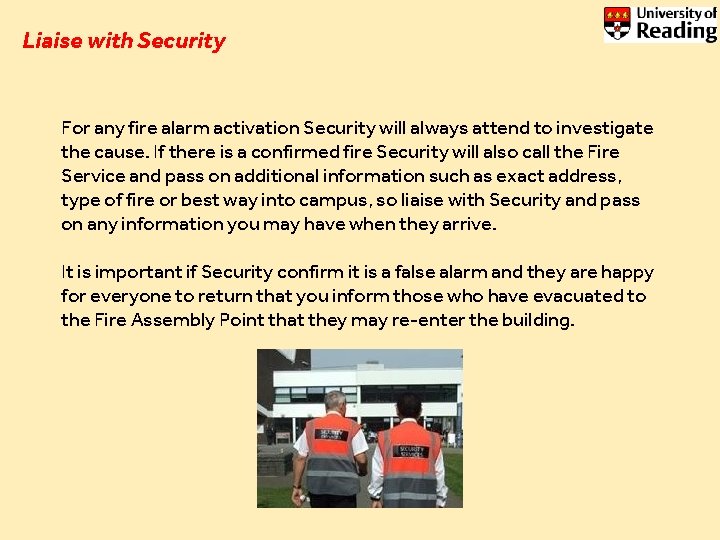
Liaise with Security For any fire alarm activation Security will always attend to investigate the cause. If there is a confirmed fire Security will also call the Fire Service and pass on additional information such as exact address, type of fire or best way into campus, so liaise with Security and pass on any information you may have when they arrive. It is important if Security confirm it is a false alarm and they are happy for everyone to return that you inform those who have evacuated to the Fire Assembly Point that they may re-enter the building.
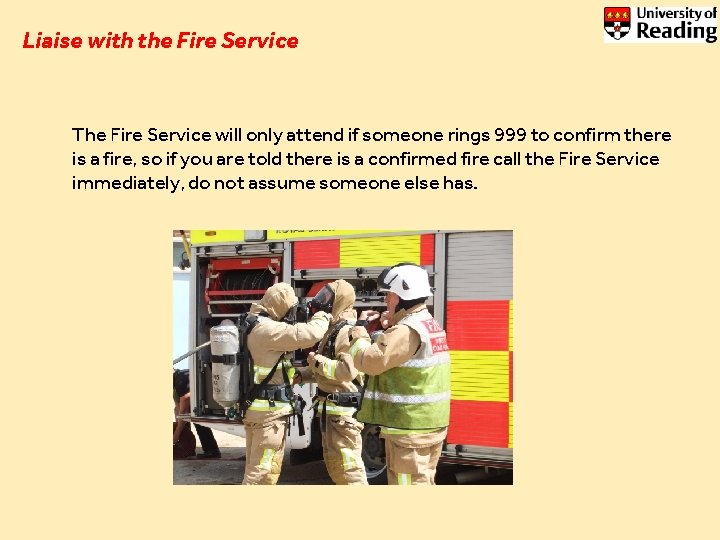
Liaise with the Fire Service The Fire Service will only attend if someone rings 999 to confirm there is a fire, so if you are told there is a confirmed fire call the Fire Service immediately, do not assume someone else has.
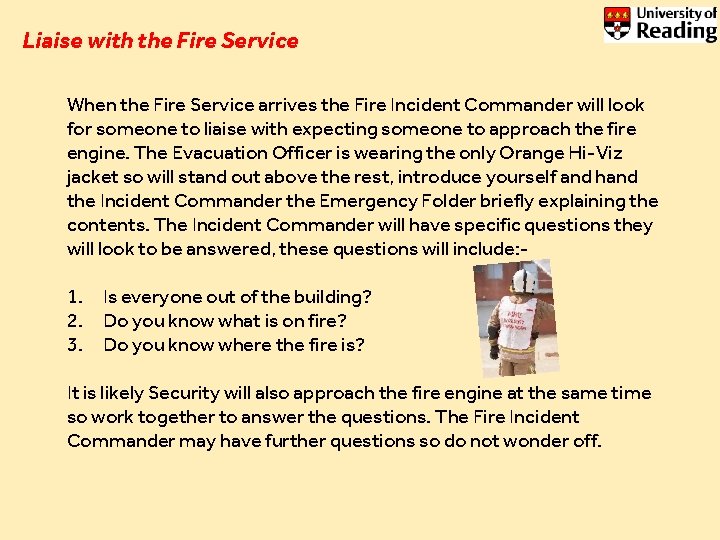
Liaise with the Fire Service When the Fire Service arrives the Fire Incident Commander will look for someone to liaise with expecting someone to approach the fire engine. The Evacuation Officer is wearing the only Orange Hi-Viz jacket so will stand out above the rest, introduce yourself and hand the Incident Commander the Emergency Folder briefly explaining the contents. The Incident Commander will have specific questions they will look to be answered, these questions will include: - 1. Is everyone out of the building? 2. Do you know what is on fire? 3. Do you know where the fire is? It is likely Security will also approach the fire engine at the same time so work together to answer the questions. The Fire Incident Commander may have further questions so do not wonder off.
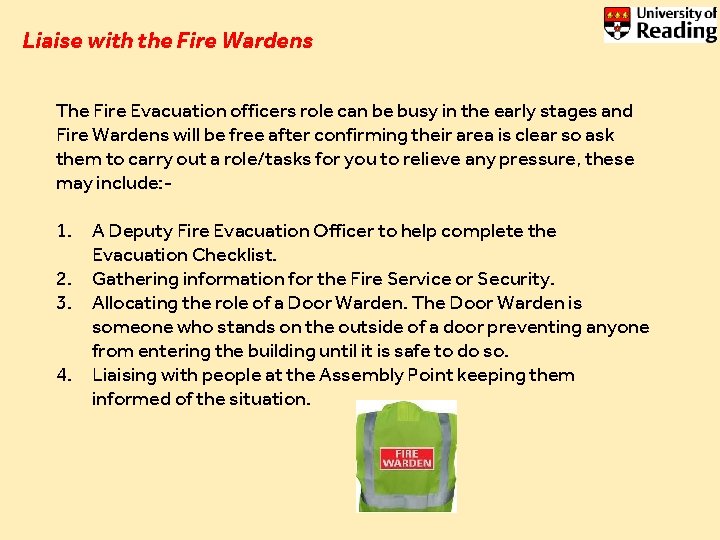
Liaise with the Fire Wardens The Fire Evacuation officers role can be busy in the early stages and Fire Wardens will be free after confirming their area is clear so ask them to carry out a role/tasks for you to relieve any pressure, these may include: - 1. A Deputy Fire Evacuation Officer to help complete the Evacuation Checklist. 2. Gathering information for the Fire Service or Security. 3. Allocating the role of a Door Warden. The Door Warden is someone who stands on the outside of a door preventing anyone from entering the building until it is safe to do so. 4. Liaising with people at the Assembly Point keeping them informed of the situation.
Evacuation Procedure If your building does not have Fire Warden Sweep Packs and Evacuation Officer Packs it is likely to be deemed a small building and have very few people, it is therefore also unlikely to have an Emergency Folder. For these buildings a very quick sweep by one person familiar with the building is all that is required. If this is your building, once you have carried out the sweep liaise with Security and or the Fire Service on their arrival. Should you have any questions or believe you should have an evacuation team please contact the University Fire Safety Advisor.
Evacuation Procedure Upon return to your building familiarise yourself with: - • How evacuations are managed within your building. • Other evacuation team members, there should be a list displayed in your building organised by the BSO. • The location of the fire alarm panel. • Contents of the Emergency Folder and Evacuation Officer pack. • The location of your building Fire Assembly Point.
Emergency telephone numbers • Campus Security emergency Tel: - 0118 378 6300 • Fire Tel: - 999 or 112 • If you are informed of a confirmed fire, call 999, the Fire Service will not attend unless someone calls them to confirm there is a fire. Do not assume someone else has called, the more calls made to the Fire Service the better the information which can be passed to the on coming fire engines. • Security are alerted automatically when the fire alarm sounds and will immediately attend to investigate the cause however still please contact Security on the emergency number to inform them if there is a confirmed fire. • It is good practice to store the Security emergency number in your mobile phone.
Quiz
Quiz 1. What should you do upon hearing the fire alarm? Immediately make your way to the fire alarm control panel and collect the Emergency Folder and Evacuation Officer Pack. 2. What should you do if someone from the building confirms there is a fire? If you are informed of a confirmed fire, call 999, the Fire Service will not attend unless someone calls them to confirm there is a fire. 3. Where is the Fire Evacuation Pack and Emergency Folder normally found? These will be located adjacent to the fire alarm panel normally located by the building main entrance. 4. Where should you stand once you have collected the Emergency Folder and Evacuation Pack? After collecting the Emergency Folder and Evacuation Officer Pack move yourself outside of the entrance the Fire Service is likely to arrive at, don’t forget to put on your orange Hi-Viz jacket.
Quiz 5. What information is contained within the Emergency Folder? The folder contains information on the building design and risks with plans for each level. 6. What should the Fire Wardens do once they have completed their sweep? Fire Wardens should report to you with their findings and Sweep Plan. 7. Who will always attend to investigate the cause of the fire alarm activation? Security will always attend to investigate the cause of the fire alarm activation however the Fire Service will only attend if a 999 call is made confirming there is a fire. 8. What should you do if the Fire Service arrive? Introduce yourself, hand the Incident Commander the Emergency Folder briefly explaining the contents and work with Security to answer any questions.
Contact details If you have any questions regarding Fire Safety or the Acting Evacuation Officer procedure please contact: David Sharp - Fire Safety Adviser Tel: - 07719 356158 d. w. sharp@reading. ac. uk Kevin Mc. Govern - Deputy Fire Safety Adviser Tel: - 07725 217289 k. b. mcgovern@reading. ac. uk
Thank you for your help