
ACT Prep Grammar 3 Verbs The most important

ACT Prep Grammar #3
Verbs The most important part of speech in a sentence is probably the verb. A verb expresses action, a state of being, or a condition of the subject of the sentence. No sentence is complete without a verb. 2
Action Verbs Action verbs help to create strong, effective sentences. Examples: Mr. Gomez teaches me Finance 102. Juanita purchased a stock certificate. Alana wrote legibly. 3

Linking Verbs Linking verbs are sometimes called to be verbs and have predicate nominatives and predicate adjectives Examples: The new president is Mr. Chow. The old software programs were expensive. 4
Condition Linking Verb A condition linking verb connects an adjective to the subject. Examples: The assistant appears cooperative. The health food tastes delicious. 5
Verb Tenses The verb tense indicates the time an action takes place. There are six verb tenses in English. 6
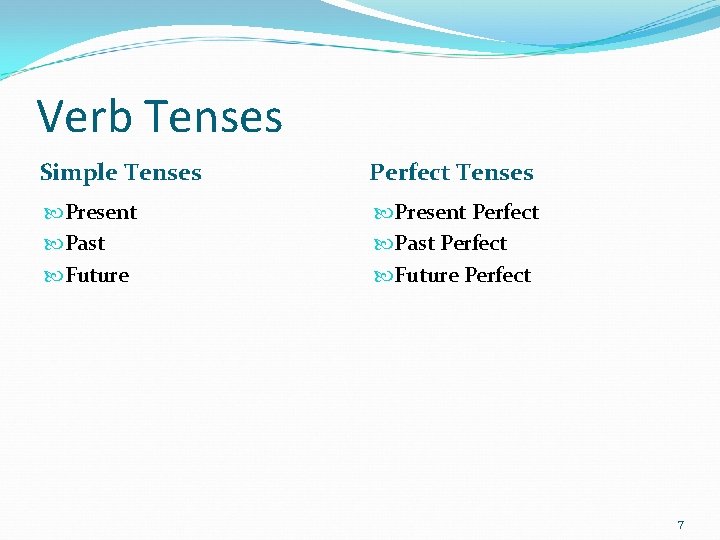
Verb Tenses Simple Tenses Perfect Tenses Present Past Future Present Perfect Past Perfect Future Perfect 7
Present Tense Verb A present tense verb expresses present occurrences (what is happening now) Examples: Computer services sell information. Georgia is teaching a course in merchandising. Rachel sings in the shower. 8
Past Tense Verb A past tense verb expresses action recently completed. Examples: Restless, the commander walked all night. Tammy was visiting her bedridden father. Joe ate lunch before noon. 9
Future Tense Verb A future tense verb expresses action or condition yet to come. Future tense is formed by placing the helping verb will before the main verb. I will vote on election day. The accountants will be consulting with their clients. 10
Perfect Tenses A perfect tense verb describes the action of the main verb in relation to a specific time period that is in the past, from the past to the present, or in the future. 11
Present Perfect Tense Verb A present perfect tense verb indicates continuous action from the past to the present. Examples: George has voted in every election since 1986. They have been jogging every day since the beginning of the month. 12
Past Perfect Tense Verb A past perfect tense verb indicates action that began in the past and continued to the more recent past when it was completed. Examples: George had voted in every election until last week. They had been jogging every day until this past Monday. 13
Future Perfect Tense Verb A future perfect tense verb indicates action that will be completed at a specific point in the future. Examples: Including next year, George will have voted in every election since 1986. By the end of the day, the train will have reached Phoenix. 14
Transitive Verbs A transitive verb is a verb that must have an object to complete the meaning of a sentence. Examples: Corrina suggested (suggested what? Not complete) Corrina suggested a profitable method. (Complete) 15

Intransitive Verb An intransitive verb is a verb that does not need an object to complete the meaning of a sentence. Examples: The recruits laughed. The merchandise is here. He will be treasurer. 16
Active Voice Active voice means that the subject of a sentence is doing the action. Examples: Mr. Park completed his report using his computer. The young sprinter won the race. Gloria presented the sales figures. 17
Passive Voice Passive voice means that the subject of a sentence is receiving the action. Examples: The ball will be caught by Yoko. The report was completed by Mr. Park. The poem is recited by the young actor. 18
Subject-Verb Agreement Good communicators make sure that their subjects and verbs always agree. Examples: He walks They walk 19
Agreement in Number Third-person singular pronouns and singular nouns require a singular verb that ends in s when the present tense is used. Examples: Lora telephones her parents daily. Geraldo drives to his client’s warehouse every Monday. 20
Agreement In Number Third-person plural pronouns and plural nouns require a plural verb that does not end in s when the present tense is used. Examples: Joy’s parents telephone her daily. The musicians record their music when they have a chance. 21
Agreement in Number If a sentence is inverted, putting the sentence in normal order will help you check subject-verb agreement. Examples: Inverted Order In the box are two bags of apples. Normal Order Two bags of apples are in the box. 22
Intervening Phrases Intervening words do not affect subject-verb agreement and should be ignored. Examples: The manager of the sports teams is traveling to New Orleans. The members of the audience have different reactions. 23
A Number, The Number When used as a subject, the expression a number is considered plural and needs a plural verb. Examples: A number of inquiries come to our office each day. There a number of tourists at our concert. The number of inquiries has decreased since last month. 24
Names of Companies Names of companies are usually considered singular. Examples: Gordon, Rodriguez, and Ramirez is representing the plaintiff. Silkowski and Daughters manufactures computer chips. Park and Sons sells hardware and supplies. 25
Amounts An amount that is plural in form takes a singular verb if the amount is considered one item. Examples: One hundred dollars is a generous wedding gift. Fifty-one books are on my shelf. Twelve students do not have their work completed. 26
Compound Subjects Errors in subject-verb agreement commonly occur with compound subjects. Examples: Francesca and Lorenzo are visiting their parents in Wuxi. Peanut butter and jelly is popular in the middle school. 27
Adverbs An adverb is a word that modifies an action verb, an adjective, or another adverb. Most adverbs end in ly. An adverb answers the questions how, when, where, how often, or to what extent. 28
Adverb Examples He wrote the report correctly. He wrote the report yesterday. He wrote the report here. He wrote the report twice. He wrote the report very quickly. 29

Modifying Verbs Adverbs modify action verbs. Examples: She gave it to me gladly. The dog sat up and begged just once. That has already been ordered. 30
Modifying Adjectives An adverb can modify an adjective. Examples: The cookies Granny bakes are very good. That new project is tremendously complex. 31
Modifying Adverbs An adverb can modify another adverb. Examples: The middle school pupil did her work too quickly. We purchased the new printer very recently. 32
Conjunctive Adverbs A conjunctive adverb is a transitional word that joins two independent but related sentences. Examples: Therefore Moreover However Nevertheless Furthermore 33
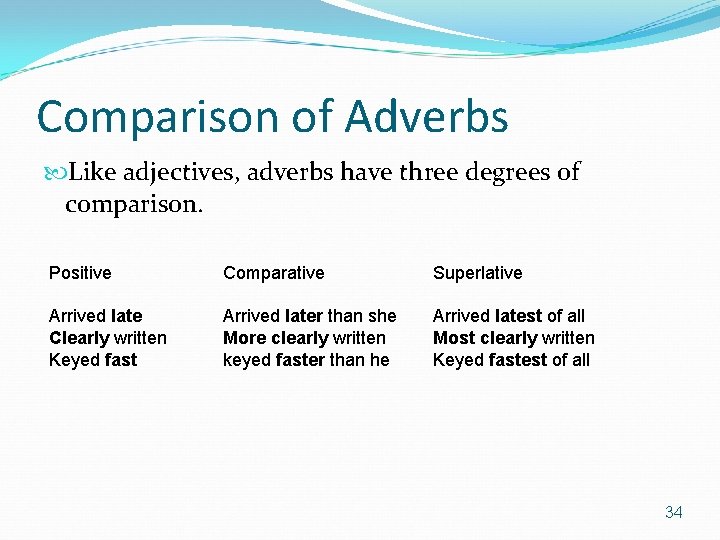
Comparison of Adverbs Like adjectives, adverbs have three degrees of comparison. Positive Comparative Superlative Arrived late Clearly written Keyed fast Arrived later than she More clearly written keyed faster than he Arrived latest of all Most clearly written Keyed fastest of all 34
- Slides: 34