
Act Now An Incremental Implementation of an ActivityBased
Act Now: An Incremental Implementation of an Activity-Based Model System in Puget Sound Presented to: 12 th TRB National Transportation Planning Applications Conference May 19, 2009 Presented by: Maren Outwater, PSRC Chris Johnson, PSRC Mark Bradley John Bowman Joe Castiglione
PRESENTATION OVERVIEW n n n PSRC model development strategy Activity-based models Activity generator technical approach Model calibration & validation Model application
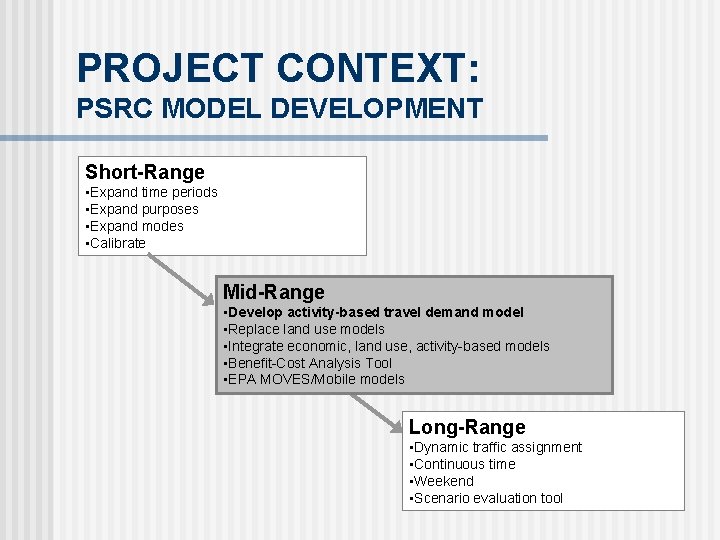
PROJECT CONTEXT: PSRC MODEL DEVELOPMENT Short-Range • Expand time periods • Expand purposes • Expand modes • Calibrate Mid-Range • Develop activity-based travel demand model • Replace land use models • Integrate economic, land use, activity-based models • Benefit-Cost Analysis Tool • EPA MOVES/Mobile models Long-Range • Dynamic traffic assignment • Continuous time • Weekend • Scenario evaluation tool
4 -STEP MODEL LIMITATIONS n Insensitive to n n n Aggregation biases n n Interactions among trips, tours (trip chains) Interactions among persons in HH Demographic / market segmentation Temporal Spatial Unable to answer key policy questions n Insensitive in trip generation to pricing and climate change policies
ACTIVITY-BASED MODELS ADVANTAGES n Better policy sensitivities n n n Consistency n n n Broader More behaviorally accurate Within person-day of travel Across persons in a household More detailed information n n Travel choices Impacts on travelers

ACTIVITY-BASED MODEL PROJECTS IN THE U. S.
AN INCREMENTAL APPROACH n n Replace parts of trip generation with activitygenerator Integrate with current and new models Build upon PSRC model design, enhancement and development efforts Implement quickly
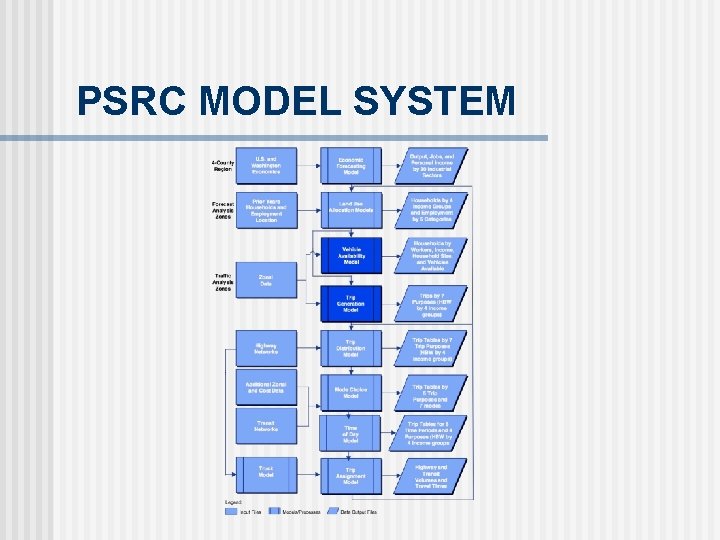
PSRC MODEL SYSTEM
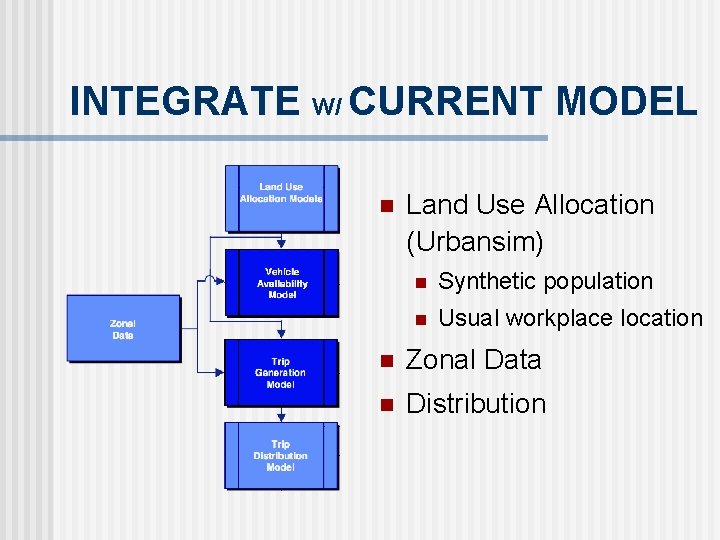
INTEGRATE W/ CURRENT MODEL n Land Use Allocation (Urbansim) n Synthetic population n Usual workplace location n Zonal Data n Distribution
KEY FEATURES n Policy Sensitivity n n n Transportation Land use Induced/suppressed demand (accessibility via logsums) Broader set of HH and individual attributes incorporated Transition to full activity-based model
ACTIVITY PURPOSES n Work n n Usual & other School n By age group n Escort (pick up / drop off) n Shopping n Personal business n Meal n Social / recreational
ESTIMATION n n 2006 HH Survey n Processed into tours, trips, activity patterns n Expanded, re-weighted Discrete choice logit models n Vehicle availability n Out-of-home activity purposes n Number of primary tours n Number of work-based tours n Number, sequence, purpose of intermediate stops
IMPLEMENTATION n Microsimulation models n Household vehicle availability n Person activity generation n Stochastic application for all HHs / persons in synthetic sample n Initially in Delphi, translated to Python n Integration into overall model runstream
ACCESSIBILITY MEASURES: MODE & DESTINATION CHOICE LOGSUMS n n Pre-calculated by Activity Generator Mode choice logsums n n Based on existing trip-based mode choice models Segmented by purpose, income, auto availability Used in destination choice modes Destination choice logsums n n Activity Generator uses destination choice models to pre-calculate mode/destination accessibility logsums for residence zones. Re-calculated at beginning of each global feedback iteration
SYNTHETIC POPULATION n n Synthetic population input to vehicle availability and activity generator model Produced by Urbansim (also predicts usual work locations) Based on 2000 Census PUMS Distributions regionally controlled: n n Household size (1, 2, 3, 4+) Household workers (0, 1, 2, 3+) Household income (<$30 K, $30 K-$60 K, $60 K-$100 K, >$100 K) 3. 45 million regional residents
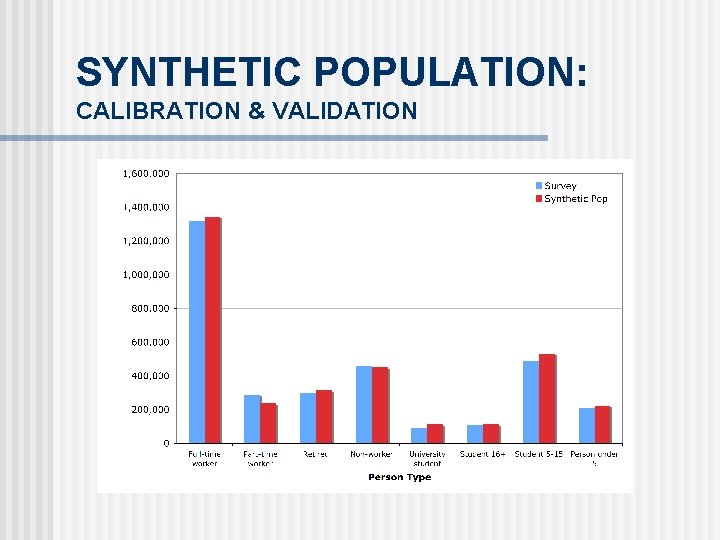
SYNTHETIC POPULATION: CALIBRATION & VALIDATION
VEHICLE AVAILABILITY n Predict number of motorized vehicles used by household (own, lease, other) n n 0, 1, 2, 3, 4+� Key inputs n n n HH attributes� Home-work mode choice logsums Usual work location accessibility information Residence location accessibility information Vehicles vs. potential drivers
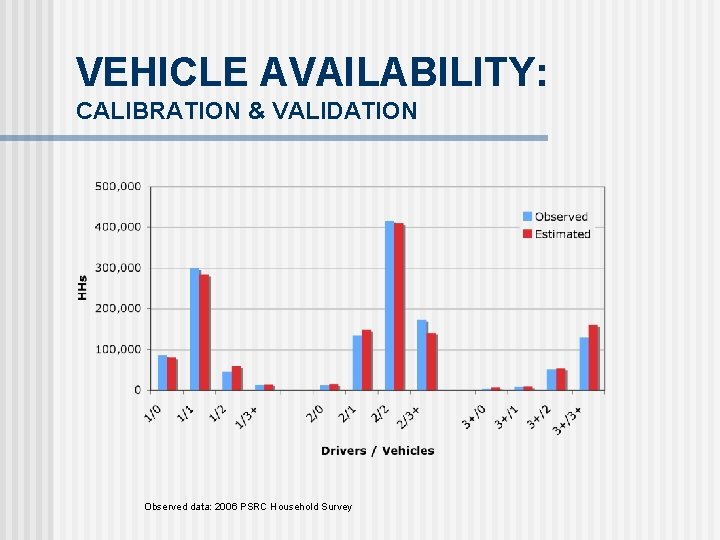
VEHICLE AVAILABILITY: CALIBRATION & VALIDATION Observed data: 2006 PSRC Household Survey
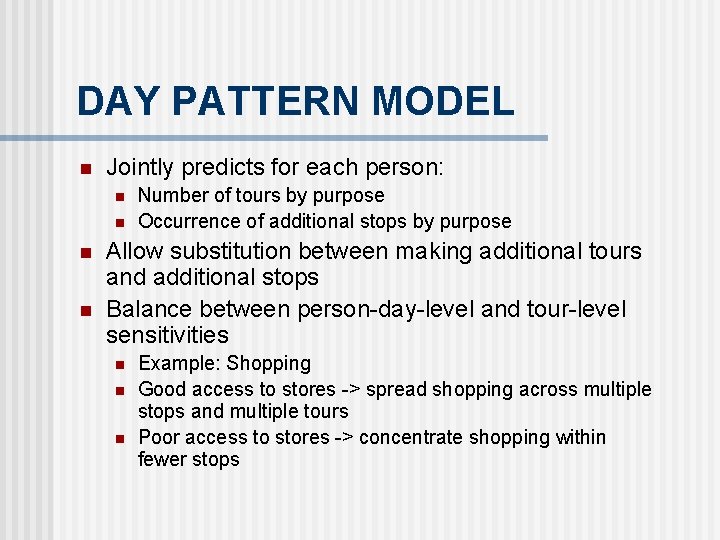
DAY PATTERN MODEL n Jointly predicts for each person: n n Number of tours by purpose Occurrence of additional stops by purpose Allow substitution between making additional tours and additional stops Balance between person-day-level and tour-level sensitivities n n n Example: Shopping Good access to stores -> spread shopping across multiple stops and multiple tours Poor access to stores -> concentrate shopping within fewer stops
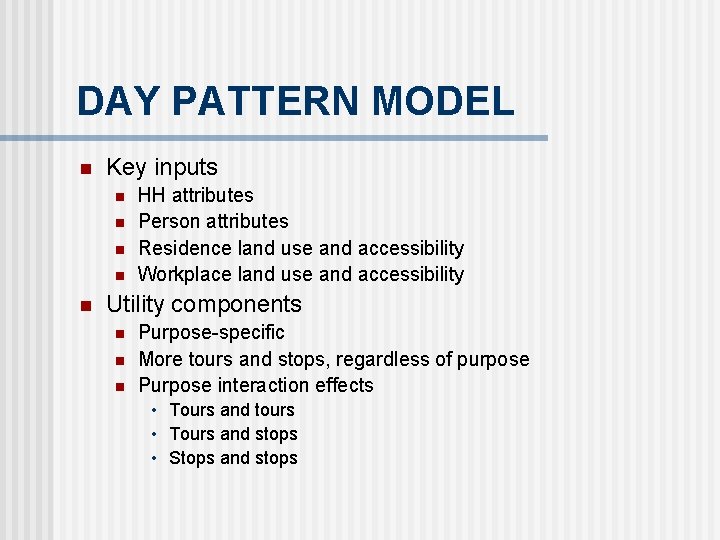
DAY PATTERN MODEL n Key inputs n n n HH attributes Person attributes Residence land use and accessibility Workplace land use and accessibility Utility components n n n Purpose-specific More tours and stops, regardless of purpose Purpose interaction effects • Tours and tours • Tours and stops • Stops and stops
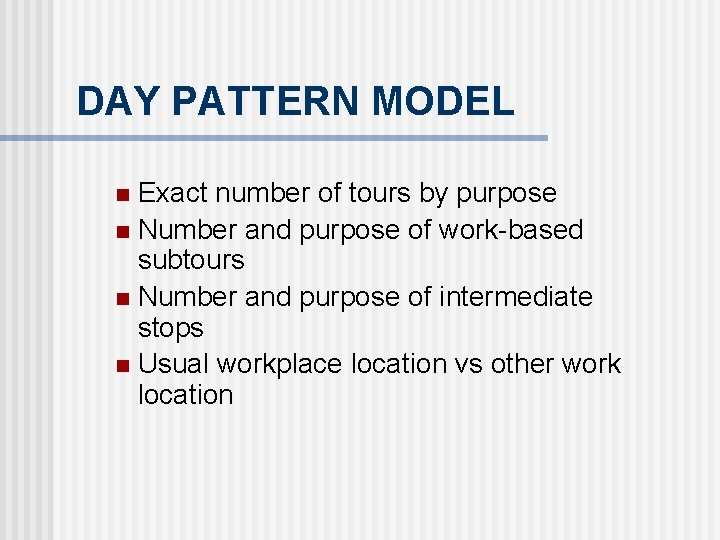
DAY PATTERN MODEL Exact number of tours by purpose n Number and purpose of work-based subtours n Number and purpose of intermediate stops n Usual workplace location vs other work location n
INTEGRATION WITH 4 -STEP PROCESS n n n Activity generator replaces parts of trip generation step Integrated into model system run stream as an executable Activity generator outputs are converted to trip arrays for use in subsequent use in distribution, mode choice, assignment
INTEGRATION WITH 4 -STEP PROCESS n Activity-based model outputs converted to trip-based model trip purposes n n n n HB Work HB School HB College HB Shop HB Other NHB Work : simple “origin choice” models predict production end NHB Other: simple “origin choice” models predict production end
ACTIVITY GENERATOR: CALIBRATION & VALIDATION n Goals n n n Replication of key aspects of travel Reasonable regional network assignment results GPS-adjusted targets n n Under-reporting of trips in HH survey HH subsample vehicle-based GPS
ACTIVITY GENERATOR: GPS ADJUSTMENTS n n Adjust for under-reporting of travel Limitations n n n Vehicle-based trips and HHs only Missing purpose information Model developed to predict probability that given type of trip was missing n n Binary logit Based on HH and trip attributes Probability converted into adjustment factor Factors constrained
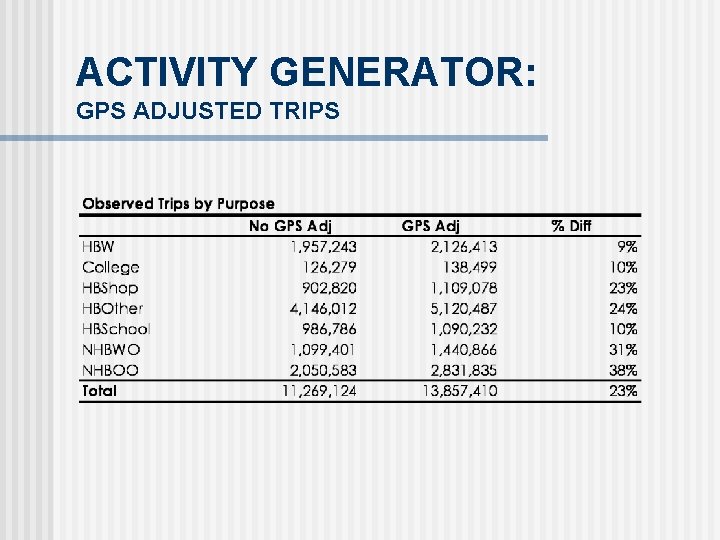
ACTIVITY GENERATOR: GPS ADJUSTED TRIPS
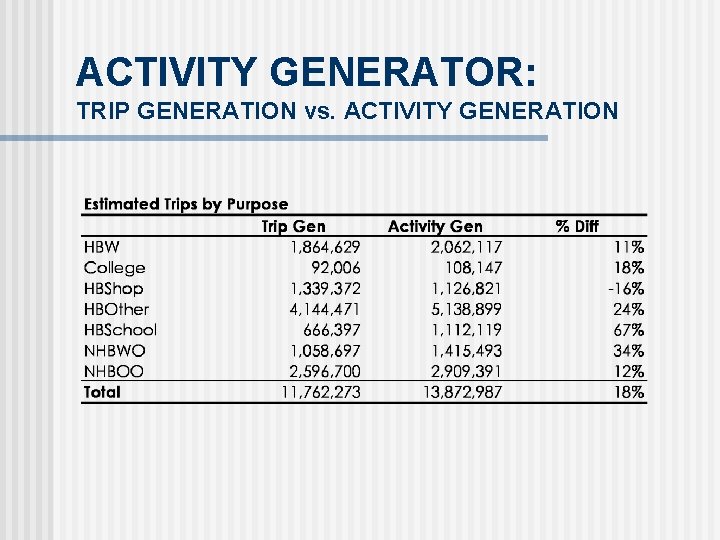
ACTIVITY GENERATOR: TRIP GENERATION vs. ACTIVITY GENERATION
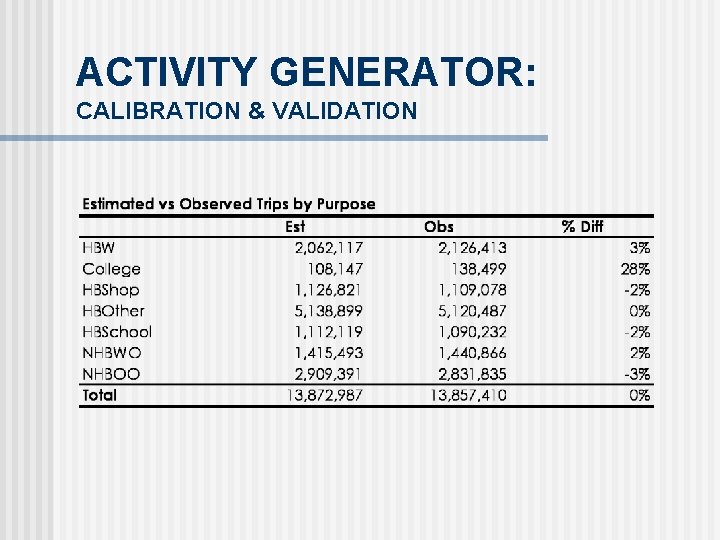
ACTIVITY GENERATOR: CALIBRATION & VALIDATION
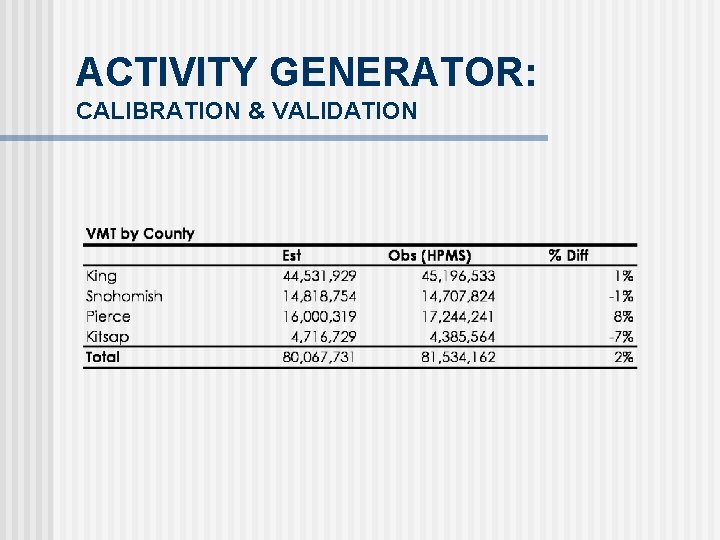
ACTIVITY GENERATOR: CALIBRATION & VALIDATION
MODEL APPLICATION: TRANSPORTATION 2040 n n Regional Transportation Plan update Integrated model system n n n Puget Sound Economic Forecasting model Urbansim Activity Generator-enhanced 4 -step model
TRANSPORTATION 2040: ALTERNATIVES n n n Alt 1: Existing system efficiency Alt 2: Capital improvements Alt 3: Core network expansion and efficiency Alt 4: Transportation system management Alt 5: Accessibility and reduced carbon emissions
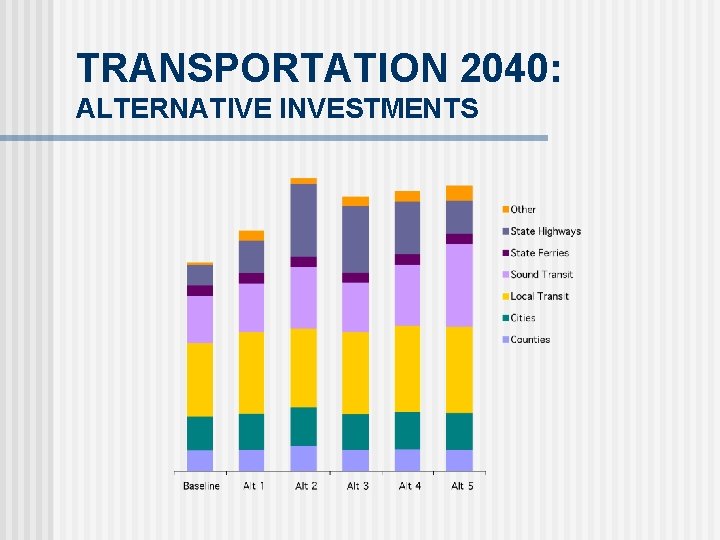
TRANSPORTATION 2040: ALTERNATIVE INVESTMENTS
TRANSPORTATION 2040: EVALUATION CRITERIA n n n n Mobility Finance Growth Management Economic Prosperity Environmental Stewardship Quality of Life Equity
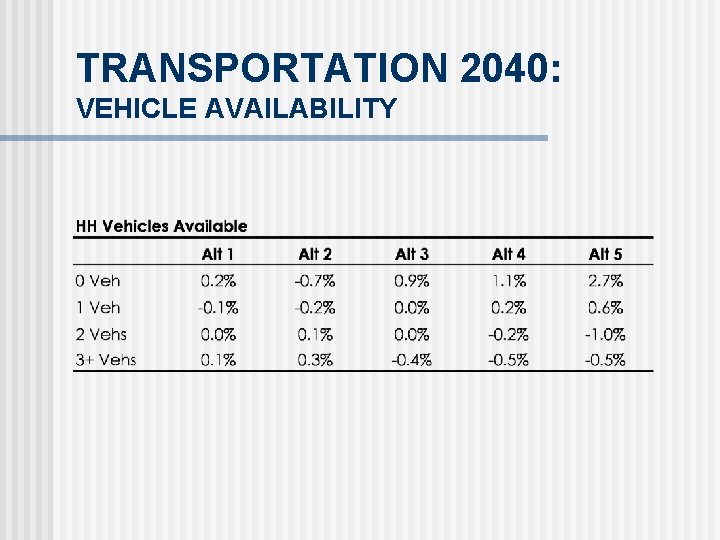
TRANSPORTATION 2040: VEHICLE AVAILABILITY
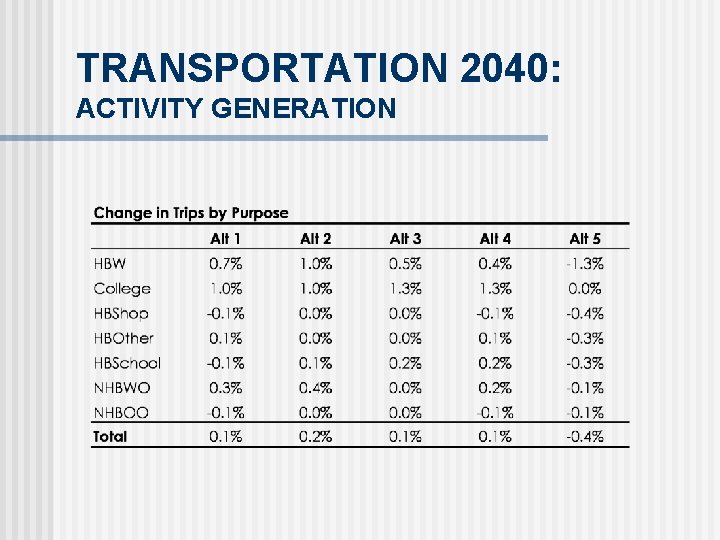
TRANSPORTATION 2040: ACTIVITY GENERATION
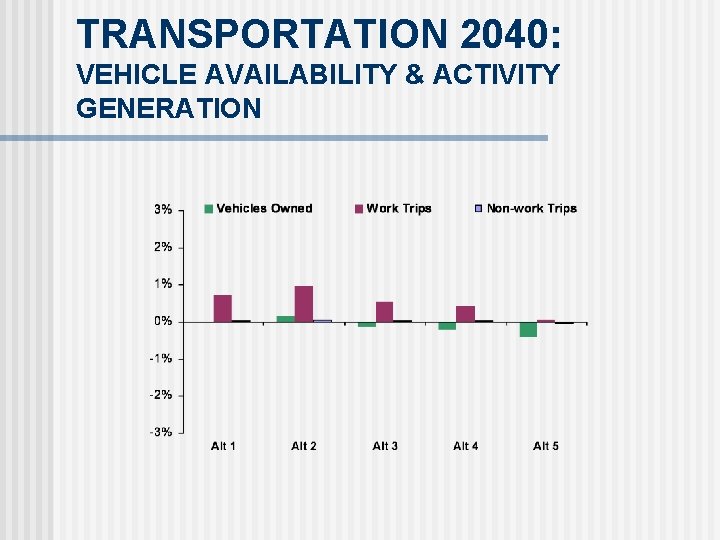
TRANSPORTATION 2040: VEHICLE AVAILABILITY & ACTIVITY GENERATION
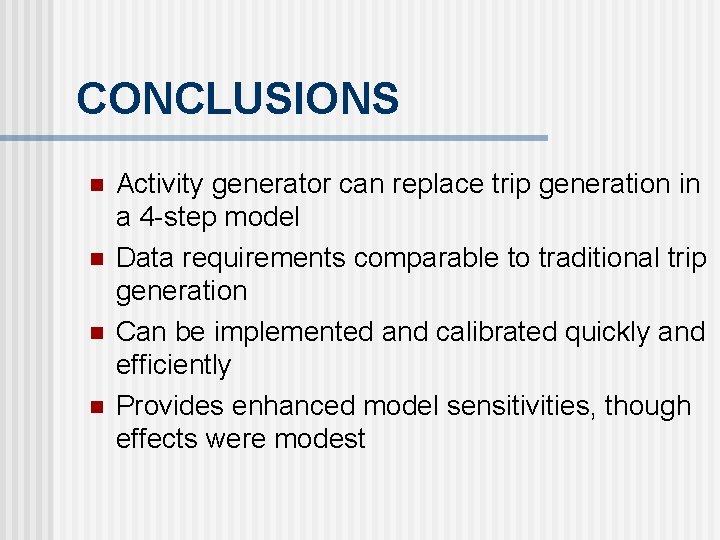
CONCLUSIONS n n Activity generator can replace trip generation in a 4 -step model Data requirements comparable to traditional trip generation Can be implemented and calibrated quickly and efficiently Provides enhanced model sensitivities, though effects were modest
- Slides: 37