
ACT and Motivational Interviewing Intersection of ACT Core

- Slides: 34
ACT and Motivational Interviewing Intersection of ACT Core Processes and MI principles
Workforce Development Director San Mateo County BHRS; Adjunct Faculty Dominican University of California Trainer, Psychotherapist, Consultant KRISTIN DEMPSEY, MS, MFT
Goals for this Workshop • Explore the client-centered nature of both approaches, as well as how each theory addresses change and action within a collaborative, client-centered model. • Examine how integration of models can provide a more powerful source of intervention as strengths of each technique is strategically combined and implemented.
Goals for this Workshop • Identify which interventions in the perspective practices can be best combined for the greatest therapeutic impact. • Develop increased ability to creatively make connections between models; be open to weaving together the approaches based on client needs, readiness and confidence to change, and participation in committed action.
This is just the beginning • The examples here of the complimentary nature of ACT and MI principles and procedures are not intended to be an exhaustive list…. • In fact, this is a place for you to be inspired…. the challenge is thus… What additional connections can you identify between the principles for both approaches, and how do these connections help reinforce the goal of behavior change toward valued action?
Let’s start with commonalities in spirit • ACT – Therapeutic stance: therapist “sits in the same boat” as our clients – Avoids convincing and arguing with clients – Therapists recognize their similarities to clients – Values the client’s experience and perspective – Collaborates with client
Let’s start with commonalities in spirit Motivational Interviewing: – Empathic, collaborative approach – Handled resistance skillfully (instead of head-on) – Therapeutic style is one of calm and caring concern – Appreciate the experiences and opinions of the client – Demonstrates a genuine concern and an awareness of client’s experiences
Let’s start with commonalities in spirit Motivational Interviewing: – Avoids advising or directing the client in an unsolicited fashion. – Decision making is shared – Clinician uses client’s reactions to what the clinician has said to guide the direction of the session – Clinician avoids arguing with client
Starting with the Basics WHAT DO YOU KNOW ABOUT MOTIVATIONAL INTERVIEWING?
Motivational Interviewing – Essential Definition of the Method – 2009 Version • Motivational Interviewing is a collaborative, person-centered form of guiding to elicit and strengthen motivation for change. – Miller and Rollnick, 2009, page 130
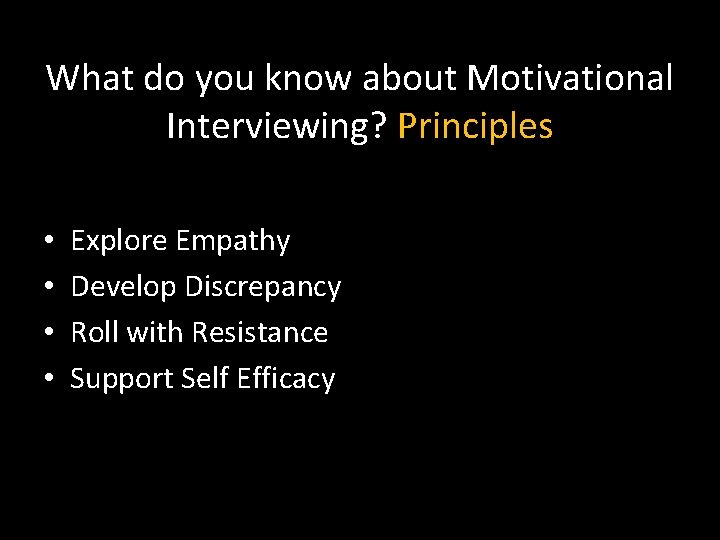
What do you know about Motivational Interviewing? Principles • • Explore Empathy Develop Discrepancy Roll with Resistance Support Self Efficacy
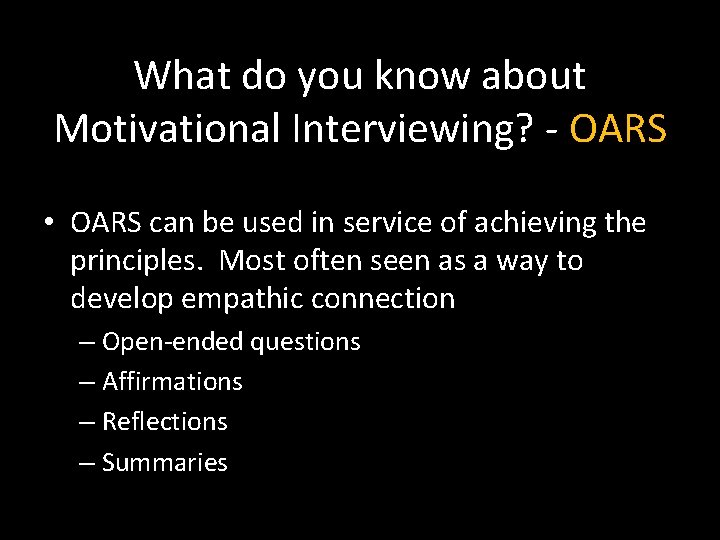
What do you know about Motivational Interviewing? - OARS • OARS can be used in service of achieving the principles. Most often seen as a way to develop empathic connection – Open-ended questions – Affirmations – Reflections – Summaries
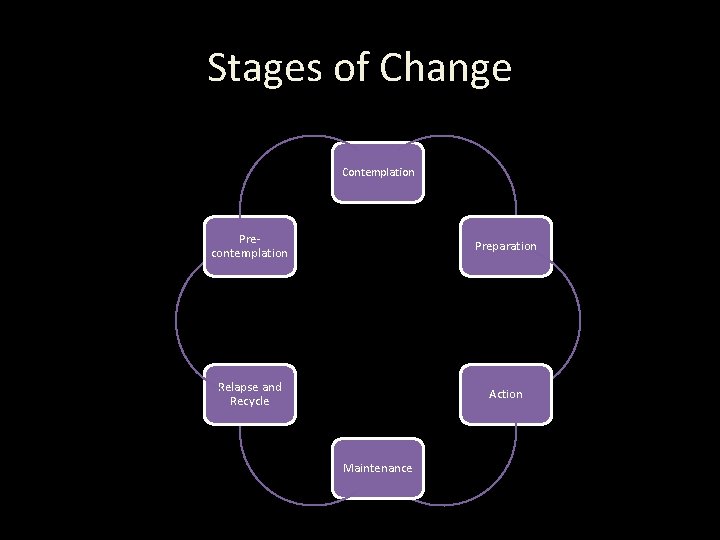
Stages of Change Contemplation Precontemplation Preparation Relapse and Recycle Action Maintenance
Phase I • Motivational Interviewing departs from more general client-centered counseling into being more consciously directive. • The counselor listens for, evokes and reinforces certain kinds of client statements (change talk), while responding to sustain talk in a way that does not strengthen it.
Phase II • This is when the client is actively motivated and committed toward change. • The counselor is negotiating change strategies with the client.
Motivational Interviewing – 3 rd Edition • The essential components of MI: –Engagement –Guidance –Evocation –Change Plan
ACT and MI Partnership • At Phase II, ACT can not only be used as the intervention to help negotiate behavior change, but ACT can help with the transition from pre-action to actively engaging change, by reinforcing motivational principles via thought defusion, acceptance skills, and addressing experiential avoidance.
If change were so easy…. . How ACT can support the MI principles and movement toward change • Client is motivated to leave a job which she finds demeaning and abusive. When asked to rate her desire to leave on a 1 -10 scale, she insists she is a 9…but she doesn’t feel confident in her ability to make the move. When asked what might be in the way of her making a change, she states she can’t get over her family rule that you can never give up what you started with out being considered a loser. She felt much more able to consider finding a new job after practicing letting go – defusing the thoughts through visualization. Her confidence regarding leaving her work rose after practicing defusion, and continued to rise independently of therapy session.
If Change Were so Easy…. • Client was able to speak at length regarding various reasons and needs for change – specifically improving reading skills and going back to work following a long period in a residential drug treatment program. • Despite his strong stated interest he always found more important things to do than to sign up for the adult school. After some exploration, he was able to firmly and
If it were so easy, continued Consistently state that he did not have any obvious resistance to going back to school. The ACT (this is also MI consistent) intervention used was to review again with client his values and be curious around how not signing up for adult school was or wasn’t contributing to his goal. • It was these conversations, which got him revisiting his values for himself and his family that moved him toward adult school.
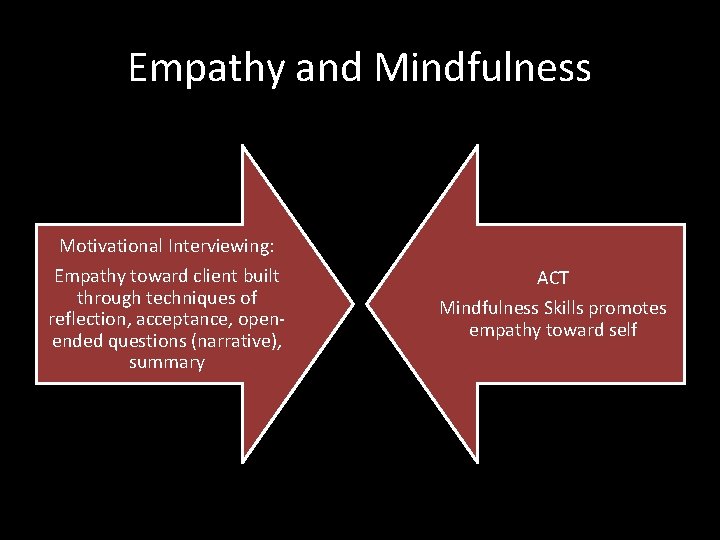
Empathy and Mindfulness Motivational Interviewing: Empathy toward client built through techniques of reflection, acceptance, openended questions (narrative), summary ACT Mindfulness Skills promotes empathy toward self
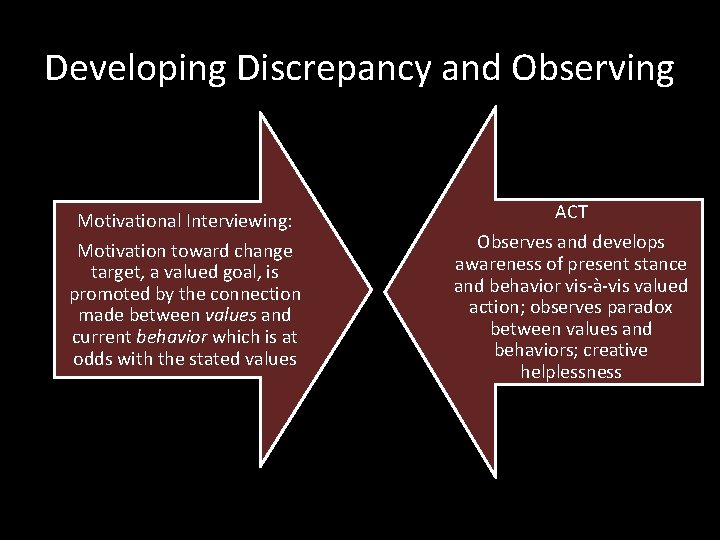
Developing Discrepancy and Observing Motivational Interviewing: Motivation toward change target, a valued goal, is promoted by the connection made between values and current behavior which is at odds with the stated values ACT Observes and develops awareness of present stance and behavior vis-à-vis valued action; observes paradox between values and behaviors; creative helplessness
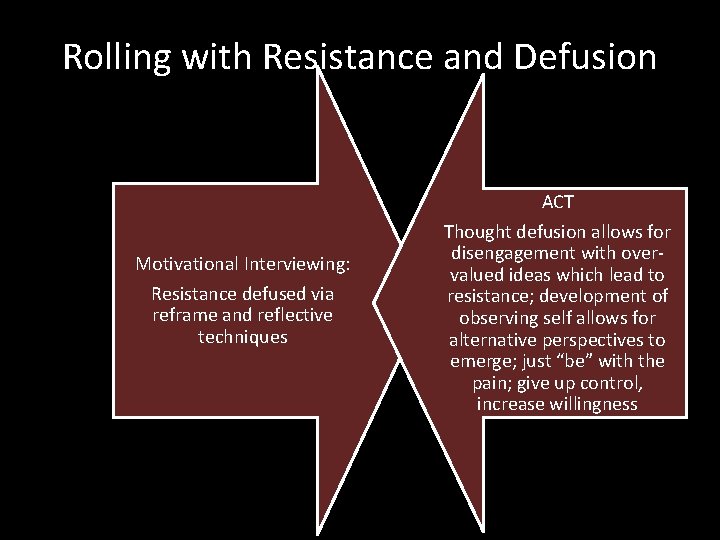
Rolling with Resistance and Defusion ACT Motivational Interviewing: Resistance defused via reframe and reflective techniques Thought defusion allows for disengagement with overvalued ideas which lead to resistance; development of observing self allows for alternative perspectives to emerge; just “be” with the pain; give up control, increase willingness
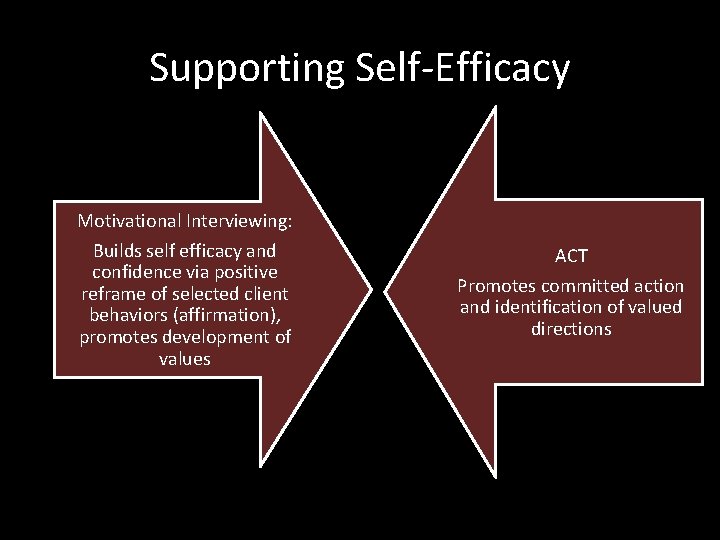
Supporting Self-Efficacy Motivational Interviewing: Builds self efficacy and confidence via positive reframe of selected client behaviors (affirmation), promotes development of values ACT Promotes committed action and identification of valued directions
Consider this…. • Mary Ann is a 53 year old client you meet at the pain management clinic. She has spotty attendance at the clinic, but states she comes because she doesn’t think the Vicodin is helping her any longer. She’s been on Vicodin for 12 years following an on the job accident at the assembly plant where she worked. She has had some success in cutting back, and says her valued goal is to stop using altogether.
Mary Ann, Continued When you explore further valued goal of being abstinent from opiates, she says she cannot bear being clean, as when she is, she cannot get over her anger around the loss of her physical health and her livelihood. As she talks, she becomes more agitated, and starts to intensely focus on the unfairness of her injury.
Looking through a double lens • The client has some motivation and some action in her life, yet she is also blocked when it comes to her target behavior and taking the next step.
Thinking it through 1. What stage of change is the client in …. – REMEMBER, FOR WHICH BEHAVIOR! 2. Name two ways you could assess her motivation for each target behavior area. 3. What are the core processes you see as needing the most attention? 4. How do issues in these core process areas help or hinder client’s move to Phase II (toward valued action).
Given this dual “assessment”… • What ACT-consistent intervention could you use to create some space in her thought/behavior process, and possibly move her toward acting on her valued goal (i. e. committed action)?
Bruce • Bruce, 22 years old, has been in four treatment programs. He has been a chronic user of marijuana, and recently picked up an Adderall habit while attending community college. He sees you in your office as he is about ready to flunk out of school due to nonattendance. His dad, with whom he lives, has given him an ultimatum to clean up or leave. Bruce says his dad is frustrated
Bruce, continued because Bruce has spent so many years in programs and has “not gotten anywhere”. Since the ultimatum 3 weeks ago, Bruce has not used. This has not been easy for him, and he admits to “white knuckling” it all this time. He doesn’t want to lose his housing, says he feels bad for his family, and is tired of “not owning my life” as the result of his use.
Bruce, continued • Bruce says he wants to quit, but he hates thinking about stopping drugs because if he does, it proves that he is a “junkie-addict”. He then goes on to rant about the “addicts” in treatment programs, how he’s not one of them, and his powerful desire/need to separate himself from “those f_____ing losers”.
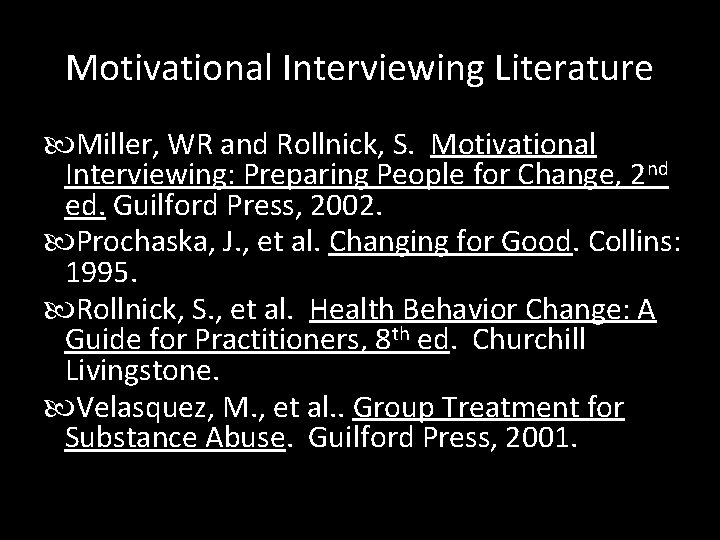
Motivational Interviewing Literature Miller, WR and Rollnick, S. Motivational Interviewing: Preparing People for Change, 2 nd ed. Guilford Press, 2002. Prochaska, J. , et al. Changing for Good. Collins: 1995. Rollnick, S. , et al. Health Behavior Change: A Guide for Practitioners, 8 th ed. Churchill Livingstone. Velasquez, M. , et al. . Group Treatment for Substance Abuse. Guilford Press, 2001.
Motivational Interviewing and Acceptance and Commitment Therapy I hope this presentation will initiate a common dialogue for all of us to consider the vast possibilities of the power of these two well-designed and compatible interventions. Please send feedback to me at dempseykristin@gmail. com