
ACR BIRADSUS Lexicon Classification Form BIRADS US For
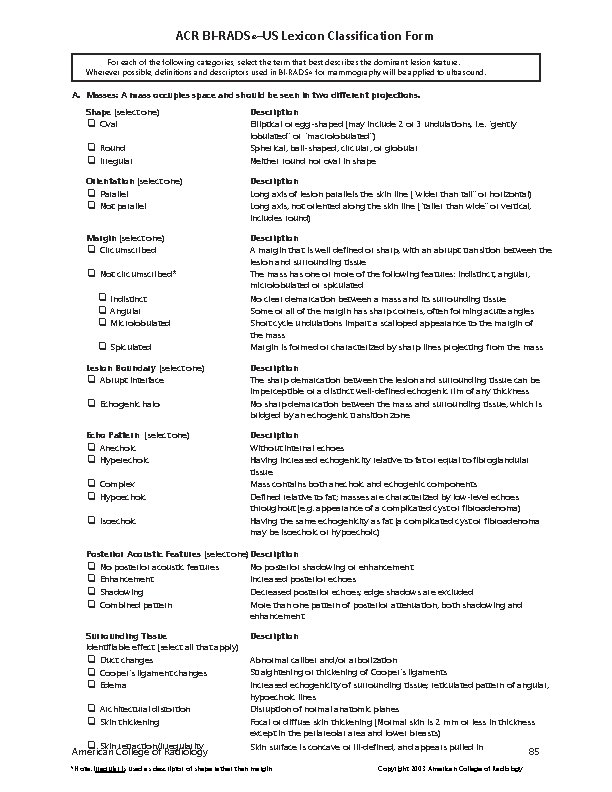
ACR BI-RADS®–US Lexicon Classification Form BI-RADS® – US For each of the following categories, select the term that best describes the dominant lesion feature. Wherever possible, definitions and descriptors used in BI-RADS® for mammography will be applied to ultrasound. A. Masses: A mass occupies space and should be seen in two different projections. Shape (select one) ❏ Oval ❏ Round ❏ Irregular Description Elliptical or egg-shaped (may include 2 or 3 undulations, i. e. “gently lobulated” or “macrolobulated”) Spherical, ball-shaped, circular, or globular Neither round nor oval in shape Orientation (select one) ❏ Parallel ❏ Not parallel Description Long axis of lesion parallels the skin line (“wider than tall” or horizontal) Long axis, not oriented along the skin line (“taller than wide” or vertical, includes round) Margin (select one) ❏ Circumscribed Description A margin that is well defined or sharp, with an abrupt transition between the lesion and surrounding tissue The mass has one or more of the following features: indistinct, angular, microlobulated or spiculated No clear demarcation between a mass and its surrounding tissue Some or all of the margin has sharp corners, often forming acute angles Short cycle undulations impart a scalloped appearance to the margin of the mass Margin is formed or characterized by sharp lines projecting from the mass ❏ Not circumscribed* ❏ Indistinct ❏ Angular ❏ Microlobulated ❏ Spiculated Lesion Boundary (select one) ❏ Abrupt interface ❏ Echogenic halo Echo Pattern (select one) ❏ Anechoic ❏ Hyperechoic ❏ Complex ❏ Hypoechoic ❏ Isoechoic Description The sharp demarcation between the lesion and surrounding tissue can be imperceptible or a distinct well-defined echogenic rim of any thickness No sharp demarcation between the mass and surrounding tissue, which is bridged by an echogenic transition zone Description Without internal echoes Having increased echogenicity relative to fat or equal to fibroglandular tissue Mass contains both anechoic and echogenic components Defined relative to fat; masses are characterized by low-level echoes throughout (e. g. appearance of a complicated cyst or fibroadenoma) Having the same echogenicity as fat (a complicated cyst or fibroadenoma may be isoechoic or hypoechoic) Posterior Acoustic Features (select one) Description No posterior shadowing or enhancement ❏ No posterior acoustic features ❏ Enhancement Increased posterior echoes ❏ Shadowing Decreased posterior echoes; edge shadows are excluded ❏ Combined pattern More than one pattern of posterior attenuation, both shadowing and enhancement Surrounding Tissue Identifiable effect (select all that apply) ❏ Duct changes ❏ Cooper’s ligament changes ❏ Edema ❏ Architectural distortion ❏ Skin thickening ❏ Skin retraction/irregularity American College of Radiology Description Abnormal caliber and/or arborization Straightening or thickening of Cooper’s ligaments Increased echogenicity of surrounding tissue; reticulated pattern of angular, hypoechoic lines Disruption of normal anatomic planes Focal or diffuse skin thickening (Normal skin is 2 mm or less in thickness except in the periareolar area and lower breasts) Skin surface is concave or ill-defined, and appears pulled in * Note: Irregular is used as descriptor of shape rather than margin Copyright 2003 American College of Radiology 85
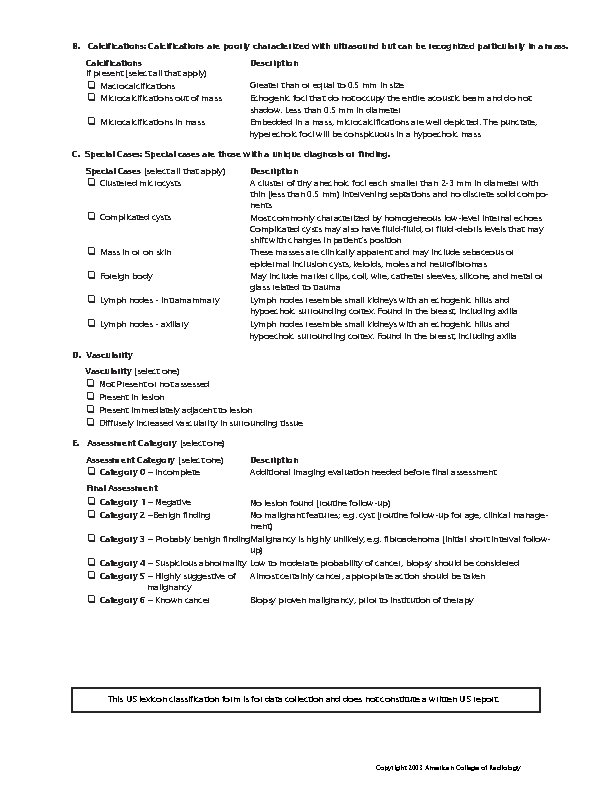
B. Calcifications: Calcifications are poorly characterized with ultrasound but can be recognized particularly in a mass. Calcifications If present (select all that apply) ❏ Macrocalcifications ❏ Microcalcifications out of mass ❏ Microcalcifications in mass Description Greater than or equal to 0. 5 mm in size Echogenic foci that do not occupy the entire acoustic beam and do not shadow. Less than 0. 5 mm in diameter Embedded in a mass, microcalcifications are well depicted. The punctate, hyperechoic foci will be conspicuous in a hypoechoic mass C. Special Cases: Special cases are those with a unique diagnosis or finding. Special Cases (select all that apply) ❏ Clustered microcysts ❏ Complicated cysts ❏ Mass in or on skin ❏ Foreign body ❏ Lymph nodes - intramammary ❏ Lymph nodes - axillary Description A cluster of tiny anechoic foci each smaller than 2 -3 mm in diameter with thin (less than 0. 5 mm) intervening septations and no discrete solid components Most commonly characterized by homogeneous low-level internal echoes Complicated cysts may also have fluid-fluid, or fluid-debris levels that may shift with changes in patient’s position These masses are clinically apparent and may include sebaceous or epidermal inclusion cysts, keloids, moles and neurofibromas May include marker clips, coil, wire, catheter sleeves, silicone, and metal or glass related to trauma Lymph nodes resemble small kidneys with an echogenic hilus and hypoechoic surrounding cortex. Found in the breast, including axilla D. Vascularity (select one) ❏ Not Present or not assessed ❏ Present in lesion ❏ Present immediately adjacent to lesion ❏ Diffusely increased vascularity in surrounding tissue E. Assessment Category (select one) ❏ Category 0 – Incomplete Description Additional imaging evaluation needed before final assessment Final Assessment ❏ Category 1 – Negative ❏ Category 2 –Benign finding ❏ ❏ No lesion found (routine follow-up) No malignant features; e. g. cyst (routine follow-up for age, clinical management) Category 3 – Probably benign finding. Malignancy is highly unlikely, e. g. fibroadenoma (initial short interval followup) Category 4 – Suspicious abnormality Low to moderate probability of cancer, biopsy should be considered Category 5 – Highly suggestive of Almost certainly cancer, appropriate action should be taken malignancy Biopsy proven malignancy, prior to institution of therapy Category 6 – Known cancer This US lexicon classification form is for data collection and does not constitute a written US report. Copyright 2003 American College of Radiology
- Slides: 2