
Acquisition of Securities by NonResidents Manvinder Singh Partner
Acquisition of Securities by Non-Residents Manvinder Singh Partner
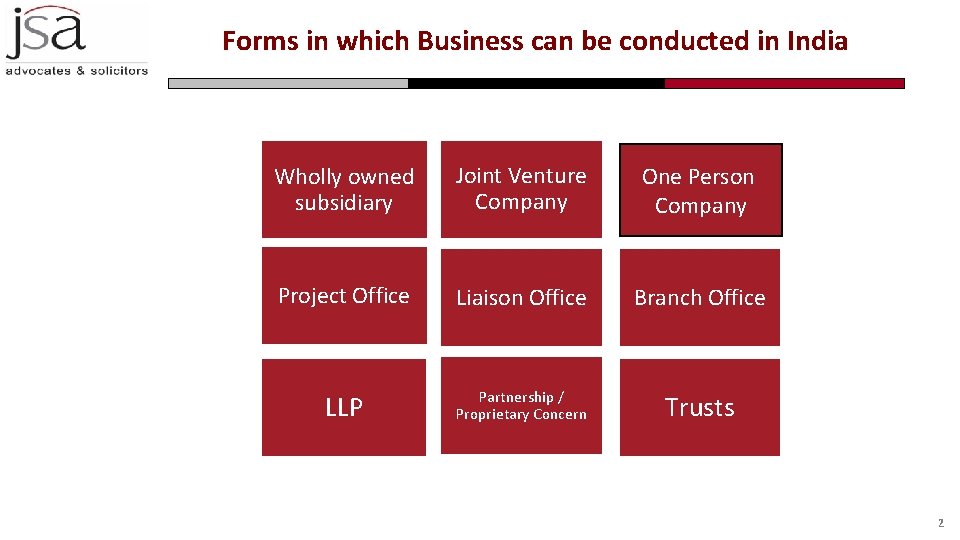
Forms in which Business can be conducted in India Wholly owned subsidiary Joint Venture Company One Person Company Project Office Liaison Office Branch Office LLP Partnership / Proprietary Concern Trusts 2
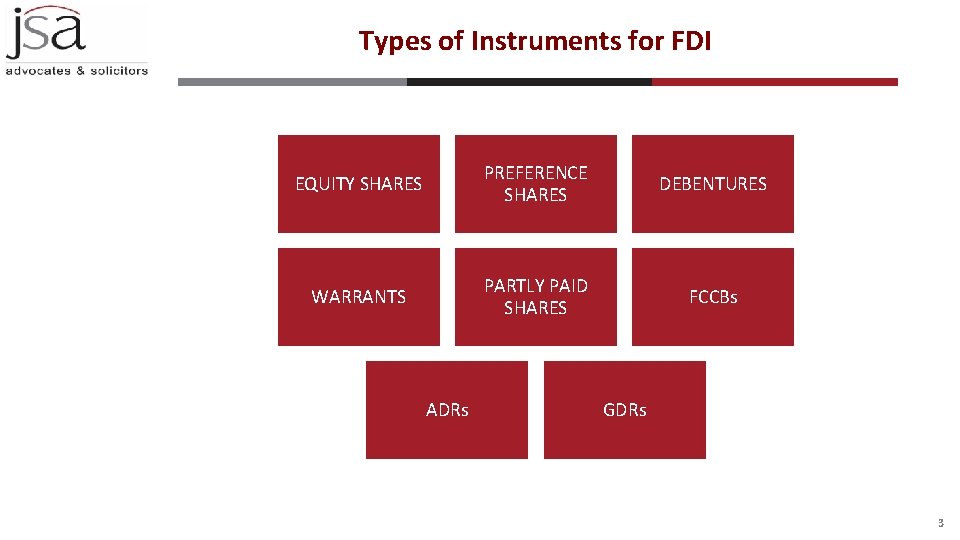
Types of Instruments for FDI EQUITY SHARES PREFERENCE SHARES DEBENTURES WARRANTS PARTLY PAID SHARES FCCBs ADRs GDRs 3
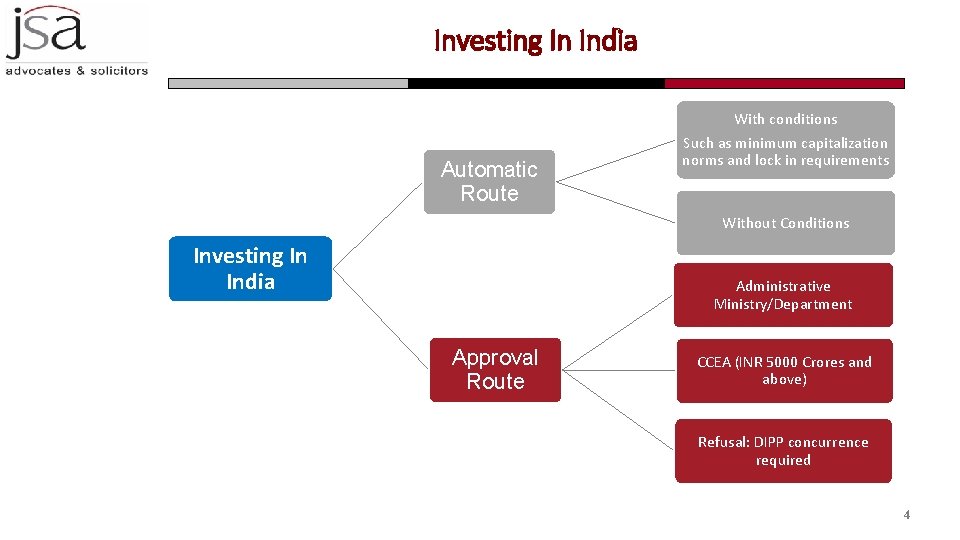
Investing In India Automatic Route With conditions Such as minimum capitalization norms and lock in requirements Without Conditions Investing In India Administrative Ministry/Department Approval Route CCEA (INR 5000 Crores and above) Refusal: DIPP concurrence required 4
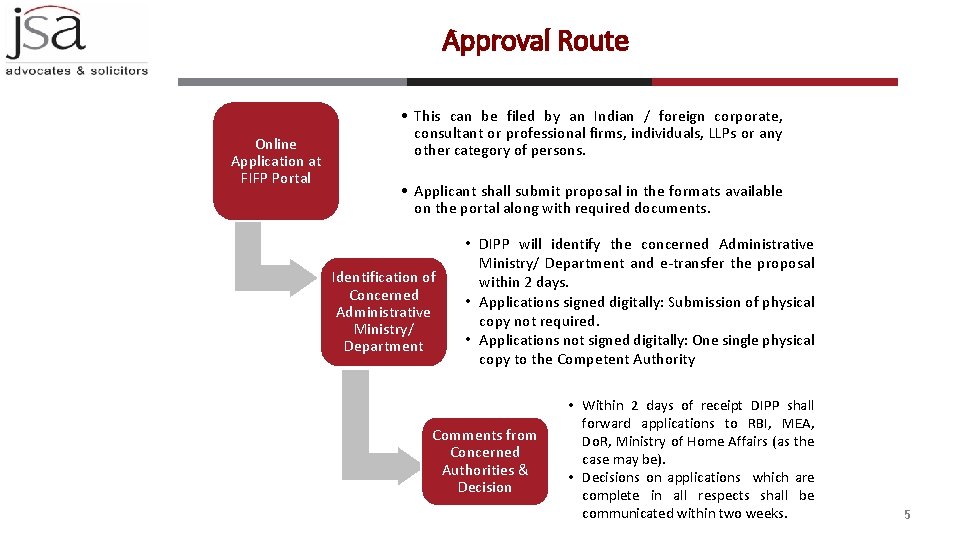
Approval Route Online Application at FIFP Portal • This can be filed by an Indian / foreign corporate, consultant or professional firms, individuals, LLPs or any other category of persons. • Applicant shall submit proposal in the formats available on the portal along with required documents. Identification of Concerned Administrative Ministry/ Department • DIPP will identify the concerned Administrative Ministry/ Department and e-transfer the proposal within 2 days. • Applications signed digitally: Submission of physical copy not required. • Applications not signed digitally: One single physical copy to the Competent Authority Comments from Concerned Authorities & Decision • Within 2 days of receipt DIPP shall forward applications to RBI, MEA, Do. R, Ministry of Home Affairs (as the case may be). • Decisions on applications which are complete in all respects shall be communicated within two weeks. 5
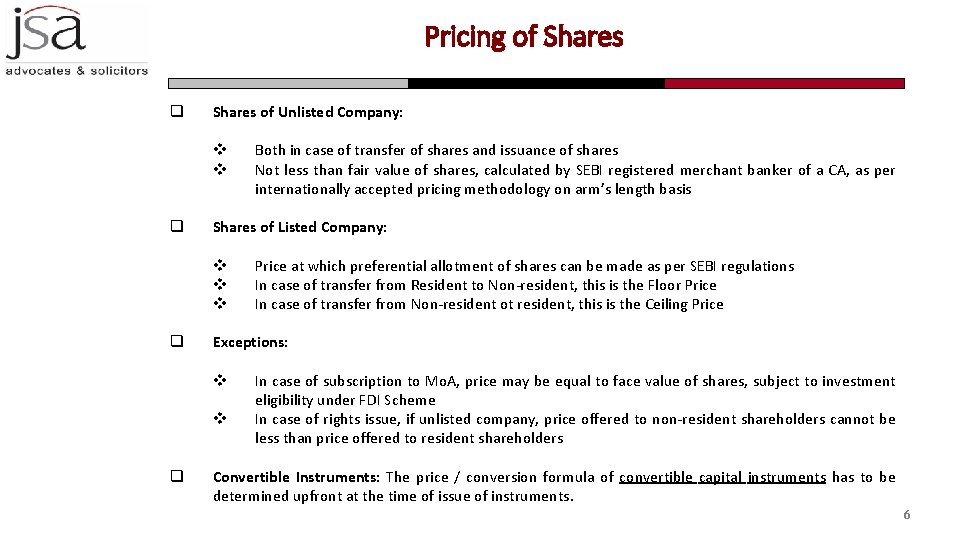
Pricing of Shares q Shares of Unlisted Company: v v q Shares of Listed Company: v v v q Price at which preferential allotment of shares can be made as per SEBI regulations In case of transfer from Resident to Non-resident, this is the Floor Price In case of transfer from Non-resident ot resident, this is the Ceiling Price Exceptions: v v q Both in case of transfer of shares and issuance of shares Not less than fair value of shares, calculated by SEBI registered merchant banker of a CA, as per internationally accepted pricing methodology on arm’s length basis In case of subscription to Mo. A, price may be equal to face value of shares, subject to investment eligibility under FDI Scheme In case of rights issue, if unlisted company, price offered to non-resident shareholders cannot be less than price offered to resident shareholders Convertible Instruments: The price / conversion formula of convertible capital instruments has to be determined upfront at the time of issue of instruments. 6
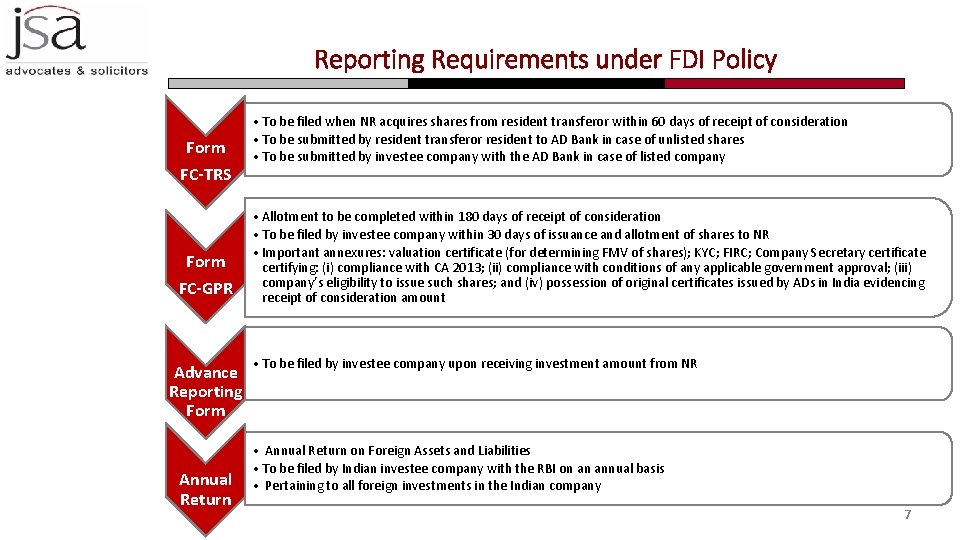
Reporting Requirements under FDI Policy Form FC-TRS Form FC-GPR Advance Reporting Form Annual Return • To be filed when NR acquires shares from resident transferor within 60 days of receipt of consideration • To be submitted by resident transferor resident to AD Bank in case of unlisted shares • To be submitted by investee company with the AD Bank in case of listed company • Allotment to be completed within 180 days of receipt of consideration • To be filed by investee company within 30 days of issuance and allotment of shares to NR • Important annexures: valuation certificate (for determining FMV of shares); KYC; FIRC; Company Secretary certificate certifying: (i) compliance with CA 2013; (ii) compliance with conditions of any applicable government approval; (iii) company’s eligibility to issue such shares; and (iv) possession of original certificates issued by ADs in India evidencing receipt of consideration amount • To be filed by investee company upon receiving investment amount from NR • Annual Return on Foreign Assets and Liabilities • To be filed by Indian investee company with the RBI on an annual basis • Pertaining to all foreign investments in the Indian company 7
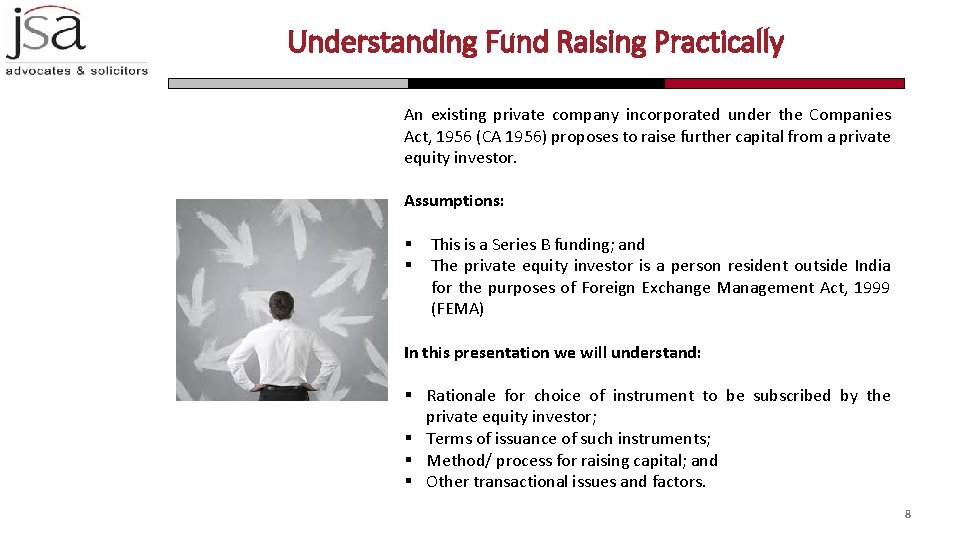
Understanding Fund Raising Practically An existing private company incorporated under the Companies Act, 1956 (CA 1956) proposes to raise further capital from a private equity investor. Assumptions: § § This is a Series B funding; and The private equity investor is a person resident outside India for the purposes of Foreign Exchange Management Act, 1999 (FEMA) In this presentation we will understand: § Rationale for choice of instrument to be subscribed by the private equity investor; § Terms of issuance of such instruments; § Method/ process for raising capital; and § Other transactional issues and factors. 8

CHOICE OF SECURITIES BY A PRIVATE EQUITY INVESTOR 9
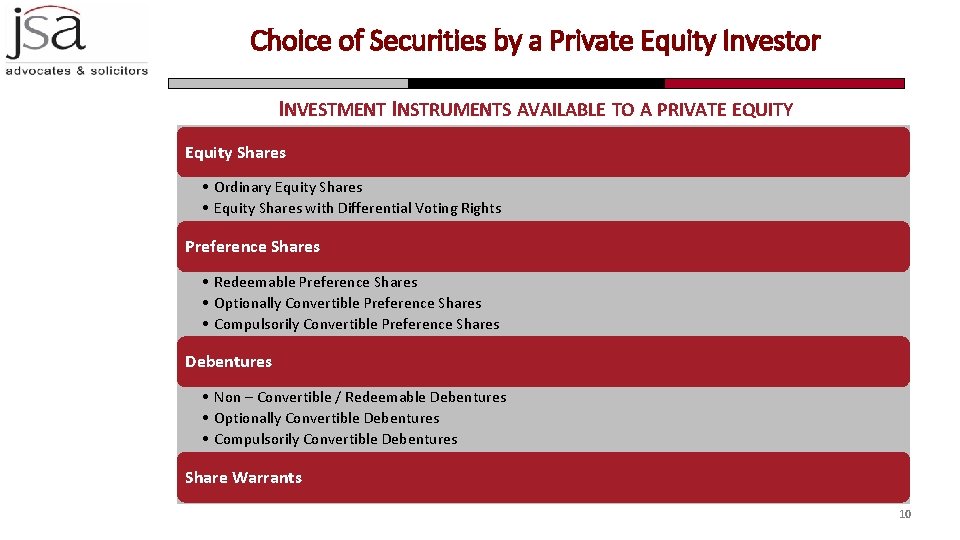
Choice of Securities by a Private Equity Investor INVESTMENT INSTRUMENTS AVAILABLE TO A PRIVATE EQUITY Equity Shares INVESTOR • Ordinary Equity Shares • Equity Shares with Differential Voting Rights Preference Shares • Redeemable Preference Shares • Optionally Convertible Preference Shares • Compulsorily Convertible Preference Shares Debentures • Non – Convertible / Redeemable Debentures • Optionally Convertible Debentures • Compulsorily Convertible Debentures Share Warrants 10
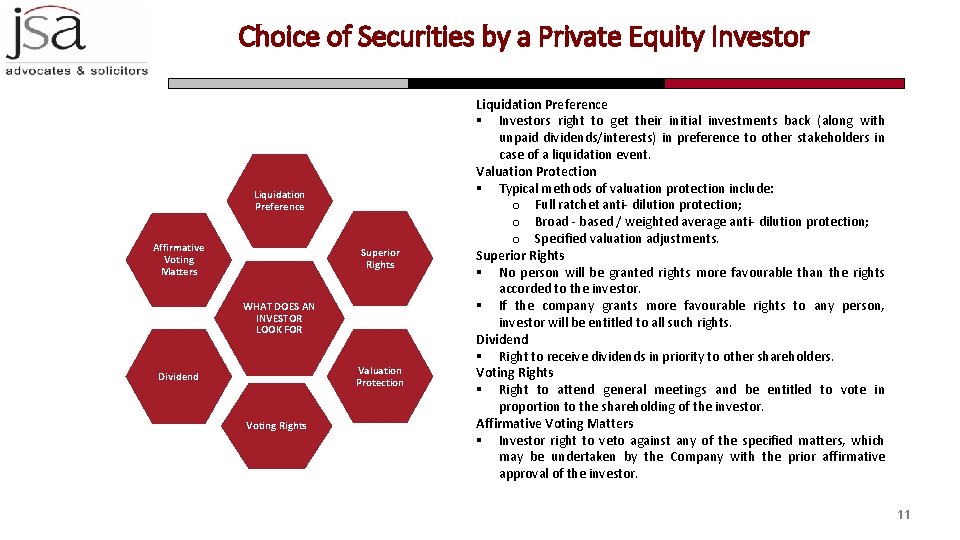
Choice of Securities by a Private Equity Investor Liquidation Preference Affirmative Voting Matters Superior Rights WHAT DOES AN INVESTOR LOOK FOR Valuation Protection Dividend Voting Rights Liquidation Preference § Investors right to get their initial investments back (along with unpaid dividends/interests) in preference to other stakeholders in case of a liquidation event. Valuation Protection § Typical methods of valuation protection include: o Full ratchet anti- dilution protection; o Broad - based / weighted average anti- dilution protection; o Specified valuation adjustments. Superior Rights § No person will be granted rights more favourable than the rights accorded to the investor. § If the company grants more favourable rights to any person, investor will be entitled to all such rights. Dividend § Right to receive dividends in priority to other shareholders. Voting Rights § Right to attend general meetings and be entitled to vote in proportion to the shareholding of the investor. Affirmative Voting Matters § Investor right to veto against any of the specified matters, which may be undertaken by the Company with the prior affirmative approval of the investor. 11
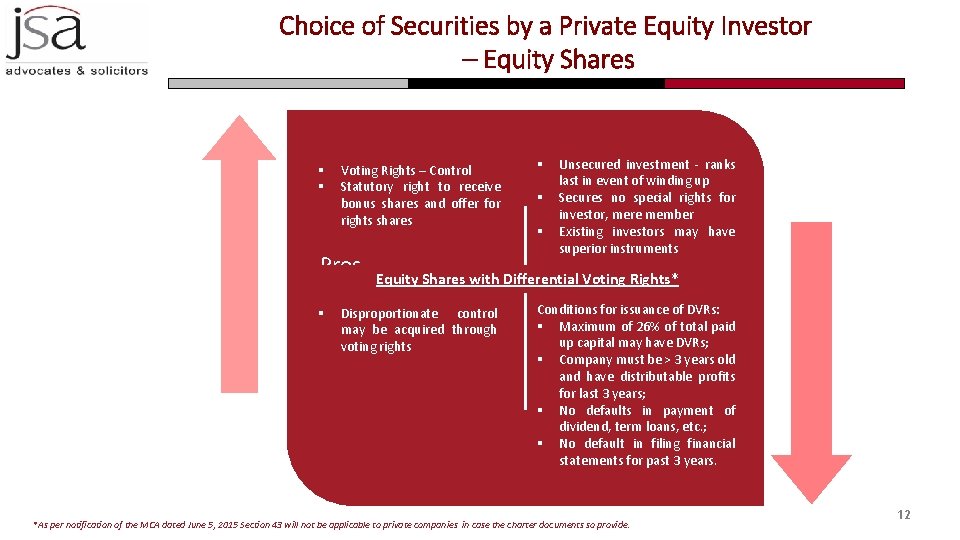
Choice of Securities by a Private Equity Investor – Equity Shares § § Voting Rights – Control Statutory right to receive bonus shares and offer for rights shares Pros § § Unsecured investment - ranks last in event of winding up Secures no special rights for investor, mere member Existing investors may have superior instruments Equity Shares with Differential Voting Rights* Disproportionate control may be acquired through voting rights Conditions for issuance of DVRs: § Maximum of 26% of total paid up capital may have DVRs; § Company must be > 3 years old and have distributable profits for last 3 years; § No defaults in payment of dividend, term loans, etc. ; § No default in filing financial statements for past 3 years. *As per notification of the MCA dated June 5, 2015 Section 43 will not be applicable to private companies in case the charter documents so provide. Cons 12
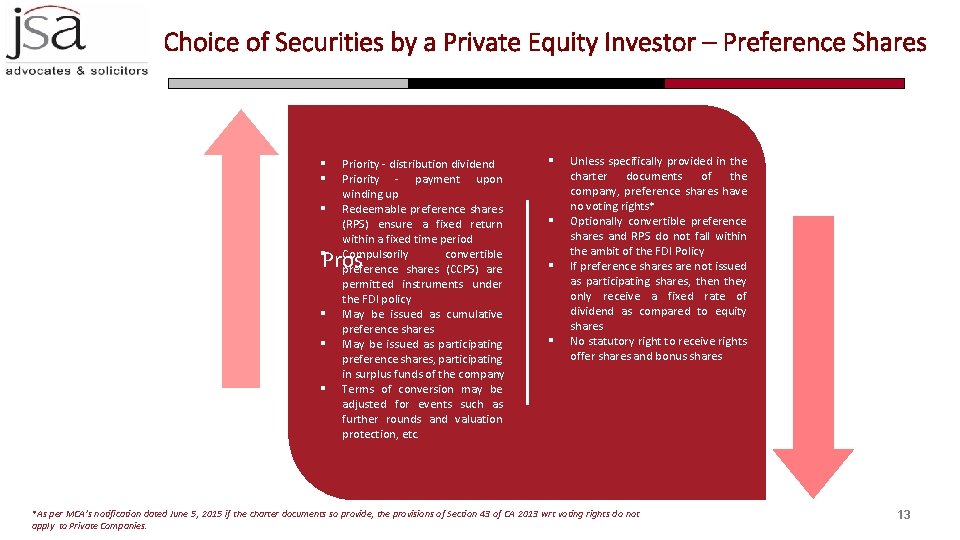
Choice of Securities by a Private Equity Investor – Preference Shares § § § Priority - distribution dividend Priority - payment upon winding up Redeemable preference shares (RPS) ensure a fixed return within a fixed time period Compulsorily convertible preference shares (CCPS) are permitted instruments under the FDI policy May be issued as cumulative preference shares May be issued as participating preference shares, participating in surplus funds of the company Terms of conversion may be adjusted for events such as further rounds and valuation protection, etc. Pros § § § § Unless specifically provided in the charter documents of the company, preference shares have no voting rights* Optionally convertible preference shares and RPS do not fall within the ambit of the FDI Policy If preference shares are not issued as participating shares, then they only receive a fixed rate of dividend as compared to equity shares No statutory right to receive rights offer shares and bonus shares *As per MCA’s notification dated June 5, 2015 if the charter documents so provide, the provisions of Section 43 of CA 2013 wrt voting rights do not apply to Private Companies. Cons 13
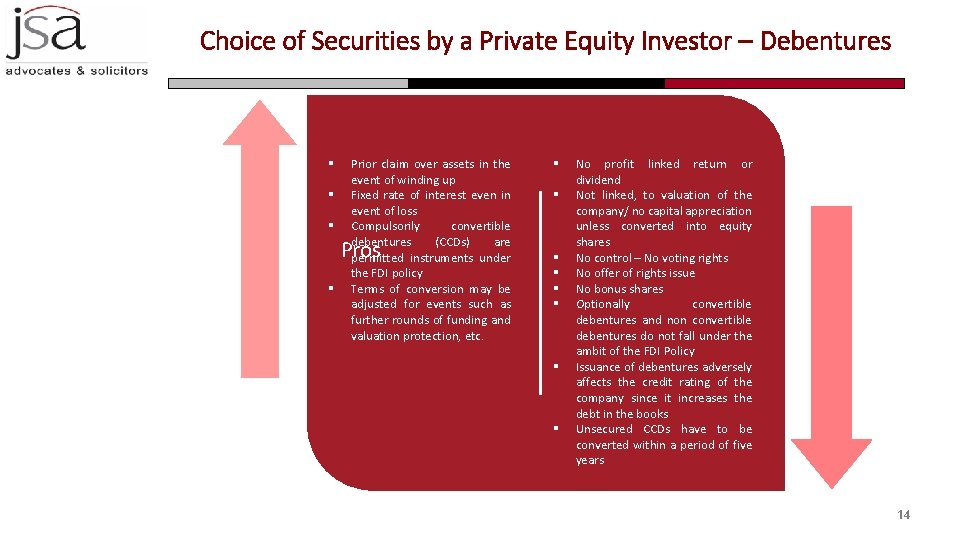
Choice of Securities by a Private Equity Investor – Debentures § § § Prior claim over assets in the event of winding up Fixed rate of interest even in event of loss Compulsorily convertible debentures (CCDs) are permitted instruments under the FDI policy Terms of conversion may be adjusted for events such as further rounds of funding and valuation protection, etc. Pros § § § § § No profit linked return or dividend Not linked, to valuation of the company/ no capital appreciation unless converted into equity shares No control – No voting rights No offer of rights issue No bonus shares Optionally convertible debentures and non convertible debentures do not fall under the ambit of the FDI Policy Issuance of debentures adversely affects the credit rating of the company since it increases the debt in the books Unsecured CCDs have to be converted within a period of five years Cons 14
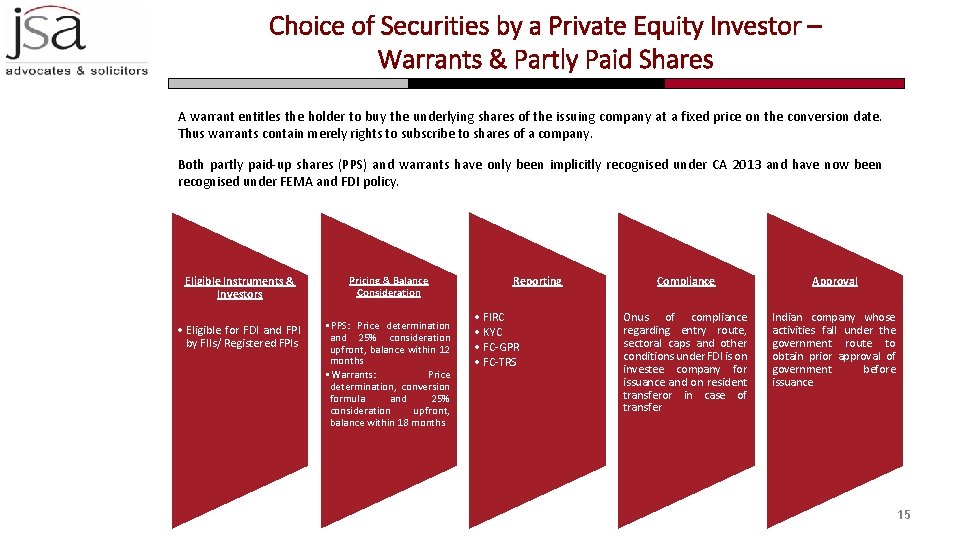
Choice of Securities by a Private Equity Investor – Warrants & Partly Paid Shares A warrant entitles the holder to buy the underlying shares of the issuing company at a fixed price on the conversion date. Thus warrants contain merely rights to subscribe to shares of a company. Both partly paid-up shares (PPS) and warrants have only been implicitly recognised under CA 2013 and have now been recognised under FEMA and FDI policy. Eligible Instruments & Investors Pricing & Balance Consideration • Eligible for FDI and FPI by FIIs/ Registered FPIs • PPS: Price determination and 25% consideration upfront, balance within 12 months • Warrants: Price determination, conversion formula and 25% consideration upfront, balance within 18 months Reporting • FIRC • KYC • FC-GPR • FC-TRS Compliance Approval Onus of compliance regarding entry route, sectoral caps and other conditions under FDI is on investee company for issuance and on resident transferor in case of transfer Indian company whose activities fall under the government route to obtain prior approval of government before issuance 15
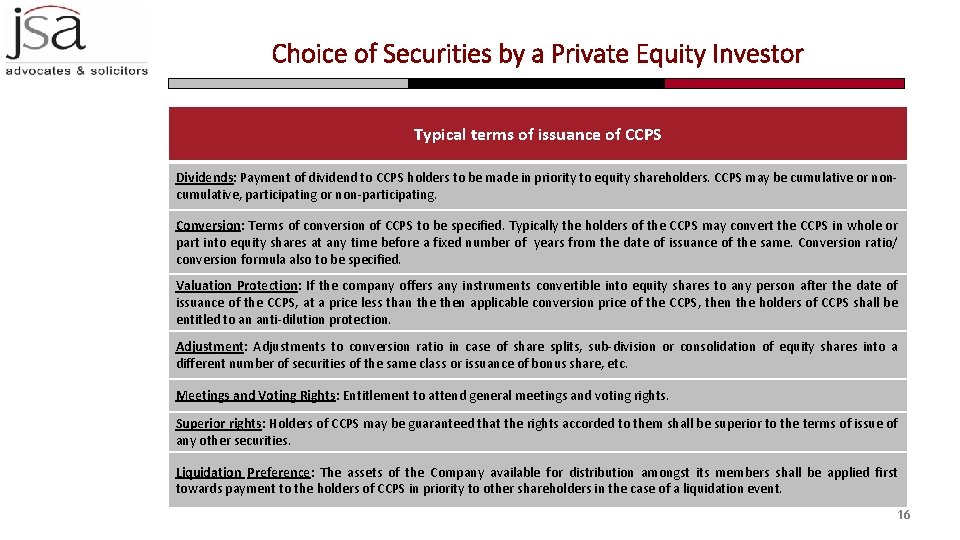
Choice of Securities by a Private Equity Investor Typical terms of issuance of CCPS Dividends: Payment of dividend to CCPS holders to be made in priority to equity shareholders. CCPS may be cumulative or non- cumulative, participating or non-participating. Conversion: Terms of conversion of CCPS to be specified. Typically the holders of the CCPS may convert the CCPS in whole or part into equity shares at any time before a fixed number of years from the date of issuance of the same. Conversion ratio/ conversion formula also to be specified. Valuation Protection: If the company offers any instruments convertible into equity shares to any person after the date of issuance of the CCPS, at a price less than then applicable conversion price of the CCPS, then the holders of CCPS shall be entitled to an anti-dilution protection. Adjustment: Adjustments to conversion ratio in case of share splits, sub-division or consolidation of equity shares into a different number of securities of the same class or issuance of bonus share, etc. Meetings and Voting Rights: Entitlement to attend general meetings and voting rights. Superior rights: Holders of CCPS may be guaranteed that the rights accorded to them shall be superior to the terms of issue of any other securities. Liquidation Preference: The assets of the Company available for distribution amongst its members shall be applied first towards payment to the holders of CCPS in priority to other shareholders in the case of a liquidation event. 16
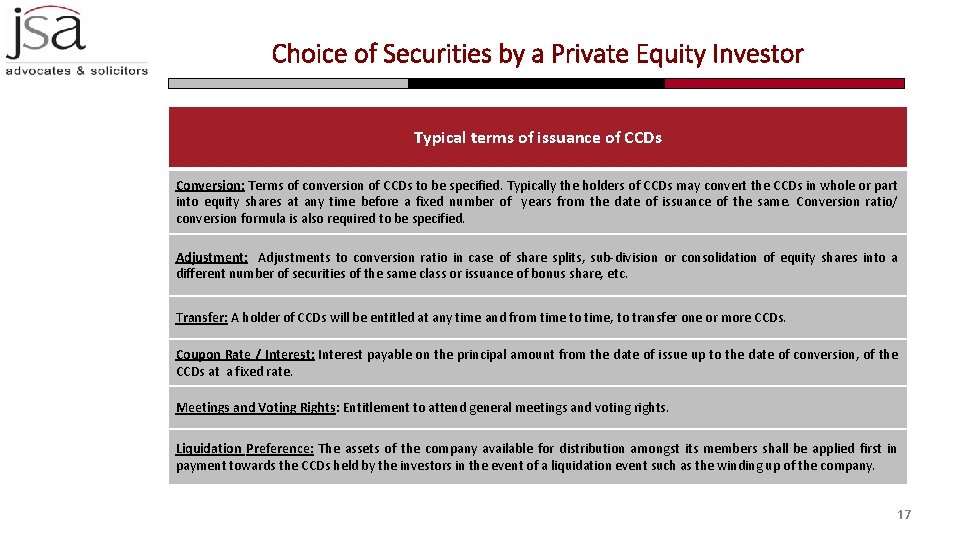
Choice of Securities by a Private Equity Investor Typical terms of issuance of CCDs Conversion: Terms of conversion of CCDs to be specified. Typically the holders of CCDs may convert the CCDs in whole or part into equity shares at any time before a fixed number of years from the date of issuance of the same. Conversion ratio/ conversion formula is also required to be specified. Adjustment: Adjustments to conversion ratio in case of share splits, sub-division or consolidation of equity shares into a different number of securities of the same class or issuance of bonus share, etc. Transfer: A holder of CCDs will be entitled at any time and from time to time, to transfer one or more CCDs. Coupon Rate / Interest: Interest payable on the principal amount from the date of issue up to the date of conversion, of the CCDs at a fixed rate. Meetings and Voting Rights: Entitlement to attend general meetings and voting rights. Liquidation Preference: The assets of the company available for distribution amongst its members shall be applied first in payment towards the CCDs held by the investors in the event of a liquidation event such as the winding up of the company. 17
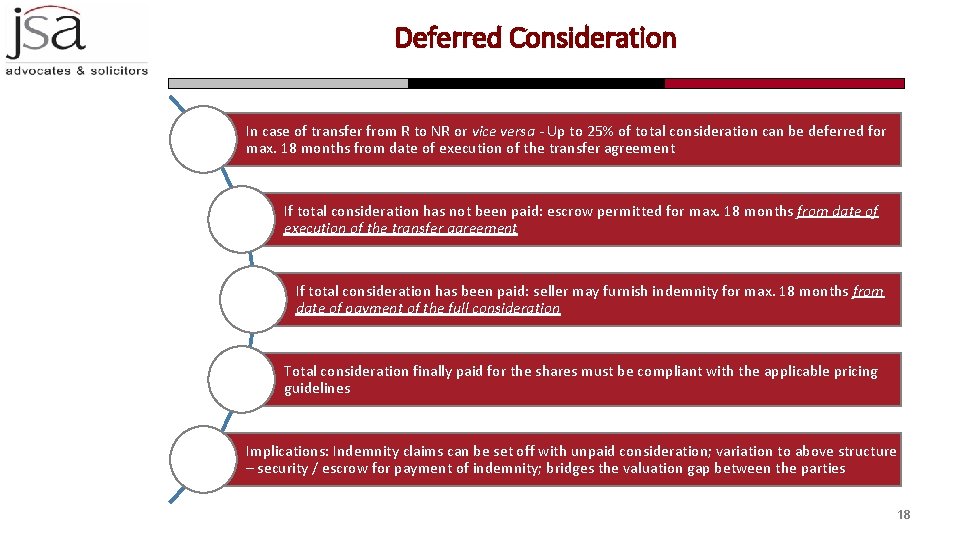
Deferred Consideration In case of transfer from R to NR or vice versa - Up to 25% of total consideration can be deferred for max. 18 months from date of execution of the transfer agreement If total consideration has not been paid: escrow permitted for max. 18 months from date of execution of the transfer agreement If total consideration has been paid: seller may furnish indemnity for max. 18 months from date of payment of the full consideration Total consideration finally paid for the shares must be compliant with the applicable pricing guidelines Implications: Indemnity claims can be set off with unpaid consideration; variation to above structure – security / escrow for payment of indemnity; bridges the valuation gap between the parties 18
Downstream Investment DOWNSTREAM INVESTMENT BY COMPANIES OWNED AND/OR CONTROLLED BY NRs § Downstream investment - Indirect foreign investment by one Indian company into another § Indirect foreign investment § Ø Company owned and/or controlled by a non- resident Ø ‘Control’ defined to include the right to appoint majority of directors or control management decisions or policies including by virtue of shareholding or management rights shareholders/voting agreements. Ø Entire investment in companies other than WOS = indirect foreign investment in step down investee company Ø Indirect foreign investment in WOS = foreign investment in step down investee company Conditions Ø Compliance with relevant sectoral conditions, entry routes and caps Ø Notification to SIA, DIPP & FIPB within 30 days of investment Ø Downstream investment in an existing Indian Company to be supported by a resolution of the Board of Directors as also a shareholders agreement, if any Ø Pricing to be in accordance with SEBI/ RBI Guidelines Ø Funds to be brought from abroad and not leveraged from domestic market (downstream companies with operations may raise debt domestically; downstream investment permissible through internal accruals) 19

TRANSACTIONAL ASPECTS 20
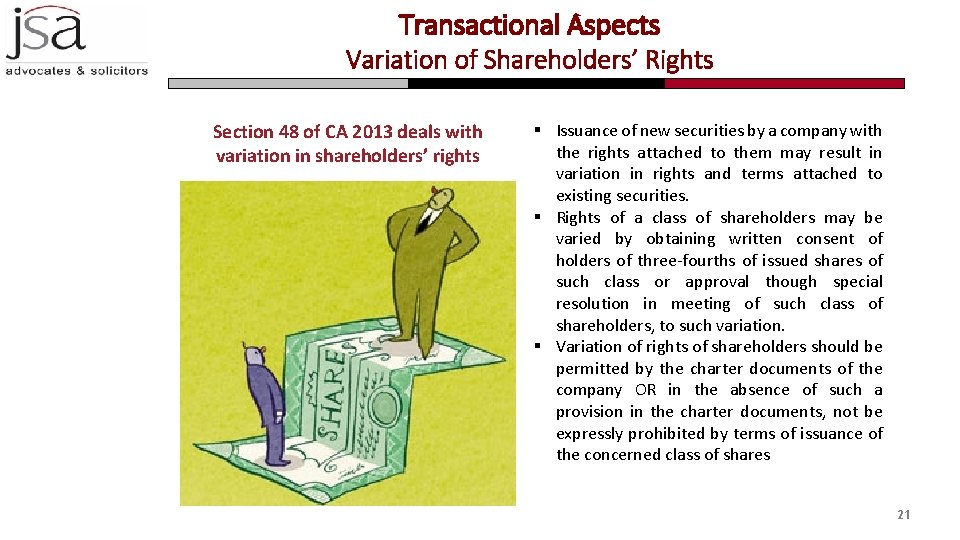
Transactional Aspects Variation of Shareholders’ Rights Section 48 of CA 2013 deals with variation in shareholders’ rights § Issuance of new securities by a company with the rights attached to them may result in variation in rights and terms attached to existing securities. § Rights of a class of shareholders may be varied by obtaining written consent of holders of three-fourths of issued shares of such class or approval though special resolution in meeting of such class of shareholders, to such variation. § Variation of rights of shareholders should be permitted by the charter documents of the company OR in the absence of such a provision in the charter documents, not be expressly prohibited by terms of issuance of the concerned class of shares 21
Transactional Aspects § Obtaining waivers of existing shareholders for issuance of new securities. § Amendment to Mo. A: Increase in and reclassification of the authorized share capital of the company; § Amendment to Ao. A: inclusion of entrenchment provisions as provided under Section 5 of CA 2013, such that specified provisions of the articles of association can be amended only after complying with the restrictive conditions/procedures as compared to a special resolution; § Termination of existing shareholder agreements; § Obtaining representations and warranties from the company and the promoters – disclosure letter may also be provided to qualify the representations and warranties; § Identifying grounds for seeking indemnity from the company and promoters and detailed provisions for claiming indemnity; and § Appointment of investor director or observer. 22
THANK YOU manvinder@jsalaw. com
- Slides: 23