
Acquisition of Modality by Advanced Learners of English

Acquisition of Modality by Advanced Learners of English Nadia Mifka-Profozic Education Department, University of York AILA, Rio de Janeiro, July 2017
Outline � Modal verbs: what makes them difficult for L 2 learners � Languages in focus: English, Slavic (Croatian) � The study: design and participants � Tests: AJT, SPR � Acceptability Judgment Test results � Self-Paced Reading results � Discussion � Questions, comments
Modality Ø Ø � � � Modality - a fundamental conceptual domain Exists in all natural languages, but different means are used in different languages to express modal meanings Modality refers to: probability, possibility, prediction, obligation, permission, necessity, ability, willingness. . . Opinion and attitude subjectivity (Lyons, 1977) The problem of indeterminacy in natural languages “fuzziness”(Coates, 2014)
A complex learning problem � From the perspective of language acquisition: modals as polysemous verbs � Each modal verb covers more than one meaning, in turn a single meaning can be covered by multiple modals a difficult mapping and learning problem Research question: To what extent do Slavic (Croatian) speakers learners of English FL acquire the semantic meaning of modal auxiliaries can and may?

Classification of modal verbs � Epistemic possibility She may come later. They may be waiting for you. � Deontic meaning Can/May I pour your tea? May I borrow your pen? � Dynamic meaning She can drive. Can you swim? er, 1979) (Palm
English L 1 acquisition of modal auxiliaries � Research on first language acquisition non-epistemic (deontic) meaning is acquired earlier than epistemic meaning of modal verbs: older children (7 -9 -year olds perform better than 4 -5 -year olds on tasks involving both comprehension and production of English modals that entail epistemic possibility and epistemic necessity.
Acquisition of English L 2 � Learning to use modal verbs presents a difficult mapping problem involving matching the lexeme to complex syntax and semantics. � Modal lexemes typically map to multiple meanings, and in turn multiple lexemes may cover a single meaning. � In Croatian, modal verbs are used in deontic and dynamic meaning, but epistemic possibility is not associated with the use of modal verbs.
Croatian language � Traditionally, in Croatian grammar books modality has not been seen as a verb category � There are lexical preferences when expressing epistemic possibility: � e. g. She may come tomorrow. = Ona će možda (ADV) doći sutra. Ona može (VERB)doći sutra. (She can/is able to come tomorrow)
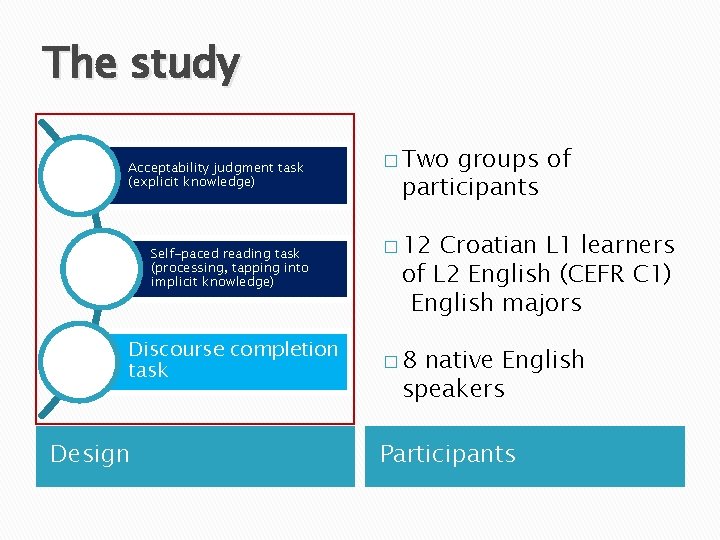
The study Acceptability judgment task (explicit knowledge) Self-paced reading task (processing, tapping into implicit knowledge) Discourse completion task Design � Two groups of participants � 12 Croatian L 1 learners of L 2 English (CEFR C 1) English majors � 8 native English speakers Participants
Tests Acceptability Judgment Test: 62 sentences (32 target sentences including the same number of appropriate and inappropriate use of modal verbs can and may, plus 30 fillers) � Classified according to the epistemic, deontic and dynamic meaning of modal auxiliaries. Self-paced reading task: 24 target sentences, imbedded in the context that gives orientation to the use of a particular modal verb, plus 16 fillers. The sentences used in both tests – slightly adapted examples from Lancaster corpus (Coates, 1983) and British National Corpus.
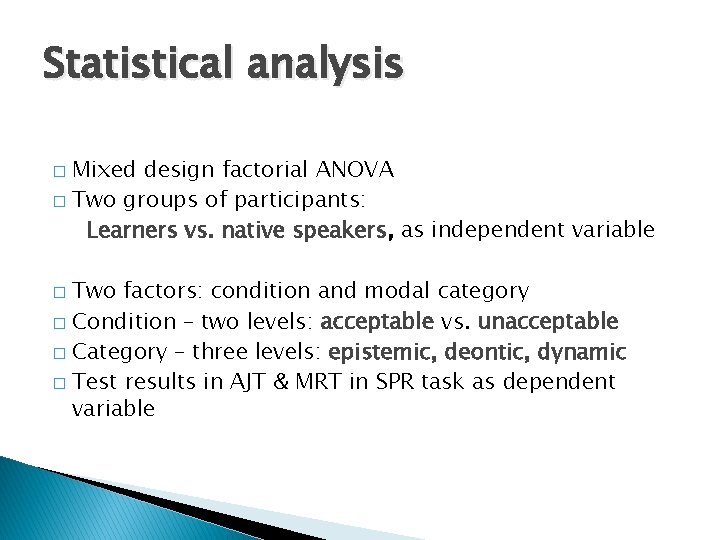
Statistical analysis Mixed design factorial ANOVA � Two groups of participants: Learners vs. native speakers, as independent variable � Two factors: condition and modal category � Condition – two levels: acceptable vs. unacceptable � Category – three levels: epistemic, deontic, dynamic � Test results in AJT & MRT in SPR task as dependent variable �
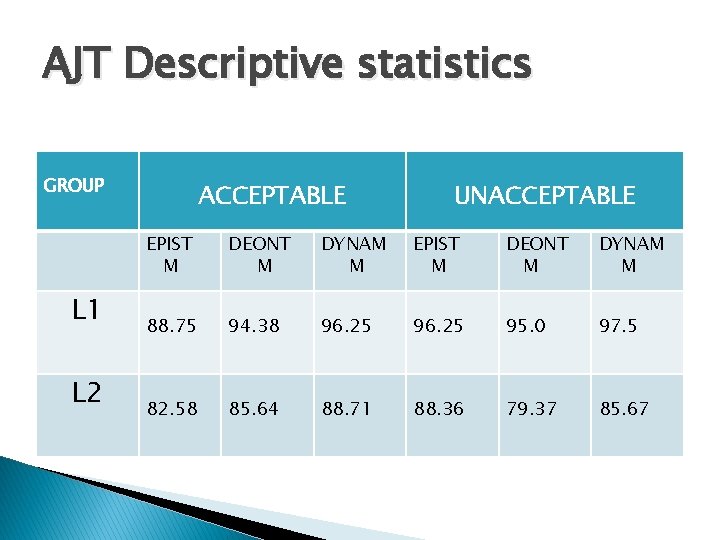
AJT Descriptive statistics GROUP ACCEPTABLE UNACCEPTABLE EPIST M DEONT M DYNAM M L 1 88. 75 94. 38 96. 25 95. 0 97. 5 L 2 82. 58 85. 64 88. 71 88. 36 79. 37 85. 67
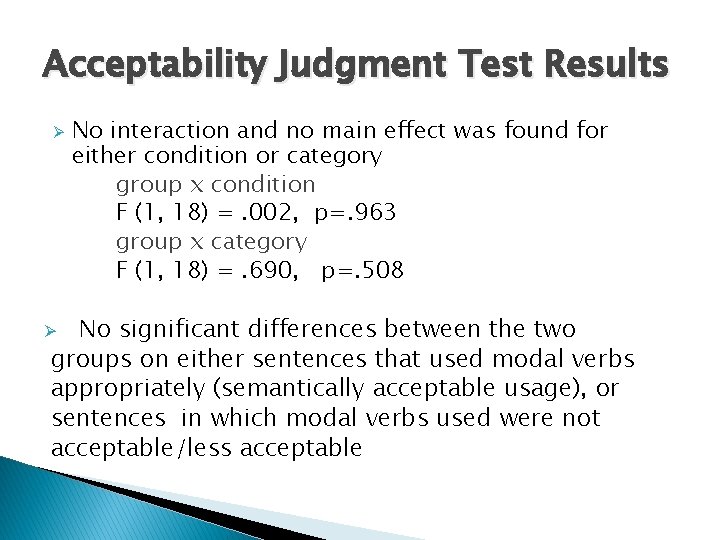
Acceptability Judgment Test Results Ø No interaction and no main effect was found for either condition or category group x condition F (1, 18) =. 002, p=. 963 group x category F (1, 18) =. 690, p=. 508 No significant differences between the two groups on either sentences that used modal verbs appropriately (semantically acceptable usage), or sentences in which modal verbs used were not acceptable/less acceptable Ø

Self-paced reading � Psychopy software (Peirce, 2007, 2009) used for self–paced reading task. � Stationary window – the text appears on the screen word by word � Twenty-four sets of sentences, involving 12 semantically acceptable and 12 semantically unacceptable sentences, plus 16 filler items. � Each type of meaning (epistemic, deontic, dynamic) represented by eight items.
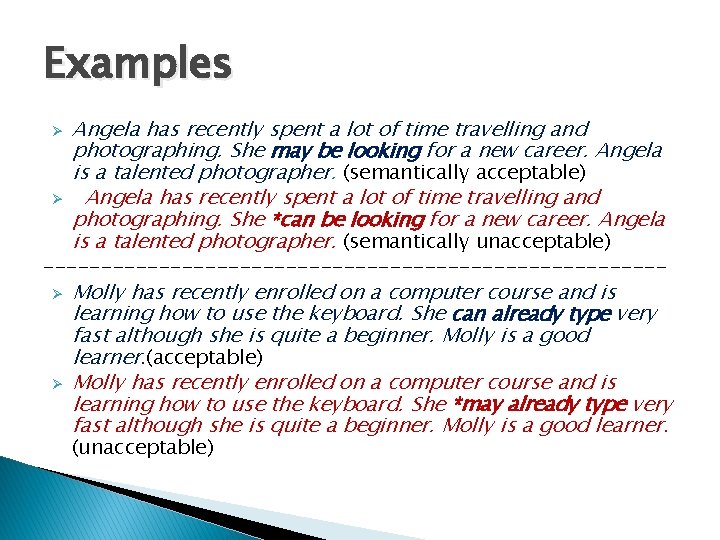
Examples Ø Ø Angela has recently spent a lot of time travelling and photographing. She may be looking for a new career. Angela is a talented photographer. (semantically acceptable) Angela has recently spent a lot of time travelling and photographing. She *can be looking for a new career. Angela is a talented photographer. (semantically unacceptable) ---------------------------Ø Ø Molly has recently enrolled on a computer course and is learning how to use the keyboard. She can already type very fast although she is quite a beginner. Molly is a good learner. (acceptable) Molly has recently enrolled on a computer course and is learning how to use the keyboard. She *may already type very fast although she is quite a beginner. Molly is a good learner. (unacceptable)

Data analysis - SPR � Two groups (learners vs. native speakers) as independent variables � Two factors (condition & modal category) �Condition (two levels): acceptable vs. unacceptable �Modal category (three levels): epistemic – deontic – dynamic • Reading times in milliseconds as dependent variable • Mixed factorial ANOVA performed on each of six segments in experimental sentences
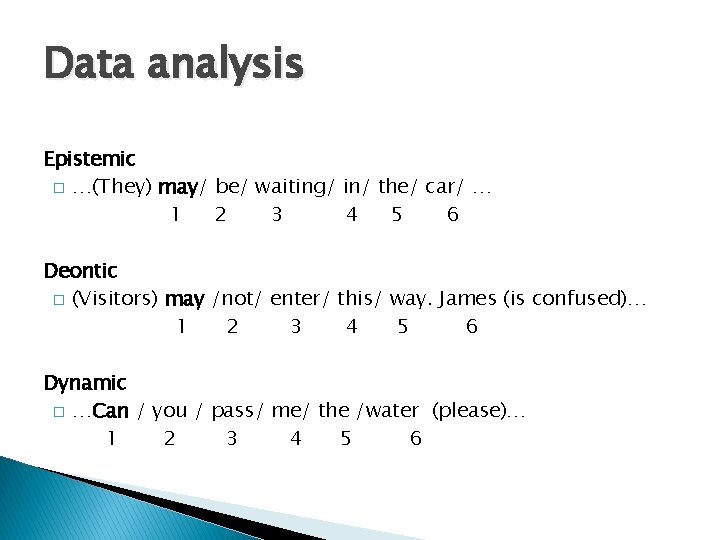
Data analysis Epistemic � …(They) may/ be/ waiting/ in/ the/ car/ … 1 2 3 4 5 6 Deontic � (Visitors) may /not/ enter/ this/ way. James (is confused)… 1 2 3 4 5 6 Dynamic � …Can / you / pass/ me/ the /water (please)… 1 2 3 4 5 6

SPR Results: Descriptive statistics (MRT in millisec) L 1 Cat Con SEG 1 SEG 2 SEG 3 SEG 4 SEG 5 SEG 6 EPI Accept 418(69) 418(85) 420(91) 456 (71) 482(94) 492(61) Unacc. 486(98) 544(175) 535(159) 718(233) 563(200) 576(176) Accept 458(203) 438(81) 503(140) 498(201) 454(109) 469(194) Unacc. 378(74) 446(50) 549(181) 563(142) 455(142) 502(149) Accept 538(133) 409(105) 550(103) 543(141) 627(261) Unacc. 561(237) 544(220) 452(76) 680(260) 608(102) 635(284) Accept 458(178) 454(149) 490(200) 522(194) 477(189) 556(221) Unacc. 464(204) 490(188) 517(180) 501(189) 526(206) 557(236) Accept 521(270) 588(269) 509(201) 533(206) 543(257) 470(196) Unacc. 392(176) 537(250) 579(231) 563(223) 489(236) 532(219) Accept 493(215) 518(236) 543(215) 585(260) 680(343) 646(223) Unacc. 570(338) 644(374) 519(211) 714(206) 642(254) 717(319) DEO DYN EPI L 2 DEO DYN
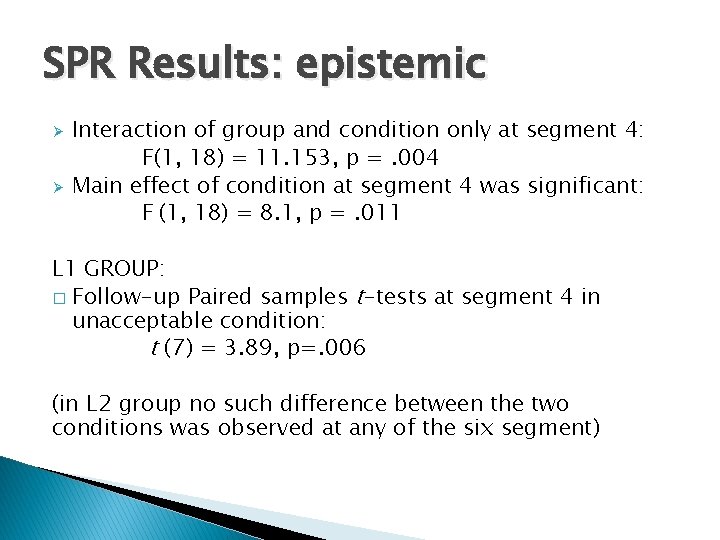
SPR Results: epistemic Ø Ø Interaction of group and condition only at segment 4: F(1, 18) = 11. 153, p =. 004 Main effect of condition at segment 4 was significant: F (1, 18) = 8. 1, p =. 011 L 1 GROUP: � Follow-up Paired samples t-tests at segment 4 in unacceptable condition: t (7) = 3. 89, p=. 006 (in L 2 group no such difference between the two conditions was observed at any of the six segment)
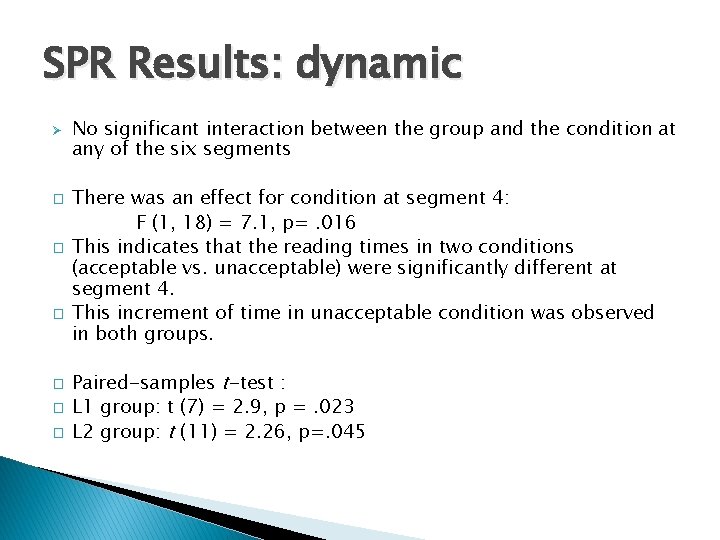
SPR Results: dynamic Ø � � � No significant interaction between the group and the condition at any of the six segments There was an effect for condition at segment 4: F (1, 18) = 7. 1, p=. 016 This indicates that the reading times in two conditions (acceptable vs. unacceptable) were significantly different at segment 4. This increment of time in unacceptable condition was observed in both groups. Paired-samples t-test : L 1 group: t (7) = 2. 9, p =. 023 L 2 group: t (11) = 2. 26, p=. 045
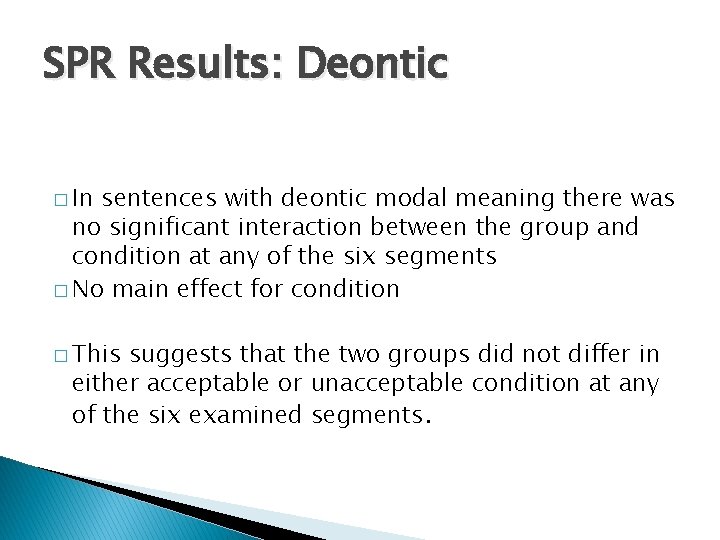
SPR Results: Deontic � In sentences with deontic modal meaning there was no significant interaction between the group and condition at any of the six segments � No main effect for condition � This suggests that the two groups did not differ in either acceptable or unacceptable condition at any of the six examined segments.
Results : factorial ANOVA On all six segments, there was no main effect for group overall, the two groups performed similarly. � A significant or marginally significant main effect for modal category on each of the six segments. � An interaction of group over condition (acceptable vs. unacceptable) – only at segment 4 for epistemic category: F (2, 36) =3. 44, p=. 043 � � No difference between the two groups for dynamic category - but both had significantly longer reading times in unacceptable condition at segment 4 (confirmed by follow-up t-tests)
Discussion � Results for self–paced reading task suggest that these L 2 speakers are not sensitive to semantic violations in the use of epistemic modals although their AJT showed the results that were no different from native speakers’ results. � However, they are sensitive to semantic violations where dynamic meaning of a modal auxiliary is expected.

Thank you! Questions? Comments?
- Slides: 24