
ACPIL Small Feedings of the Mind Outpatient Practice



- Slides: 44
ACP-IL “Small Feedings of the Mind” Outpatient Practice /PCMH Update Jennifer Cichon Mackinnon, MD, MM Associate Director Ambulatory Quality Froedtert Hospital, General Internal Medicine Clinic Associate Professor, General Internal Medicine Medical College of Wisconsin
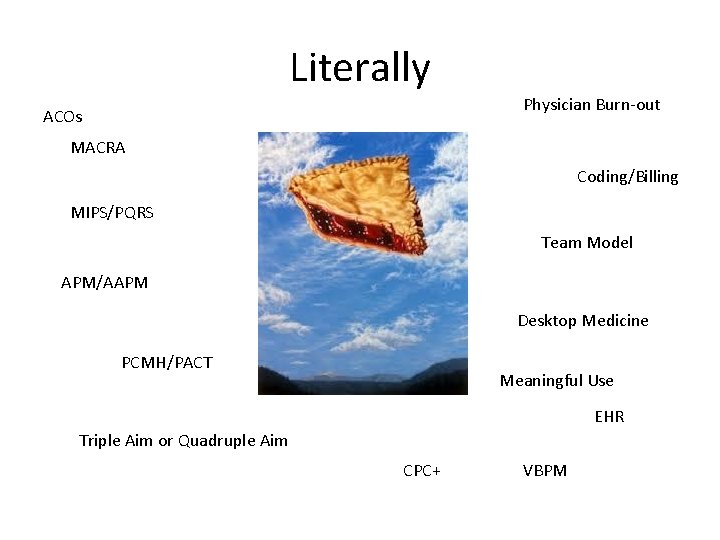
Literally Physician Burn-out ACOs MACRA Coding/Billing MIPS/PQRS Team Model APM/AAPM Desktop Medicine PCMH/PACT Meaningful Use EHR Triple Aim or Quadruple Aim CPC+ VBPM
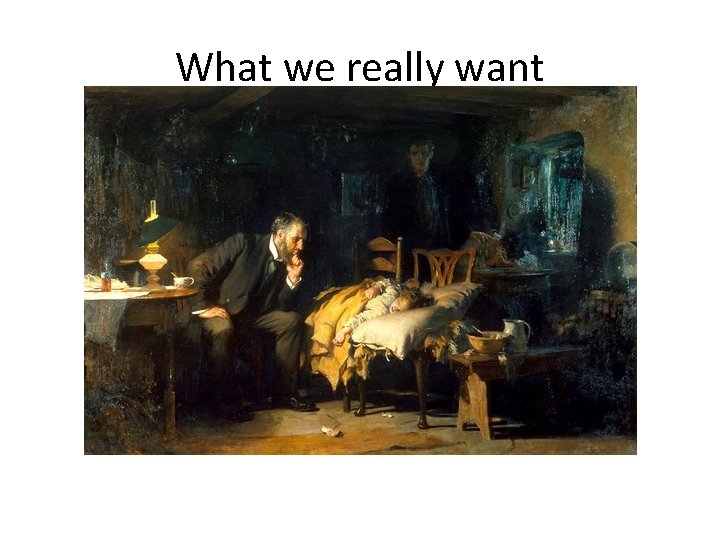
What we really want
50/50 Time Ill-Spent • N= 471 community primary care practices • Clinical Time – Face to face visits 49% – Desktop medicine 51% *Goal to move to CMS Model- Comprehensive Primary Care Plus (CPC+) Initiative to pay practices for per-beneficiary-per-month care management fees combined with fee-for-service payments Health Affairs, April 2017
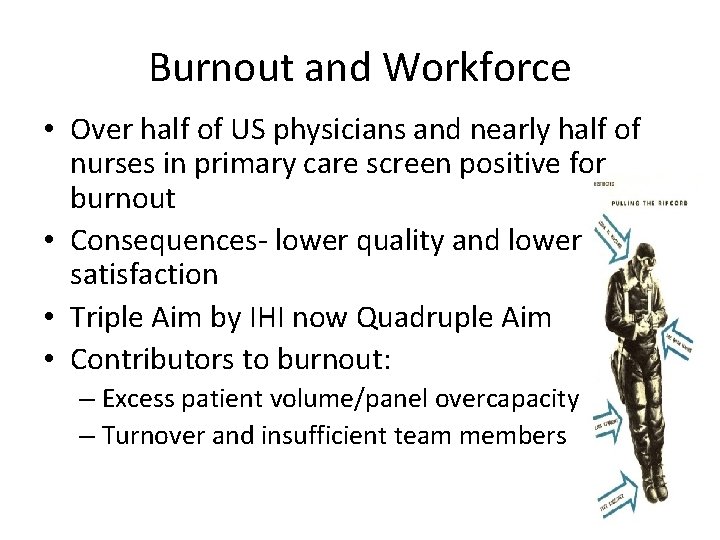
Burnout and Workforce • Over half of US physicians and nearly half of nurses in primary care screen positive for burnout • Consequences- lower quality and lower satisfaction • Triple Aim by IHI now Quadruple Aim • Contributors to burnout: – Excess patient volume/panel overcapacity – Turnover and insufficient team members
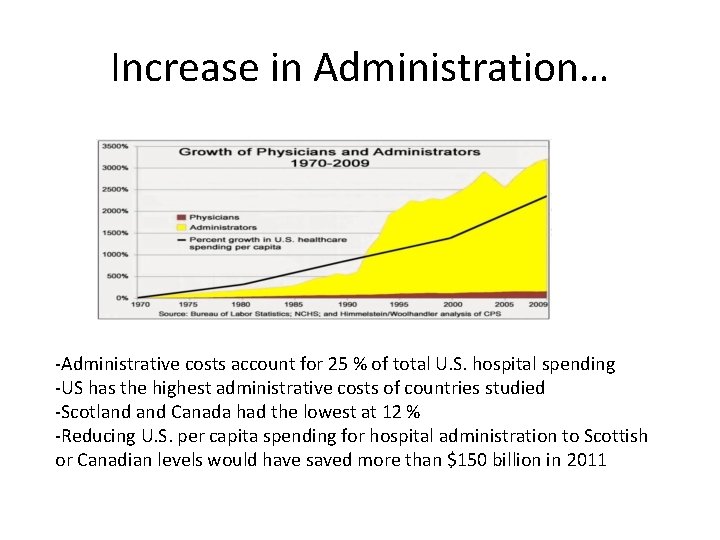
Increase in Administration… -Administrative costs account for 25 % of total U. S. hospital spending -US has the highest administrative costs of countries studied -Scotland Canada had the lowest at 12 % -Reducing U. S. per capita spending for hospital administration to Scottish or Canadian levels would have saved more than $150 billion in 2011
CMS Update: MACRA 2015 QPP. CMS. gov MIPS APMs • Calculates payment adjustments (bonus &penalty) based on quality data categories • Importance of registries • Likely private payers also • Small & large practices • Payment models add incentives to provide highquality and cost-efficient care for specific condition, care episode or population • CPC+ in 14 regions-5 yrs started 2011 –”PCMH on steroids” • Population based payments
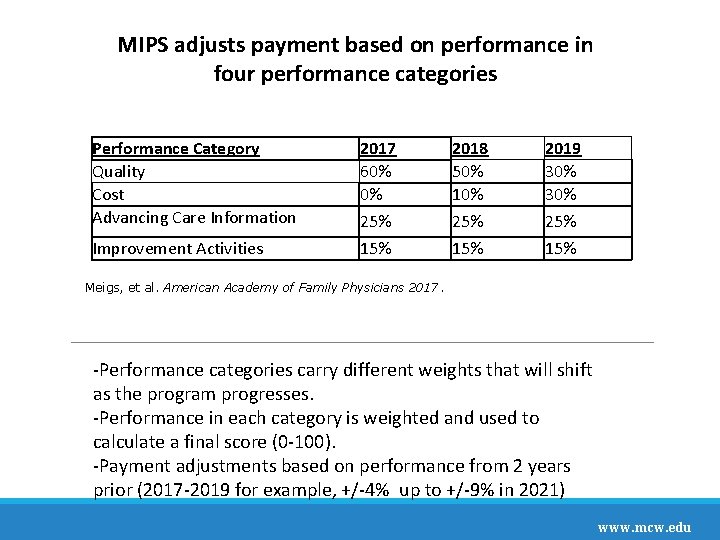
MIPS Payment Tracks • Quality- 6 measures (one must be an outcome measure)-based on PQRS • Advancing Care Information- based on Medicare EHR Incentive Program (Meaningful Use) • Improvement Activities- a new category • Cost -Based on Value-based payment Modifier
MIPS adjusts payment based on performance in four performance categories Performance Category Quality Cost Advancing Care Information Improvement Activities 2017 60% 0% 25% 15% 2018 50% 10% 25% 15% 2019 30% 25% 15% Meigs, et al. American Academy of Family Physicians 2017. -Performance categories carry different weights that will shift as the program progresses. -Performance in each category is weighted and used to calculate a final score (0 -100). -Payment adjustments based on performance from 2 years prior (2017 -2019 for example, +/-4% up to +/-9% in 2021) www. mcw. edu
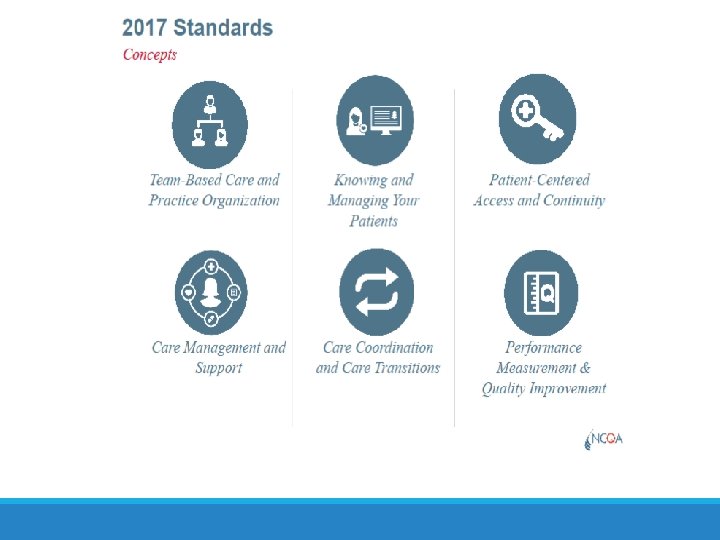
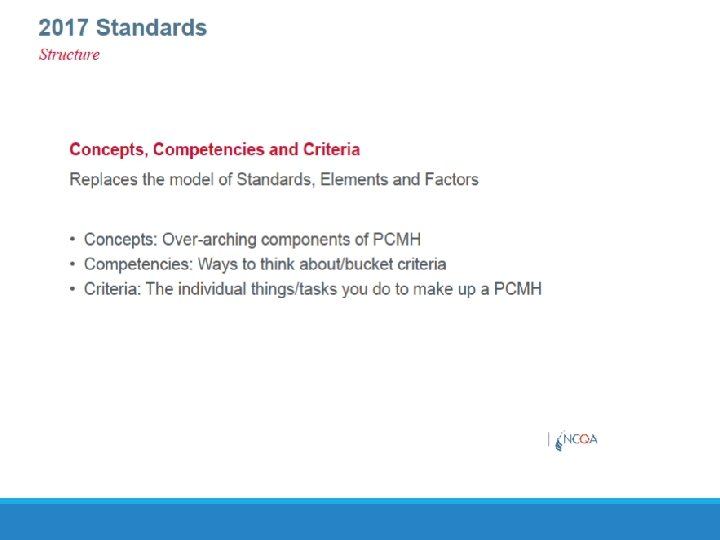
Solution? The Patient Centered Medical Home PCMH/ PACT for VA -1967 first PCMH in Pediatrics -Joint principles- 2007 ACP, ABIM, AAFP, AAP -NCQA released standards 2008 -ACA- 2010 Primary Care central to health care delivery; “Health Homes” for Medicaid
www. mcw. edu
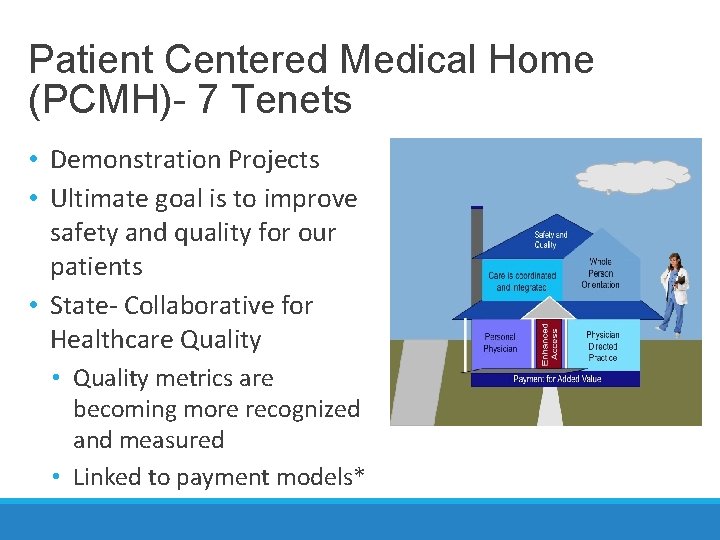
Patient Centered Medical Home (PCMH)- 7 Tenets • Demonstration Projects • Ultimate goal is to improve safety and quality for our patients • State- Collaborative for Healthcare Quality • Quality metrics are becoming more recognized and measured • Linked to payment models*
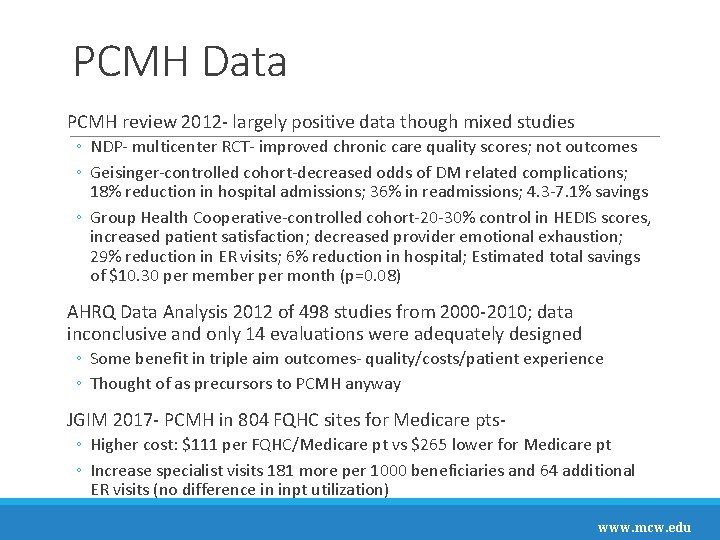
PCMH Data PCMH review 2012 - largely positive data though mixed studies ◦ NDP- multicenter RCT- improved chronic care quality scores; not outcomes ◦ Geisinger-controlled cohort-decreased odds of DM related complications; 18% reduction in hospital admissions; 36% in readmissions; 4. 3 -7. 1% savings ◦ Group Health Cooperative-controlled cohort-20 -30% control in HEDIS scores, increased patient satisfaction; decreased provider emotional exhaustion; 29% reduction in ER visits; 6% reduction in hospital; Estimated total savings of $10. 30 per member per month (p=0. 08) AHRQ Data Analysis 2012 of 498 studies from 2000 -2010; data inconclusive and only 14 evaluations were adequately designed ◦ Some benefit in triple aim outcomes- quality/costs/patient experience ◦ Thought of as precursors to PCMH anyway JGIM 2017 - PCMH in 804 FQHC sites for Medicare pts◦ Higher cost: $111 per FQHC/Medicare pt vs $265 lower for Medicare pt ◦ Increase specialist visits 181 more per 1000 beneficiaries and 64 additional ER visits (no difference in inpt utilization) www. mcw. edu
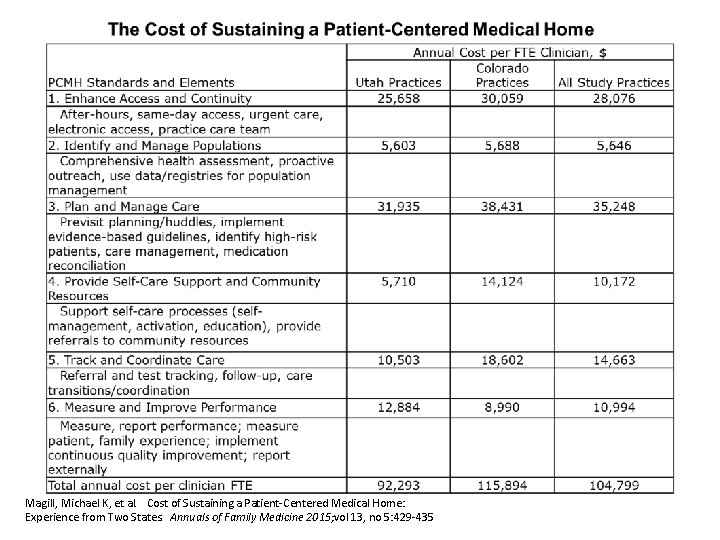
Magill, Michael K, et al. Cost of Sustaining a Patient-Centered Medical Home: Experience from Two States. Annuals of Family Medicine 2015; vol 13, no 5: 429 -435
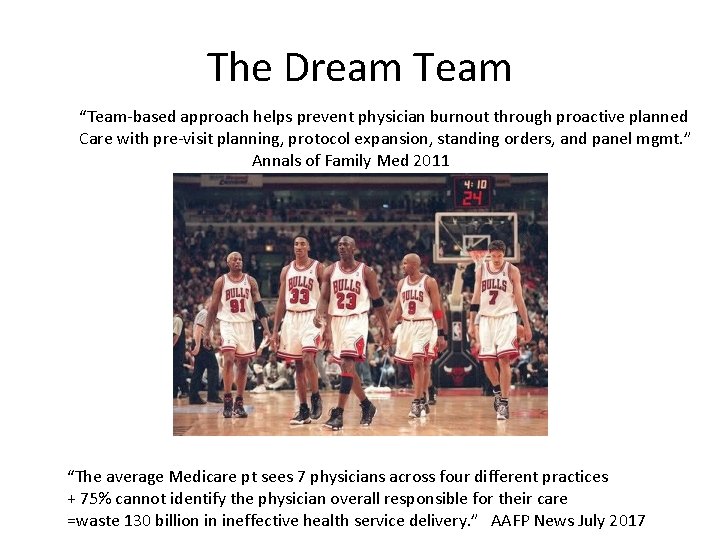
The Dream Team “Team-based approach helps prevent physician burnout through proactive planned Care with pre-visit planning, protocol expansion, standing orders, and panel mgmt. ” Annals of Family Med 2011 “The average Medicare pt sees 7 physicians across four different practices + 75% cannot identify the physician overall responsible for their care =waste 130 billion in ineffective health service delivery. ” AAFP News July 2017
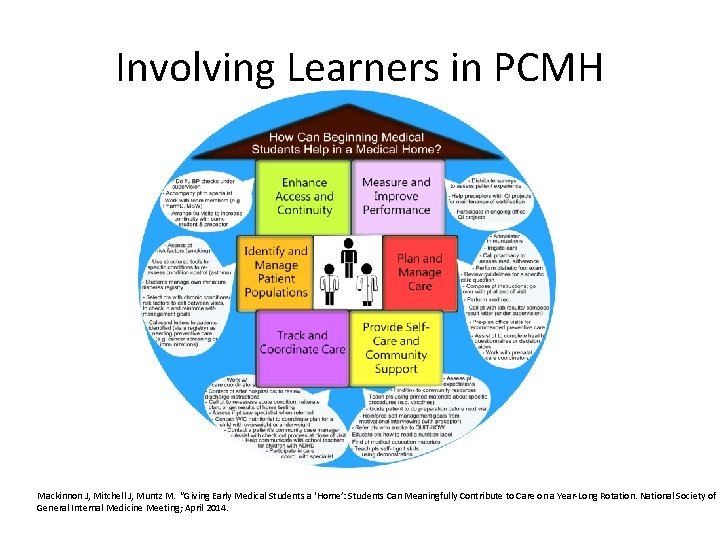
Involving Learners in PCMH Mackinnon J, Mitchell J, Muntz M. “Giving Early Medical Students a ‘Home’: Students Can Meaningfully Contribute to Care on a Year-Long Rotation. National Society of General Internal Medicine Meeting; April 2014.
Panel Size/Staffing Ratio • • Panel size debatable- 800 -2400 pts: 1 FTE “Work at the top of their license” Enhanced roles of various players True PCMH (Am Journal of Managed Care 2013) – 1 FTE Physician: 4. 25 FTE Staff Members – 59% higher than avg 1 FTE Physician: 2. 68 FTE – Physician increase productive capacity 10 -20%
Communication 101 • Audit of processes/protocols • Co-location – “At least on same end of the court” • Huddles – Balance meaning with time management – E-huddles in EPIC • Team meetings – Timing of these and who attends – How does resultant work get achieved
Documentation/Coding: Clickety, clack, click • 2, 400 “clicks a day” • Dangerous recipe for disaster and why I miss Cook County Hospital – Major player in physician burnout – Major player in patient dissatisfaction – Major player in payment
Scribes “For decades, physicians pinned their hopes on computers to help them manage the overwhelming demands of office visits. Instead, electronic health records have become a disease in need of a cure, as physicians do their best to diagnose and treat patients while continuously feeding the data-hungry computer. ” (NYT Health, Hafner 2017) • • • Documentation guidelines Authentication guidelines Regulations and guidance Minimum knowledge, experience, and education qualifications Definition of roles (i. e. , scribe vs. provider) Responsibilities and clear scope of practice Performance expectations (i. e. , productivity) Continuous training Sanctions Documentation auditing protocols Privacy and security auditing protocols Certification and/or licensure
Mail/Test Results/Referral Management • Who does this work and how? – Mail/faxes (!#$%>) – Test results – Tracking referrals- critical ones • How do they handle results? – Normal vs abnormal vs critical • In between visit communication – Phone Triage- ongoing battle – My. Chart- Email threads that are too long
Clinic Lessons Learned • Engage all staff- team concept-include learners! • Try to hold on to staff- turnover is costly and burnout is too • Standardize “some” practices- PVP and other protocols • Regular communication- colocation/huddles • Quality for our patients Ultimately… • Awareness of the continual & ongoing management of sick patients • “We are all in this together” mentality- including the patient- reducing their “unrealistic expectations”
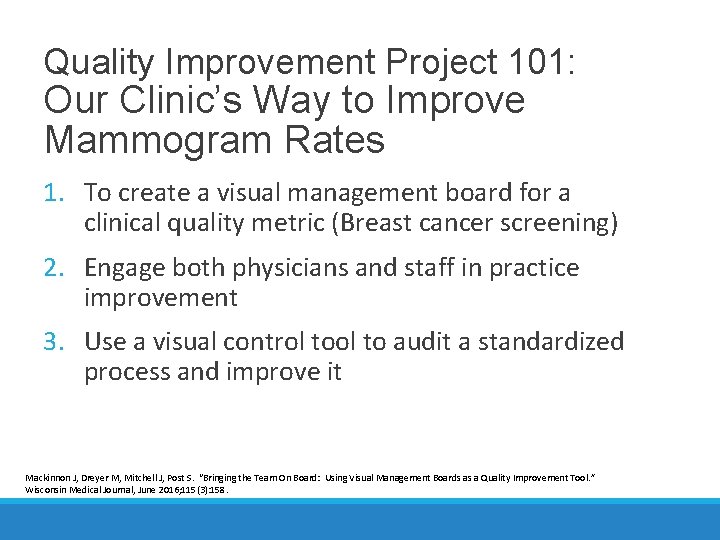
Quality Improvement Project 101: Our Clinic’s Way to Improve Mammogram Rates 1. To create a visual management board for a clinical quality metric (Breast cancer screening) 2. Engage both physicians and staff in practice improvement 3. Use a visual control to audit a standardized process and improve it Mackinnon J, Dreyer M, Mitchell J, Post S. “Bringing the Team On Board: Using Visual Management Boards as a Quality Improvement Tool. ” Wisconsin Medical Journal, June 2016; 115(3): 158.
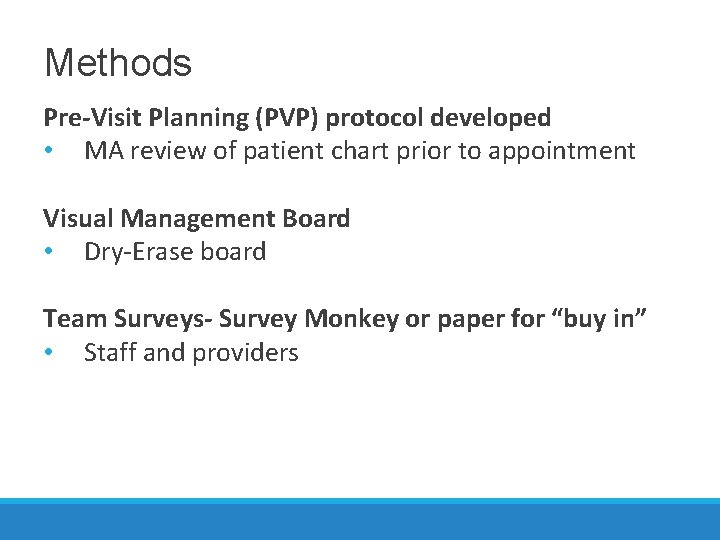
Methods Pre-Visit Planning (PVP) protocol developed • MA review of patient chart prior to appointment Visual Management Board • Dry-Erase board Team Surveys- Survey Monkey or paper for “buy in” • Staff and providers
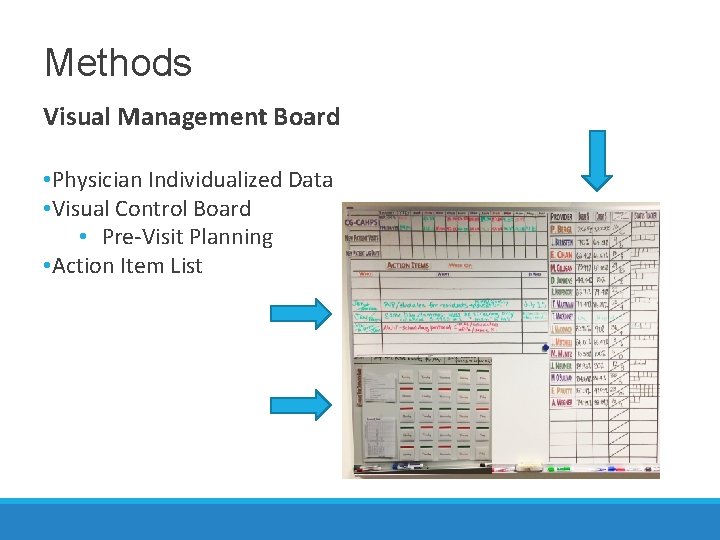
Methods Visual Management Board • Physician Individualized Data • Visual Control Board • Pre-Visit Planning • Action Item List
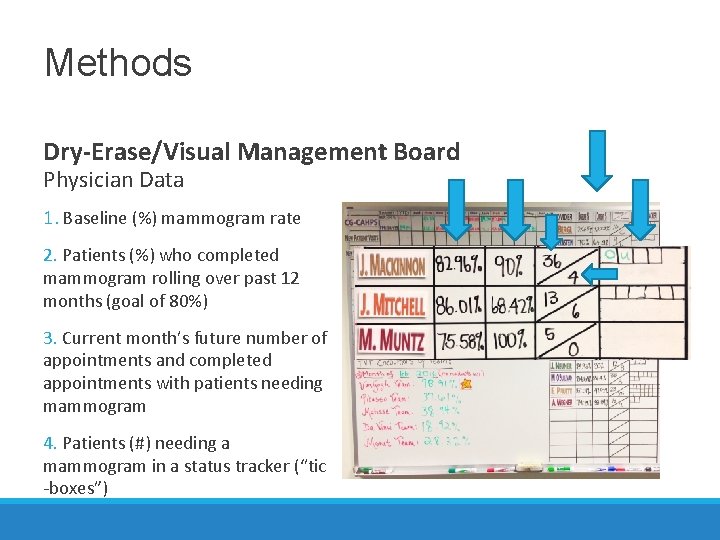
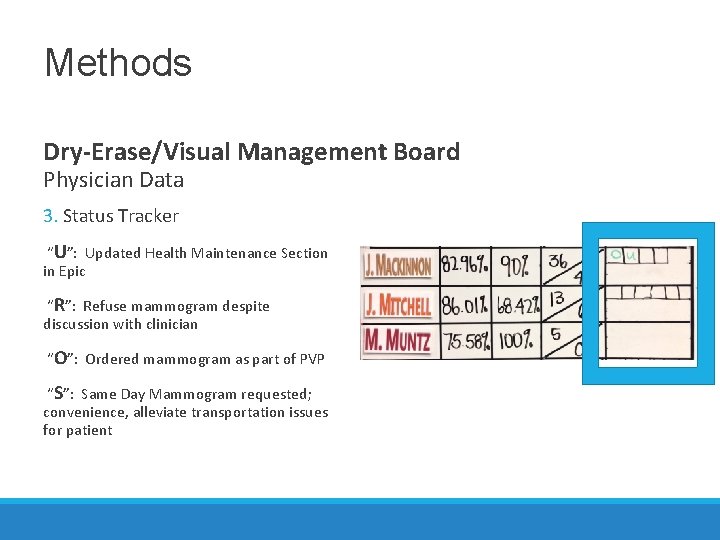
Methods Dry-Erase/Visual Management Board Physician Data 1. Baseline (%) mammogram rate 2. Patients (%) who completed mammogram rolling over past 12 months (goal of 80%) 3. Current month’s future number of appointments and completed appointments with patients needing mammogram 4. Patients (#) needing a mammogram in a status tracker (“tic -boxes”)
Methods Dry-Erase/Visual Management Board Physician Data 3. Status Tracker “U”: Updated Health Maintenance Section in Epic “R”: Refuse mammogram despite discussion with clinician “O”: Ordered mammogram as part of PVP “S”: Same Day Mammogram requested; convenience, alleviate transportation issues for patient
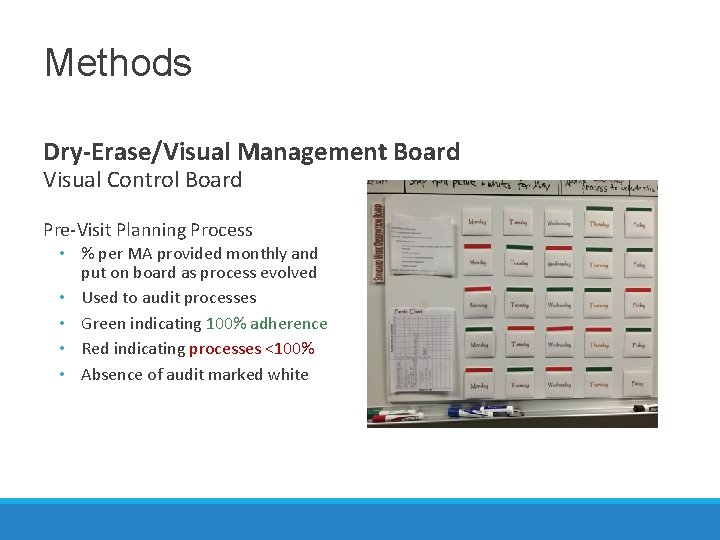
Methods Dry-Erase/Visual Management Board Visual Control Board Pre-Visit Planning Process • % per MA provided monthly and put on board as process evolved • Used to audit processes • Green indicating 100% adherence • Red indicating processes <100% • Absence of audit marked white
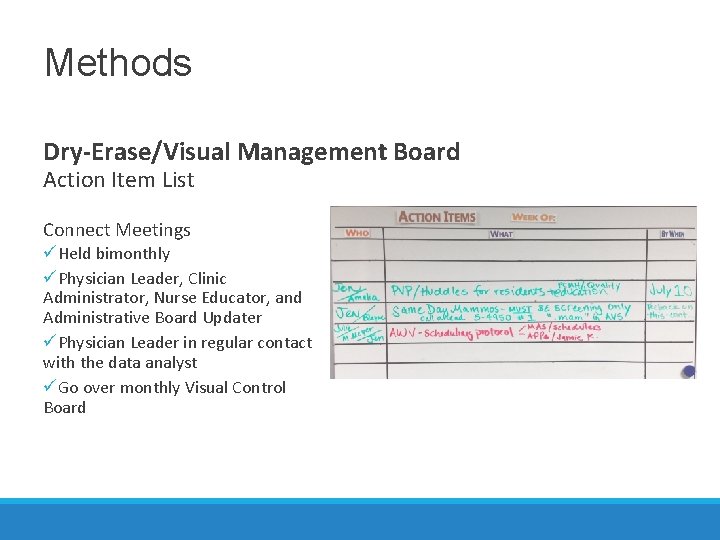
Methods Dry-Erase/Visual Management Board Action Item List Connect Meetings üHeld bimonthly üPhysician Leader, Clinic Administrator, Nurse Educator, and Administrative Board Updater üPhysician Leader in regular contact with the data analyst üGo over monthly Visual Control Board
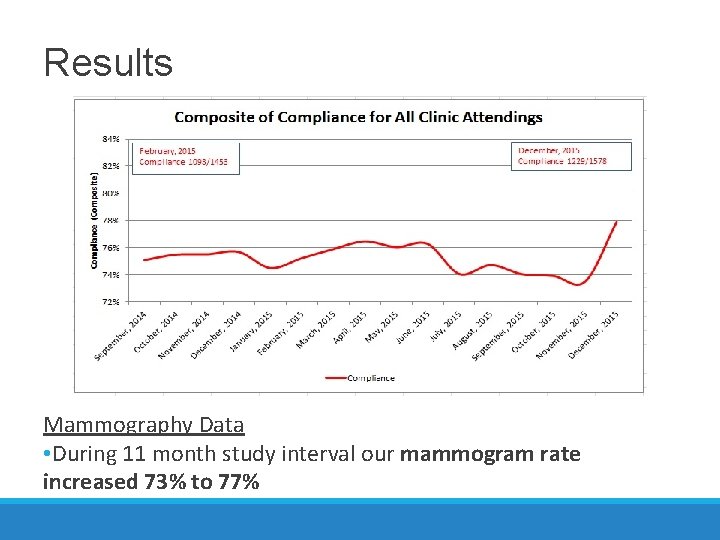
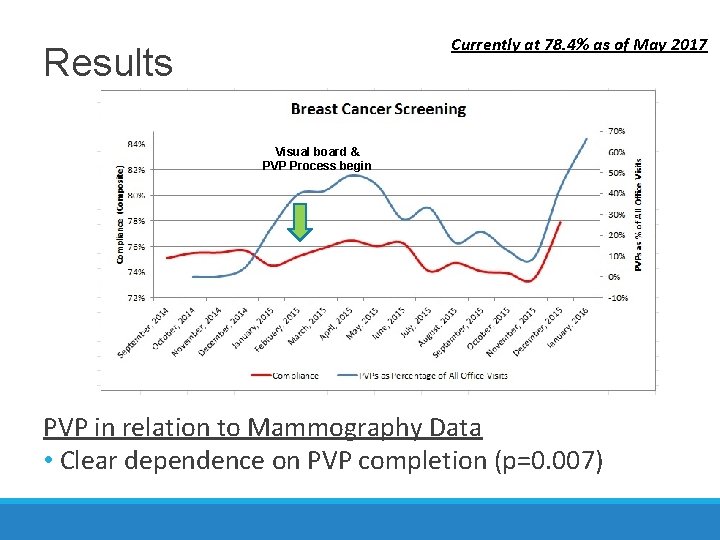
Results Mammography Data • During 11 month study interval our mammogram rate increased 73% to 77%
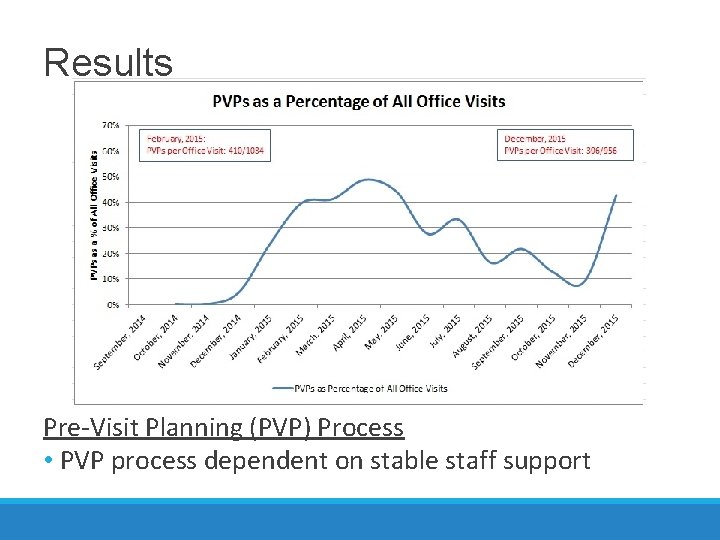
Results Pre-Visit Planning (PVP) Process • PVP process dependent on stable staff support
Currently at 78. 4% as of May 2017 Results Visual board & PVP Process begin PVP in relation to Mammography Data • Clear dependence on PVP completion (p=0. 007)
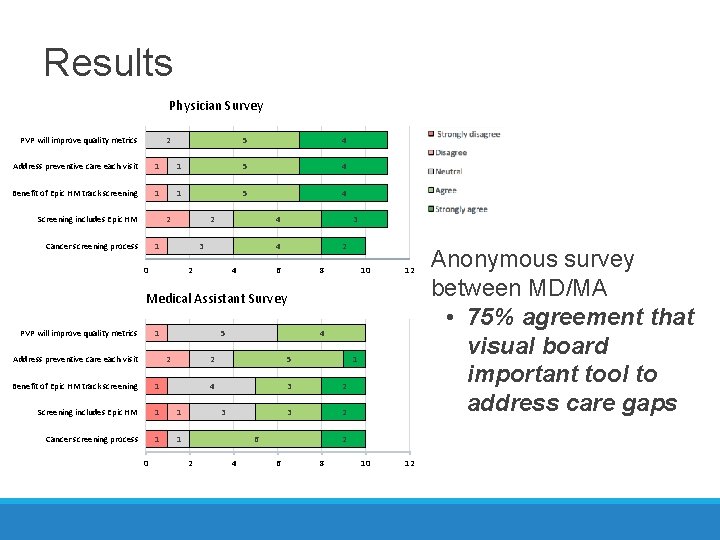
Results Physician Survey PVP will improve quality metrics 2 5 4 Address preventive care each visit 1 1 5 4 Benefit of Epic HM track screening 1 1 5 4 Screening includes Epic HM 2 Cancer screening process 2 1 4 3 0 3 4 2 6 8 10 12 Medical Assistant Survey PVP will improve quality metrics 1 Address preventive care each visit 5 2 Benefit of Epic HM track screening 1 Screening includes Epic HM 1 1 Cancer screening process 1 1 0 4 2 5 4 3 2 3 1 6 2 4 2 6 8 Anonymous survey between MD/MA • 75% agreement that visual board important tool to address care gaps
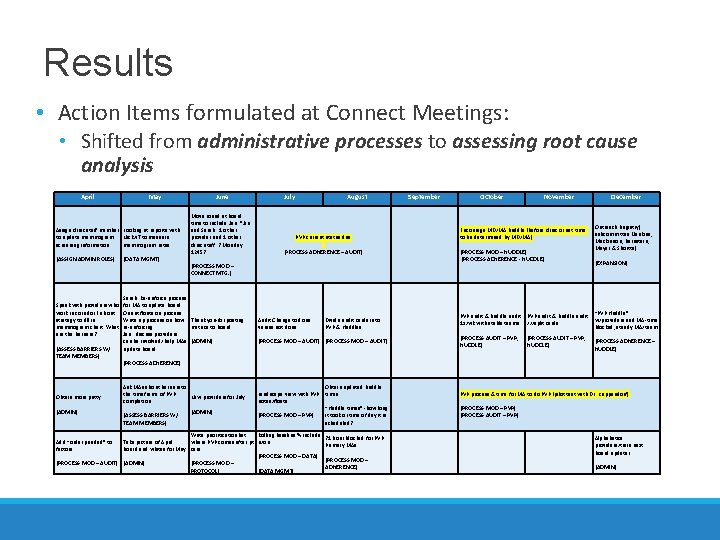
Results • Action Items formulated at Connect Meetings: • Shifted from administrative processes to assessing root cause analysis April May Assign clinic staff member Looking at reports with to update mammogram Nick/IT to measure screening information mammogram rates [ASSIGN ADMIN ROLES] Speak with providers who work in corridor F about strategy to fill in mammogram chart. What are the barriers? [ASSESS BARRIERS W/ TEAM MEMBERS] Obtain more putty [ADMIN] [DATA MGMT] June Move round at board time to include Jen. *Jen and Sarah. 1 other provider and 1 other clinic staff. ? Monday 1245? July August PVP current status due [PROCESS ADHERENCE – AUDIT] [PROCESS MOD – CONNECT MTG. ] Sarah: Re-enforce process for MA to update board. Orient floats on process. Write up process on how Thank you-for posting re-enforcing. metrics to board Jen: discuss providers can be involved/help MAs [ADMIN] update board Audit Change to done versus not done [PROCESS MOD – AUDIT] October November Encourage MD/MA huddle (before clinic or set time to be determined by MD/MA) [PROCESS MOD – HUDDLE] [PROCESS ADHERENCE - HUDDLE] PVP audit & huddle audit 1 x/wk with stable teams PVP audit & huddle audit ///split cards [PROCESS AUDIT – PVP; HUDDLE] December Outreach (registry) subcommittee (Jankins, Mackinnon, Bernstein, Meyer & Shortts) [EXPANSION] “PVP Huddle” w/providers and MA-time blocked, steady MA/team [PROCESS ADHERENCE – HUDDLE] [PROCESS ADHERENCE] Ask MAs about barriers to the timeframe of PVP New providers for July completion [ASSESS BARRIERS W/ TEAM MEMBERS] [ADMIN] Obtain updated huddle Landscape view with PVP times notes/floats “Huddle times” -how long [PROCESS MOD – PVP] it took or time of day it is scheduled? Write prioritization list Rolling baseline % include where PVP comes after pt u/o s Take picture of April board and whites for May care [PROCESS MOD – DATA] [PROCESS MOD – AUDIT] [ADMIN] [PROCESS MOD – PROTOCOL] [DATA MGMT] Add “order pended” to factors Divide audit cards into PVP & Huddles September ? 1 hour blocked for PVP Primary MAs [PROCESS MOD – ADHERENCE] PVP process & time for MA to do PVP (pilot test with Dr. Krippendorf) [PROCESS MOD – PVP] [PROCESS AUDIT – PVP] Alphabetize providers/train next board updater [ADMIN]
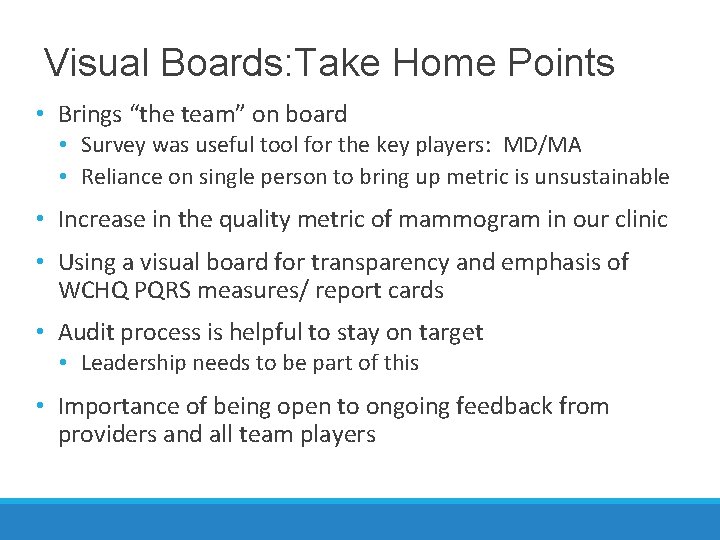
Visual Boards: Take Home Points • Brings “the team” on board • Survey was useful tool for the key players: MD/MA • Reliance on single person to bring up metric is unsustainable • Increase in the quality metric of mammogram in our clinic • Using a visual board for transparency and emphasis of WCHQ PQRS measures/ report cards • Audit process is helpful to stay on target • Leadership needs to be part of this • Importance of being open to ongoing feedback from providers and all team players
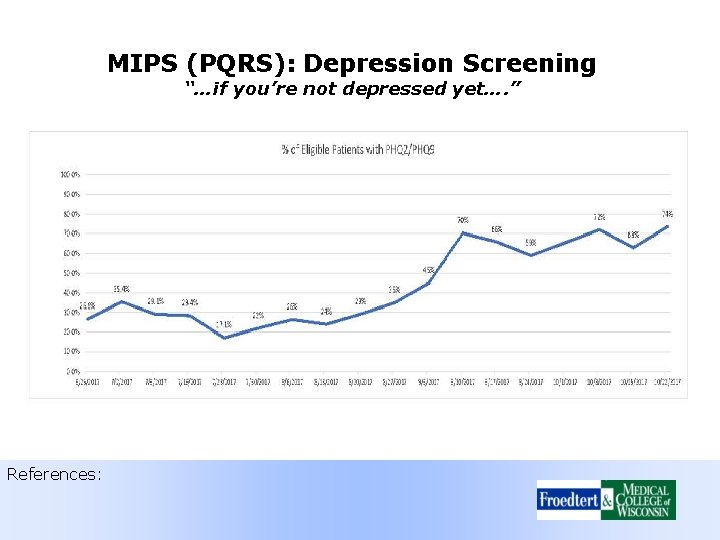
MIPS (PQRS): Depression Screening “…if you’re not depressed yet…. ” References:
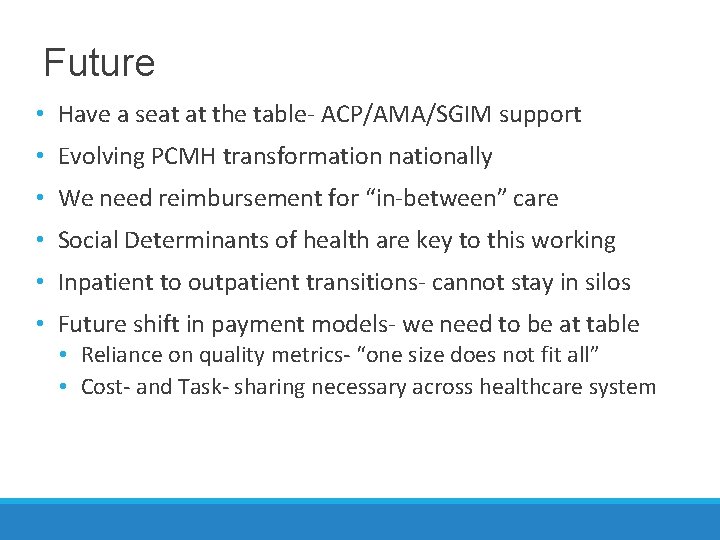
Future • Have a seat at the table- ACP/AMA/SGIM support • Evolving PCMH transformation nationally • We need reimbursement for “in-between” care • Social Determinants of health are key to this working • Inpatient to outpatient transitions- cannot stay in silos • Future shift in payment models- we need to be at table • Reliance on quality metrics- “one size does not fit all” • Cost- and Task- sharing necessary across healthcare system
Questions? www. mcw. edu
References • • • • • D. U. Himmelstein, M. Jun, R. Busse et al. , "A Comparison of Hospital Administrative Costs in Eight Nations: U. S. Costs Exceed All Others by Far, " Health Affairs, Sept. 2014 33(9): 1586– 94. Mackinnon J, Mitchell J, Dreyer, M. “Bringing the Team On Board: Using Visual Management Boards as a Quality Improvement Tool. ” Wisconsin Medical Journal, June 2016; 115(3): 158. Singh P, Gandhi N. “Listening is a Lost Art in Medicine: Here’s How to Rediscover It. ” Harvard Business Review; Nov. 2017. Bujold EJ. An Opinion Piece: PCMH. JAMA Internal Medicine; Sept 2017. Reynolds P, et al. The Patient-Centered Medical Home: Preparation of the Workforce, More Questions than Answers. JGIM, Feb. 2015; 1013 -1017. Helfrich CD, et al. The Association of Team-Specific Workload and Staffing with Odds of Burnout Among VA Primary Care Team Members. JGIM, Feb. 2017: 760 -766. Magill, Michael K, et al. Cost of Sustaining a Patient-Centered Medical Home: Experience from Two States. Annuals of Family Medicine 2015; vol 13, no 5: 429 -435. Mackinnon J, Muntz M, Mitchell J. Giving early medical students a “home”: students can meaningfully contribute to care on a year-long continuity rotation in a PCMH. MCW Faculty Development, 2015. Sinsky C, et al. Allocation of Physician Time in Ambulatory Practice: A Time and Motion Study in 4 Specialties. Annals of Internal Medicine 2016; 165: 753 -760. Peikes D et al. Early Evidence on the Patient-Centered Medical Home. AHRQ Report ; Feb. 2012 Berk-Clark C, et al. Do Patient-Centered Medical Homes Improve Health Behaviors, Outcomes and Exerperiences of Low-Income Patients? A Systematic Review and Meta-Analysis. Health Services Research; Educational Trust DOI: 10. 1111/1475 -6773. 12737 Wong E, et al. Patient-Centered Medical Home Implementation in the Veterans Health Administration and Primary Care Use: Differences by Patient Comorbidity Burden; JGIM 2016; 31(12): 1467 -74. Arend J, et al. The Patient-Centered Medical Home: History, Components, and Review of the Evidence. Mount Sinai Journal Of Medicine 2012; 79: 433 -450. Timble JW, et al. Association Between Patient-Centered Medical Home Capabilities and Outcomes for Medicare Beneficiaries Seeking Care from Federally Qualified Health Centers. JGIM, May 2017; 32(9); 997 -1004. Mackinnon J, Mitchell J, Muntz M. “Giving Early Medical Students a ‘Home’: Students Can Meaningfully Contribute to Care on a Year-Long Rotation. National Society of General Internal Medicine Meeting; April 2014. Williams M. “The Pros and Cons of Using Scribes. ” ACP Internist; October 2016. Proctor L. “diagnostics Errors: Medical Scribes Improve Physician Satisfaction. Can They Improve Diagnosis, Too? “ www. pshq. com Banks A, et al. Impact of scribes on patient interaction, productivity, and revenue in a cardiology clinic: A prospective study. J of Clijnicoeconomics and Outcomes Research: 5: 399 -405. Hafner K. A busy doctor’s right hand, ever ready to type. The New York Times, Jan. 2014. Barrett T. NCQA PCMH Recognition: 2017 Standards Preview. Jan 2017.