
ACOUSTO OPTIC MODULATORS 1 BINAR ALAM PAMUNGKAS 2

ACOUSTO OPTIC MODULATORS 1. BINAR ALAM PAMUNGKAS 2. AS’AD MUHAMMAD NASHRULLAH 3. ALFIKRI D PRATAMA
DEFINITION An acousto-optic modulator (AOM), also called a Bragg cell, uses the acousto-optic effect to diffract and shift the frequency of light using sound waves (usually at radiofrequency) They are used in lasers for Q-switching, telecommunications for signal modulation, and in spectroscopy for frequency control.
ADVANTAGE AOMs offer more deflection range, simple design, and low power consumption (less than 3 watts) Acousto-optic modulators are much faster than typical mechanical devices.
DISADVANTAGES Weak link Sound takes time to travel from transducer to laser beam Time delay: t. D = l / v -- acts like multi-pole rolloff (phase shift increases with frequency)
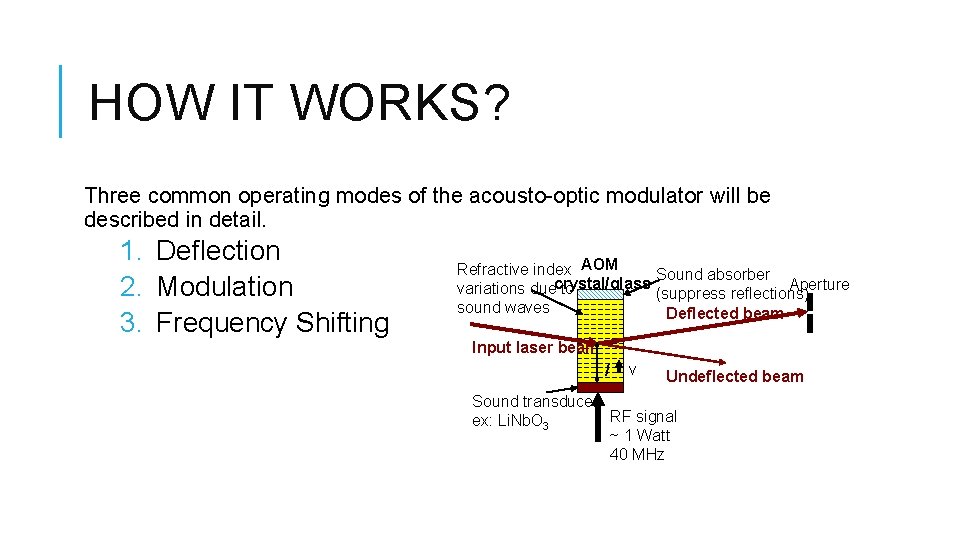
HOW IT WORKS? Three common operating modes of the acousto-optic modulator will be described in detail. 1. Deflection 2. Modulation 3. Frequency Shifting Refractive index AOM Sound absorber crystal/glass Aperture variations due to (suppress reflections) sound waves Deflected beam Input laser beam l v Undeflected beam Sound transducer RF signal ex: Li. Nb. O 3 ~ 1 Watt 40 MHz
MODULATION The amount of laser light diffracted to the first order beam depends on the amplitude of the acoustic waves that diffract the incident laser beam, and therefore, by modulating the power level of the acoustic wave source, the intensity of the diffracted light beam can be modulated. By this means an electrical signal containing voice, music, or television can modulate the intensity of a light beam as part of an optical communications system.
FREQUENCY SHIFTING This is one of the most useful properties of the acousto-optic modulator. The ability of the acousto-optic modulator to shift the frequency of a laser light beam by a precise and stable amount is crucial to production of a beat note from two light beams in this experiment. Bragg diffraction of x-rays occurs for atomic planes that are at rest in the laboratory, while acousto-optic diffraction occurs from acoustic wave planes that travel at the relatively high-speed vs with respect to the laboratory.
(CONT. ) FREQUENCY SHIFTING The frequency of the first order-diffracted beam is shifted by an amount exactly equal to the acoustooptic modulator frequency f. If 0 is the frequency of the light incident on the acousto-optic modulator, the frequency of the first order beam will be up shifted to 0+f in the case that the acoustic planes have a component of motion toward the incident light beam, and downshifted to 0 -f when the acoustic planes have a component of motion away from the incident light beam.
(CONT. ) FREQUENCY SHIFTING The frequency shift produced by an acousto-optic modulator can be used to transform a fixed frequency laser like the He. Ne laser, into a tunable laser, although only over the small range of frequencies (20 MHz for the ADM-40) over which the acousto-optic modulator can be operated.
AOM DRIVER Fixed frequency: 40 MHz Can change amplitude (power) with input voltage RF power determines sound wave amplitude, density change, refractive index modulation depth, diffracted light power
AOM MATERIALS Glass AOM (ex. Li Nb. O 3) sound speed 6 km/sec time delay 160 nsec / mm distance from transducer 40 MHz drive --> 150 mm fringe spacing for 0. 6 micron light, Bragg angle = 2 mrad = 0. 1 degree
APPLICATIONS Q switchinh Regenerative amplifiers Cavity dumpling Modelocking Laser Doppler Vibrometer RGB Laser Light Modulation for Digital Imaging of Photographic Film Confocal Microscopy Hyperspectral imaging
- Slides: 12