
ACOUSTICS part 2 Sound Engineering Course Angelo Farina
- Slides: 35
ACOUSTICS part - 2 Sound Engineering Course Angelo Farina Dip. di Ingegneria Industriale - Università di Parma Parco Area delle Scienze 181/A, 43100 Parma – Italy angelo. farina@unipr. it www. angelofarina. it
The human auditory system
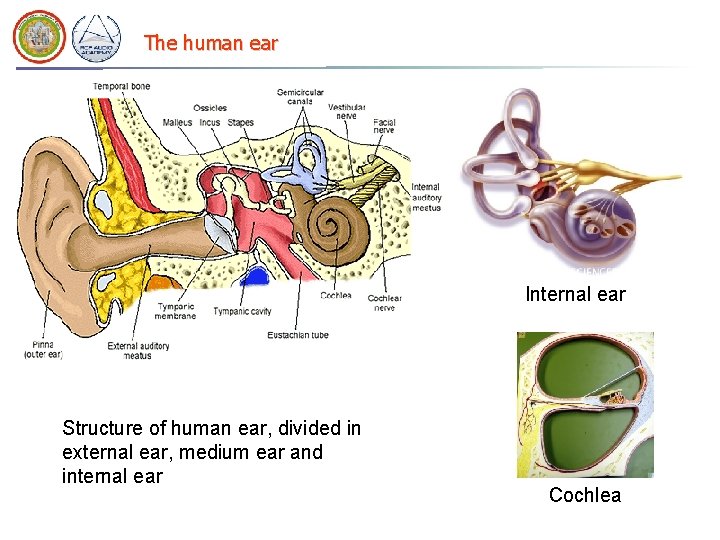
The human ear Internal ear Structure of human ear, divided in external ear, medium ear and internal ear Cochlea
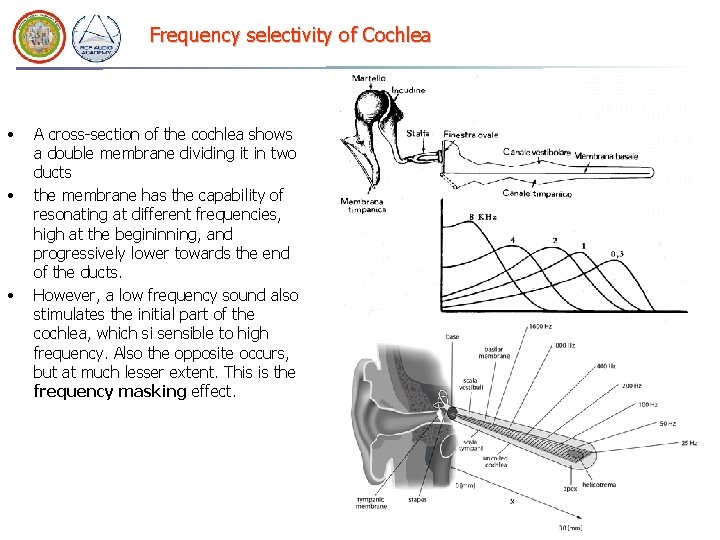
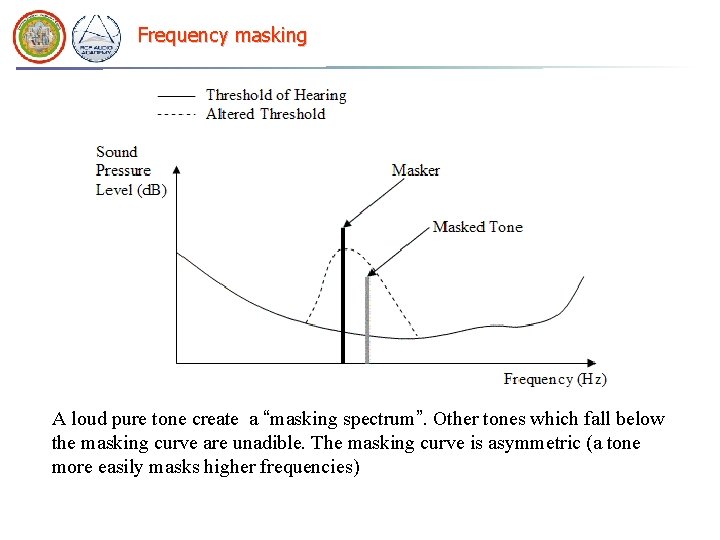
Frequency selectivity of Cochlea • • • A cross-section of the cochlea shows a double membrane dividing it in two ducts the membrane has the capability of resonating at different frequencies, high at the begininning, and progressively lower towards the end of the ducts. However, a low frequency sound also stimulates the initial part of the cochlea, which si sensible to high frequency. Also the opposite occurs, but at much lesser extent. This is the frequency masking effect.
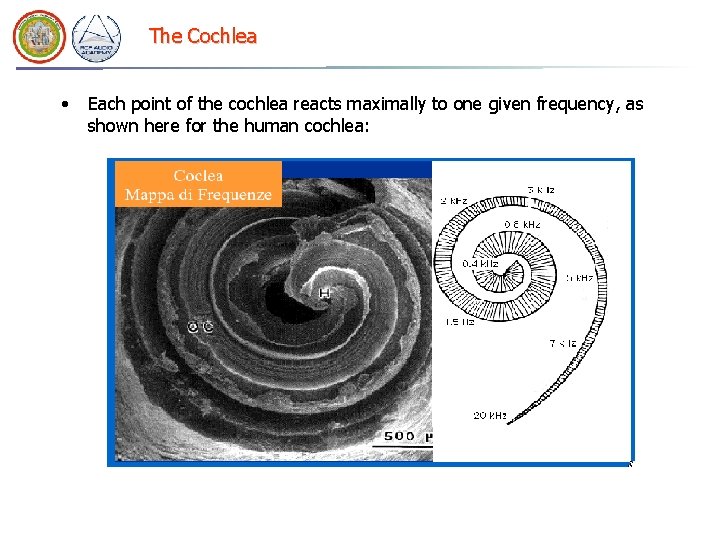
The Cochlea • Each point of the cochlea reacts maximally to one given frequency, as shown here for the human cochlea:
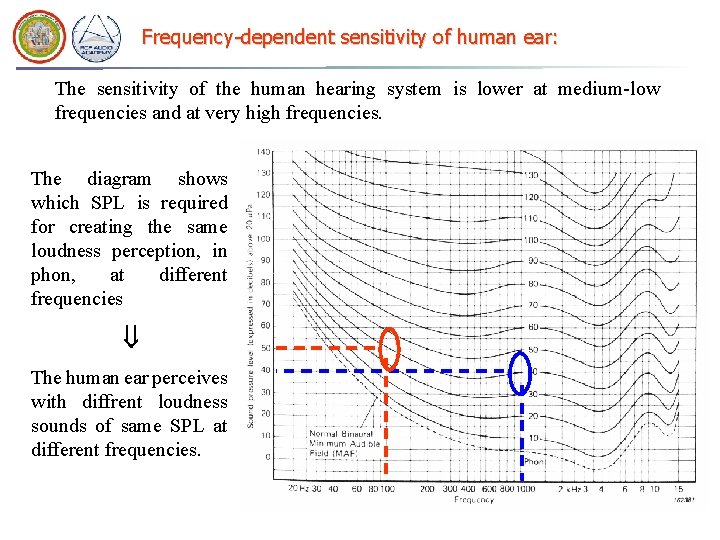
Frequency-dependent sensitivity of human ear: The sensitivity of the human hearing system is lower at medium-low frequencies and at very high frequencies. The diagram shows which SPL is required for creating the same loudness perception, in phon, at different frequencies The human ear perceives with diffrent loudness sounds of same SPL at different frequencies.
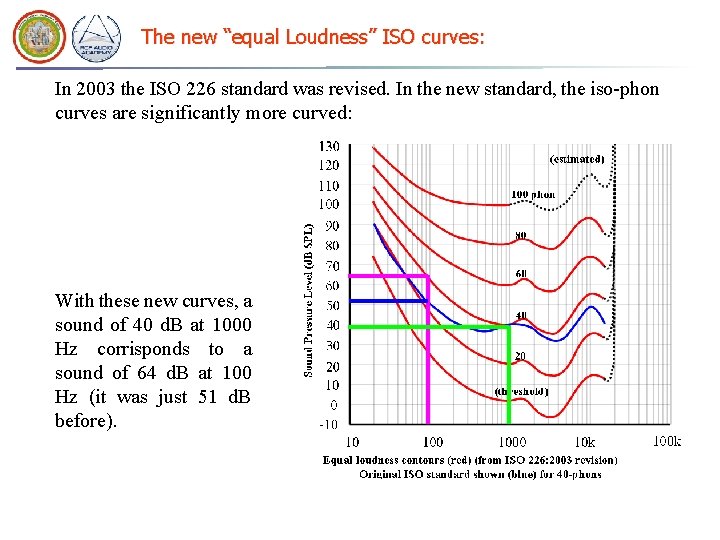
The new “equal Loudness” ISO curves: In 2003 the ISO 226 standard was revised. In the new standard, the iso-phon curves are significantly more curved: With these new curves, a sound of 40 d. B at 1000 Hz corrisponds to a sound of 64 d. B at 100 Hz (it was just 51 d. B before).
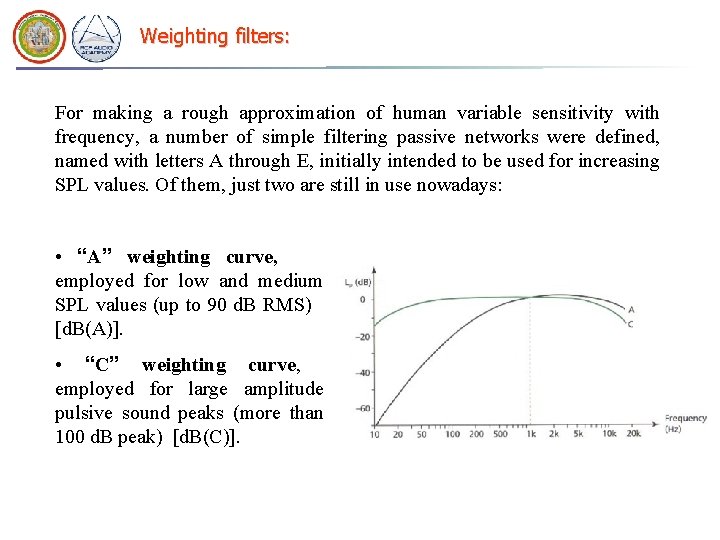
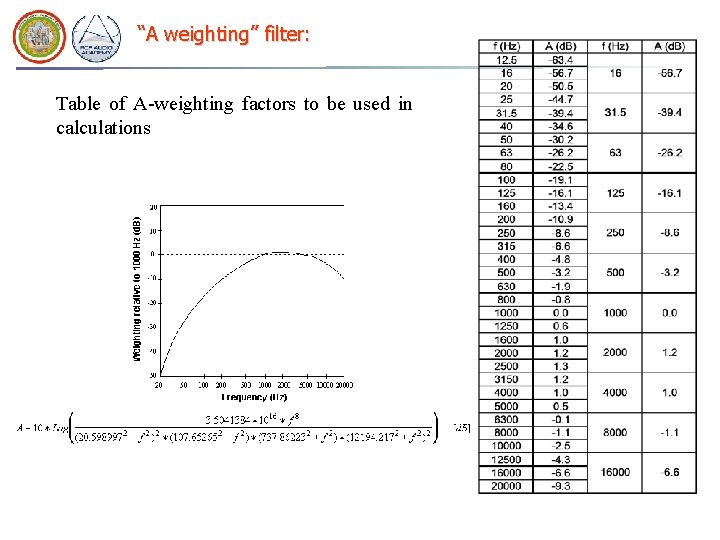
Weighting filters: For making a rough approximation of human variable sensitivity with frequency, a number of simple filtering passive networks were defined, named with letters A through E, initially intended to be used for increasing SPL values. Of them, just two are still in use nowadays: • “A” weighting curve, employed for low and medium SPL values (up to 90 d. B RMS) [d. B(A)]. • “C” weighting curve, employed for large amplitude pulsive sound peaks (more than 100 d. B peak) [d. B(C)].
“A weighting” filter: Table of A-weighting factors to be used in calculations
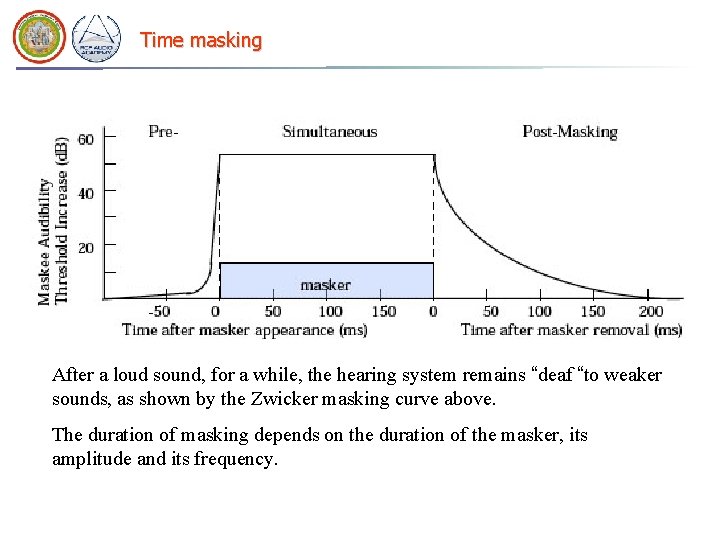
Time masking After a loud sound, for a while, the hearing system remains “deaf “to weaker sounds, as shown by the Zwicker masking curve above. The duration of masking depends on the duration of the masker, its amplitude and its frequency.
Frequency masking A loud pure tone create a “masking spectrum”. Other tones which fall below the masking curve are unadible. The masking curve is asymmetric (a tone more easily masks higher frequencies)
Sound pressure measurement: sound level meters
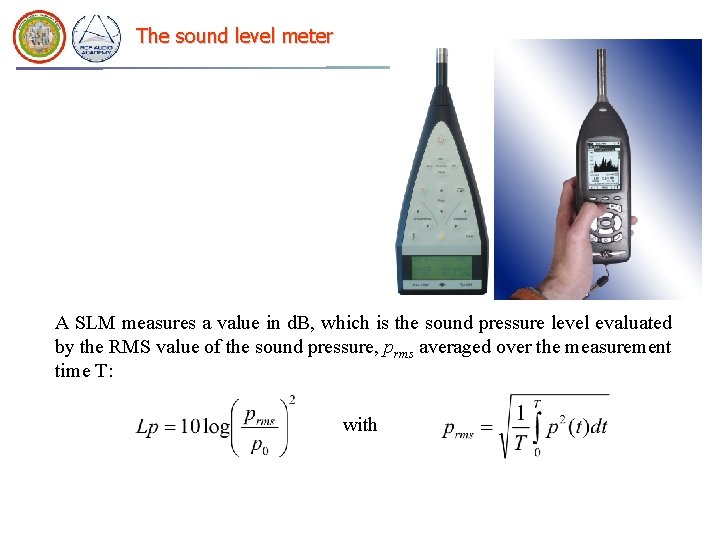
The sound level meter A SLM measures a value in d. B, which is the sound pressure level evaluated by the RMS value of the sound pressure, prms averaged over the measurement time T: with
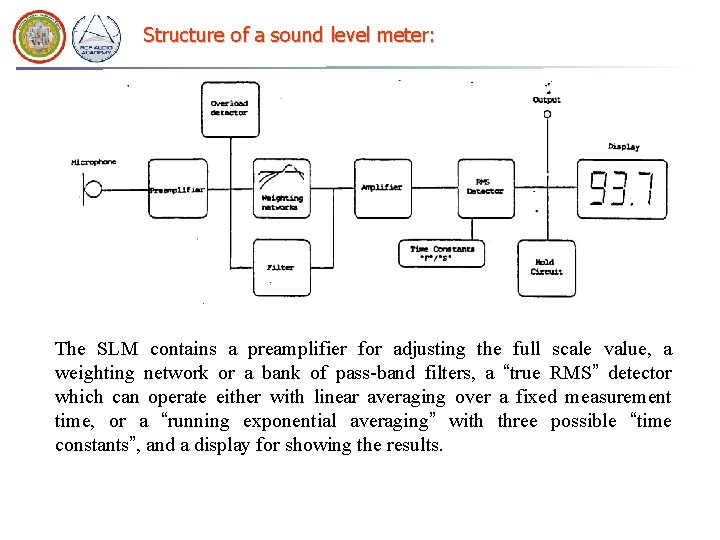
Structure of a sound level meter: The SLM contains a preamplifier for adjusting the full scale value, a weighting network or a bank of pass-band filters, a “true RMS” detector which can operate either with linear averaging over a fixed measurement time, or a “running exponential averaging” with three possible “time constants”, and a display for showing the results.
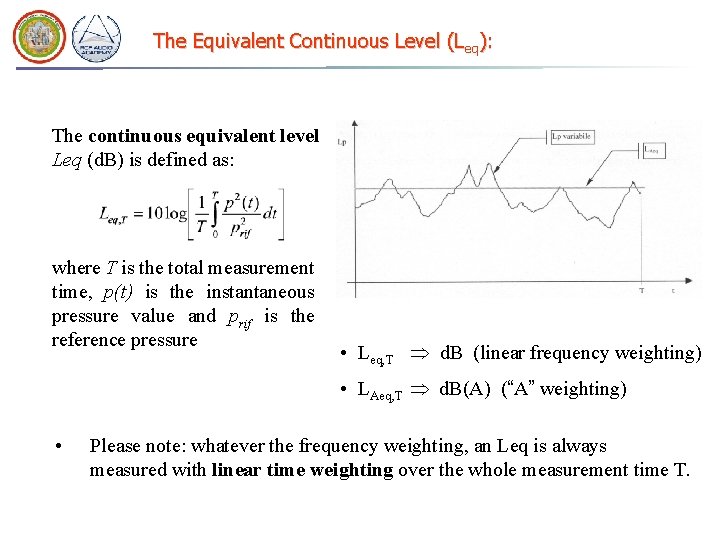
The Equivalent Continuous Level (Leq): The continuous equivalent level Leq (d. B) is defined as: where T is the total measurement time, p(t) is the instantaneous pressure value and prif is the reference pressure • Leq, T d. B (linear frequency weighting) • LAeq, T d. B(A) (“A” weighting) • Please note: whatever the frequency weighting, an Leq is always measured with linear time weighting over the whole measurement time T.
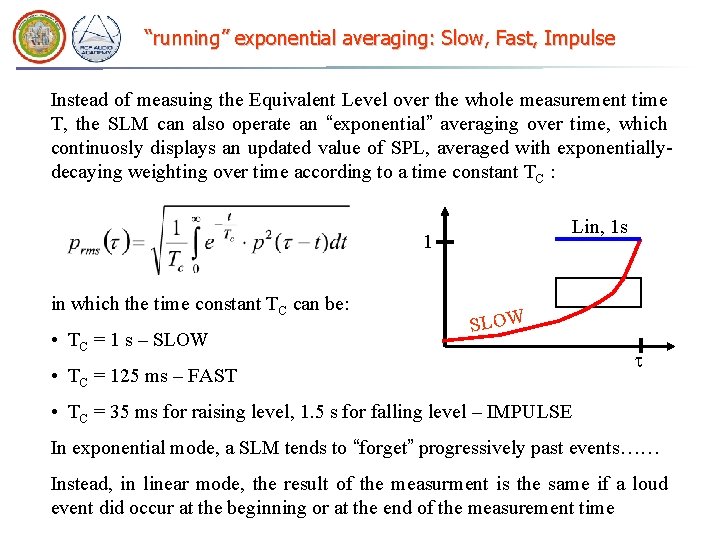
“running” exponential averaging: Slow, Fast, Impulse Instead of measuing the Equivalent Level over the whole measurement time T, the SLM can also operate an “exponential” averaging over time, which continuosly displays an updated value of SPL, averaged with exponentiallydecaying weighting over time according to a time constant TC : Lin, 1 s 1 in which the time constant TC can be: • TC = 1 s – SLOW • TC = 125 ms – FAST t • TC = 35 ms for raising level, 1. 5 s for falling level – IMPULSE In exponential mode, a SLM tends to “forget” progressively past events…… Instead, in linear mode, the result of the measurment is the same if a loud event did occur at the beginning or at the end of the measurement time
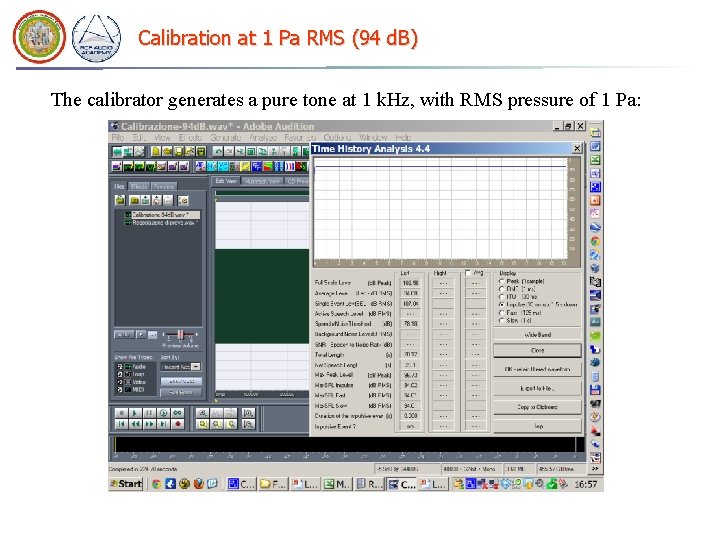
Calibration at 1 Pa RMS (94 d. B) The calibrator generates a pure tone at 1 k. Hz, with RMS pressure of 1 Pa:
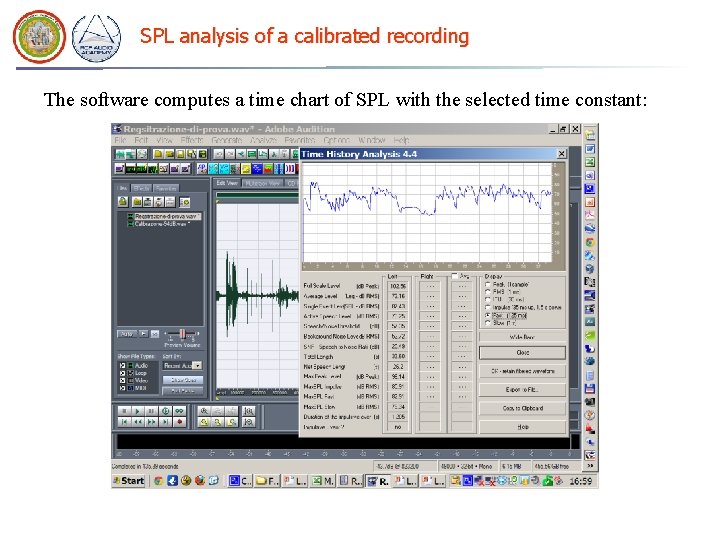
SPL analysis of a calibrated recording The software computes a time chart of SPL with the selected time constant:
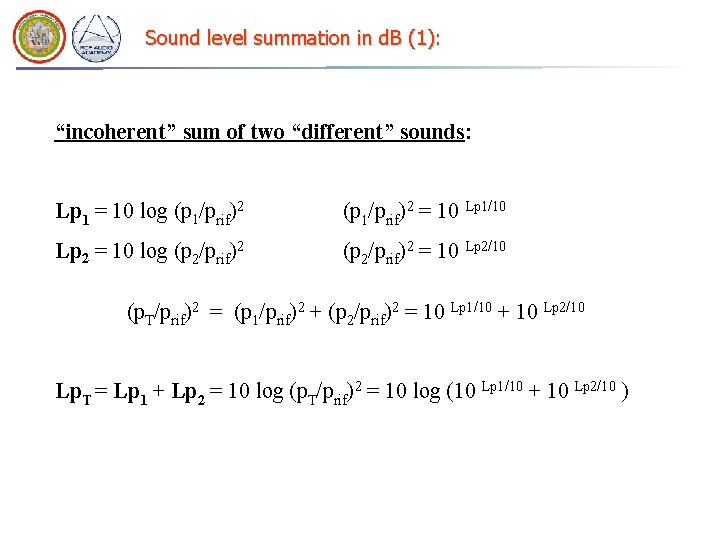
Sound level summation in d. B (1): “incoherent” sum of two “different” sounds: Lp 1 = 10 log (p 1/prif)2 = 10 Lp 1/10 Lp 2 = 10 log (p 2/prif)2 = 10 Lp 2/10 (p. T/prif)2 = (p 1/prif)2 + (p 2/prif)2 = 10 Lp 1/10 + 10 Lp 2/10 Lp. T = Lp 1 + Lp 2 = 10 log (p. T/prif)2 = 10 log (10 Lp 1/10 + 10 Lp 2/10 )
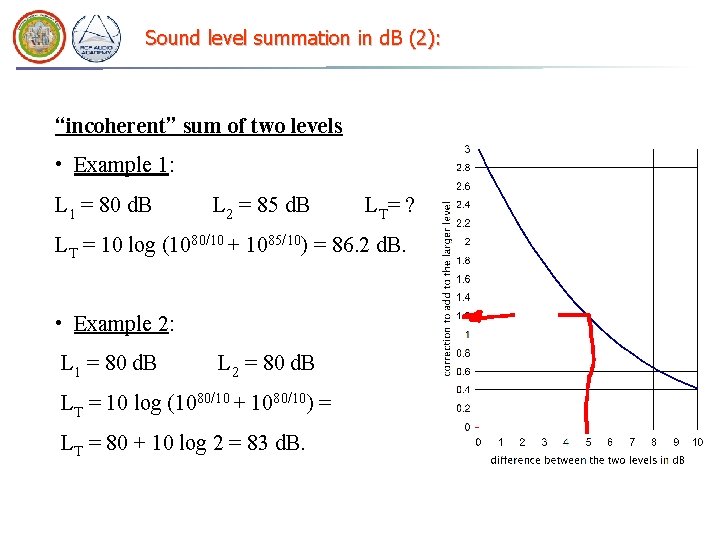
Sound level summation in d. B (2): “incoherent” sum of two levels • Example 1: L 1 = 80 d. B L 2 = 85 d. B LT= ? LT = 10 log (1080/10 + 1085/10) = 86. 2 d. B. • Example 2: L 1 = 80 d. B L 2 = 80 d. B LT = 10 log (1080/10 + 1080/10) = LT = 80 + 10 log 2 = 83 d. B.
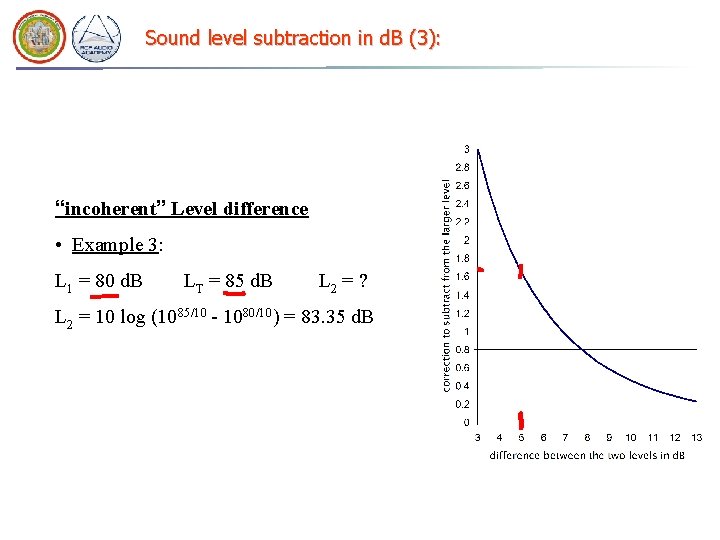
Sound level subtraction in d. B (3): “incoherent” Level difference • Example 3: L 1 = 80 d. B LT = 85 d. B L 2 = ? L 2 = 10 log (1085/10 - 1080/10) = 83. 35 d. B
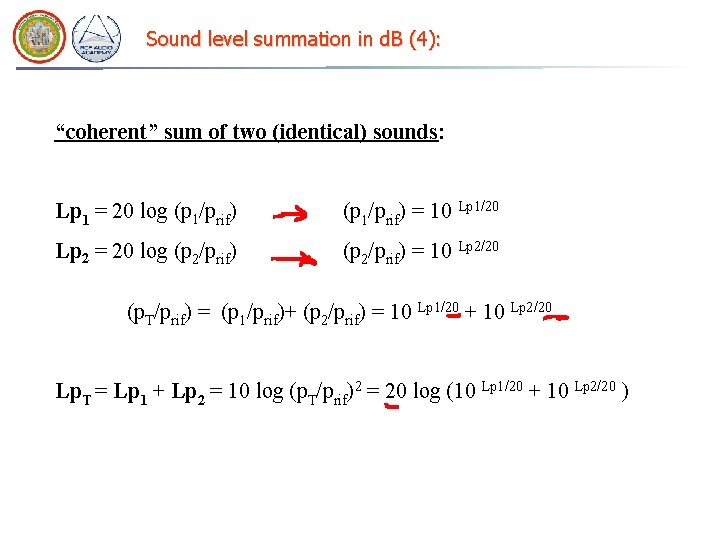
Sound level summation in d. B (4): “coherent” sum of two (identical) sounds: Lp 1 = 20 log (p 1/prif) Lp 2 = 20 log (p 2/prif) (p 1/prif) = 10 Lp 1/20 (p 2/prif) = 10 Lp 2/20 (p. T/prif) = (p 1/prif)+ (p 2/prif) = 10 Lp 1/20 + 10 Lp 2/20 Lp. T = Lp 1 + Lp 2 = 10 log (p. T/prif)2 = 20 log (10 Lp 1/20 + 10 Lp 2/20 )
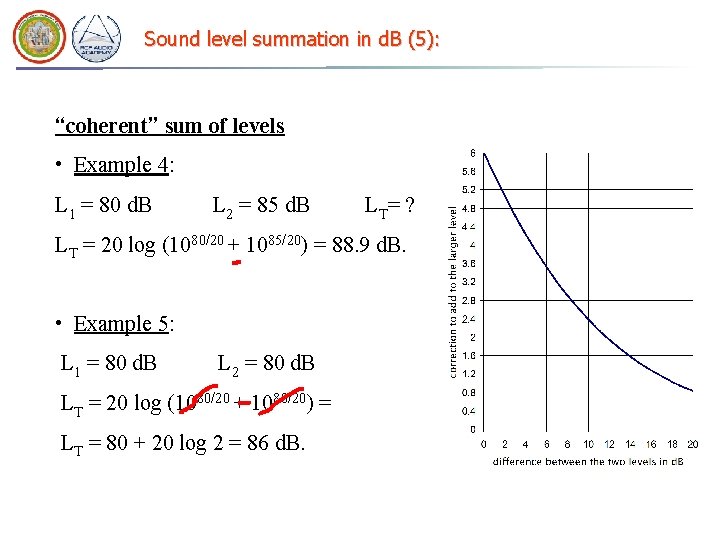
Sound level summation in d. B (5): “coherent” sum of levels • Example 4: L 1 = 80 d. B L 2 = 85 d. B LT= ? LT = 20 log (1080/20 + 1085/20) = 88. 9 d. B. • Example 5: L 1 = 80 d. B L 2 = 80 d. B LT = 20 log (1080/20 + 1080/20) = LT = 80 + 20 log 2 = 86 d. B.
Frequency analysis
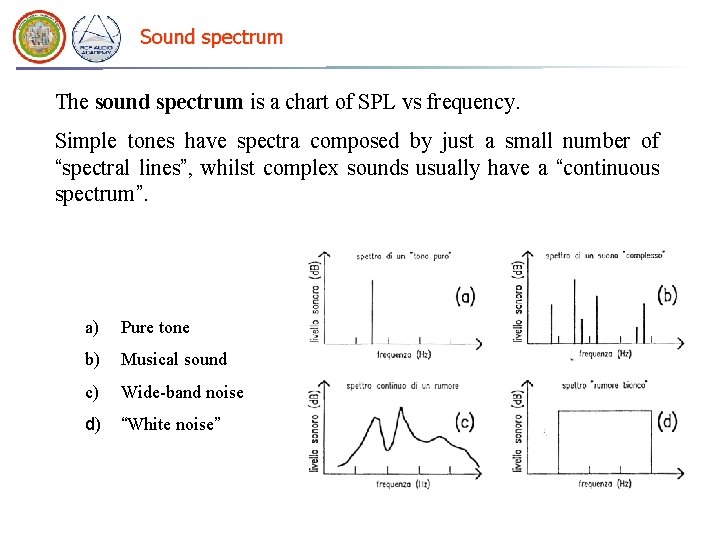
Sound spectrum The sound spectrum is a chart of SPL vs frequency. Simple tones have spectra composed by just a small number of “spectral lines”, whilst complex sounds usually have a “continuous spectrum”. a) Pure tone b) Musical sound c) Wide-band noise d) “White noise”
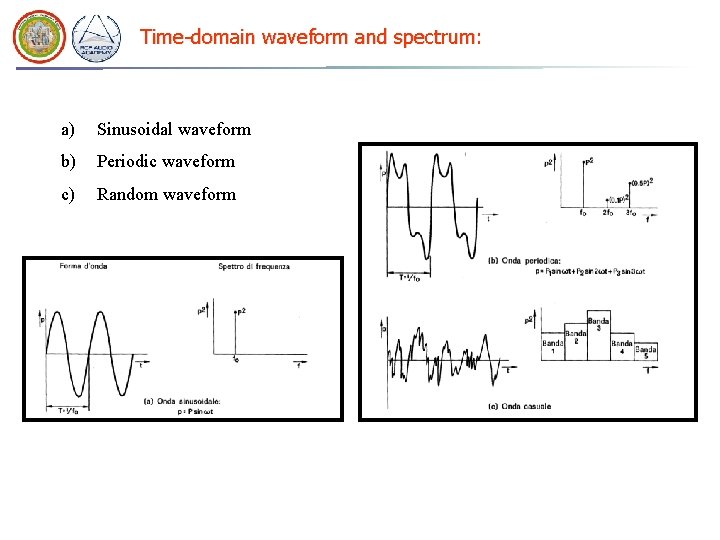
Time-domain waveform and spectrum: a) Sinusoidal waveform b) Periodic waveform c) Random waveform
Analisi in bande di frequenza: A practical way of measuring a sound spectrum consist in employing a filter bank, which decomposes the original signal in a number of frequency bands. Each band is defined by two corner frequencies, named higher frequency fhi and lower frequency flo. Their difference is called the bandwidth Df. Two types of filterbanks are commonly employed for frequency analysis: • constant bandwidth (FFT); • constant percentage bandwidth (1/1 or 1/3 of octave).
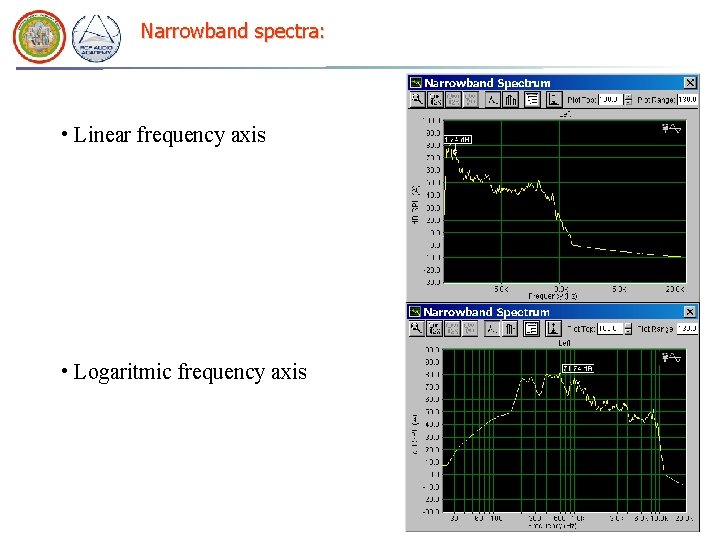
Constant bandwidth analysis: “narrow band”, constant bandwidth filterbank: • f = fhi – flo = constant, for example 1 Hz, 10 Hz, etc. Provides a very sharp frequency resolution (thousands of bands), which makes it possible to detect very narrow pure tones and get their exact frequency. It is performed efficiently on a digital computer by means of a well known algorithm, called FFT (Fast Fourier Transform)
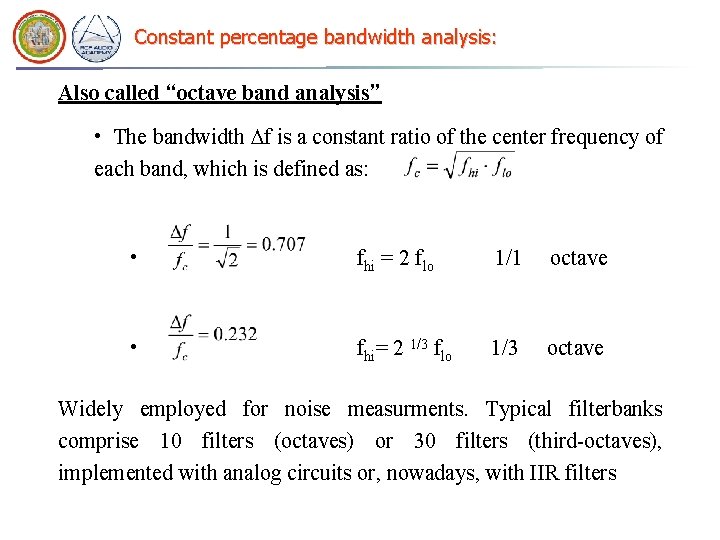
Constant percentage bandwidth analysis: Also called “octave band analysis” • The bandwidth Df is a constant ratio of the center frequency of each band, which is defined as: • fhi = 2 flo 1/1 octave • fhi= 2 1/3 flo 1/3 octave Widely employed for noise measurments. Typical filterbanks comprise 10 filters (octaves) or 30 filters (third-octaves), implemented with analog circuits or, nowadays, with IIR filters
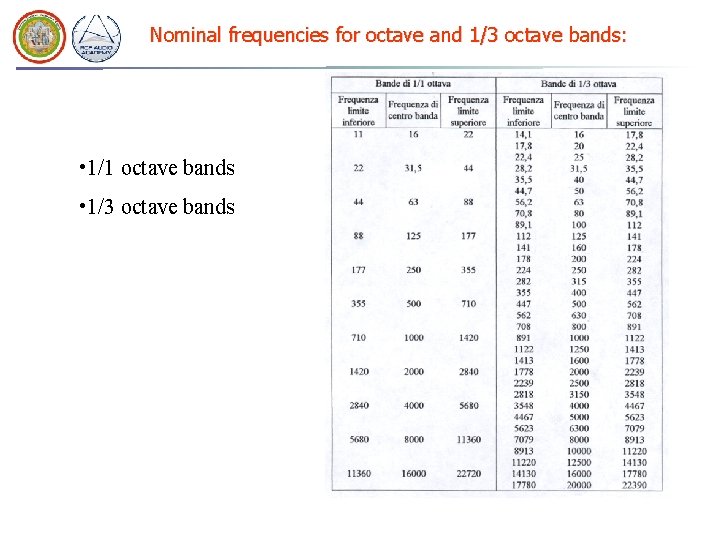
Nominal frequencies for octave and 1/3 octave bands: • 1/1 octave bands • 1/3 octave bands
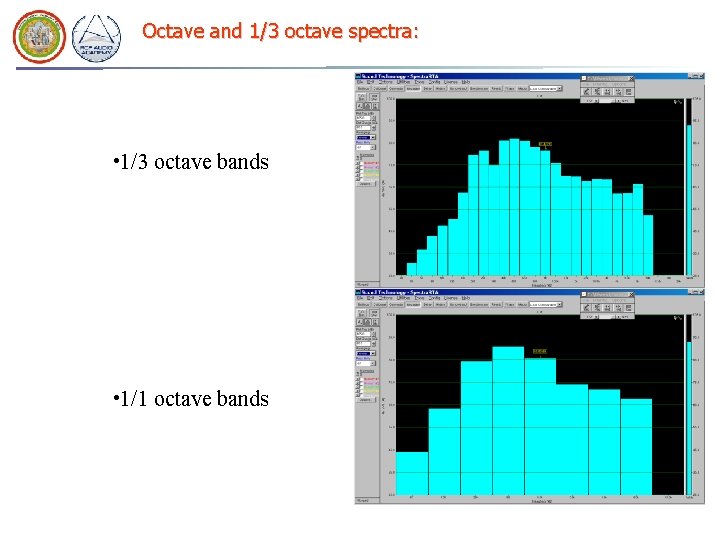
Octave and 1/3 octave spectra: • 1/3 octave bands • 1/1 octave bands
Narrowband spectra: • Linear frequency axis • Logaritmic frequency axis
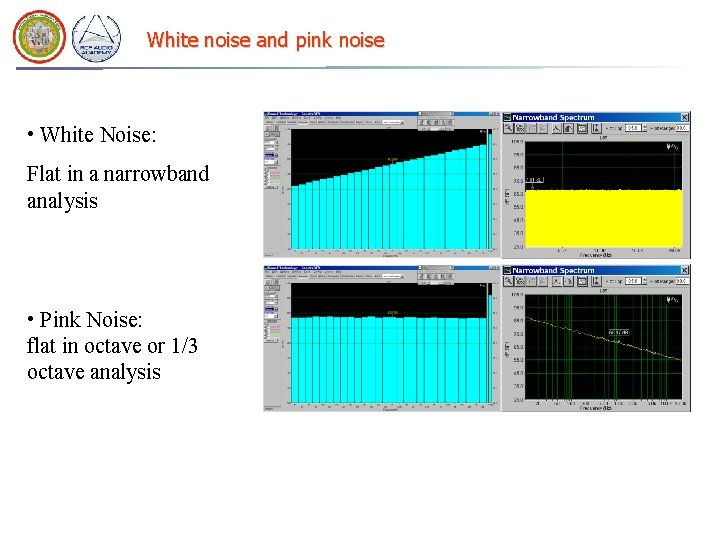
White noise and pink noise • White Noise: Flat in a narrowband analysis • Pink Noise: flat in octave or 1/3 octave analysis
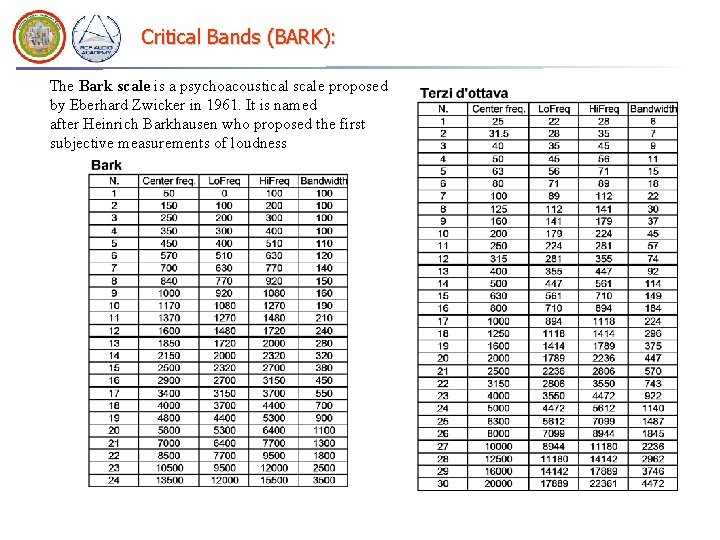
Critical Bands (BARK): The Bark scale is a psychoacoustical scale proposed by Eberhard Zwicker in 1961. It is named after Heinrich Barkhausen who proposed the first subjective measurements of loudness
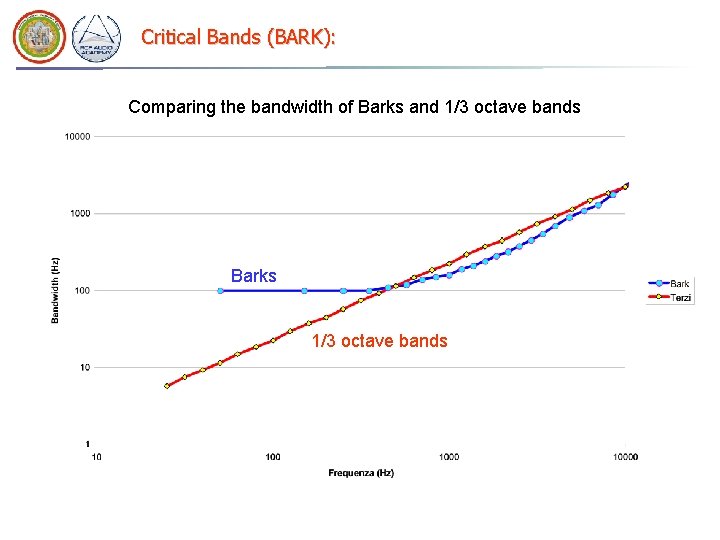
Critical Bands (BARK): Comparing the bandwidth of Barks and 1/3 octave bands Barks 1/3 octave bands