
Acoustics of the Marimba Heather Hill Advised by
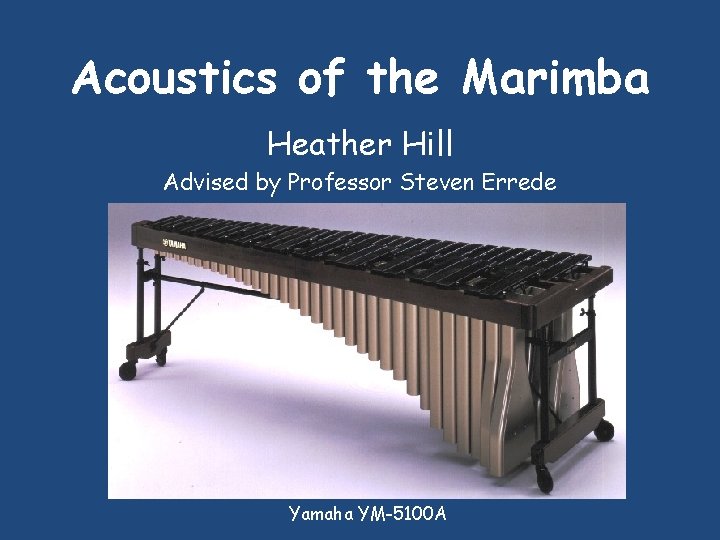
Acoustics of the Marimba Heather Hill Advised by Professor Steven Errede Yamaha YM-5100 A
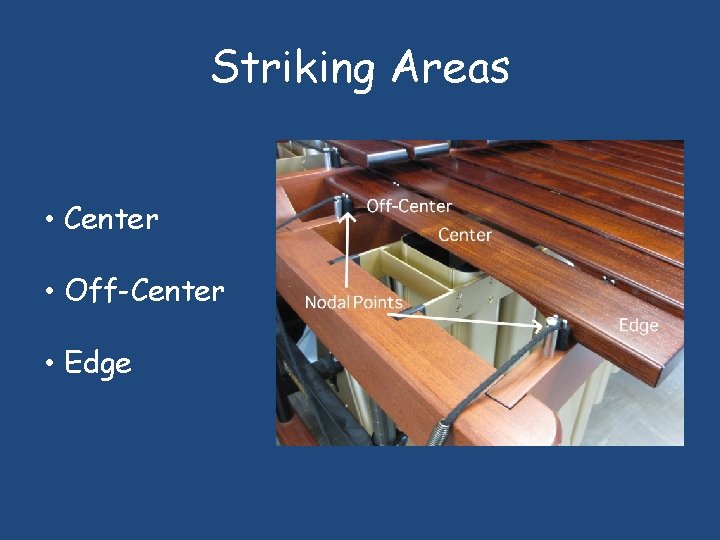
Striking Areas • Center • Off-Center • Edge
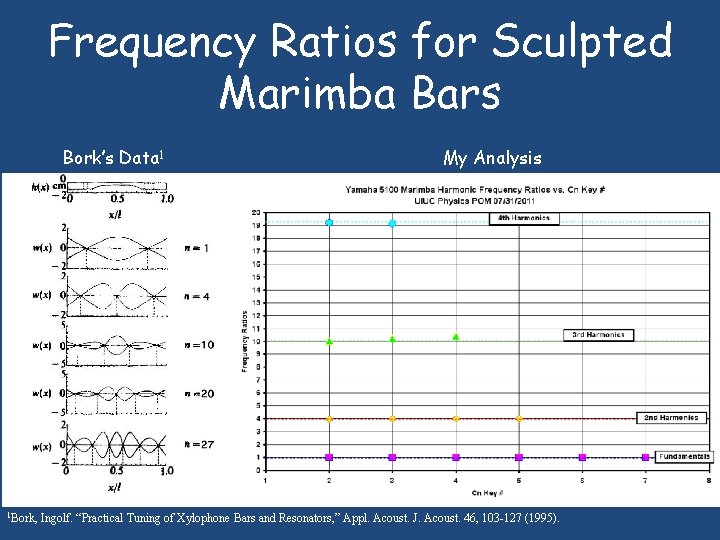
Frequency Ratios for Sculpted Marimba Bars Bork’s Data 1 1 Bork, My Analysis Ingolf. “Practical Tuning of Xylophone Bars and Resonators, ” Appl. Acoust. J. Acoust. 46, 103 -127 (1995).
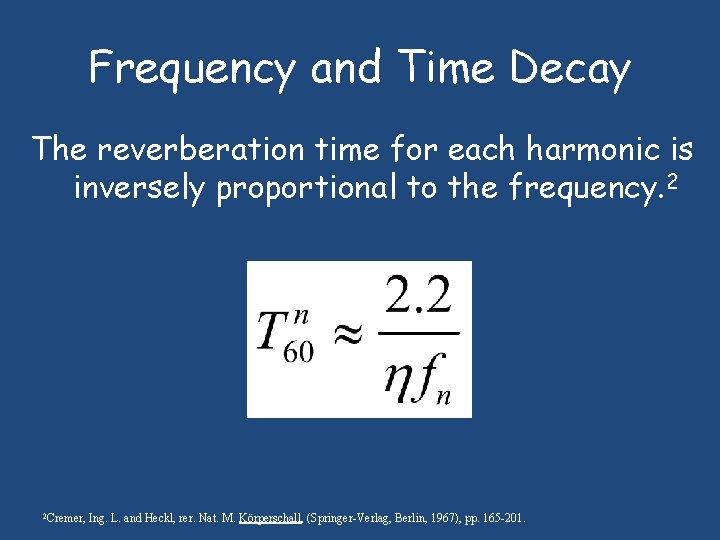
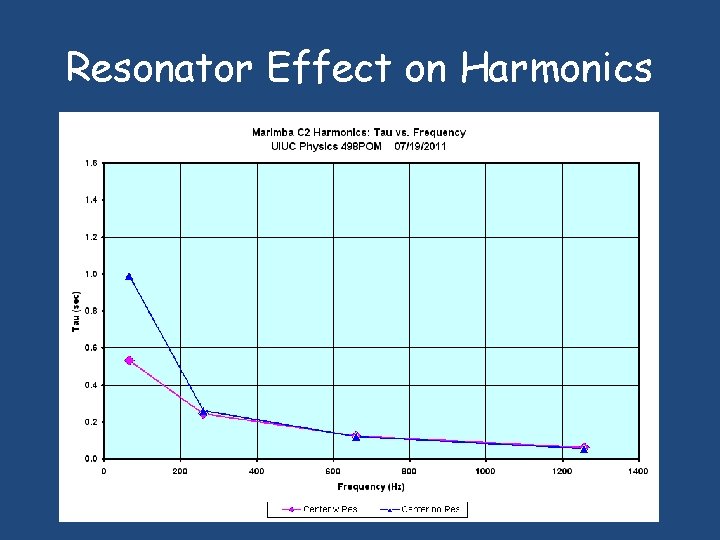
Frequency and Time Decay The reverberation time for each harmonic is inversely proportional to the frequency. 2 2 Cremer, Ing. L. and Heckl, rer. Nat. M. Körperschall, (Springer-Verlag, Berlin, 1967), pp. 165 -201.
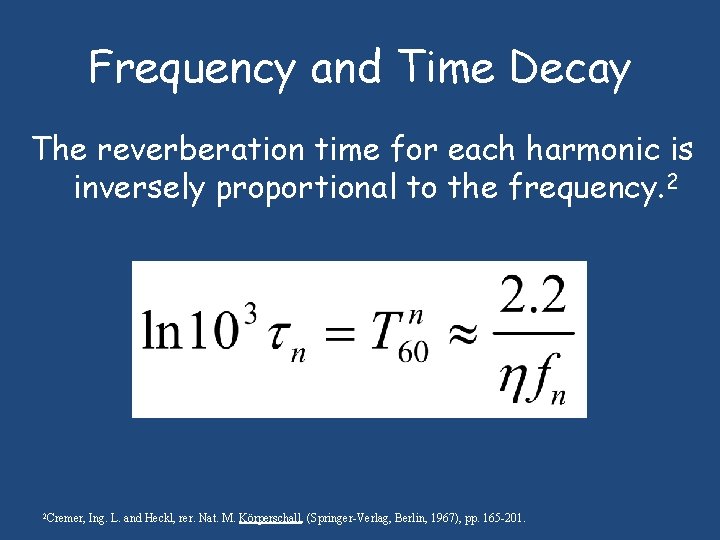
Frequency and Time Decay The reverberation time for each harmonic is inversely proportional to the frequency. 2 2 Cremer, Ing. L. and Heckl, rer. Nat. M. Körperschall, (Springer-Verlag, Berlin, 1967), pp. 165 -201.
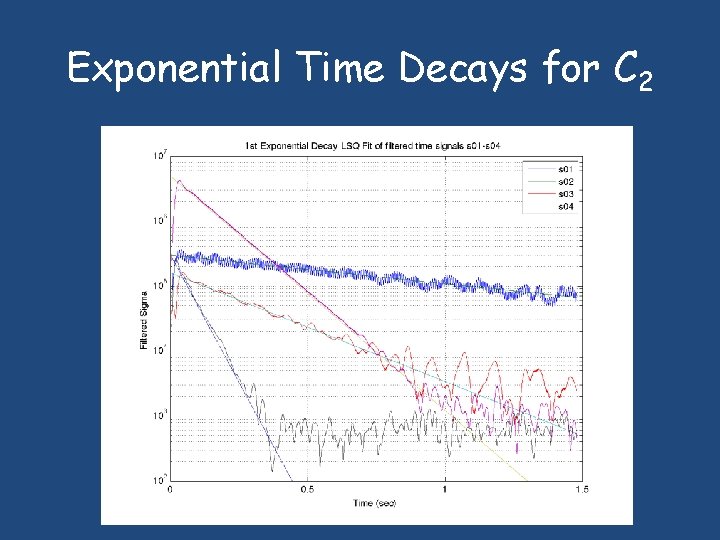
Exponential Time Decays for C 2
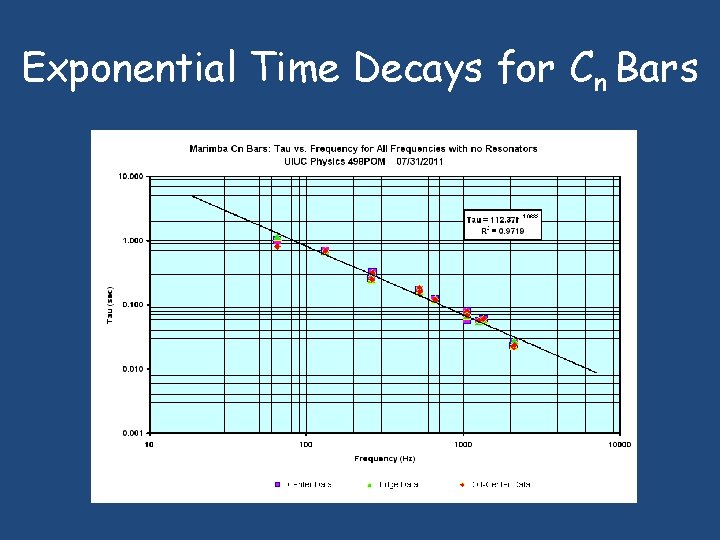
Exponential Time Decays for Cn Bars
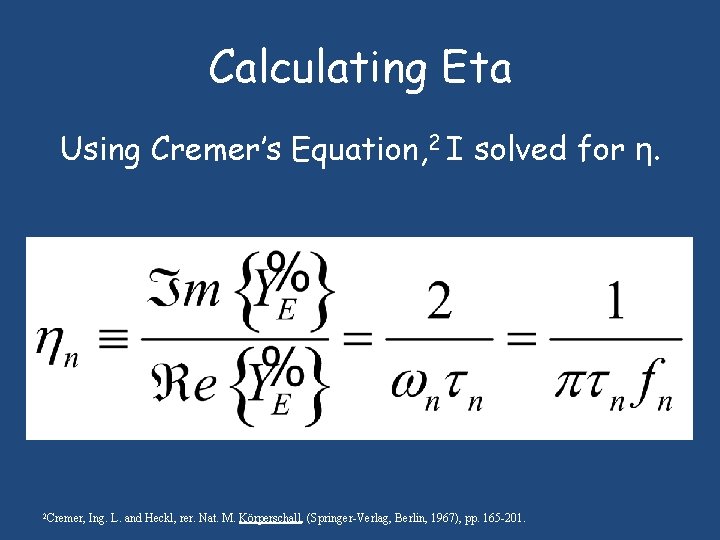
Calculating Eta Using Cremer’s Equation, 2 I solved for η. 2 Cremer, Ing. L. and Heckl, rer. Nat. M. Körperschall, (Springer-Verlag, Berlin, 1967), pp. 165 -201.
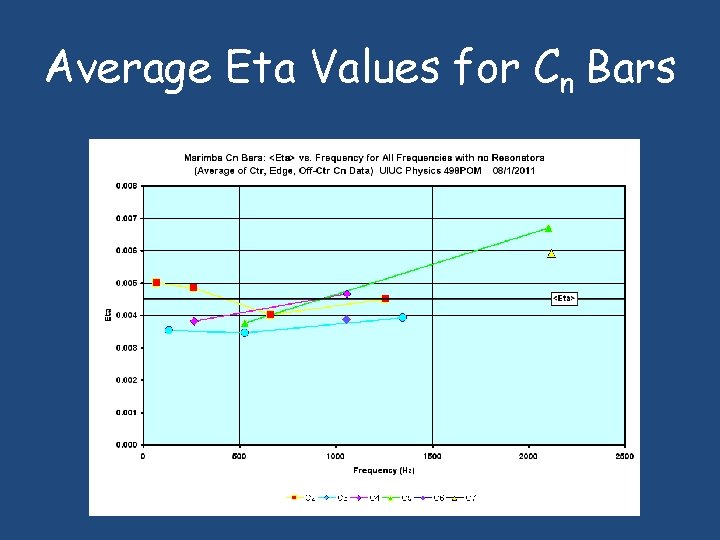
Average Eta Values for Cn Bars
Summary • The harmonics present in a sculpted marimba bar are f 1, f 4, f 10, and f 20. • The exponential time decay constants τn are inversely proportional to the frequency • The mean absorptivity of rosewood is <η> = 0. 45% ± 0. 09% • The methodology we have developed can be used to analyze the decay times of other musical instruments, room acoustics, etc. Acknowledgements: I thank Professor Steven Errede for a wonderful summer and for all of his advice and support. I also thank John Nichols for his additional guidance. The NSF Grant PHY-1062690 supports the REU program at UIUC.
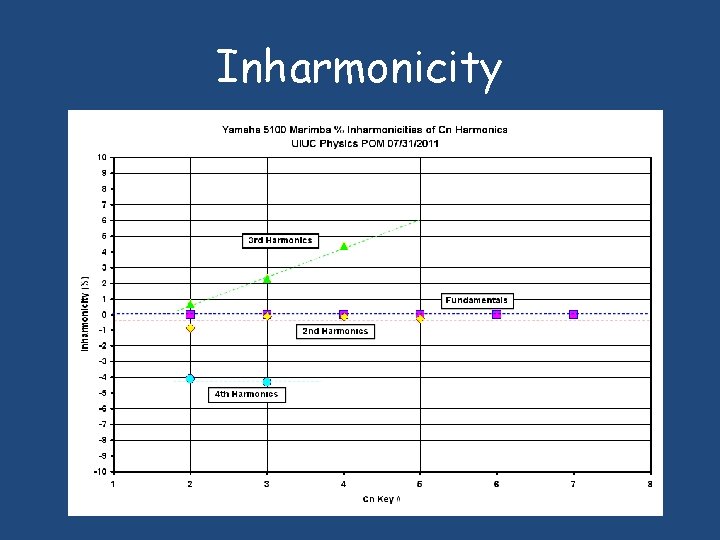
Inharmonicity
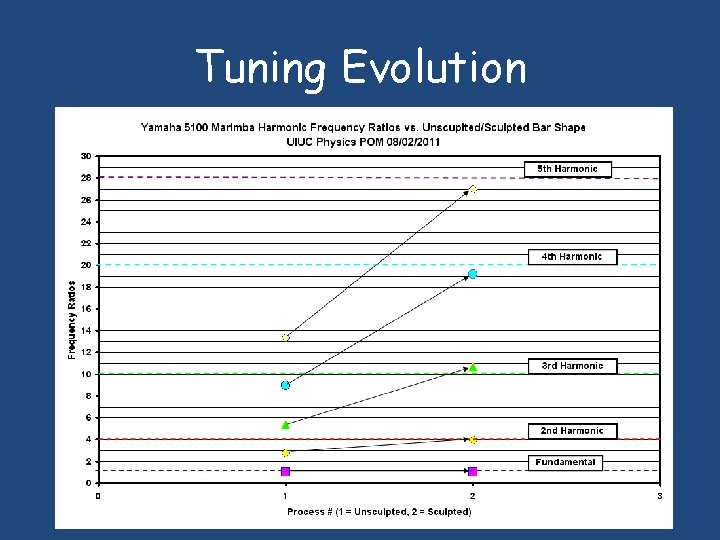
Tuning Evolution
Resonator Effect on Harmonics
- Slides: 13