
Acoustics of Instruments Music Theory Class Gettysburg College
Acoustics of Instruments Music Theory Class Gettysburg College
Sound waves • Variation in air pressure (and air density) • Amplitude (size of pressure variation) • Frequency (repetition rate) – cycles/sec or Hertz (Hz) – Humans hear from ~20 Hz to ~20, 000 Hz • Wavelength (~17 m to 17 mm) • Wave speed (344 m/s = 770 mph)
Sound Characteristics Characteristic Physical quantity Loudness Pitch Timbre wave amplitude wave frequency harmonics or overtones It’s actually more complicated than this, but we’ll start here. Let’s measure some sound waves…

Harmonics (overtones) • Real sound waves have many frequencies • Vibrating objects vibrate in many modes at once -overtones ringing on piano • Definite pitch implies a harmonic series fn = n f 1 , where n=1, 2, 3, … f 1 is called the fundamental f 2 – fn are called the overtones

An example: Harmonic Series of A 2 Harmonic frequency Equal f(Hz) Temp. f(Hz) Note interval in Overtone scale 1 110 A 2 1 2 220 A 3 1 1 3 330 329. 6 E 4 ~P 5 2 4 440 A 4 1 3 5 550 554. 4 C# 5 ~M 3 4 6 660 659. 3 E 5 ~P 5 5 7 770 784. 0 G 5 ~~m 7 6 8 880 A 5 1 7

Complex (real) Sound Wave By adding harmonics together we can create a complex wave Fourier Synthesizer Applet We can also analyze a complex sound by breaking it into is component harmonics Fourier Analysis
Instruments Two basic pieces we need to study • Source of the vibration – Produces the sound energy with characteristic sound determined by vibration modes • Resonant cavity – Helps radiate the sound energy – Filters the source vibration (colors timbre) – Cavity geometry determines pitch in wind instruments What is source of vibration for your instrument? What is resonant cavity of your instrument?

Stringed Instruments • Vibration of string determines pitch – For given string only one pitch is possible unless tension, mass or length is changed – Many modes vibrate at the same time – Fundamental of harmonics determines pitch • Resonant cavity colors timbre by enhancing some overtones and suppressing others
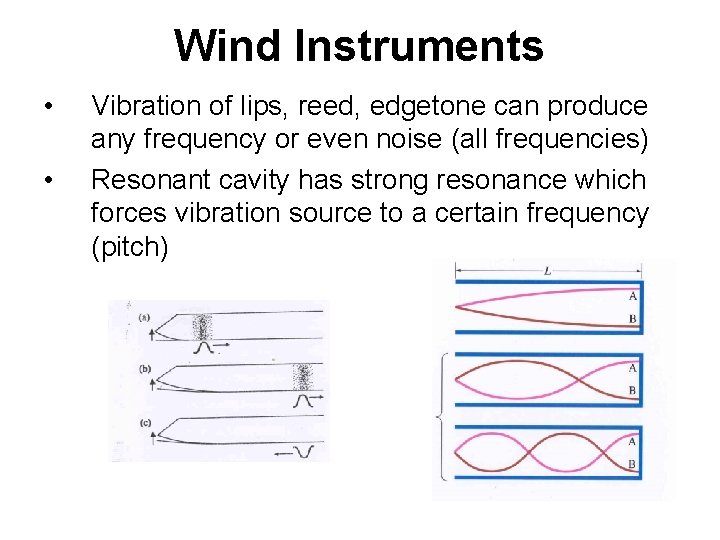
Wind Instruments • • Vibration of lips, reed, edgetone can produce any frequency or even noise (all frequencies) Resonant cavity has strong resonance which forces vibration source to a certain frequency (pitch)
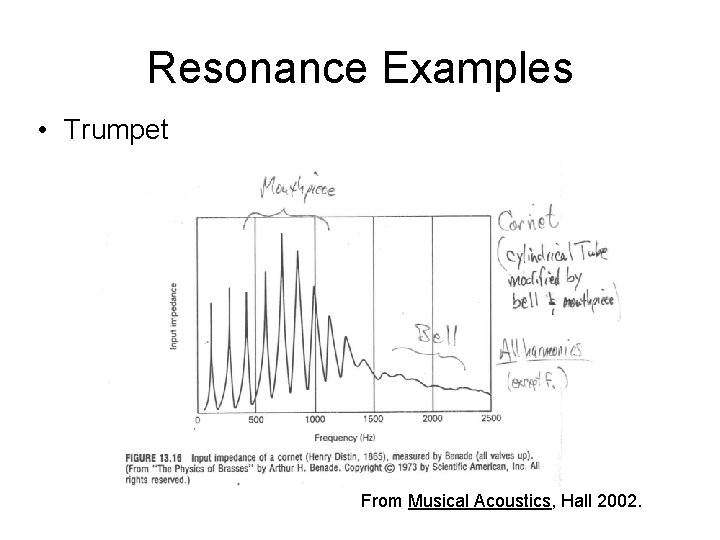
Resonance Examples • Trumpet From Musical Acoustics, Hall 2002.
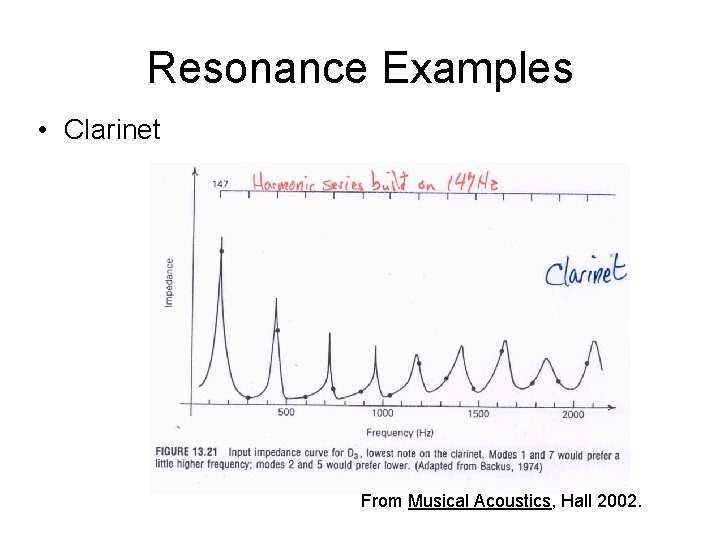
Resonance Examples • Clarinet From Musical Acoustics, Hall 2002.
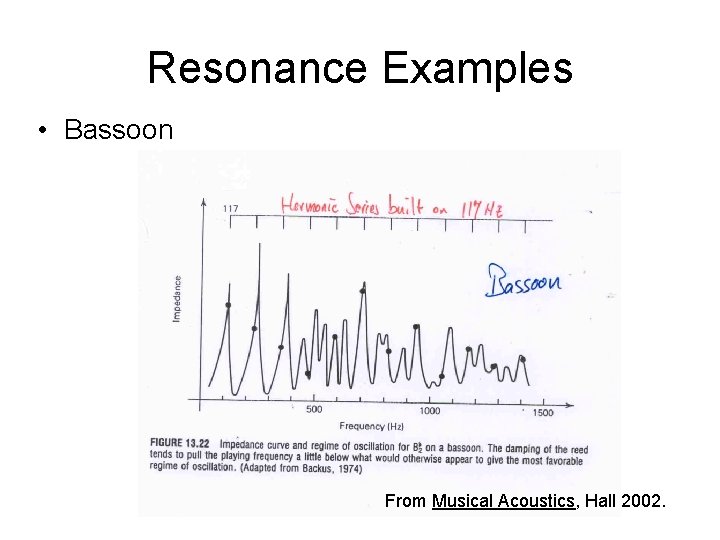
Resonance Examples • Bassoon From Musical Acoustics, Hall 2002.
Voice • Vibration of vocal cords create sound wave rich in harmonics – Vary pitch by varying tension in vocal cords • Vocal tract resonates with three main broad resonances called formants – Unlike wind instruments vocal tract resonances are not strong enough to force vocal cords to a definite pitch – Vary vowel sound (timbre) by varying shape of vocal tract (changes resonant frequencies) !!Incredibly versatile!! Fourier Analysis
Notes and Intonation • How do you vary the note you are playing on your instrument? • How do you vary the intonation? • Are there instruments on which you can not vary intonation?
References and websites • Musical Acoustics by Donald E. Hall (Brooks/Cole, Thomas Publishing, 2002) • The science of sound by Thomas D. Rossing (Addison-Wesley Pub. Co. , 1990) • Fourier Synthesizer Applet http: //www. phy. ntnu. edu. tw/ntnujava/index. php? topic=17 • Tuvan throat singing – xray movies http: //www. sciam. com/article. cfm? article. ID=000 C 5 ABE-B 135 -1 CBCB 4 A 8809 EC 588 EEDF&page. Number=1&cat. ID=9 (or google “scientific american tuvan”)
- Slides: 15