
Acoustic Features for Speech Recognition From MelFrequency Cepstrum

- Slides: 26
Acoustic Features for Speech Recognition: From Mel-Frequency Cepstrum Coefficients (MFCC) to Bottle. Neck Features(BNF) F 01921031 鍾承道
Outline �Mel-Frequency Cepstrum Coefficients �DFT �Mel Filter Bank �DCT �From human knowledge to data driven methods �Supervised objective �Machine Learning �DNN �Bottle Neck Feature
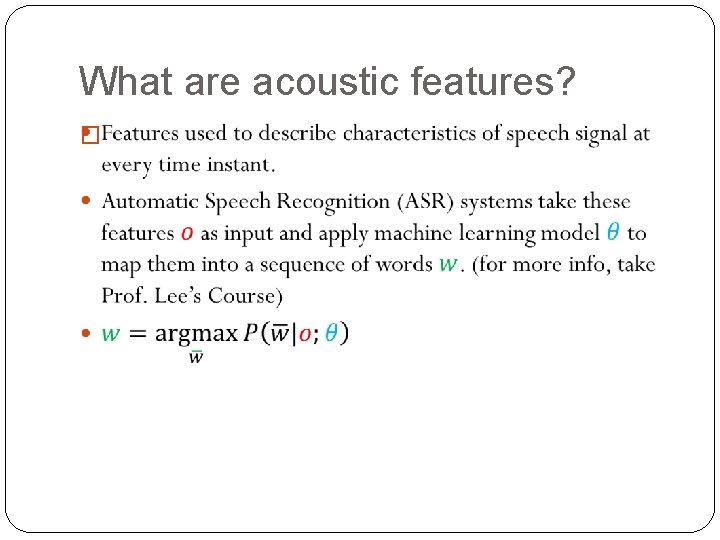
What are acoustic features? �
What are acoustic features? � Consists of two dimensions : �Features space �Time � For Example: �Fourier transform coefficients, Spectrogram, MFCC, Filter bank output, BNF… � Desired properties of acoustic features for ASR: �Noise Robustness �Speaker Invariance � From the Machine Learning point of view, the design of the feature has to be considered with the learning method applied.
Mel-Frequency Cepstrum Coefficients(MFCC) �The most popular speech feature in from 1990 to the early 2000 s �It is the result of countless trial and errors optimized to overcome noise and speaker variation issues under the HMM-GMM framework for ASR.
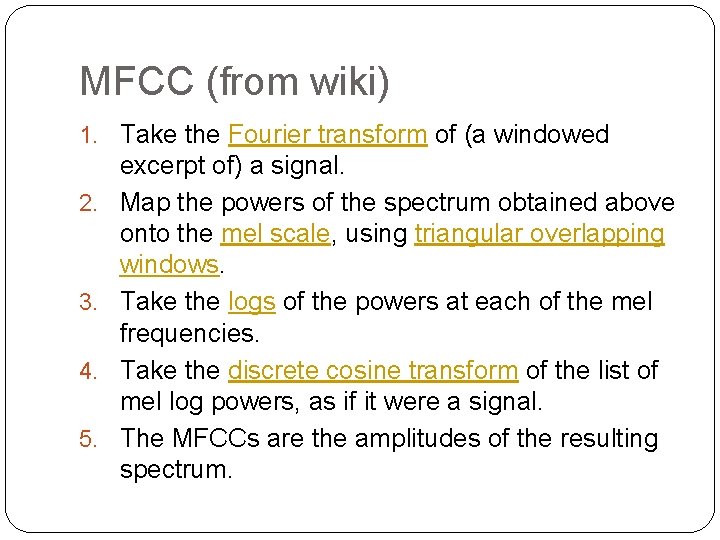
MFCC (from wiki) 1. Take the Fourier transform of (a windowed 2. 3. 4. 5. excerpt of) a signal. Map the powers of the spectrum obtained above onto the mel scale, using triangular overlapping windows. Take the logs of the powers at each of the mel frequencies. Take the discrete cosine transform of the list of mel log powers, as if it were a signal. The MFCCs are the amplitudes of the resulting spectrum.
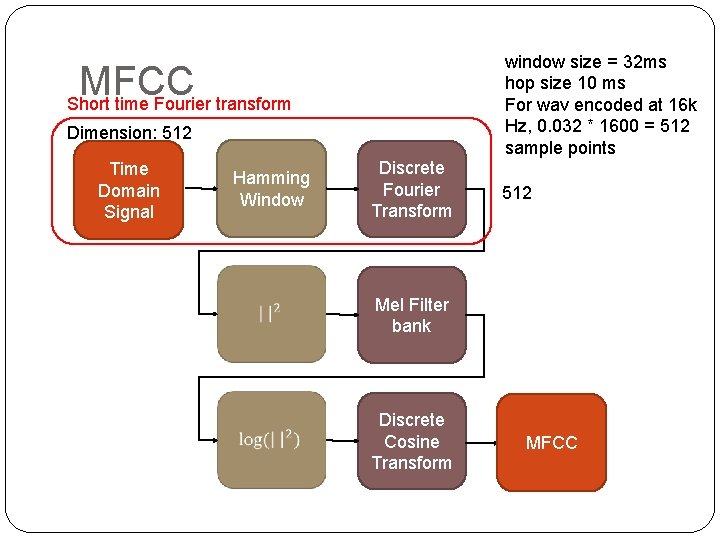
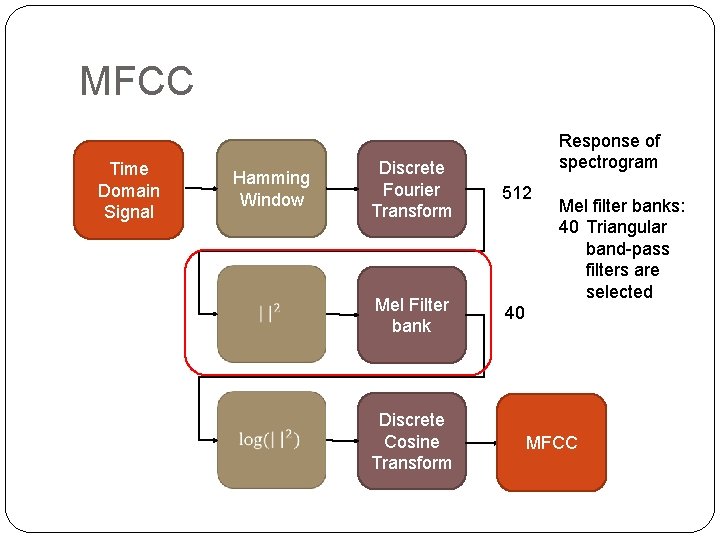
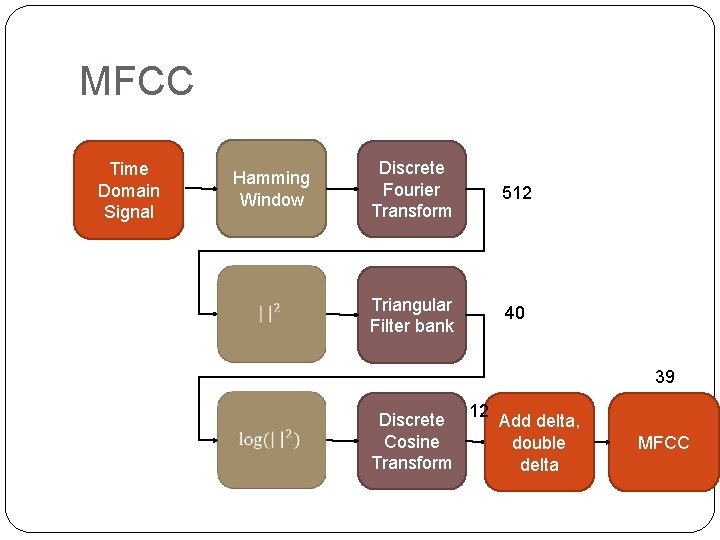
MFCC Time Domain Signal Hamming Window Discrete Fourier Transform Mel Filter bank Discrete Cosine Transform MFCC
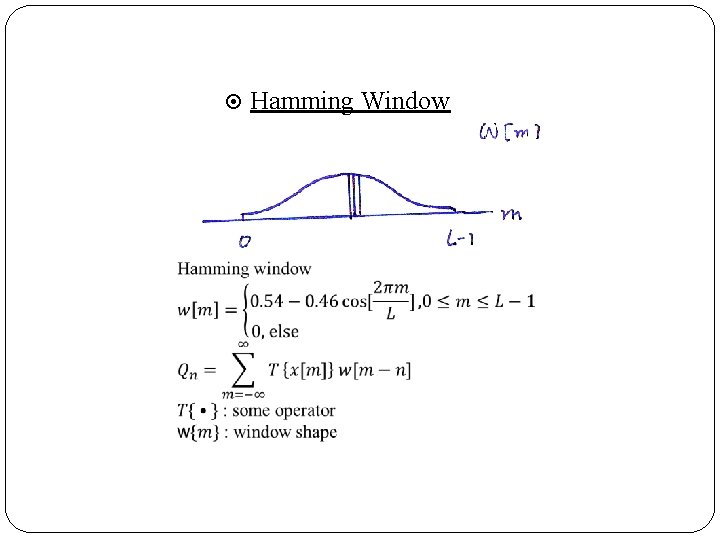
Hamming Window
window size = 32 ms hop size 10 ms For wav encoded at 16 k Hz, 0. 032 * 1600 = 512 sample points MFCC Short time Fourier transform Dimension: 512 Time Domain Signal Hamming Window Discrete Fourier Transform 512 Mel Filter bank Discrete Cosine Transform MFCC
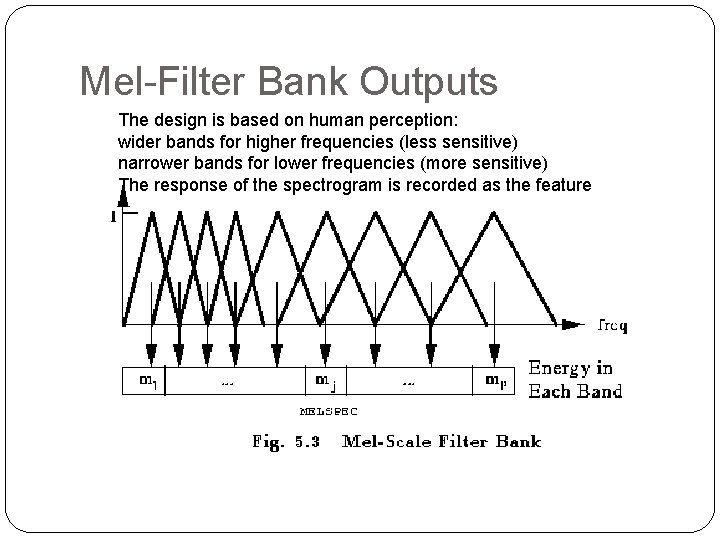
Mel-Filter Bank Outputs The design is based on human perception: wider bands for higher frequencies (less sensitive) narrower bands for lower frequencies (more sensitive) The response of the spectrogram is recorded as the feature
MFCC Time Domain Signal Hamming Window Response of spectrogram Discrete Fourier Transform 512 Mel Filter bank 40 Discrete Cosine Transform Mel filter banks: 40 Triangular band-pass filters are selected MFCC
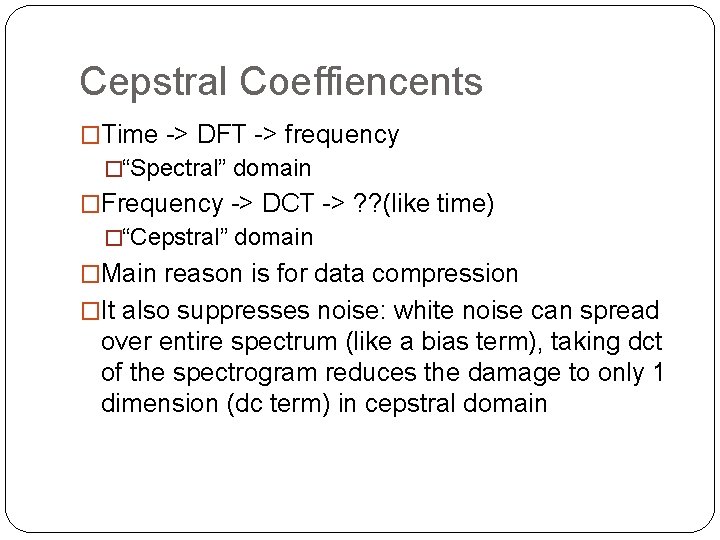
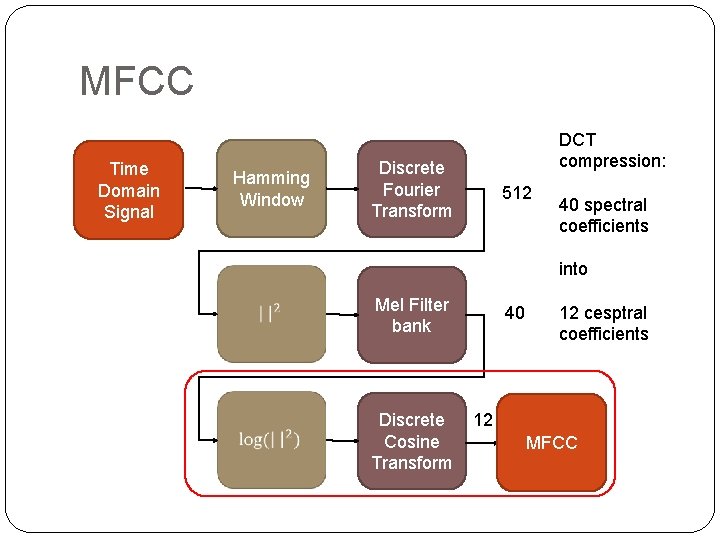
Cepstral Coeffiencents �Time -> DFT -> frequency �“Spectral” domain �Frequency -> DCT -> ? ? (like time) �“Cepstral” domain �Main reason is for data compression �It also suppresses noise: white noise can spread over entire spectrum (like a bias term), taking dct of the spectrogram reduces the damage to only 1 dimension (dc term) in cepstral domain
MFCC Time Domain Signal Hamming Window DCT compression: Discrete Fourier Transform 512 40 spectral coefficients into Mel Filter bank Discrete Cosine Transform 40 12 cesptral coefficients 12 MFCC
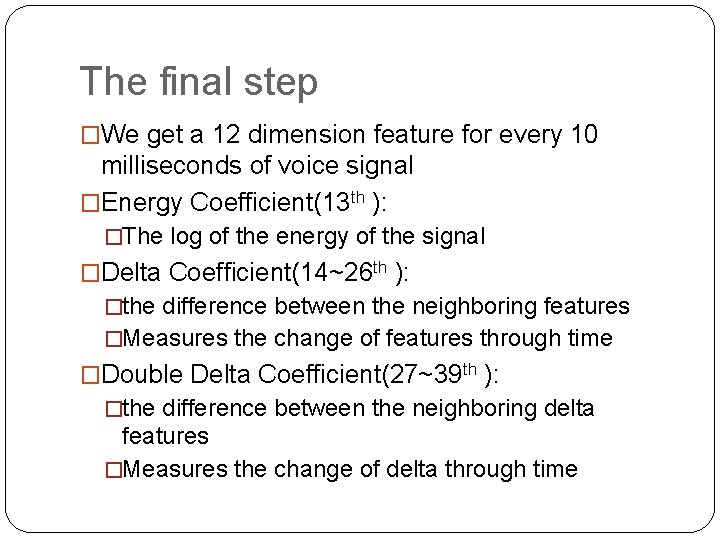
The final step �We get a 12 dimension feature for every 10 milliseconds of voice signal �Energy Coefficient(13 th ): �The log of the energy of the signal �Delta Coefficient(14~26 th ): �the difference between the neighboring features �Measures the change of features through time �Double Delta Coefficient(27~39 th ): �the difference between the neighboring delta features �Measures the change of delta through time
MFCC Time Domain Signal Hamming Window Discrete Fourier Transform 512 Triangular Filter bank 40 39 Discrete Cosine Transform 12 Add delta, double delta MFCC
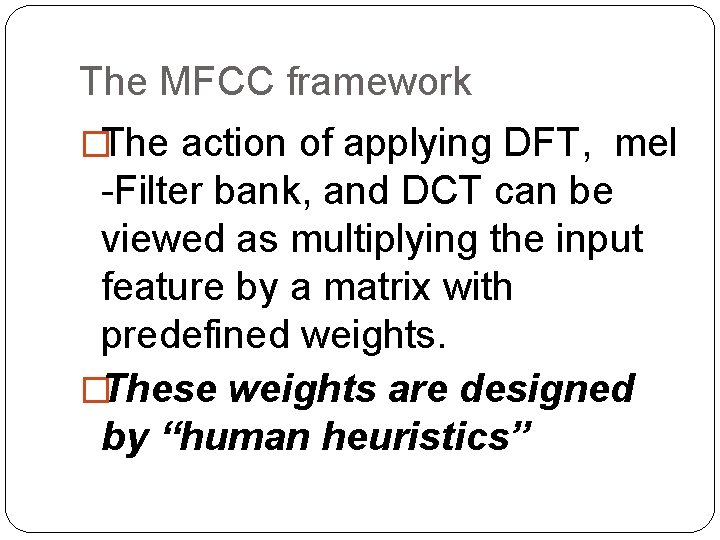
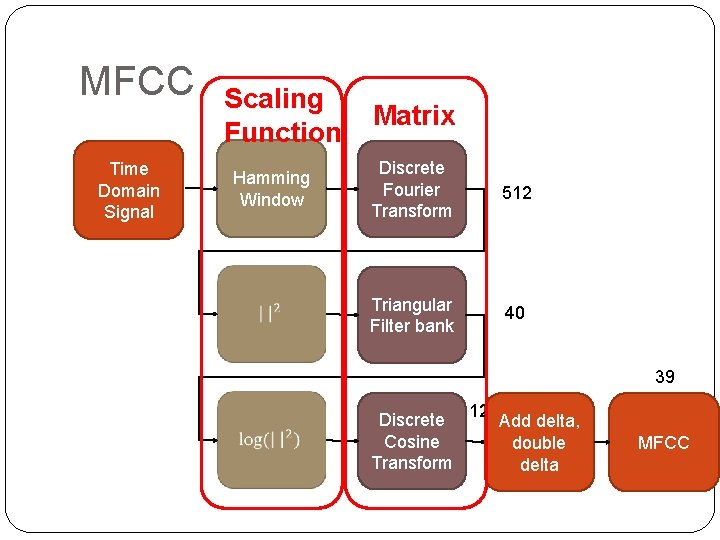
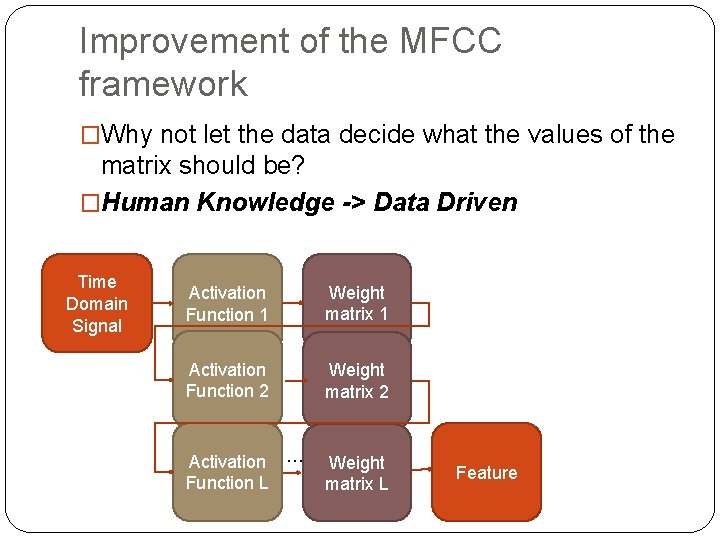
The MFCC framework �The action of applying DFT, mel -Filter bank, and DCT can be viewed as multiplying the input feature by a matrix with predefined weights. �These weights are designed by “human heuristics”
MFCC Time Domain Signal Scaling Function Hamming Window Matrix Discrete Fourier Transform 512 Triangular Filter bank 40 39 Discrete Cosine Transform 12 Add delta, double delta MFCC
Improvement of the MFCC framework �Why not let the data decide what the values of the matrix should be? �Human Knowledge -> Data Driven Time Domain Signal Activation Function 1 Weight matrix 1 Activation Function 2 Weight matrix 2 Activation … Function L Weight matrix L Feature
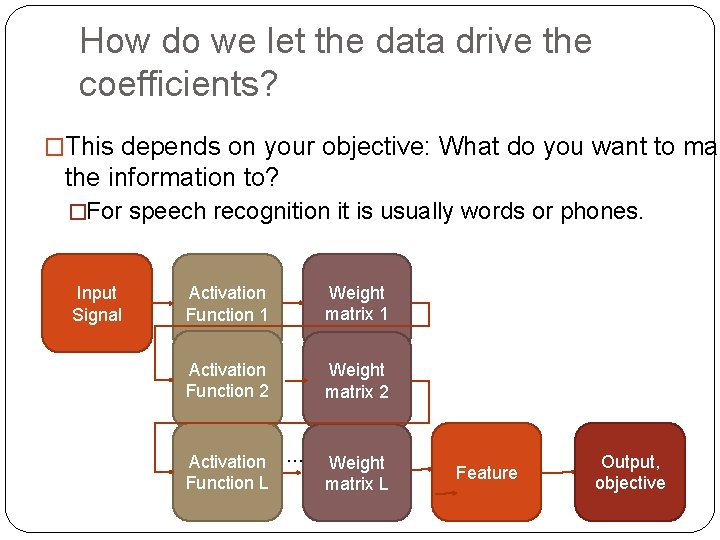
How do we let the data drive the coefficients? �This depends on your objective: What do you want to map the information to? �For speech recognition it is usually words or phones. Input Signal Activation Function 1 Weight matrix 1 Activation Function 2 Weight matrix 2 Activation … Function L Weight matrix L Feature Output, objective
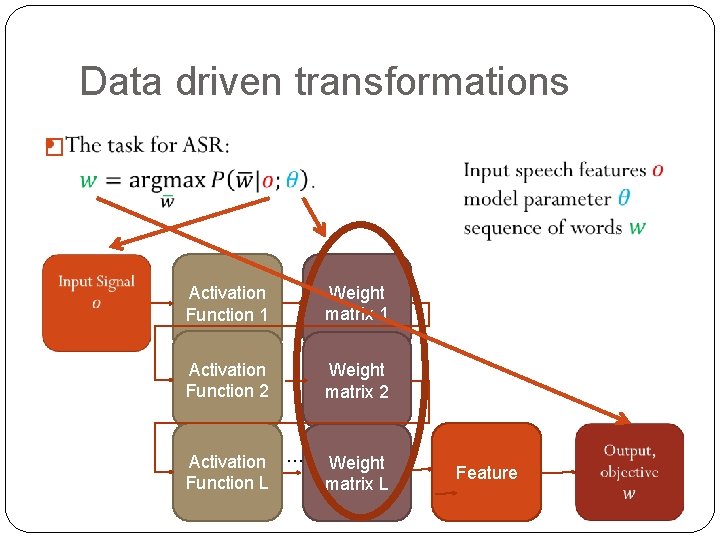
Data driven transformations � Activation Function 1 Weight matrix 1 Activation Function 2 Weight matrix 2 Activation … Function L Weight matrix L Feature
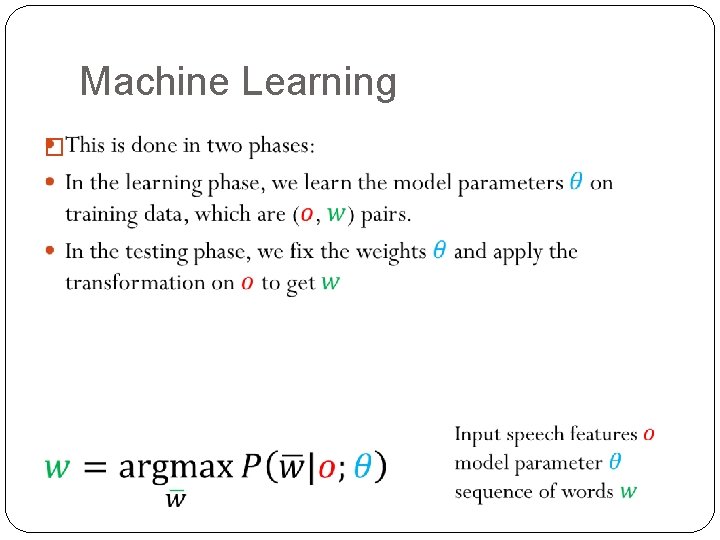
Machine Learning �
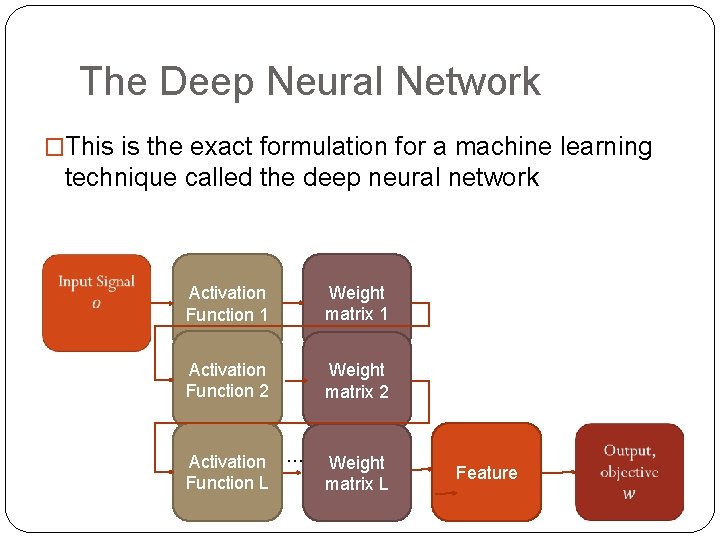
The Deep Neural Network �This is the exact formulation for a machine learning technique called the deep neural network Activation Function 1 Weight matrix 1 Activation Function 2 Weight matrix 2 Activation … Function L Weight matrix L Feature
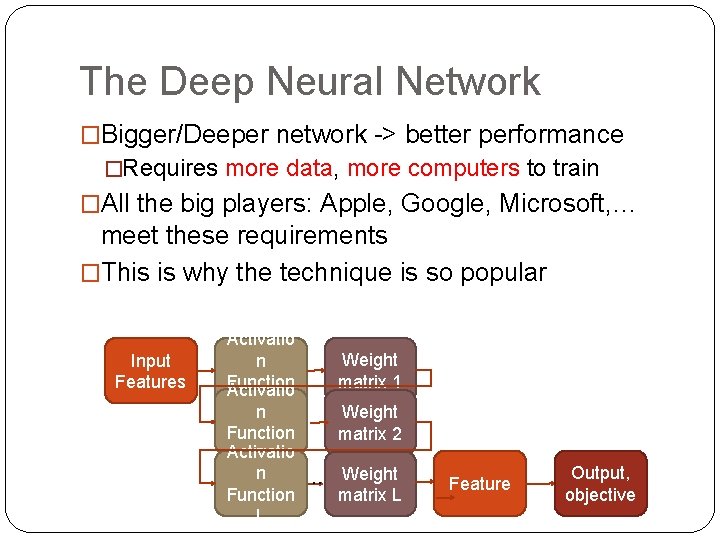
The Deep Neural Network �Bigger/Deeper network -> better performance �Requires more data, more computers to train �All the big players: Apple, Google, Microsoft, … meet these requirements �This is why the technique is so popular Input Features Activatio n Function Activatio 1 n Weight matrix 1 Weight matrix 2 Function Activatio 2 n … Weight Function matrix L L Feature Output, objective
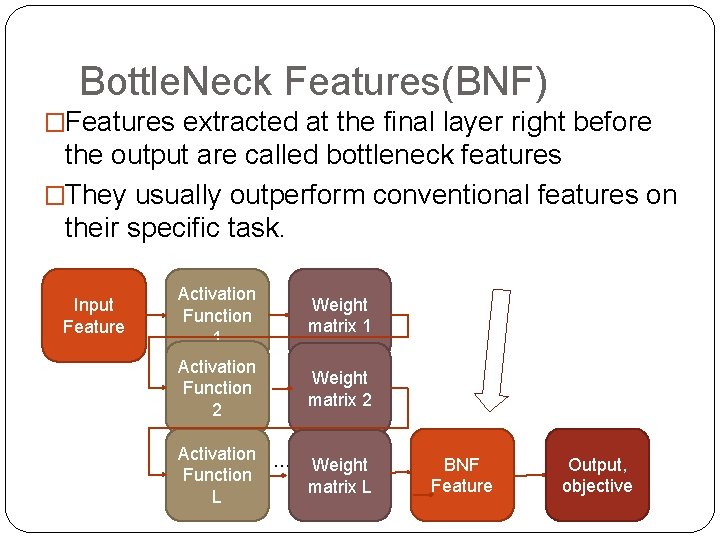
Bottle. Neck Features(BNF) �Features extracted at the final layer right before the output are called bottleneck features �They usually outperform conventional features on their specific task. Input Feature Activation Function 1 Weight matrix 1 Activation Function 2 Weight matrix 2 Activation … Weight Function matrix L L BNF Feature Output, objective
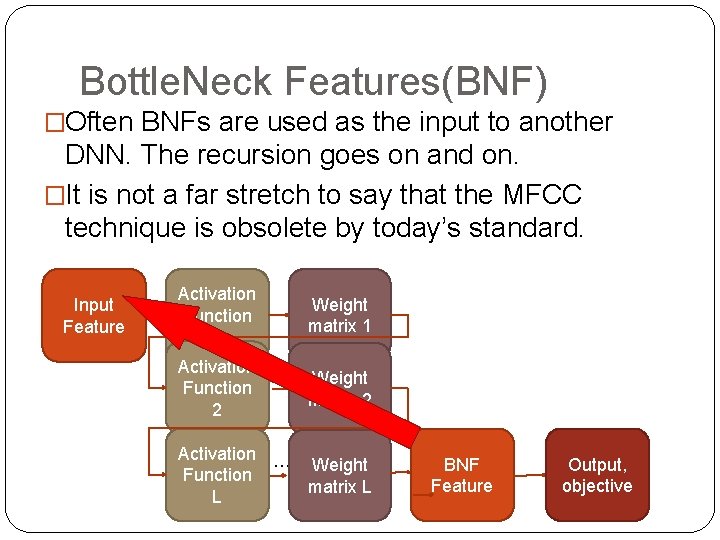
Bottle. Neck Features(BNF) �Often BNFs are used as the input to another DNN. The recursion goes on and on. �It is not a far stretch to say that the MFCC technique is obsolete by today’s standard. Input Feature Activation Function 1 Weight matrix 1 Activation Function 2 Weight matrix 2 Activation … Weight Function matrix L L BNF Feature Output, objective
References 1. 2. 3. 4. 5. 6. Xu, Min, et al. "HMM-based audio keyword generation. " Advances in Multimedia Information Processing-PCM 2004. Springer Berlin Heidelberg, 2005. 566 -574. Zheng, Fang, Guoliang Zhang, and Zhanjiang Song. "Comparison of different implementations of MFCC. " Journal of Computer Science and Technology 16. 6 (2001): 582 -589. Hinton, Geoffrey, et al. "Deep neural networks for acoustic modeling in speech recognition: The shared views of four research groups. " Signal Processing Magazine, IEEE 29. 6 (2012): 82 -97. http: //en. wikipedia. org/wiki/Mel-frequency_cepstrum Professor Lin-Shan Lee’s slides Evermann, Gunnar, et al. The HTK book. Vol. 2. Cambridge: Entropic Cambridge Research Laboratory, 1997.