
Acoustic Assessment of Yearround Bat Activity and Distribution
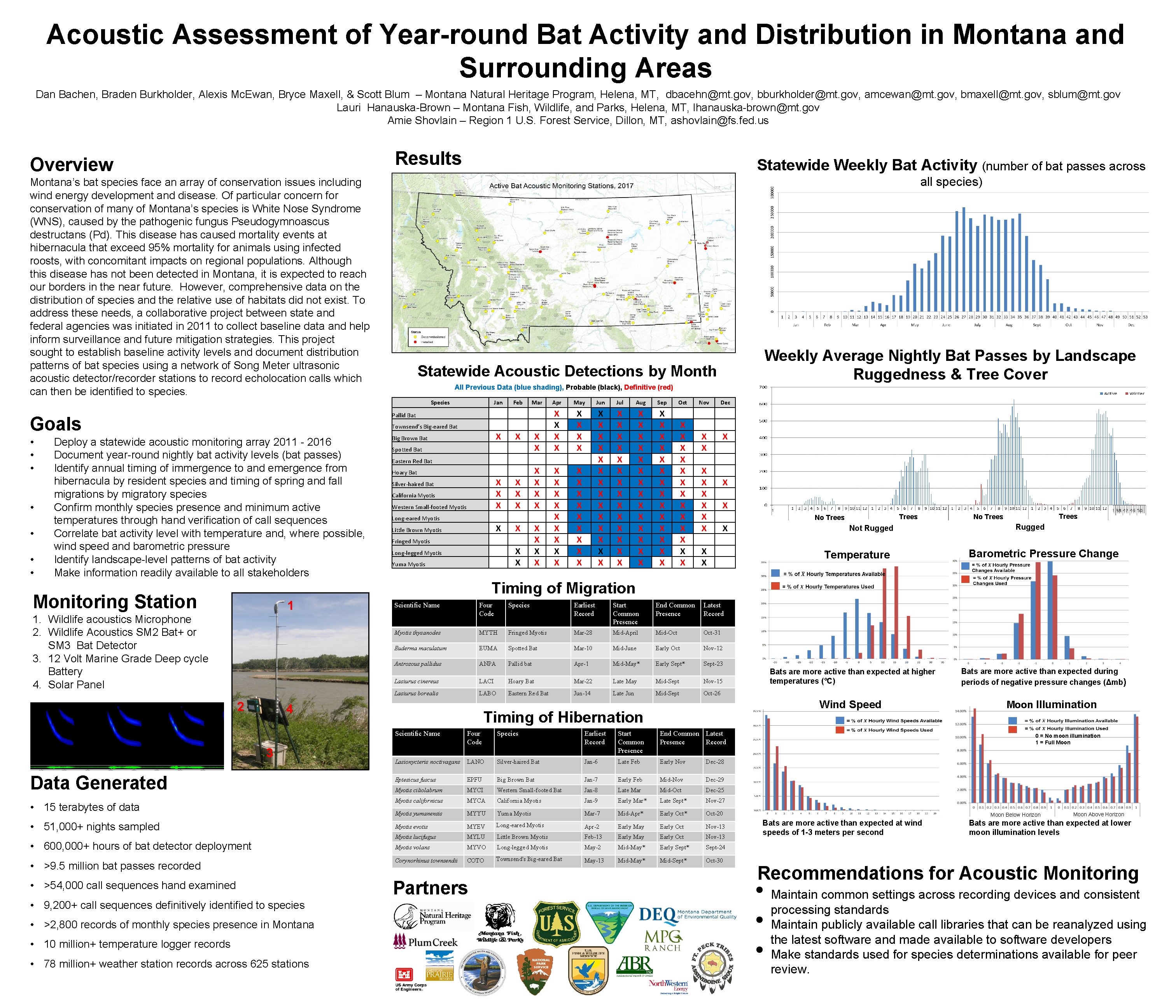
Acoustic Assessment of Year-round Bat Activity and Distribution in Montana and Surrounding Areas Dan Bachen, Braden Burkholder, Alexis Mc. Ewan, Bryce Maxell, & Scott Blum – Montana Natural Heritage Program, Helena, MT, dbacehn@mt. gov, bburkholder@mt. gov, amcewan@mt. gov, bmaxell@mt. gov, sblum@mt. gov Lauri Hanauska-Brown – Montana Fish, Wildlife, and Parks, Helena, MT, lhanauska-brown@mt. gov Amie Shovlain – Region 1 U. S. Forest Service, Dillon, MT, ashovlain@fs. fed. us Results Overview Statewide Weekly Bat Activity (number of bat passes across all species) Montana’s bat species face an array of conservation issues including wind energy development and disease. Of particular concern for conservation of many of Montana’s species is White Nose Syndrome (WNS), caused by the pathogenic fungus Pseudogymnoascus destructans (Pd). This disease has caused mortality events at hibernacula that exceed 95% mortality for animals using infected roosts, with concomitant impacts on regional populations. Although this disease has not been detected in Montana, it is expected to reach our borders in the near future. However, comprehensive data on the distribution of species and the relative use of habitats did not exist. To address these needs, a collaborative project between state and federal agencies was initiated in 2011 to collect baseline data and help inform surveillance and future mitigation strategies. This project sought to establish baseline activity levels and document distribution patterns of bat species using a network of Song Meter ultrasonic acoustic detector/recorder stations to record echolocation calls which can then be identified to species. Statewide Acoustic Detections by Month All Previous Data (blue shading), Probable (black), Definitive (red) Species • • Jan Feb Mar Apr May Jun Jul Aug Sep Oct X X X X X X X X X X X X X X X X X X X X X X X X X Pallid Bat Goals Townsend’s Big-eared Bat Deploy a statewide acoustic monitoring array 2011 - 2016 Document year-round nightly bat activity levels (bat passes) Identify annual timing of immergence to and emergence from hibernacula by resident species and timing of spring and fall migrations by migratory species Confirm monthly species presence and minimum active temperatures through hand verification of call sequences Correlate bat activity level with temperature and, where possible, wind speed and barometric pressure Identify landscape-level patterns of bat activity Make information readily available to all stakeholders Weekly Average Nightly Bat Passes by Landscape Ruggedness & Tree Cover X Big Brown Bat X Spotted Bat Eastern Red Bat Hoary Bat X X X Silver-haired Bat California Myotis Western Small-footed Myotis X X X X Long-eared Myotis X Little Brown Myotis X Fringed Myotis X X Long-legged Myotis Yuma Myotis X X Nov Dec X X X X Temperature 1 1. Wildlife acoustics Microphone 2. Wildlife Acoustics SM 2 Bat+ or SM 3 Bat Detector 3. 12 Volt Marine Grade Deep cycle Battery 4. Solar Panel 2 Four Code Species Earliest Record Start Common Presence End Common Presence Latest Record Myotis thysanodes MYTH Fringed Myotis Mar-28 Mid-April Mid-Oct Oct-31 Euderma maculatum EUMA Spotted Bat Mar-10 Mid-June Early Oct Nov-12 Antrozous pallidus ANPA Pallid bat Apr-1 Mid-May* Early Sept* Sept-23 Lasiurus cinereus LACI Hoary Bat Mar-22 Late May Mid-Sept Nov-15 Lasiurus borealis LABO Eastern Red Bat Jun-14 Late Jun Mid-Sept Oct-26 4 3 Data Generated • 15 terabytes of data • 51, 000+ nights sampled • 600, 000+ hours of bat detector deployment • >9. 5 million bat passes recorded • >54, 000 call sequences hand examined • 9, 200+ call sequences definitively identified to species • >2, 800 records of monthly species presence in Montana • 10 million+ temperature logger records • 78 million+ weather station records across 625 stations Bats are more active than expected at higher temperatures (°C) Wind Speed Timing of Hibernation Scientific Name Four Code Species Earliest Record Start Common Presence End Common Latest Presence Record Lasionycteris noctivagans LANO Silver-haired Bat Jan-6 Late Feb Early Nov Dec-28 Eptesicus fuscus EPFU Big Brown Bat Jan-7 Early Feb Mid-Nov Dec-29 Myotis ciliolabrum MYCI Western Small-footed Bat Jan-8 Late Mar Mid-Oct Dec-25 Myotis californicus MYCA California Myotis Jan-9 Early Mar* Late Sept* Nov-27 Myotis yumanensis MYYU Yuma Myotis Mar-7 Mid-Apr* Early Oct* Oct-20 Myotis evotis MYEV Long-eared Myotis Apr-2 Early May Early Oct Nov-13 Myotis lucifugus MYLU Little Brown Myotis Feb-13 Early May Early Oct Nov-13 Myotis volans MYVO Long-legged Myotis May-2 Mid-May* Early Sept* Sept-24 Corynorhinus townsendii COTO Townsend's Big-eared Bat May-13 Mid-May* Mid-Sept* Oct-30 Partners Rugged Barometric Pressure Change Scientific Name Trees Not Rugged Timing of Migration Monitoring Station Trees No Trees Bats are more active than expected during periods of negative pressure changes (Δmb) Moon Illumination 0 = No moon illumination 1 = Full Moon Below Horizon Bats are more active than expected at wind speeds of 1 -3 meters per second Moon Above Horizon Bats are more active than expected at lower moon illumination levels Recommendations for Acoustic Monitoring • Maintain common settings across recording devices and consistent processing standards • Maintain publicly available call libraries that can be reanalyzed using the latest software and made available to software developers • Make standards used for species determinations available for peer review.
- Slides: 1