
ACM An Efficient Approach for Managing Shared Caches


- Slides: 24
ACM: An Efficient Approach for Managing Shared Caches in Chip Multiprocessors Mohammad Hammoud, Sangyeun Cho, and Rami Melhem Presenter: Socrates Demetriades Dept. of Computer Science University of Pittsburgh
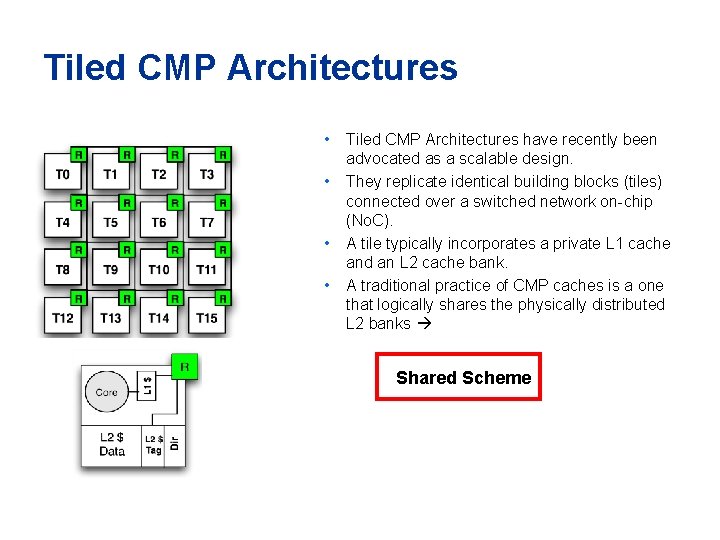
Tiled CMP Architectures • • Tiled CMP Architectures have recently been advocated as a scalable design. They replicate identical building blocks (tiles) connected over a switched network on-chip (No. C). A tile typically incorporates a private L 1 cache and an L 2 cache bank. A traditional practice of CMP caches is a one that logically shares the physically distributed L 2 banks Shared Scheme
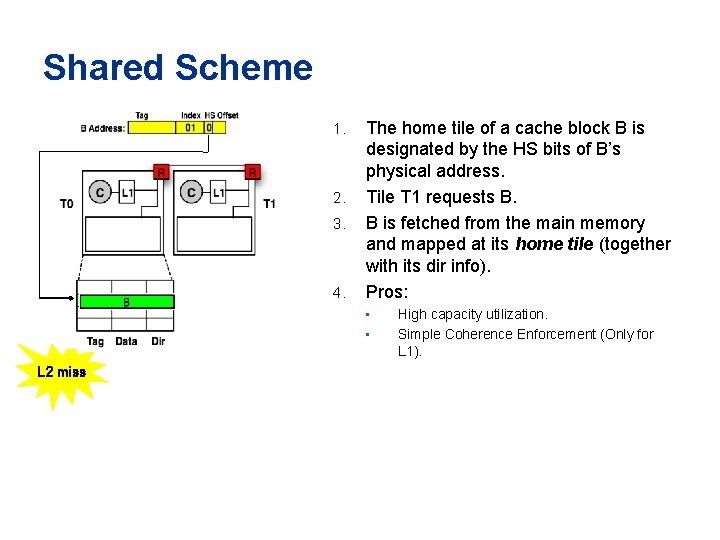
Shared Scheme 1. 2. 3. 4. The home tile of a cache block B is designated by the HS bits of B’s physical address. Tile T 1 requests B. B is fetched from the main memory and mapped at its home tile (together with its dir info). Pros: • • L 2 miss High capacity utilization. Simple Coherence Enforcement (Only for L 1).
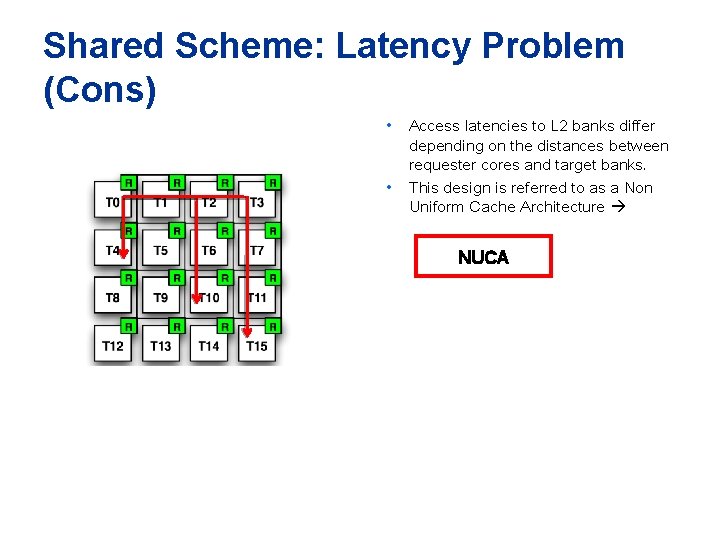
Shared Scheme: Latency Problem (Cons) • • Access latencies to L 2 banks differ depending on the distances between requester cores and target banks. This design is referred to as a Non Uniform Cache Architecture NUCA
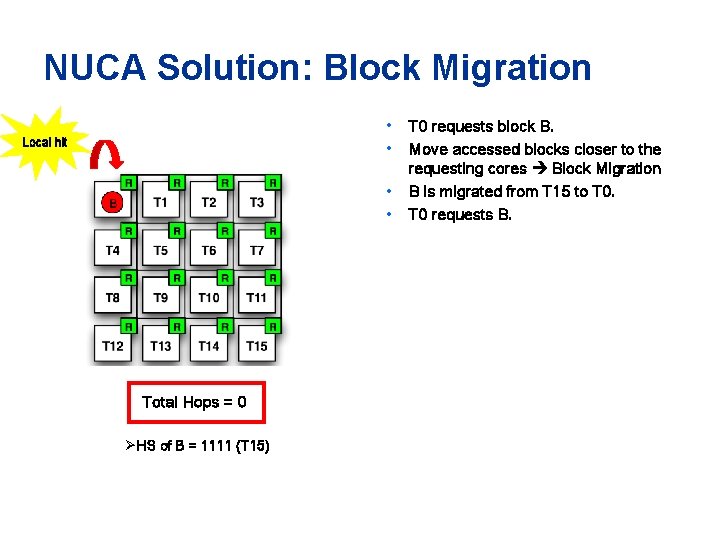
NUCA Solution: Block Migration • • Local hit • • Total. Hops== 14 0 Total ØHS of B = 1111 (T 15) T 0 requests block B. Move accessed blocks closer to the requesting cores Block Migration B is migrated from T 15 to T 0 requests B.
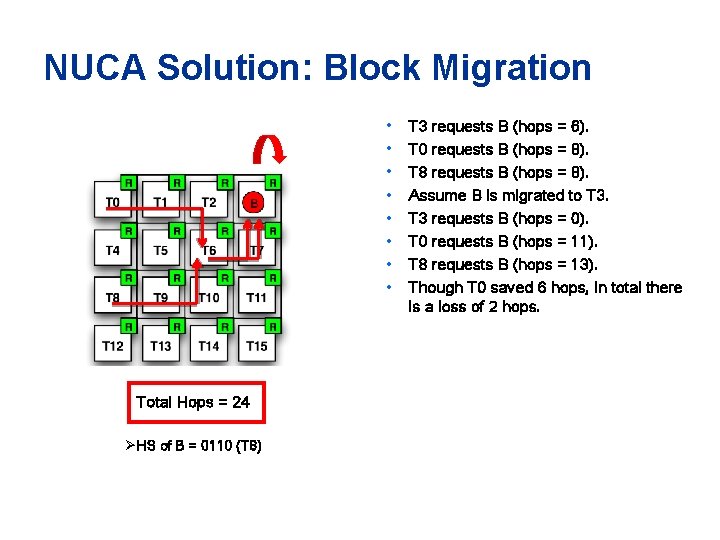
NUCA Solution: Block Migration • • Total. Hops = 24 Total 22 ØHS of B = 0110 (T 6) T 3 requests B (hops = 6). T 0 requests B (hops = 8). T 8 requests B (hops = 8). Assume B is migrated to T 3 requests B (hops = 0). T 0 requests B (hops = 11). T 8 requests B (hops = 13). Though T 0 saved 6 hops, in total there is a loss of 2 hops.
Our work § Collect information about tiles (sharers) that have accessed a block B. § Depend on the past to predict the future: a core that accessed a block in the past is likely to access it again in the future. § Migrate B to a tile (host) that minimizes the overall number of No. C hops needed.
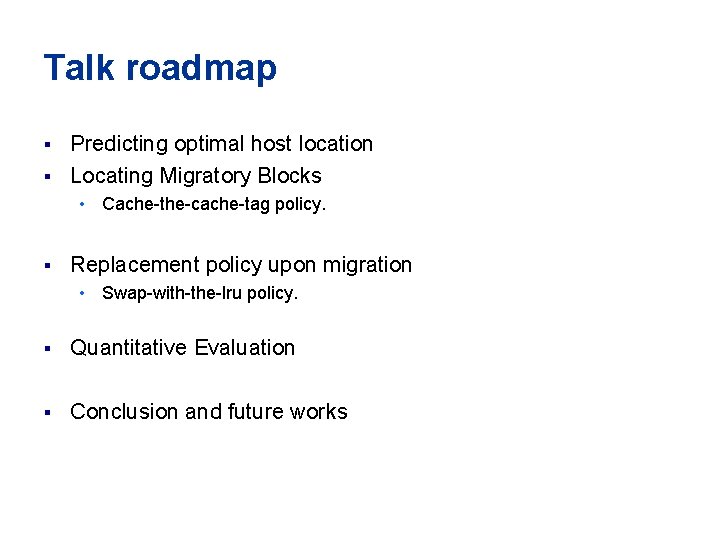
Talk roadmap Predicting optimal host location § Locating Migratory Blocks § • Cache-the-cache-tag policy. § Replacement policy upon migration • Swap-with-the-lru policy. § Quantitative Evaluation § Conclusion and future works
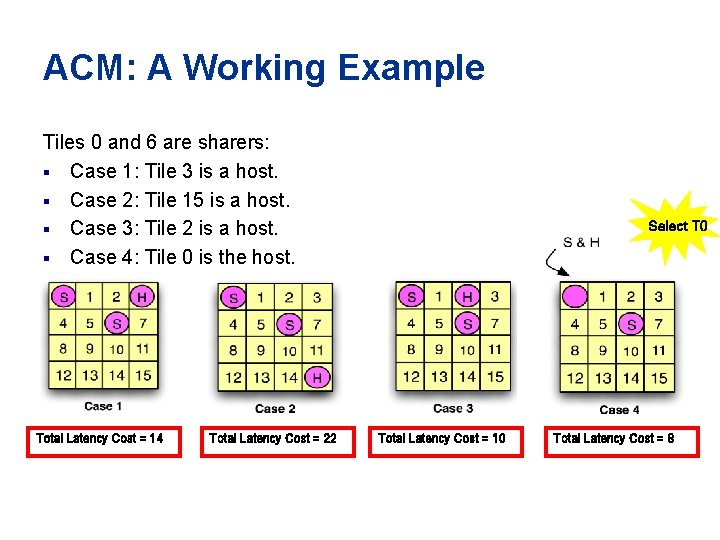
Predicting Optimal Host Location § Keeping a cache block B at its home tile might not be optimal. § The best host location of B is not known until runtime. § Adaptive Controlled Migration (ACM): • Keep a pattern for the accessibility of B. • At runtime (after a specific migration frequency level is reached for B) compute the best host to migrate B by finding the one that minimizes the total latency cost between the sharers of B
ACM: A Working Example Tiles 0 and 6 are sharers: § Case 1: Tile 3 is a host. § Case 2: Tile 15 is a host. § Case 3: Tile 2 is a host. § Case 4: Tile 0 is the host. Total Latency Cost = 14 Total Latency Cost = 22 Select T 0 Total Latency Cost = 10 Total Latency Cost = 8
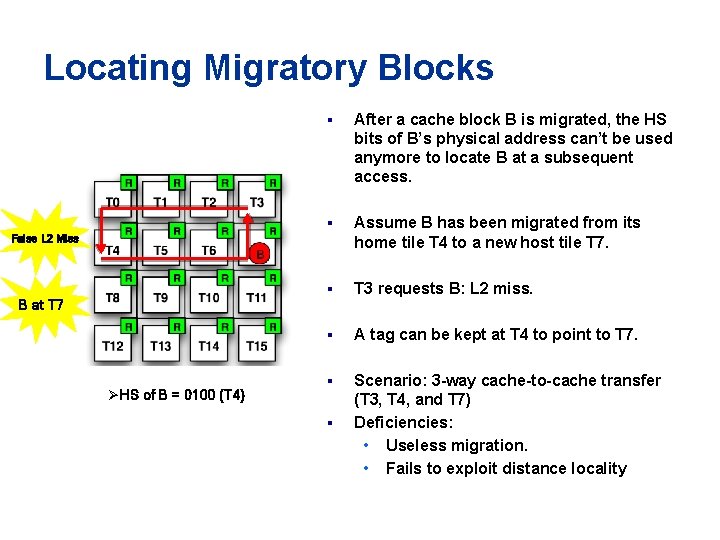
Locating Migratory Blocks False L 2 Miss B at T 7 ØHS of B = 0100 (T 4) § After a cache block B is migrated, the HS bits of B’s physical address can’t be used anymore to locate B at a subsequent access. § Assume B has been migrated from its home tile T 4 to a new host tile T 7. § T 3 requests B: L 2 miss. § A tag can be kept at T 4 to point to T 7. § Scenario: 3 -way cache-to-cache transfer (T 3, T 4, and T 7) Deficiencies: • Useless migration. • Fails to exploit distance locality §
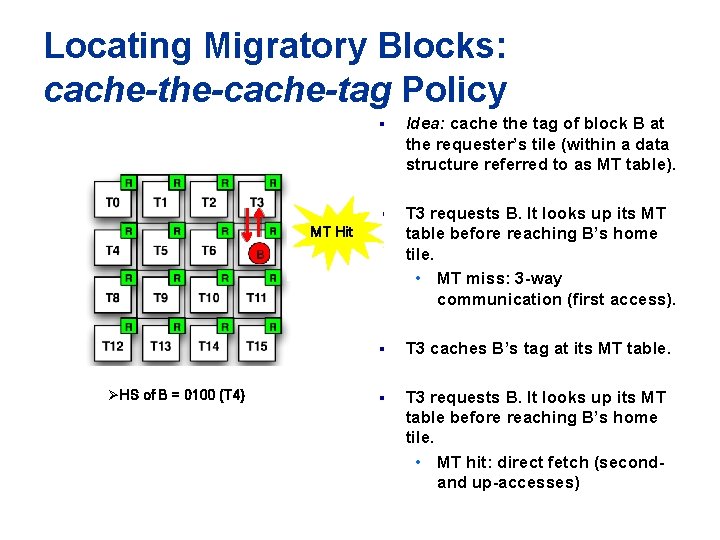
Locating Migratory Blocks: cache-the-cache-tag Policy MT MT Hit Miss ØHS of B = 0100 (T 4) § Idea: cache tag of block B at the requester’s tile (within a data structure referred to as MT table). § T 3 requests B. It looks up its MT table before reaching B’s home tile. • MT miss: 3 -way communication (first access). § T 3 caches B’s tag at its MT table. § T 3 requests B. It looks up its MT table before reaching B’s home tile. • MT hit: direct fetch (secondand up-accesses)
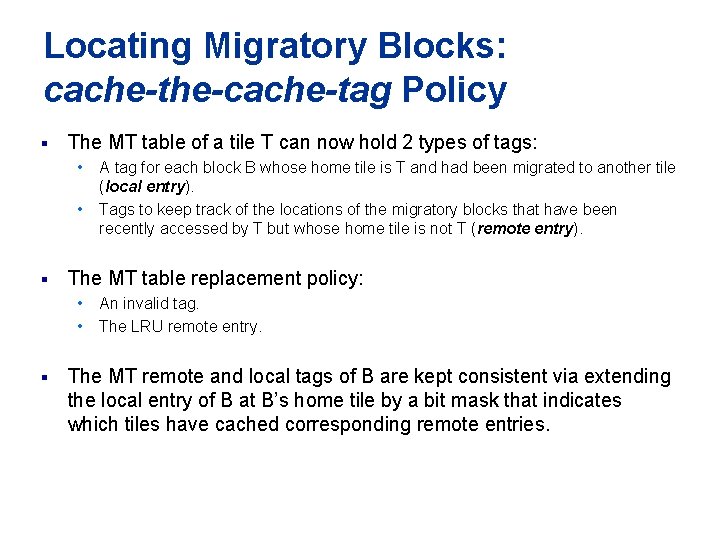
Locating Migratory Blocks: cache-the-cache-tag Policy § The MT table of a tile T can now hold 2 types of tags: • • § The MT table replacement policy: • • § A tag for each block B whose home tile is T and had been migrated to another tile (local entry). Tags to keep track of the locations of the migratory blocks that have been recently accessed by T but whose home tile is not T (remote entry). An invalid tag. The LRU remote entry. The MT remote and local tags of B are kept consistent via extending the local entry of B at B’s home tile by a bit mask that indicates which tiles have cached corresponding remote entries.
Replacement Policy Upon Migration: swap-with-lru Policy § After the ACM algorithm predicts the optimal host, H, for a block B, a decision is to be made regarding which block to replace at H upon migrating B. Idea: Swap B with the LRU block at H (swap-with-the-lru policy). § The LRU block at H could be: § • • § A migratory one. A non-migratory one. The swap-with-the-lru policy is very effective especially for workloads that have working sets which are large relative to L 2 banks (bears similarity to victim replication but more robust)
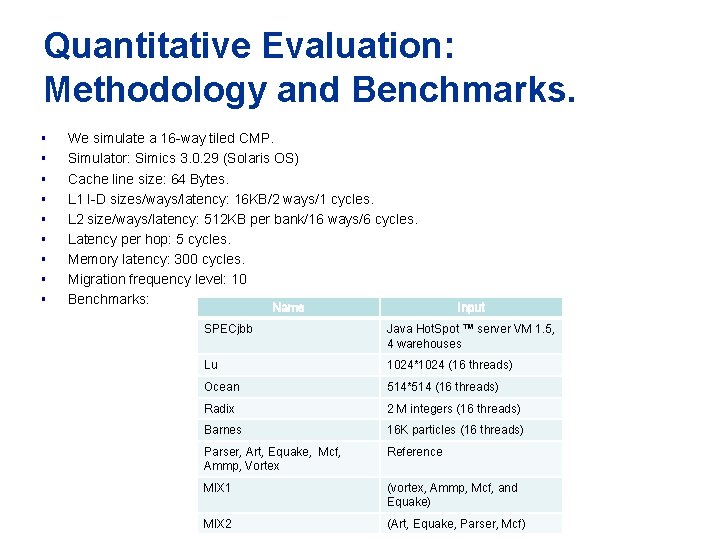
Quantitative Evaluation: Methodology and Benchmarks. § § § § § We simulate a 16 -way tiled CMP. Simulator: Simics 3. 0. 29 (Solaris OS) Cache line size: 64 Bytes. L 1 I-D sizes/ways/latency: 16 KB/2 ways/1 cycles. L 2 size/ways/latency: 512 KB per bank/16 ways/6 cycles. Latency per hop: 5 cycles. Memory latency: 300 cycles. Migration frequency level: 10 Benchmarks: Name Input SPECjbb Java Hot. Spot ™ server VM 1. 5, 4 warehouses Lu 1024*1024 (16 threads) Ocean 514*514 (16 threads) Radix 2 M integers (16 threads) Barnes 16 K particles (16 threads) Parser, Art, Equake, Mcf, Ammp, Vortex Reference MIX 1 (vortex, Ammp, Mcf, and Equake) MIX 2 (Art, Equake, Parser, Mcf)
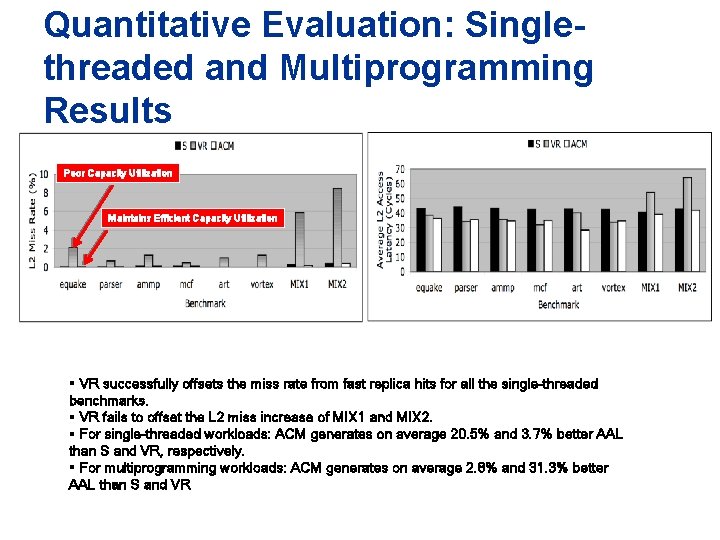
Quantitative Evaluation: Singlethreaded and Multiprogramming Results Poor Capacity Utilization Maintains Efficient Capacity Utilization § VR successfully offsets the miss rate from fast replica hits for all the single-threaded benchmarks. § VR fails to offset the L 2 miss increase of MIX 1 and MIX 2. § For single-threaded workloads: ACM generates on average 20. 5% and 3. 7% better AAL than S and VR, respectively. § For multiprogramming workloads: ACM generates on average 2. 8% and 31. 3% better AAL than S and VR
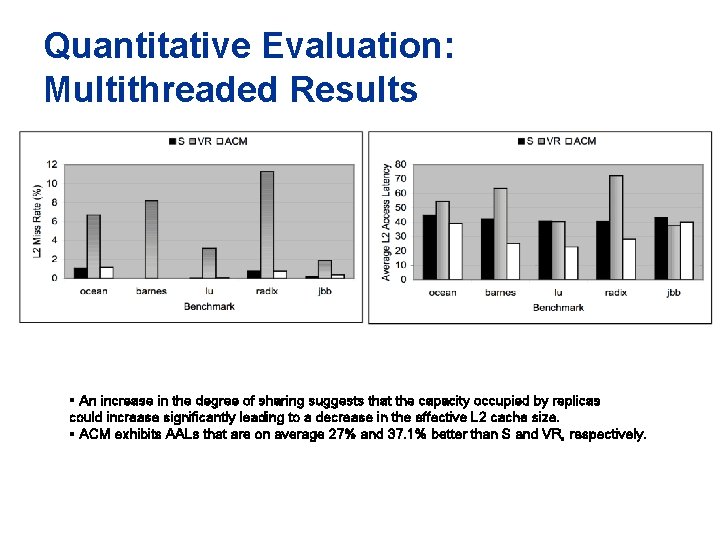
Quantitative Evaluation: Multithreaded Results § An increase in the degree of sharing suggests that the capacity occupied by replicas could increase significantly leading to a decrease in the effective L 2 cache size. § ACM exhibits AALs that are on average 27% and 37. 1% better than S and VR, respectively.
Quantitative Evaluation: Avg. Memory Access Cycles Per 1 K Instr. §ACM performs on average 18. 6% and 2. 6% better than S for the single-threaded and multiprogramming workloads, respectively. §ACM performs on average 20. 7% better than S for multithreaded workloads. § VR performs on average 15. 1% better than S, and 38. 4% worse than S for the singlethreaded and multiprogramming workloads, respectively. §VR performs on average 19. 6% worse than S for multithreaded workloads.
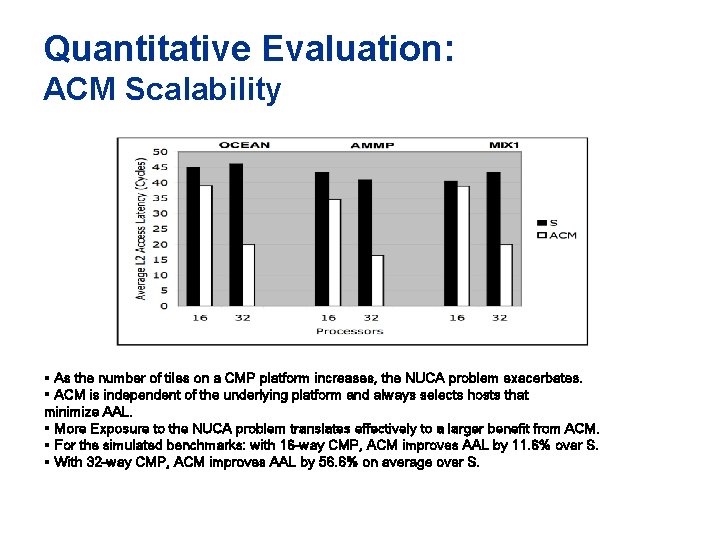
Quantitative Evaluation: ACM Scalability Poor Capacity Utilization § As the number of tiles on a CMP platform increases, the NUCA problem exacerbates. § ACM is independent of the underlying platform and always selects hosts that minimize AAL. § More Exposure to the NUCA problem translates effectively to a larger benefit from ACM. § For the simulated benchmarks: with 16 -way CMP, ACM improves AAL by 11. 6% over S. § With 32 -way CMP, ACM improves AAL by 56. 6% on average over S.
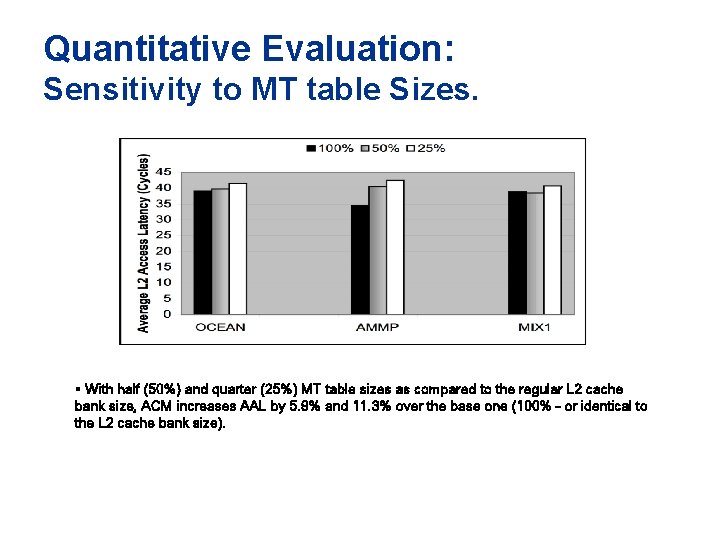
Quantitative Evaluation: Sensitivity to MT table Sizes. § With half (50%) and quarter (25%) MT table sizes as compared to the regular L 2 cache bank size, ACM increases AAL by 5. 9% and 11. 3% over the base one (100% - or identical to the L 2 cache bank size).
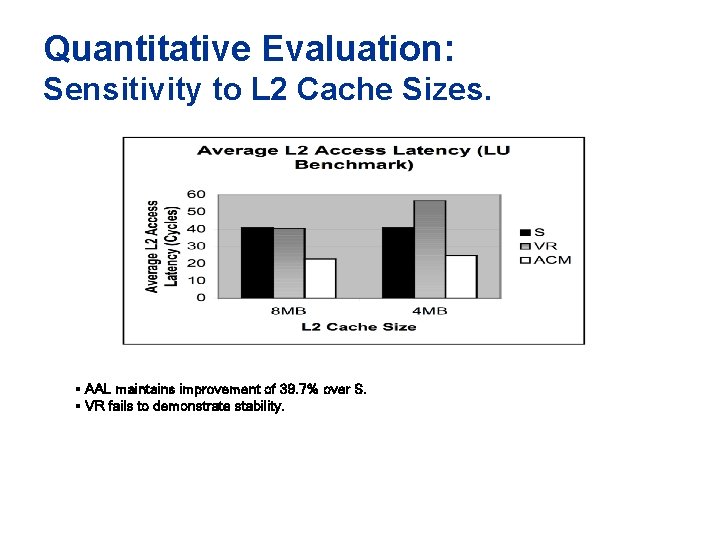
Quantitative Evaluation: Sensitivity to L 2 Cache Sizes. § AAL maintains improvement of 39. 7% over S. § VR fails to demonstrate stability.
Conclusion § This work proposes ACM, a strategy to manage CMP NUCA caches. § ACM offers: • Better average L 2 access latency over traditional NUCA (20. 4% on average). • Maintains L 2 miss rate of NUCA. § ACM proposes a robust location strategy (cache-the-cachetag) that can work for any NUCA migration scheme. § ACM reveals the usefulness of migration technique in CMP context.
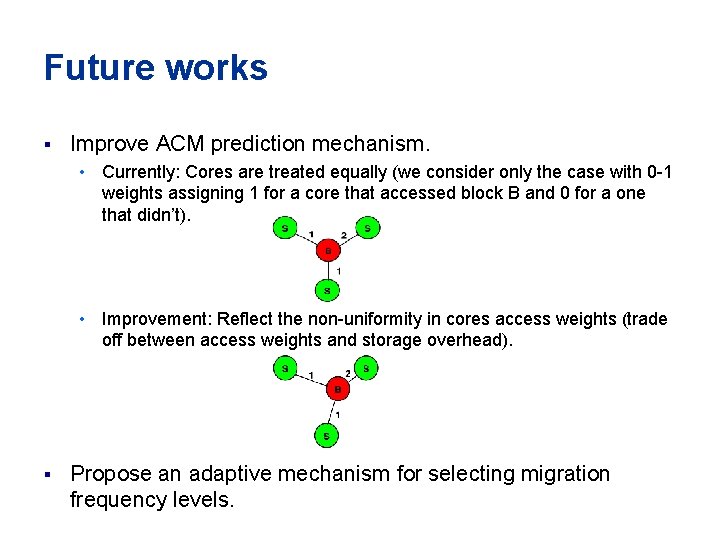
Future works § Improve ACM prediction mechanism. • Currently: Cores are treated equally (we consider only the case with 0 -1 weights assigning 1 for a core that accessed block B and 0 for a one that didn’t). • Improvement: Reflect the non-uniformity in cores access weights (trade off between access weights and storage overhead). § Propose an adaptive mechanism for selecting migration frequency levels.
Thank you! ACM: An Efficient Approach for Managing Shared Caches in Chip Multiprocessors M. Hammoud, S. Cho, and R. Melhem Special thank to Socrates Demetriades Dept. of Computer Science University of Pittsburgh