
ACLT 052 Integrating Reading Writing and Thinking for


- Slides: 53
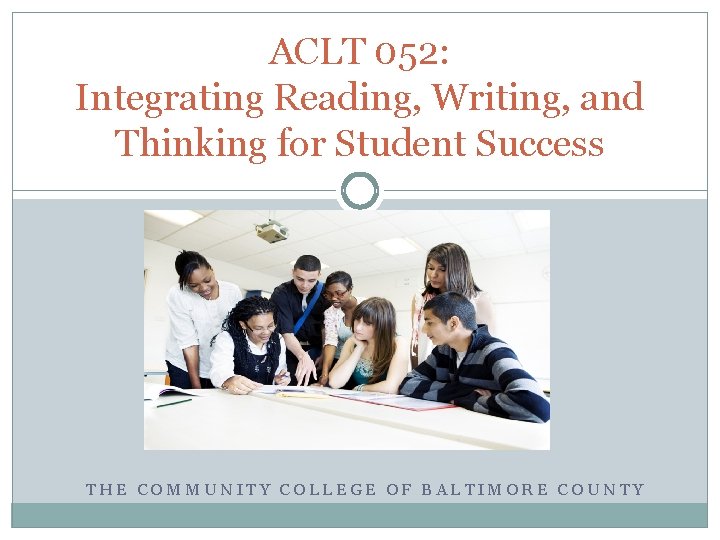
ACLT 052: Integrating Reading, Writing, and Thinking for Student Success THE COMMUNITY COLLEGE OF BALTIMORE COUNTY
Presenters �Professor Sharon Hayes, Reading Faculty and Coordinator �Professor Ryan Donnelly, English Faculty �Dr. Jeanine Williams, Reading Faculty and Coordinator of Reading Acceleration Initiatives
Workshop Overview �Introduction to ACLT 052 �Skill-embedded Curriculum �Thinking-focused Pedagogy �Growth-centered Assessment �Group Activity and Gallery Walk �Discussion and Questions
Got Questions? �Well, we have answers! �As questions arise, please make note of them on your index card. �We will answer 2 -3 pertinent questions after each segment. �We have allotted plenty of time for discussion and questions at the end of the workshop.
Introduction to ACLT 052
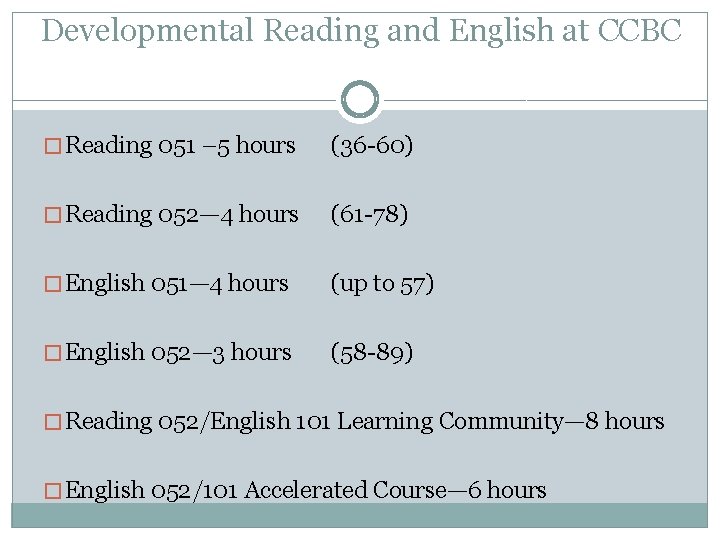
Developmental Reading and English at CCBC � Reading 051 – 5 hours (36 -60) � Reading 052— 4 hours (61 -78) � English 051— 4 hours (up to 57) � English 052— 3 hours (58 -89) � Reading 052/English 101 Learning Community— 8 hours � English 052/101 Accelerated Course— 6 hours
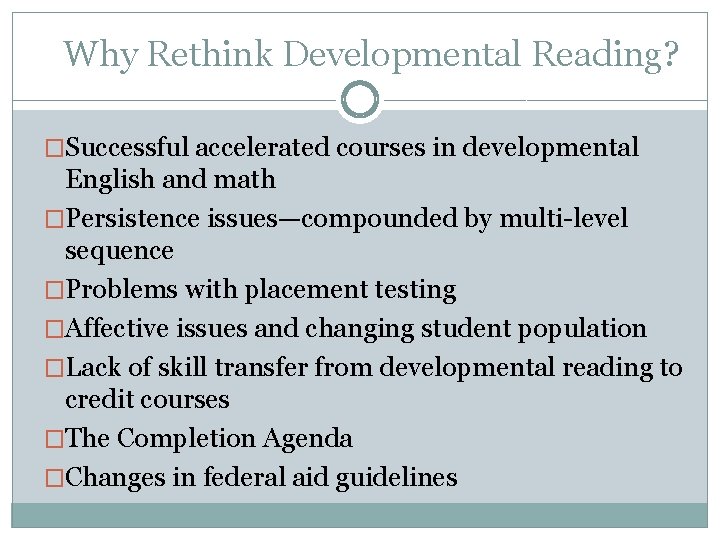
Why Rethink Developmental Reading? �Successful accelerated courses in developmental English and math �Persistence issues—compounded by multi-level sequence �Problems with placement testing �Affective issues and changing student population �Lack of skill transfer from developmental reading to credit courses �The Completion Agenda �Changes in federal aid guidelines
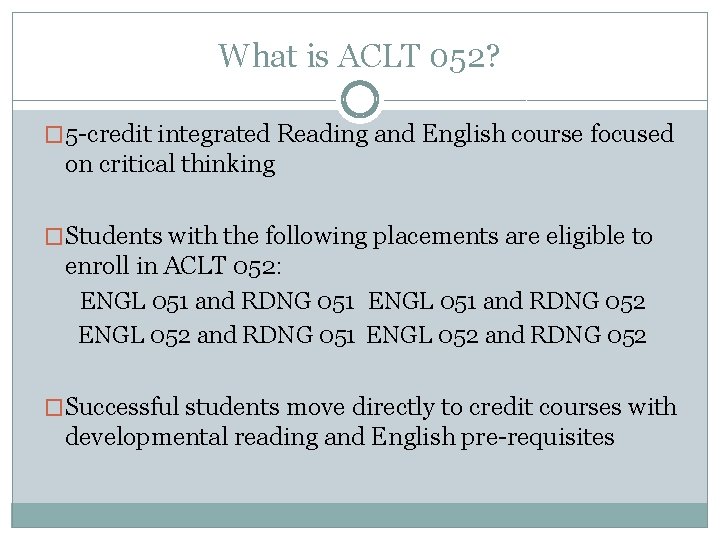
What is ACLT 052? � 5 -credit integrated Reading and English course focused on critical thinking �Students with the following placements are eligible to enroll in ACLT 052: ENGL 051 and RDNG 051 ENGL 051 and RDNG 052 ENGL 052 and RDNG 051 ENGL 052 and RDNG 052 �Successful students move directly to credit courses with developmental reading and English pre-requisites
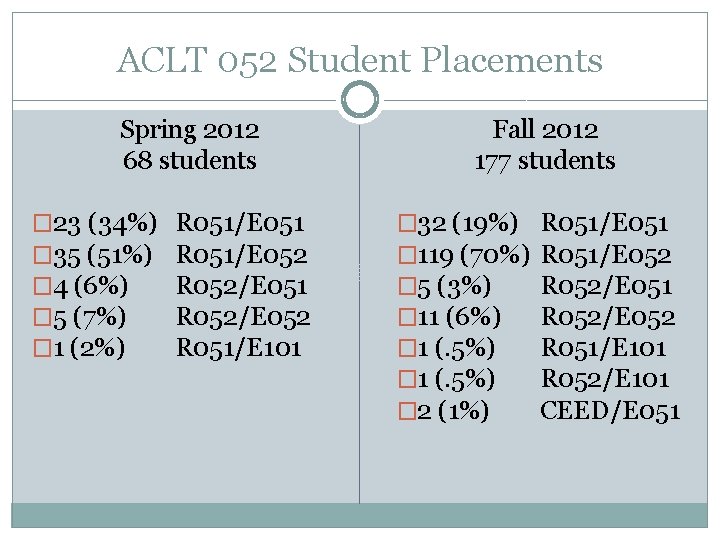
ACLT 052 Student Placements Spring 2012 68 students � 23 (34%) � 35 (51%) � 4 (6%) � 5 (7%) � 1 (2%) R 051/E 051 R 051/E 052 R 052/E 051 R 052/E 052 R 051/E 101 Fall 2012 177 students � 32 (19%) R 051/E 051 � 119 (70%) R 051/E 052 � 5 (3%) R 052/E 051 � 11 (6%) R 052/E 052 � 1 (. 5%) R 051/E 101 � 1 (. 5%) R 052/E 101 � 2 (1%) CEED/E 051
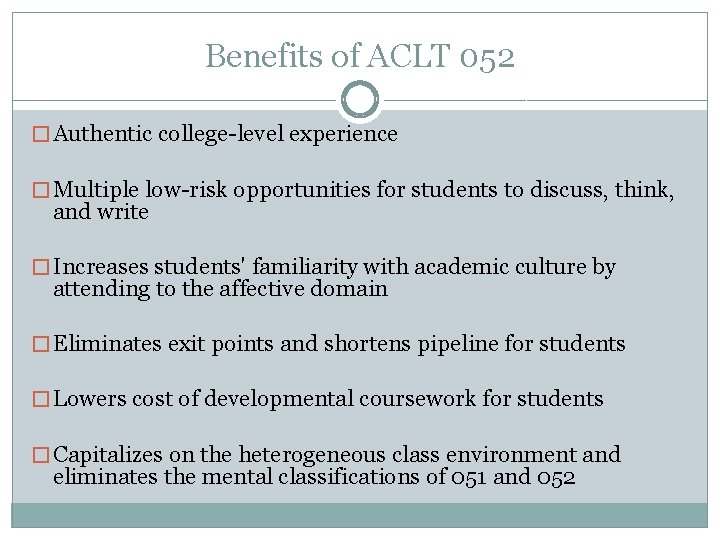
Benefits of ACLT 052 � Authentic college-level experience � Multiple low-risk opportunities for students to discuss, think, and write � Increases students' familiarity with academic culture by attending to the affective domain � Eliminates exit points and shortens pipeline for students � Lowers cost of developmental coursework for students � Capitalizes on the heterogeneous class environment and eliminates the mental classifications of 051 and 052
Skill-Embedded Curriculum
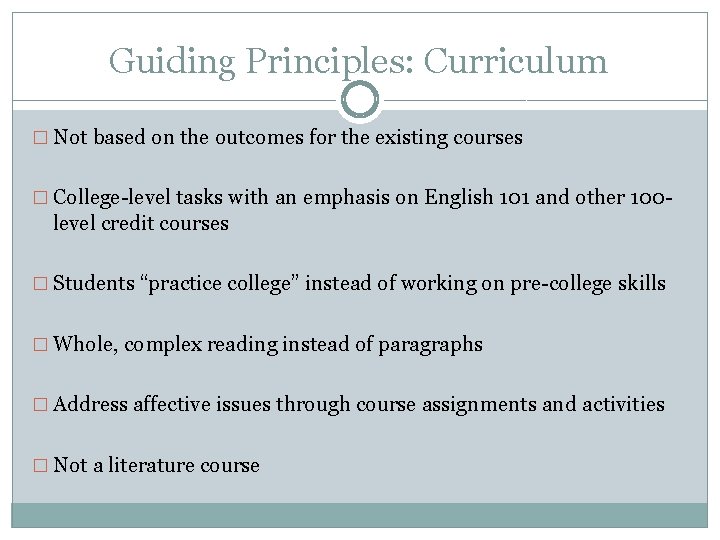
Guiding Principles: Curriculum � Not based on the outcomes for the existing courses � College-level tasks with an emphasis on English 101 and other 100 - level credit courses � Students “practice college” instead of working on pre-college skills � Whole, complex reading instead of paragraphs � Address affective issues through course assignments and activities � Not a literature course
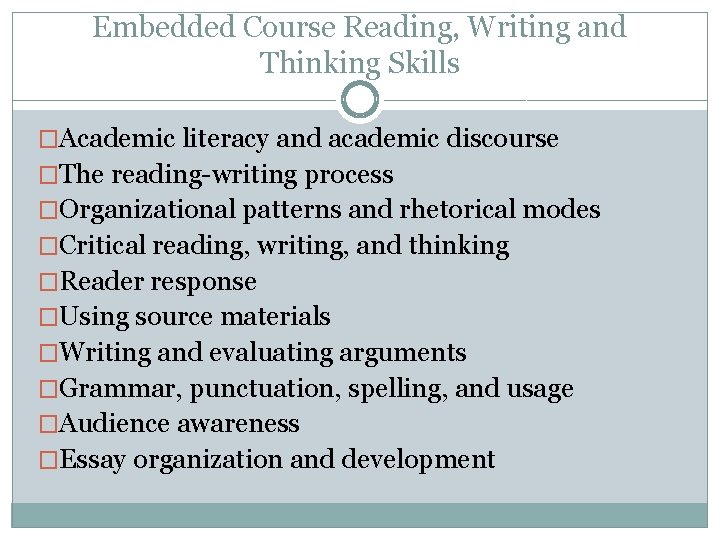
Embedded Course Reading, Writing and Thinking Skills �Academic literacy and academic discourse �The reading-writing process �Organizational patterns and rhetorical modes �Critical reading, writing, and thinking �Reader response �Using source materials �Writing and evaluating arguments �Grammar, punctuation, spelling, and usage �Audience awareness �Essay organization and development
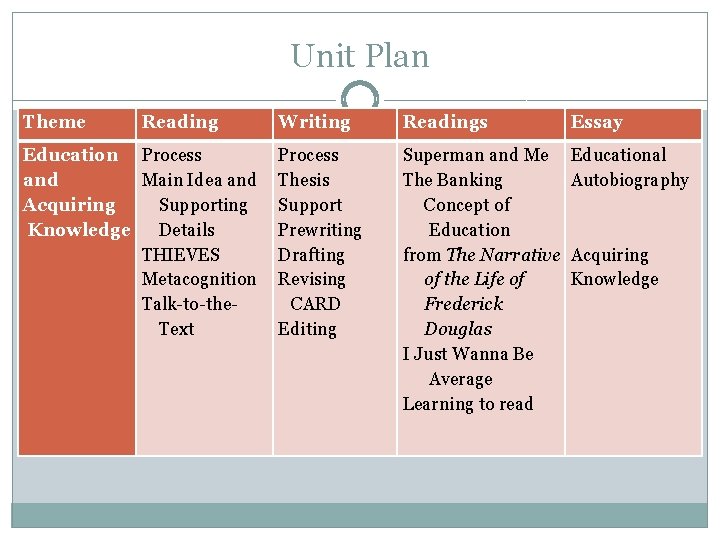
Unit Plan Theme Reading Writing Readings Essay Education and Acquiring Knowledge Process Main Idea and Supporting Details THIEVES Metacognition Talk-to-the Text Process Thesis Support Prewriting Drafting Revising CARD Editing Superman and Me The Banking Concept of Education from The Narrative of the Life of Frederick Douglas I Just Wanna Be Average Learning to read Educational Autobiography Acquiring Knowledge
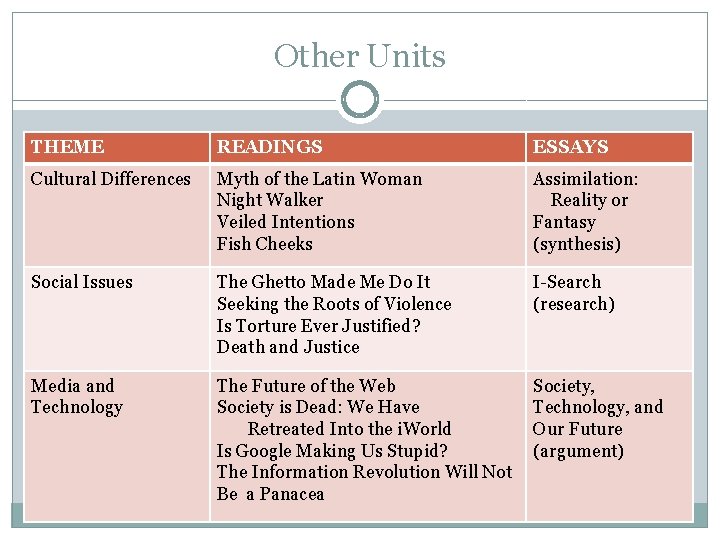
Other Units THEME READINGS ESSAYS Cultural Differences Myth of the Latin Woman Night Walker Veiled Intentions Fish Cheeks Assimilation: Reality or Fantasy (synthesis) Social Issues The Ghetto Made Me Do It Seeking the Roots of Violence Is Torture Ever Justified? Death and Justice I-Search (research) Media and Technology The Future of the Web Society is Dead: We Have Retreated Into the i. World Is Google Making Us Stupid? The Information Revolution Will Not Be a Panacea Society, Technology, and Our Future (argument)
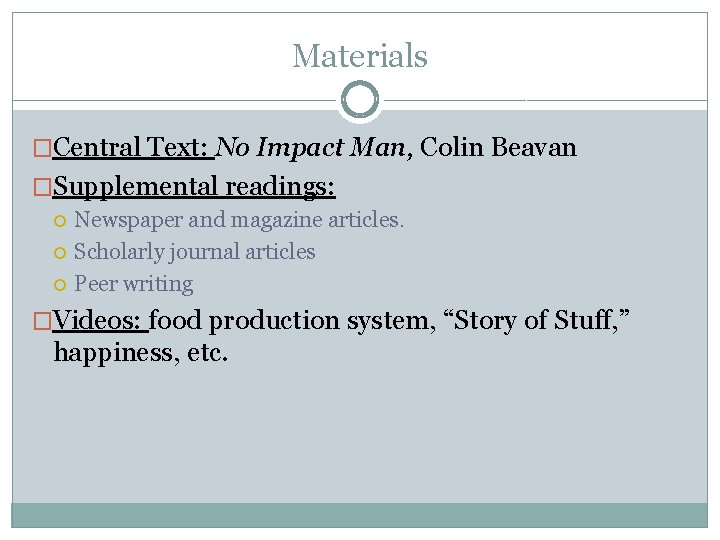
Materials �Central Text: No Impact Man, Colin Beavan �Supplemental readings: Newspaper and magazine articles. Scholarly journal articles Peer writing �Videos: food production system, “Story of Stuff, ” happiness, etc.
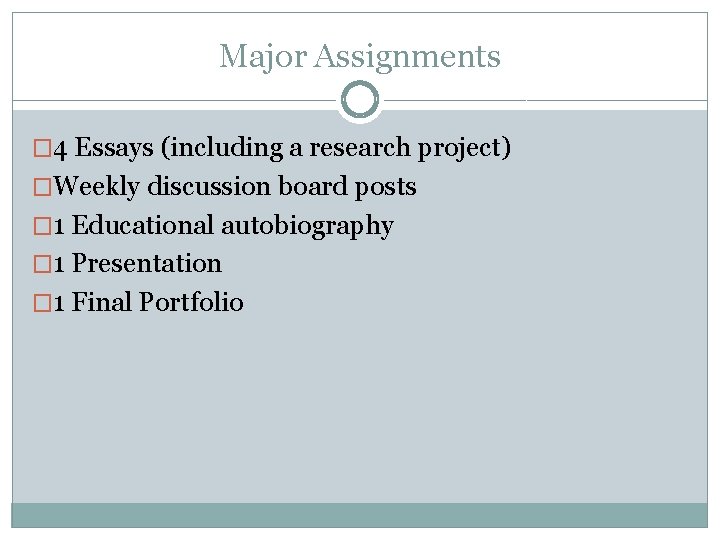
Major Assignments � 4 Essays (including a research project) �Weekly discussion board posts � 1 Educational autobiography � 1 Presentation � 1 Final Portfolio
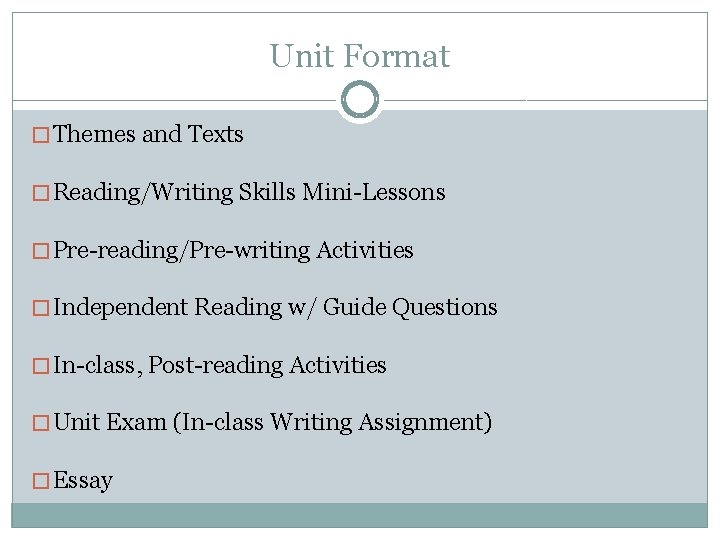
Unit Format � Themes and Texts � Reading/Writing Skills Mini-Lessons � Pre-reading/Pre-writing Activities � Independent Reading w/ Guide Questions � In-class, Post-reading Activities � Unit Exam (In-class Writing Assignment) � Essay
Typical Class � Quiz on homework � Small group comprehension-based activity � Quick-write on theme-related critical thinking question � Mini lesson on a timely reading/writing skill � Exam preparation— “Speed Dating” � Essay planning and drafting � Peer editing � Instructor-student conferencing Everyday is different—“No Autopilot”
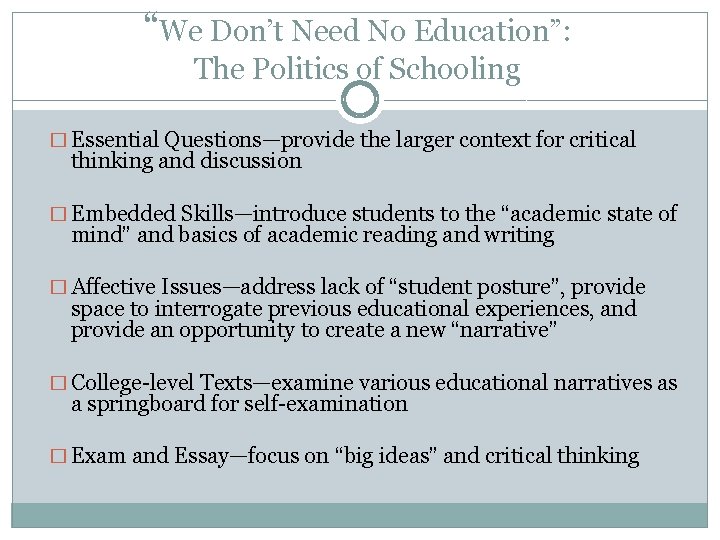
“We Don’t Need No Education”: The Politics of Schooling � Essential Questions—provide the larger context for critical thinking and discussion � Embedded Skills—introduce students to the “academic state of mind” and basics of academic reading and writing � Affective Issues—address lack of “student posture”, provide space to interrogate previous educational experiences, and provide an opportunity to create a new “narrative” � College-level Texts—examine various educational narratives as a springboard for self-examination � Exam and Essay—focus on “big ideas” and critical thinking
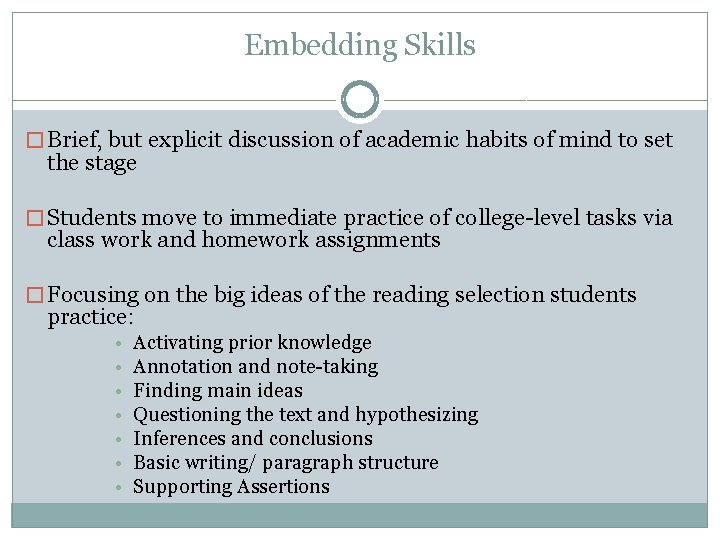
Embedding Skills � Brief, but explicit discussion of academic habits of mind to set the stage � Students move to immediate practice of college-level tasks via class work and homework assignments � Focusing on the big ideas of the reading selection students practice: • • Activating prior knowledge Annotation and note-taking Finding main ideas Questioning the text and hypothesizing Inferences and conclusions Basic writing/ paragraph structure Supporting Assertions
Thinking-Focused Pedagogy
Guiding Principles: Pedagogy � Turn our assumptions on their head or “before they can do this, they have to do this. ” Start with the real academic tasks right away—not baby steps � Use a thematic approach � Use active learning techniques � Use triage to deal with student areas that need support rather than lowering the entire curriculum to sub-skills—“just in time remediation” � Have a “growth mindset” towards students and their progress � Help grow student sense of responsibility
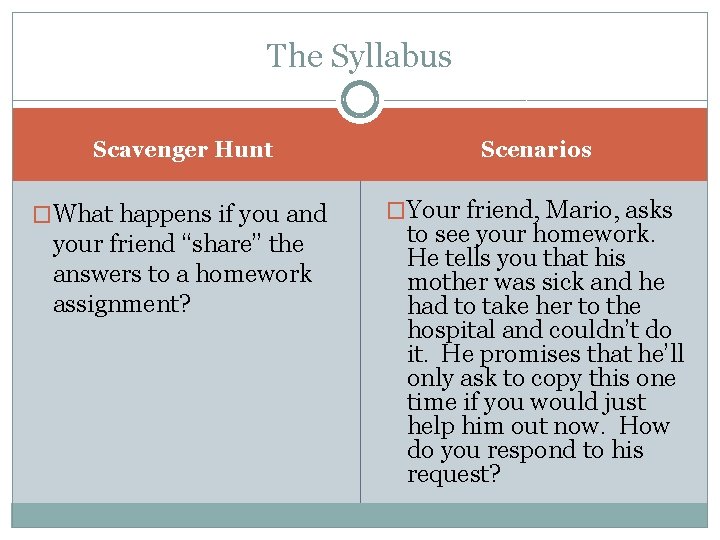
The Syllabus Scavenger Hunt Scenarios �What happens if you and �Your friend, Mario, asks your friend “share” the answers to a homework assignment? to see your homework. He tells you that his mother was sick and he had to take her to the hospital and couldn’t do it. He promises that he’ll only ask to copy this one time if you would just help him out now. How do you respond to his request?
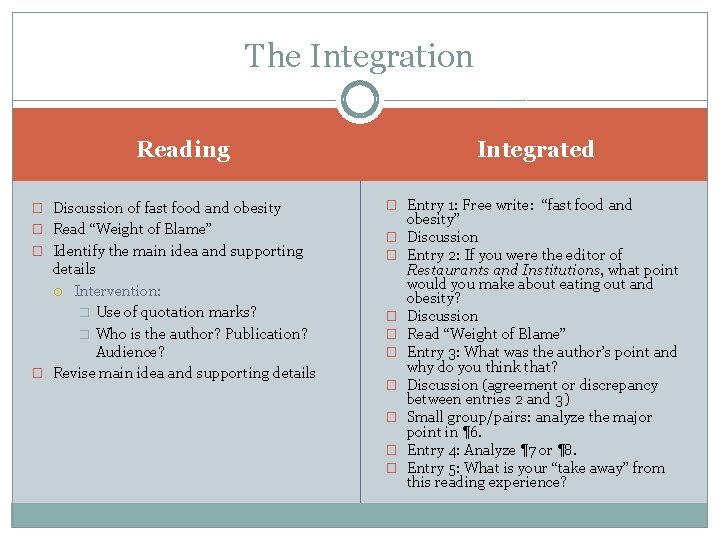
The Integration Integrated Reading � Discussion of fast food and obesity � Read “Weight of Blame” � Identify the main idea and supporting details Intervention: � Use of quotation marks? � Who is the author? Publication? Audience? � Revise main idea and supporting details � Entry 1: Free write: “fast food and � � � � � obesity” Discussion Entry 2: If you were the editor of Restaurants and Institutions, what point would you make about eating out and obesity? Discussion Read “Weight of Blame” Entry 3: What was the author’s point and why do you think that? Discussion (agreement or discrepancy between entries 2 and 3) Small group/pairs: analyze the major point in ¶ 6. Entry 4: Analyze ¶ 7 or ¶ 8. Entry 5: What is your “take away” from this reading experience?
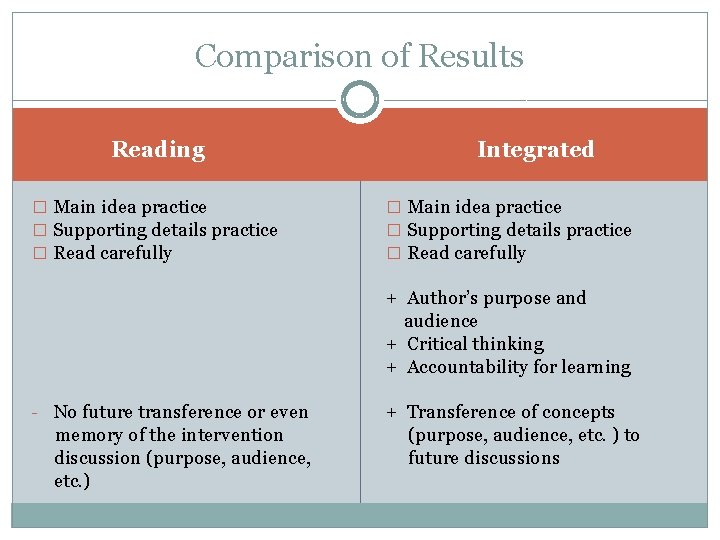
Comparison of Results Reading � Main idea practice � Supporting details practice � Read carefully Integrated � Main idea practice � Supporting details practice � Read carefully + Author’s purpose and audience + Critical thinking + Accountability for learning - No future transference or even memory of the intervention discussion (purpose, audience, etc. ) + Transference of concepts (purpose, audience, etc. ) to future discussions
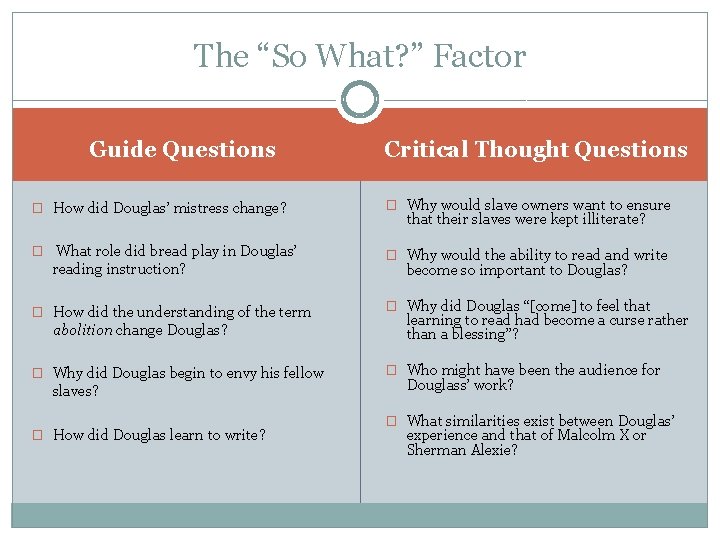
The “So What? ” Factor Guide Questions � How did Douglas’ mistress change? � What role did bread play in Douglas’ reading instruction? Critical Thought Questions � Why would slave owners want to ensure that their slaves were kept illiterate? � Why would the ability to read and write become so important to Douglas? � How did the understanding of the term � Why did Douglas “[come] to feel that learning to read had become a curse rather than a blessing”? abolition change Douglas? � Why did Douglas begin to envy his fellow � Who might have been the audience for slaves? � How did Douglas learn to write? Douglass’ work? � What similarities exist between Douglas’ experience and that of Malcolm X or Sherman Alexie?
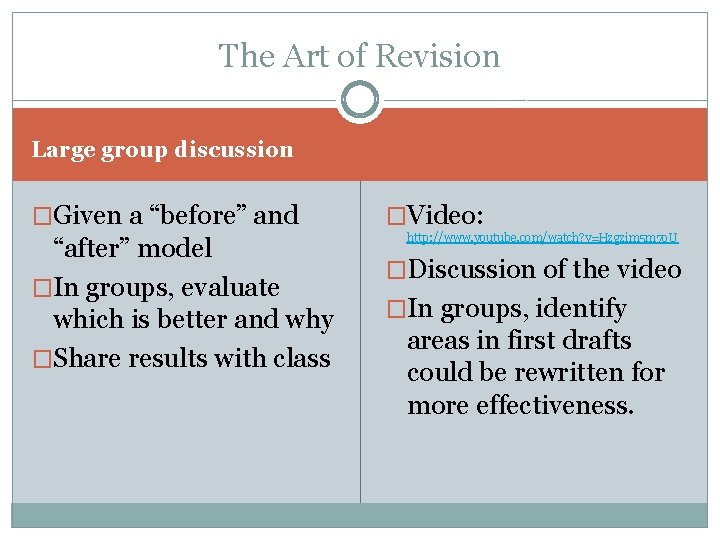
The Art of Revision Large group discussion �Given a “before” and “after” model �In groups, evaluate which is better and why �Share results with class �Video: http: //www. youtube. com/watch? v=Hzgzim 5 m 7 o. U �Discussion of the video �In groups, identify areas in first drafts could be rewritten for more effectiveness.
The Challenge of Critical Thought � http: //www. youtube. com/watch? v=PSMCKNk. Ky. FA �How can you relate this group to this class?
Growth-Centered Assessment
Guiding Principles: Assessment � Holistic approach to assessing student work—look at content as well as grammar � Progressive approach to grading: tolerance for less than perfect work early in the semester � Provide a lot of “low-risk” opportunities to talk, think, and write before graded, higher-stakes assignments � Embrace 3 Goals: Independently read and understand complex academic texts Critically respond to the ideas and information in those texts Write essays integrating ideas and information from those texts
Assessment Structure �Three stages 1. 2. 3. Pre-reading Reading Post-reading
Pre-Reading �Goal: Tap into existing knowledge Free-write Watch video Class discussion Key concepts and terms
Pre-Reading �Example: Prep for a reading on importance of biodiversity Free-write and discussion �What is a food web? Why is it important to understand? �During discussion: How do food webs work? What is extinction and why is it a problem? What would happen if a disease killed all the spiders in the world?
Pre-Reading �Lecture: Reinforce concept of systems and how they function. Reinforce “relationships” of organisms to each other. Introduce “biodiversity” as a term.
Reading �Goal: Guide students to facilitate comprehension. Annotations Guiding questions Dual-entry journals Written responses
Reading �Article: “Will we soon be extinct? ” by Josh Clark. Annotations Guiding Questions: �Why is nitrogen important to humans? �How do worms keep up us alive? �What will happen if species continue to die? �How much biodiversity is in your neighborhood? Count as many different kinds of life as you can (think about large animals like humans, about small ones like insects, and about bacteria, mold, and fungus as well. )
Post-Reading �Goal: Assess comprehension and engage with concepts. Quizzes Response papers Discussion Group activity Further research
Post-Reading �Short Quiz: How do many advances in technology depend on nature? �Discussion: Why is biodiversity important? What places might have high and low levels of biodiversity? �Follow-up: How bio-diverse is our campus?
Post-Reading �Essay Problem: How can we increase biodiversity on the community, national, and international level? �Make a case for biodiversity �Offer solutions for species extinction Individual action Collective action
Discussion/Essay Prompts �Integrated Directly address content Prompt sophisticated writing �Critical Thinking Students should cognitively engage with content (e. g. craft an argument)
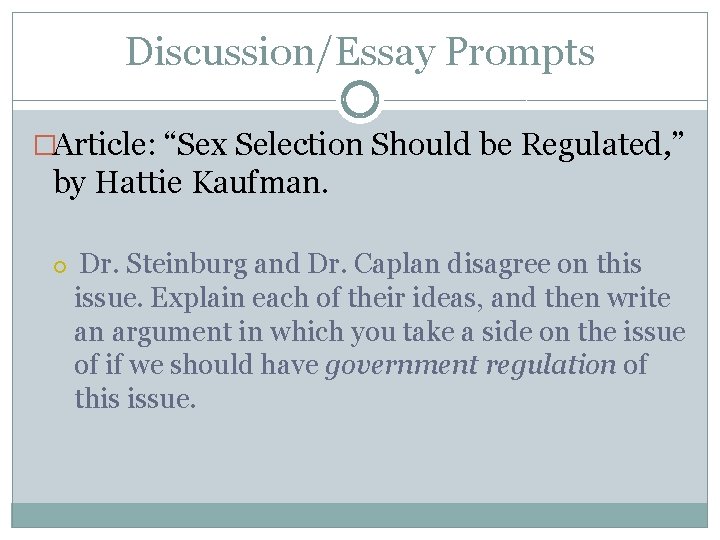
Discussion/Essay Prompts �Article: “Sex Selection Should be Regulated, ” by Hattie Kaufman. Dr. Steinburg and Dr. Caplan disagree on this issue. Explain each of their ideas, and then write an argument in which you take a side on the issue of if we should have government regulation of this issue.
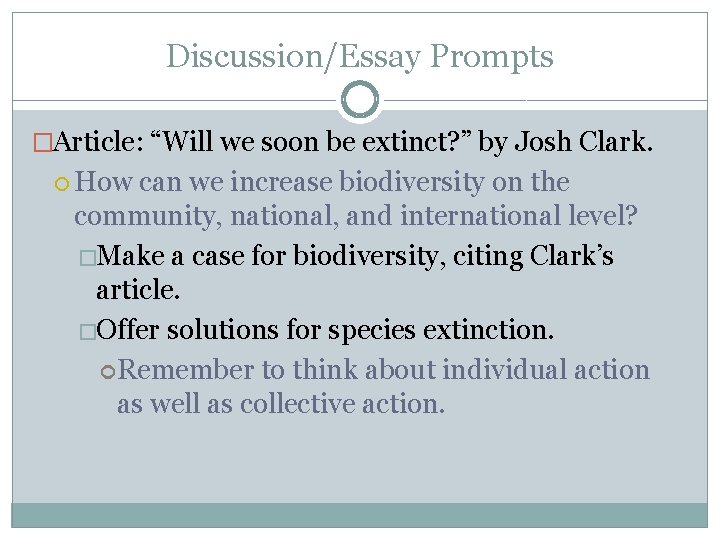
Discussion/Essay Prompts �Article: “Will we soon be extinct? ” by Josh Clark. How can we increase biodiversity on the community, national, and international level? �Make a case for biodiversity, citing Clark’s article. �Offer solutions for species extinction. Remember to think about individual action as well as collective action.
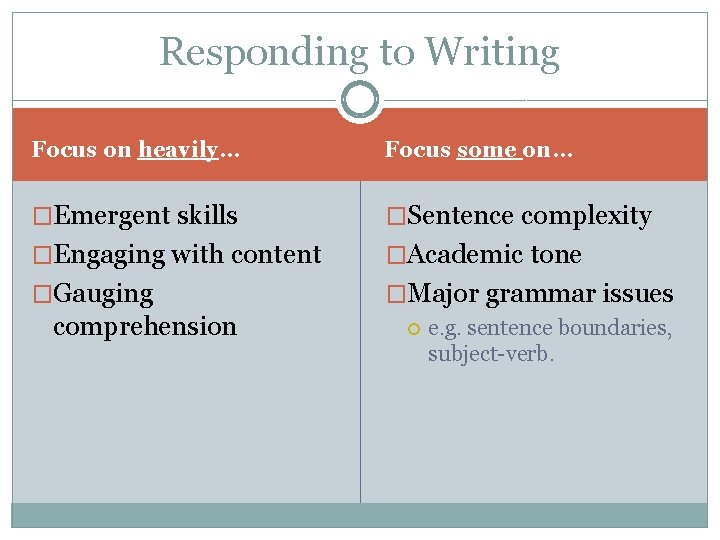
Responding to Writing Focus on heavily… Focus some on… �Emergent skills �Sentence complexity �Engaging with content �Academic tone �Gauging �Major grammar issues comprehension e. g. sentence boundaries, subject-verb.
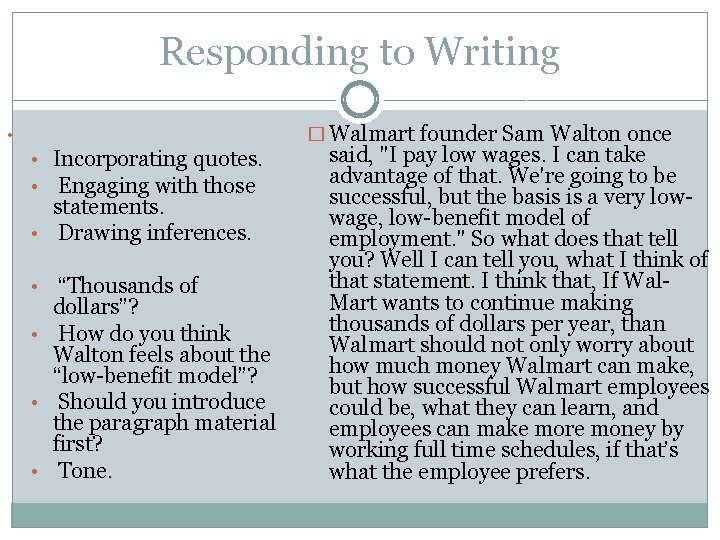
Responding to Writing • • Incorporating quotes. • Engaging with those statements. • Drawing inferences. • “Thousands of dollars”? • How do you think Walton feels about the “low-benefit model”? • Should you introduce the paragraph material first? • Tone. � Walmart founder Sam Walton once said, "I pay low wages. I can take advantage of that. We're going to be successful, but the basis is a very lowwage, low-benefit model of employment. " So what does that tell you? Well I can tell you, what I think of that statement. I think that, If Wal. Mart wants to continue making thousands of dollars per year, than Walmart should not only worry about how much money Walmart can make, but how successful Walmart employees could be, what they can learn, and employees can make more money by working full time schedules, if that’s what the employee prefers.
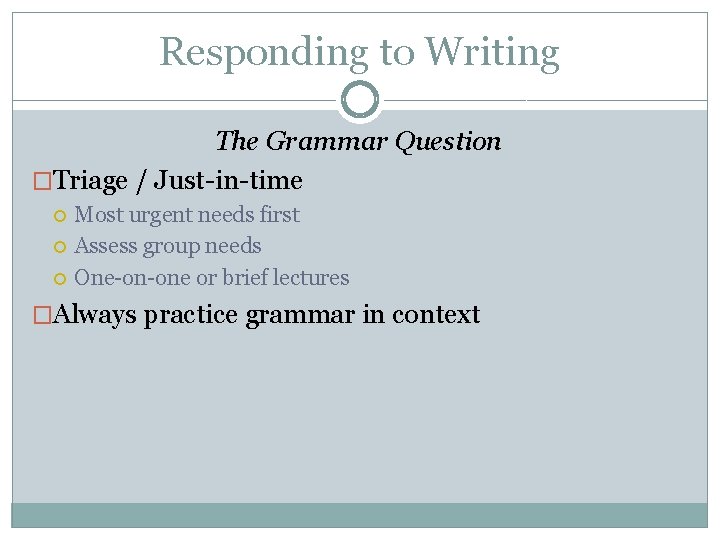
Responding to Writing The Grammar Question �Triage / Just-in-time Most urgent needs first Assess group needs One-on-one or brief lectures �Always practice grammar in context
Group Activity and Gallery Walk
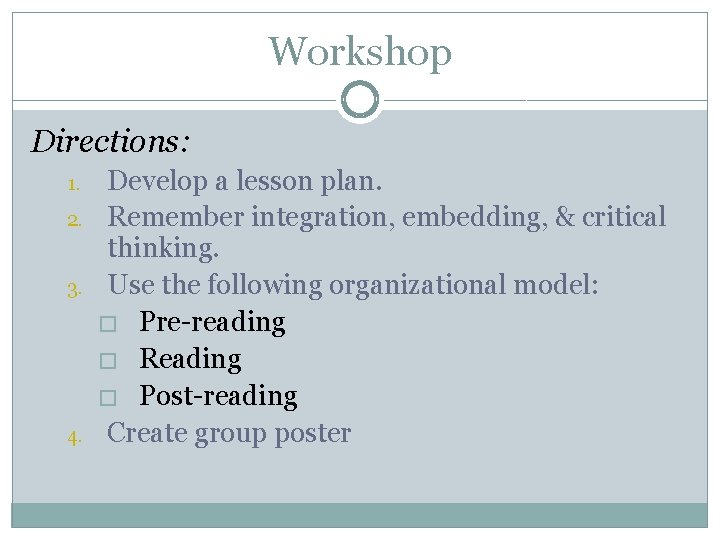
Workshop Directions: 1. 2. 3. 4. Develop a lesson plan. Remember integration, embedding, & critical thinking. Use the following organizational model: � Pre-reading � Reading � Post-reading Create group poster
Discussion and Questions
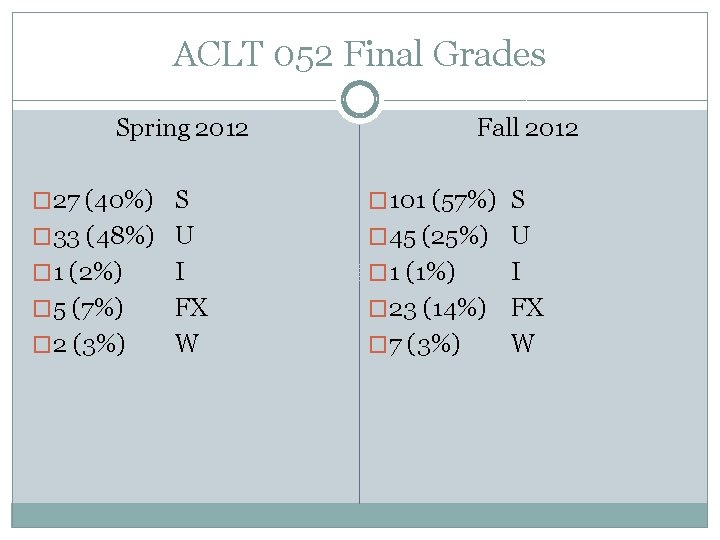
ACLT 052 Final Grades Spring 2012 Fall 2012 � 27 (40%) S � 101 (57%) S � 33 (48%) U � 45 (25%) � 1 (2%) � 5 (7%) � 2 (3%) I FX W U � 1 (1%) I � 23 (14%) FX � 7 (3%) W
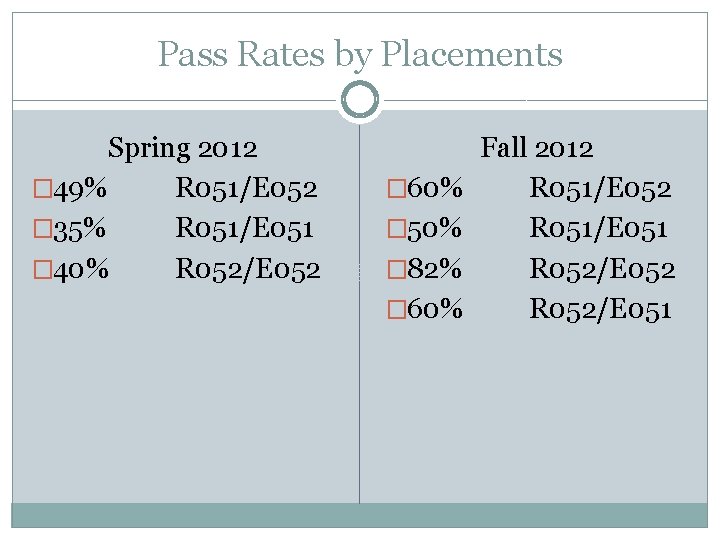
Pass Rates by Placements Spring 2012 � 49% R 051/E 052 � 35% R 051/E 051 � 40% R 052/E 052 � 60% � 50% � 82% � 60% Fall 2012 R 051/E 051 R 052/E 052 R 052/E 051
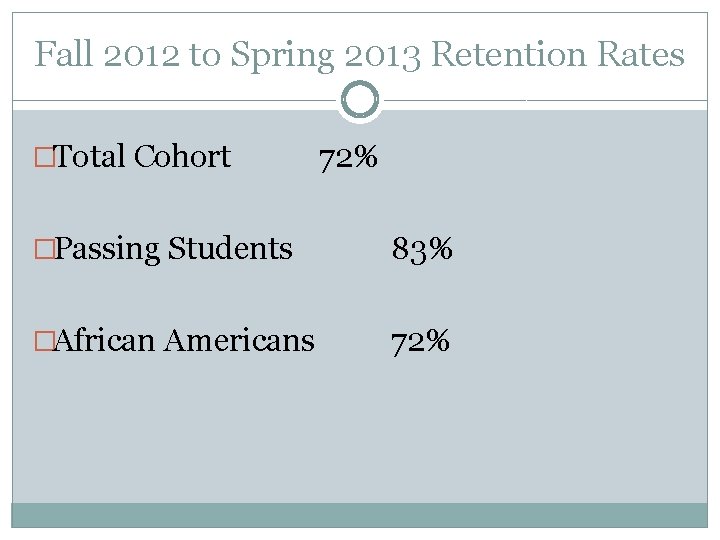
Fall 2012 to Spring 2013 Retention Rates �Total Cohort 72% �Passing Students 83% �African Americans 72%
Contact Information Dr. Jeanine L. Williams Coordinator of Reading Acceleration Initiatives jwilliams 4@ccbcmd. edu 443 -840 -3031 Prof. Sharon Hayes shayes@ccbcmd. edu Prof. Ryan Donnelly rdonnelly@ccbcmd. edu