
ACL INTERFERENCE SCREW K J Davis A J
- Slides: 1
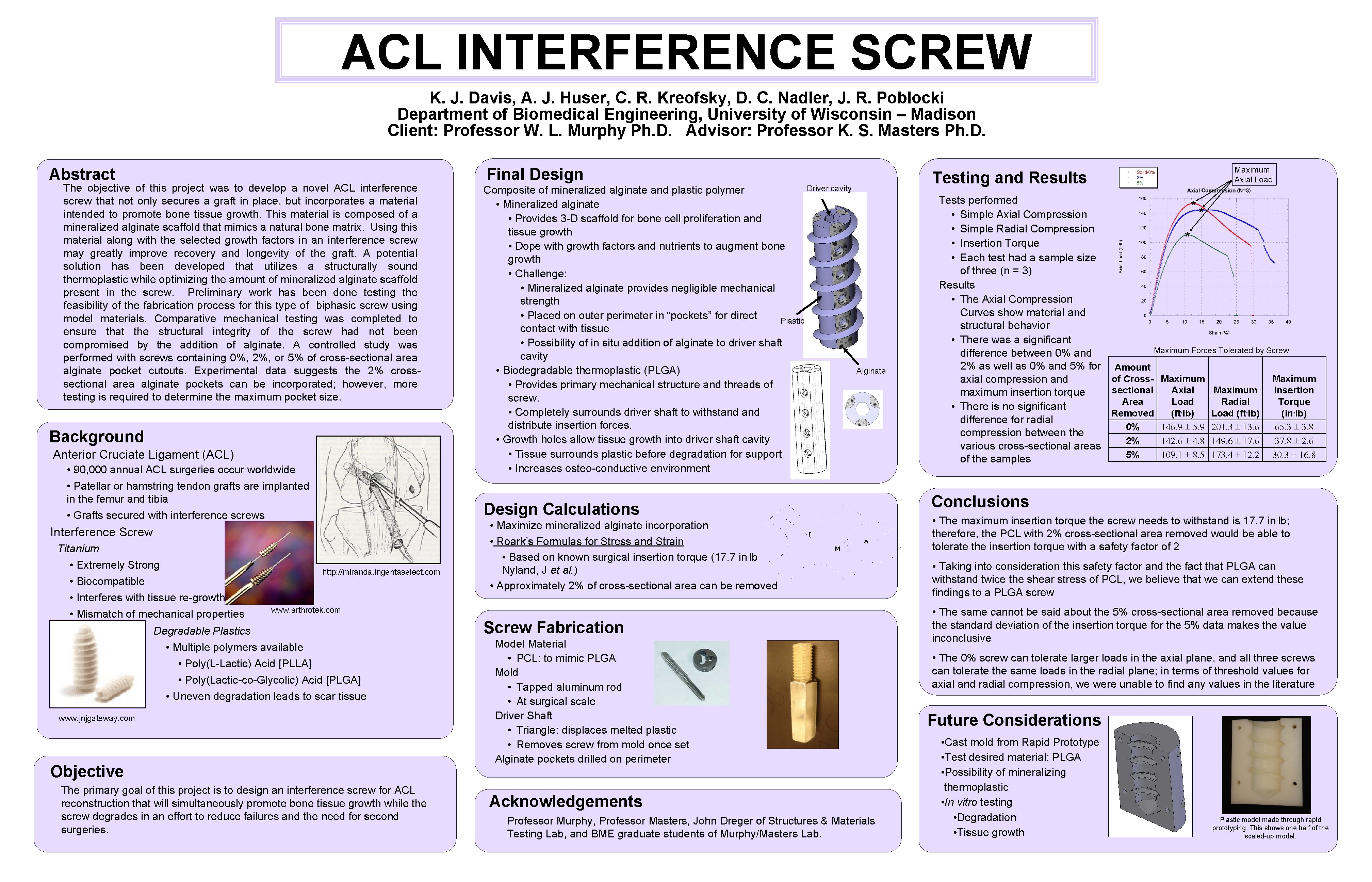
ACL INTERFERENCE SCREW K. J. Davis, A. J. Huser, C. R. Kreofsky, D. C. Nadler, J. R. Poblocki Department of Biomedical Engineering, University of Wisconsin – Madison Client: Professor W. L. Murphy Ph. D. Advisor: Professor K. S. Masters Ph. D. Abstract The objective of this project was to develop a novel ACL interference screw that not only secures a graft in place, but incorporates a material intended to promote bone tissue growth. This material is composed of a mineralized alginate scaffold that mimics a natural bone matrix. Using this material along with the selected growth factors in an interference screw may greatly improve recovery and longevity of the graft. A potential solution has been developed that utilizes a structurally sound thermoplastic while optimizing the amount of mineralized alginate scaffold present in the screw. Preliminary work has been done testing the feasibility of the fabrication process for this type of biphasic screw using model materials. Comparative mechanical testing was completed to ensure that the structural integrity of the screw had not been compromised by the addition of alginate. A controlled study was performed with screws containing 0%, 2%, or 5% of cross-sectional area alginate pocket cutouts. Experimental data suggests the 2% crosssectional area alginate pockets can be incorporated; however, more testing is required to determine the maximum pocket size. Background Anterior Cruciate Ligament (ACL) • 90, 000 annual ACL surgeries occur worldwide • Patellar or hamstring tendon grafts are implanted in the femur and tibia • Grafts secured with interference screws http: //miranda. ingentaselect. com • Interferes with tissue re-growth • Mismatch of mechanical properties Driver cavity Composite of mineralized alginate and plastic polymer • Mineralized alginate • Provides 3 -D scaffold for bone cell proliferation and tissue growth • Dope with growth factors and nutrients to augment bone growth • Challenge: • Mineralized alginate provides negligible mechanical strength • Placed on outer perimeter in “pockets” for direct Plastic contact with tissue • Possibility of in situ addition of alginate to driver shaft cavity • Biodegradable thermoplastic (PLGA) • Provides primary mechanical structure and threads of screw. • Completely surrounds driver shaft to withstand distribute insertion forces. • Growth holes allow tissue growth into driver shaft cavity • Tissue surrounds plastic before degradation for support • Increases osteo-conductive environment Testing and Results Alginate • Maximize mineralized alginate incorporation • Roark’s Formulas for Stress and Strain • Based on known surgical insertion torque (17. 7 in. lb Nyland, J et al. ) • Approximately 2% of cross-sectional area can be removed r a M www. arthrotek. com Degradable Plastics • Multiple polymers available • Poly(L-Lactic) Acid [PLLA] • Poly(Lactic-co-Glycolic) Acid [PLGA] • Uneven degradation leads to scar tissue www. jnjgateway. com Objective The primary goal of this project is to design an interference screw for ACL reconstruction that will simultaneously promote bone tissue growth while the screw degrades in an effort to reduce failures and the need for second surgeries. Tests performed * • Simple Axial Compression * • Simple Radial Compression * • Insertion Torque • Each test had a sample size of three (n = 3) Results • The Axial Compression Curves show material and structural behavior • There was a significant Maximum Forces Tolerated by Screw difference between 0% and 2% as well as 0% and 5% for Amount of Cross- Maximum axial compression and sectional Axial Maximum Insertion maximum insertion torque Area Load Radial Torque • There is no significant Removed (ft. lb) Load (ft. lb) (in. lb) difference for radial 146. 9 ± 5. 9 201. 3 ± 13. 6 65. 3 ± 3. 8 0% compression between the 142. 6 ± 4. 8 149. 6 ± 17. 6 37. 8 ± 2. 6 2% various cross-sectional areas 109. 1 ± 8. 5 173. 4 ± 12. 2 30. 3 ± 16. 8 5% of the samples Conclusions Design Calculations Interference Screw Titanium • Extremely Strong • Biocompatible Final Design Maximum Axial Load Screw Fabrication Model Material • PCL: to mimic PLGA Mold • Tapped aluminum rod • At surgical scale Driver Shaft • Triangle: displaces melted plastic • Removes screw from mold once set Alginate pockets drilled on perimeter Acknowledgements Professor Murphy, Professor Masters, John Dreger of Structures & Materials Testing Lab, and BME graduate students of Murphy/Masters Lab. • The maximum insertion torque the screw needs to withstand is 17. 7 in. lb; therefore, the PCL with 2% cross-sectional area removed would be able to tolerate the insertion torque with a safety factor of 2 • Taking into consideration this safety factor and the fact that PLGA can withstand twice the shear stress of PCL, we believe that we can extend these findings to a PLGA screw • The same cannot be said about the 5% cross-sectional area removed because the standard deviation of the insertion torque for the 5% data makes the value inconclusive • The 0% screw can tolerate larger loads in the axial plane, and all three screws can tolerate the same loads in the radial plane; in terms of threshold values for axial and radial compression, we were unable to find any values in the literature Future Considerations • Cast mold from Rapid Prototype • Test desired material: PLGA • Possibility of mineralizing thermoplastic • In vitro testing • Degradation • Tissue growth Plastic model made through rapid prototyping. This shows one half of the scaled-up model.