
ACL Injury Prevention Through Proprioceptive Neuromuscular Training Arlington

![References • • Biedert RM, Bachmann M. [Women's soccer. Injuries, risks, and prevention]. Orthopade.](https://slidetodoc.com/presentation_image_h2/7179b0830d5d8ecad41b0398ccc60386/image-28.jpg "References • • Biedert RM, Bachmann M. [Women's soccer. Injuries, risks, and prevention]. Orthopade.")


- Slides: 30
ACL Injury Prevention Through Proprioceptive & Neuromuscular Training Arlington Soccer Club April 1, 2010 Matthew R. Mc. Manus, PT Co-Owner & Regional Clinical Director - Massachusetts Pro. Ex Physical Therapy www. PROex. PT. com
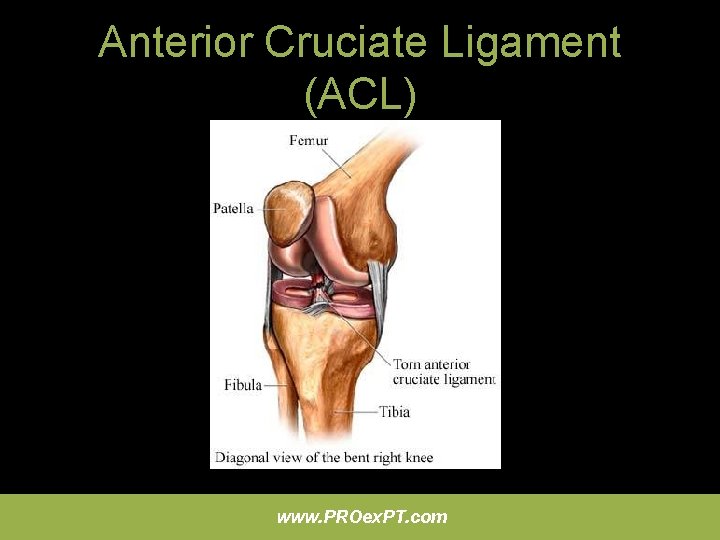
Anterior Cruciate Ligament (ACL) www. PROex. PT. com
Anatomy and Biomechanics • ACL is 2 nd weakest ligament in knee (LCL is weakest but less commonly injured due to location) • Prevents tibial anterior translation • Acts as a secondary restraint in tibial rotation • ACL is made of two bands and remains tight throughout knee ROM –> can be torn at any knee angle www. PROex. PT. com
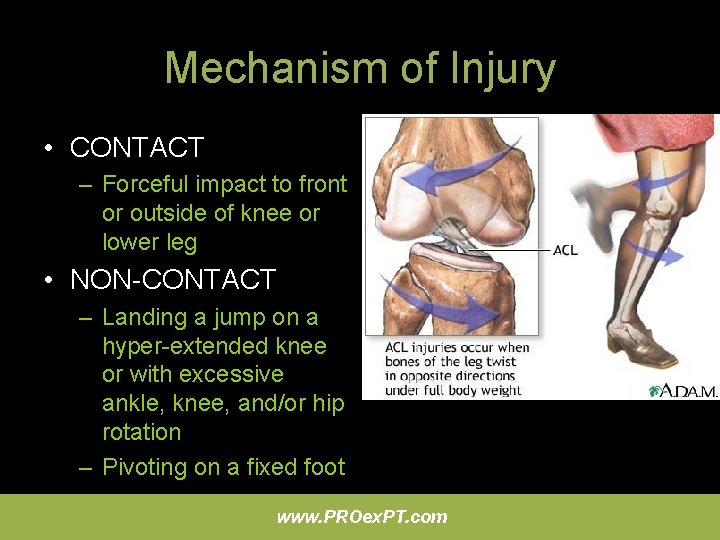
Mechanism of Injury • CONTACT – Forceful impact to front or outside of knee or lower leg • NON-CONTACT – Landing a jump on a hyper-extended knee or with excessive ankle, knee, and/or hip rotation – Pivoting on a fixed foot www. PROex. PT. com
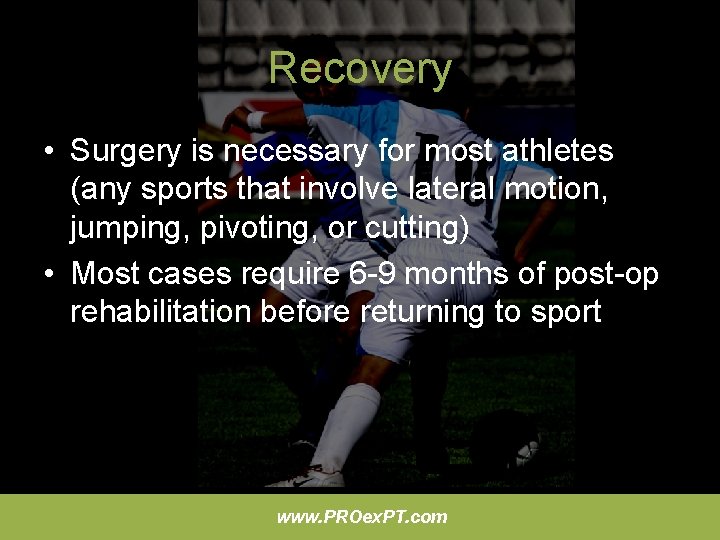
Recovery • Surgery is necessary for most athletes (any sports that involve lateral motion, jumping, pivoting, or cutting) • Most cases require 6 -9 months of post-op rehabilitation before returning to sport www. PROex. PT. com
Injury Rates • ACL injuries in general population: est. 1 in 3500 • Soccer players injure knees at rate of 1 -3 injuries per 100 hours (~ 1 every 5 -6 weeks) • Females are 2. 4 -9. 7 x more likely than males to injure ACL in comparable sports (bball and soccer) • Females have 25% chance of re-injuring ACL www. PROex. PT. com
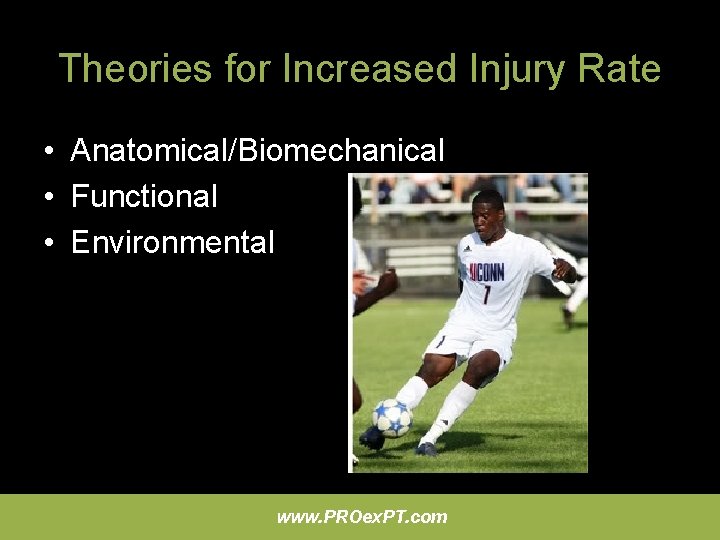
Theories for Increased Injury Rate • Anatomical/Biomechanical • Functional • Environmental www. PROex. PT. com
Anatomical/Biomechanical • Femoral condyle/notch size relative to ACL size • Lower extremity alignment – (valgus angle, Q angle, femoral/tibial rotation – *may change during skeletal growth) • Quad: Hamstring strength ratio – (quad-dominance is seen more often in females) • Muscle activation/firing pattern of quads/hamstrings • Decreased strength: weight ratio • Increased joint/ligamentous laxity www. PROex. PT. com
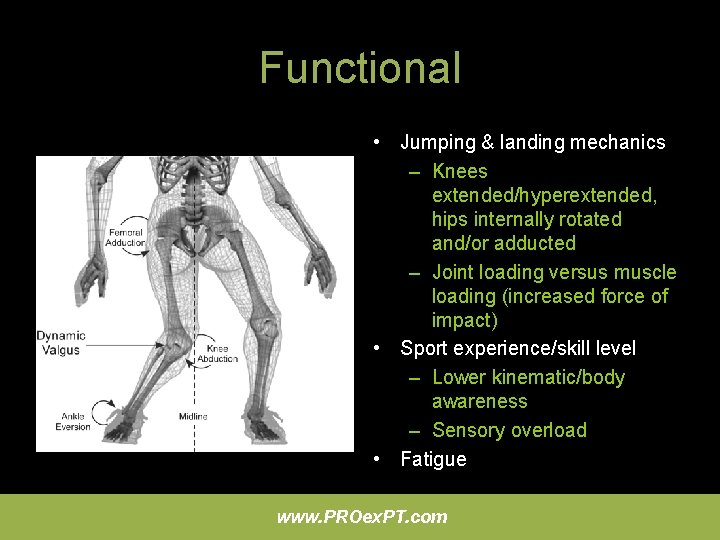
Functional • Jumping & landing mechanics – Knees extended/hyperextended, hips internally rotated and/or adducted – Joint loading versus muscle loading (increased force of impact) • Sport experience/skill level – Lower kinematic/body awareness – Sensory overload • Fatigue www. PROex. PT. com
Environmental • Cleats – Increased friction with planting, cutting, and push-off • Training surface (remember Astroturf) – Change in friction, speed of play, and impact forces www. PROex. PT. com
Recent Research • Ligamentous laxity due to hormones – Estrogen and progesterone have no effect on ACL injury rate (study evaluated effect of BCP on injury rates) • Strength: weight ratio & skill level/sport experience – No change in injury rate from high school to college • (implies ACL injuries are independent of strength and skill) www. PROex. PT. com
Recent Research • Quad: hamstring strength ratio – Hamstring activation decreases with fatigue – No change in quad activation with fatigue • Jumping/landing – Knee joint angle during landing decreases with fatigue (more likely to hyperextend) • Proprioceptive & Neuromuscular Training – Decreased ACL injury rate by 88% in female soccer players (14 -18 y. o. ) within one year • (implies anatomical factors’ influence is less than previously thought) www. PROex. PT. com
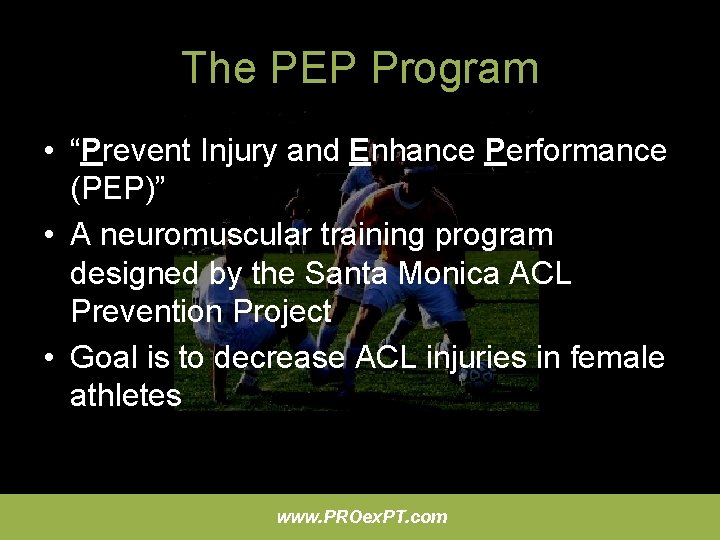
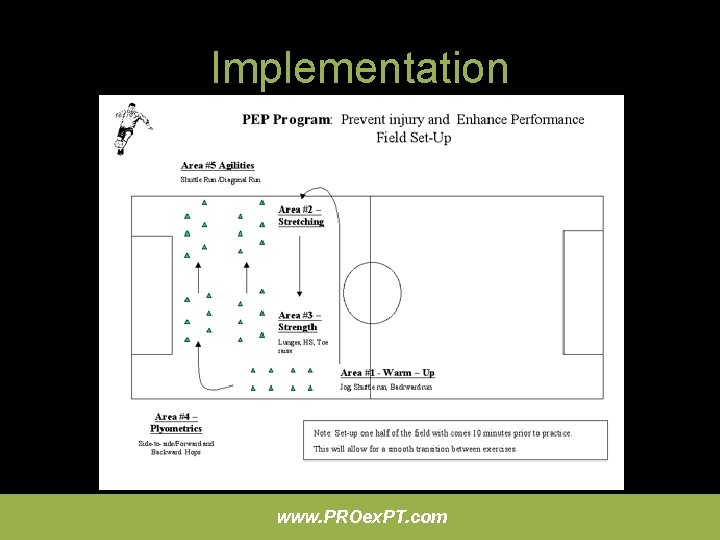
The PEP Program • “Prevent Injury and Enhance Performance (PEP)” • A neuromuscular training program designed by the Santa Monica ACL Prevention Project • Goal is to decrease ACL injuries in female athletes www. PROex. PT. com
The PEP Program • 20 minutes at the start of practice, 2 -3 x per week (pieces of the program are already performed by most teams) • Focuses on muscle strength and power, balance, coordination, agility, endurance, and flexibility • Increases athletes’ performance while decreasing risk of injury – (plyometrics are most important based on studies of individual components of program) www. PROex. PT. com
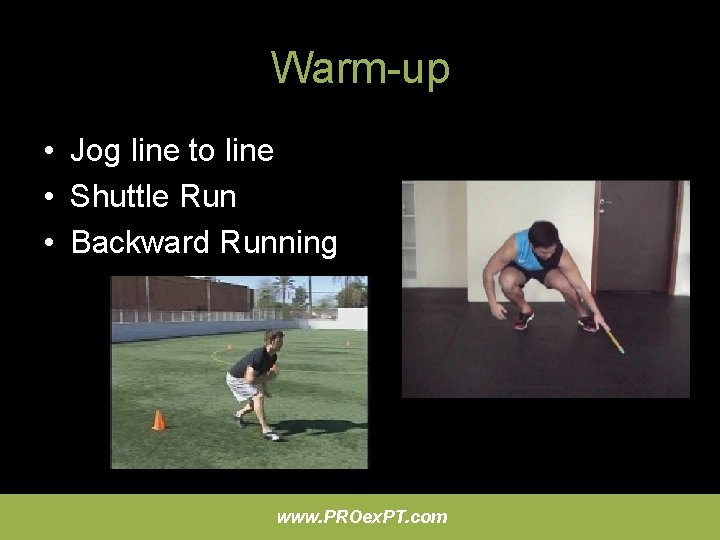
Warm-up • Jog line to line • Shuttle Run • Backward Running www. PROex. PT. com
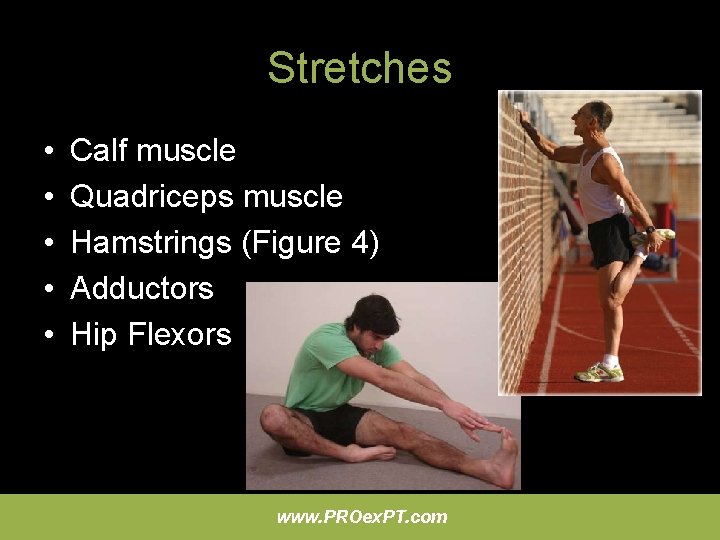
Stretches • • • Calf muscle Quadriceps muscle Hamstrings (Figure 4) Adductors Hip Flexors www. PROex. PT. com
Exercise Demo • Ensure that the stretch is felt in the correct muscle • Keep lower back in neutral alignment • Hold stretch in static position, DO NOT BOUNCE www. PROex. PT. com
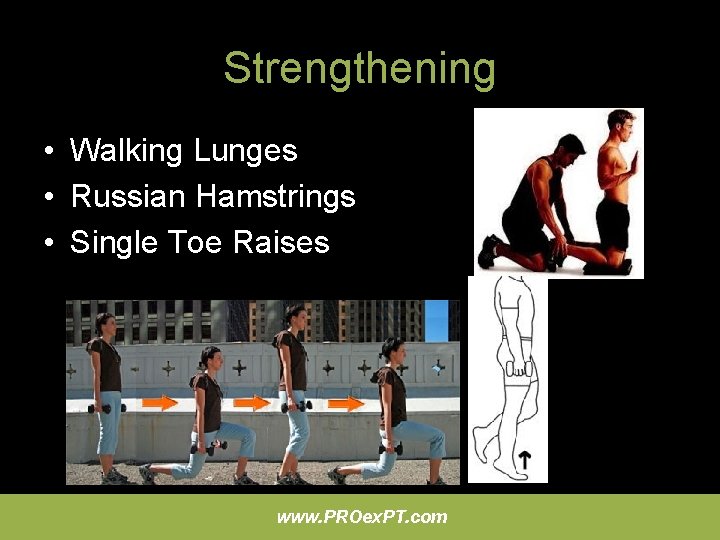
Strengthening • Walking Lunges • Russian Hamstrings • Single Toe Raises www. PROex. PT. com
Exercise Demo • Check ankle/knee/hip alignment during lunges – 90 degree angle at each joint • Motion should be slow and controlled throughout exercise www. PROex. PT. com
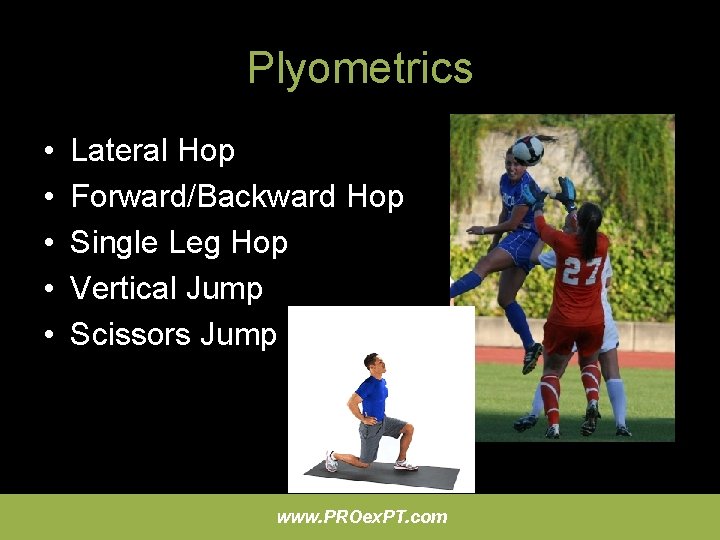
Plyometrics • • • Lateral Hop Forward/Backward Hop Single Leg Hop Vertical Jump Scissors Jump www. PROex. PT. com
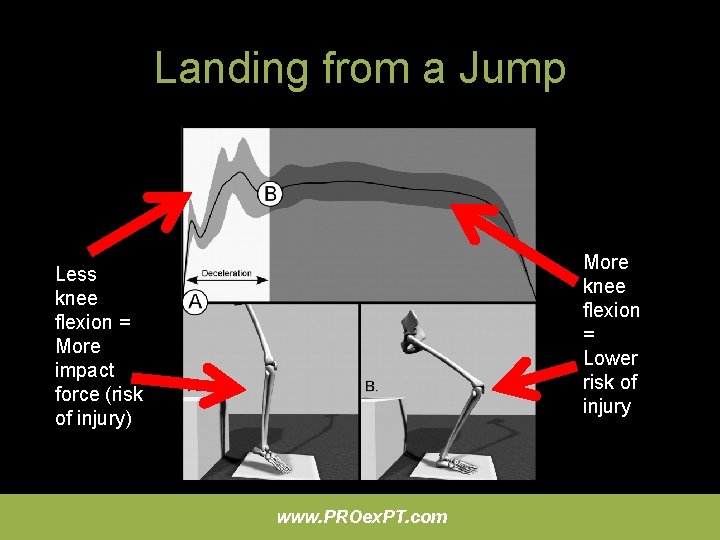
Landing from a Jump More knee flexion = Lower risk of injury Less knee flexion = More impact force (risk of injury) www. PROex. PT. com
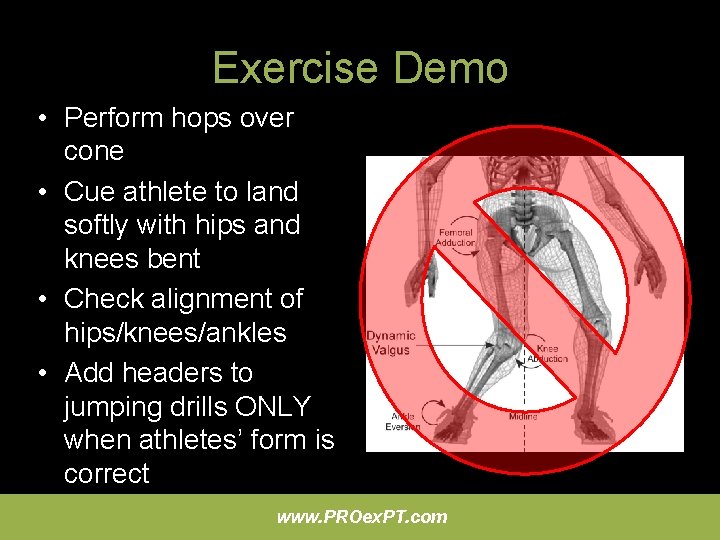
Exercise Demo • Perform hops over cone • Cue athlete to land softly with hips and knees bent • Check alignment of hips/knees/ankles • Add headers to jumping drills ONLY when athletes’ form is correct www. PROex. PT. com
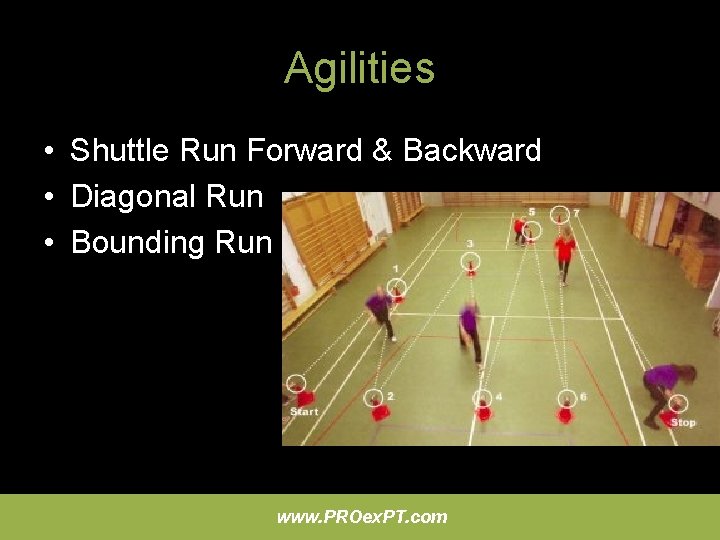
Agilities • Shuttle Run Forward & Backward • Diagonal Run • Bounding Run www. PROex. PT. com
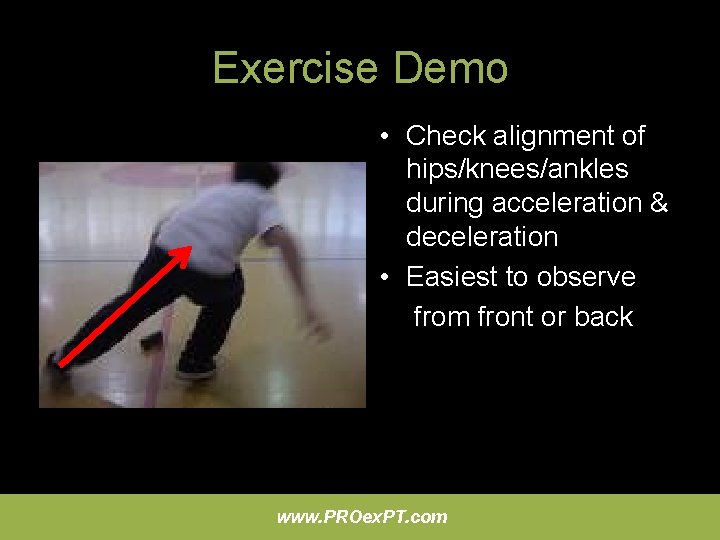
Exercise Demo • Check alignment of hips/knees/ankles during acceleration & deceleration • Easiest to observe from front or back www. PROex. PT. com
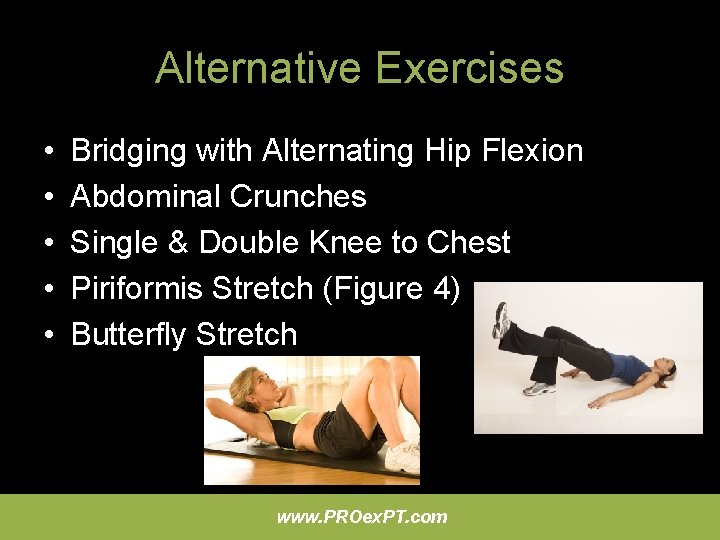
Alternative Exercises • • • Bridging with Alternating Hip Flexion Abdominal Crunches Single & Double Knee to Chest Piriformis Stretch (Figure 4) Butterfly Stretch www. PROex. PT. com
Exercise Demo • Motion should be slow and controlled for strengthening exercises • Keep lower back in neutral alignment for stretches www. PROex. PT. com
Implementation www. PROex. PT. com
References • • Biedert RM, Bachmann M. [Women's soccer. Injuries, risks, and prevention]. Orthopade. May 2005; 34(5): 448 -53 Hewett TE, Lindenfeld TN, Riccobene JV, et al. The effect of neuromuscular training on the incidence of knee injury in female athletes. A prospective study. Am J Sports Med. Nov-Dec 1999; 27(6): 699 -706 Huston LJ, Greenfield ML, Wojtys EM. Anterior cruciate ligament injuries in the female athlete. Potential risk factors. Clin Orthop Relat Res. Mar 2000; 50 -63 Myer GD, Ford KR, Palumbo JP, Hewett TE. Neuromuscular Training improves performance and lower-extremity biomechanics in female athletes. J Strength Cond Res. 2005; 19(1): 51 -60 Nagano Y, Ida H, Akai M, et al. Biomechanical characteristics of the knee joint in female athletes during tasks associated with anterior cruciate ligament injury. Knee. Dec 23 2008 Vescovi JD, Canavan PK, Hasson S. Effects of a plyometric program on vertical landing force and jumping performance in college women. Phys Ther Sport. 2008; 9(4): 185 -192 Wojtys EM, Huston LJ, Taylor PD, et al. Neuromuscular adaptations in isokinetic, isotonic, and agility training programs. Am J Sports Med. Mar-Apr 1996; 24(2): 187 -92 www. PROex. PT. com
Thank You • Jess Barsotti, DPT, ATC Pro. Ex Boston/Pro. Ex Woburn • Kate Doherty, ATC Pro. Ex Woburn/Head ATC Wilmington High School • Kelly Hardy Pro. Ex Woburn www. PROex. PT. com
Questions? Contact Info: Matt Mc. Manus, PT 300 Trade. Center, Suite 1650 Woburn, MA 01801 P (781) 935 -2655 F (781) 935 -9097 mmcmanus@PROex. PT. com www. PROex. PT. com