
Acknowledge Ask Adapt Training Strategies to Improve Communication
![Negotiation “[With negotiation] it’s not a question of giving up everything we know. It’s](https://slidetodoc.com/presentation_image/8efbcebe4016843ad05c19d714f2e526/image-7.jpg "Negotiation “[With negotiation] it’s not a question of giving up everything we know. It’s")
- Slides: 12
Acknowledge, Ask, Adapt Training Strategies to Improve Communication with Family Members in Collaborative Relationships Laurie Beckel, MA/LPC Pyramid Model Coach/Trainer Permission to use materials given by:
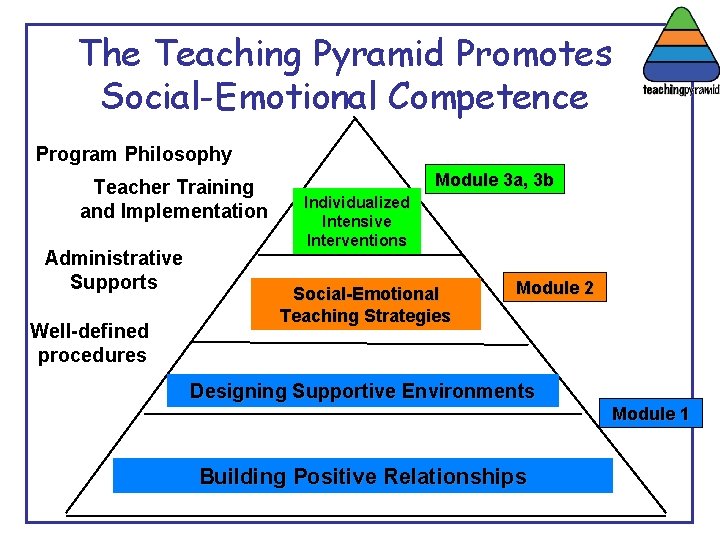
The Teaching Pyramid Promotes Social-Emotional Competence Program Philosophy Teacher Training and Implementation Administrative Supports Well-defined procedures Module 3 a, 3 b Individualized Intensive Interventions Social-Emotional Teaching Strategies Module 2 Designing Supportive Environments Module 1 Building Positive Relationships
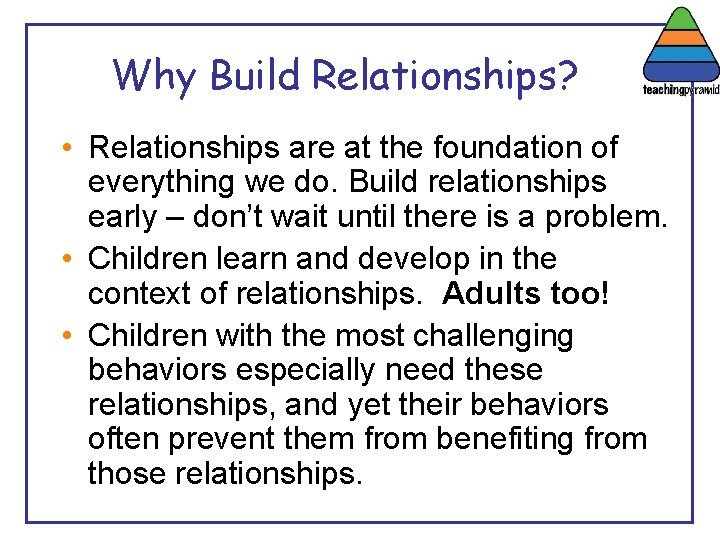
Why Build Relationships? • Relationships are at the foundation of everything we do. Build relationships early – don’t wait until there is a problem. • Children learn and develop in the context of relationships. Adults too! • Children with the most challenging behaviors especially need these relationships, and yet their behaviors often prevent them from benefiting from those relationships.
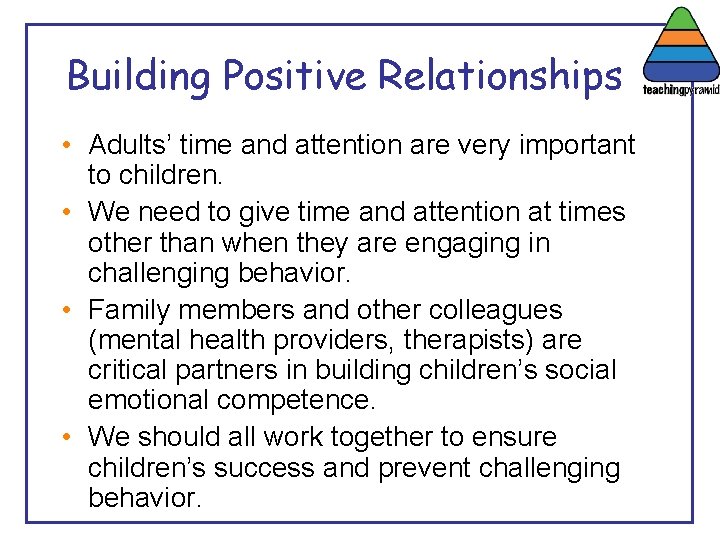
Building Positive Relationships • Adults’ time and attention are very important to children. • We need to give time and attention at times other than when they are engaging in challenging behavior. • Family members and other colleagues (mental health providers, therapists) are critical partners in building children’s social emotional competence. • We should all work together to ensure children’s success and prevent challenging behavior.
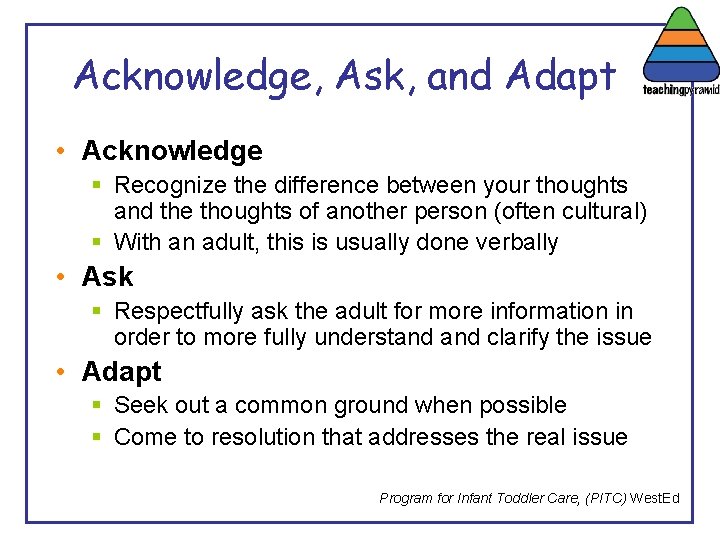
Acknowledge, Ask, and Adapt • Acknowledge § Recognize the difference between your thoughts and the thoughts of another person (often cultural) § With an adult, this is usually done verbally • Ask § Respectfully ask the adult for more information in order to more fully understand clarify the issue • Adapt § Seek out a common ground when possible § Come to resolution that addresses the real issue Program for Infant Toddler Care, (PITC) West. Ed
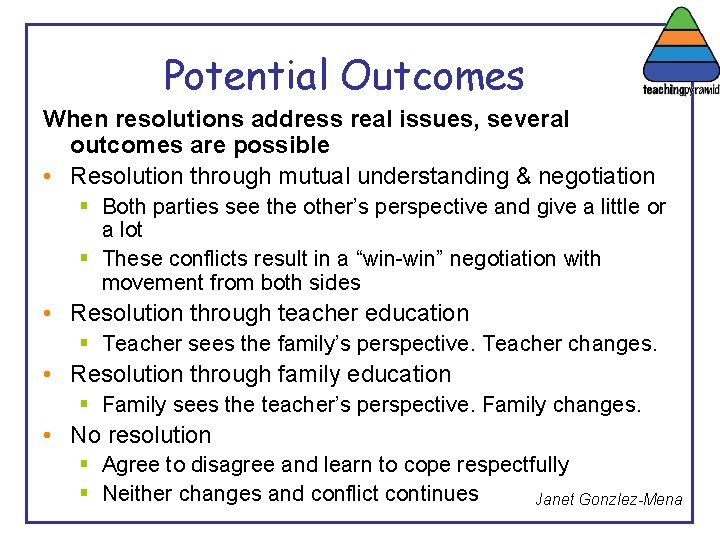
Potential Outcomes When resolutions address real issues, several outcomes are possible • Resolution through mutual understanding & negotiation § Both parties see the other’s perspective and give a little or a lot § These conflicts result in a “win-win” negotiation with movement from both sides • Resolution through teacher education § Teacher sees the family’s perspective. Teacher changes. • Resolution through family education § Family sees the teacher’s perspective. Family changes. • No resolution § Agree to disagree and learn to cope respectfully § Neither changes and conflict continues Janet Gonzlez-Mena
Negotiation “[With negotiation] it’s not a question of giving up everything we know. It’s a question of balancing what we know and what the parent knows, and figuring out together what would be in the best interests of the child. ”
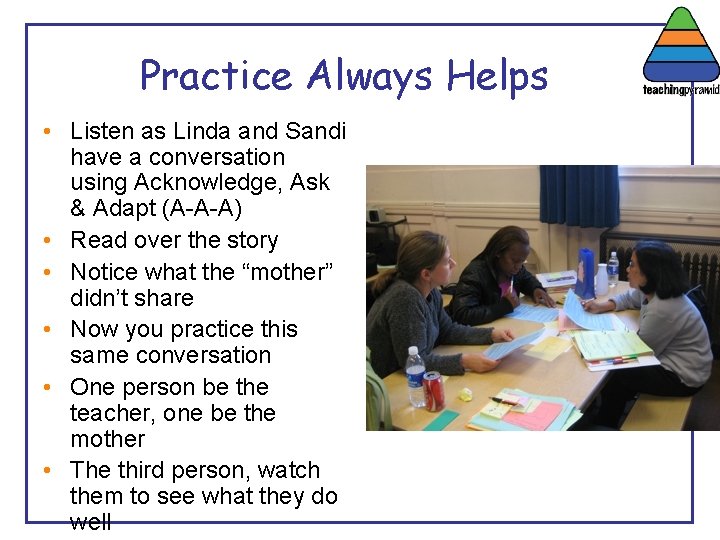
Practice Always Helps • Listen as Linda and Sandi have a conversation using Acknowledge, Ask & Adapt (A-A-A) • Read over the story • Notice what the “mother” didn’t share • Now you practice this same conversation • One person be the teacher, one be the mother • The third person, watch them to see what they do well
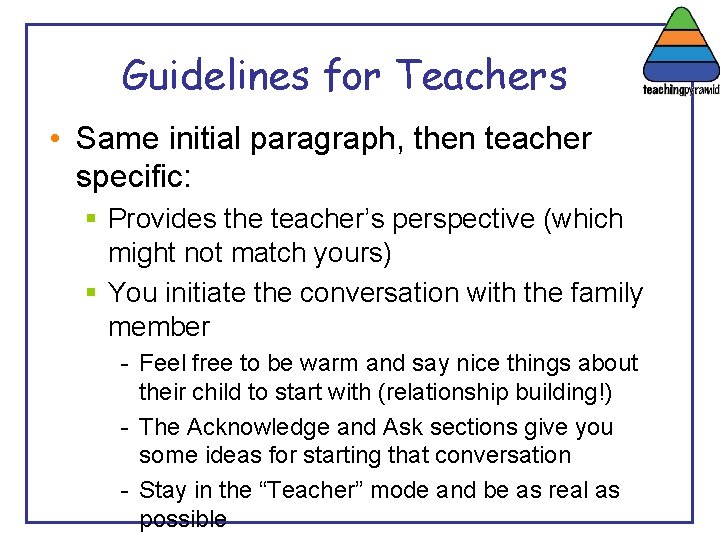
Guidelines for Teachers • Same initial paragraph, then teacher specific: § Provides the teacher’s perspective (which might not match yours) § You initiate the conversation with the family member - Feel free to be warm and say nice things about their child to start with (relationship building!) - The Acknowledge and Ask sections give you some ideas for starting that conversation - Stay in the “Teacher” mode and be as real as possible
Guidelines for Family Members • Same initial paragraph, then family specific: § You can be the mother, father, grandparent, or anyone else who is actively raising this child (unless it states otherwise) § The “teacher” has been given some ideas of how to start the conversation with you - You can respond to the teacher in any way that feels natural to you in your role as the family member - Try and respond with answers that come from the perspective points listed for the family member
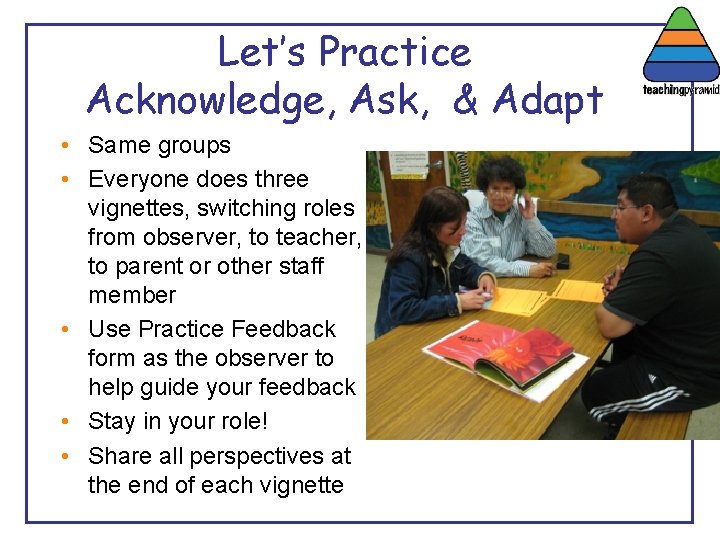
Let’s Practice Acknowledge, Ask, & Adapt • Same groups • Everyone does three vignettes, switching roles from observer, to teacher, to parent or other staff member • Use Practice Feedback form as the observer to help guide your feedback • Stay in your role! • Share all perspectives at the end of each vignette
A-A-A Has Many Uses • Staff members also have different “buttons, ” different beliefs and values, differences about how to approach behavior • We can use this process of “Acknowledge, Ask, and Adapt” as a way of having dialogue and respectful conversations • Sometimes the presence of a facilitator can be helpful for tense conversations • There are many “right” ways to do