
Acids Bases Titration A Neutralization u Chemical reaction
Acids & Bases Titration
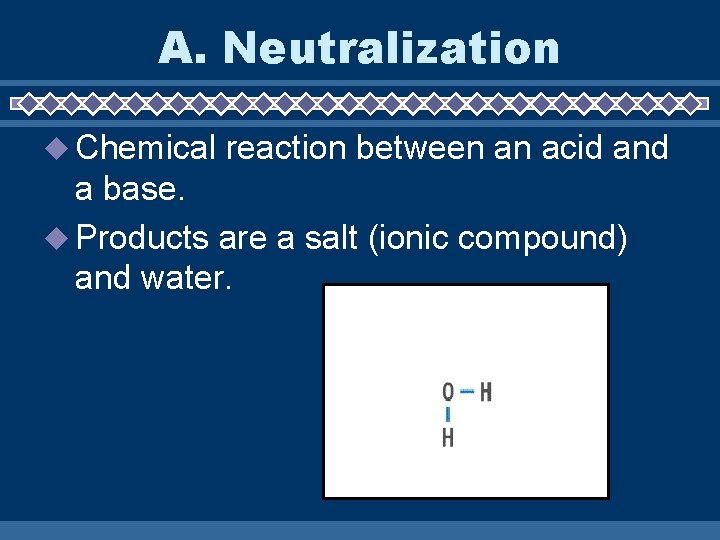
A. Neutralization u Chemical reaction between an acid and a base. u Products are a salt (ionic compound) and water.
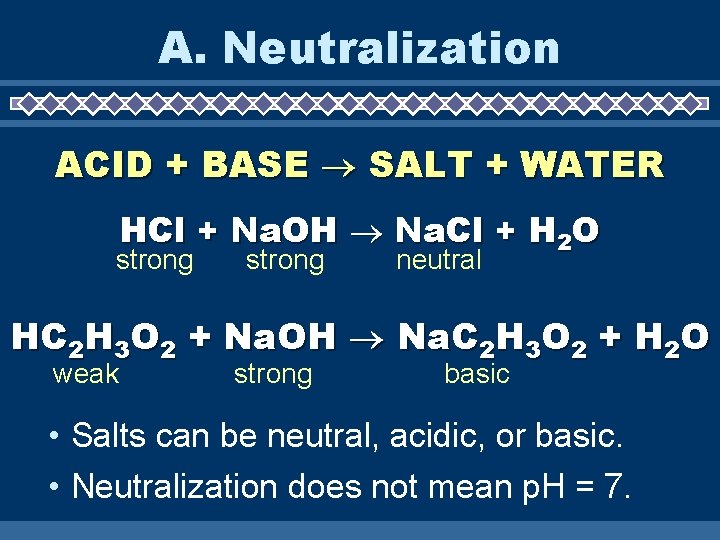
A. Neutralization ACID + BASE SALT + WATER HCl + Na. OH Na. Cl + H 2 O strong neutral HC 2 H 3 O 2 + Na. OH Na. C 2 H 3 O 2 + H 2 O weak strong basic • Salts can be neutral, acidic, or basic. • Neutralization does not mean p. H = 7.
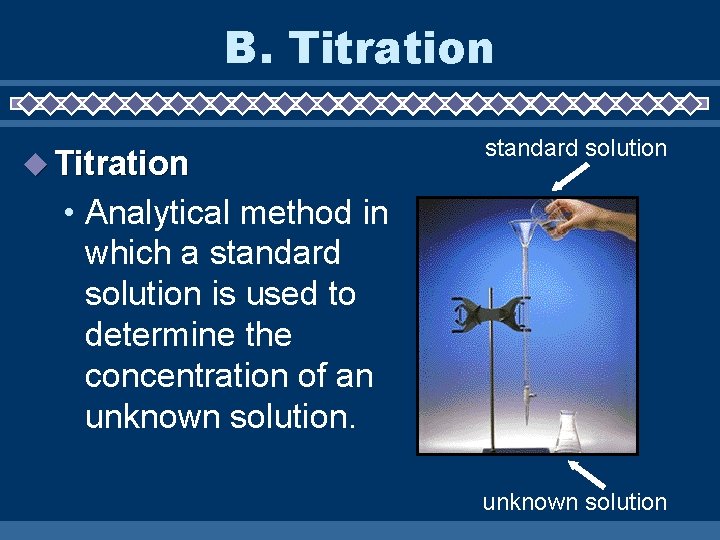
B. Titration u Titration standard solution • Analytical method in which a standard solution is used to determine the concentration of an unknown solution
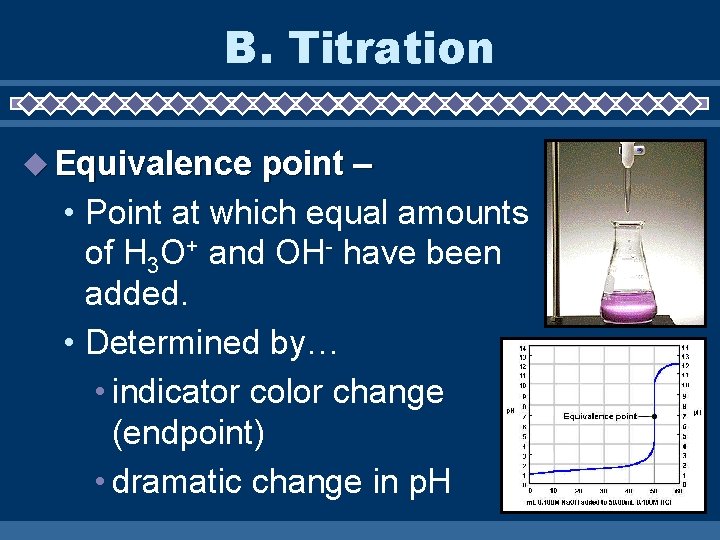
B. Titration u Equivalence point – • Point at which equal amounts of H 3 O+ and OH- have been added. • Determined by… • indicator color change (endpoint) • dramatic change in p. H
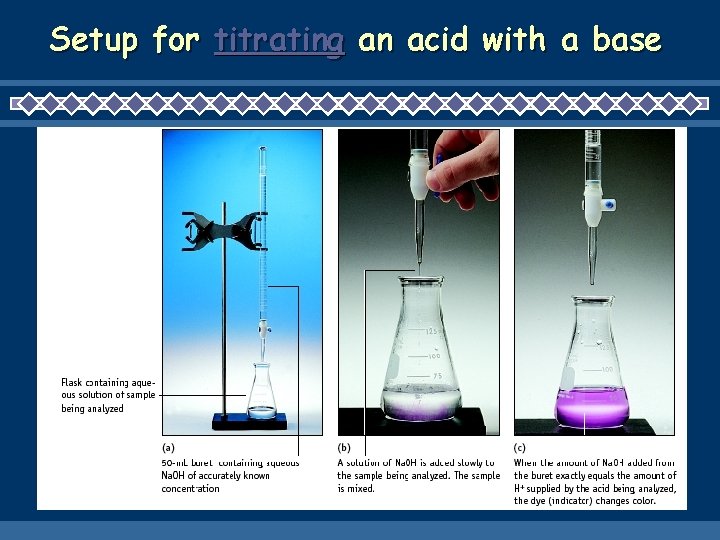
Setup for titrating an acid with a base
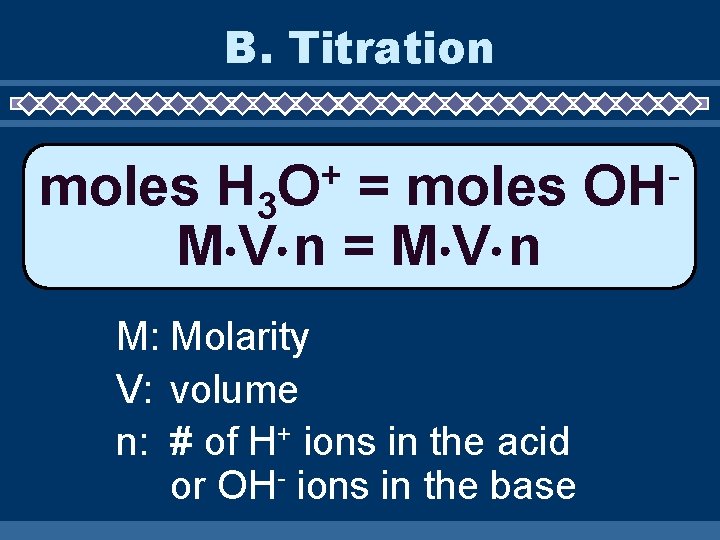
B. Titration + O moles H 3 = moles M V n = M V n M: Molarity V: volume n: # of H+ ions in the acid or OH- ions in the base OH
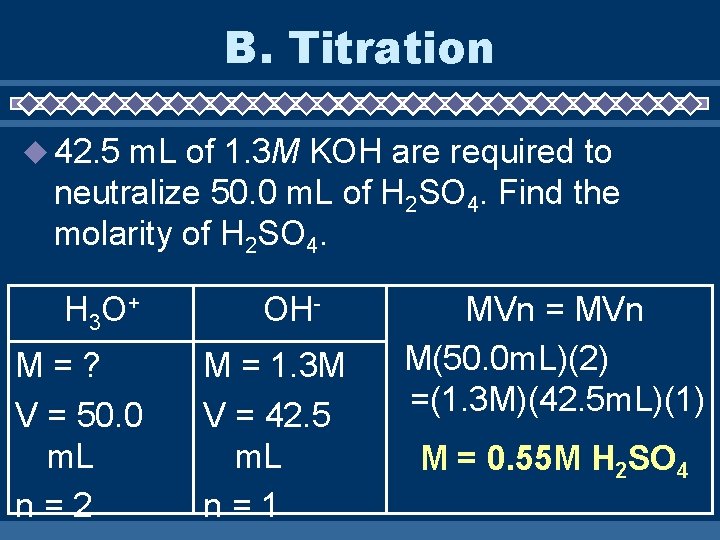
B. Titration u 42. 5 m. L of 1. 3 M KOH are required to neutralize 50. 0 m. L of H 2 SO 4. Find the molarity of H 2 SO 4. H 3 O + M=? V = 50. 0 m. L n=2 OHM = 1. 3 M V = 42. 5 m. L n=1 MVn = MVn M(50. 0 m. L)(2) =(1. 3 M)(42. 5 m. L)(1) M = 0. 55 M H 2 SO 4
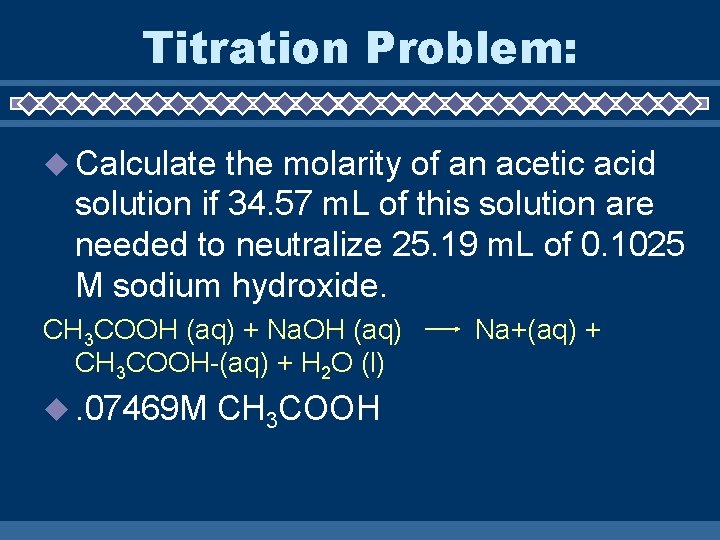
Titration Problem: u Calculate the molarity of an acetic acid solution if 34. 57 m. L of this solution are needed to neutralize 25. 19 m. L of 0. 1025 M sodium hydroxide. CH 3 COOH (aq) + Na. OH (aq) CH 3 COOH-(aq) + H 2 O (l) u. 07469 M CH 3 COOH Na+(aq) +
Standard Deviation The standard deviation of a statistical population, a data set is the square root of its variance Standard deviation is a widely used measure of variability or dispersion, it shows how much variation there is from the "average" (mean)
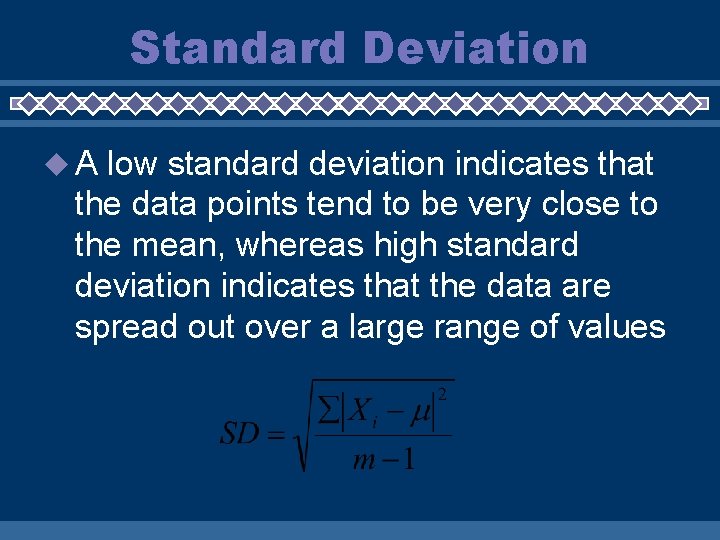
Standard Deviation u. A low standard deviation indicates that the data points tend to be very close to the mean, whereas high standard deviation indicates that the data are spread out over a large range of values
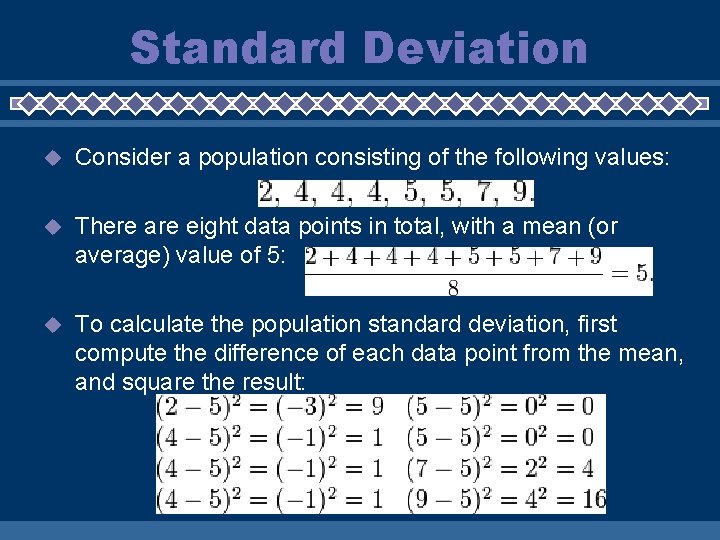
Standard Deviation u Consider a population consisting of the following values: u There are eight data points in total, with a mean (or average) value of 5: u To calculate the population standard deviation, first compute the difference of each data point from the mean, and square the result:
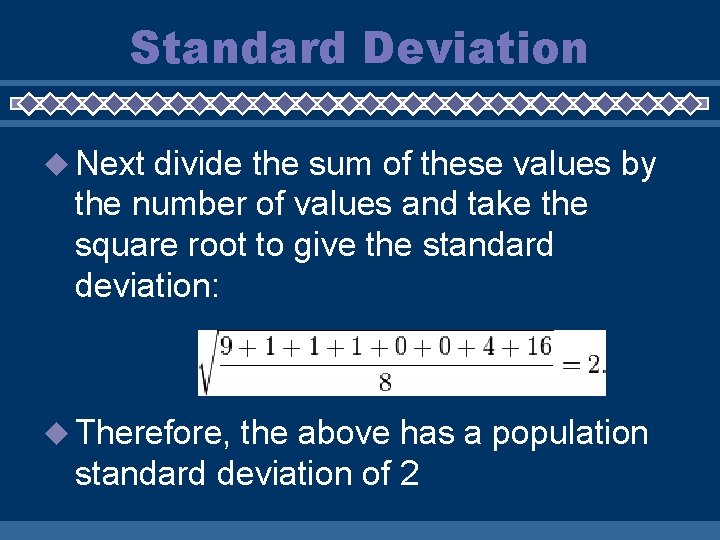
Standard Deviation u Next divide the sum of these values by the number of values and take the square root to give the standard deviation: u Therefore, the above has a population standard deviation of 2
- Slides: 13