
ACIDS BASES SOLUTIONS Physical Science Acid Substance that
ACIDS, BASES, SOLUTIONS Physical Science
![Acid � Substance that releases hydrogen ions (H+) in water [or hydronium (H 30+)]](http://slidetodoc.com/presentation_image_h2/37705cf314e843d1b737921b23876bc4/image-2.jpg "Acid � Substance that releases hydrogen ions (H+) in water [or hydronium (H 30+)]")
Acid � Substance that releases hydrogen ions (H+) in water [or hydronium (H 30+)] HCl + H 2 O H 3 + O + – Cl
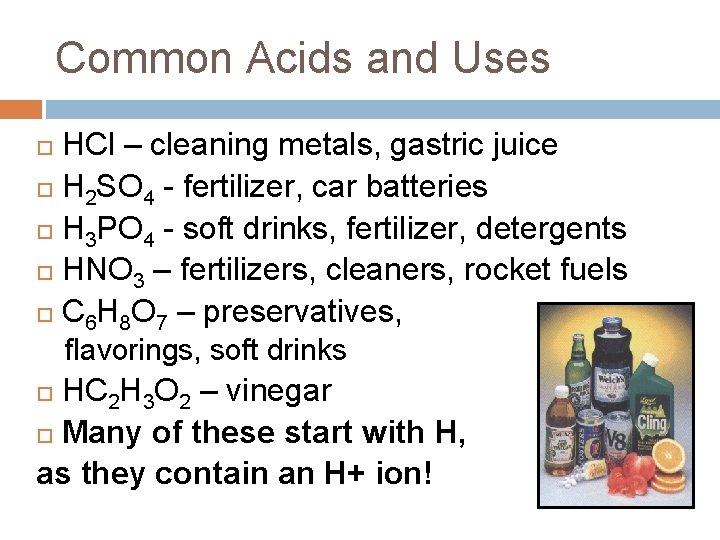
Common Acids and Uses HCl – cleaning metals, gastric juice H 2 SO 4 - fertilizer, car batteries H 3 PO 4 - soft drinks, fertilizer, detergents HNO 3 – fertilizers, cleaners, rocket fuels C 6 H 8 O 7 – preservatives, flavorings, soft drinks HC 2 H 3 O 2 – vinegar Many of these start with H, as they contain an H+ ion!
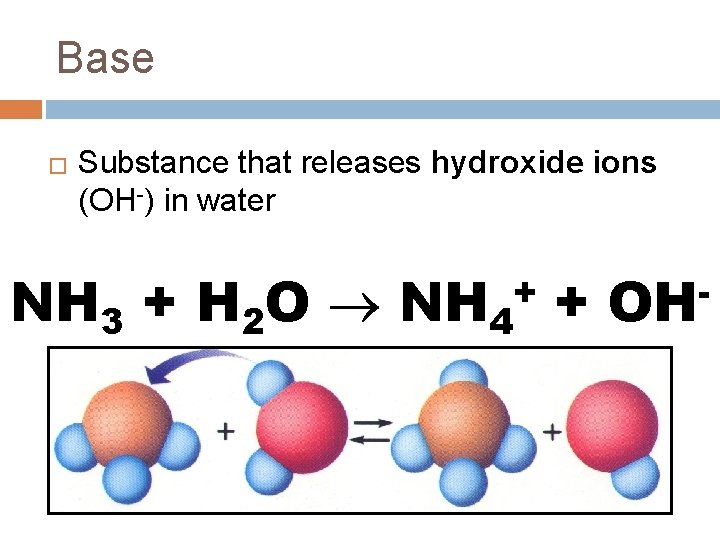
Base � Substance that releases hydroxide ions (OH-) in water NH 3 + H 2 O NH 4 + + OH
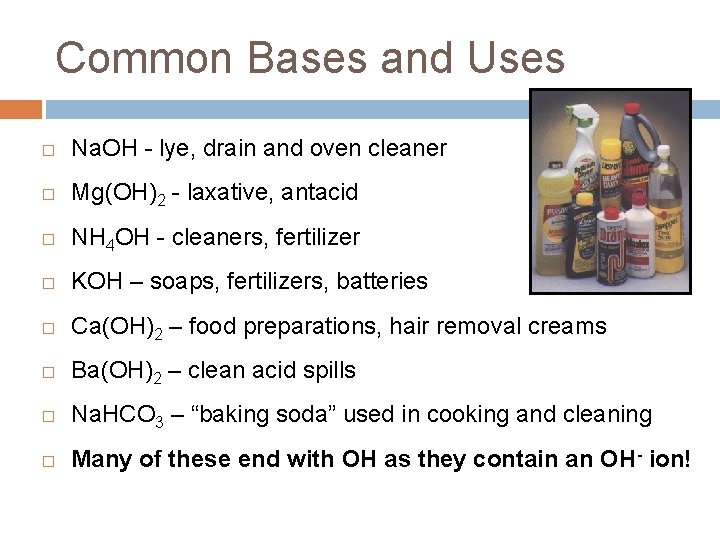
Common Bases and Uses � Na. OH - lye, drain and oven cleaner � Mg(OH)2 - laxative, antacid � NH 4 OH - cleaners, fertilizer � KOH – soaps, fertilizers, batteries � Ca(OH)2 – food preparations, hair removal creams � Ba(OH)2 – clean acid spills � Na. HCO 3 – “baking soda” used in cooking and cleaning � Many of these end with OH as they contain an OH- ion!
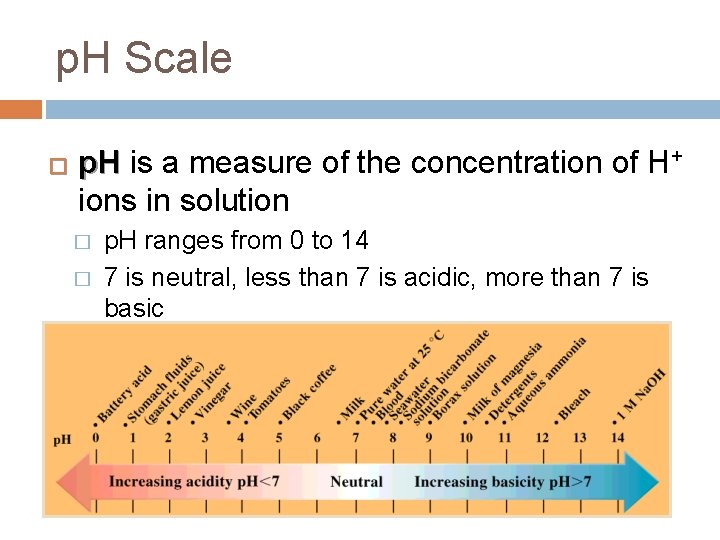
p. H Scale � p. H is a measure of the concentration of H+ ions in solution � � p. H ranges from 0 to 14 7 is neutral, less than 7 is acidic, more than 7 is basic
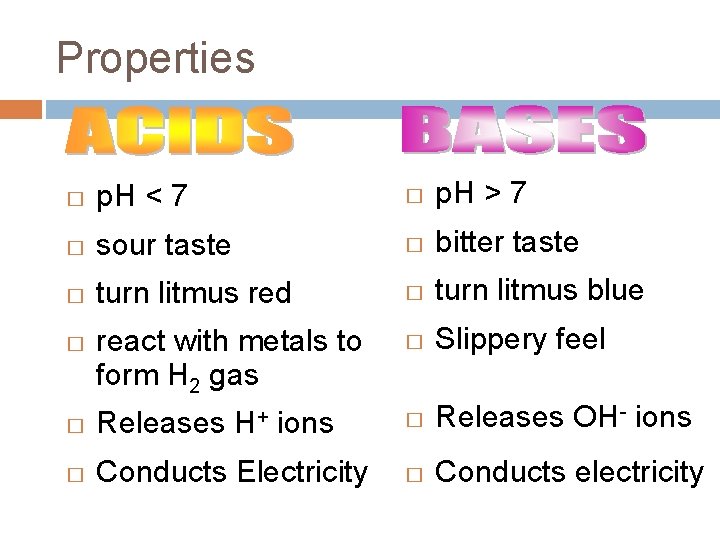
Properties � p. H < 7 � p. H > 7 � sour taste � bitter taste � turn litmus red � turn litmus blue react with metals to form H 2 gas � Slippery feel � Releases OH- ions � Conducts electricity � H+ � Releases ions � Conducts Electricity
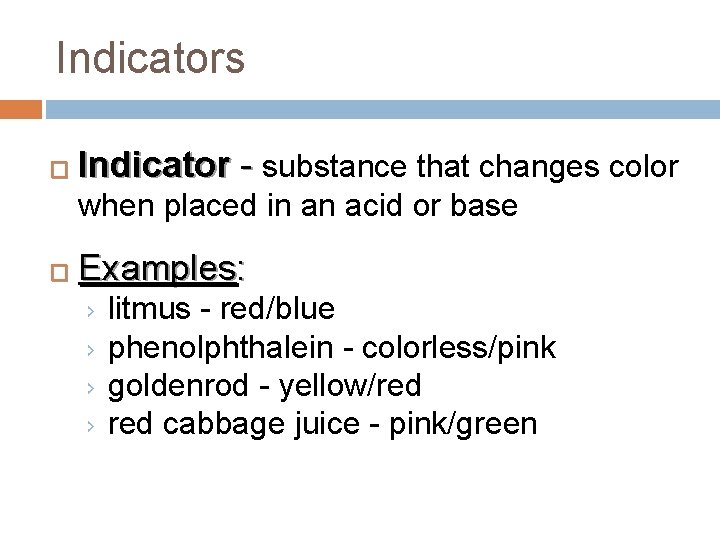
Indicators � Indicator - substance that changes color when placed in an acid or base � Examples: › › litmus - red/blue phenolphthalein - colorless/pink goldenrod - yellow/red cabbage juice - pink/green
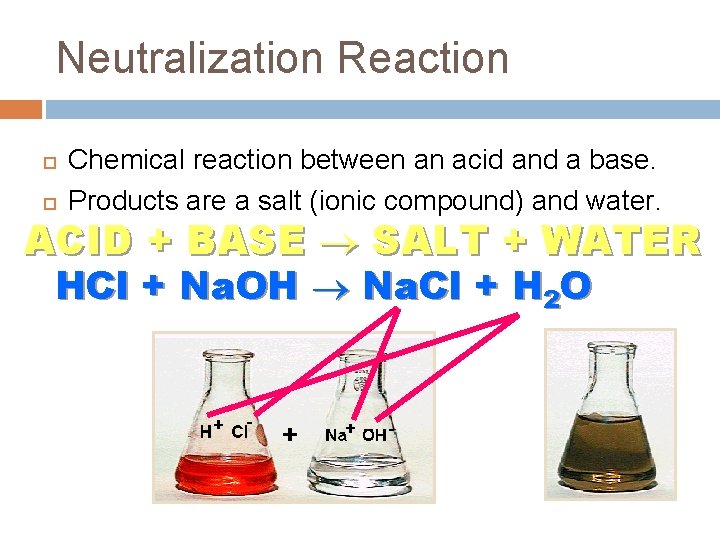
Neutralization Reaction Chemical reaction between an acid and a base. Products are a salt (ionic compound) and water. ACID + BASE SALT + WATER HCl + Na. OH Na. Cl + H 2 O = Neutralization does not always mean p. H = 7.
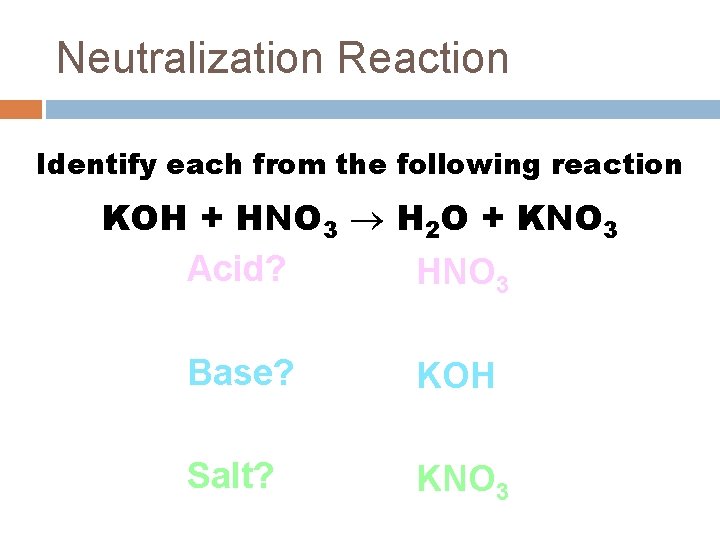
Neutralization Reaction Identify each from the following reaction KOH + HNO 3 H 2 O + KNO 3 Acid? HNO 3 Base? KOH Salt? KNO 3

SOLUTIONS Physical Science
Classifications of Matter Recall that matter could either be a pure substance (element or compound) or a mixture Mixtures are just mingled together, not chemically combined. They can either be � Heterogeneous – does not appear the same throughout � Homogenous – appears the same throughout. Depending on the size of particles, homogenous mixtures can be a Colloid – with large enough particles to scatter light Solution – with particles too small to be seen in a microscope
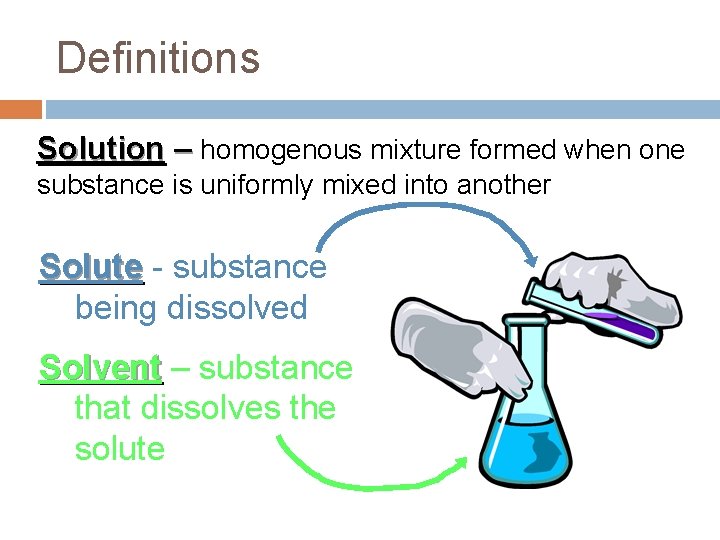
Definitions Solution – homogenous mixture formed when one substance is uniformly mixed into another Solute - substance being dissolved Solvent – substance that dissolves the solute
Types of Solutions Based on state of solvent. “Universal solvent” is water (H 2 O) as many things dissolve in water All solid-liquid-gas combos are possible. EX: � Tooth filling: mercury (liquid) dissolved in silver (solid) � Adult 21+ beverages: alcohol (liquid) dissolved in water (liquid) � Soda: carbon dioxide (gas) dissolved in water (liquid)
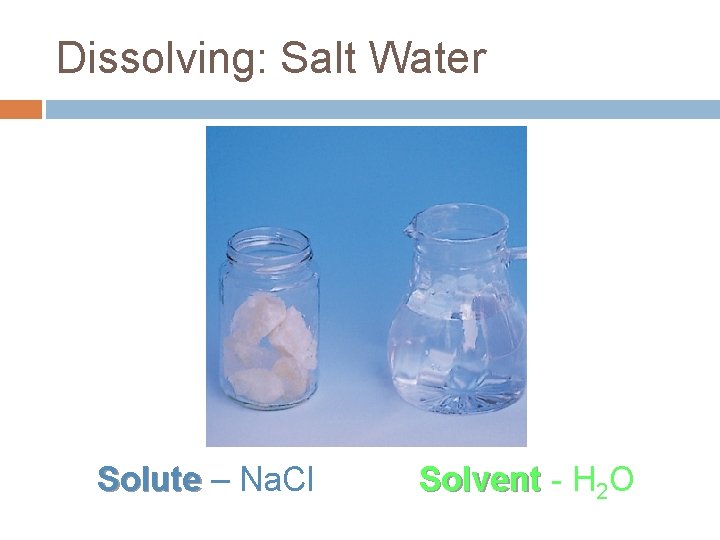
Dissolving: Salt Water Solute – Na. Cl Solvent - H 2 O
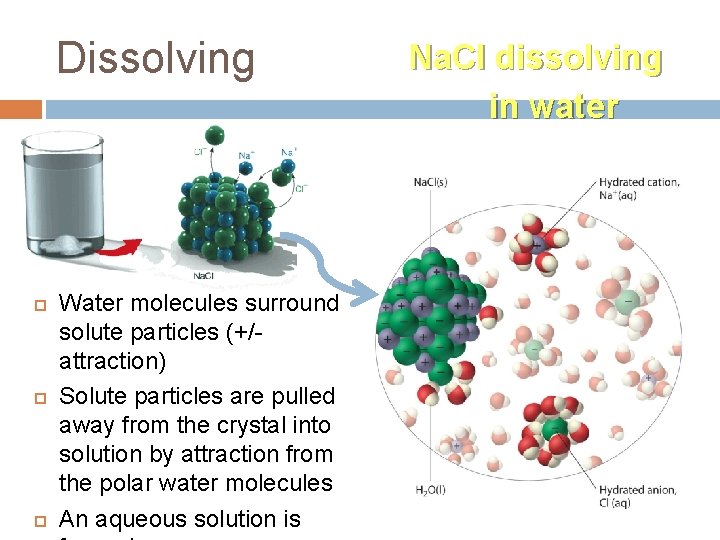
Dissolving Water molecules surround solute particles (+/attraction) Solute particles are pulled away from the crystal into solution by attraction from the polar water molecules An aqueous solution is Na. Cl dissolving in water
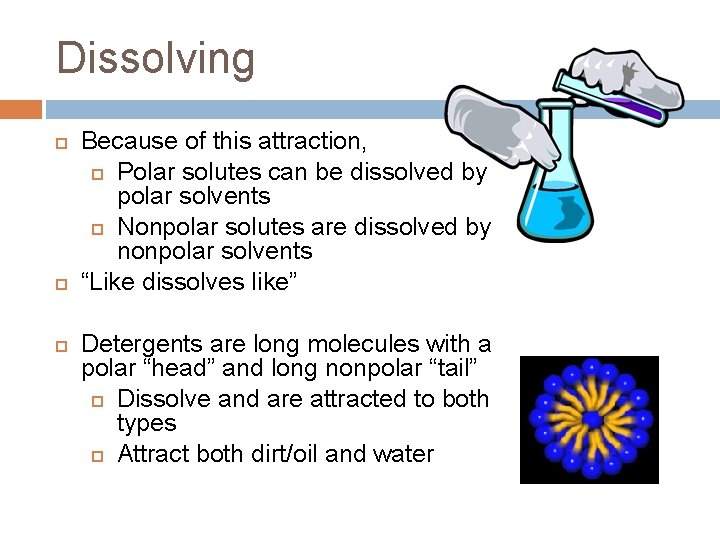
Dissolving Because of this attraction, Polar solutes can be dissolved by polar solvents Nonpolar solutes are dissolved by nonpolar solvents “Like dissolves like” Detergents are long molecules with a polar “head” and long nonpolar “tail” Dissolve and are attracted to both types Attract both dirt/oil and water
Solubility is a measure of how much solute will dissolve in a given amount of solvent at a given temperature � �EX: 8 g of water will dissolve in 100 m. L of water at 25˚C Soluble – substance can dissolve in another substance �Insoluble – substance cannot dissolve in another substance �
Concentration � Concentration – ratio of the amount of solute dissolved per quantity of solvent � Dilute solution – contains a large amount of solvent and a small amount of solute � Example: � A tablespoon of sugar in a bucket of water Concentrated solution – contains a large amount of solute and a small amount of solvent � Example: Two cups of sugar in a glass of lemonade
Concentration Unsaturated solution: solution Saturated solution: � Contains the maximum � The solvent contains less amount of solute than the maximum amount dissolved in a given of solute amount of solvent at a � More solute can be specific temperature dissolved � No more solute can be dissolved �Supersaturated solution �A solution that contains more solute than a saturated solution at that temperature �Formed by heating a saturated solution until all of the solute dissolves and it remains dissolved after cooling
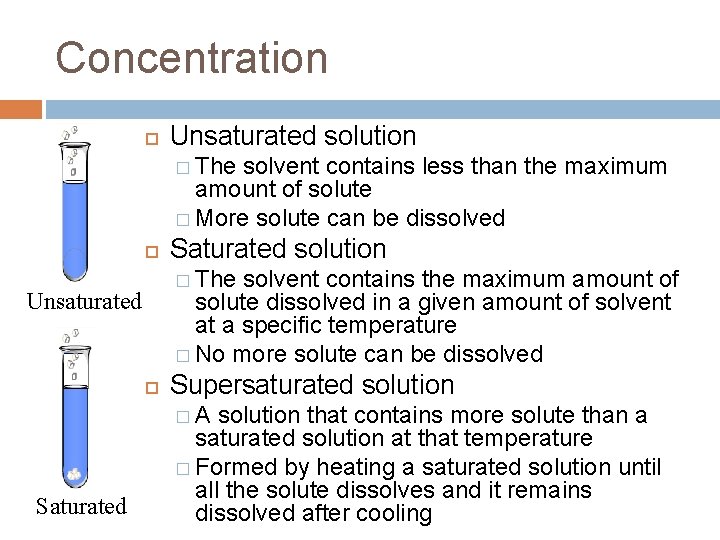
Concentration Unsaturated solution � The solvent contains less than the maximum amount of solute � More solute can be dissolved Saturated solution � The solvent contains the maximum amount of solute dissolved in a given amount of solvent at a specific temperature � No more solute can be dissolved Unsaturated Supersaturated solution �A Saturated solution that contains more solute than a saturated solution at that temperature � Formed by heating a saturated solution until all the solute dissolves and it remains dissolved after cooling
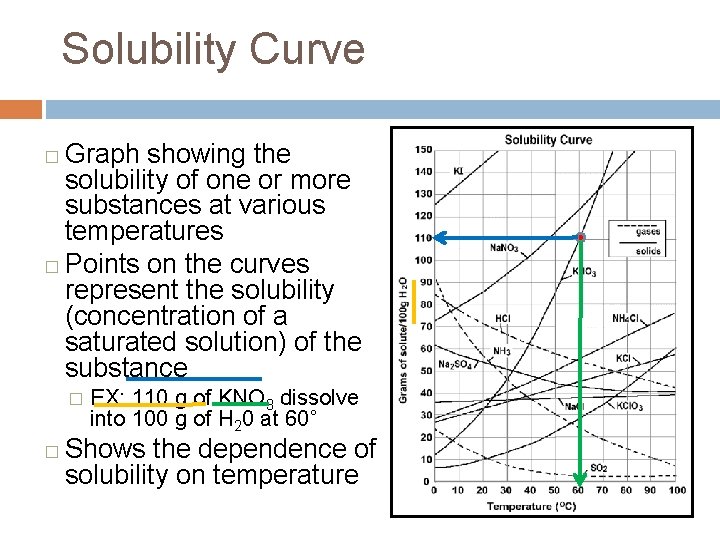
Solubility Curve Graph showing the solubility of one or more substances at various temperatures � Points on the curves represent the solubility (concentration of a saturated solution) of the substance � � � EX: 110 g of KNO 3 dissolve into 100 g of H 20 at 60˚ Shows the dependence of solubility on temperature
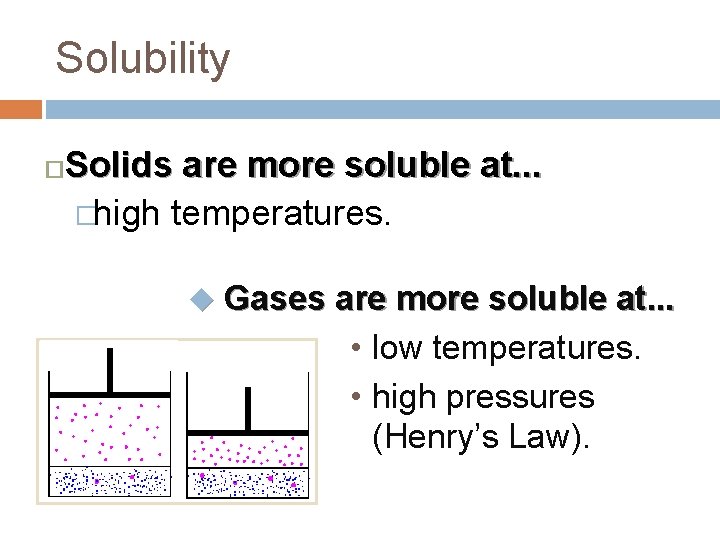
Solubility Solids are more soluble at. . . �high temperatures. � u Gases are more soluble at. . . • low temperatures. • high pressures (Henry’s Law).
- Slides: 23