
Acids and Bases Sometimes strong sometimes weak always
Acids and Bases Sometimes strong, sometimes weak, always salty
Acids n n Although some acids can burn and are dangerous to handle, most acids in foods are safe to eat. What acids have in common, however, is that they contain at least one hydrogen atom that can be removed when the acid is dissolved in water
Acids n n An acid is a substance that produces hydrogen ions in a water solution. It is the ability to produce these ions that gives acids their characteristic properties. When an acid dissolves in water, H+ ions interact with water molecules to form H 3 O+ ions, which are called hydronium ions (hi DROH nee um I ahnz).
Acids n All acids taste sour. n Taste never should be used to test for the presence of acids. n Acids are corrosive n Acids turn indicators different colors: n An indicator is an organic compound that changes color in acid and base. For example, the indicator litmus paper turns red in acid.
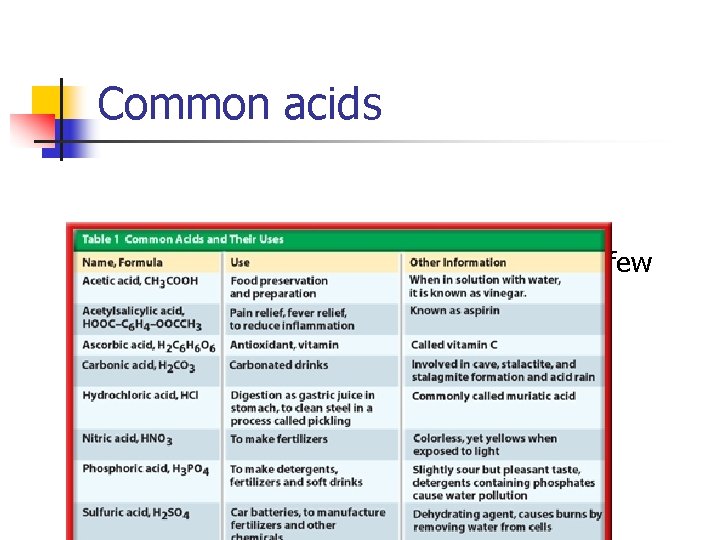
Common acids n This lists the names and formulas of a few acids, their uses, and some properties

Bases n n n You don’t consume many bases. Some foods, such as egg whites, are slightly basic Medicines, such as milk of magnesia and antacids, are basic, too.
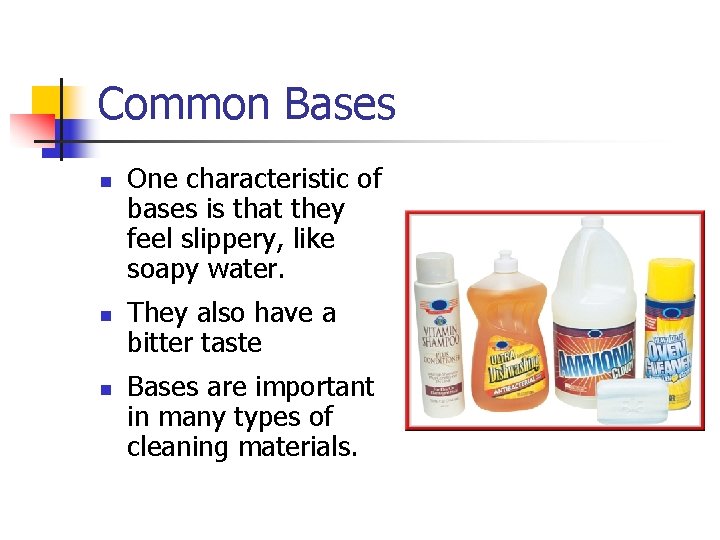
Common Bases n n n One characteristic of bases is that they feel slippery, like soapy water. They also have a bitter taste Bases are important in many types of cleaning materials.

Properties n n Strong bases are corrosive, and contact with skin can result in severe burns. Therefore, taste and touch never should be used to test for the presence of a base. Bases react with indicators to produce changes in color. The indicator litmus turns blue in bases.
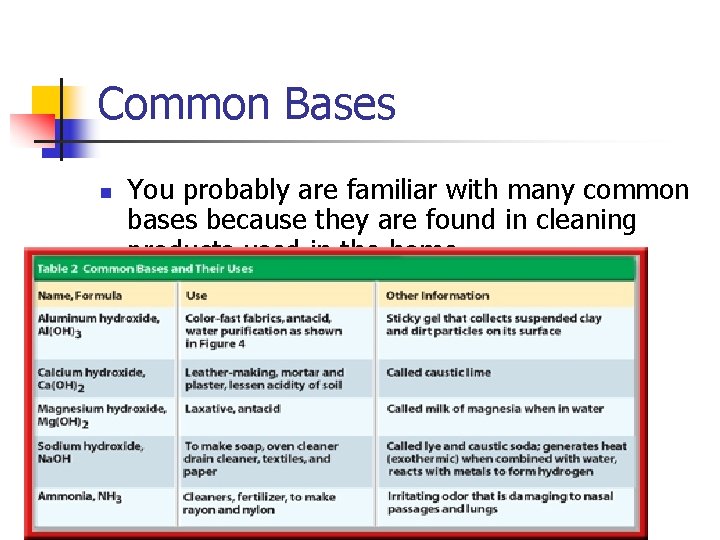
Common Bases n You probably are familiar with many common bases because they are found in cleaning products used in the home.
Dissociation n n The acid dissociates or separates into ions and the hydrogen atom combines with a water molecule to form hydronium ions (H 3 O+). Therefore, an acid can more accurately be described as a compound that produces hydronium ions when dissolved in water
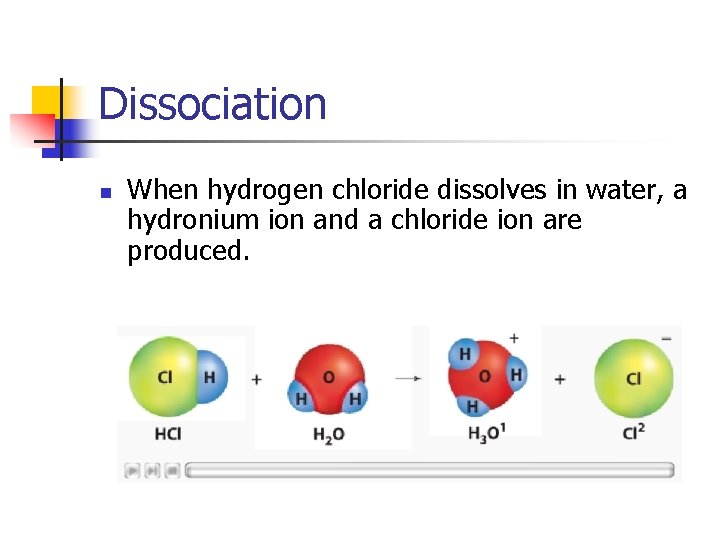
Dissociation n When hydrogen chloride dissolves in water, a hydronium ion and a chloride ion are produced.
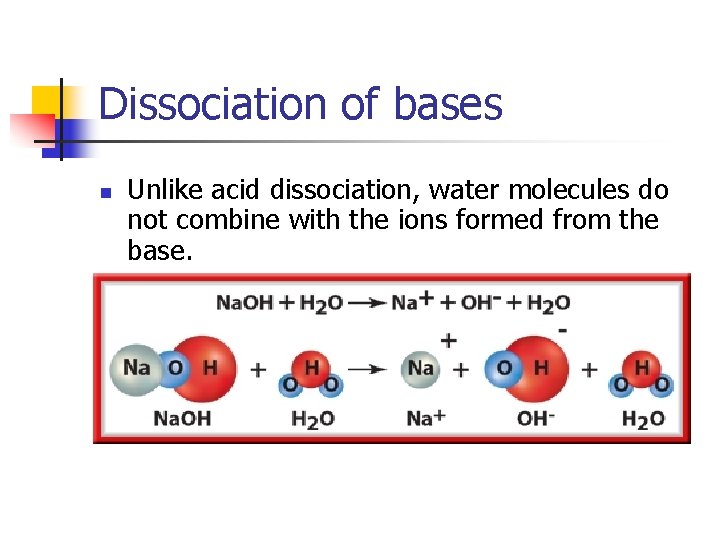
Dissociation of bases n Unlike acid dissociation, water molecules do not combine with the ions formed from the base.
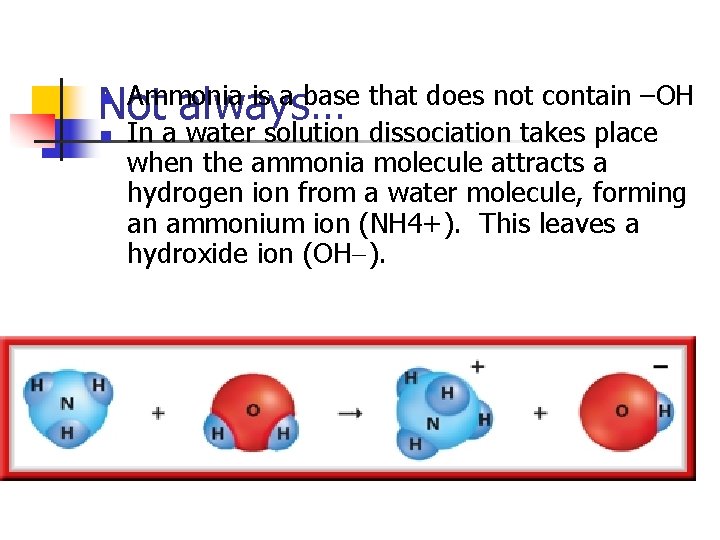
Ammonia is a base that does not contain –OH Not always… n n In a water solution dissociation takes place when the ammonia molecule attracts a hydrogen ion from a water molecule, forming an ammonium ion (NH 4+). This leaves a hydroxide ion (OH ).
- Slides: 13