
Acids and Bases Properties of acids and bases
Acids and Bases
Properties of acids and bases: l Acids are substances that dissolve to produce conducting solutions that taste sour, turn litmus red, have a low p. H, react violently with metals, and neutralize bases. l Bases are substances that dissolve to produce conducting solutions that taste bitter, turn litmus blue, feel slippery, are corrosive, have a high p. H and neutralize acids.
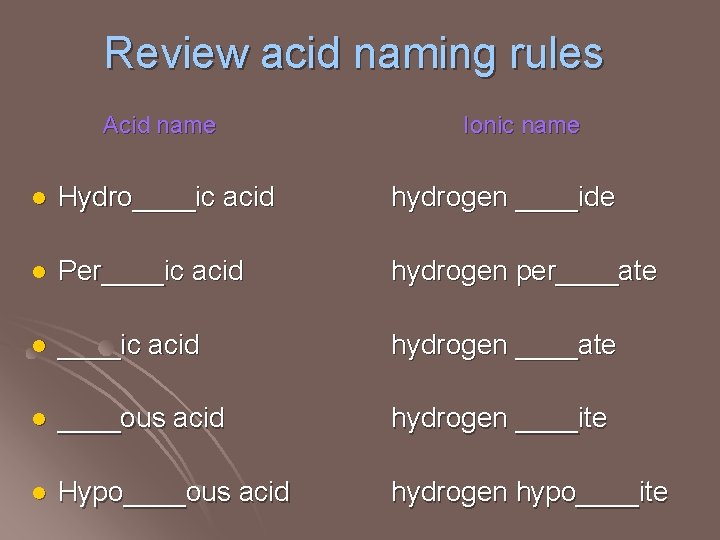
Review acid naming rules Acid name Ionic name l Hydro____ic acid hydrogen ____ide l Per____ic acid hydrogen per____ate l ____ic acid hydrogen ____ate l ____ous acid hydrogen ____ite l Hypo____ous acid hydrogen hypo____ite
Empirical and theoretical definitions. Empirical definitions are practical, observable, or experimental Theoretical definitions are explanations or ideas.
l Empirical definition of an acid would be any solution that conducts electricity, tastes sour, reacts with metals, turns litmus red, neutralizes bases and has a low p. H (below 7). l An empirical definition of a base is any conductive solution that tastes bitter, is corrosive, turns litmus blue, neutralizes acids and has a high p. H (above 7).
l The first theoretical definition for an acid was proposed by Arrhenius: l An acid is any substance that dissociates in water to increase the hydrogen ion concentration. l. A base is any substance that dissociates in water to increase the hydroxide ion concentration.
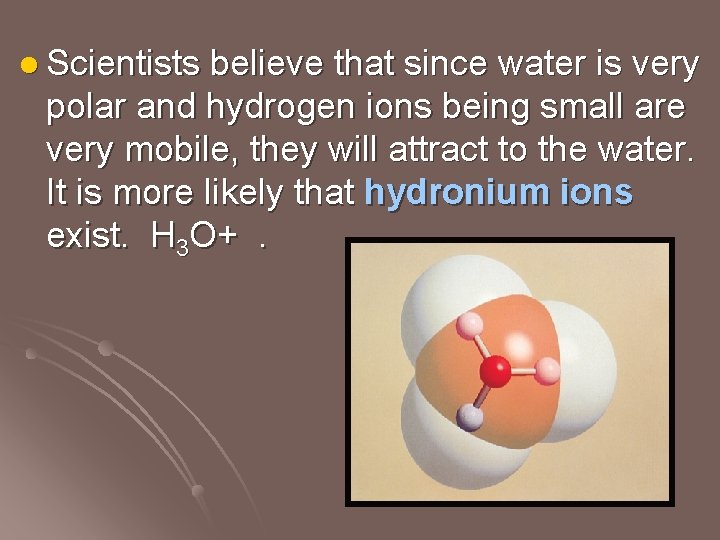
l Scientists believe that since water is very polar and hydrogen ions being small are very mobile, they will attract to the water. It is more likely that hydronium ions exist. H 3 O+.
l Soon it was found that other substances showed properties of acid or base solutions but did not initially contain hydrogen ions or hydroxide ions. l A modified Arrhenius definition was developed; l An acid is any substance that reacts with water to produce hydronium ions. l A base is any substance that reacts with water to produce hydroxide ions.

- Slides: 9