
Acids and Bases Different Definitions of Acids n
Acids and Bases

Different Definitions of Acids n Arrhenius Acid – a substance that increases the concentration of hydronium ions (H 3 O+) when dissolved in water n Notice that this definition is only good for aqueous solutions n Brønsted-Lowry Acids – A substance that donates a proton (H+) to another substance. n Lewis Acids –Accepts a pair of electrons
Properties of Acids n Acids are usually liquids and gases n Acids can be tart, sour, or sharp tasting, although it is not recommended that you taste them. n Common acids in the house: n Carbonic acid – in sodas n Citric Acid – in lemons, limes, and oranges n Ascorbic Acid – in tomatoes n Acetic Acid – vinegar
More Properties n Acids conduct electricity well n Acids react with many metals n Acids generate hydronium ions n Acids can be strong or weak n Strong acids completely ionize in a solvent n In other words, the reaction goes to completion n Weak acids only partially ionize in an aqueous solution. n Table 1 on page 532 lists some strong and weak acids
The flip side of the coin - bases n Arrhenius Bases – a substance that increases the concentration of hydroxide ions (OH-) when dissolved in water n Brønsted-Lowry Bases – A substance that accepts a proton (H+) from another substance. n Lewis Bases –Donates a pair of electrons
Properties of Bases n Bases are also good electrolytes n Bases tend to be solids n Basic solutions are slippery to the touch, though it is not recommended that they are touched to identify them. n Bases can also be strong or weak depending on whether they completely or partially ionize in solution.
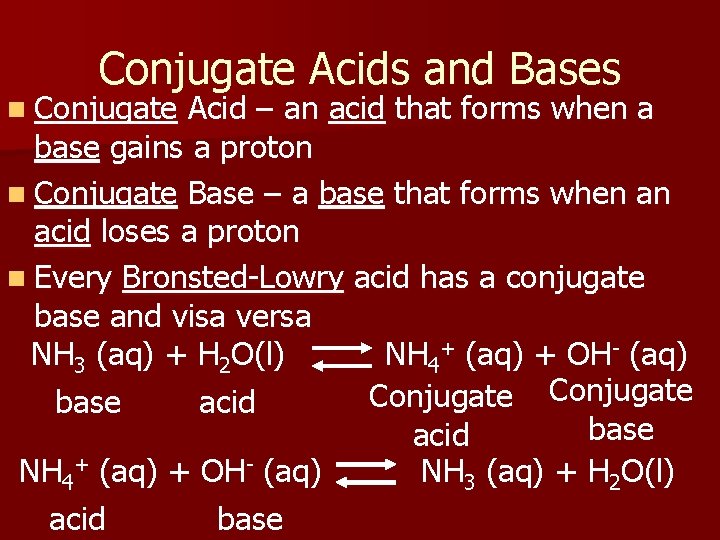
Conjugate Acids and Bases n Conjugate Acid – an acid that forms when a base gains a proton n Conjugate Base – a base that forms when an acid loses a proton n Every Bronsted-Lowry acid has a conjugate base and visa versa NH 3 (aq) + H 2 O(l) NH 4+ (aq) + OH- (aq) Conjugate base acid NH 4+ (aq) + OH- (aq) NH 3 (aq) + H 2 O(l) acid base
Amphoteric Species n. A substance that has properties of an acid and properties of a base. n An example is water n Water can donate a proton (Brønsted. Lowry acid) or it can accept a proton (Brønsted-Lowry base)
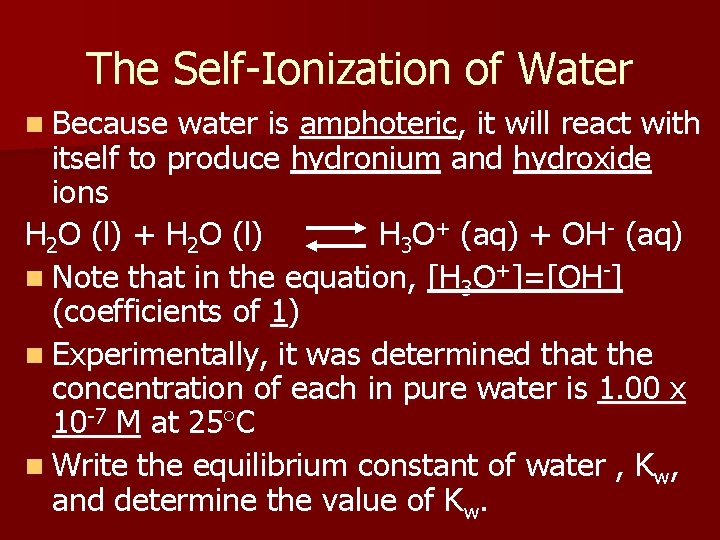
The Self-Ionization of Water n Because water is amphoteric, it will react with itself to produce hydronium and hydroxide ions H 2 O (l) + H 2 O (l) H 3 O+ (aq) + OH- (aq) n Note that in the equation, [H 3 O+]=[OH-] (coefficients of 1) n Experimentally, it was determined that the concentration of each in pure water is 1. 00 x 10 -7 M at 25 C n Write the equilibrium constant of water , Kw, and determine the value of Kw.
Using Kw n n n 1. 2. 3. The product of these two concentrations is always a constant (1. 0 x 10 -14). Thus, when one goes up, the other goes down (inversely proportional). Example problems: What is the [OH-] concentration in a 3. 00 x 10 -5 M solution of HCl, a strong acid? What is [OH-] in a 0. 450 M solution of HNO 3? What is [H 3 O+] in a solution of Na. OH whose concentration is 3. 75 x 10 -2 M
p. H n Stands for power of Hydrogen n Used to avoid the awkwardness of the negative exponents. n p. H = - log [H 3 O+] n Because of the negative sign, as the hydronium ion concentration increases, the p. H will decrease. n Therefore, p. H < 7, acidic n p. H > 7, basic n p. H = 7, neutral – equal concentrations of H 3 O+ and OH-
Some things to note n [H 3 O+] = 10 -p. H n If p. H is a whole number, the calculation is simple n A change in 1 p. H unit results in a 10 x change in [H 3 O+]. n p. OH refers to power of hydroxide and is handled the same way, except it will result in OH- concentrations n p. H + p. OH = 14 n Keep balanced equation in mind.
Examples n Calculate p. H if [H 3 O+] = 5. 0 x 10 -3 M. n What is the p. H of a 0. 2 M solution of H 2 SO 4? n Calculate p. H if [OH-] = 2. 0 x 10 -3 M. n What is the hydronium ion concentration in a fruit juice that has a p. H of 3. 3? n A commercial window-cleaning liquid has a p. H of 11. 7. What is the hydroxide ion concentration?
Ways to measure p. H n Indicators – a compound that can reversibly change color depending on the p. H of a solution n p. H paper – usually paper that has been soaked in indicators. When dipped in a solution, it will change color to reflect the p. H. n p. H meters – an electronic instrument equipped with a probe that can digitally display the p. H of a solution.
Homework n Page 547, 7 -11.
- Slides: 15