
Acids and Bases Chapter 19 Properties of acids
Acids and Bases Chapter 19
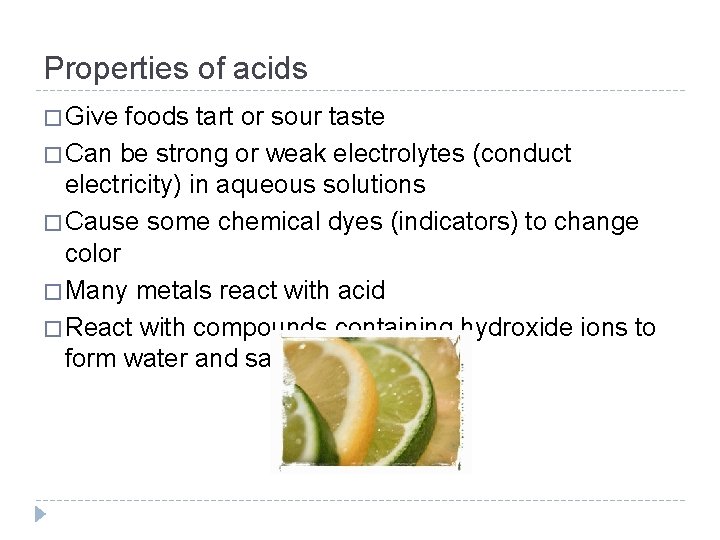
Properties of acids � Give foods tart or sour taste � Can be strong or weak electrolytes (conduct electricity) in aqueous solutions � Cause some chemical dyes (indicators) to change color � Many metals react with acid � React with compounds containing hydroxide ions to form water and salt
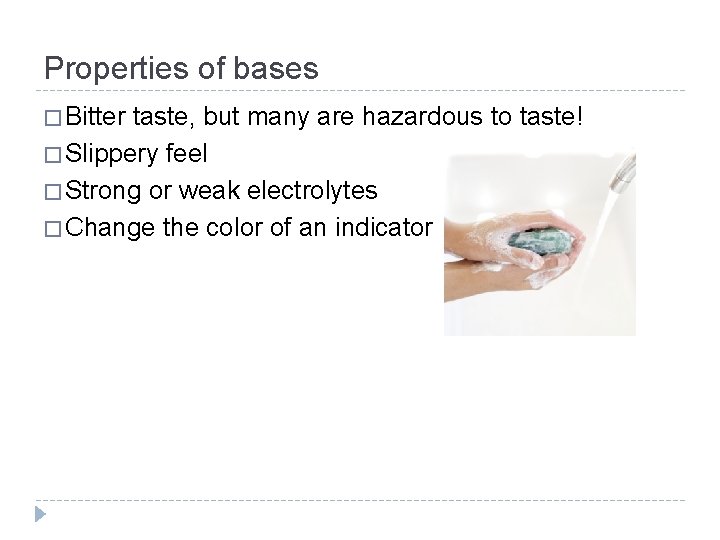
Properties of bases � Bitter taste, but many are hazardous to taste! � Slippery feel � Strong or weak electrolytes � Change the color of an indicator
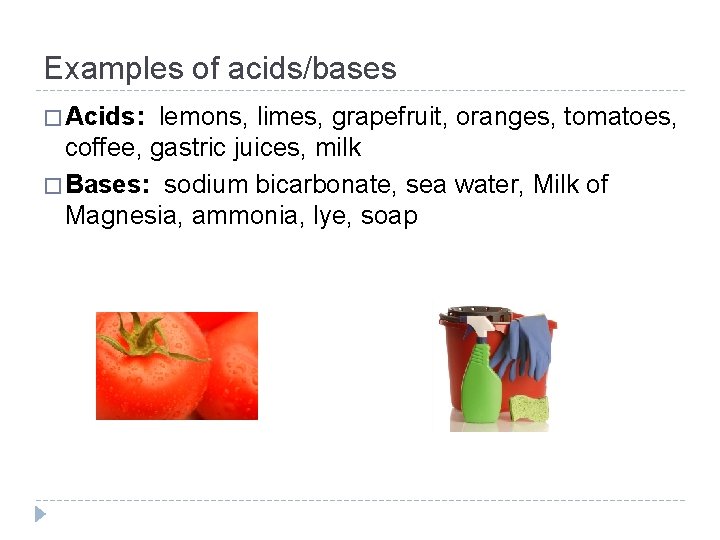
Examples of acids/bases � Acids: lemons, limes, grapefruit, oranges, tomatoes, coffee, gastric juices, milk � Bases: sodium bicarbonate, sea water, Milk of Magnesia, ammonia, lye, soap
Arrhenius acids and bases � Acids are hydrogen-containing compounds that ionize to yield hydrogen (H+ ) ions in aqueous solutions. � Monoprotic: 1 ionizable hydrogen (HNO 3) � Diprotic: 2 ionizable hydrogens (H 2 SO 4) � Triprotic: 3 ionizable hydrogens (H 3 PO 4) � Bases are compounds that yield hydroxide (OH-) ions in aqueous solutions.
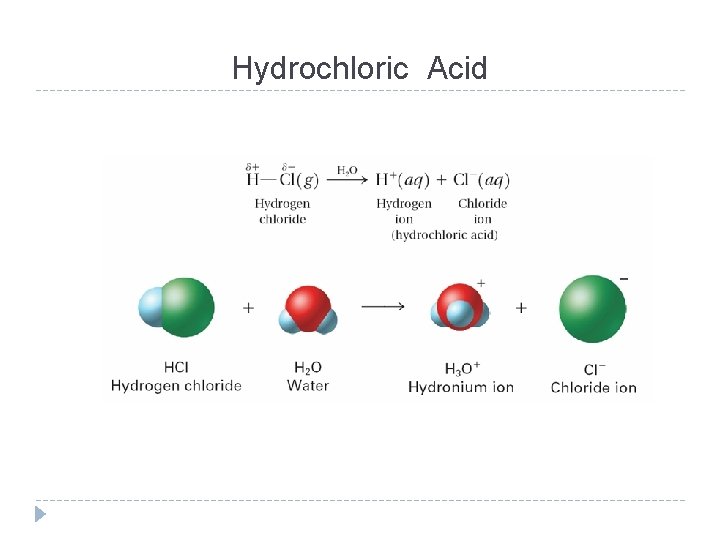
Hydrochloric Acid
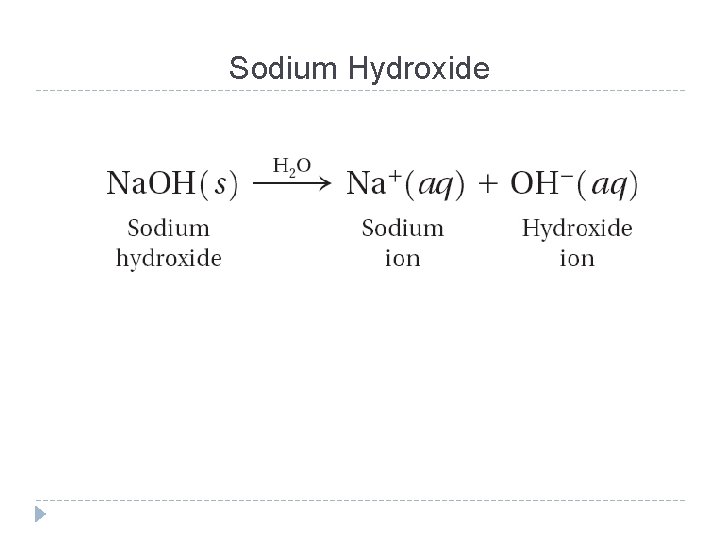
Sodium Hydroxide
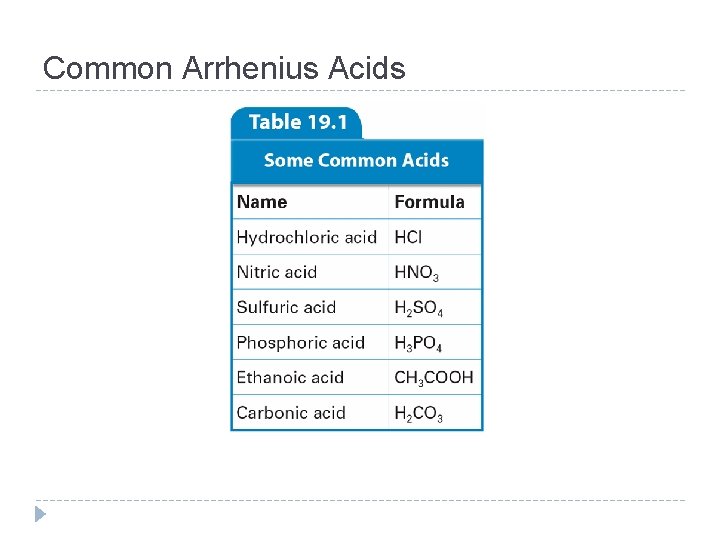
Common Arrhenius Acids
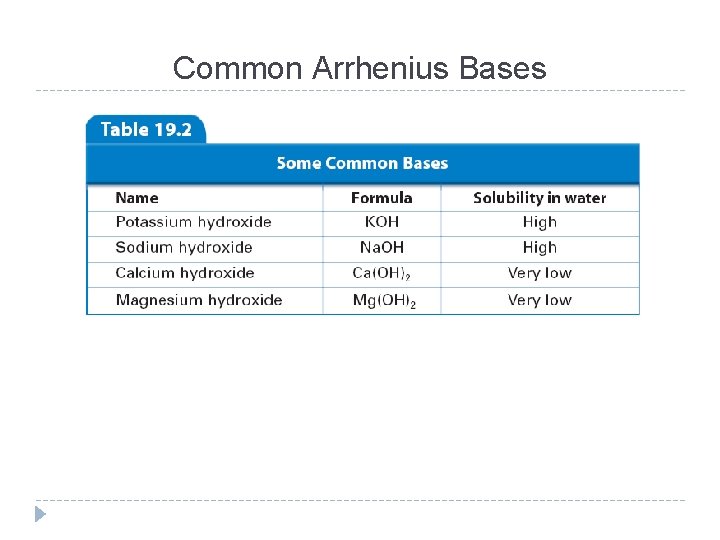
Common Arrhenius Bases
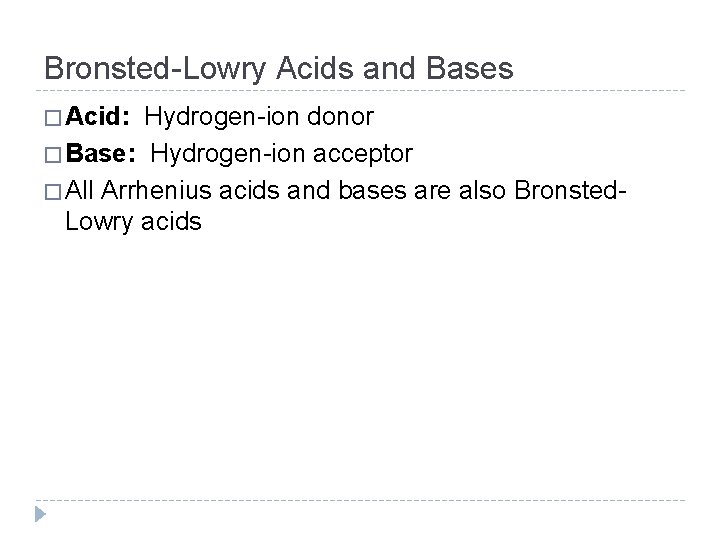
Bronsted-Lowry Acids and Bases � Acid: Hydrogen-ion donor � Base: Hydrogen-ion acceptor � All Arrhenius acids and bases are also Bronsted. Lowry acids

Ammonia is a base
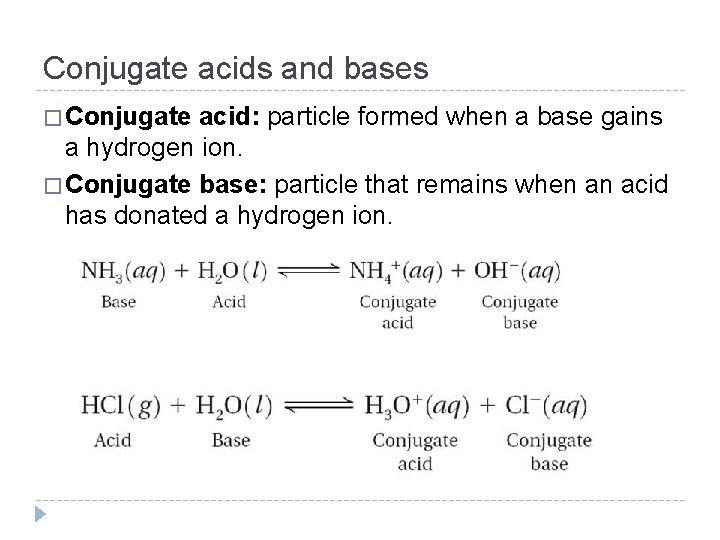
Conjugate acids and bases � Conjugate acid: particle formed when a base gains a hydrogen ion. � Conjugate base: particle that remains when an acid has donated a hydrogen ion.
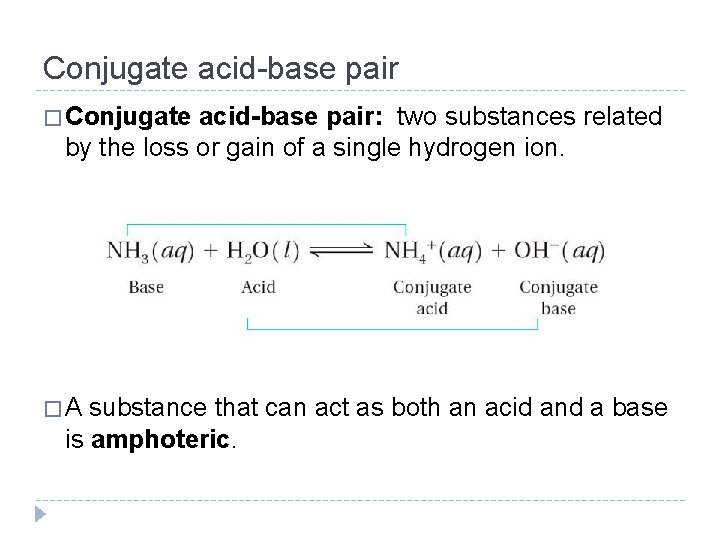
Conjugate acid-base pair � Conjugate acid-base pair: two substances related by the loss or gain of a single hydrogen ion. �A substance that can act as both an acid and a base is amphoteric.
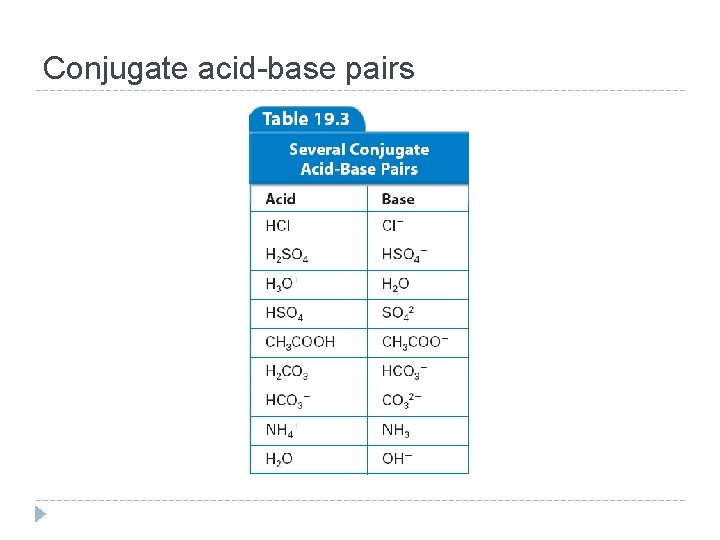
Conjugate acid-base pairs
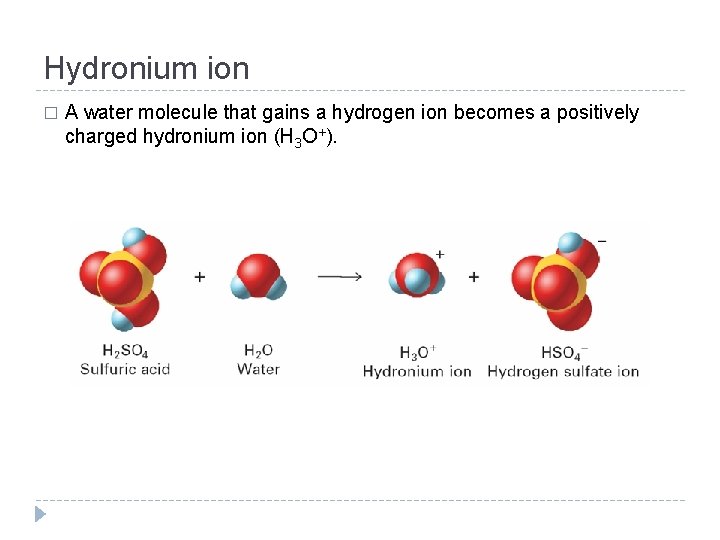
Hydronium ion � A water molecule that gains a hydrogen ion becomes a positively charged hydronium ion (H 3 O+).
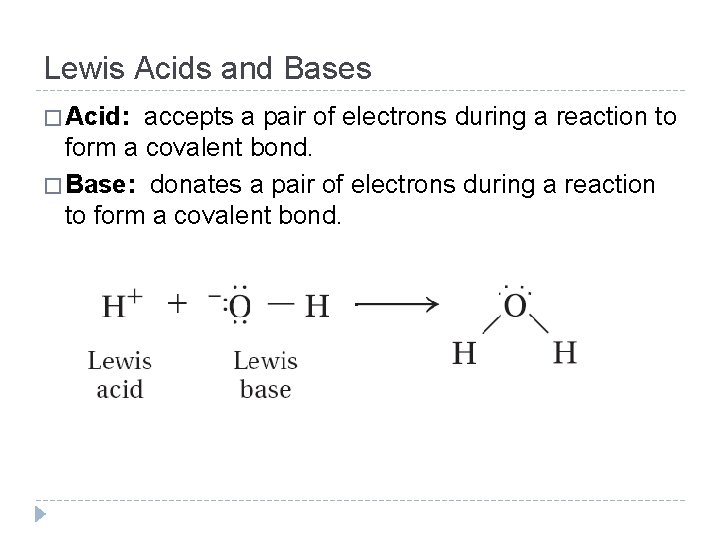
Lewis Acids and Bases � Acid: accepts a pair of electrons during a reaction to form a covalent bond. � Base: donates a pair of electrons during a reaction to form a covalent bond.
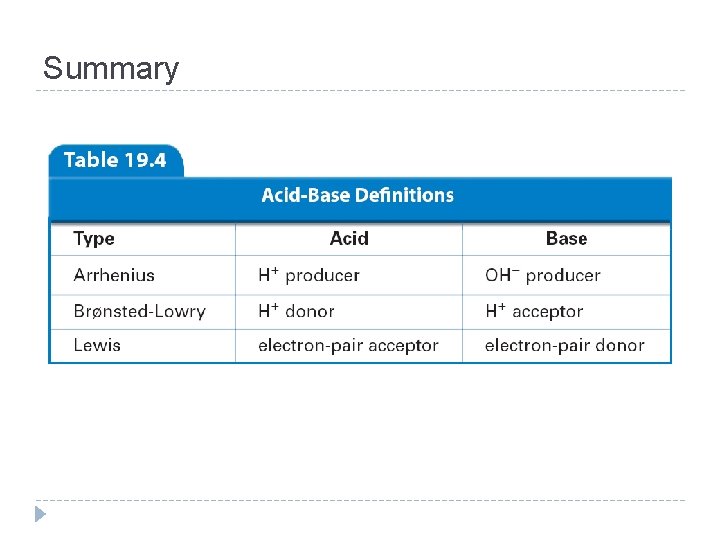
Summary
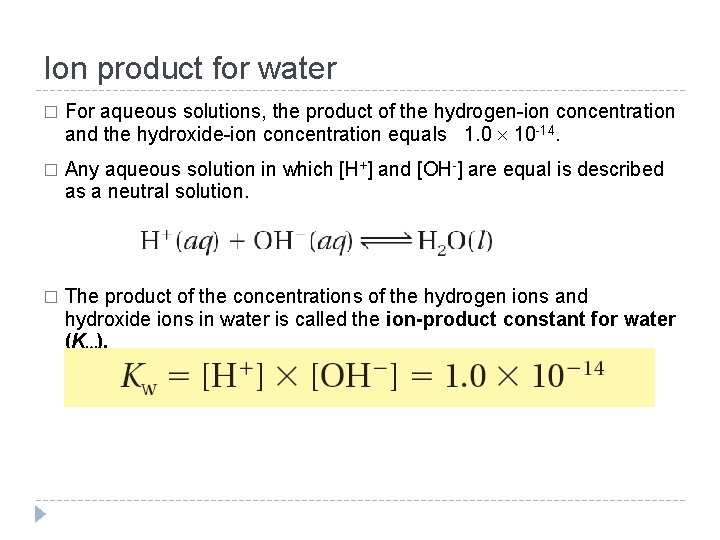
Ion product for water � For aqueous solutions, the product of the hydrogen-ion concentration and the hydroxide-ion concentration equals 1. 0 10 -14. � Any aqueous solution in which [H+] and [OH-] are equal is described as a neutral solution. � The product of the concentrations of the hydrogen ions and hydroxide ions in water is called the ion-product constant for water (Kw).
![Acidic solution � An acidic solution is one in which [H+] is greater than](http://slidetodoc.com/presentation_image_h2/66485402aa8a24baed875cefd2b13bf6/image-19.jpg "Acidic solution � An acidic solution is one in which [H+] is greater than")
Acidic solution � An acidic solution is one in which [H+] is greater than [OH-].
![Basic solution � A basic solution is one in which [H+] is less than](http://slidetodoc.com/presentation_image_h2/66485402aa8a24baed875cefd2b13bf6/image-20.jpg "Basic solution � A basic solution is one in which [H+] is less than")
Basic solution � A basic solution is one in which [H+] is less than [OH ]. Basic solutions are also known as alkaline solutions.
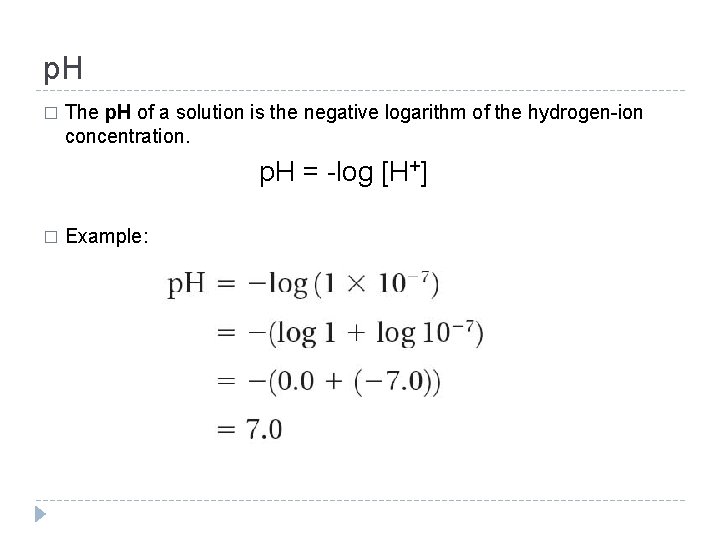
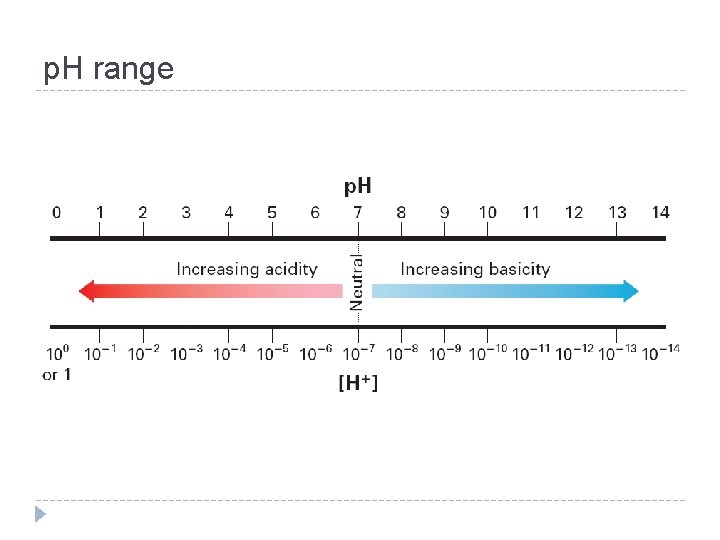
p. H � The p. H of a solution is the negative logarithm of the hydrogen-ion concentration. p. H = -log [H+] � Example:
![p. H Concept � A solution in which [H+] is greater than 1 10–](http://slidetodoc.com/presentation_image_h2/66485402aa8a24baed875cefd2b13bf6/image-22.jpg "p. H Concept � A solution in which [H+] is greater than 1 10–")
p. H Concept � A solution in which [H+] is greater than 1 10– 7 M has a p. H less than 7. 0 and is acidic. The p. H of pure water or a neutral aqueous solution is 7. 0. A solution with a p. H greater than 7 is basic and has a [H+] of less than 1 10– 7 M.
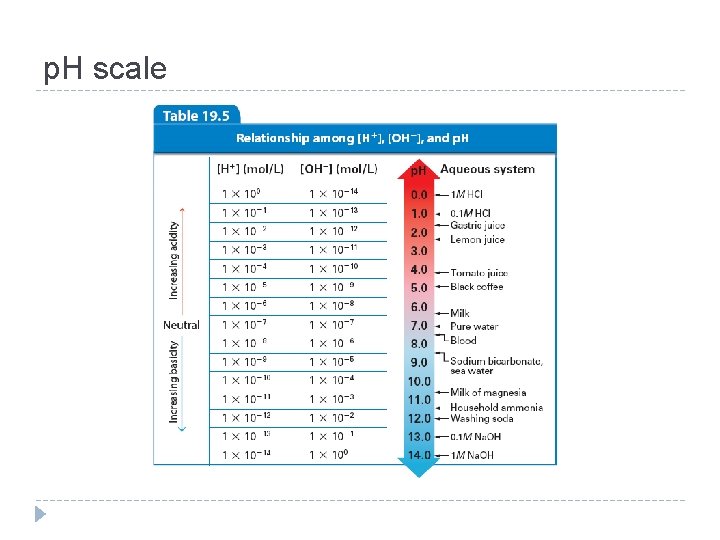
p. H scale
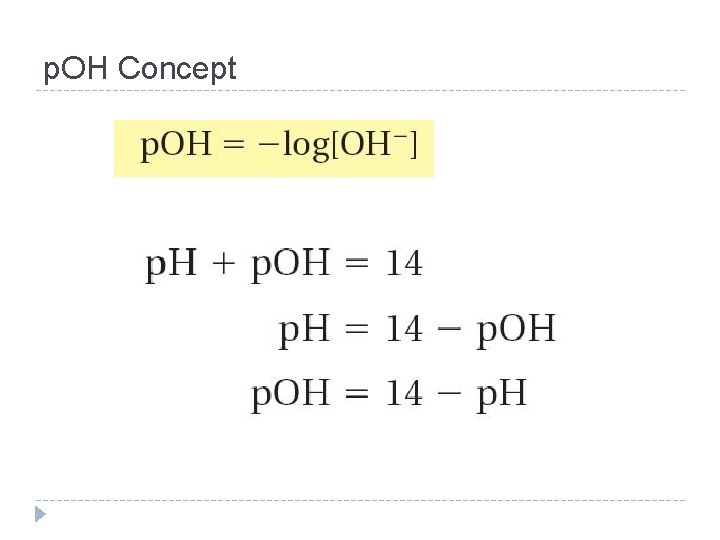
p. OH Concept
p. H range
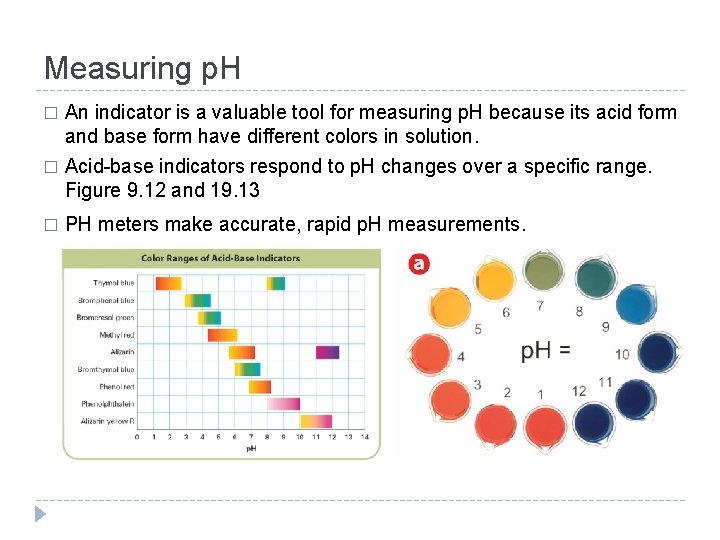
Measuring p. H � An indicator is a valuable tool for measuring p. H because its acid form and base form have different colors in solution. � Acid-base indicators respond to p. H changes over a specific range. Figure 9. 12 and 19. 13 � PH meters make accurate, rapid p. H measurements.
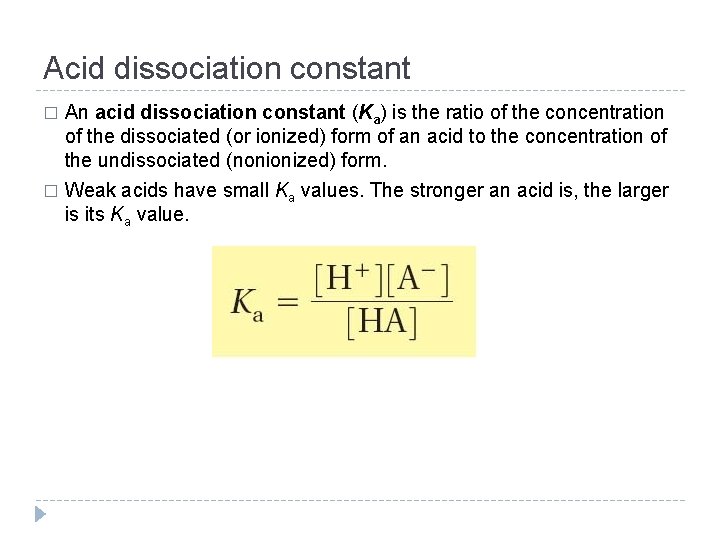
Acid dissociation constant An acid dissociation constant (Ka) is the ratio of the concentration of the dissociated (or ionized) form of an acid to the concentration of the undissociated (nonionized) form. � Weak acids have small Ka values. The stronger an acid is, the larger is its Ka value. �
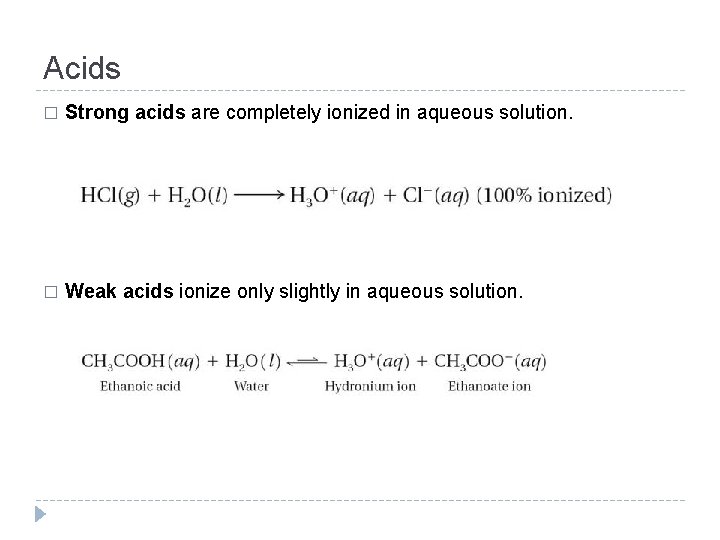
Acids � Strong acids are completely ionized in aqueous solution. � Weak acids ionize only slightly in aqueous solution.
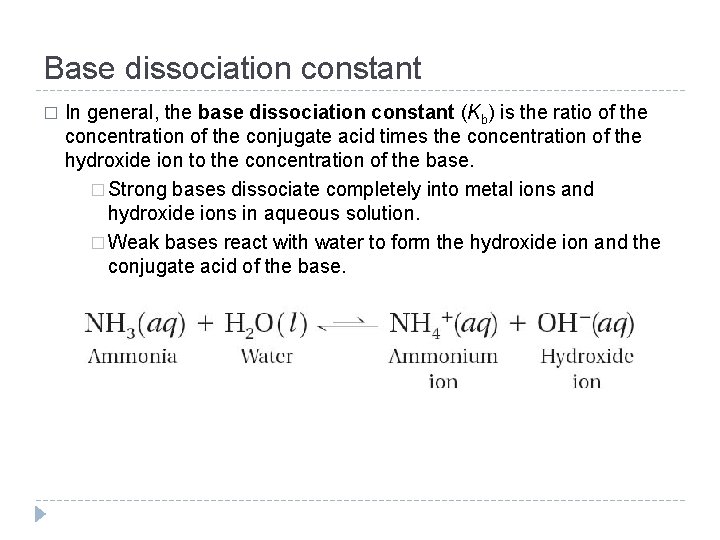
Base dissociation constant � In general, the base dissociation constant (Kb) is the ratio of the concentration of the conjugate acid times the concentration of the hydroxide ion to the concentration of the base. � Strong bases dissociate completely into metal ions and hydroxide ions in aqueous solution. � Weak bases react with water to form the hydroxide ion and the conjugate acid of the base.
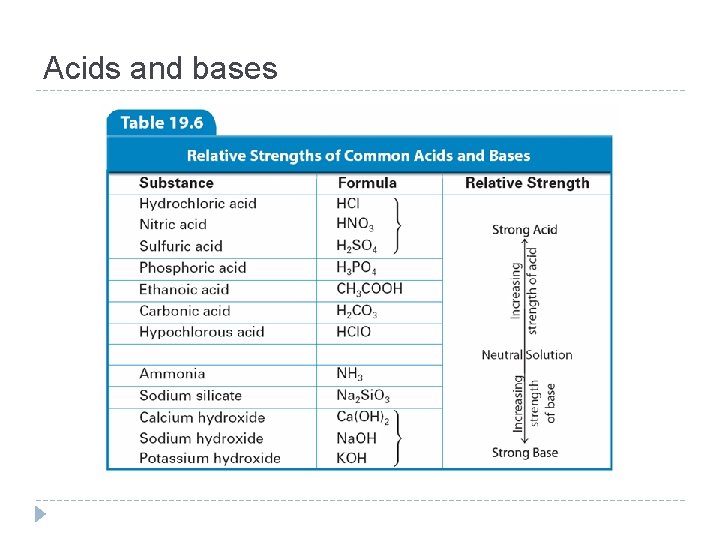
Acids and bases
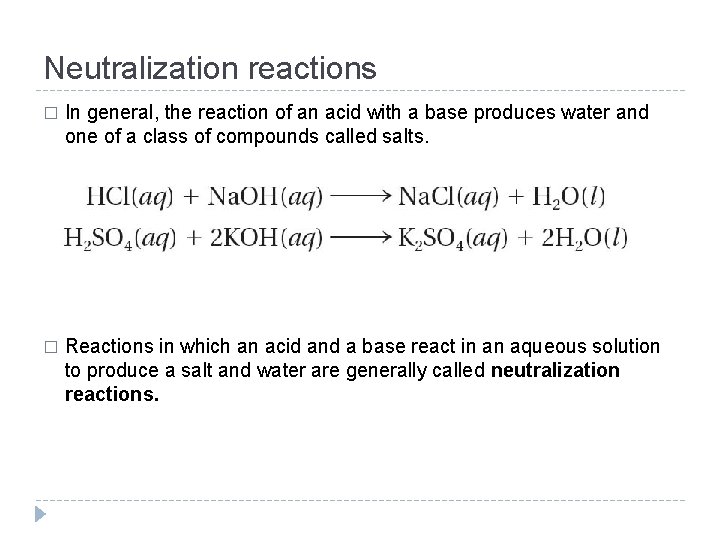
Neutralization reactions � In general, the reaction of an acid with a base produces water and one of a class of compounds called salts. � Reactions in which an acid and a base react in an aqueous solution to produce a salt and water are generally called neutralization reactions.
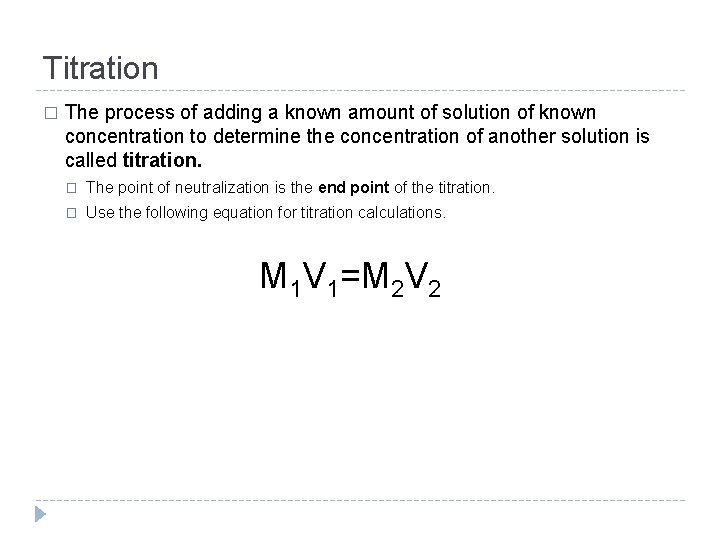
Titration � The process of adding a known amount of solution of known concentration to determine the concentration of another solution is called titration. � The point of neutralization is the end point of the titration. � Use the following equation for titration calculations. M 1 V 1=M 2 V 2
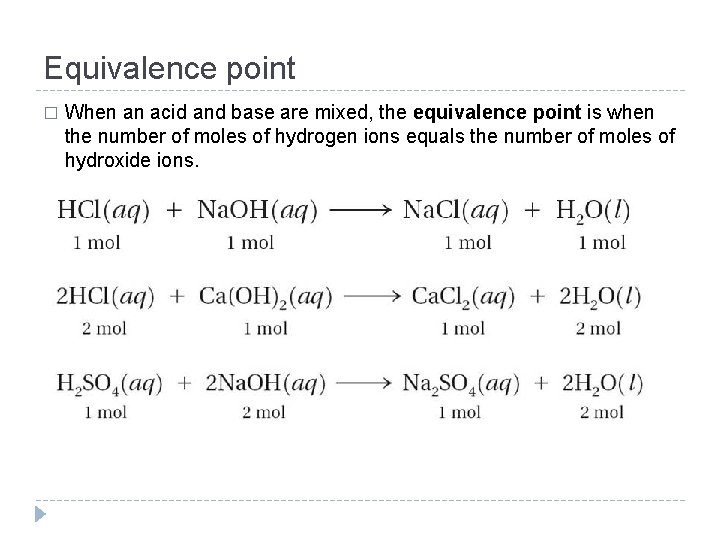
Equivalence point � When an acid and base are mixed, the equivalence point is when the number of moles of hydrogen ions equals the number of moles of hydroxide ions.
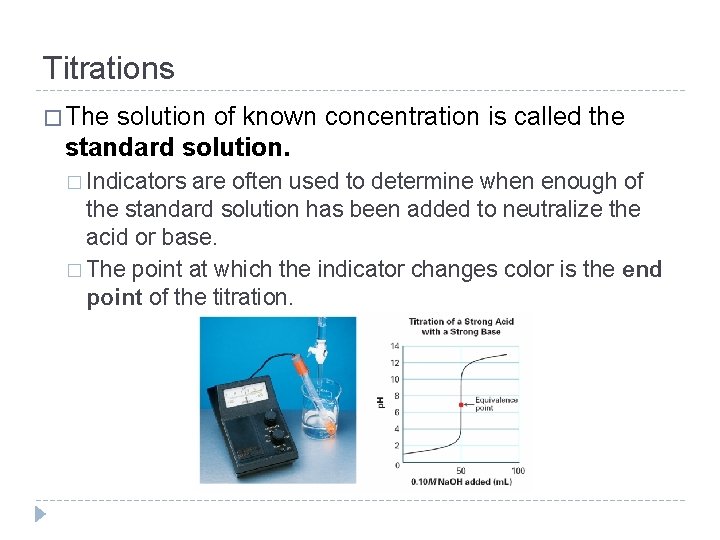
Titrations � The solution of known concentration is called the standard solution. � Indicators are often used to determine when enough of the standard solution has been added to neutralize the acid or base. � The point at which the indicator changes color is the end point of the titration.
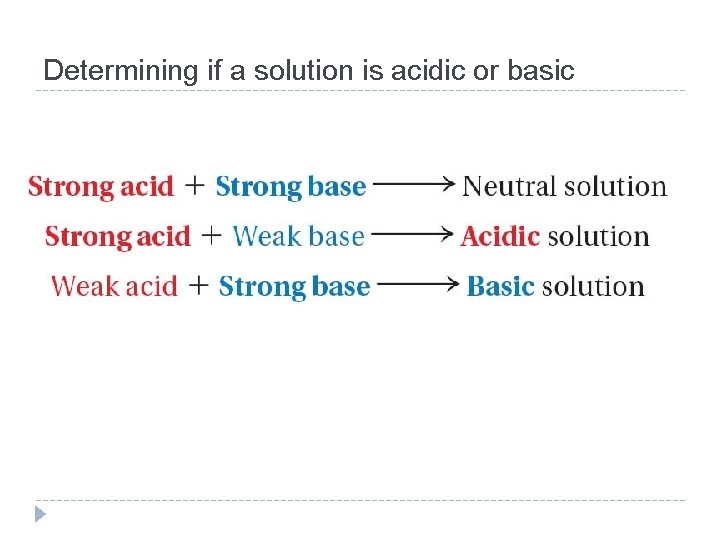
Determining if a solution is acidic or basic
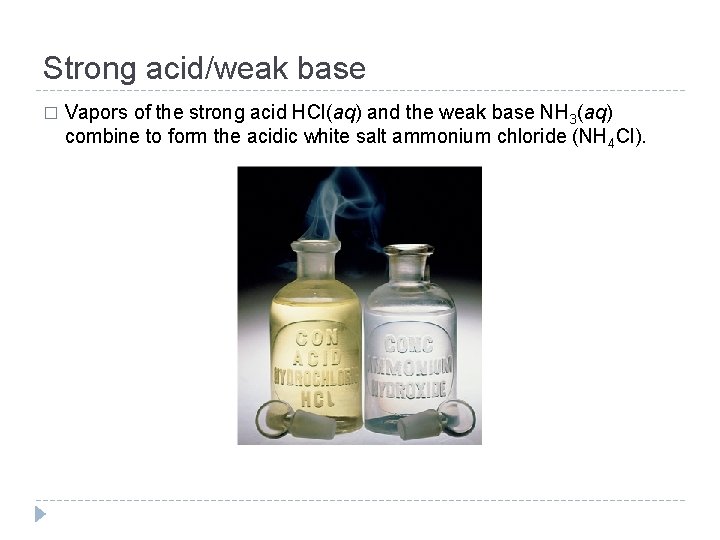
Strong acid/weak base � Vapors of the strong acid HCl(aq) and the weak base NH 3(aq) combine to form the acidic white salt ammonium chloride (NH 4 Cl).
Buffers �A buffer is a solution of a weak acid and one of its salts, or a solution of a weak base and one of its salts. �The p. H of a buffer remains relatively constant when small amounts of acid or base are added. �The buffer capacity is the amount of acid or base that can be added to a buffer solution before a significant change in p. H occurs.
- Slides: 37