
Acids and Bases Chapter 18 Properties of Acids
Acids and Bases Chapter 18
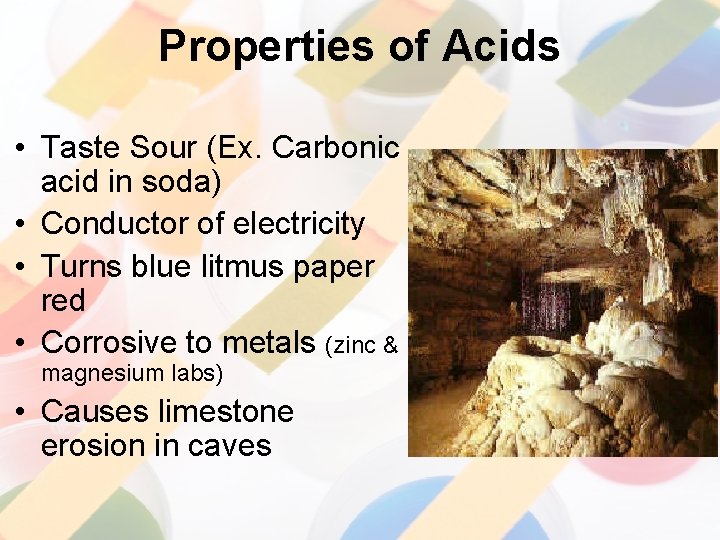
Properties of Acids • Taste Sour (Ex. Carbonic acid in soda) • Conductor of electricity • Turns blue litmus paper red • Corrosive to metals (zinc & magnesium labs) • Causes limestone erosion in caves
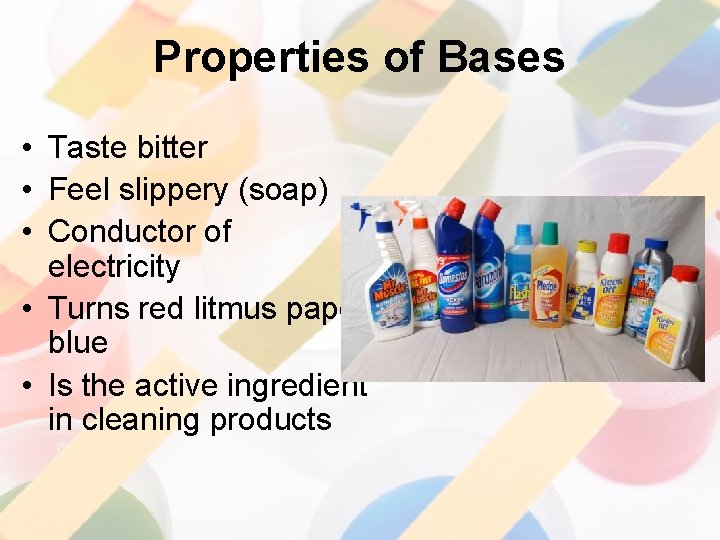
Properties of Bases • Taste bitter • Feel slippery (soap) • Conductor of electricity • Turns red litmus paper blue • Is the active ingredient in cleaning products
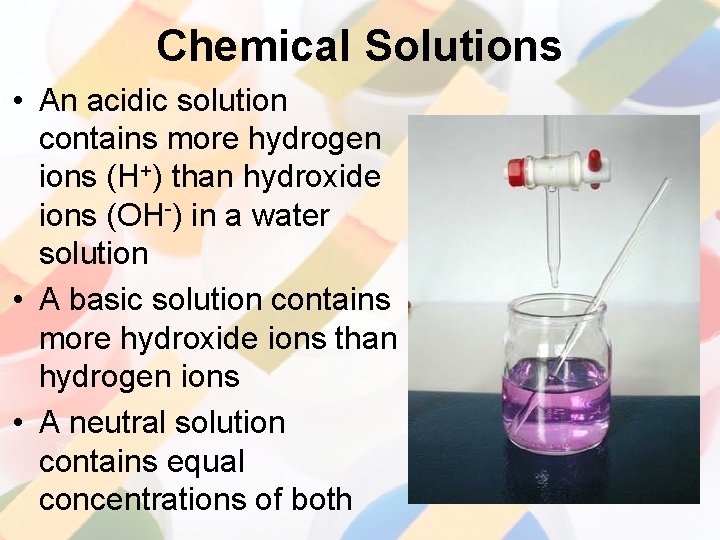
Chemical Solutions • An acidic solution contains more hydrogen ions (H+) than hydroxide ions (OH-) in a water solution • A basic solution contains more hydroxide ions than hydrogen ions • A neutral solution contains equal concentrations of both
Arrhenius Model • States that an acid is a substance that contains hydrogen and ionizes to produce hydrogen ions in aqueous solutions. • HCl(g) H+(aq) + Cl-(aq) • States that a base is a substance that contains a hydroxide group and dissociates to produce a hydroxide ion in aqueous solutions. • Na. OH(s) Na+(aq) + OH-(aq)
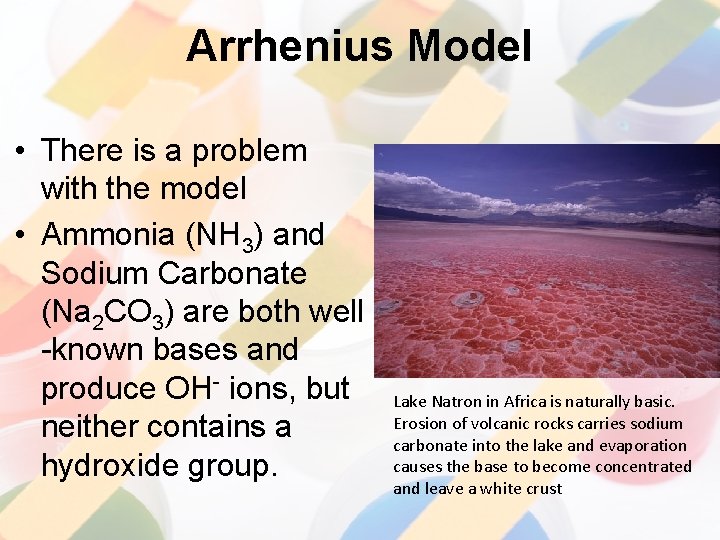
Arrhenius Model • There is a problem with the model • Ammonia (NH 3) and Sodium Carbonate (Na 2 CO 3) are both well -known bases and produce OH- ions, but neither contains a hydroxide group. Lake Natron in Africa is naturally basic. Erosion of volcanic rocks carries sodium carbonate into the lake and evaporation causes the base to become concentrated and leave a white crust
Brønsted-Lowry Model • An acid is a hydrogen ion donor and a base is a hydrogen ion acceptor. • HX(aq) + H 2 O(l) H 3 O+(aq) + X-(aq) • A conjugate acid is the acid formed when a base accepts a hydrogen ion. • A conjugate base is the base formed when an acid donates a hydrogen ion • A conjugate acid-base pair consists of two substances related to each other by donating and accepting of a single hydrogen ion.
The p. H scale • The p. H level of a solution indicates the amount of H+ ions present within the solution. • p. H = -log [H+] • The more H+ ions, the stronger the acid due to a complete ionization of the chemical • The p. OH level of a solution indicates the amount of OH- ions present within the solution. • p. OH = -log [OH-] • The more OH- ions, the stronger the base due to a complete dissociation of the chemical into metal ions and OH- ions
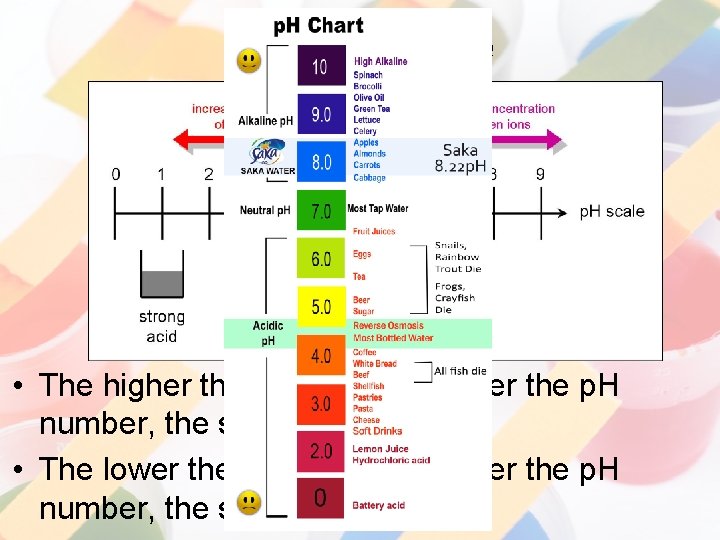
The p. H scale • The higher the p. H level, the lower the p. H number, the stronger the acid. • The lower the p. H level, the higher the p. H number, the stronger the base.
Acid and Base Titration • When an acid and a base are combined to form a salt and water, the reaction is considered a neutralizing reaction. • A salt is an ionic compound made up of a cation from a base and an anion from an acid.
Acid and Base Titration • Titration is a method for determining the concentration of a solution by reacting a known volume of that solution with a solution of known concentration. • The known concentration solution is called the titrant. • This process of adding acid and base continues until the equivalence point when the number of moles of H+ and OH- are the same.
- Slides: 11