
ACIDS AND BASES Acid Bases CONTENTS BrnstedLowry theory
ACIDS AND BASES
Acid & Bases CONTENTS • Brønsted-Lowry theory of acids and bases • Strong acids and bases • Weak acids • Weak bases • Hydrogen ion concentration and p. H • Ionic product of water Kw • Relation between p. H and p. OH
Acid & Bases Before you start it would be helpful to… • know the simple properties of acids, bases and alkalis
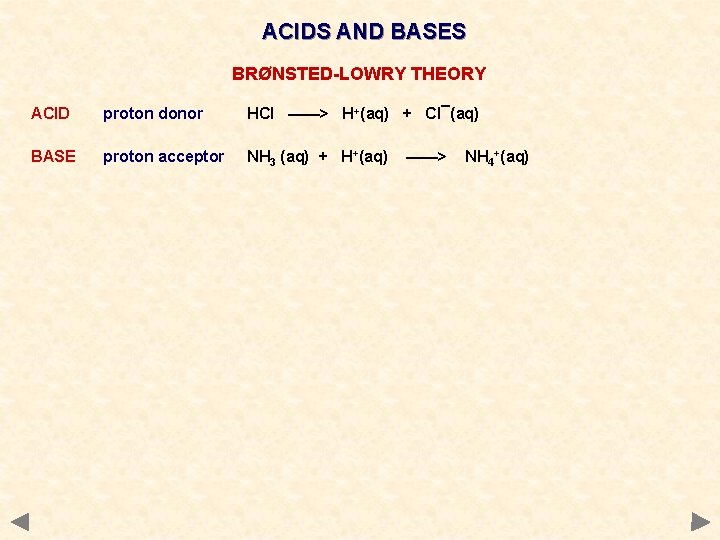
ACIDS AND BASES BRØNSTED-LOWRY THEORY ACID proton donor HCl ——> H+(aq) + Cl¯(aq) BASE proton acceptor NH 3 (aq) + H+(aq) ——> NH 4+(aq)
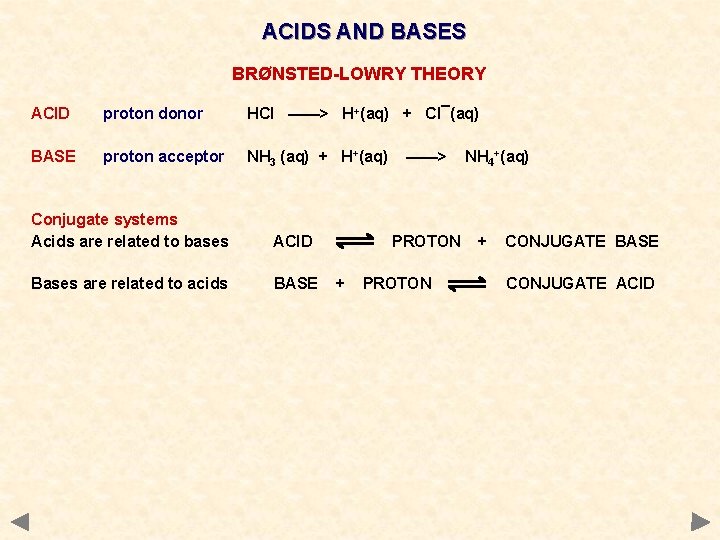
ACIDS AND BASES BRØNSTED-LOWRY THEORY ACID proton donor HCl ——> H+(aq) + Cl¯(aq) BASE proton acceptor NH 3 (aq) + H+(aq) Conjugate systems Acids are related to bases ACID Bases are related to acids BASE ——> PROTON + PROTON NH 4+(aq) + CONJUGATE BASE CONJUGATE ACID
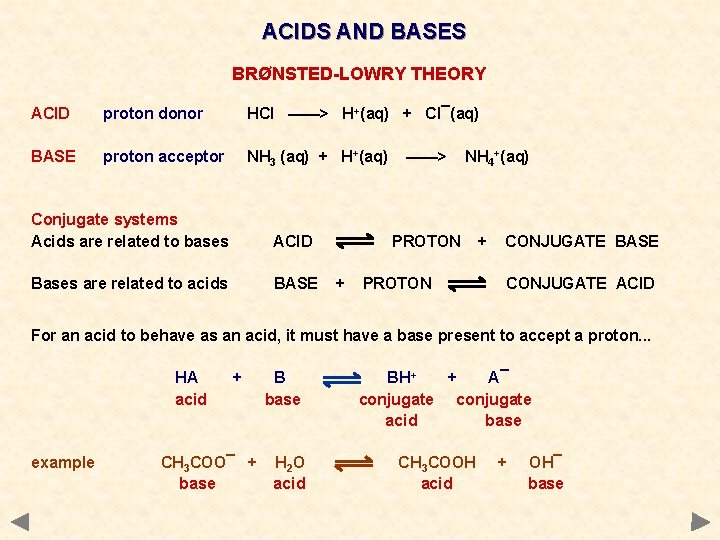
ACIDS AND BASES BRØNSTED-LOWRY THEORY ACID proton donor HCl ——> H+(aq) + Cl¯(aq) BASE proton acceptor NH 3 (aq) + H+(aq) Conjugate systems Acids are related to bases ACID Bases are related to acids BASE ——> NH 4+(aq) PROTON + CONJUGATE BASE CONJUGATE ACID For an acid to behave as an acid, it must have a base present to accept a proton. . . HA acid example + B base CH 3 COO¯ + H 2 O base acid BH + + A¯ conjugate acid base CH 3 COOH acid + OH¯ base
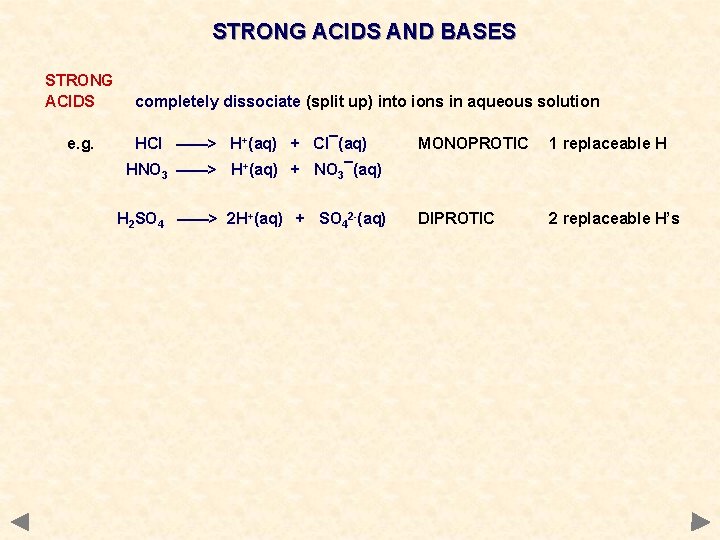
STRONG ACIDS AND BASES STRONG ACIDS e. g. completely dissociate (split up) into ions in aqueous solution HCl ——> H+(aq) + Cl¯(aq) MONOPROTIC 1 replaceable H DIPROTIC 2 replaceable H’s HNO 3 ——> H+(aq) + NO 3¯(aq) H 2 SO 4 ——> 2 H+(aq) + SO 42 -(aq)
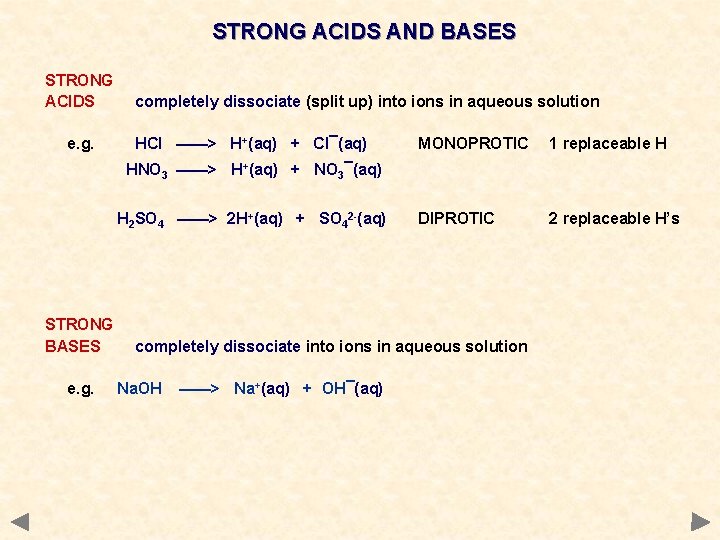
STRONG ACIDS AND BASES STRONG ACIDS e. g. completely dissociate (split up) into ions in aqueous solution HCl ——> H+(aq) + Cl¯(aq) MONOPROTIC 1 replaceable H DIPROTIC 2 replaceable H’s HNO 3 ——> H+(aq) + NO 3¯(aq) H 2 SO 4 ——> 2 H+(aq) + SO 42 -(aq) STRONG BASES e. g. completely dissociate into ions in aqueous solution Na. OH ——> Na+(aq) + OH¯(aq)
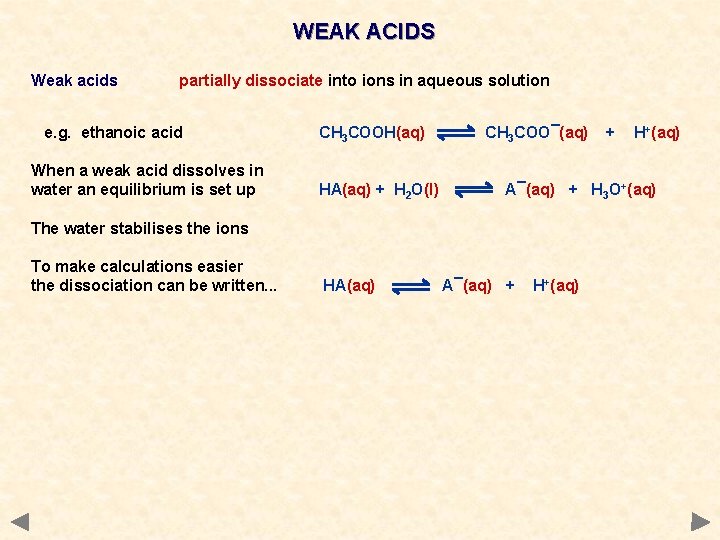
WEAK ACIDS Weak acids partially dissociate into ions in aqueous solution e. g. ethanoic acid When a weak acid dissolves in water an equilibrium is set up CH 3 COOH(aq) HA(aq) + H 2 O(l) CH 3 COO¯(aq) HA(aq) H+(aq) A¯(aq) + H 3 O+(aq) The water stabilises the ions To make calculations easier the dissociation can be written. . . + A¯(aq) + H+(aq)

WEAK ACIDS Weak acids partially dissociate into ions in aqueous solution e. g. ethanoic acid CH 3 COOH(aq) When a weak acid dissolves in water an equilibrium is set up CH 3 COO¯(aq) HA(aq) + H 2 O(l) + H+(aq) A¯(aq) + H 3 O+(aq) The water stabilises the ions To make calculations easier the dissociation can be written. . . The weaker the acid HA(aq) A¯(aq) + H+(aq) the less it dissociates the more the equilibrium lies to the left. The relative strengths of acids can be expressed as Ka or p. Ka values The dissociation constant for the weak acid HA is Ka = [H+(aq)] [A¯(aq)] [HA(aq)] mol dm-3

WEAK BASES Partially react with water to give ions in aqueous solution e. g. ammonia When a weak base dissolves in water an equilibrium is set up NH 3 (aq) + H 2 O (l) NH 4+ (aq) + OH¯ (aq) as in the case of acids it is more simply written NH 3 (aq) + H+ (aq) NH 4+ (aq)
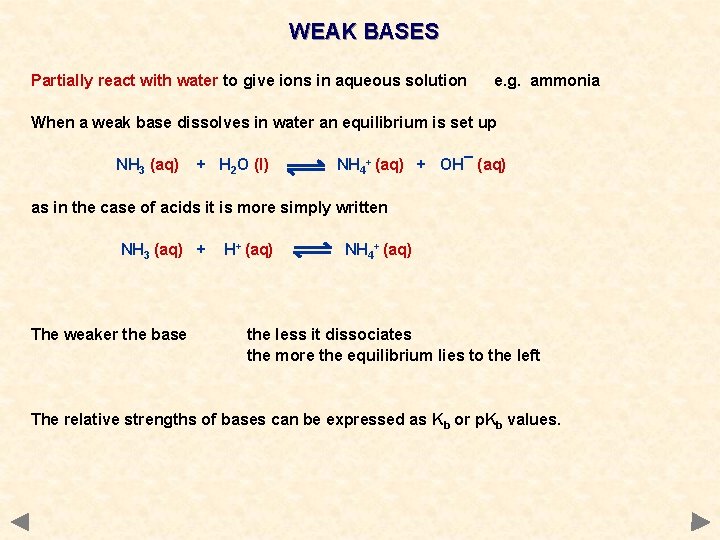
WEAK BASES Partially react with water to give ions in aqueous solution e. g. ammonia When a weak base dissolves in water an equilibrium is set up NH 3 (aq) + H 2 O (l) NH 4+ (aq) + OH¯ (aq) as in the case of acids it is more simply written NH 3 (aq) + The weaker the base H+ (aq) NH 4+ (aq) the less it dissociates the more the equilibrium lies to the left The relative strengths of bases can be expressed as Kb or p. Kb values.
![Hydrogen ion concentration [H+(aq)] Introduction hydrogen ion concentration determines the acidity of a solution](http://slidetodoc.com/presentation_image_h2/58251188e9fd2f0eaa4df1a5f0e183d8/image-13.jpg "Hydrogen ion concentration [H+(aq)] Introduction hydrogen ion concentration determines the acidity of a solution")
Hydrogen ion concentration [H+(aq)] Introduction hydrogen ion concentration determines the acidity of a solution hydroxide ion concentration determines the alkalinity for strong acids and bases the concentration of ions is very much larger than their weaker counterparts which only partially dissociate.
![Hydrogen ion concentration [H+(aq)] p. H p. OH hydrogen ion concentration can be converted](http://slidetodoc.com/presentation_image_h2/58251188e9fd2f0eaa4df1a5f0e183d8/image-14.jpg "Hydrogen ion concentration [H+(aq)] p. H p. OH hydrogen ion concentration can be converted")
Hydrogen ion concentration [H+(aq)] p. H p. OH hydrogen ion concentration can be converted to p. H = - log 10 [H+(aq)] to convert p. H into hydrogen ion concentration [H+(aq)] = antilog (-p. H) An equivalent calculation for bases converts the hydroxide ion concentration to p. OH = - log 10 [OH¯(aq)] in both the above, [ ] represents the concentration in mol dm -3 [H+] 100 10 -1 10 -2 10 -3 10 -4 10 -5 10 -6 10 -7 10 -8 10 -9 10 -10 10 -11 10 -12 10 -13 10 -14 OH¯ 10 -14 10 -13 10 -12 10 -11 10 -10 10 -9 10 -8 10 -7 10 -6 10 -5 10 -4 10 -3 10 -2 10 -1 10 -0 p. H 0 1 2 STRONGLY ACIDIC 3 4 5 WEAKLY ACIDIC 6 7 8 NEUTRAL 9 10 WEAKLY ALKALINE 11 12 13 14 STRONGLY ALKALINE
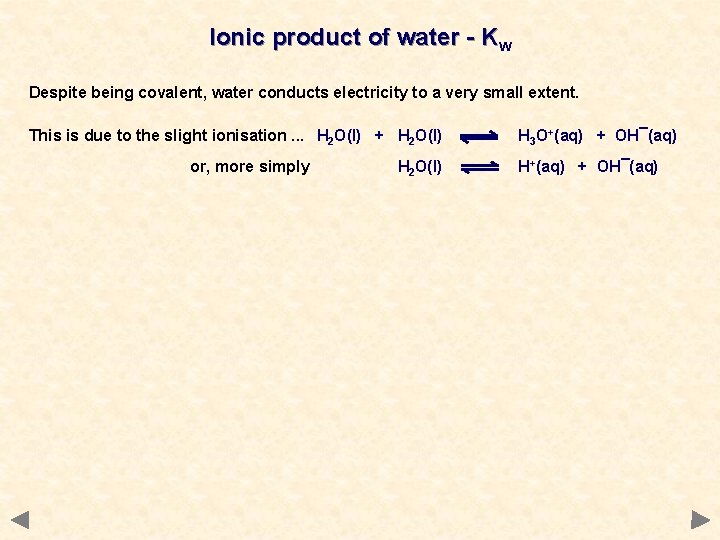
Ionic product of water - Kw Despite being covalent, water conducts electricity to a very small extent. This is due to the slight ionisation. . . H 2 O(l) + H 2 O(l) or, more simply H 2 O(l) H 3 O+(aq) + OH¯(aq) H+(aq) + OH¯(aq)
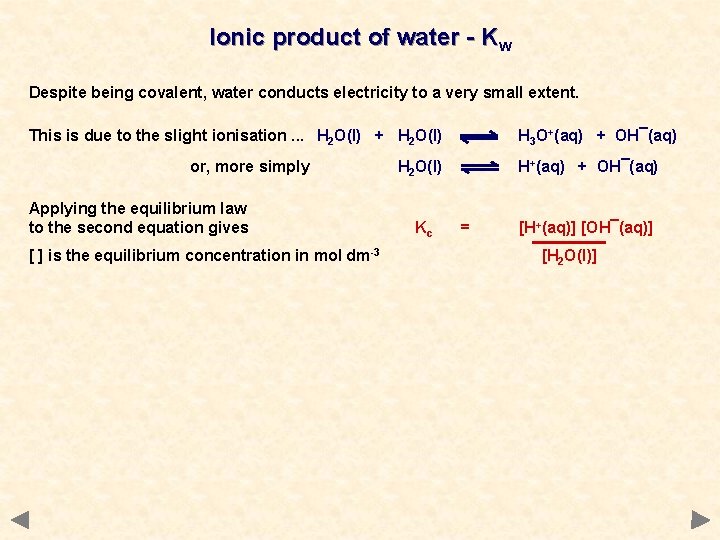
Ionic product of water - Kw Despite being covalent, water conducts electricity to a very small extent. This is due to the slight ionisation. . . H 2 O(l) + H 2 O(l) or, more simply Applying the equilibrium law to the second equation gives [ ] is the equilibrium concentration in mol dm-3 H 3 O+(aq) + OH¯(aq) H 2 O(l) Kc H+(aq) + OH¯(aq) = [H+(aq)] [OH¯(aq)] [H 2 O(l)]
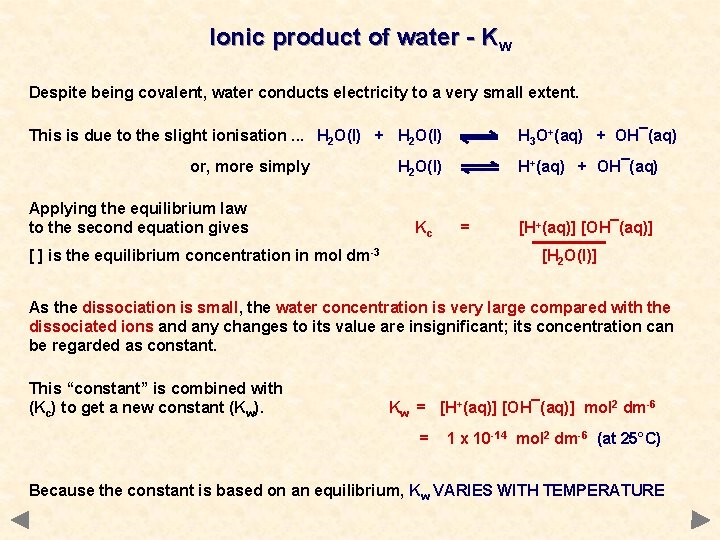
Ionic product of water - Kw Despite being covalent, water conducts electricity to a very small extent. This is due to the slight ionisation. . . H 2 O(l) + H 2 O(l) or, more simply Applying the equilibrium law to the second equation gives H 3 O+(aq) + OH¯(aq) H 2 O(l) Kc [ ] is the equilibrium concentration in mol dm-3 H+(aq) + OH¯(aq) = [H+(aq)] [OH¯(aq)] [H 2 O(l)] As the dissociation is small, the water concentration is very large compared with the dissociated ions and any changes to its value are insignificant; its concentration can be regarded as constant. This “constant” is combined with (Kc) to get a new constant (Kw). Kw = [H+(aq)] [OH¯(aq)] mol 2 dm-6 = 1 x 10 -14 mol 2 dm-6 (at 25°C) Because the constant is based on an equilibrium, Kw VARIES WITH TEMPERATURE
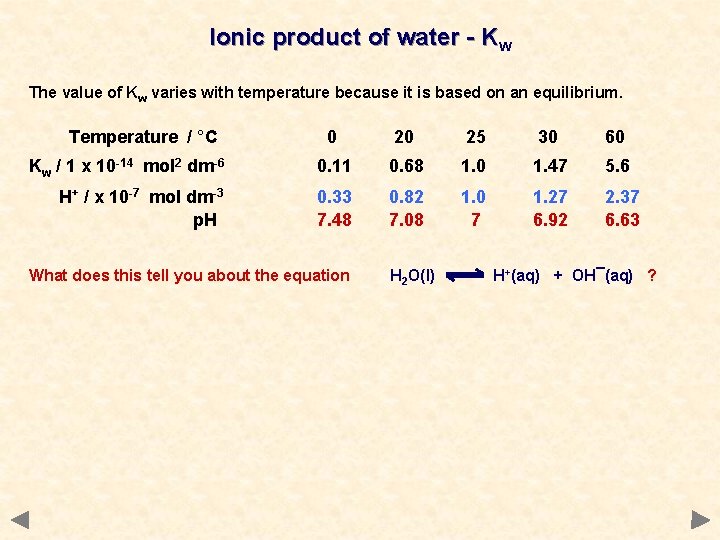
Ionic product of water - Kw The value of Kw varies with temperature because it is based on an equilibrium. Temperature / °C 0 20 25 30 60 Kw / 1 x 10 -14 mol 2 dm-6 0. 11 0. 68 1. 0 1. 47 5. 6 H+ / x 10 -7 mol dm-3 p. H 0. 33 7. 48 0. 82 7. 08 1. 0 7 1. 27 6. 92 2. 37 6. 63 What does this tell you about the equation H 2 O(l) H+(aq) + OH¯(aq) ?
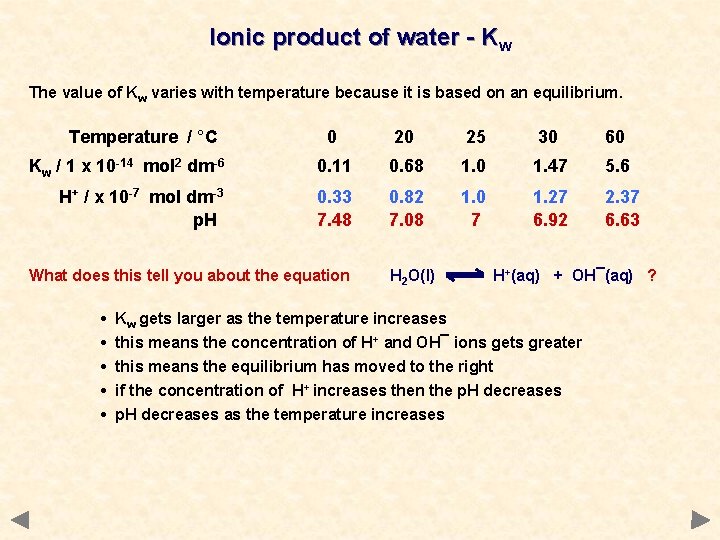
Ionic product of water - Kw The value of Kw varies with temperature because it is based on an equilibrium. Temperature / °C 0 20 25 30 60 Kw / 1 x 10 -14 mol 2 dm-6 0. 11 0. 68 1. 0 1. 47 5. 6 H+ / x 10 -7 mol dm-3 p. H 0. 33 7. 48 0. 82 7. 08 1. 0 7 1. 27 6. 92 2. 37 6. 63 What does this tell you about the equation H 2 O(l) H+(aq) + OH¯(aq) ? • Kw gets larger as the temperature increases • this means the concentration of H+ and OH¯ ions gets greater • this means the equilibrium has moved to the right • if the concentration of H+ increases then the p. H decreases • p. H decreases as the temperature increases
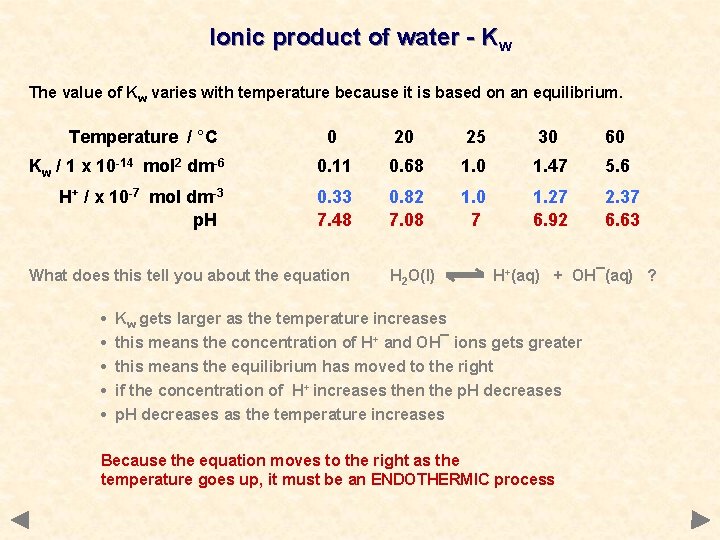
Ionic product of water - Kw The value of Kw varies with temperature because it is based on an equilibrium. Temperature / °C 0 20 25 30 60 Kw / 1 x 10 -14 mol 2 dm-6 0. 11 0. 68 1. 0 1. 47 5. 6 H+ / x 10 -7 mol dm-3 p. H 0. 33 7. 48 0. 82 7. 08 1. 0 7 1. 27 6. 92 2. 37 6. 63 What does this tell you about the equation H 2 O(l) H+(aq) + OH¯(aq) ? • Kw gets larger as the temperature increases • this means the concentration of H+ and OH¯ ions gets greater • this means the equilibrium has moved to the right • if the concentration of H+ increases then the p. H decreases • p. H decreases as the temperature increases Because the equation moves to the right as the temperature goes up, it must be an ENDOTHERMIC process
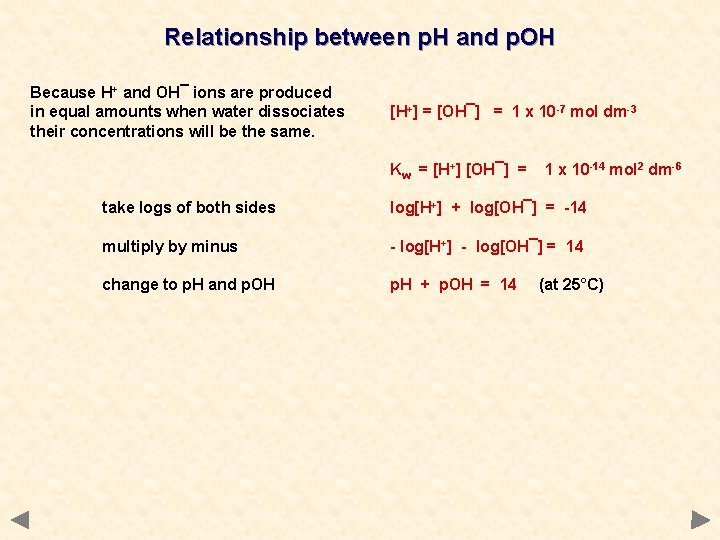
Relationship between p. H and p. OH Because H+ and OH¯ ions are produced in equal amounts when water dissociates their concentrations will be the same. [H+] = [OH¯] = 1 x 10 -7 mol dm-3 Kw = [H+] [OH¯] = 1 x 10 -14 mol 2 dm-6 take logs of both sides log[H+] + log[OH¯] = -14 multiply by minus - log[H+] - log[OH¯] = 14 change to p. H and p. OH p. H + p. OH = 14 (at 25°C)
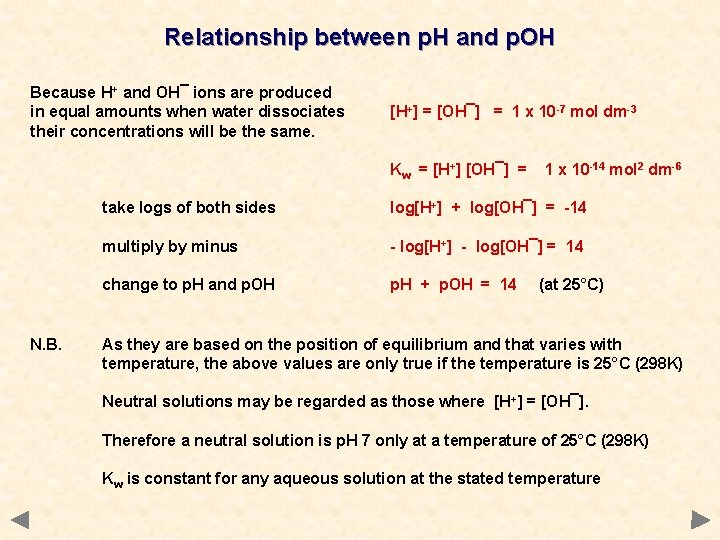
Relationship between p. H and p. OH Because H+ and OH¯ ions are produced in equal amounts when water dissociates their concentrations will be the same. [H+] = [OH¯] = 1 x 10 -7 mol dm-3 Kw = [H+] [OH¯] = N. B. 1 x 10 -14 mol 2 dm-6 take logs of both sides log[H+] + log[OH¯] = -14 multiply by minus - log[H+] - log[OH¯] = 14 change to p. H and p. OH p. H + p. OH = 14 (at 25°C) As they are based on the position of equilibrium and that varies with temperature, the above values are only true if the temperature is 25°C (298 K) Neutral solutions may be regarded as those where [H+] = [OH¯]. Therefore a neutral solution is p. H 7 only at a temperature of 25°C (298 K) Kw is constant for any aqueous solution at the stated temperature
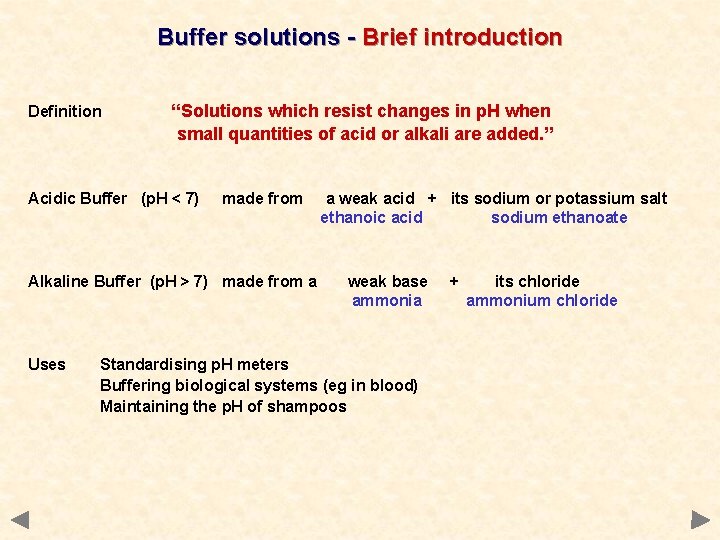
Buffer solutions - Brief introduction Definition “Solutions which resist changes in p. H when small quantities of acid or alkali are added. ” Acidic Buffer (p. H < 7) made from Alkaline Buffer (p. H > 7) made from a Uses a weak acid + its sodium or potassium salt ethanoic acid sodium ethanoate weak base ammonia Standardising p. H meters Buffering biological systems (eg in blood) Maintaining the p. H of shampoos + its chloride ammonium chloride
- Slides: 23