
AcidBase Titration and p H l Aqueous Solution
Acid-Base Titration and p. H l Aqueous Solution and the Concept of p. H – Hydronium Ions and Hydroxide Ions – The p. H Scale – Calculating Involving p. H l Determining p. H and Titrations – Indicators and p. H Meters – Titration – Molarity and Titration
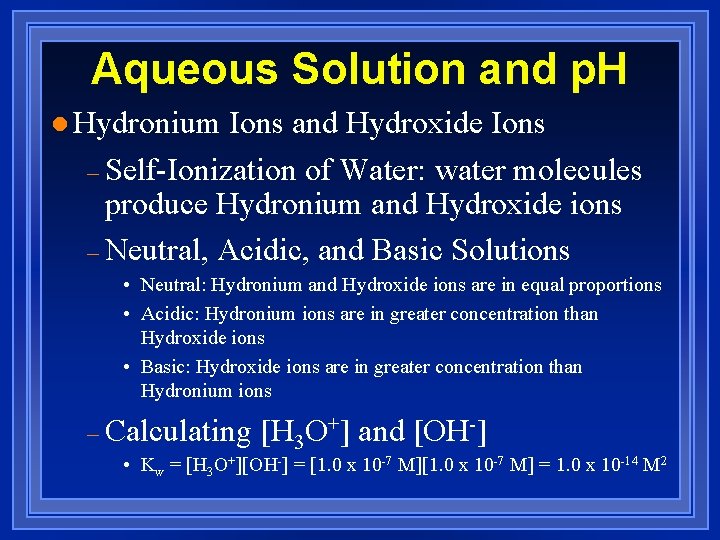
Aqueous Solution and p. H l Hydronium Ions and Hydroxide Ions – Self-Ionization of Water: water molecules produce Hydronium and Hydroxide ions – Neutral, Acidic, and Basic Solutions • Neutral: Hydronium and Hydroxide ions are in equal proportions • Acidic: Hydronium ions are in greater concentration than Hydroxide ions • Basic: Hydroxide ions are in greater concentration than Hydronium ions – Calculating [H 3 O+] and [OH-] • Kw = [H 3 O+][OH-] = [1. 0 x 10 -7 M] = 1. 0 x 10 -14 M 2
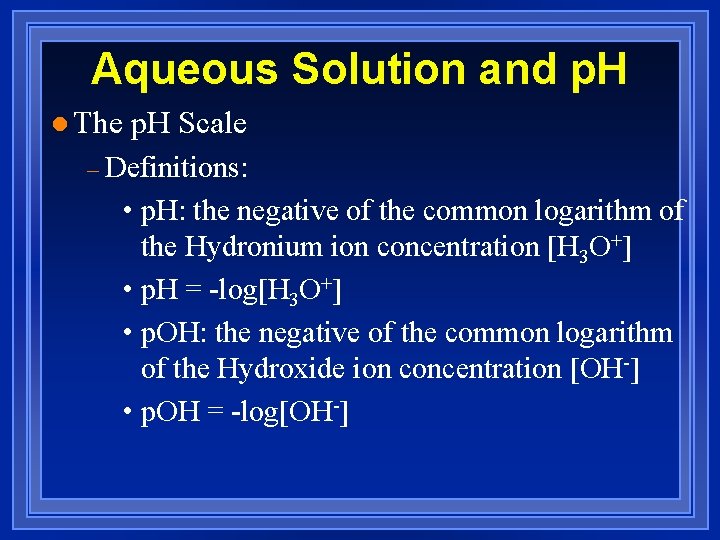
Aqueous Solution and p. H l The p. H Scale – Definitions: • p. H: the negative of the common logarithm of the Hydronium ion concentration [H 3 O+] • p. H = -log[H 3 O+] • p. OH: the negative of the common logarithm of the Hydroxide ion concentration [OH-] • p. OH = -log[OH-]
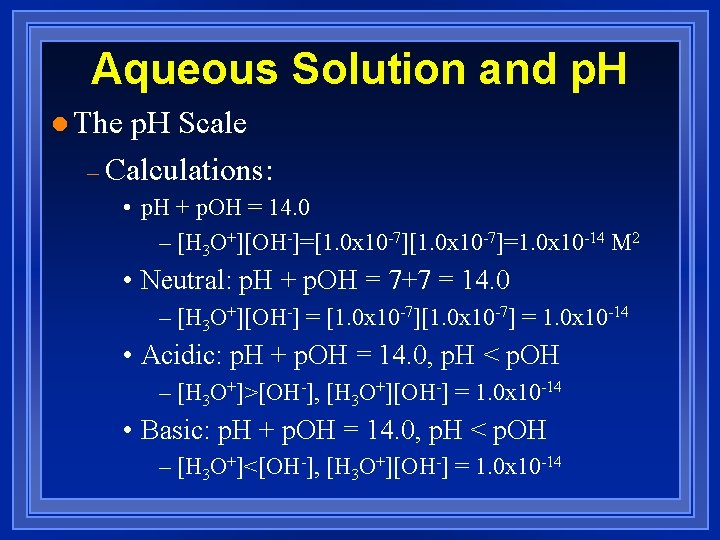
Aqueous Solution and p. H l The p. H Scale – Calculations: • p. H + p. OH = 14. 0 – [H 3 O+][OH-]=[1. 0 x 10 -7]=1. 0 x 10 -14 M 2 • Neutral: p. H + p. OH = 7+7 = 14. 0 – [H 3 O+][OH-] = [1. 0 x 10 -7] = 1. 0 x 10 -14 • Acidic: p. H + p. OH = 14. 0, p. H < p. OH – [H 3 O+]>[OH-], [H 3 O+][OH-] = 1. 0 x 10 -14 • Basic: p. H + p. OH = 14. 0, p. H < p. OH – [H 3 O+]<[OH-], [H 3 O+][OH-] = 1. 0 x 10 -14
Acid-Base Titration and p. H l Calculating Involving p. H • There as many numbers to the right of the decimal as in the logarithmic quantity – Calculating p. H from [H 3 O+] • Use the negative of the exponent to determine the p. H – Calculate p. H from [H 3 O+] using a calculator – Calculating [H 3 O+] and [OH-] from p. H – p. H calculations measure the strength of Acids and Bases
Acid-Base Titration and p. H l Determining p. H and Titrations – Indicators and p. H Meters – Titration – Molarity and Titration
Determining p. H and Titrations l Indicators and p. H Meters – Acid Base indicators: compounds that change color in response to p. H – Transitional Interval: the p. H range over which an indicator changes color – p. H Meter: determines the p. H of a solution by measuring the voltage between electrodes
Determining p. H and Titrations l Titration – Titration: the controlled addition and measurement of the amount of a solution of a known concentration required to react completely with a measured amount of a solution of unknown concentration. – Equivalence Point: when two titration solutions are in chemically equivalent amounts – End Point: when an indicator within a titration changes color
Determining p. H and Titrations l Molarity and Titration – Standard Solution: The solution that contains the precisely known concentration of solute – Primary Standard: The highly purified solid used to check the concentration of a standard
- Slides: 9