
AcidBase p H and p OH What is
Acid/Base: p. H and p. OH
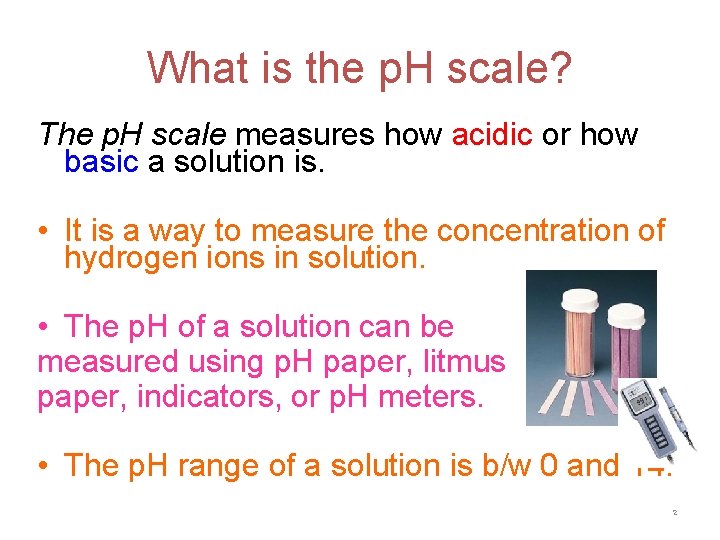
What is the p. H scale? The p. H scale measures how acidic or how basic a solution is. • It is a way to measure the concentration of hydrogen ions in solution. • The p. H of a solution can be measured using p. H paper, litmus paper, indicators, or p. H meters. • The p. H range of a solution is b/w 0 and 14. 2
• The p. H of water is 7. 0. Any solution with a p. H of 7 contains equal concentrations of H+ and OH- and is considered a neutral solution. • The p. H of an acid solution is less than 7. 0. It contains more H+ than OH-. – A lower number indicates more hydrogen ions. • The p. H of a base solution is greater than 7. 0. It contains less H+ than OH-. – A higher number indicates more OH- ions. 3
![Calculating p. H and p. OH Use the formulas: p. H = -log[H+] p.](http://slidetodoc.com/presentation_image_h2/4b8ded15795c0c95118090e0d379ecf4/image-4.jpg "Calculating p. H and p. OH Use the formulas: p. H = -log[H+] p.")
Calculating p. H and p. OH Use the formulas: p. H = -log[H+] p. OH = -log[OH-] p. H + p. OH = 14. 0 [H+] = 10 -p. H [OH-] = 10 -p. OH
![Guided Problem 1. What is the [H+] of an Na. OH solution if the](http://slidetodoc.com/presentation_image_h2/4b8ded15795c0c95118090e0d379ecf4/image-5.jpg "Guided Problem 1. What is the [H+] of an Na. OH solution if the")
Guided Problem 1. What is the [H+] of an Na. OH solution if the p. OH is measured to be 6. 5? 2. What is the p. H of a solution that has a [OH-] of 5. 8 x 10 -9 ?

Neutralization and Buffers • Neutralization Reaction - Acids react with bases to form water and a salt. – In forming water, both hydrogen ions and hydroxide ions are equal in solution, therefore it is neutral • Buffers – solutions containing ions that react with additional acids and bases to minimize their effects on p. H. – Blood plasma acts as a buffer to keep your blood p. H to be about 7. 4 6
Titrations • Lab technique where an acid/base of known molarity (titrant) is added to a known volume of acid/base with unknown molarity • At point of neutralization, the indicator will change color • You can use the now known volume and molarity of titrant to calculate molarity of unknown solution (using Ma. Va = Mb. Vb

Titration Setup
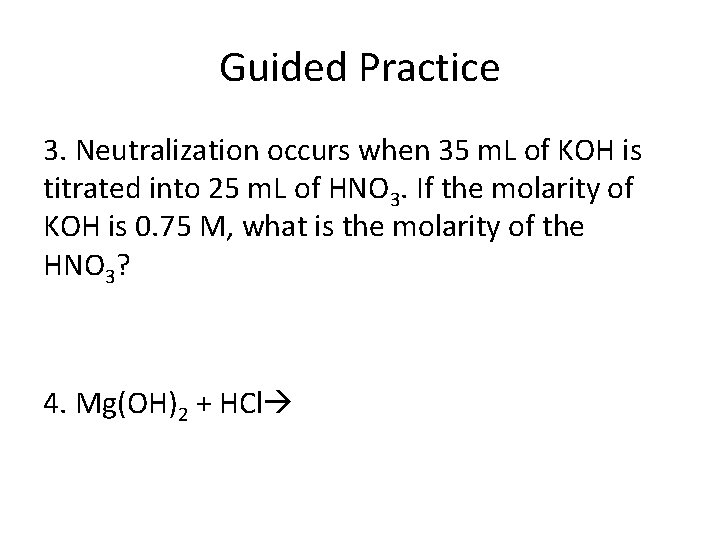
Guided Practice 3. Neutralization occurs when 35 m. L of KOH is titrated into 25 m. L of HNO 3. If the molarity of KOH is 0. 75 M, what is the molarity of the HNO 3? 4. Mg(OH)2 + HCl
- Slides: 9