
AcidBase Equilibria Chapter 15 The common ion effect
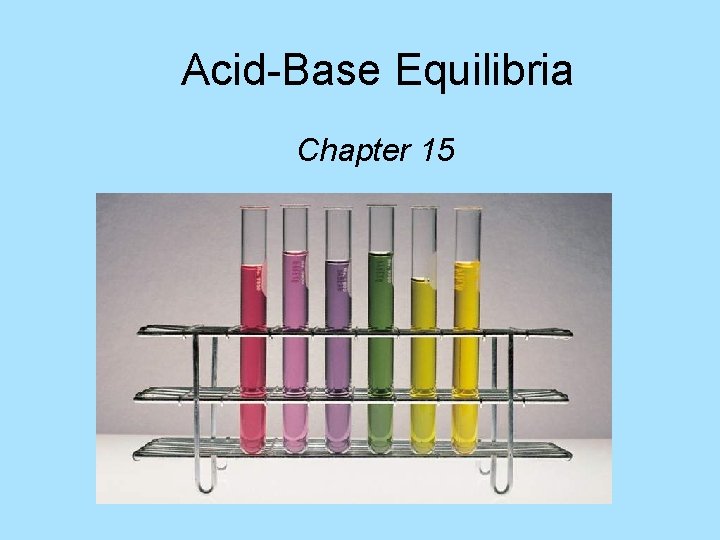
Acid-Base Equilibria Chapter 15
The common ion effect is the shift in equilibrium caused by the addition of a compound having an ion in common with the dissolved substance. The presence of a common ion suppresses the ionization of a weak acid or a weak base. HF(aq) + H 2 O(l) H 3 O+(aq) + F-(aq) • Addition of Na. F will shift the equilibrium to the left _______because of the addition of F-, which is already involved in the equilibrium reaction. • A solution of HF and Na. F is less acidic than a solution of HF alone. 2
A buffer solution is a solution of: 1. A weak acid and its salt or a weak base and its salt 2. A buffer must contain relatively large concentration of acid to react with added base (OH-) and must also contain similar concentration of base to react with added acid (H+). A buffer solution has the ability to resist changes in p. H upon the addition of small amounts of either acid or base. 16. 3
Which of the following are buffer systems? (a) KF/HF (b) KBr/HBr (c) Na 2 CO 3/Na. HCO 3 (d) Na. Cl. O 4/HCl. O 4 (e) NH 3/NH 4 NO 3 Answer (a) HF is a weak acid and KF is its salt. Therefore, this is a buffer system. (b) HBr is a strong acid and hence this is not a buffer system. (c) Na. HCO 3 contains a weak acid (HCO 3 -) and Na 2 CO 3 is a salt of weak acid. Therefore, this is a buffer system. (d) HCl. O 4 is a strong acid and hence this is not a buffer system. (e) NH 3 is a weak base and NH 4 NO 3 is a salt of weak base, and therefore this is a buffer system. Make a buffer 16. 3
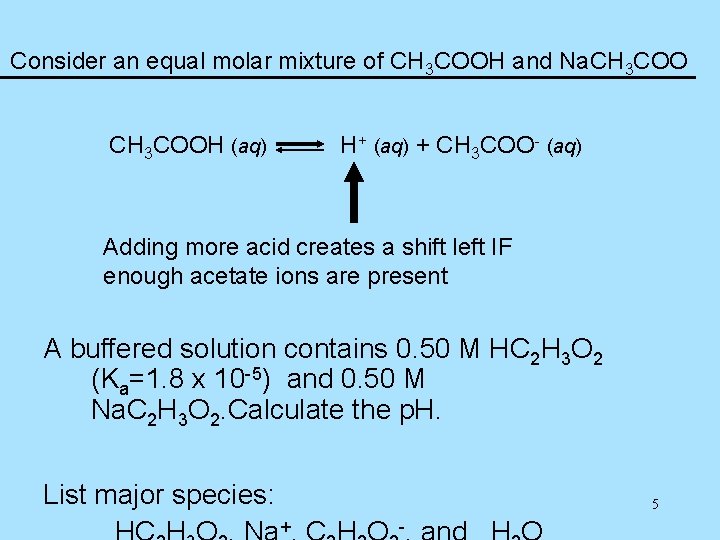
Consider an equal molar mixture of CH 3 COOH and Na. CH 3 COOH (aq) H+ (aq) + CH 3 COO- (aq) Adding more acid creates a shift left IF enough acetate ions are present A buffered solution contains 0. 50 M HC 2 H 3 O 2 (Ka=1. 8 x 10 -5) and 0. 50 M Na. C 2 H 3 O 2. Calculate the p. H. List major species: 5 + -
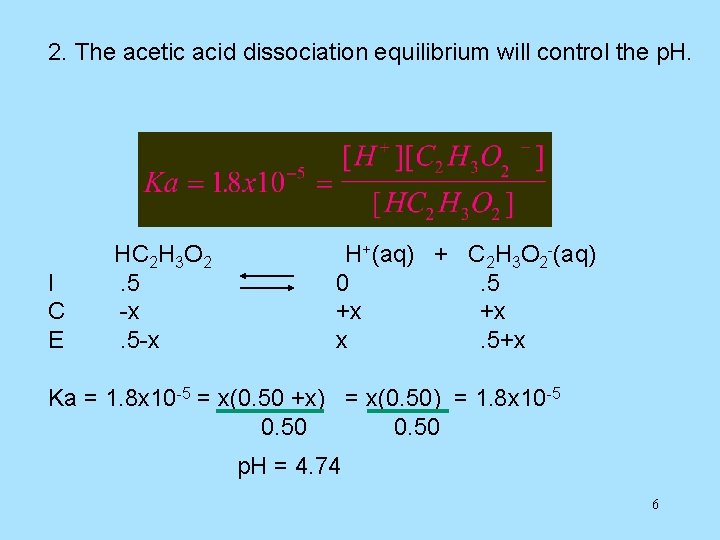
2. The acetic acid dissociation equilibrium will control the p. H. I C E HC 2 H 3 O 2. 5 -x. 5 -x H+(aq) + C 2 H 3 O 2 -(aq) 0. 5 +x +x x. 5+x Ka = 1. 8 x 10 -5 = x(0. 50 +x) = x(0. 50) = 1. 8 x 10 -5 0. 50 p. H = 4. 74 6
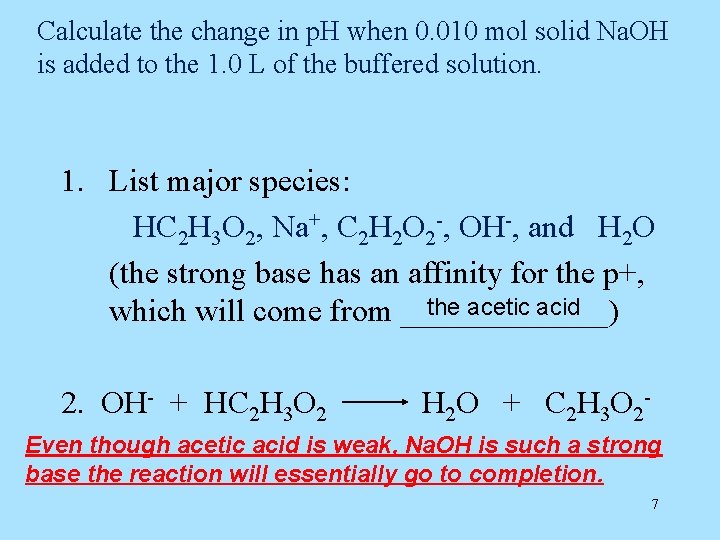
Calculate the change in p. H when 0. 010 mol solid Na. OH is added to the 1. 0 L of the buffered solution. 1. List major species: HC 2 H 3 O 2, Na+, C 2 H 2 O 2 -, OH-, and H 2 O (the strong base has an affinity for the p+, the acetic acid which will come from _______) 2. OH- + HC 2 H 3 O 2 H 2 O + C 2 H 3 O 2 - Even though acetic acid is weak, Na. OH is such a strong base the reaction will essentially go to completion. 7
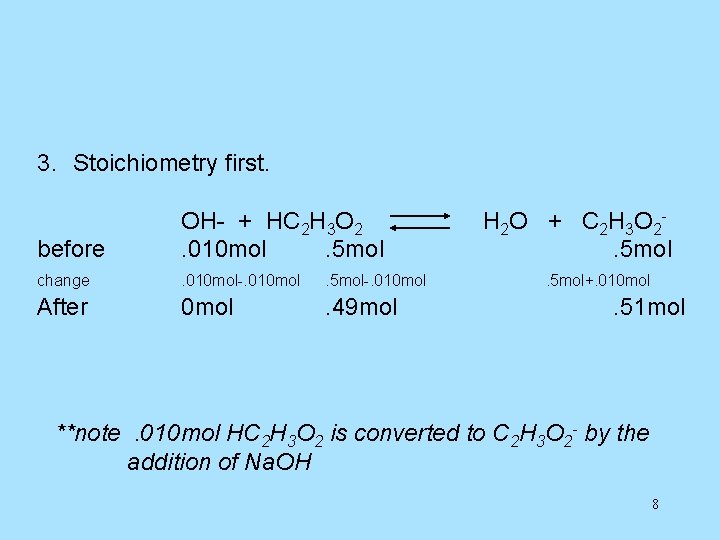
3. Stoichiometry first. before OH- + HC 2 H 3 O 2. 010 mol. 5 mol change . 010 mol-. 010 mol . 5 mol-. 010 mol After 0 mol . 49 mol H 2 O + C 2 H 3 O 2. 5 mol+. 010 mol . 51 mol **note. 010 mol HC 2 H 3 O 2 is converted to C 2 H 3 O 2 - by the addition of Na. OH 8
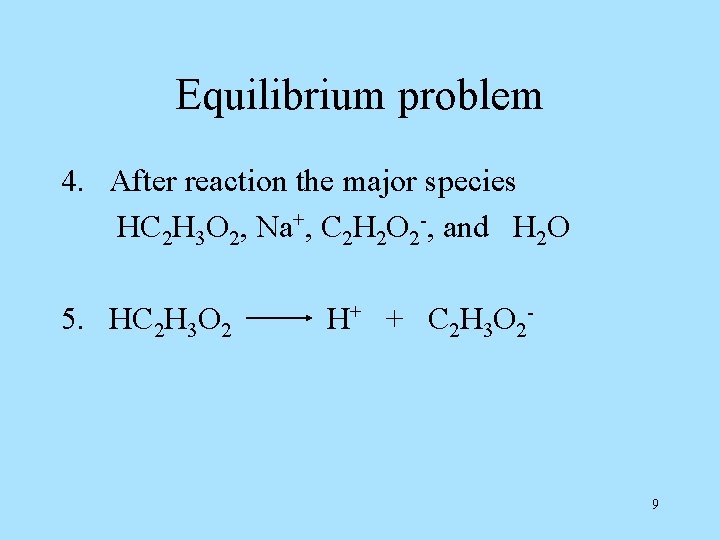
Equilibrium problem 4. After reaction the major species HC 2 H 3 O 2, Na+, C 2 H 2 O 2 -, and H 2 O 5. HC 2 H 3 O 2 H+ + C 2 H 3 O 2 - 9
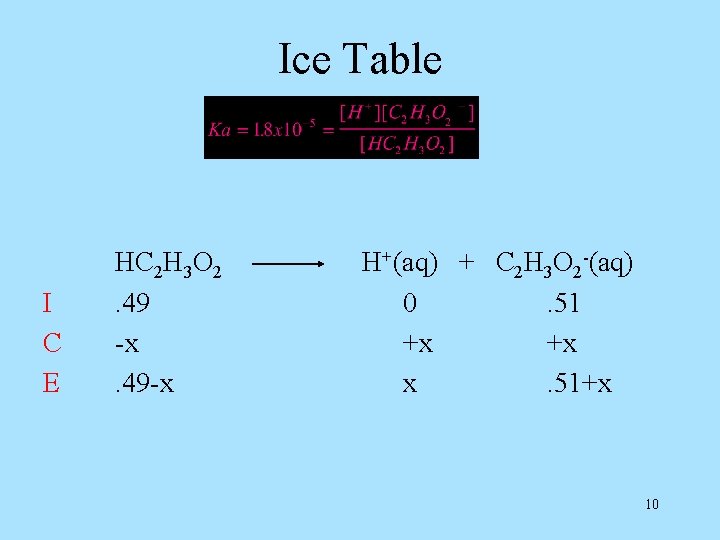
Ice Table I C E HC 2 H 3 O 2. 49 -x. 49 -x H+(aq) + C 2 H 3 O 2 -(aq) 0. 51 +x +x x. 51+x 10
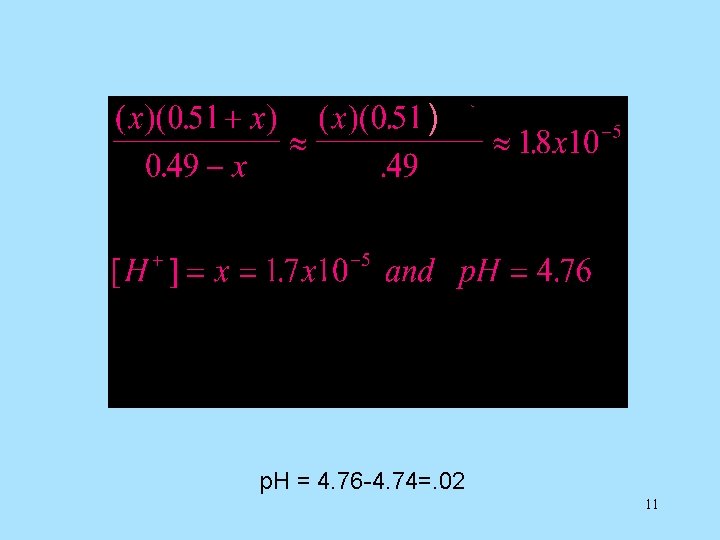
) Δp. H=. 02 p. H = 4. 76 -4. 74=. 02 11
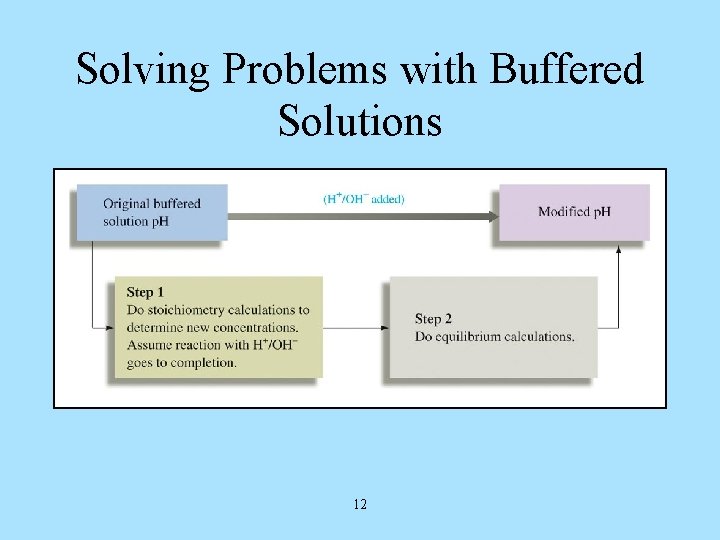
Solving Problems with Buffered Solutions 12

Buffers 13
Adding an Acid to a Buffer 14
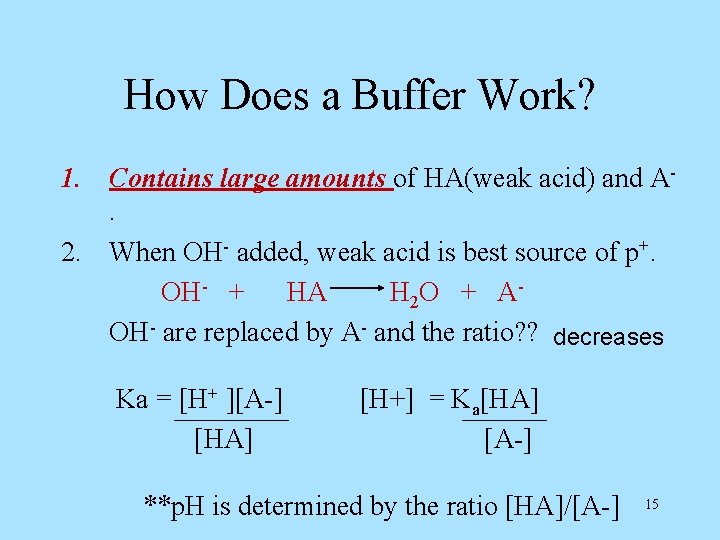
How Does a Buffer Work? 1. Contains large amounts of HA(weak acid) and A. 2. When OH- added, weak acid is best source of p+. OH- + HA H 2 O + AOH- are replaced by A- and the ratio? ? decreases Ka = [H+ ][A-] [HA] [H+] = Ka[HA] [A-] **p. H is determined by the ratio [HA]/[A-] 15
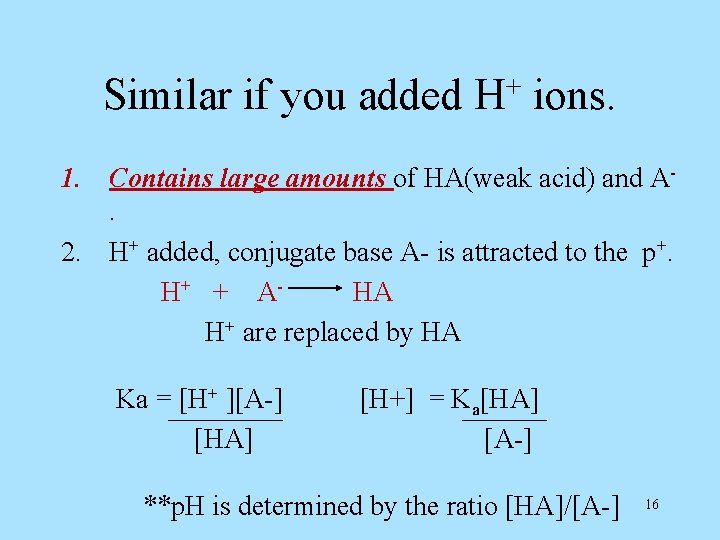
Similar if you added + H ions. 1. Contains large amounts of HA(weak acid) and A. 2. H+ added, conjugate base A- is attracted to the p+. H+ + A HA H+ are replaced by HA Ka = [H+ ][A-] [HA] [H+] = Ka[HA] [A-] **p. H is determined by the ratio [HA]/[A-] 16
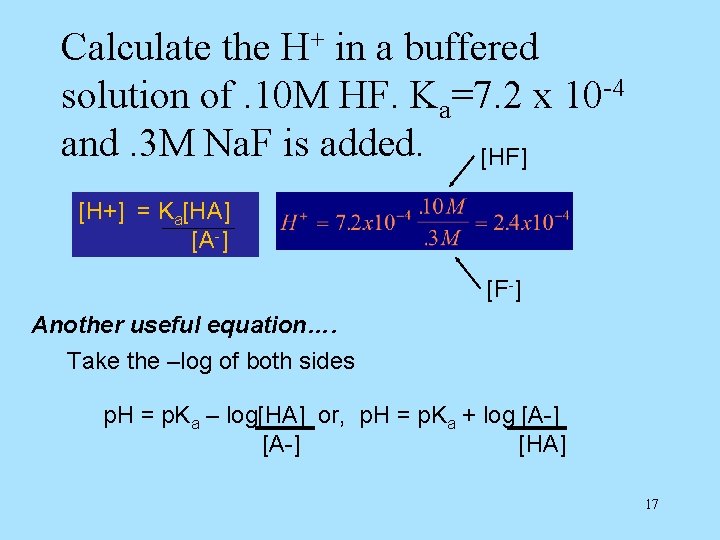
Calculate the H+ in a buffered solution of. 10 M HF. Ka=7. 2 x 10 -4 and. 3 M Na. F is added. [HF] [H+] = Ka[HA] [A-] [F-] Another useful equation…. Take the –log of both sides p. H = p. Ka – log[HA] or, p. H = p. Ka + log [A-] [HA] 17
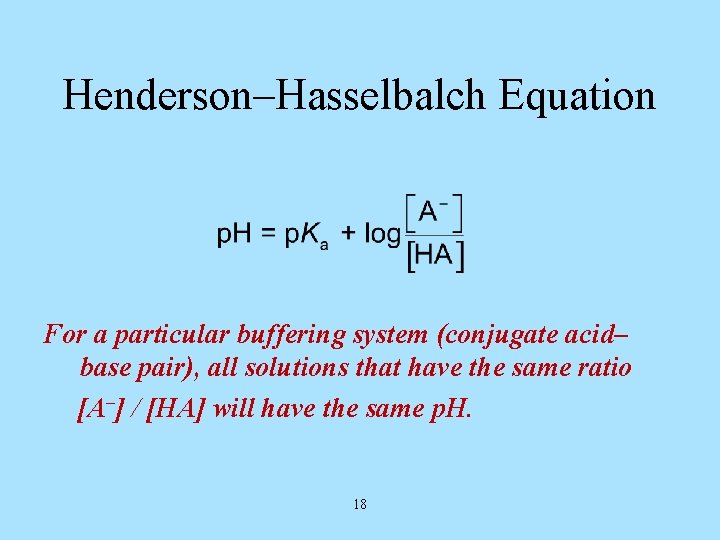
Henderson–Hasselbalch Equation For a particular buffering system (conjugate acid– base pair), all solutions that have the same ratio [A–] / [HA] will have the same p. H. 18
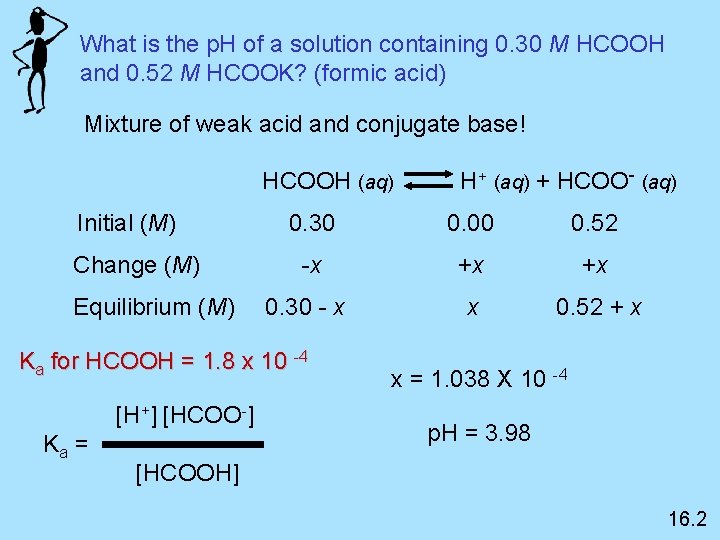
What is the p. H of a solution containing 0. 30 M HCOOH and 0. 52 M HCOOK? (formic acid) Mixture of weak acid and conjugate base! HCOOH (aq) Initial (M) Change (M) Equilibrium (M) 0. 30 0. 00 0. 52 -x +x +x 0. 30 - x x 0. 52 + x Ka for HCOOH = 1. 8 x 10 -4 [H+] [HCOO-] Ka = H+ (aq) + HCOO- (aq) x = 1. 038 X 10 -4 p. H = 3. 98 [HCOOH] 16. 2
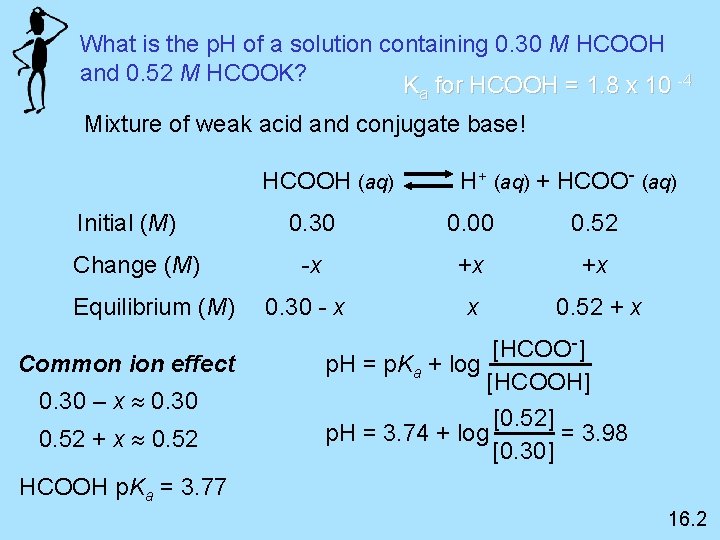
What is the p. H of a solution containing 0. 30 M HCOOH and 0. 52 M HCOOK? Ka for HCOOH = 1. 8 x 10 -4 Mixture of weak acid and conjugate base! HCOOH (aq) Initial (M) Change (M) Equilibrium (M) Common ion effect 0. 30 – x 0. 30 0. 52 + x 0. 52 H+ (aq) + HCOO- (aq) 0. 30 0. 00 0. 52 -x +x +x 0. 30 - x x 0. 52 + x [HCOO-] p. H = p. Ka + log [HCOOH] [0. 52] = 3. 98 p. H = 3. 74 + log [0. 30] HCOOH p. Ka = 3. 77 16. 2
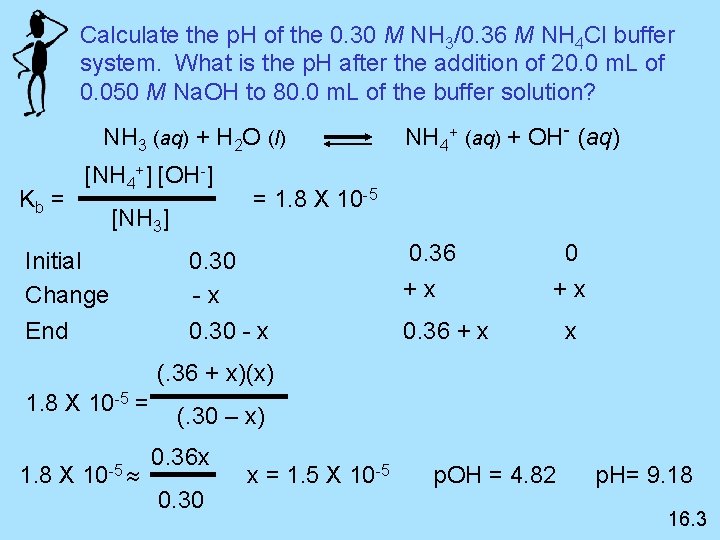
Calculate the p. H of the 0. 30 M NH 3/0. 36 M NH 4 Cl buffer system. What is the p. H after the addition of 20. 0 m. L of 0. 050 M Na. OH to 80. 0 m. L of the buffer solution? NH 3 (aq) + H 2 O (l) Kb = [NH 4+] [OH-] [NH 3] Initial Change End NH 4+ (aq) + OH- (aq) = 1. 8 X 10 -5 0. 30 -x 0. 30 - x 0. 36 +x 0. 36 + x x (. 36 + x)(x) 1. 8 X 10 -5 = 1. 8 X 10 -5 (. 30 – x) 0. 36 x 0. 30 x = 1. 5 X 10 -5 p. OH = 4. 82 p. H= 9. 18 16. 3
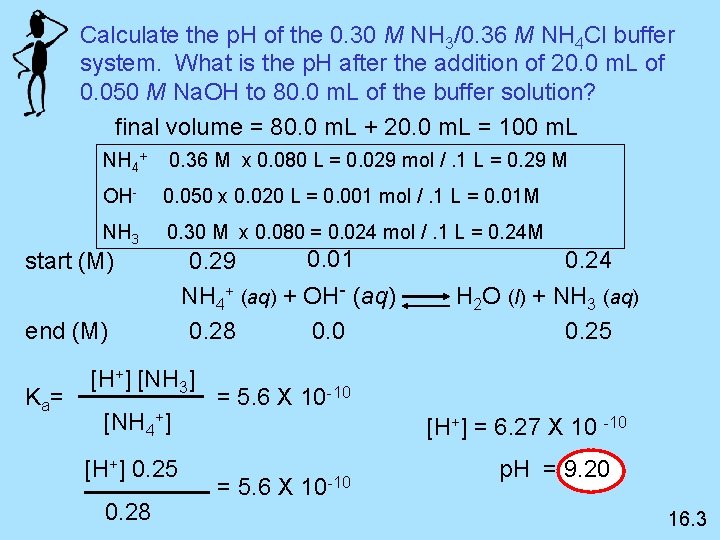
Calculate the p. H of the 0. 30 M NH 3/0. 36 M NH 4 Cl buffer system. What is the p. H after the addition of 20. 0 m. L of 0. 050 M Na. OH to 80. 0 m. L of the buffer solution? final volume = 80. 0 m. L + 20. 0 m. L = 100 m. L NH 4+ 0. 36 M x 0. 080 L = 0. 029 mol /. 1 L = 0. 29 M OH- 0. 050 x 0. 020 L = 0. 001 mol /. 1 L = 0. 01 M NH 3 0. 30 M x 0. 080 = 0. 024 mol /. 1 L = 0. 24 M start (M) end (M) K a= 0. 01 0. 29 NH 4+ (aq) + OH- (aq) 0. 28 0. 0 [H+] [NH 3] [NH 4+] [H+] 0. 25 0. 28 0. 24 H 2 O (l) + NH 3 (aq) 0. 25 = 5. 6 X 10 -10 [H+] = 6. 27 X 10 -10 = 5. 6 X 10 -10 p. H = 9. 20 16. 3
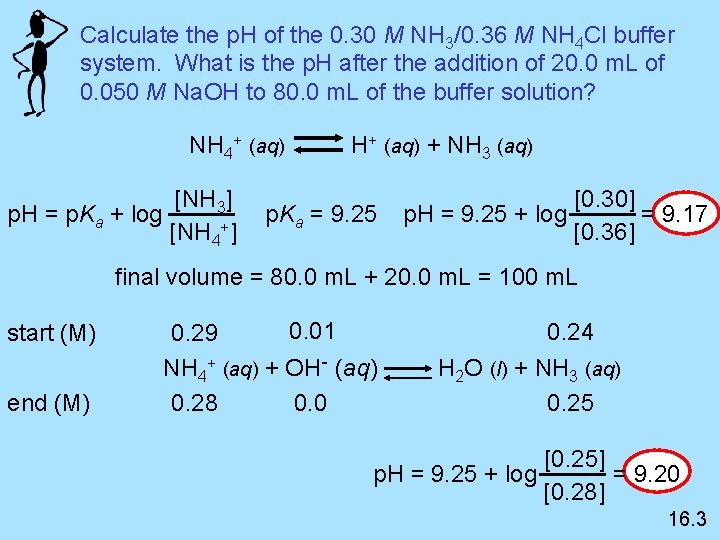
Calculate the p. H of the 0. 30 M NH 3/0. 36 M NH 4 Cl buffer system. What is the p. H after the addition of 20. 0 m. L of 0. 050 M Na. OH to 80. 0 m. L of the buffer solution? NH 4+ (aq) [NH 3] p. H = p. Ka + log [NH 4+] H+ (aq) + NH 3 (aq) p. Ka = 9. 25 [0. 30] p. H = 9. 25 + log = 9. 17 [0. 36] final volume = 80. 0 m. L + 20. 0 m. L = 100 m. L start (M) end (M) 0. 01 0. 29 NH 4+ (aq) + OH- (aq) 0. 28 0. 0 0. 24 H 2 O (l) + NH 3 (aq) 0. 25 [0. 25] p. H = 9. 25 + log = 9. 20 [0. 28] 16. 3
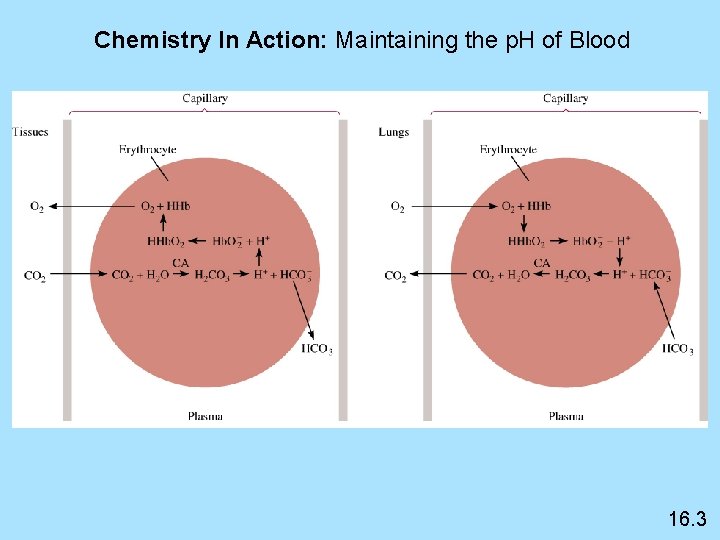
Chemistry In Action: Maintaining the p. H of Blood 16. 3
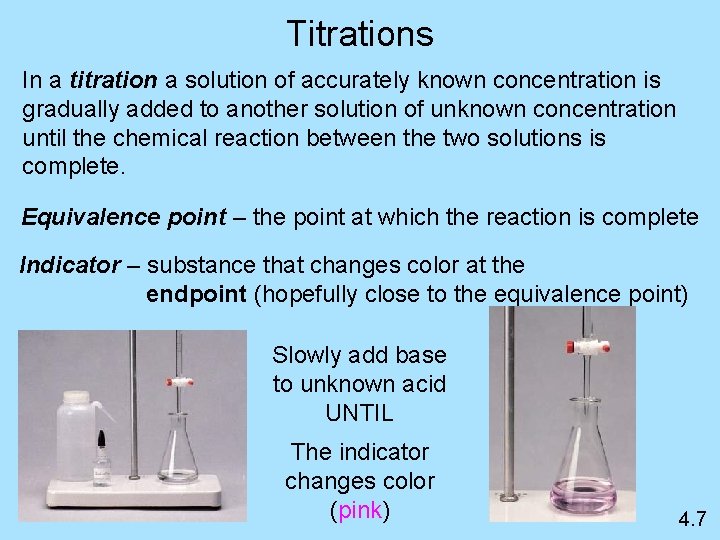
Titrations In a titration a solution of accurately known concentration is gradually added to another solution of unknown concentration until the chemical reaction between the two solutions is complete. Equivalence point – the point at which the reaction is complete Indicator – substance that changes color at the endpoint (hopefully close to the equivalence point) Slowly add base to unknown acid UNTIL The indicator changes color (pink) 4. 7
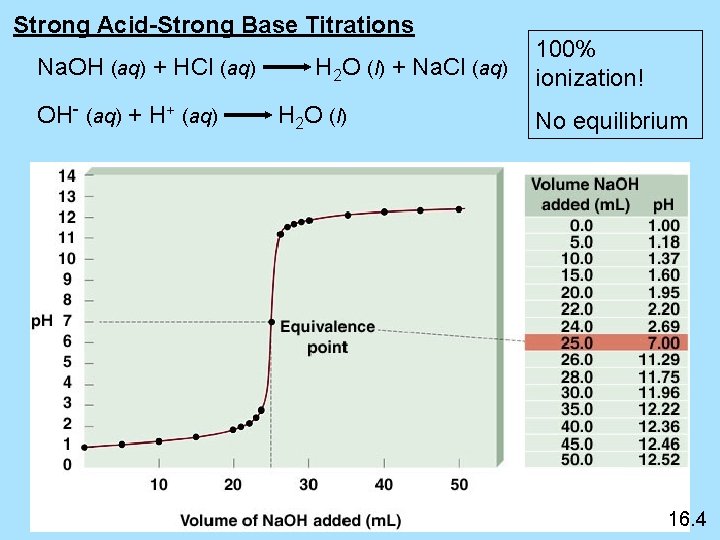
Strong Acid-Strong Base Titrations Na. OH (aq) + HCl (aq) OH- (aq) + H+ (aq) H 2 O (l) + Na. Cl (aq) H 2 O (l) 100% ionization! No equilibrium 16. 4
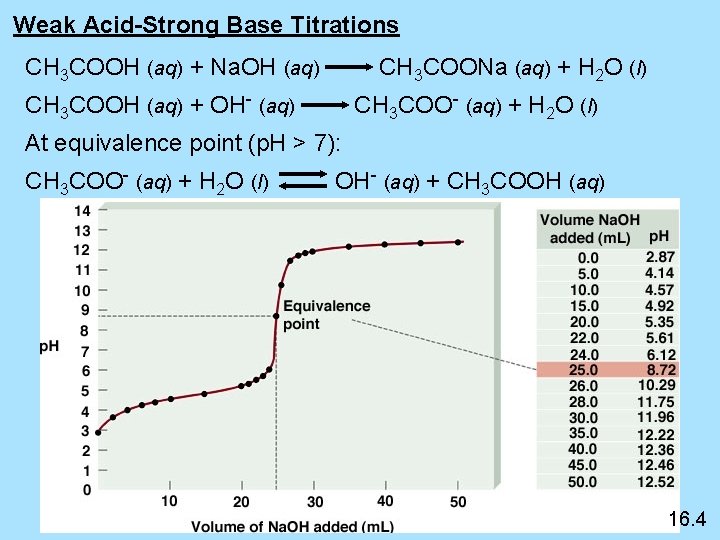
Weak Acid-Strong Base Titrations CH 3 COOH (aq) + Na. OH (aq) CH 3 COONa (aq) + H 2 O (l) CH 3 COOH (aq) + OH- (aq) CH 3 COO- (aq) + H 2 O (l) At equivalence point (p. H > 7): CH 3 COO- (aq) + H 2 O (l) OH- (aq) + CH 3 COOH (aq) 16. 4
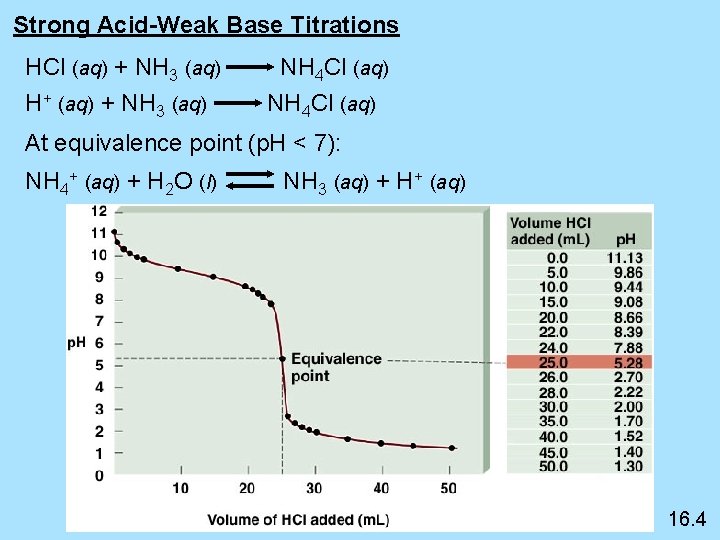
Strong Acid-Weak Base Titrations HCl (aq) + NH 3 (aq) H+ (aq) + NH 3 (aq) NH 4 Cl (aq) At equivalence point (p. H < 7): NH 4+ (aq) + H 2 O (l) NH 3 (aq) + H+ (aq) 16. 4
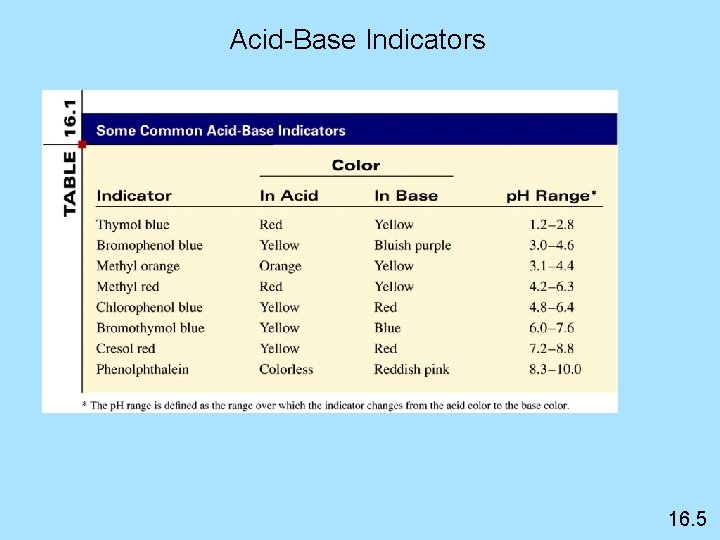
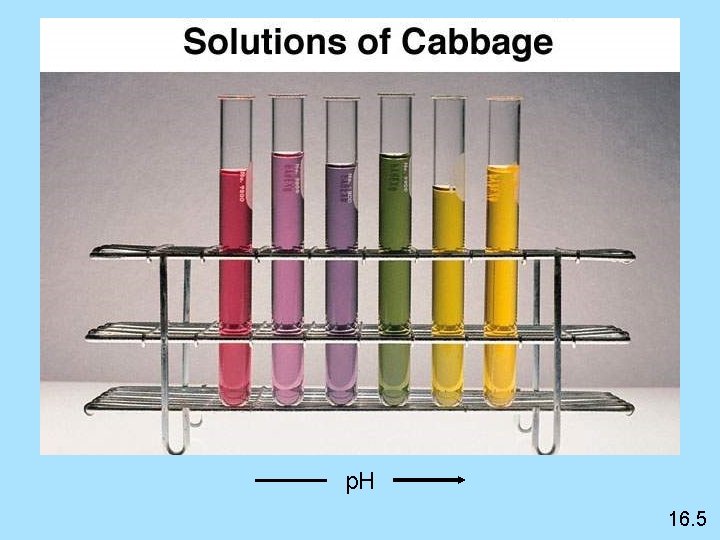
Acid-Base Indicators 16. 5
p. H 16. 5
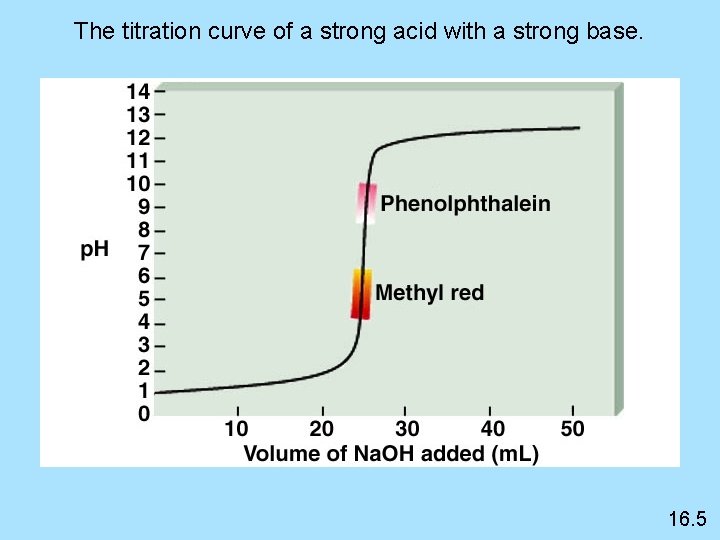
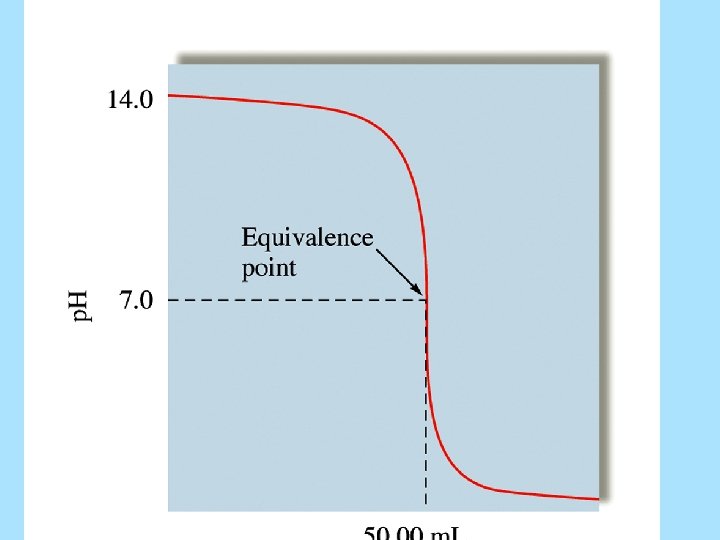
The titration curve of a strong acid with a strong base. 16. 5
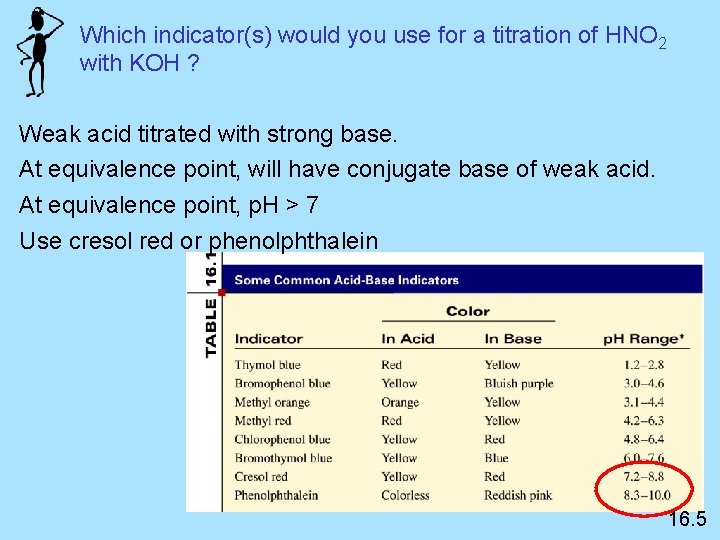
Which indicator(s) would you use for a titration of HNO 2 with KOH ? Weak acid titrated with strong base. At equivalence point, will have conjugate base of weak acid. At equivalence point, p. H > 7 Use cresol red or phenolphthalein 16. 5
Finding the Equivalence Point (calculation method) • Strong Acid vs. Strong Base – 100 % ionized! p. H = 7 No equilibrium! • Weak Acid vs. Strong Base – Acid is neutralized; Need Kb for conjugate base equilibrium • Strong Acid vs. Weak Base – Base is neutralized; Need Ka for conjugate acid equilibrium • Weak Acid vs. Weak Base – Depends on the strength of both; could be conjugate acid, conjugate base, or p. H 7
Weak Acid - Strong Base Titration Step 1 - A stoichiometry problem - reaction is assumed to run to completion - then determine remaining species. Step 2 - An equilibrium problem - determine position of weak acid equilibrium and calculate p. H. 34
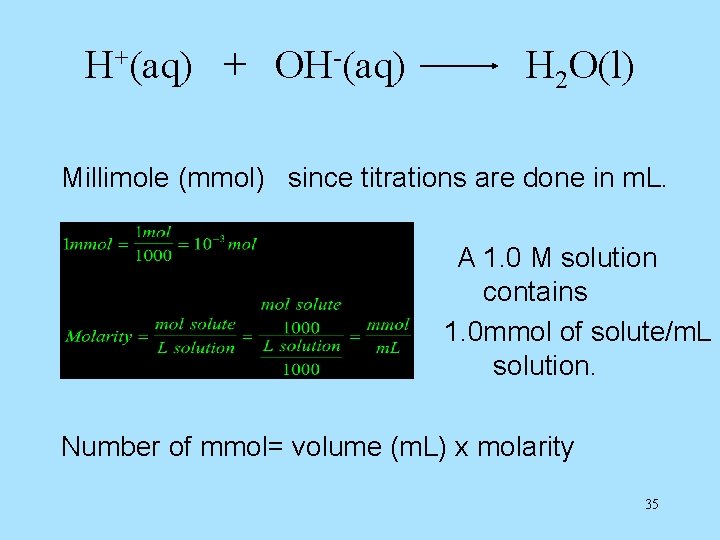
H+(aq) + OH-(aq) H 2 O(l) Millimole (mmol) since titrations are done in m. L. contains A 1. 0 M solution contains 1. 0 mmol of solute/m. L solution. Number of mmol= volume (m. L) x molarity 35
Strong Acid-Strong Base Titration of 50. 0 m. L of 0. 200 M HNO 3 with 0. 100 M Na. OH. Calculate the p. H when 0. 100 M Na. OH has been added. a. no Na. OH added b. 10. 0 m. L Na. OH c. 20. 0 m. L Na. OH d. 50. 0 m. L Na. OH e. 100. 0 m. L Na. OH 36
a) 0 Na. OH Strong acid goes to completion. 1) [H+] =. 200 M and p. H =. 699 37
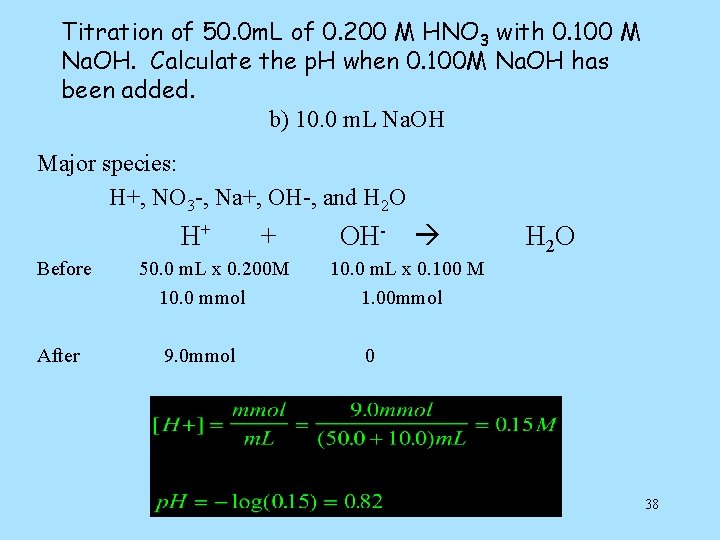
Titration of 50. 0 m. L of 0. 200 M HNO 3 with 0. 100 M Na. OH. Calculate the p. H when 0. 100 M Na. OH has been added. b) 10. 0 m. L Na. OH Major species: H+, NO 3 -, Na+, OH-, and H 2 O H+ Before After + 50. 0 m. L x 0. 200 M 10. 0 mmol 9. 0 mmol OH- H 2 O 10. 0 m. L x 0. 100 M 1. 00 mmol 0 38
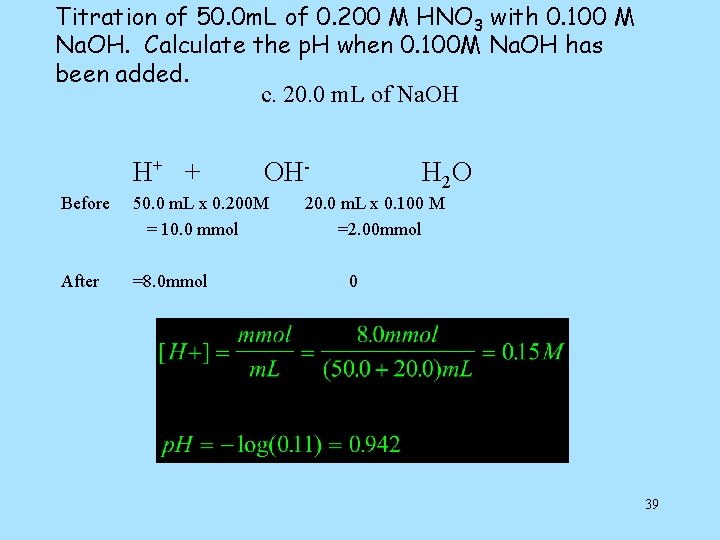
Titration of 50. 0 m. L of 0. 200 M HNO 3 with 0. 100 M Na. OH. Calculate the p. H when 0. 100 M Na. OH has been added. c. 20. 0 m. L of Na. OH H+ + OH- Before 50. 0 m. L x 0. 200 M = 10. 0 mmol After =8. 0 mmol H 2 O 20. 0 m. L x 0. 100 M =2. 00 mmol 0 39
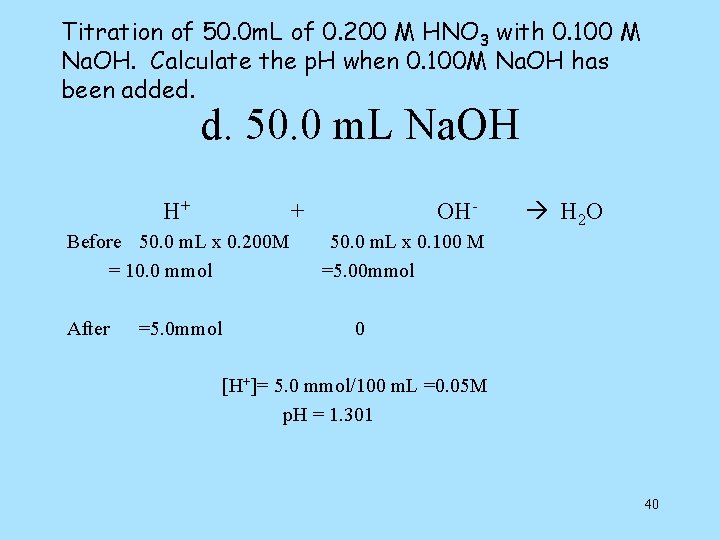
Titration of 50. 0 m. L of 0. 200 M HNO 3 with 0. 100 M Na. OH. Calculate the p. H when 0. 100 M Na. OH has been added. d. 50. 0 m. L Na. OH H+ + Before 50. 0 m. L x 0. 200 M = 10. 0 mmol After =5. 0 mmol OH- H 2 O 50. 0 m. L x 0. 100 M =5. 00 mmol 0 [H+]= 5. 0 mmol/100 m. L =0. 05 M p. H = 1. 301 40
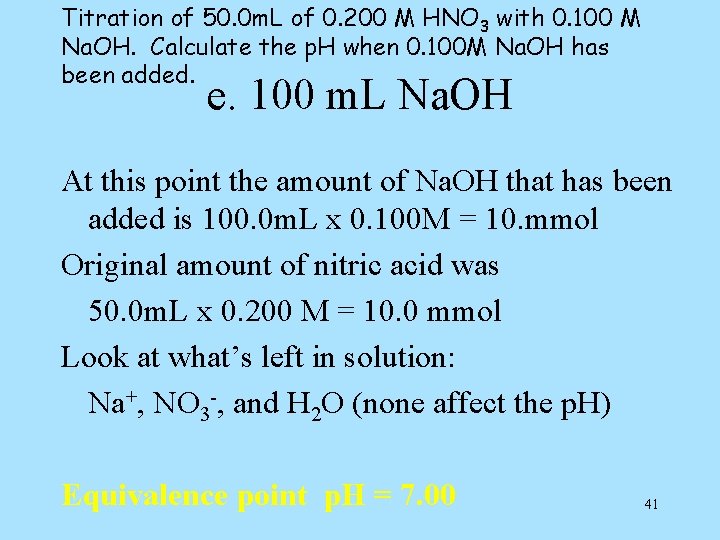
Titration of 50. 0 m. L of 0. 200 M HNO 3 with 0. 100 M Na. OH. Calculate the p. H when 0. 100 M Na. OH has been added. e. 100 m. L Na. OH At this point the amount of Na. OH that has been added is 100. 0 m. L x 0. 100 M = 10. mmol Original amount of nitric acid was 50. 0 m. L x 0. 200 M = 10. 0 mmol Look at what’s left in solution: Na+, NO 3 -, and H 2 O (none affect the p. H) Equivalence point p. H = 7. 00 41
Copyright© 2000 by Houghton Mifflin Company. All rights reserved. 42
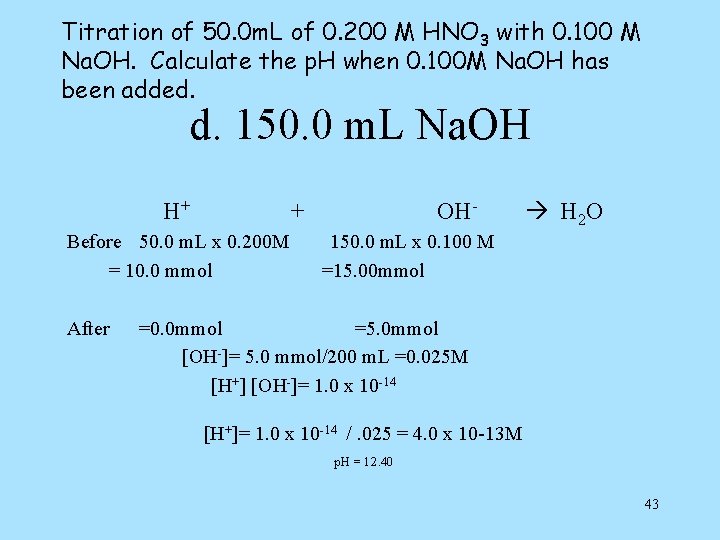
Titration of 50. 0 m. L of 0. 200 M HNO 3 with 0. 100 M Na. OH. Calculate the p. H when 0. 100 M Na. OH has been added. d. 150. 0 m. L Na. OH H+ + Before 50. 0 m. L x 0. 200 M = 10. 0 mmol After OH- H 2 O 150. 0 m. L x 0. 100 M =15. 00 mmol =0. 0 mmol =5. 0 mmol [OH-]= 5. 0 mmol/200 m. L =0. 025 M [H+] [OH-]= 1. 0 x 10 -14 [H+]= 1. 0 x 10 -14 /. 025 = 4. 0 x 10 -13 M p. H = 12. 40 43
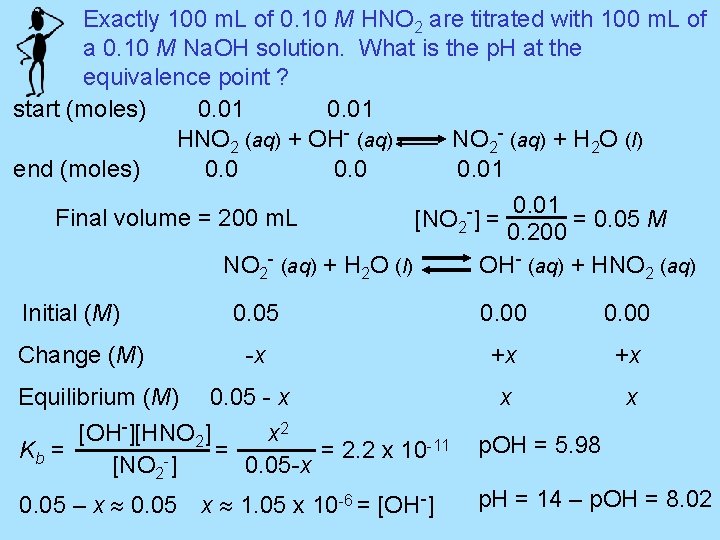
Exactly 100 m. L of 0. 10 M HNO 2 are titrated with 100 m. L of a 0. 10 M Na. OH solution. What is the p. H at the equivalence point ? start (moles) 0. 01 HNO 2 (aq) + OH- (aq) NO 2 - (aq) + H 2 O (l) end (moles) 0. 01 Final volume = 200 m. L [NO 2 -] = = 0. 05 M 0. 200 NO 2 - (aq) + H 2 O (l) OH- (aq) + HNO 2 (aq) Initial (M) Change (M) Equilibrium (M) 0. 05 0. 00 -x +x +x 0. 05 - x x x [OH-][HNO 2] x 2 -11 = 2. 2 x 10 Kb = = [NO 2 -] 0. 05 -x p. OH = 5. 98 0. 05 – x 0. 05 x 1. 05 x 10 -6 = [OH-] p. H = 14 – p. OH = 8. 02
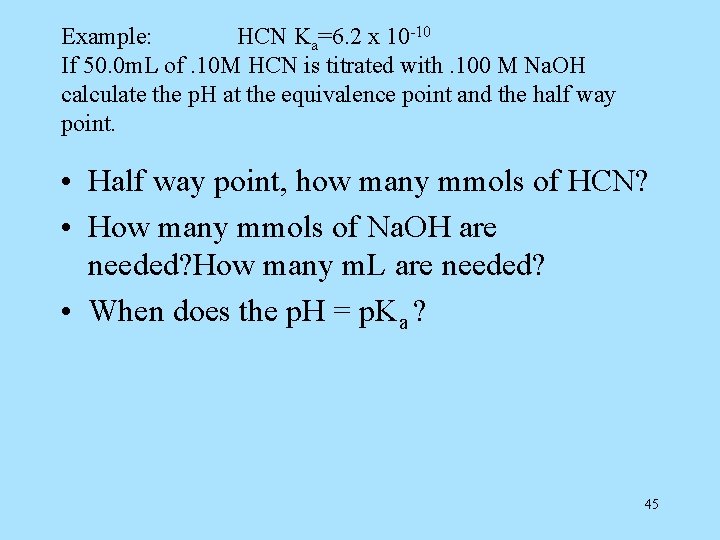
Example: HCN Ka=6. 2 x 10 -10 If 50. 0 m. L of. 10 M HCN is titrated with. 100 M Na. OH calculate the p. H at the equivalence point and the half way point. • Half way point, how many mmols of HCN? • How many mmols of Na. OH are needed? How many m. L are needed? • When does the p. H = p. Ka ? 45
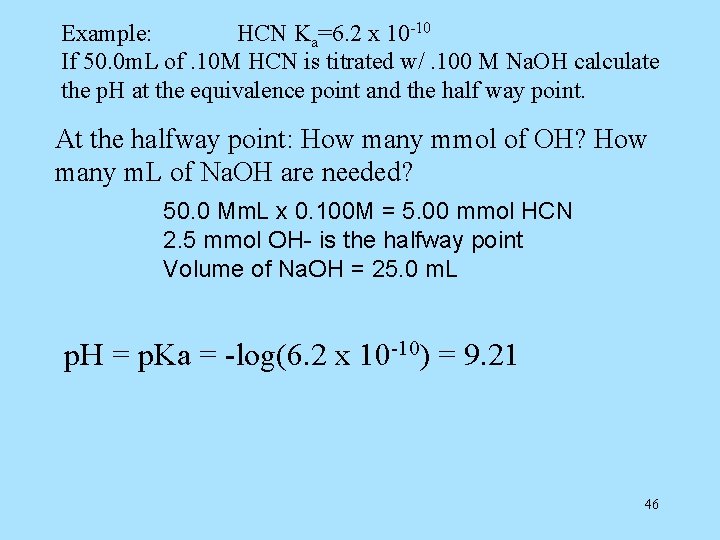
Example: HCN Ka=6. 2 x 10 -10 If 50. 0 m. L of. 10 M HCN is titrated w/. 100 M Na. OH calculate the p. H at the equivalence point and the half way point. At the halfway point: How many mmol of OH? How many m. L of Na. OH are needed? 50. 0 Mm. L x 0. 100 M = 5. 00 mmol HCN 2. 5 mmol OH- is the halfway point Volume of Na. OH = 25. 0 m. L p. H = p. Ka = -log(6. 2 x 10 -10) = 9. 21 46

Example: HCN Ka=6. 2 x 10 -10 If 50. 0 m. L of. 10 M HCN is titrated w/. 100 M Na. OH calculate the p. H at the equivalence point and the half way point. At the equivalence point: How many mmol of OH? How many m. L of Na. OH are needed? 5. 00 mmol OH- which is 50. 0 m. L Major species: CN-, Na+, H 2 O K b =Kw/Ka 1. 6 x 10 -5 = [HCN][OH-] [CN-] CN- + H 2 O HCN + OH- [OH-] = x = 8. 9 x 10 -4 [H+] = 1. 1 x 10 -11 p. H = 10. 96 47
Weak acid and a strong base • Reacts essentially to completion • The equivalence point is always greater than 7. • At the half way point [H+] = Ka p. H = p. Ka • It is the amount of acid, not the strength that determines the equivalence point. • p. H values at equivalence point is effected by acid strength • Acid strength effects the shape of the curve. 48
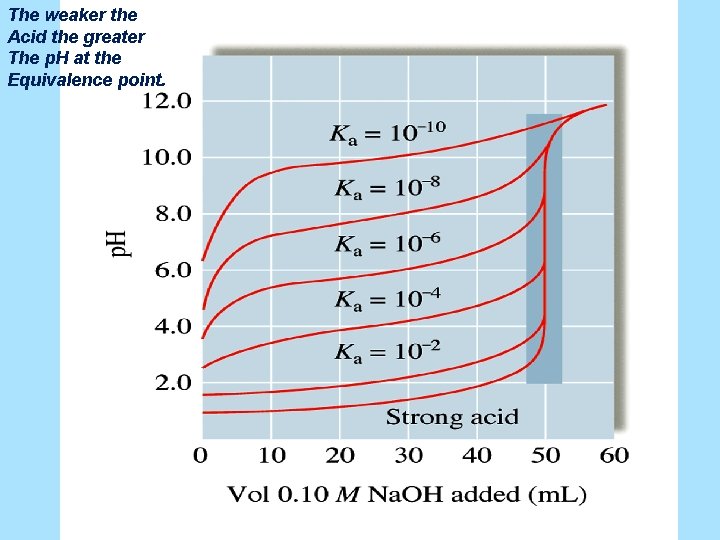
The weaker the Acid the greater The p. H at the Equivalence point. Copyright© 2000 by Houghton Mifflin Company. All rights reserved. 49
Acid-Base Indicator • . . . marks the end point of a titration by changing color. • The equivalence point is not necessarily the same as the end point. Copyright© 2000 by Houghton Mifflin Company. All rights reserved. 50

Solubility Equilibria Will it all dissolve, and if not, how much?
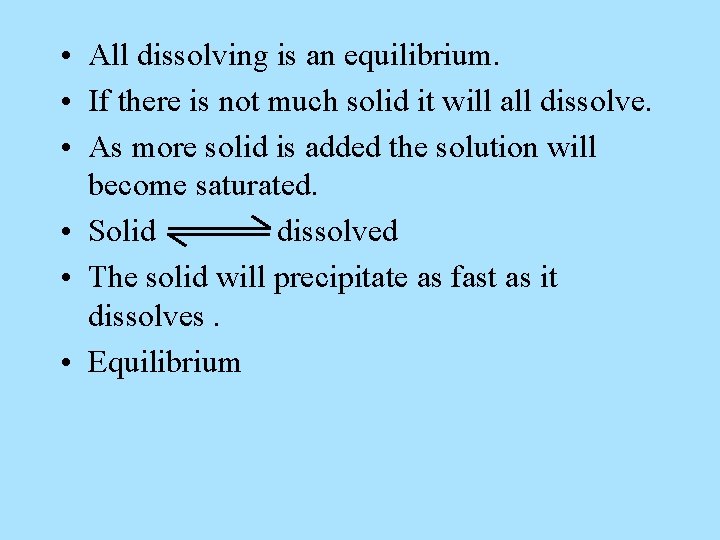
• All dissolving is an equilibrium. • If there is not much solid it will all dissolve. • As more solid is added the solution will become saturated. • Solid dissolved • The solid will precipitate as fast as it dissolves. • Equilibrium
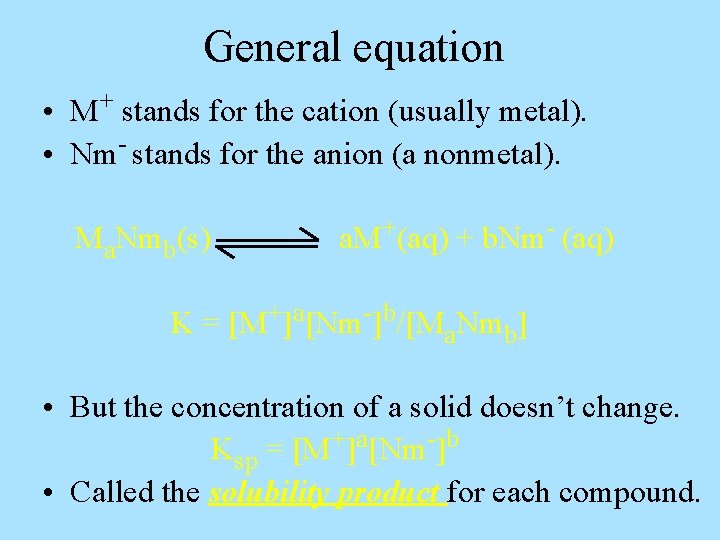
General equation • M+ stands for the cation (usually metal). • Nm- stands for the anion (a nonmetal). Ma. Nmb(s) a. M+(aq) + b. Nm- (aq) K = [M+]a[Nm-]b/[Ma. Nmb] • But the concentration of a solid doesn’t change. Ksp = [M+]a[Nm-]b • Called the solubility product for each compound.
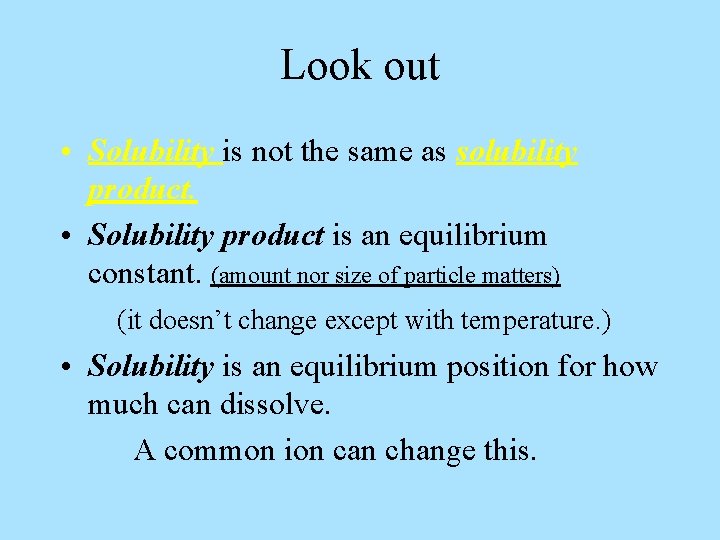
Look out • Solubility is not the same as solubility product. • Solubility product is an equilibrium constant. (amount nor size of particle matters) (it doesn’t change except with temperature. ) • Solubility is an equilibrium position for how much can dissolve. A common ion can change this.
Calculating Solubility • The solubility is determined by equilibrium. • Its an equilibrium problem. • Watch the coefficients
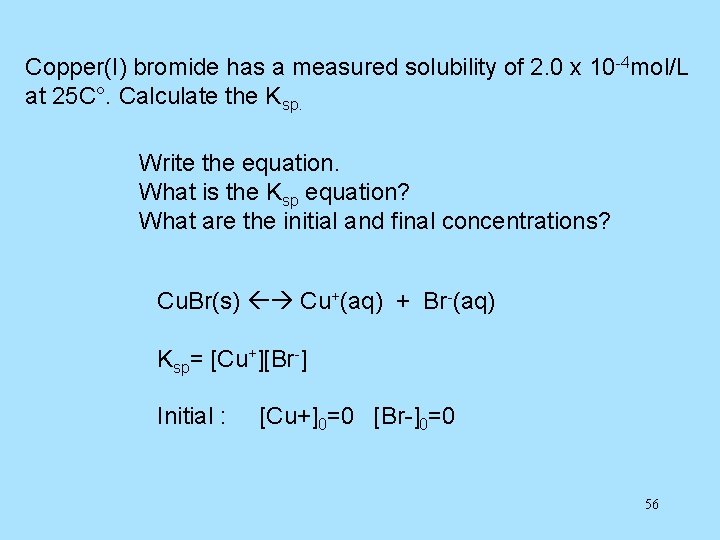
Copper(I) bromide has a measured solubility of 2. 0 x 10 -4 mol/L at 25 C°. Calculate the Ksp. Write the equation. What is the Ksp equation? What are the initial and final concentrations? Cu. Br(s) Cu+(aq) + Br-(aq) Ksp= [Cu+][Br-] Initial : [Cu+]0=0 [Br-]0=0 56
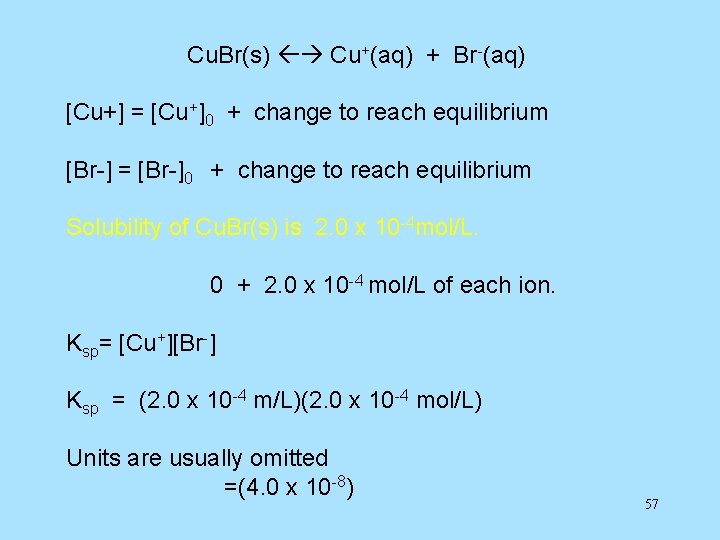
Cu. Br(s) Cu+(aq) + Br-(aq) [Cu+] = [Cu+]0 + change to reach equilibrium [Br-] = [Br-]0 + change to reach equilibrium Solubility of Cu. Br(s) is 2. 0 x 10 -4 mol/L. 0 + 2. 0 x 10 -4 mol/L of each ion. Ksp= [Cu+][Br-] Ksp = (2. 0 x 10 -4 m/L)(2. 0 x 10 -4 mol/L) Units are usually omitted =(4. 0 x 10 -8) 57
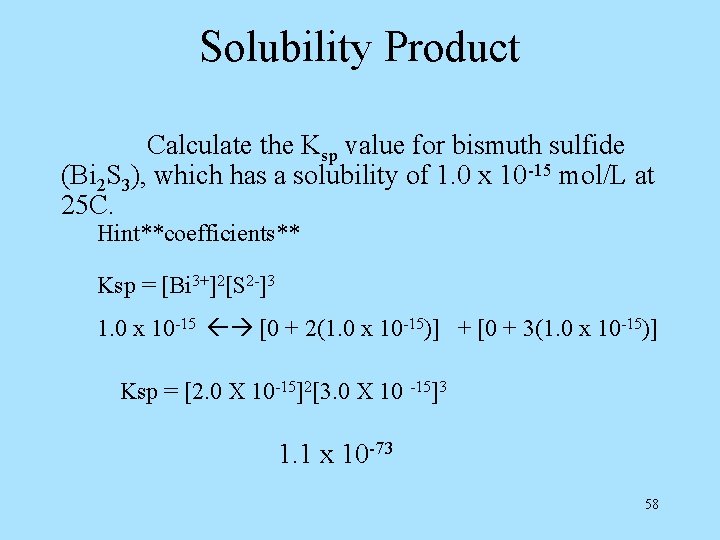
Solubility Product Calculate the Ksp value for bismuth sulfide (Bi 2 S 3), which has a solubility of 1. 0 x 10 -15 mol/L at 25 C. Hint**coefficients** Ksp = [Bi 3+]2[S 2 -]3 1. 0 x 10 -15 [0 + 2(1. 0 x 10 -15)] + [0 + 3(1. 0 x 10 -15)] Ksp = [2. 0 X 10 -15]2[3. 0 X 10 -15]3 1. 1 x 10 -73 58
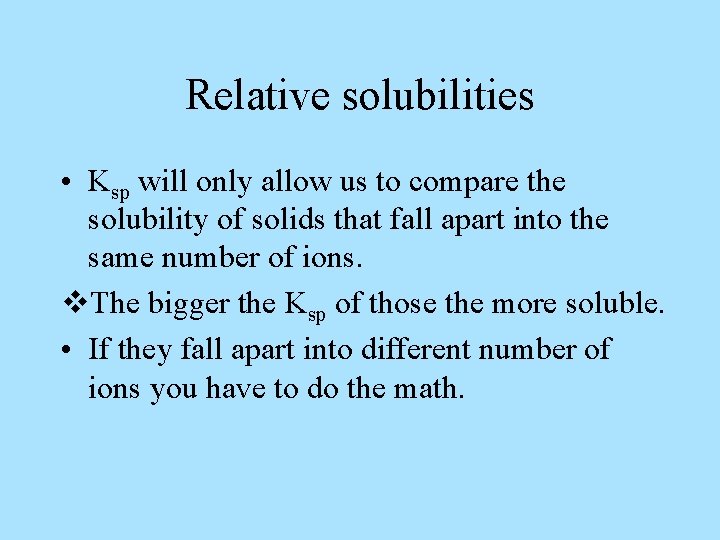
Relative solubilities • Ksp will only allow us to compare the solubility of solids that fall apart into the same number of ions. v. The bigger the Ksp of those the more soluble. • If they fall apart into different number of ions you have to do the math.
Common Ion Effect • If we try to dissolve the solid in a solution with either the cation or anion already present less will dissolve.
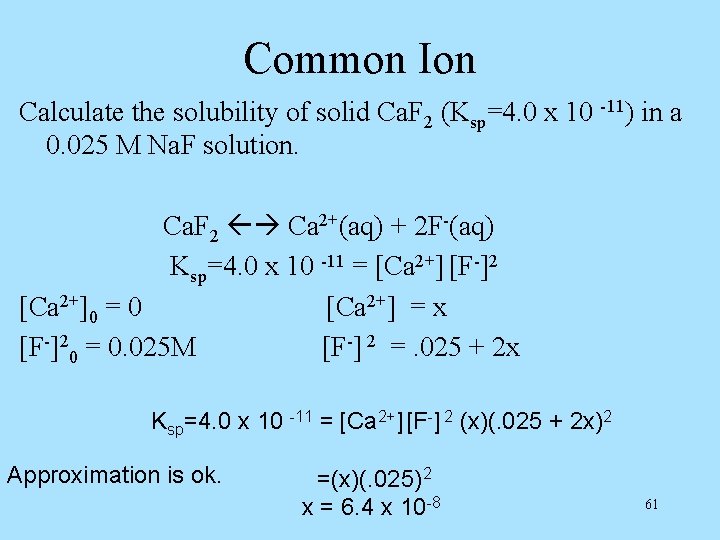
Common Ion Calculate the solubility of solid Ca. F 2 (Ksp=4. 0 x 10 -11) in a 0. 025 M Na. F solution. Ca. F 2 Ca 2+(aq) + 2 F-(aq) Ksp=4. 0 x 10 -11 = [Ca 2+] [F-]2 [Ca 2+]0 = 0 [Ca 2+] = x [F-]20 = 0. 025 M [F-] 2 =. 025 + 2 x Ksp=4. 0 x 10 -11 = [Ca 2+] [F-] 2 (x)(. 025 + 2 x)2 Approximation is ok. =(x)(. 025)2 x = 6. 4 x 10 -8 61
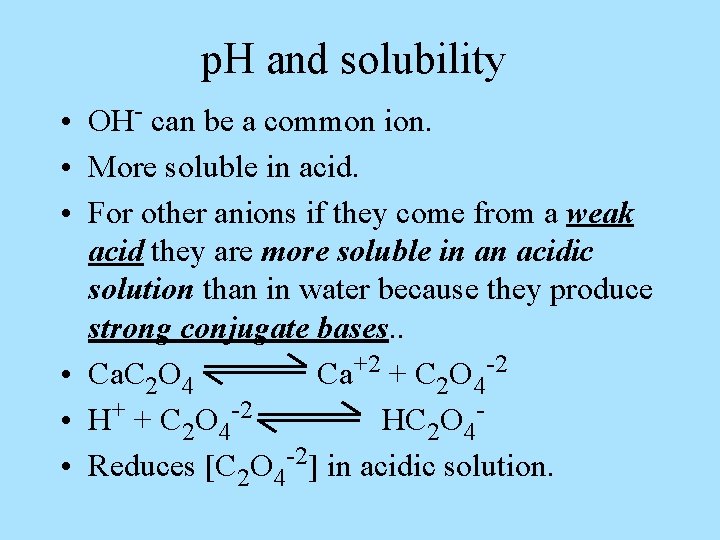
p. H and solubility • OH- can be a common ion. • More soluble in acid. • For other anions if they come from a weak acid they are more soluble in an acidic solution than in water because they produce strong conjugate bases. . • Ca. C 2 O 4 Ca+2 + C 2 O 4 -2 • H+ + C 2 O 4 -2 HC 2 O 4 • Reduces [C 2 O 4 -2] in acidic solution.
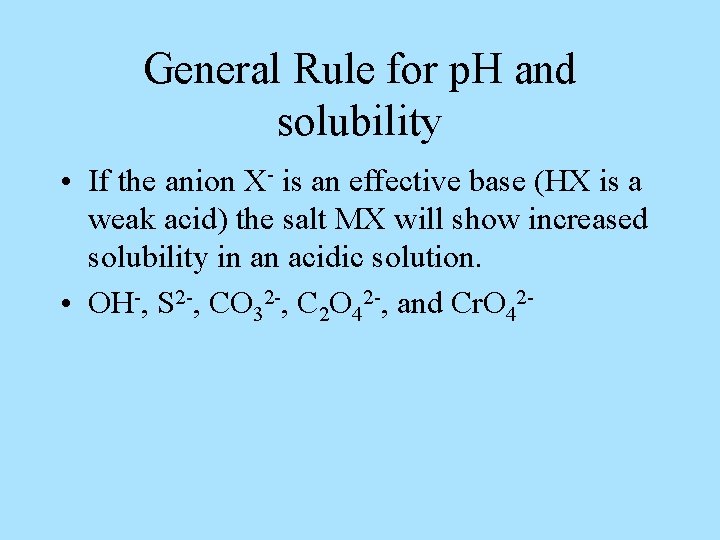
General Rule for p. H and solubility • If the anion X- is an effective base (HX is a weak acid) the salt MX will show increased solubility in an acidic solution. • OH-, S 2 -, CO 32 -, C 2 O 42 -, and Cr. O 42 -
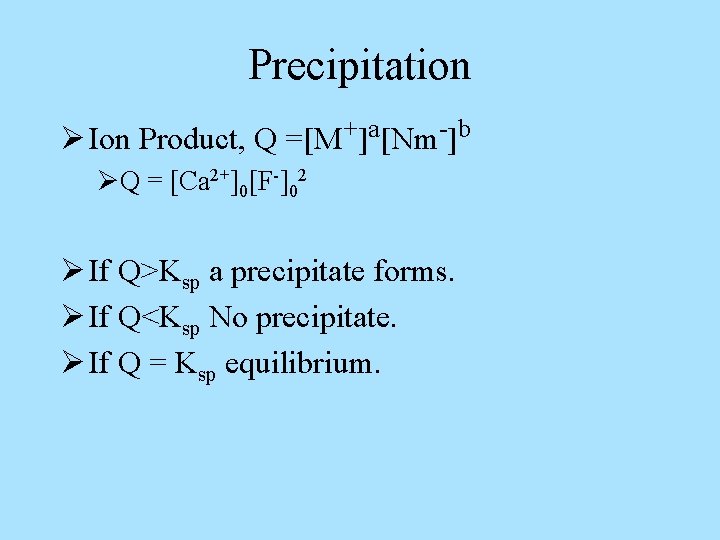
Precipitation Ø Ion Product, Q =[M+]a[Nm-]b ØQ = [Ca 2+]0[F-]02 Ø If Q>Ksp a precipitate forms. Ø If Q<Ksp No precipitate. Ø If Q = Ksp equilibrium.
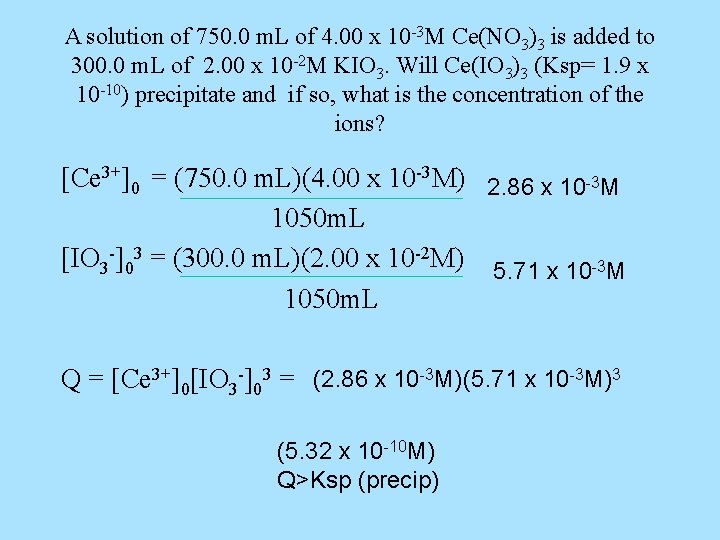
A solution of 750. 0 m. L of 4. 00 x 10 -3 M Ce(NO 3)3 is added to 300. 0 m. L of 2. 00 x 10 -2 M KIO 3. Will Ce(IO 3)3 (Ksp= 1. 9 x 10 -10) precipitate and if so, what is the concentration of the ions? [Ce 3+]0 = (750. 0 m. L)(4. 00 x 10 -3 M) 2. 86 x 10 -3 M 1050 m. L [IO 3 -]03 = (300. 0 m. L)(2. 00 x 10 -2 M) 5. 71 x 10 -3 M 1050 m. L Q = [Ce 3+]0[IO 3 -]03 = (2. 86 x 10 -3 M)(5. 71 x 10 -3 M)3 (5. 32 x 10 -10 M) Q>Ksp (precip)
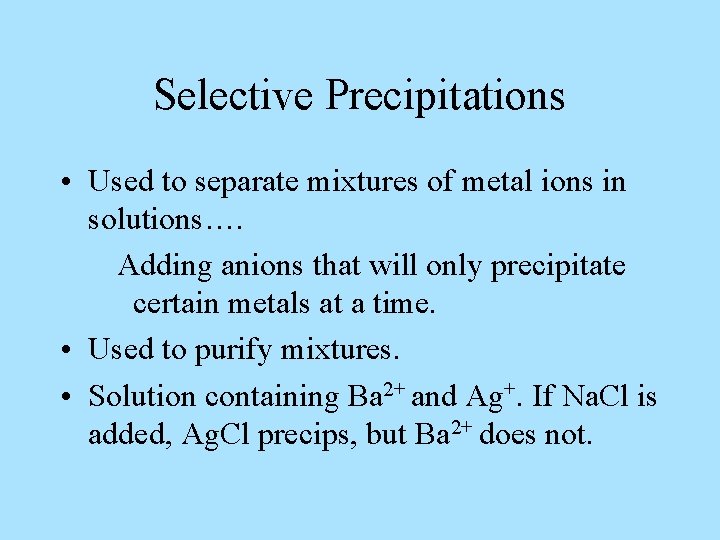
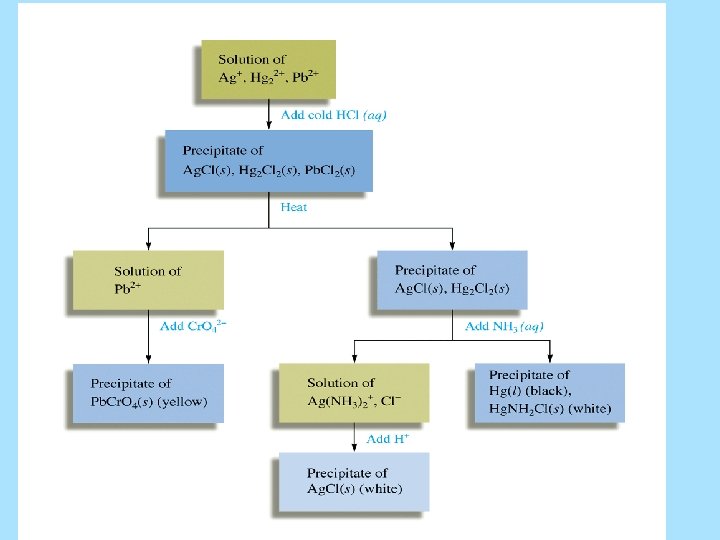
Selective Precipitations • Used to separate mixtures of metal ions in solutions…. Adding anions that will only precipitate certain metals at a time. • Used to purify mixtures. • Solution containing Ba 2+ and Ag+. If Na. Cl is added, Ag. Cl precips, but Ba 2+ does not.
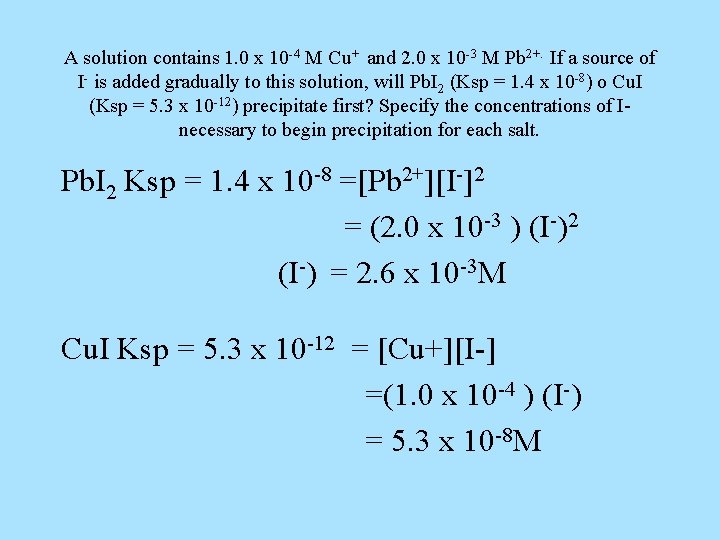
A solution contains 1. 0 x 10 -4 M Cu+ and 2. 0 x 10 -3 M Pb 2+. If a source of I- is added gradually to this solution, will Pb. I 2 (Ksp = 1. 4 x 10 -8) o Cu. I (Ksp = 5. 3 x 10 -12) precipitate first? Specify the concentrations of Inecessary to begin precipitation for each salt. Pb. I 2 Ksp = 1. 4 x 10 -8 =[Pb 2+][I-]2 = (2. 0 x 10 -3 ) (I-)2 (I-) = 2. 6 x 10 -3 M Cu. I Ksp = 5. 3 x 10 -12 = [Cu+][I-] =(1. 0 x 10 -4 ) (I-) = 5. 3 x 10 -8 M
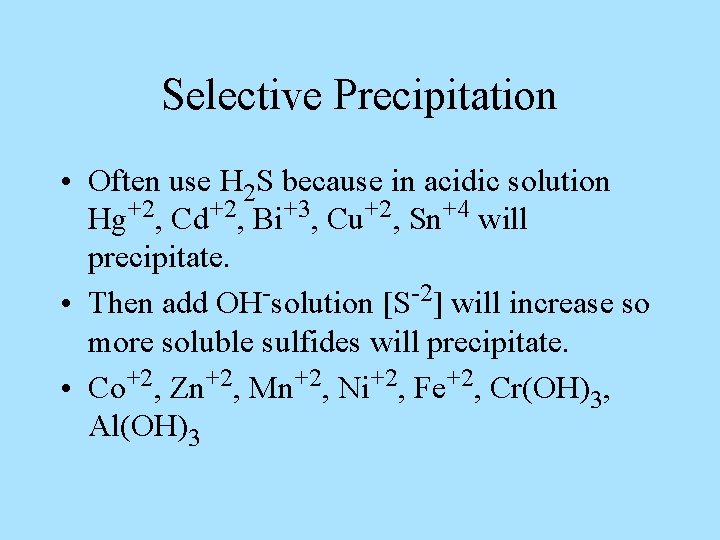
Selective Precipitation • Often use H 2 S because in acidic solution Hg+2, Cd+2, Bi+3, Cu+2, Sn+4 will precipitate. • Then add OH-solution [S-2] will increase so more soluble sulfides will precipitate. • Co+2, Zn+2, Mn+2, Ni+2, Fe+2, Cr(OH)3, Al(OH)3
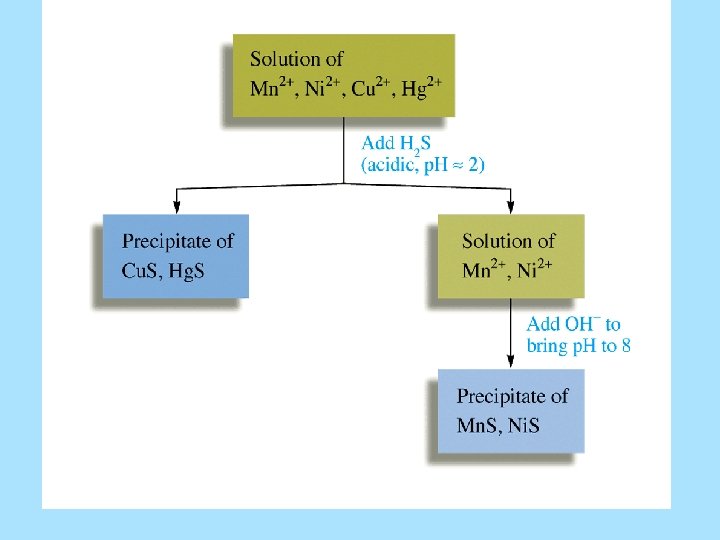
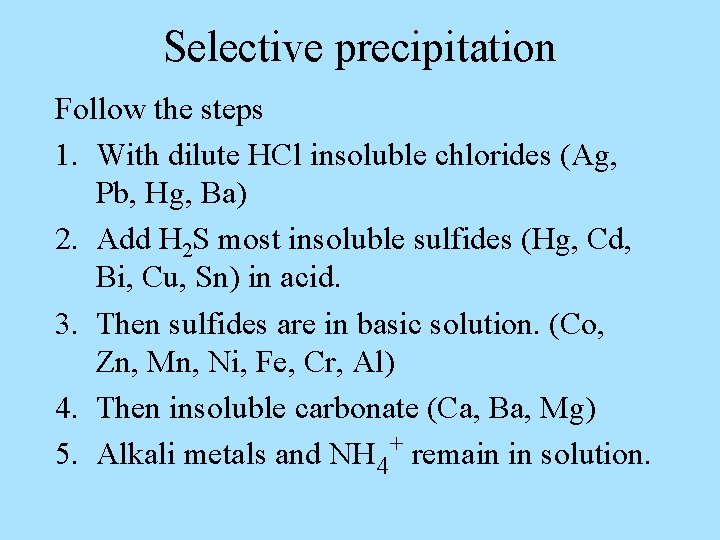
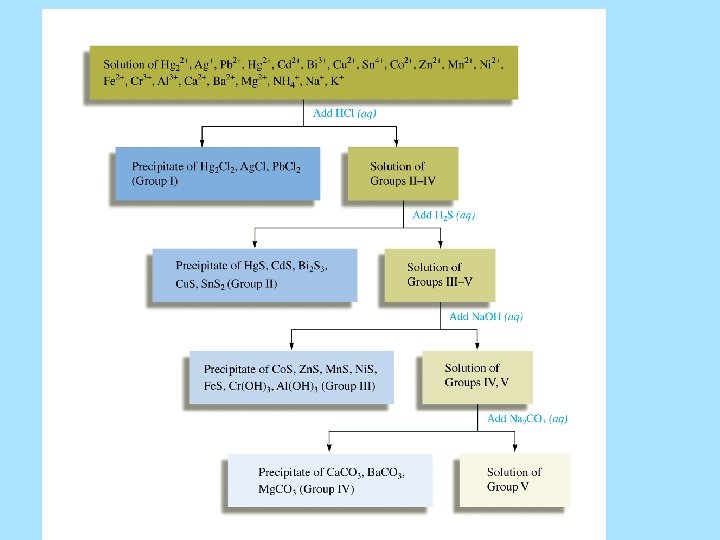
Selective precipitation Follow the steps 1. With dilute HCl insoluble chlorides (Ag, Pb, Hg, Ba) 2. Add H 2 S most insoluble sulfides (Hg, Cd, Bi, Cu, Sn) in acid. 3. Then sulfides are in basic solution. (Co, Zn, Mn, Ni, Fe, Cr, Al) 4. Then insoluble carbonate (Ca, Ba, Mg) 5. Alkali metals and NH 4+ remain in solution.
We have a solution that contains the following cations: Ag+, Cu 2+, and Mg 2+ We wish to isolate each ion by causing one at a time to precipitate out of solution. Once a solid precipitate forms, we can filter the solid precipitate out, leaving the other ions still in solution. • We are given the following solutions to use: Na 2 S, Na. Cl, and Na. OH.
• To help us analyze our situation, we'll prepare a chart, with the cations we need to separate along one axis and anions along the other axis.
Complex ion Equilibria • A charged ion surrounded by ligands. • Ligands are Lewis bases using their lone pair to stabilize the charged metal ions. • Common ligands are NH 3, H 2 O, Cl-, CN • Coordination number is the number of attached ligands. • Cu(NH 3)42+ has a coordination # of 4
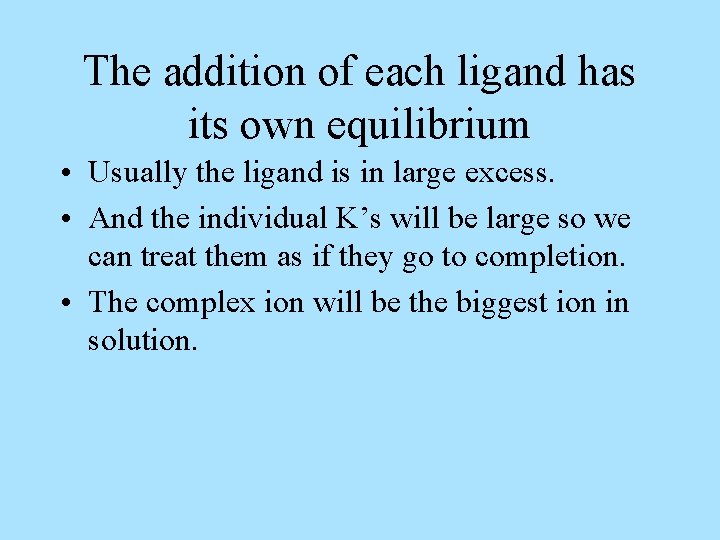
The addition of each ligand has its own equilibrium • Usually the ligand is in large excess. • And the individual K’s will be large so we can treat them as if they go to completion. • The complex ion will be the biggest ion in solution.
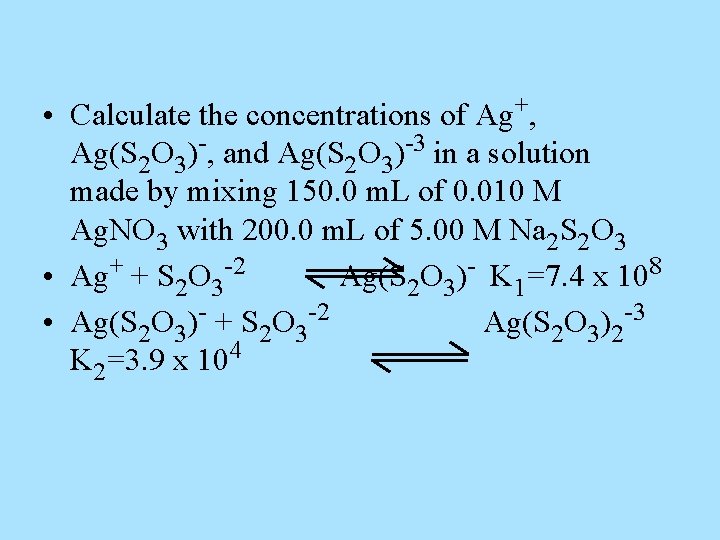
• Calculate the concentrations of Ag+, Ag(S 2 O 3)-, and Ag(S 2 O 3)-3 in a solution made by mixing 150. 0 m. L of 0. 010 M Ag. NO 3 with 200. 0 m. L of 5. 00 M Na 2 S 2 O 3 • Ag+ + S 2 O 3 -2 Ag(S 2 O 3)- K 1=7. 4 x 10⁸ • Ag(S 2 O 3)- + S 2 O 3 -2 Ag(S 2 O 3)2 -3 K 2=3. 9 x 10⁴
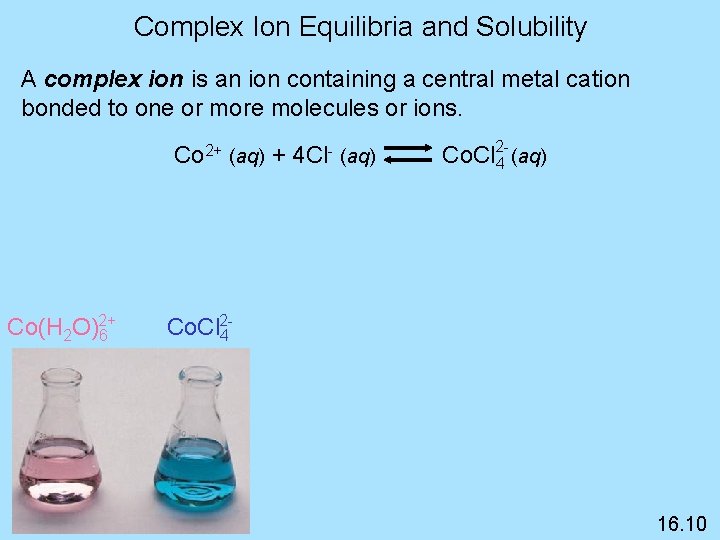
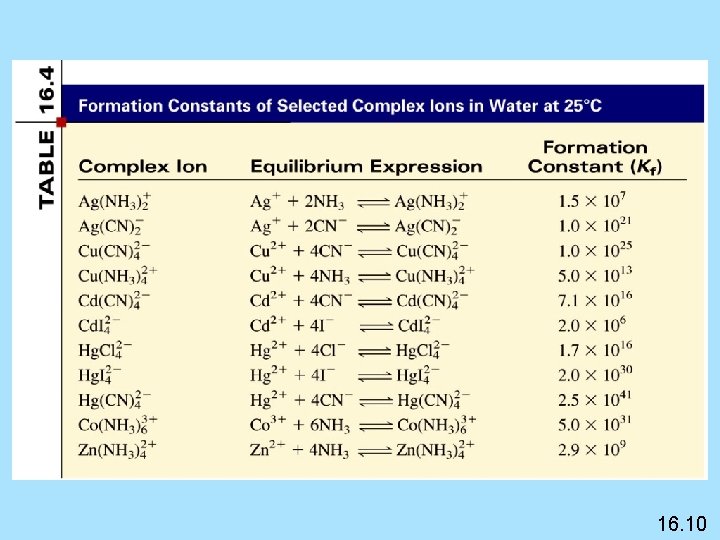
Complex Ion Equilibria and Solubility A complex ion is an ion containing a central metal cation bonded to one or more molecules or ions. Co 2+ (aq) + 4 Cl- (aq) Co(H 2 O)2+ 6 Co. Cl 24 (aq) Co. Cl 24 16. 10
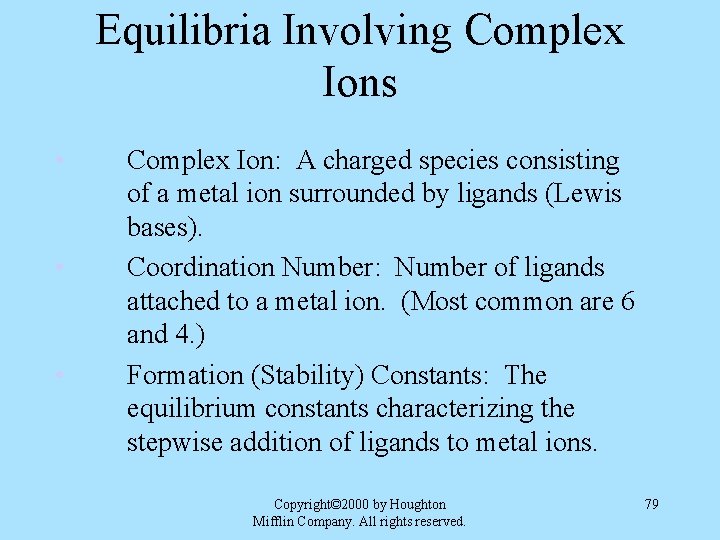
Equilibria Involving Complex Ions • • • Complex Ion: A charged species consisting of a metal ion surrounded by ligands (Lewis bases). Coordination Number: Number of ligands attached to a metal ion. (Most common are 6 and 4. ) Formation (Stability) Constants: The equilibrium constants characterizing the stepwise addition of ligands to metal ions. Copyright© 2000 by Houghton Mifflin Company. All rights reserved. 79
16. 10
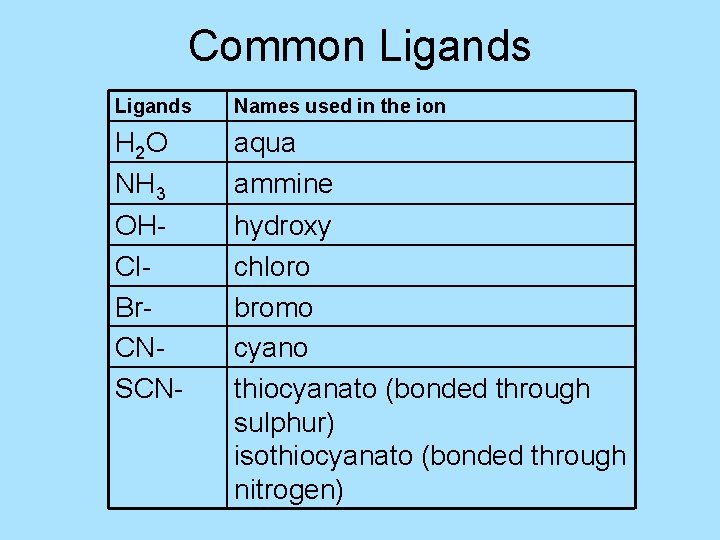
Complex Ion Formation • These are usually formed from a transition metal surrounded by ligands (polar molecules or negative ions). • As a "rule of thumb" you place twice the number of ligands around an ion as the charge on the ion. . . example: the dark blue Cu(NH 3)42+ (ammonia is used as a test for Cu 2+ ions), and Ag(NH 3)2+. • Memorize the common ligands.
Common Ligands Names used in the ion H 2 O NH 3 OHCl. Br. CNSCN- aqua ammine hydroxy chloro bromo cyano thiocyanato (bonded through sulphur) isothiocyanato (bonded through nitrogen)
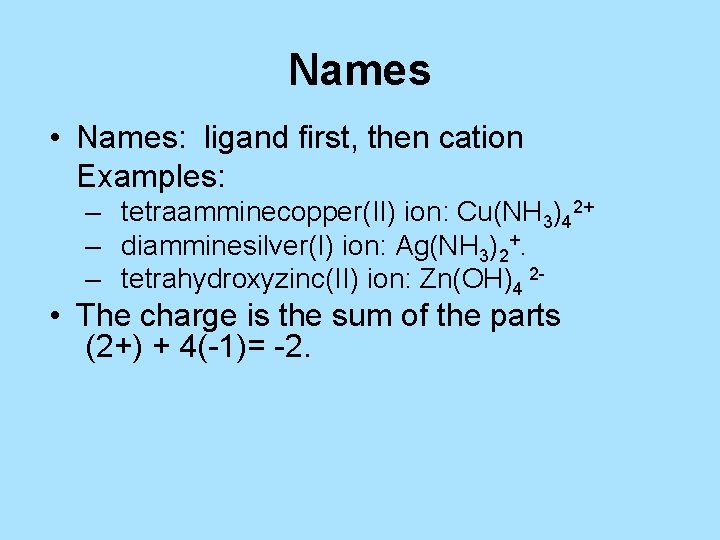
Names • Names: ligand first, then cation Examples: – tetraamminecopper(II) ion: Cu(NH 3)42+ – diamminesilver(I) ion: Ag(NH 3)2+. – tetrahydroxyzinc(II) ion: Zn(OH)4 2 - • The charge is the sum of the parts (2+) + 4(-1)= -2.
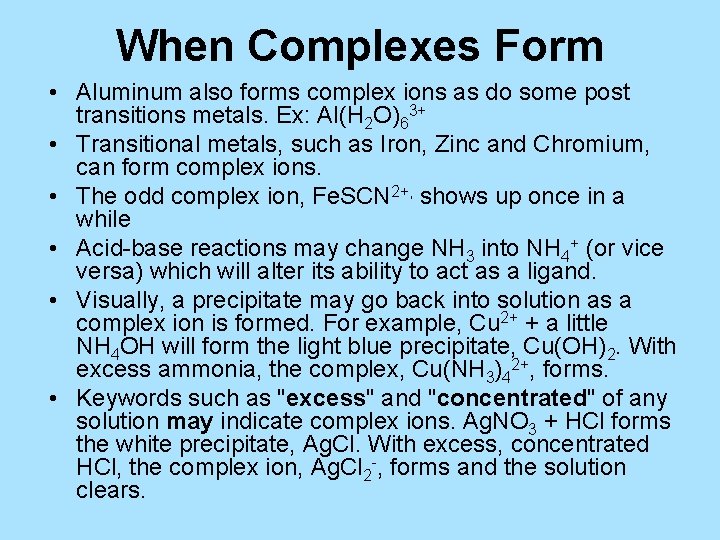
When Complexes Form • Aluminum also forms complex ions as do some post transitions metals. Ex: Al(H 2 O)63+ • Transitional metals, such as Iron, Zinc and Chromium, can form complex ions. • The odd complex ion, Fe. SCN 2+, shows up once in a while • Acid-base reactions may change NH 3 into NH 4+ (or vice versa) which will alter its ability to act as a ligand. • Visually, a precipitate may go back into solution as a complex ion is formed. For example, Cu 2+ + a little NH 4 OH will form the light blue precipitate, Cu(OH)2. With excess ammonia, the complex, Cu(NH 3)42+, forms. • Keywords such as "excess" and "concentrated" of any solution may indicate complex ions. Ag. NO 3 + HCl forms the white precipitate, Ag. Cl. With excess, concentrated HCl, the complex ion, Ag. Cl 2 -, forms and the solution clears.
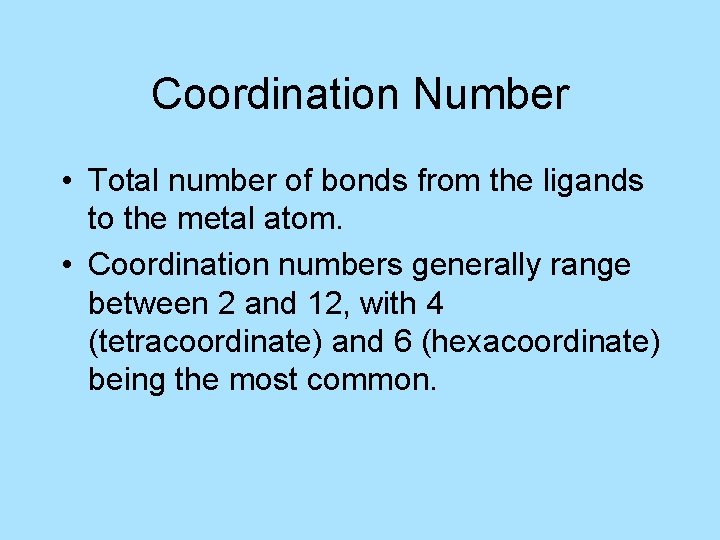
Coordination Number • Total number of bonds from the ligands to the metal atom. • Coordination numbers generally range between 2 and 12, with 4 (tetracoordinate) and 6 (hexacoordinate) being the most common.
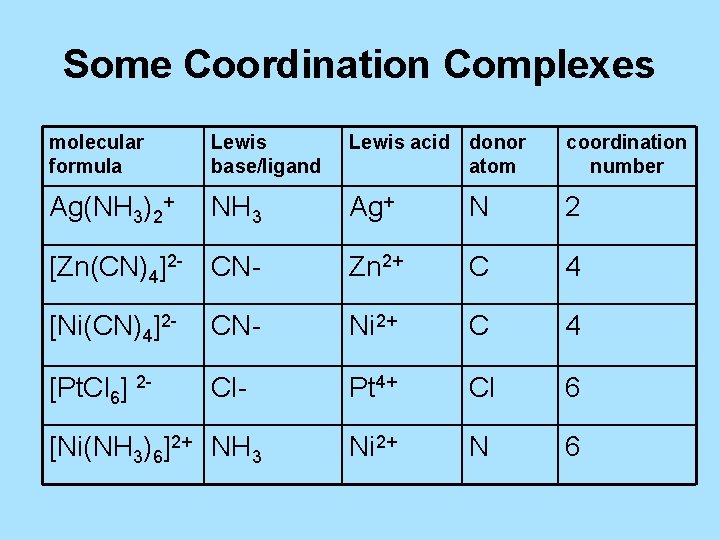
Some Coordination Complexes molecular formula Lewis base/ligand Lewis acid donor atom coordination number Ag(NH 3)2+ NH 3 Ag+ N 2 [Zn(CN)4]2 - CN- Zn 2+ C 4 [Ni(CN)4]2 - CN- Ni 2+ C 4 [Pt. Cl 6] 2 - Cl- Pt 4+ Cl 6 Ni 2+ N 6 [Ni(NH 3)6]2+ NH 3
- Slides: 86