
AcidBase Equilibria and Solubility Equilibria Chapter 16 The
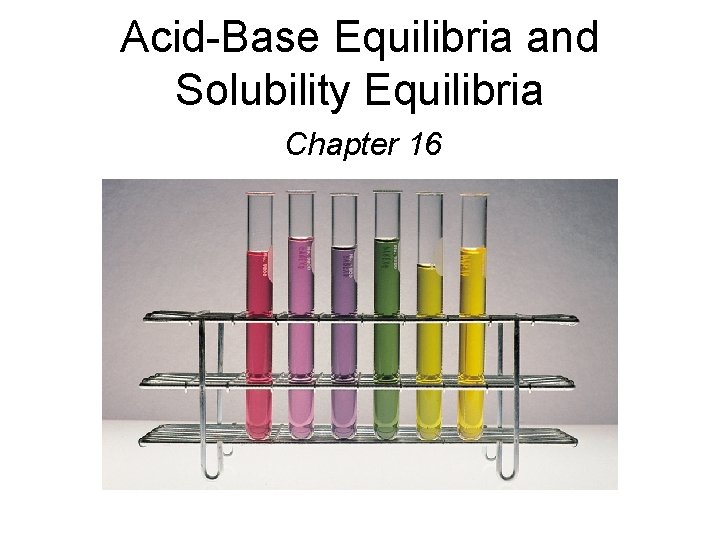
Acid-Base Equilibria and Solubility Equilibria Chapter 16
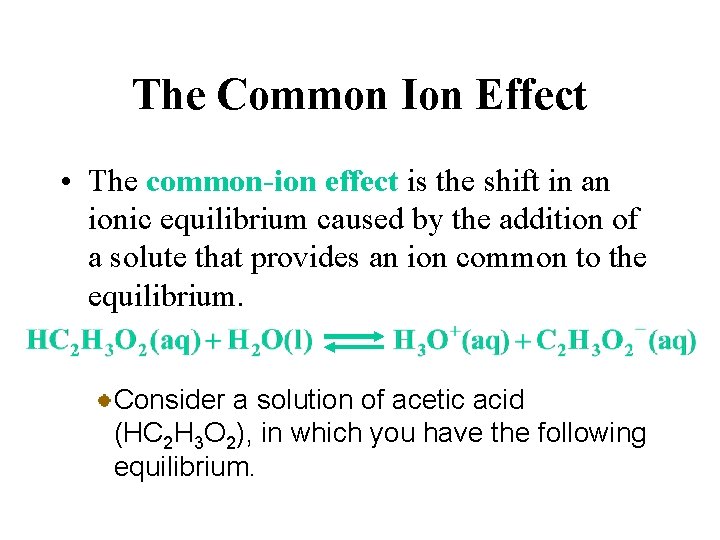
The Common Ion Effect • The common-ion effect is the shift in an ionic equilibrium caused by the addition of a solute that provides an ion common to the equilibrium. Consider a solution of acetic acid (HC 2 H 3 O 2), in which you have the following equilibrium.
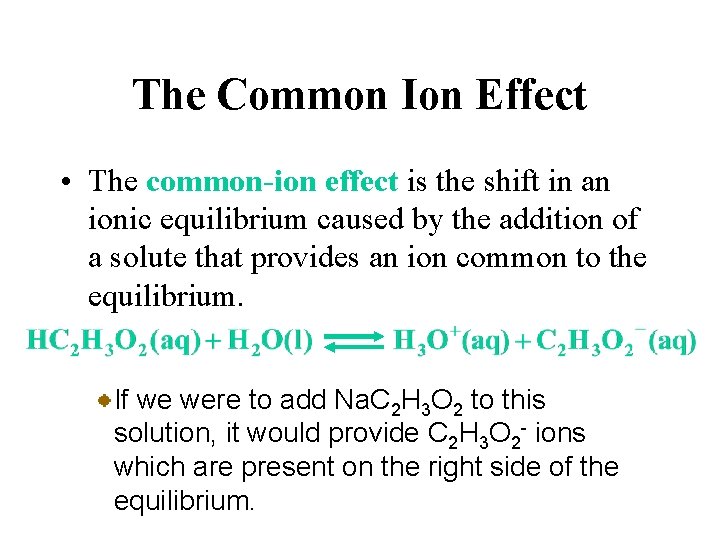
The Common Ion Effect • The common-ion effect is the shift in an ionic equilibrium caused by the addition of a solute that provides an ion common to the equilibrium. If we were to add Na. C 2 H 3 O 2 to this solution, it would provide C 2 H 3 O 2 - ions which are present on the right side of the equilibrium.
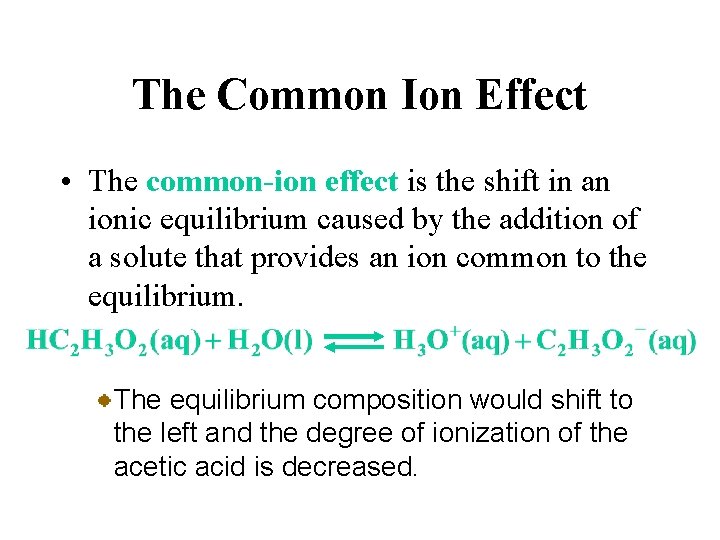
The Common Ion Effect • The common-ion effect is the shift in an ionic equilibrium caused by the addition of a solute that provides an ion common to the equilibrium. The equilibrium composition would shift to the left and the degree of ionization of the acetic acid is decreased.
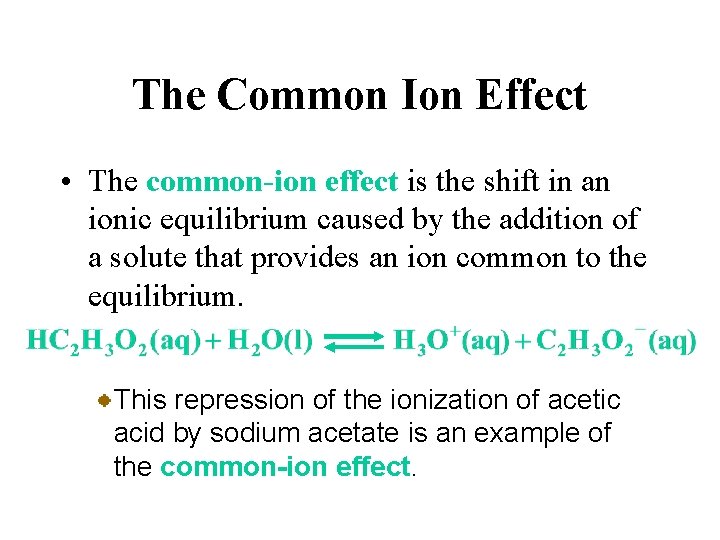
The Common Ion Effect • The common-ion effect is the shift in an ionic equilibrium caused by the addition of a solute that provides an ion common to the equilibrium. This repression of the ionization of acetic acid by sodium acetate is an example of the common-ion effect.
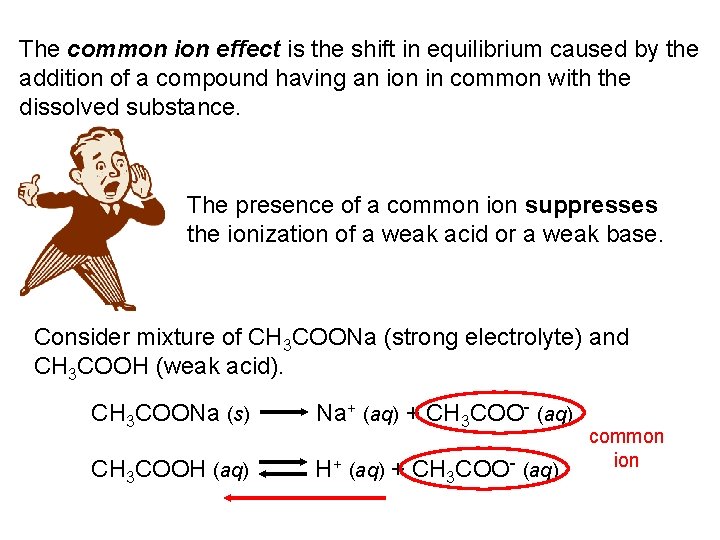
The common ion effect is the shift in equilibrium caused by the addition of a compound having an ion in common with the dissolved substance. The presence of a common ion suppresses the ionization of a weak acid or a weak base. Consider mixture of CH 3 COONa (strong electrolyte) and CH 3 COOH (weak acid). CH 3 COONa (s) Na+ (aq) + CH 3 COO- (aq) CH 3 COOH (aq) H+ (aq) + CH 3 COO- (aq) common ion
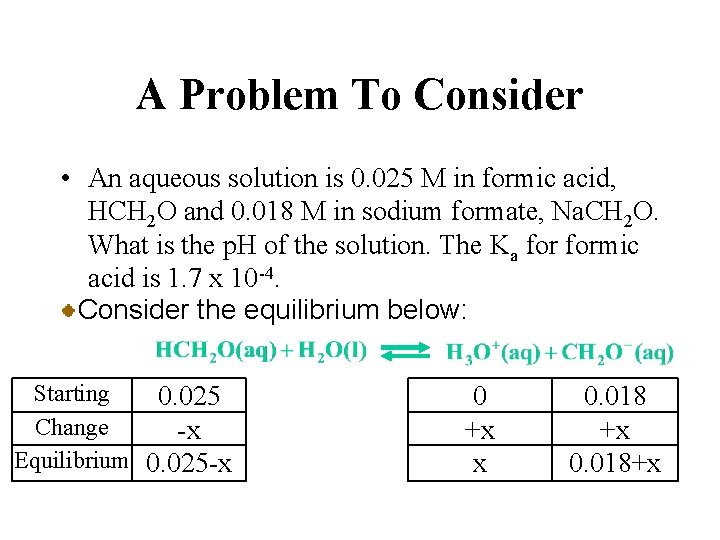
A Problem To Consider • An aqueous solution is 0. 025 M in formic acid, HCH 2 O and 0. 018 M in sodium formate, Na. CH 2 O. What is the p. H of the solution. The Ka formic acid is 1. 7 x 10 -4. Consider the equilibrium below: Starting 0. 025 Change -x Equilibrium 0. 025 -x 0 +x x 0. 018 +x 0. 018+x
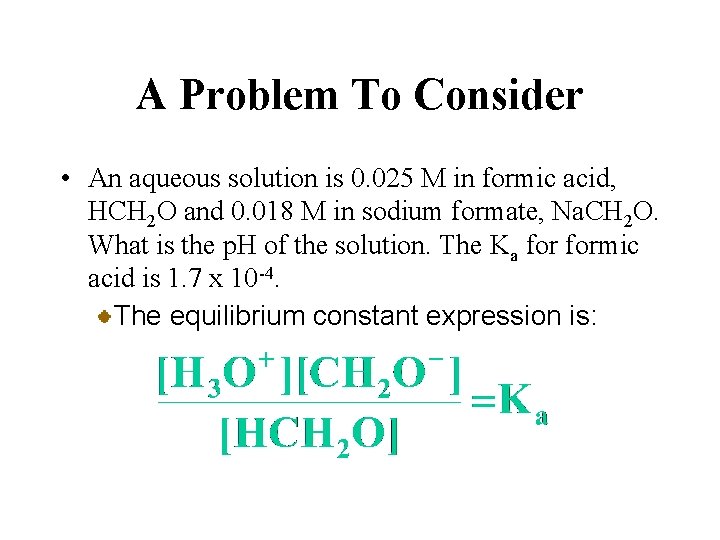
A Problem To Consider • An aqueous solution is 0. 025 M in formic acid, HCH 2 O and 0. 018 M in sodium formate, Na. CH 2 O. What is the p. H of the solution. The Ka formic acid is 1. 7 x 10 -4. The equilibrium constant expression is:
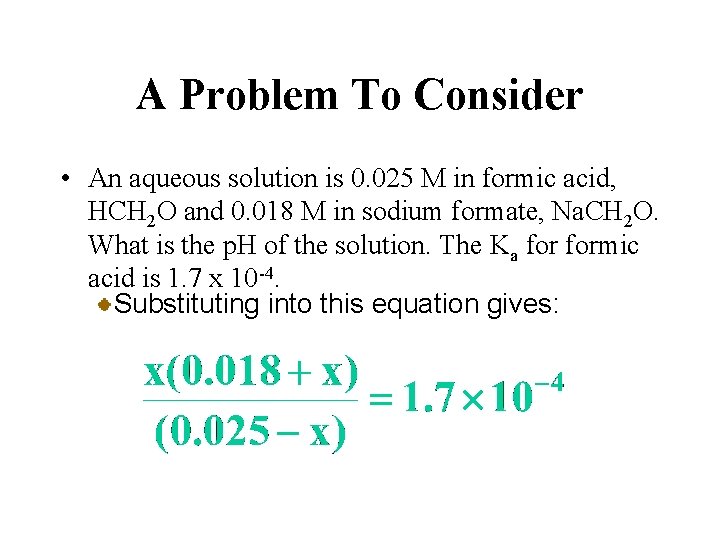
A Problem To Consider • An aqueous solution is 0. 025 M in formic acid, HCH 2 O and 0. 018 M in sodium formate, Na. CH 2 O. What is the p. H of the solution. The Ka formic acid is 1. 7 x 10 -4. Substituting into this equation gives:
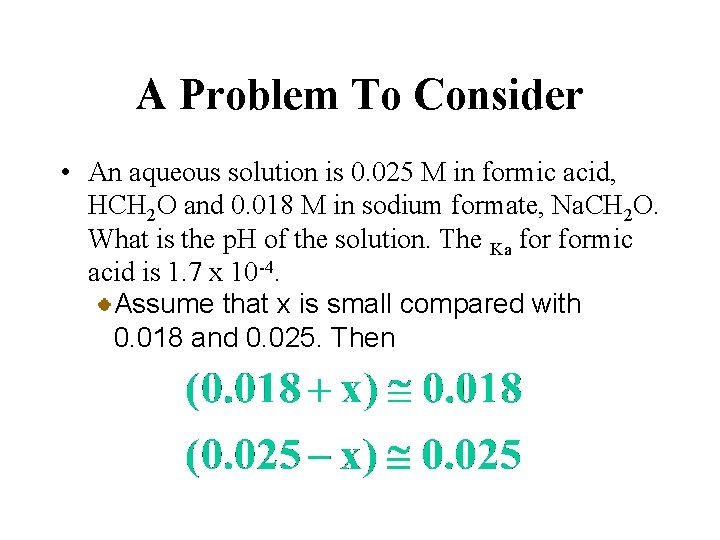
A Problem To Consider • An aqueous solution is 0. 025 M in formic acid, HCH 2 O and 0. 018 M in sodium formate, Na. CH 2 O. What is the p. H of the solution. The Ka formic acid is 1. 7 x 10 -4. Assume that x is small compared with 0. 018 and 0. 025. Then
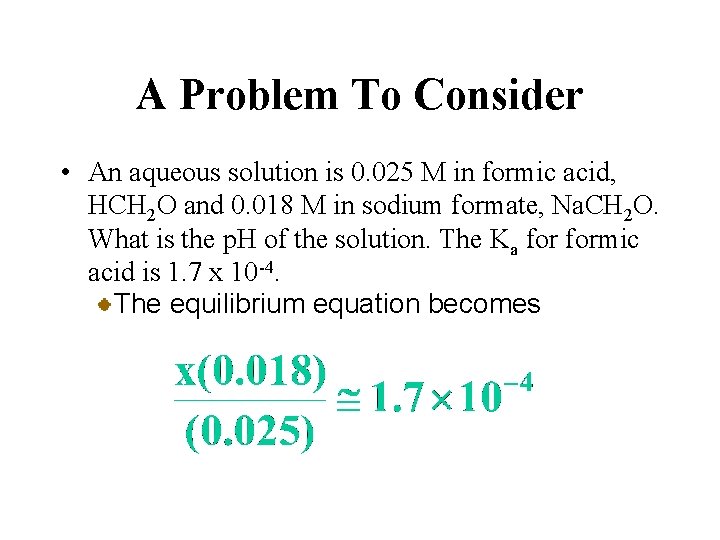
A Problem To Consider • An aqueous solution is 0. 025 M in formic acid, HCH 2 O and 0. 018 M in sodium formate, Na. CH 2 O. What is the p. H of the solution. The Ka formic acid is 1. 7 x 10 -4. The equilibrium equation becomes
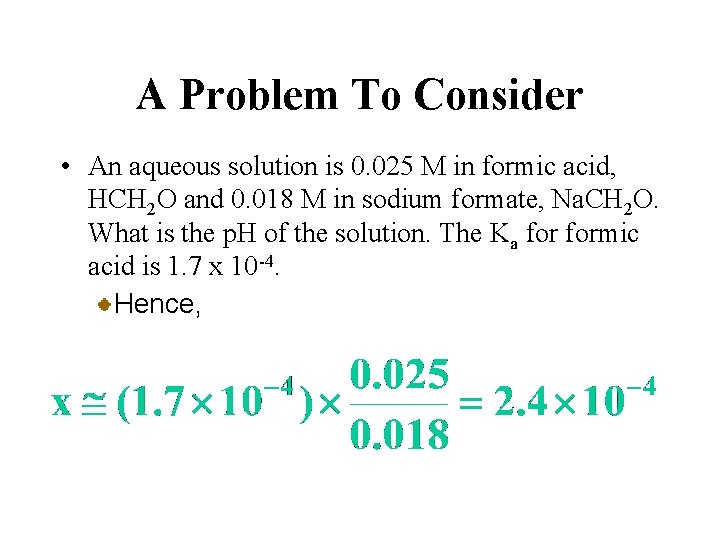
A Problem To Consider • An aqueous solution is 0. 025 M in formic acid, HCH 2 O and 0. 018 M in sodium formate, Na. CH 2 O. What is the p. H of the solution. The Ka formic acid is 1. 7 x 10 -4. Hence,
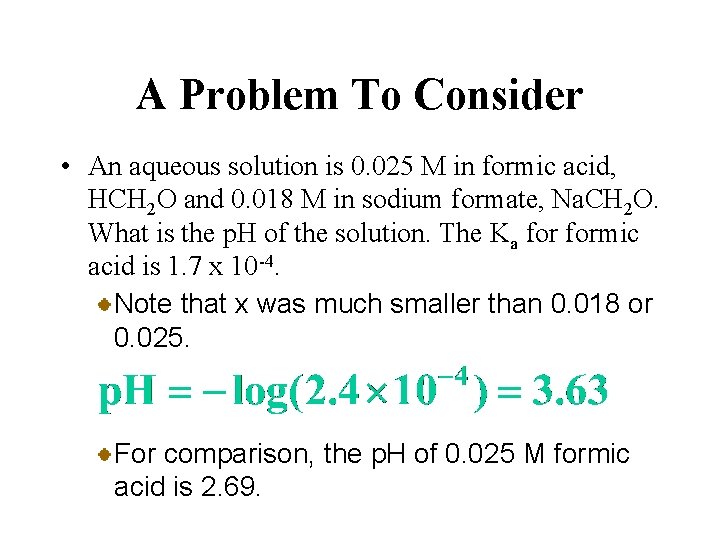
A Problem To Consider • An aqueous solution is 0. 025 M in formic acid, HCH 2 O and 0. 018 M in sodium formate, Na. CH 2 O. What is the p. H of the solution. The Ka formic acid is 1. 7 x 10 -4. Note that x was much smaller than 0. 018 or 0. 025. For comparison, the p. H of 0. 025 M formic acid is 2. 69.
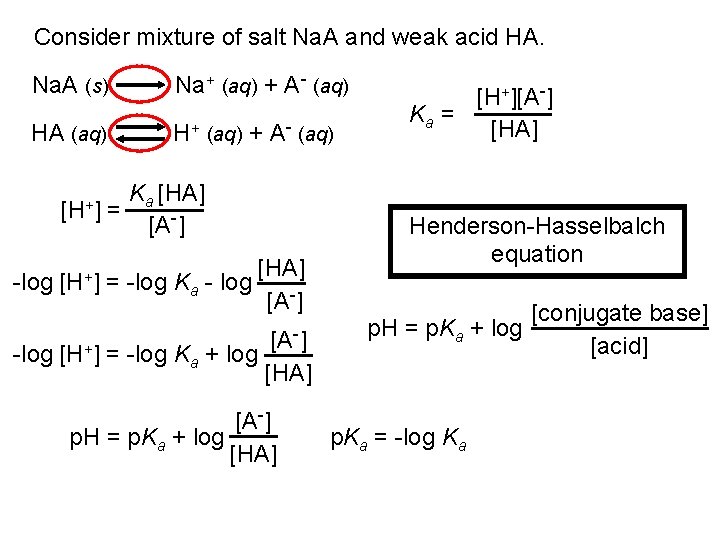
Consider mixture of salt Na. A and weak acid HA. Na. A (s) Na+ (aq) + A- (aq) HA (aq) H+ (aq) + A- (aq) [H+] Ka [HA] = [A-] -log [H+] = -log Ka - log [HA] [A-] -] [A -log [H+] = -log Ka + log [HA] [A-] p. H = p. Ka + log [HA] [H+][A-] Ka = [HA] Henderson-Hasselbalch equation p. H = p. Ka + log p. Ka = -log Ka [conjugate base] [acid]
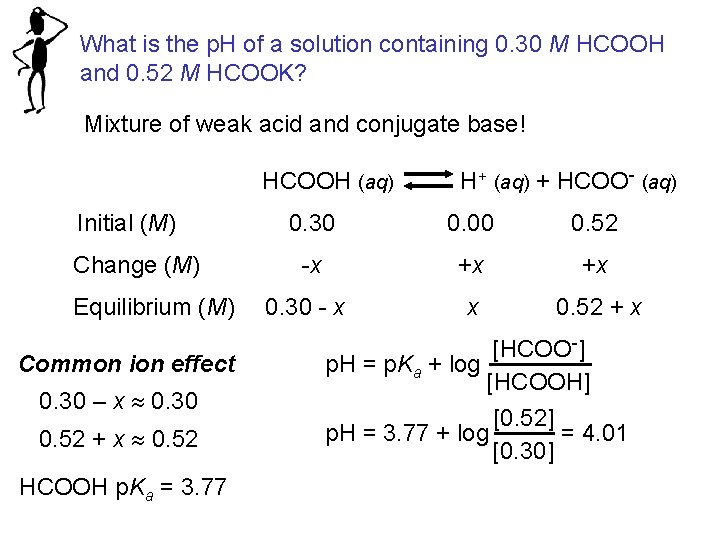
What is the p. H of a solution containing 0. 30 M HCOOH and 0. 52 M HCOOK? Mixture of weak acid and conjugate base! HCOOH (aq) Initial (M) Change (M) Equilibrium (M) Common ion effect 0. 30 – x 0. 30 0. 52 + x 0. 52 HCOOH p. Ka = 3. 77 H+ (aq) + HCOO- (aq) 0. 30 0. 00 0. 52 -x +x +x 0. 30 - x x 0. 52 + x [HCOO-] p. H = p. Ka + log [HCOOH] [0. 52] = 4. 01 p. H = 3. 77 + log [0. 30]
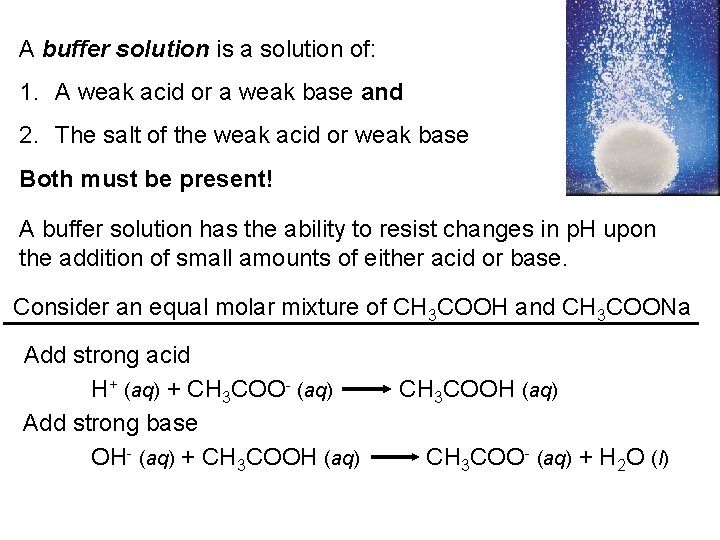
A buffer solution is a solution of: 1. A weak acid or a weak base and 2. The salt of the weak acid or weak base Both must be present! A buffer solution has the ability to resist changes in p. H upon the addition of small amounts of either acid or base. Consider an equal molar mixture of CH 3 COOH and CH 3 COONa Add strong acid H+ (aq) + CH 3 COO- (aq) Add strong base OH- (aq) + CH 3 COOH (aq) CH 3 COO- (aq) + H 2 O (l)
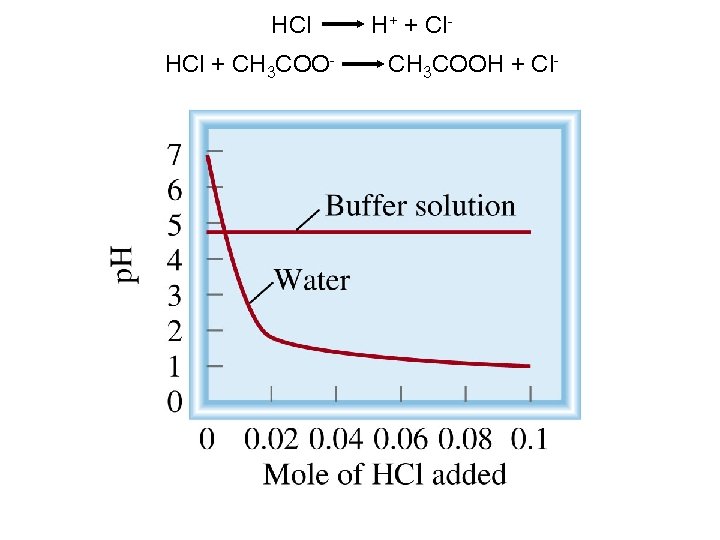
HCl + CH 3 COO- H+ + Cl. CH 3 COOH + Cl-
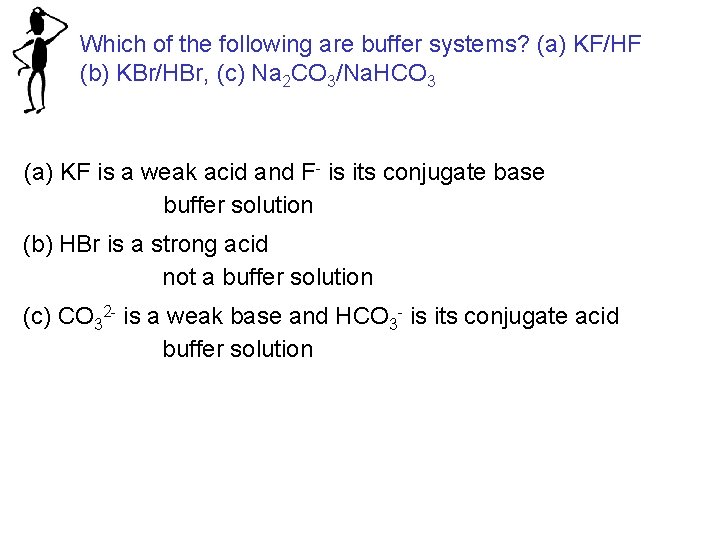
Which of the following are buffer systems? (a) KF/HF (b) KBr/HBr, (c) Na 2 CO 3/Na. HCO 3 (a) KF is a weak acid and F- is its conjugate base buffer solution (b) HBr is a strong acid not a buffer solution (c) CO 32 - is a weak base and HCO 3 - is its conjugate acid buffer solution
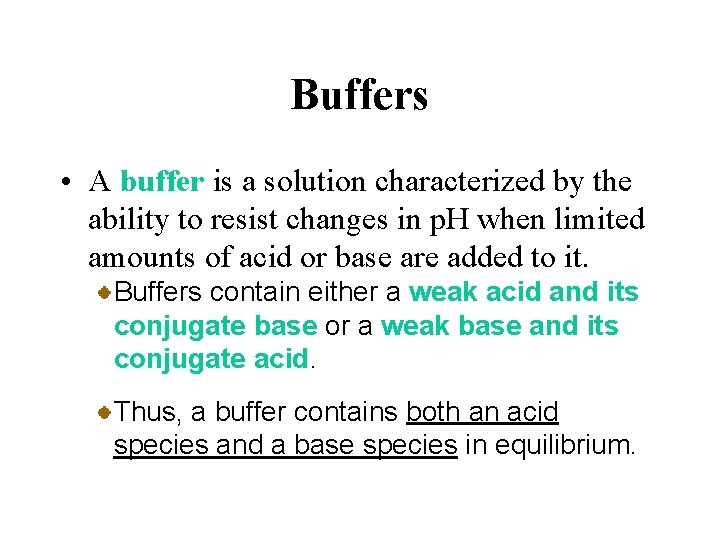
Buffers • A buffer is a solution characterized by the ability to resist changes in p. H when limited amounts of acid or base are added to it. Buffers contain either a weak acid and its conjugate base or a weak base and its conjugate acid. Thus, a buffer contains both an acid species and a base species in equilibrium.
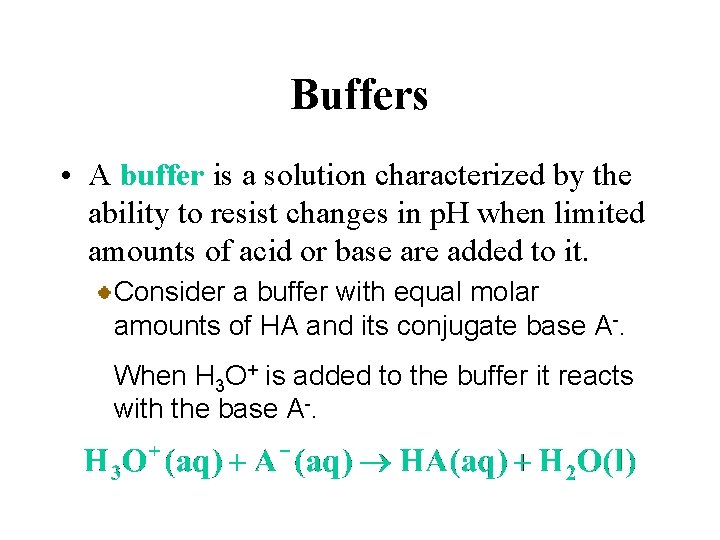
Buffers • A buffer is a solution characterized by the ability to resist changes in p. H when limited amounts of acid or base are added to it. Consider a buffer with equal molar amounts of HA and its conjugate base A-. When H 3 O+ is added to the buffer it reacts with the base A-.
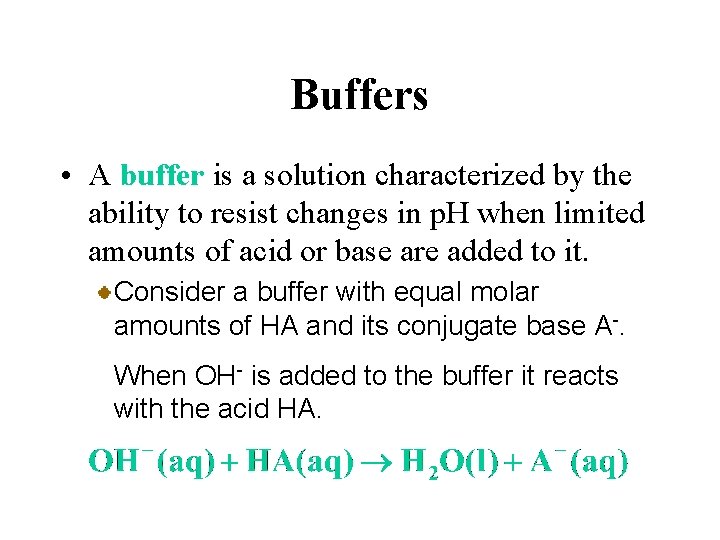
Buffers • A buffer is a solution characterized by the ability to resist changes in p. H when limited amounts of acid or base are added to it. Consider a buffer with equal molar amounts of HA and its conjugate base A-. When OH- is added to the buffer it reacts with the acid HA.
Buffers • A buffer is a solution characterized by the ability to resist changes in p. H when limited amounts of acid or base are added to it. Two important characteristics of a buffer are its buffer capacity and its p. H. Buffer capacity depends on the amount of acid and conjugate base present in the solution. The next example illustrates how to calculate the p. H of a buffer.
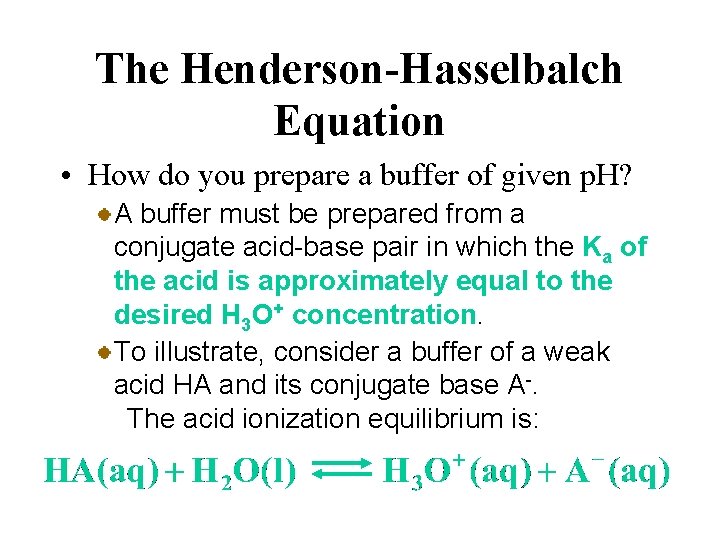
The Henderson-Hasselbalch Equation • How do you prepare a buffer of given p. H? A buffer must be prepared from a conjugate acid-base pair in which the Ka of the acid is approximately equal to the desired H 3 O+ concentration. To illustrate, consider a buffer of a weak acid HA and its conjugate base A-. The acid ionization equilibrium is:
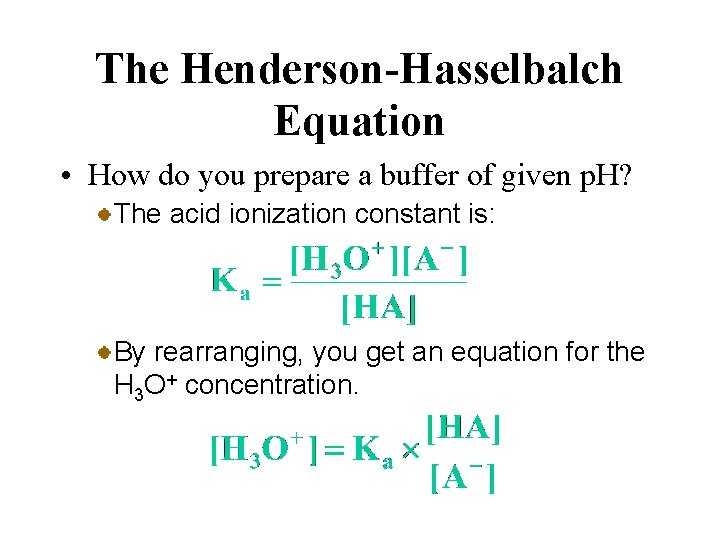
The Henderson-Hasselbalch Equation • How do you prepare a buffer of given p. H? The acid ionization constant is: By rearranging, you get an equation for the H 3 O+ concentration.
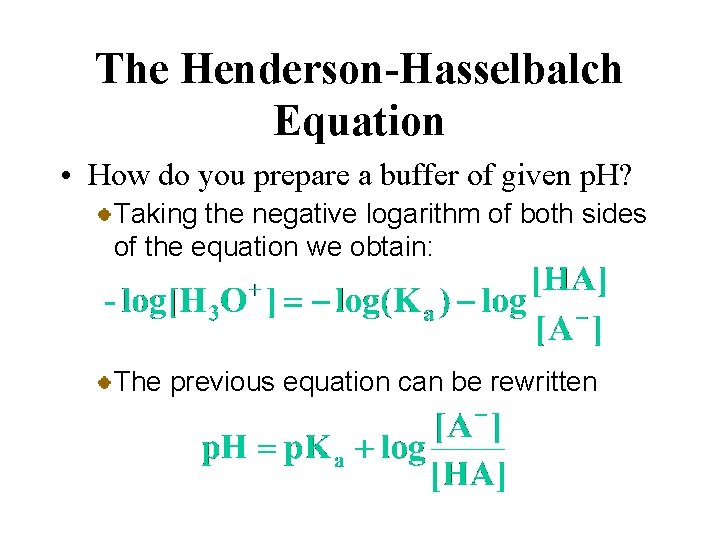
The Henderson-Hasselbalch Equation • How do you prepare a buffer of given p. H? Taking the negative logarithm of both sides of the equation we obtain: The previous equation can be rewritten
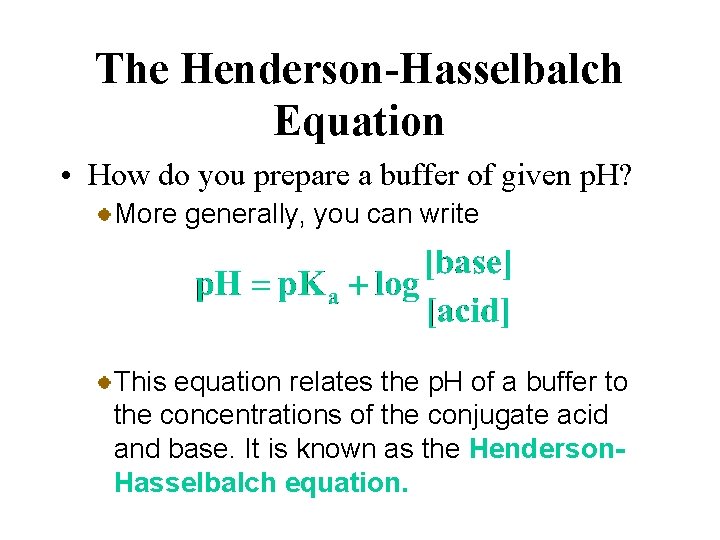
The Henderson-Hasselbalch Equation • How do you prepare a buffer of given p. H? More generally, you can write This equation relates the p. H of a buffer to the concentrations of the conjugate acid and base. It is known as the Henderson. Hasselbalch equation.
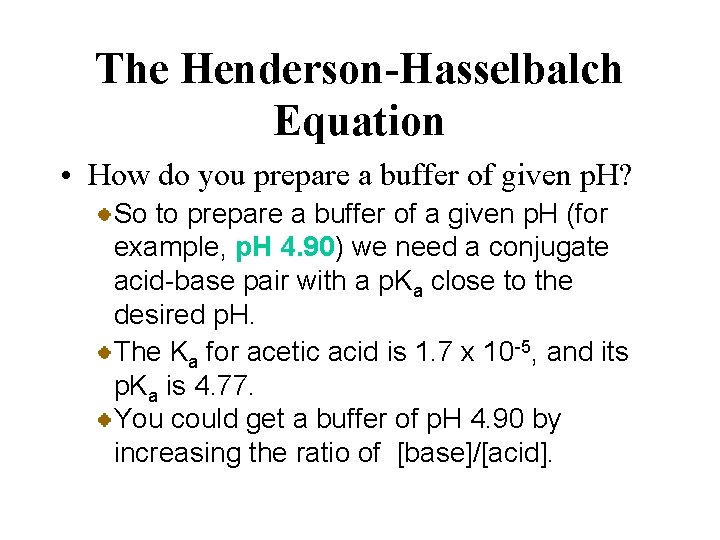
The Henderson-Hasselbalch Equation • How do you prepare a buffer of given p. H? So to prepare a buffer of a given p. H (for example, p. H 4. 90) we need a conjugate acid-base pair with a p. Ka close to the desired p. H. The Ka for acetic acid is 1. 7 x 10 -5, and its p. Ka is 4. 77. You could get a buffer of p. H 4. 90 by increasing the ratio of [base]/[acid].
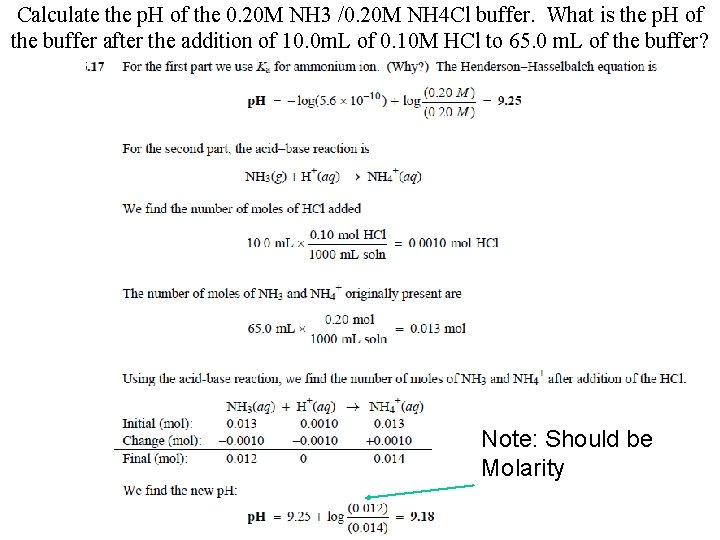
Calculate the p. H of the 0. 20 M NH 3 /0. 20 M NH 4 Cl buffer. What is the p. H of the buffer after the addition of 10. 0 m. L of 0. 10 M HCl to 65. 0 m. L of the buffer? Note: Should be Molarity
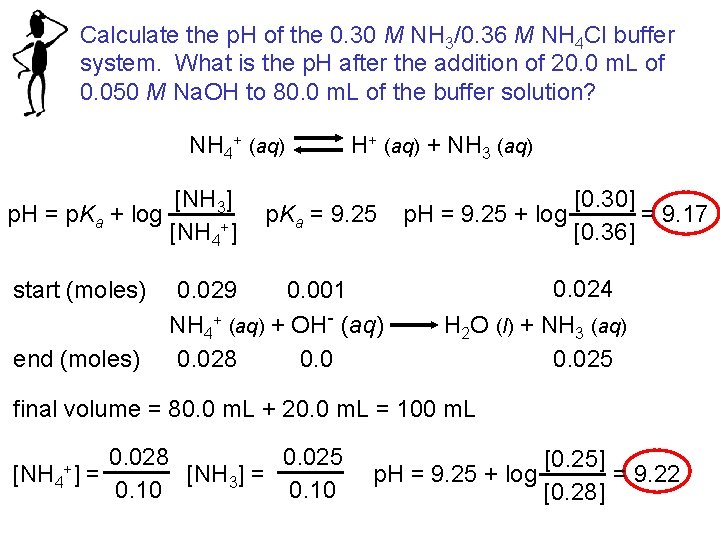
Calculate the p. H of the 0. 30 M NH 3/0. 36 M NH 4 Cl buffer system. What is the p. H after the addition of 20. 0 m. L of 0. 050 M Na. OH to 80. 0 m. L of the buffer solution? NH 4+ (aq) [NH 3] p. H = p. Ka + log [NH 4+] start (moles) end (moles) H+ (aq) + NH 3 (aq) p. Ka = 9. 25 0. 029 0. 001 NH 4+ (aq) + OH- (aq) 0. 028 0. 0 [0. 30] p. H = 9. 25 + log = 9. 17 [0. 36] 0. 024 H 2 O (l) + NH 3 (aq) 0. 025 final volume = 80. 0 m. L + 20. 0 m. L = 100 m. L [NH 4 +] 0. 028 0. 025 = [NH 3] = 0. 10 [0. 25] p. H = 9. 25 + log = 9. 22 [0. 28]
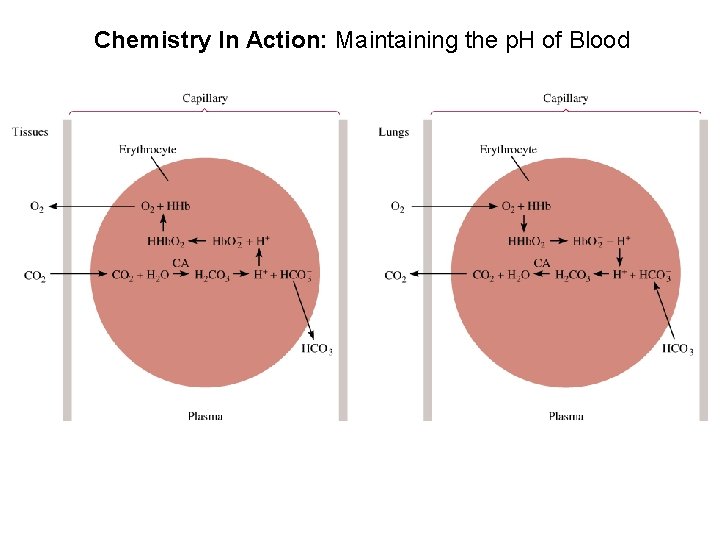
Chemistry In Action: Maintaining the p. H of Blood
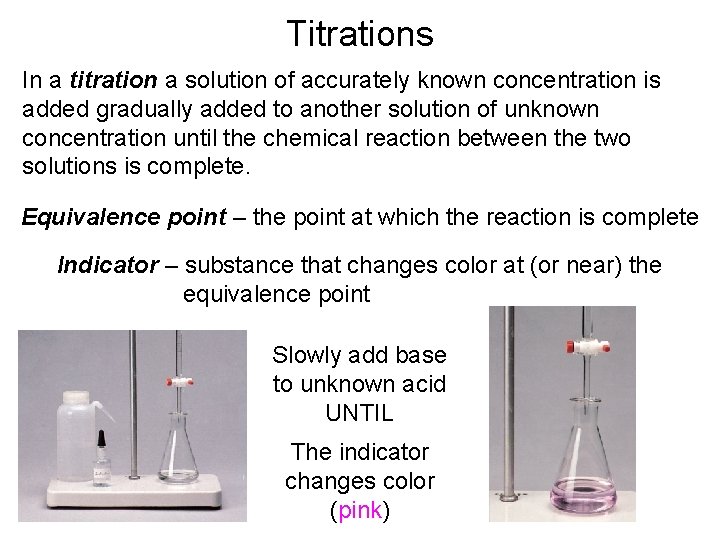
Titrations In a titration a solution of accurately known concentration is added gradually added to another solution of unknown concentration until the chemical reaction between the two solutions is complete. Equivalence point – the point at which the reaction is complete Indicator – substance that changes color at (or near) the equivalence point Slowly add base to unknown acid UNTIL The indicator changes color (pink)
Acid-Ionization Titration Curves • An acid-base titration curve is a plot of the p. H of a solution of acid (or base) against the volume of added base (or acid). Such curves are used to gain insight into the titration process. You can use titration curves to choose an appropriate indicator that will show when the titration is complete.
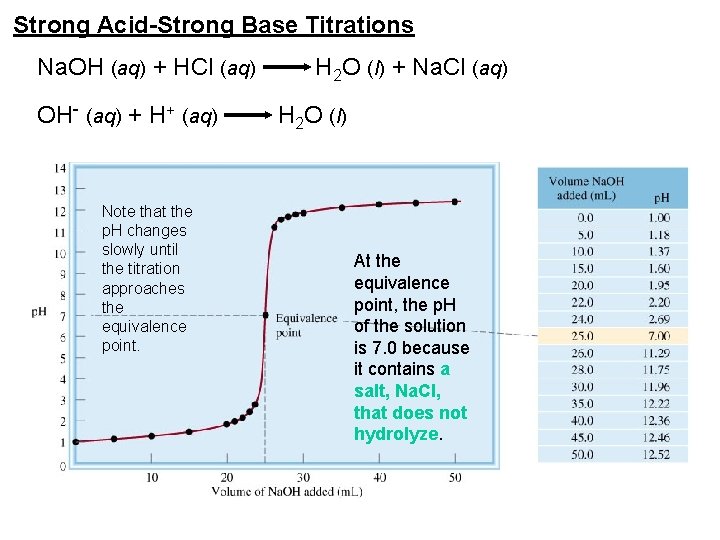
Strong Acid-Strong Base Titrations Na. OH (aq) + HCl (aq) OH- (aq) + H+ (aq) Note that the p. H changes slowly until the titration approaches the equivalence point. H 2 O (l) + Na. Cl (aq) H 2 O (l) At the equivalence point, the p. H of the solution is 7. 0 because it contains a salt, Na. Cl, that does not hydrolyze.
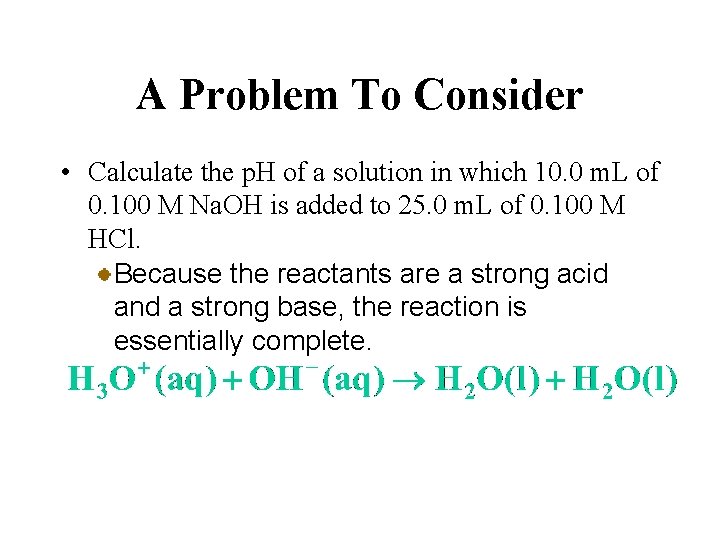
A Problem To Consider • Calculate the p. H of a solution in which 10. 0 m. L of 0. 100 M Na. OH is added to 25. 0 m. L of 0. 100 M HCl. Because the reactants are a strong acid and a strong base, the reaction is essentially complete.
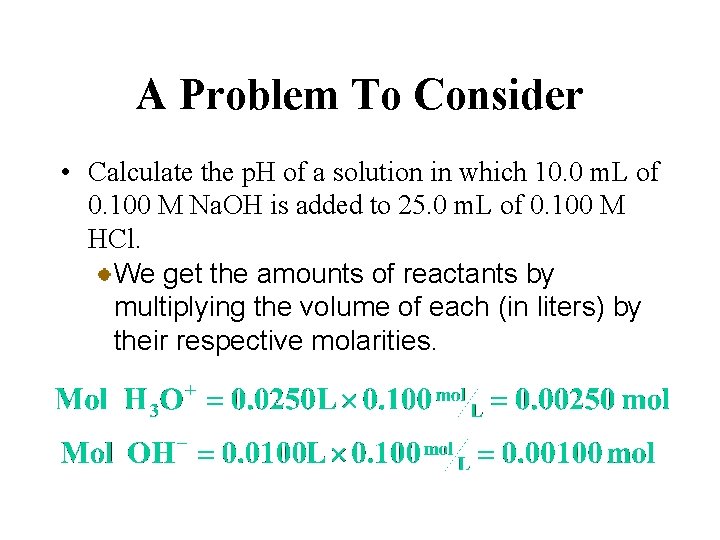
A Problem To Consider • Calculate the p. H of a solution in which 10. 0 m. L of 0. 100 M Na. OH is added to 25. 0 m. L of 0. 100 M HCl. We get the amounts of reactants by multiplying the volume of each (in liters) by their respective molarities.
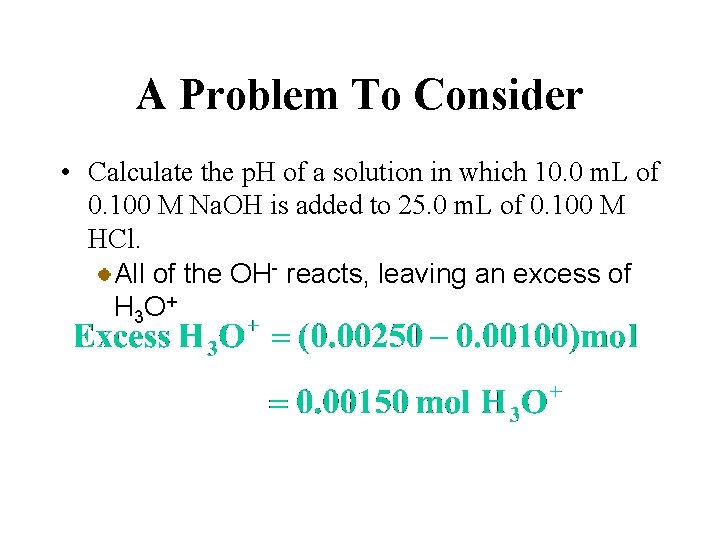
A Problem To Consider • Calculate the p. H of a solution in which 10. 0 m. L of 0. 100 M Na. OH is added to 25. 0 m. L of 0. 100 M HCl. All of the OH- reacts, leaving an excess of H 3 O +
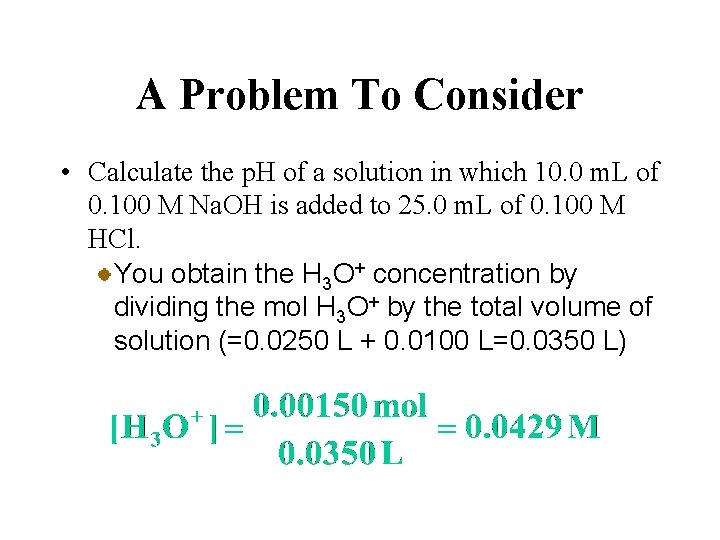
A Problem To Consider • Calculate the p. H of a solution in which 10. 0 m. L of 0. 100 M Na. OH is added to 25. 0 m. L of 0. 100 M HCl. You obtain the H 3 O+ concentration by dividing the mol H 3 O+ by the total volume of solution (=0. 0250 L + 0. 0100 L=0. 0350 L)
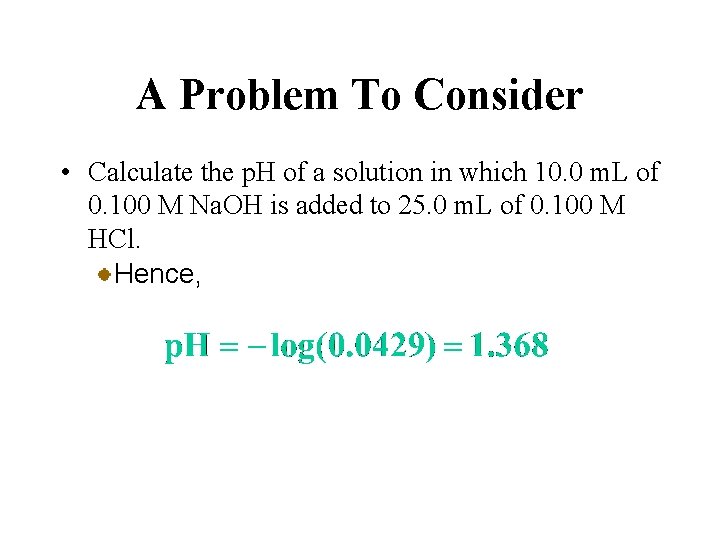
A Problem To Consider • Calculate the p. H of a solution in which 10. 0 m. L of 0. 100 M Na. OH is added to 25. 0 m. L of 0. 100 M HCl. Hence,
Titration of a Weak Acid by a Strong Base • The titration of a weak acid by a strong base gives a somewhat different curve. The p. H range of these titrations is shorter. The equivalence point will be on the basic side since the salt produced contains the anion of a weak acid.
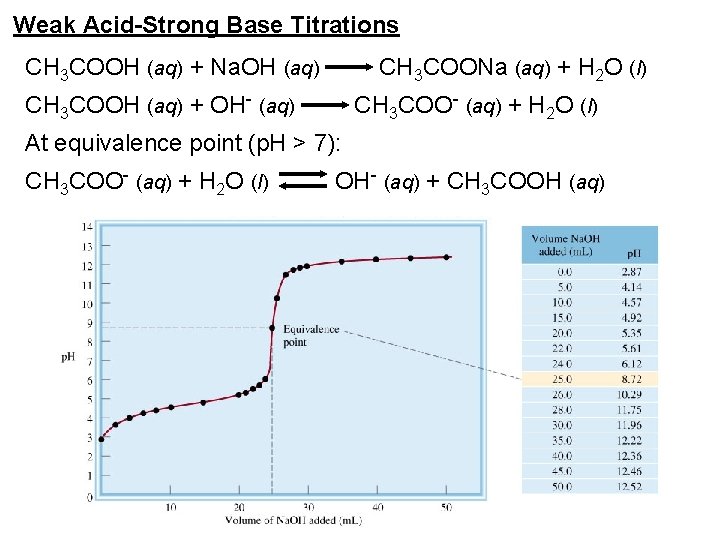
Weak Acid-Strong Base Titrations CH 3 COOH (aq) + Na. OH (aq) CH 3 COONa (aq) + H 2 O (l) CH 3 COOH (aq) + OH- (aq) CH 3 COO- (aq) + H 2 O (l) At equivalence point (p. H > 7): CH 3 COO- (aq) + H 2 O (l) OH- (aq) + CH 3 COOH (aq)
A Problem To Consider • Calculate the p. H of the solution at the equivalence point when 25. 0 m. L of 0. 10 M acetic acid is titrated with 0. 10 M sodium hydroxide. The Ka for acetic acid is 1. 7 x 10 -5. At the equivalence point, equal molar amounts of acetic acid and sodium hydroxide react to give sodium acetate.
A Problem To Consider • Calculate the p. H of the solution at the equivalence point when 25. 0 m. L of 0. 10 M acetic acid is titrated with 0. 10 M sodium hydroxide. The Ka for acetic acid is 1. 7 x 10 -5. First, calculate the concentration of the acetate ion. In this case, 25. 0 m. L of 0. 10 M Na. OH is needed to react with 25. 0 m. L of 0. 10 M acetic acid.
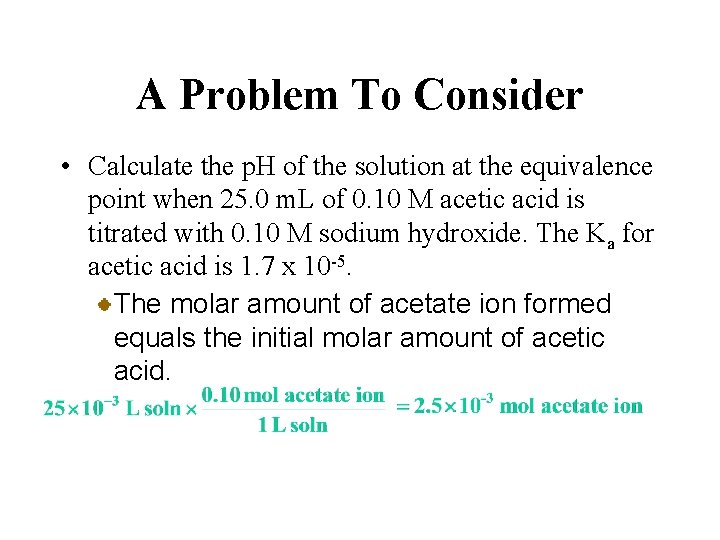
A Problem To Consider • Calculate the p. H of the solution at the equivalence point when 25. 0 m. L of 0. 10 M acetic acid is titrated with 0. 10 M sodium hydroxide. The Ka for acetic acid is 1. 7 x 10 -5. The molar amount of acetate ion formed equals the initial molar amount of acetic acid.
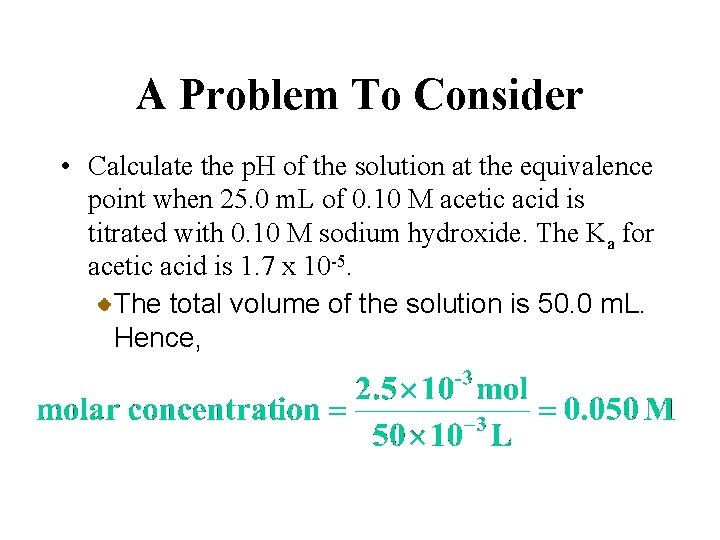
A Problem To Consider • Calculate the p. H of the solution at the equivalence point when 25. 0 m. L of 0. 10 M acetic acid is titrated with 0. 10 M sodium hydroxide. The Ka for acetic acid is 1. 7 x 10 -5. The total volume of the solution is 50. 0 m. L. Hence,
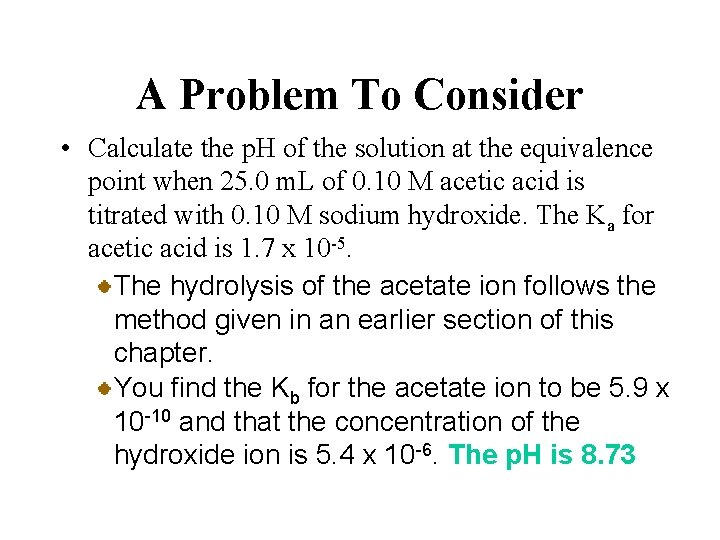
A Problem To Consider • Calculate the p. H of the solution at the equivalence point when 25. 0 m. L of 0. 10 M acetic acid is titrated with 0. 10 M sodium hydroxide. The Ka for acetic acid is 1. 7 x 10 -5. The hydrolysis of the acetate ion follows the method given in an earlier section of this chapter. You find the Kb for the acetate ion to be 5. 9 x 10 -10 and that the concentration of the hydroxide ion is 5. 4 x 10 -6. The p. H is 8. 73
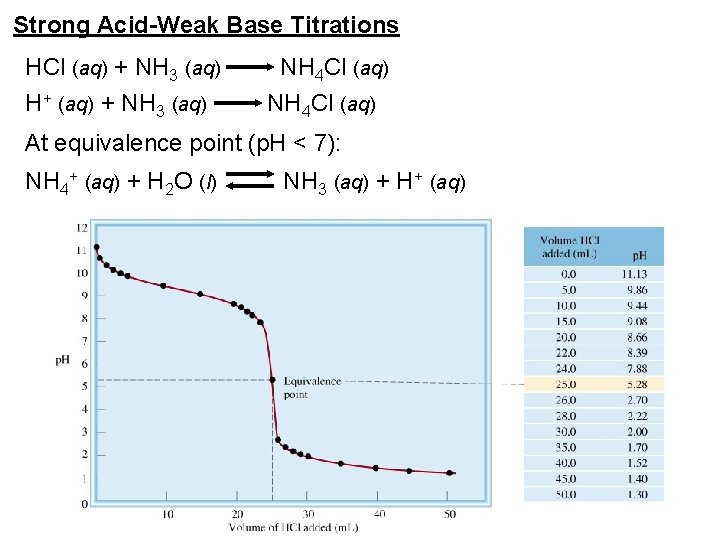
Strong Acid-Weak Base Titrations HCl (aq) + NH 3 (aq) H+ (aq) + NH 3 (aq) NH 4 Cl (aq) At equivalence point (p. H < 7): NH 4+ (aq) + H 2 O (l) NH 3 (aq) + H+ (aq)
Titration of a Weak Base by a Strong Acid • The titration of a weak base with a strong acid is a reflection of our previous example. In this case, the p. H declines slowly at first, then falls abruptly from about p. H 7 to p. H 3. Methyl red, which changes color from yellow at p. H 6 to red at p. H 4. 8, is a possible indicator.
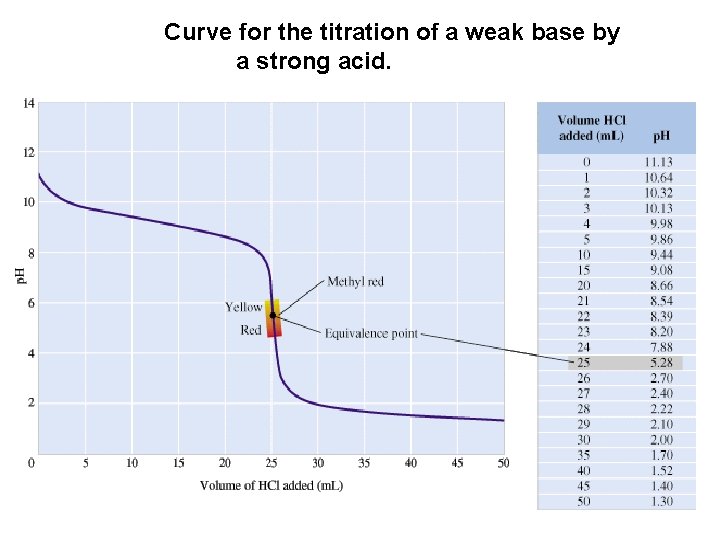
Curve for the titration of a weak base by a strong acid.
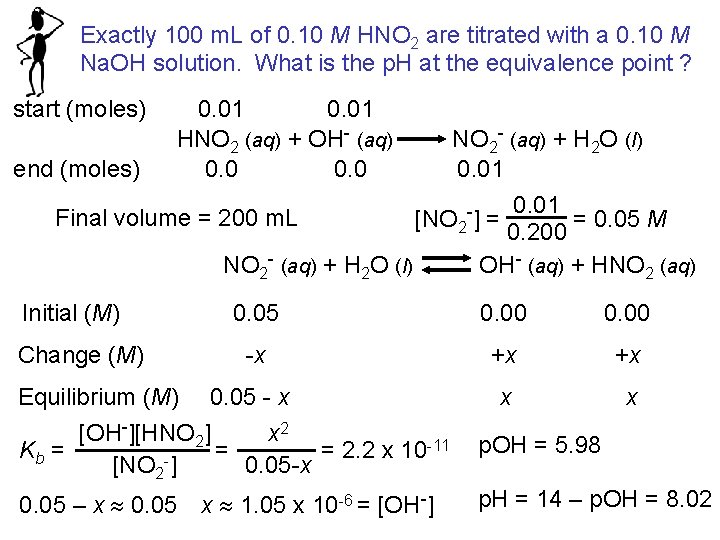
Exactly 100 m. L of 0. 10 M HNO 2 are titrated with a 0. 10 M Na. OH solution. What is the p. H at the equivalence point ? start (moles) 0. 01 HNO 2 (aq) + OH- (aq) 0. 0 NO 2 - (aq) + H 2 O (l) end (moles) 0. 01 Final volume = 200 m. L [NO 2 -] = = 0. 05 M 0. 200 NO 2 - (aq) + H 2 O (l) OH- (aq) + HNO 2 (aq) Initial (M) Change (M) Equilibrium (M) 0. 05 0. 00 -x +x +x 0. 05 - x x x [OH-][HNO 2] x 2 -11 = 2. 2 x 10 Kb = = [NO 2 -] 0. 05 -x p. OH = 5. 98 0. 05 – x 0. 05 x 1. 05 x 10 -6 = [OH-] p. H = 14 – p. OH = 8. 02
![Acid-Base Indicators HIn (aq) H+ (aq) + In- (aq) [HIn] 10 Color of acid](http://slidetodoc.com/presentation_image_h2/a56bde4b150dd145a7f3cd46728f421f/image-50.jpg "Acid-Base Indicators HIn (aq) H+ (aq) + In- (aq) [HIn] 10 Color of acid")
Acid-Base Indicators HIn (aq) H+ (aq) + In- (aq) [HIn] 10 Color of acid (HIn) predominates [In ] [HIn] -) predominates Color of conjugate base (In 10 [In-]
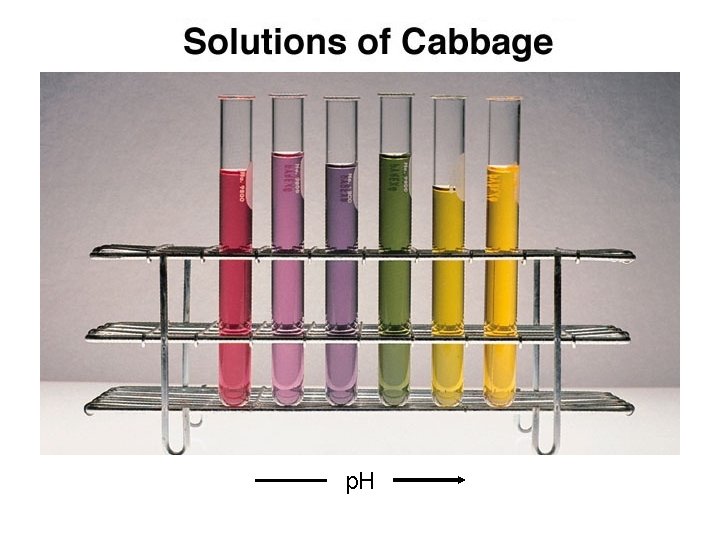
p. H
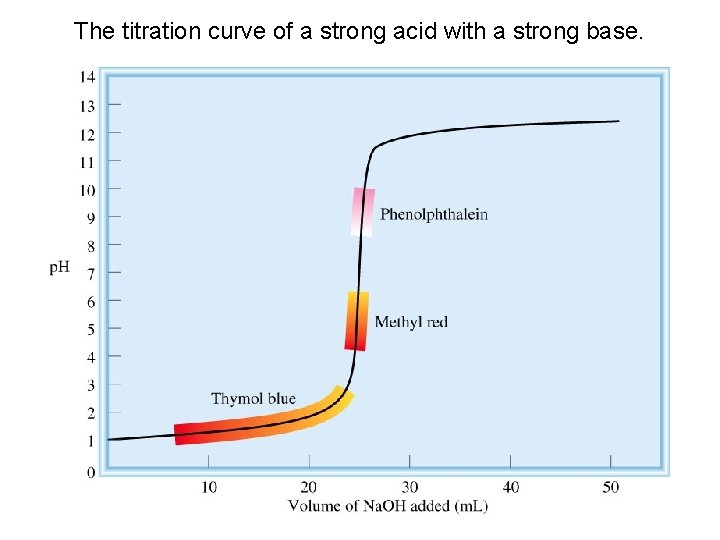
The titration curve of a strong acid with a strong base.
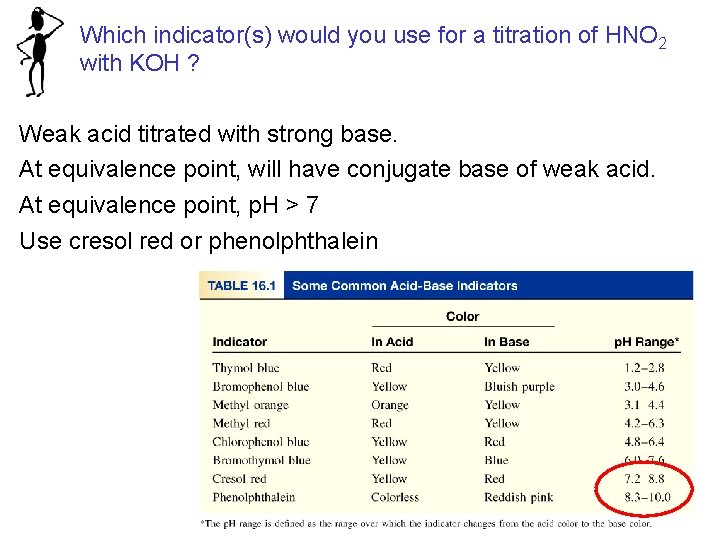
Which indicator(s) would you use for a titration of HNO 2 with KOH ? Weak acid titrated with strong base. At equivalence point, will have conjugate base of weak acid. At equivalence point, p. H > 7 Use cresol red or phenolphthalein
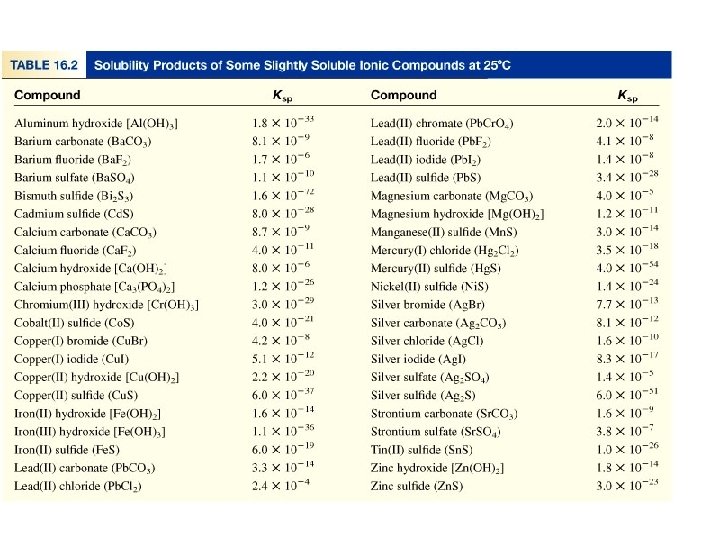
Solubility Equilibria • Many natural processes depend on the precipitation or dissolving of a slightly soluble salt. In the next section, we look at the equilibria of slightly soluble, or nearly insoluble, ionic compounds. Their equilibrium constants can be used to answer questions regarding solubility and precipitation.
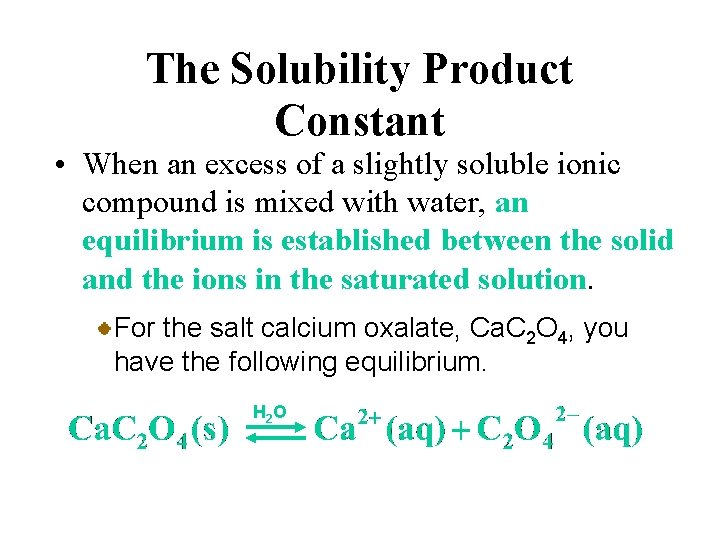
The Solubility Product Constant • When an excess of a slightly soluble ionic compound is mixed with water, an equilibrium is established between the solid and the ions in the saturated solution. For the salt calcium oxalate, Ca. C 2 O 4, you have the following equilibrium. H 2 O
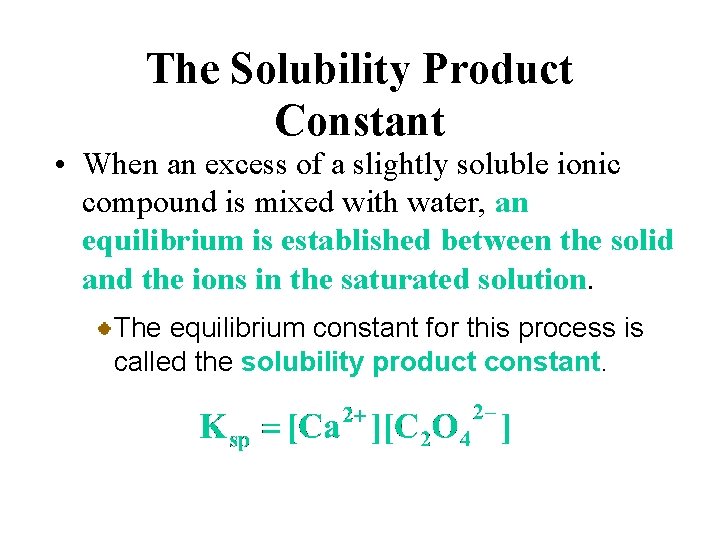
The Solubility Product Constant • When an excess of a slightly soluble ionic compound is mixed with water, an equilibrium is established between the solid and the ions in the saturated solution. The equilibrium constant for this process is called the solubility product constant.
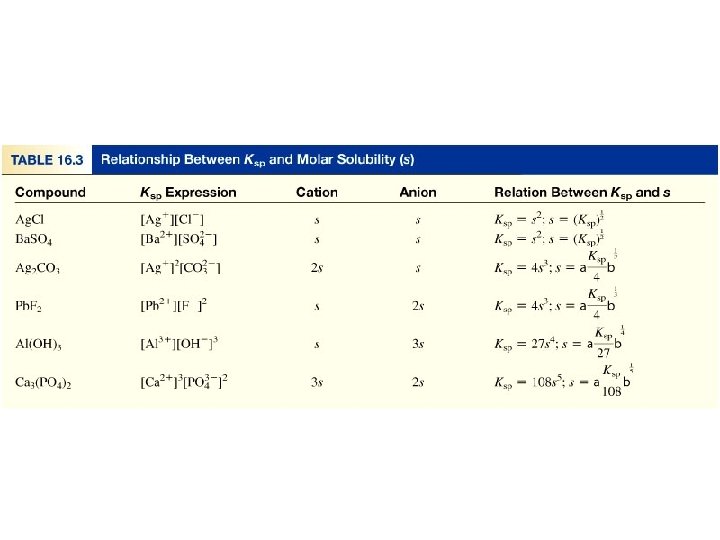
The Solubility Product Constant • In general, the solubility product constant is the equilibrium constant for the solubility equilibrium of a slightly soluble (or nearly insoluble) ionic compound. It equals the product of the equilibrium concentrations of the ions in the compound. Each concentration is raised to a power equal to the number of such ions in the formula of the compound.
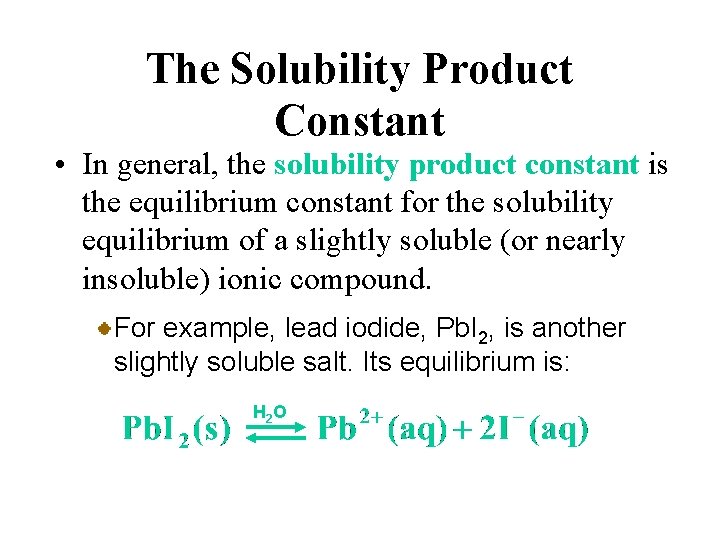
The Solubility Product Constant • In general, the solubility product constant is the equilibrium constant for the solubility equilibrium of a slightly soluble (or nearly insoluble) ionic compound. For example, lead iodide, Pb. I 2, is another slightly soluble salt. Its equilibrium is: H 2 O
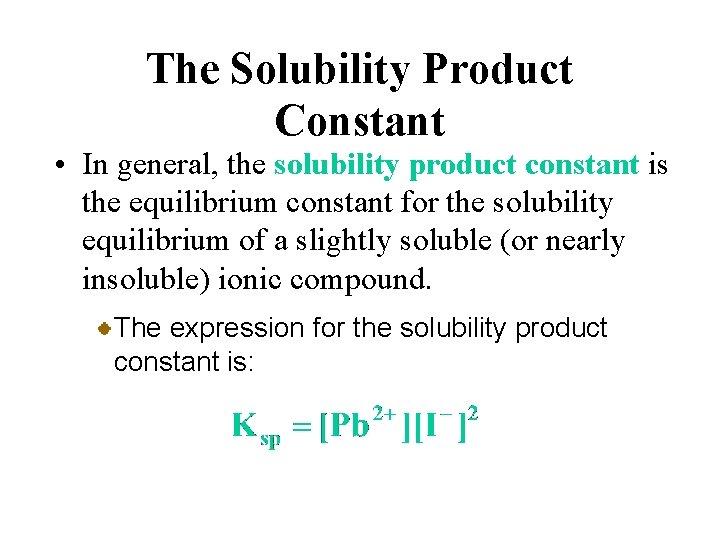
The Solubility Product Constant • In general, the solubility product constant is the equilibrium constant for the solubility equilibrium of a slightly soluble (or nearly insoluble) ionic compound. The expression for the solubility product constant is:
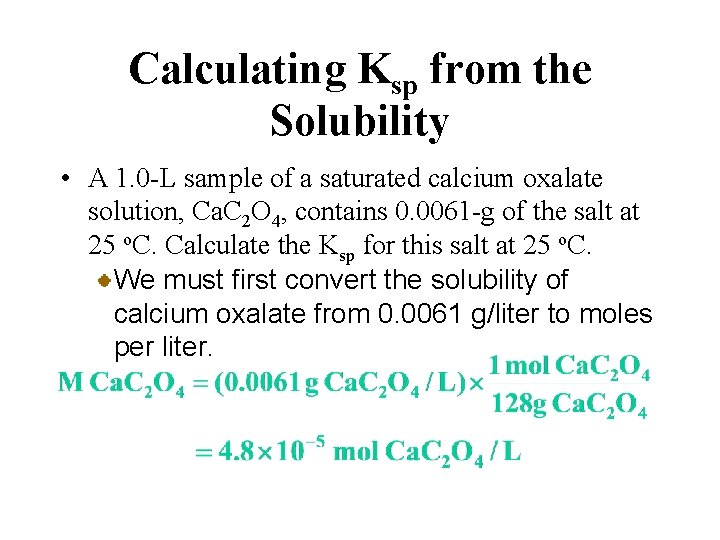
Calculating Ksp from the Solubility • A 1. 0 -L sample of a saturated calcium oxalate solution, Ca. C 2 O 4, contains 0. 0061 -g of the salt at 25 o. C. Calculate the Ksp for this salt at 25 o. C. We must first convert the solubility of calcium oxalate from 0. 0061 g/liter to moles per liter.
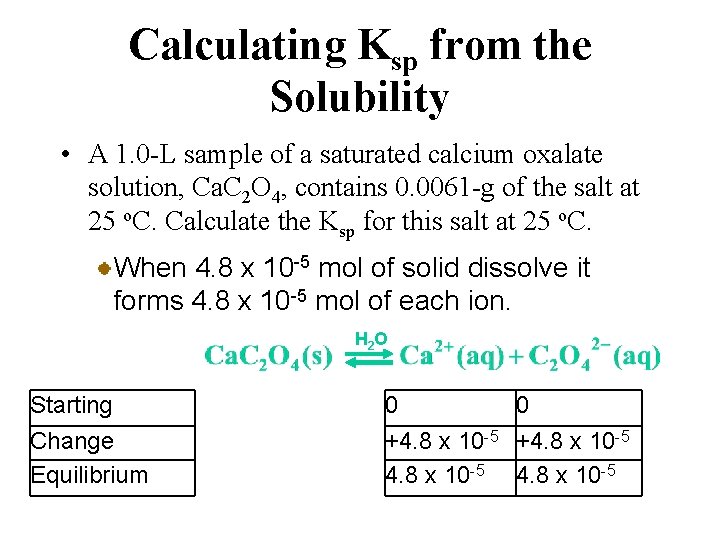
Calculating Ksp from the Solubility • A 1. 0 -L sample of a saturated calcium oxalate solution, Ca. C 2 O 4, contains 0. 0061 -g of the salt at 25 o. C. Calculate the Ksp for this salt at 25 o. C. When 4. 8 x 10 -5 mol of solid dissolve it forms 4. 8 x 10 -5 mol of each ion. H 2 O Starting Change Equilibrium 0 0 +4. 8 x 10 -5
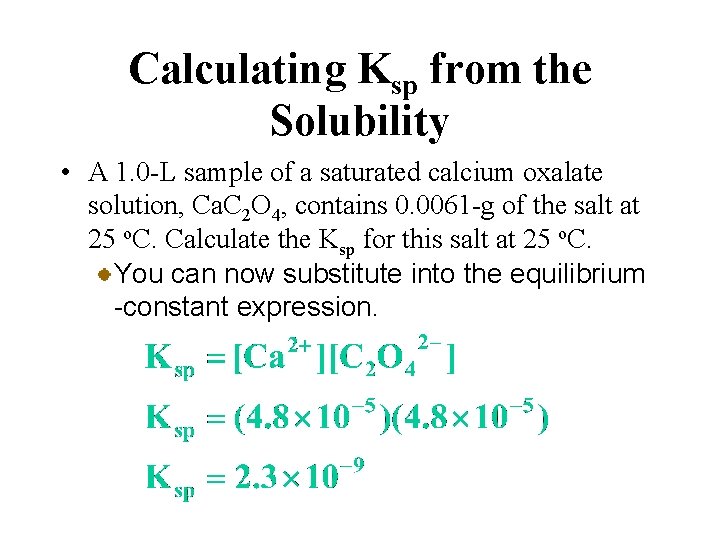
Calculating Ksp from the Solubility • A 1. 0 -L sample of a saturated calcium oxalate solution, Ca. C 2 O 4, contains 0. 0061 -g of the salt at 25 o. C. Calculate the Ksp for this salt at 25 o. C. You can now substitute into the equilibrium -constant expression.
Calculating Ksp from the Solubility • By experiment, it is found that 1. 2 x 10 -3 mol of lead(II) iodide, Pb. I 2, dissolves in 1. 0 L of water at 25 o. C. What is the Ksp at this temperature? Note that in this example, you find that 1. 2 x 10 -3 mol of the solid dissolves to give 1. 2 x 10³ mol Pb 2+ and 2 x (1. 2 x 10 -3) mol of I-.
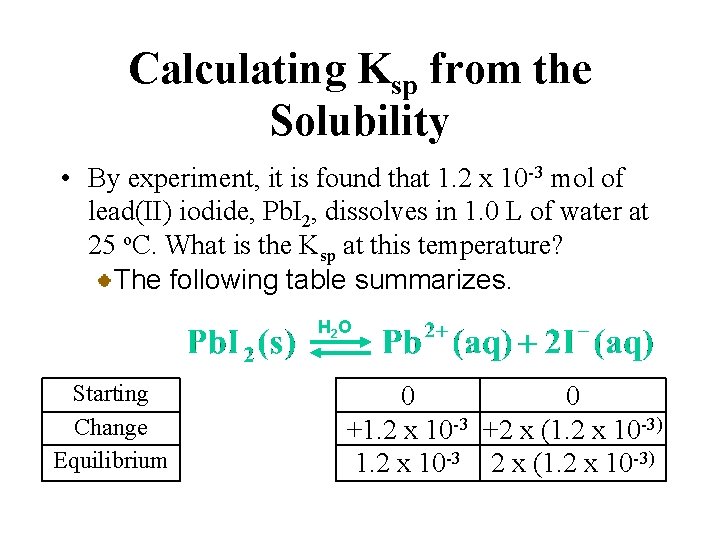
Calculating Ksp from the Solubility • By experiment, it is found that 1. 2 x 10 -3 mol of lead(II) iodide, Pb. I 2, dissolves in 1. 0 L of water at 25 o. C. What is the Ksp at this temperature? The following table summarizes. H 2 O Starting Change Equilibrium 0 0 +1. 2 x 10 -3 +2 x (1. 2 x 10 -3) 1. 2 x 10 -3 2 x (1. 2 x 10 -3)
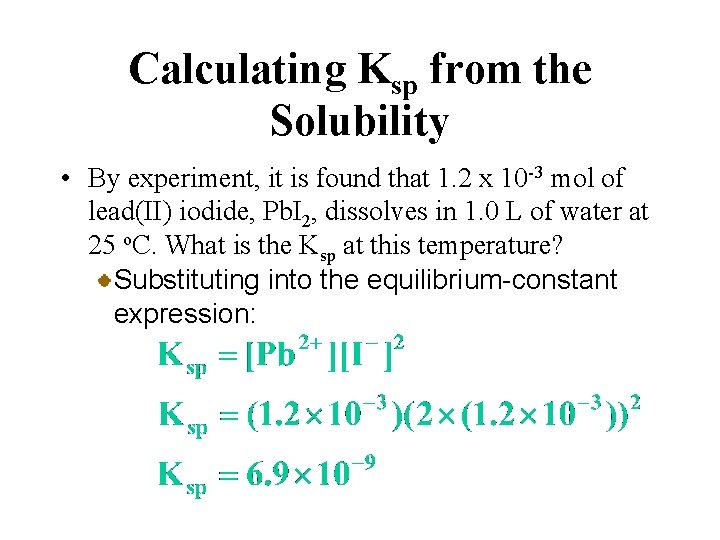
Calculating Ksp from the Solubility • By experiment, it is found that 1. 2 x 10 -3 mol of lead(II) iodide, Pb. I 2, dissolves in 1. 0 L of water at 25 o. C. What is the Ksp at this temperature? Substituting into the equilibrium-constant expression:
Calculating Ksp from the Solubility • By experiment, it is found that 1. 2 x 10 -3 mol of lead(II) iodide, Pb. I 2, dissolves in 1. 0 L of water at 25 o. C. What is the Ksp at this temperature? If the solubility product constant is known, the solubility of the compound can be calculated.
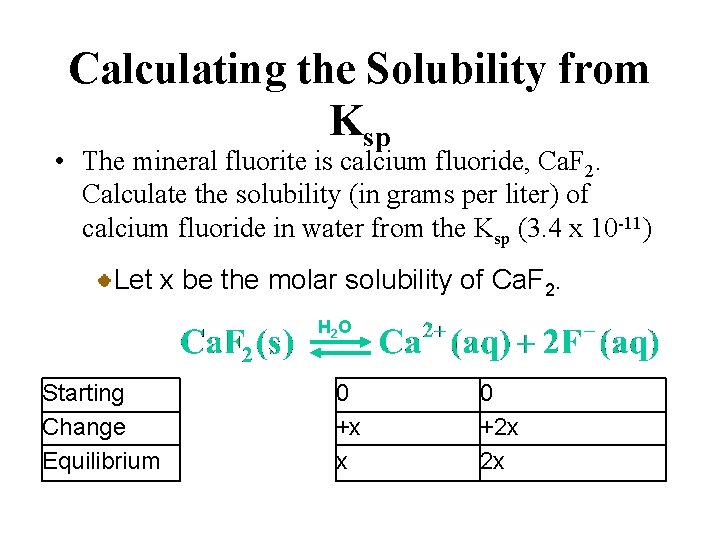
Calculating the Solubility from Ksp • The mineral fluorite is calcium fluoride, Ca. F 2. Calculate the solubility (in grams per liter) of calcium fluoride in water from the Ksp (3. 4 x 10 -11) Let x be the molar solubility of Ca. F 2. H 2 O Starting Change Equilibrium 0 +x x 0 +2 x 2 x
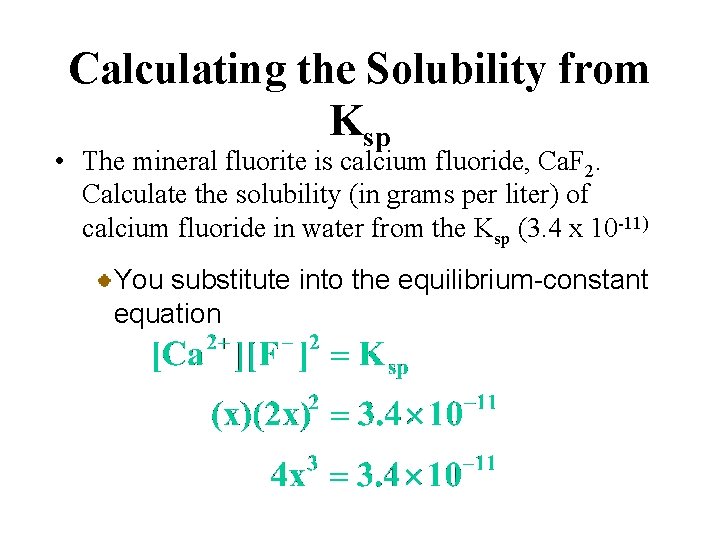
Calculating the Solubility from Ksp • The mineral fluorite is calcium fluoride, Ca. F 2. Calculate the solubility (in grams per liter) of calcium fluoride in water from the Ksp (3. 4 x 10 -11) You substitute into the equilibrium-constant equation
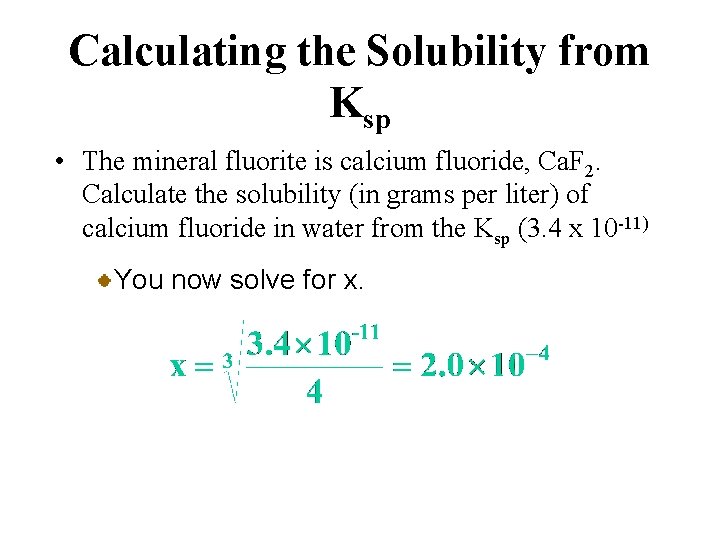
Calculating the Solubility from Ksp • The mineral fluorite is calcium fluoride, Ca. F 2. Calculate the solubility (in grams per liter) of calcium fluoride in water from the Ksp (3. 4 x 10 -11) You now solve for x.
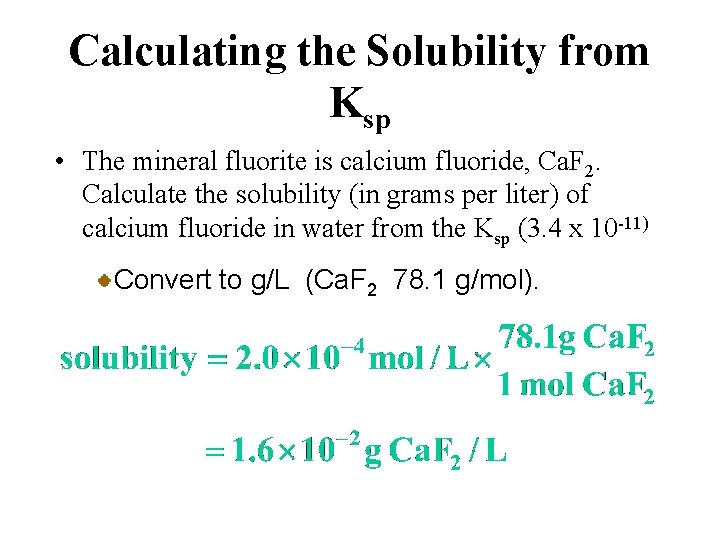
Calculating the Solubility from Ksp • The mineral fluorite is calcium fluoride, Ca. F 2. Calculate the solubility (in grams per liter) of calcium fluoride in water from the Ksp (3. 4 x 10 -11) Convert to g/L (Ca. F 2 78. 1 g/mol).
Solubility Equilibria – Ion Product (reaction quotient) Q is defined as the ion product (reaction quotient) Q = same as Ksp only at initial concentration I. e. Ag. Cl ↔ Ag+ + Cl- Q = [Ag+ ]0[Cl- ]0 The subscript 0 reminds us that these are initial concentrations
Criteria for Precipitation • To determine whether an equilibrium system will go in the forward or reverse direction requires that we evaluate the reaction quotient, Qc. To predict the direction of reaction, you compare Qc with Kc (Chapter 14). The reaction quotient has the same form as the Ksp expression, but the concentrations of products are starting values.
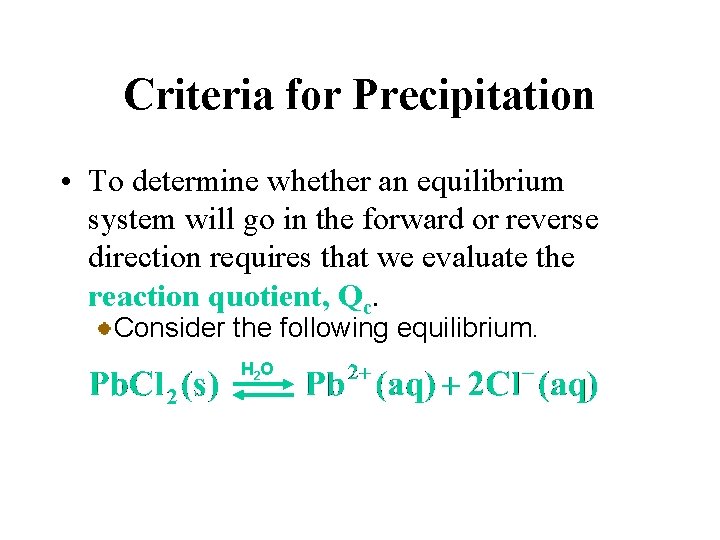
Criteria for Precipitation • To determine whether an equilibrium system will go in the forward or reverse direction requires that we evaluate the reaction quotient, Qc. Consider the following equilibrium. H 2 O
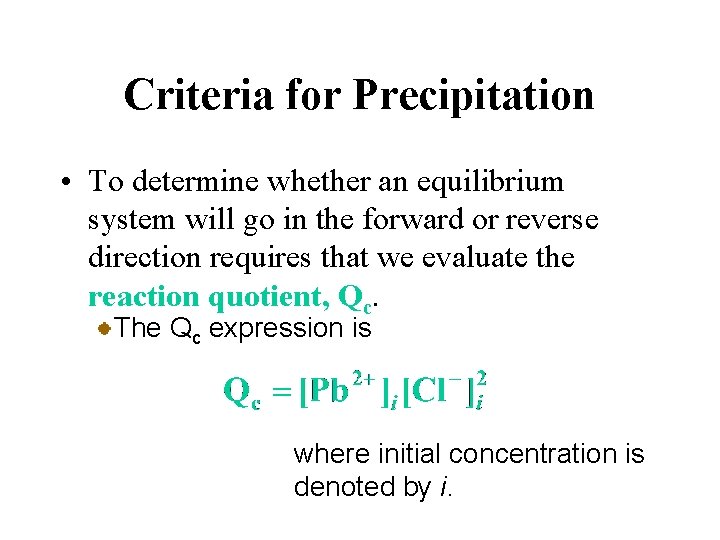
Criteria for Precipitation • To determine whether an equilibrium system will go in the forward or reverse direction requires that we evaluate the reaction quotient, Qc. The Qc expression is where initial concentration is denoted by i.
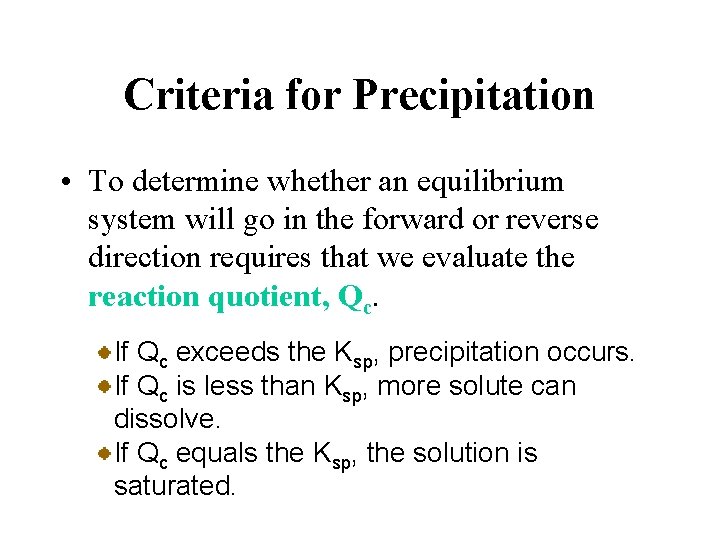
Criteria for Precipitation • To determine whether an equilibrium system will go in the forward or reverse direction requires that we evaluate the reaction quotient, Qc. If Qc exceeds the Ksp, precipitation occurs. If Qc is less than Ksp, more solute can dissolve. If Qc equals the Ksp, the solution is saturated.
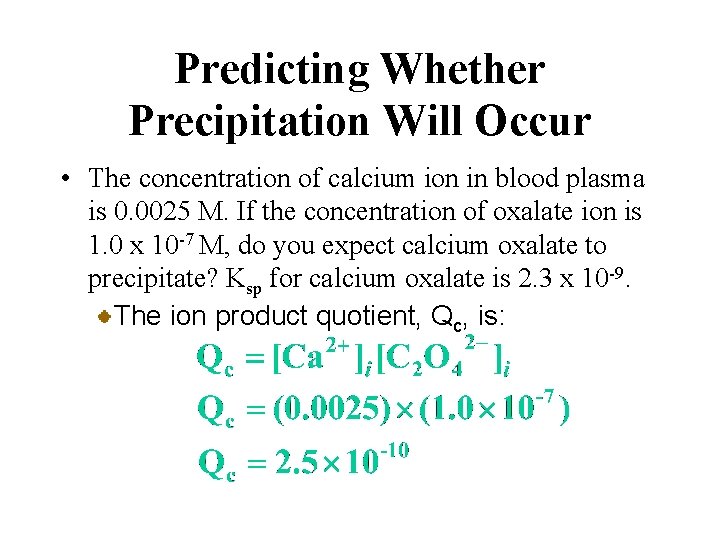
Predicting Whether Precipitation Will Occur • The concentration of calcium ion in blood plasma is 0. 0025 M. If the concentration of oxalate ion is 1. 0 x 10 -7 M, do you expect calcium oxalate to precipitate? Ksp for calcium oxalate is 2. 3 x 10 -9. The ion product quotient, Qc, is:
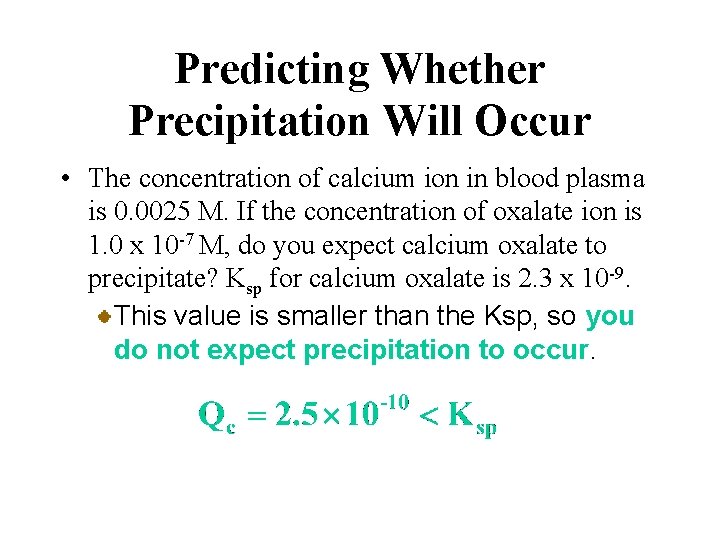
Predicting Whether Precipitation Will Occur • The concentration of calcium ion in blood plasma is 0. 0025 M. If the concentration of oxalate ion is 1. 0 x 10 -7 M, do you expect calcium oxalate to precipitate? Ksp for calcium oxalate is 2. 3 x 10 -9. This value is smaller than the Ksp, so you do not expect precipitation to occur.
![Solubility Equilibria Ag. Cl (s) Ksp = [Ag+][Cl-] Mg. F 2 (s) Ag 2](http://slidetodoc.com/presentation_image_h2/a56bde4b150dd145a7f3cd46728f421f/image-78.jpg "Solubility Equilibria Ag. Cl (s) Ksp = [Ag+][Cl-] Mg. F 2 (s) Ag 2")
Solubility Equilibria Ag. Cl (s) Ksp = [Ag+][Cl-] Mg. F 2 (s) Ag 2 CO 3 (s) Ca 3(PO 4)2 (s) Ag+ (aq) + Cl- (aq) Ksp is the solubility product constant Mg 2+ (aq) + 2 F- (aq) Ksp = [Mg 2+][F-]2 2 Ag+ (aq) + CO 32 - (aq) Ksp = [Ag+]2[CO 32 -] 3 Ca 2+ (aq) + 2 PO 43 - (aq) Ksp = [Ca 2+]3[PO 43 -]2 Dissolution of an ionic solid in aqueous solution: Q < Ksp Unsaturated solution Q = Ksp Saturated solution Q > Ksp Supersaturated solution No precipitate Precipitate will form
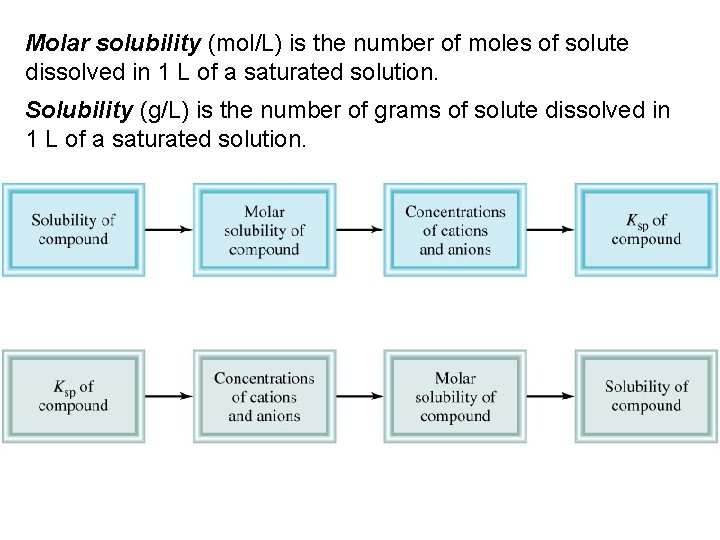
Molar solubility (mol/L) is the number of moles of solute dissolved in 1 L of a saturated solution. Solubility (g/L) is the number of grams of solute dissolved in 1 L of a saturated solution.
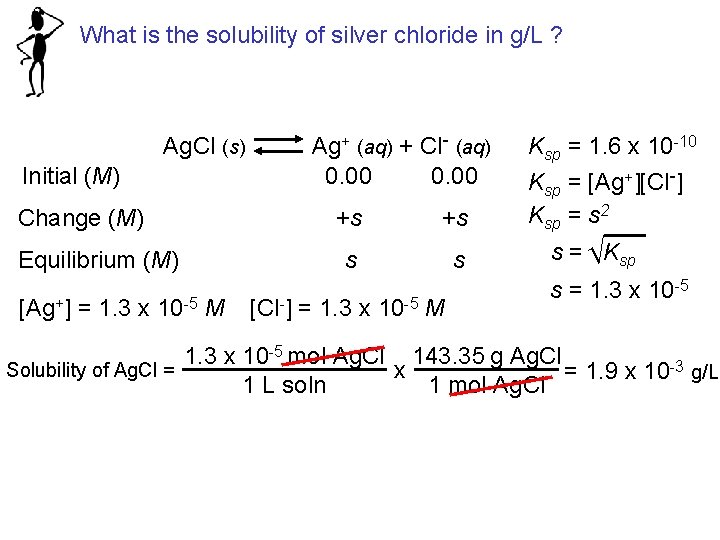
What is the solubility of silver chloride in g/L ? Ag. Cl (s) Initial (M) Change (M) Equilibrium (M) [Ag+] = 1. 3 x 10 -5 M Ag+ (aq) + Cl- (aq) 0. 00 +s +s s s [Cl-] = 1. 3 x 10 -5 M Ksp = 1. 6 x 10 -10 Ksp = [Ag+][Cl-] Ksp = s 2 s = Ksp s = 1. 3 x 10 -5 mol Ag. Cl 143. 35 g Ag. Cl Solubility of Ag. Cl = x = 1. 9 x 10 -3 g/L 1 L soln 1 mol Ag. Cl
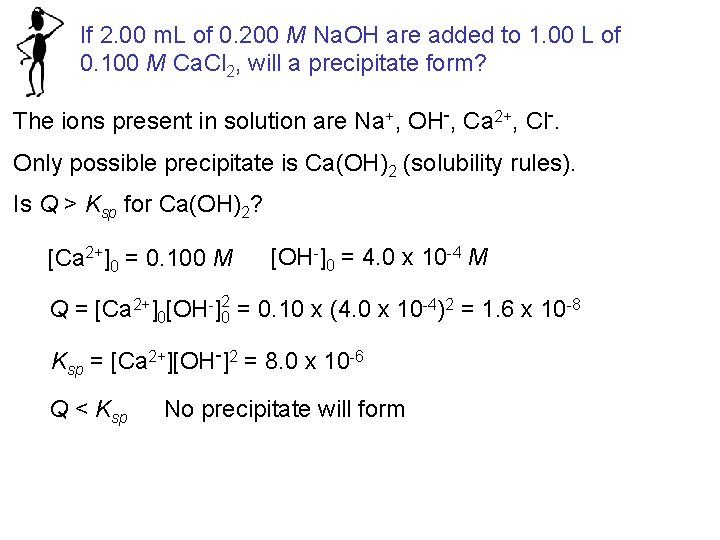
If 2. 00 m. L of 0. 200 M Na. OH are added to 1. 00 L of 0. 100 M Ca. Cl 2, will a precipitate form? The ions present in solution are Na+, OH-, Ca 2+, Cl-. Only possible precipitate is Ca(OH)2 (solubility rules). Is Q > Ksp for Ca(OH)2? [Ca 2+]0 = 0. 100 M [OH-]0 = 4. 0 x 10 -4 M Q = [Ca 2+]0[OH-]02 = 0. 10 x (4. 0 x 10 -4)2 = 1. 6 x 10 -8 Ksp = [Ca 2+][OH-]2 = 8. 0 x 10 -6 Q < Ksp No precipitate will form
Fractional Precipitation • Fractional precipitation is the technique of separating two or more ions from a solution by adding a reactant that precipitates first one ion, then another, and so forth. For example, when you slowly add potassium chromate, K 2 Cr. O 4, to a solution containing Ba 2+ and Sr 2+, barium chromate precipitates first.
Fractional Precipitation • Fractional precipitation is the technique of separating two or more ions from a solution by adding a reactant that precipitates first one ion, then another, and so forth. After most of the Ba 2+ ion has precipitated, strontium chromate begins to precipitate. It is therefore possible to separate Ba 2+ from Sr 2+ by fractional precipitation using K 2 Cr. O 4.
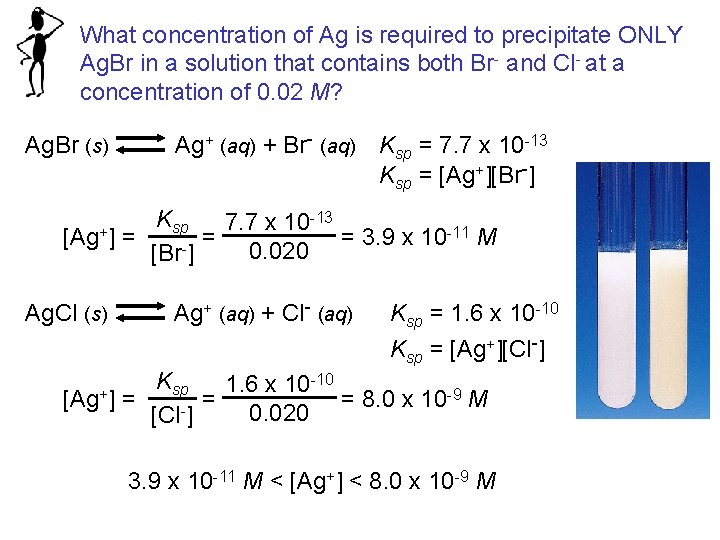
What concentration of Ag is required to precipitate ONLY Ag. Br in a solution that contains both Br- and Cl- at a concentration of 0. 02 M? Ag. Br (s) Ag+ (aq) + Br- (aq) Ksp = 7. 7 x 10 -13 Ksp = [Ag+][Br-] -13 K 7. 7 x 10 sp -11 M = = 3. 9 x 10 [Ag+] = 0. 020 [Br-] Ag. Cl (s) [Ag+] Ag+ (aq) + Cl- (aq) Ksp = 1. 6 x 10 -10 Ksp = [Ag+][Cl-] Ksp 1. 6 x 10 -10 -9 M = = 8. 0 x 10 = 0. 020 [Cl-] 3. 9 x 10 -11 M < [Ag+] < 8. 0 x 10 -9 M
Solubility and the Common-Ion Effect • In this section we will look at calculating solubilities in the presence of other ions. The importance of the Ksp becomes apparent when you consider the solubility of one salt in the solution of another having the same cation.
Solubility and the Common-Ion Effect • In this section we will look at calculating solubilities in the presence of other ions. For example, suppose you wish to know the solubility of calcium oxalate in a solution of calcium chloride. Each salt contributes the same cation (Ca 2+) The effect is to make calcium oxalate less soluble than it would be in pure water.
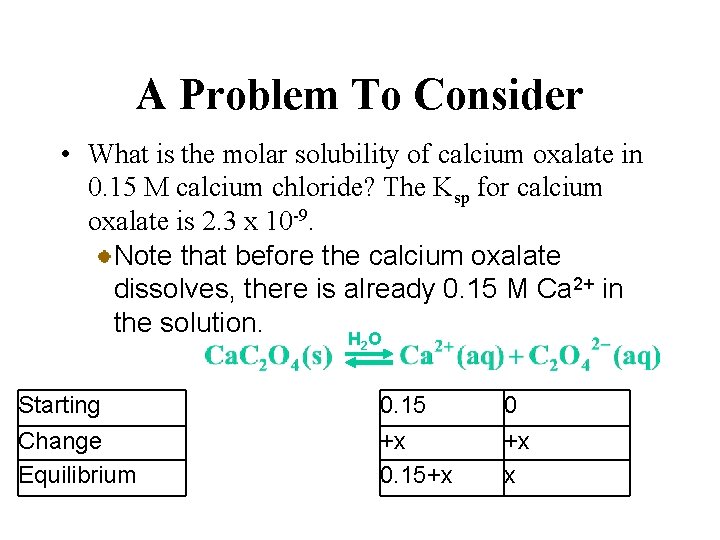
A Problem To Consider • What is the molar solubility of calcium oxalate in 0. 15 M calcium chloride? The Ksp for calcium oxalate is 2. 3 x 10 -9. Note that before the calcium oxalate dissolves, there is already 0. 15 M Ca 2+ in the solution. HO 2 Starting Change Equilibrium 0. 15 +x 0. 15+x 0 +x x
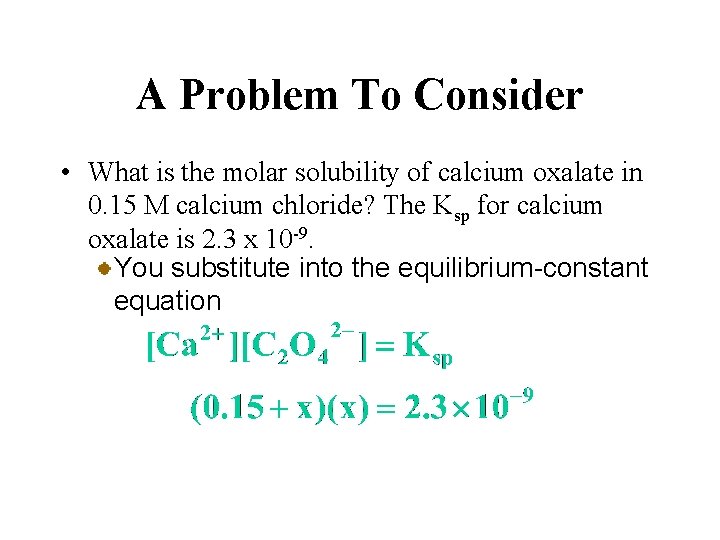
A Problem To Consider • What is the molar solubility of calcium oxalate in 0. 15 M calcium chloride? The Ksp for calcium oxalate is 2. 3 x 10 -9. You substitute into the equilibrium-constant equation
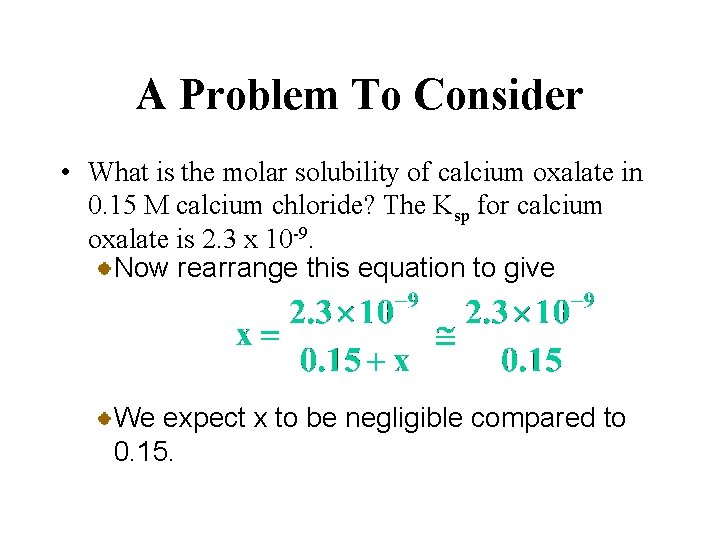
A Problem To Consider • What is the molar solubility of calcium oxalate in 0. 15 M calcium chloride? The Ksp for calcium oxalate is 2. 3 x 10 -9. Now rearrange this equation to give We expect x to be negligible compared to 0. 15.
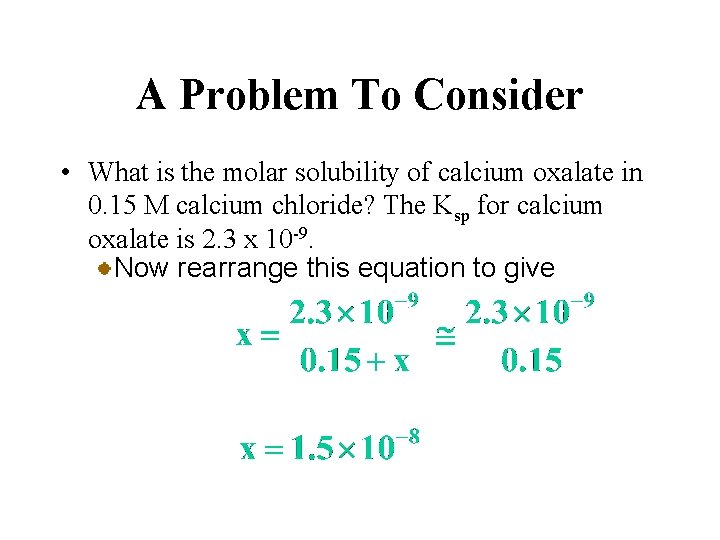
A Problem To Consider • What is the molar solubility of calcium oxalate in 0. 15 M calcium chloride? The Ksp for calcium oxalate is 2. 3 x 10 -9. Now rearrange this equation to give
A Problem To Consider • What is the molar solubility of calcium oxalate in 0. 15 M calcium chloride? The Ksp for calcium oxalate is 2. 3 x 10 -9. Therefore, the molar solubility of calcium oxalate in 0. 15 M Ca. Cl 2 is 1. 5 x 10 -8 M. In pure water, the molarity was 4. 8 x 10 -5 M, which is over 3000 times greater.
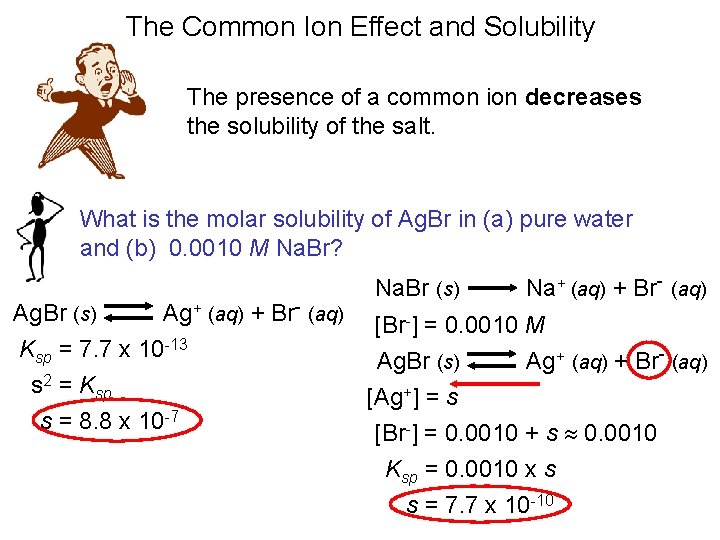
The Common Ion Effect and Solubility The presence of a common ion decreases the solubility of the salt. What is the molar solubility of Ag. Br in (a) pure water and (b) 0. 0010 M Na. Br? Na. Br (s) Na+ (aq) + Br- (aq) Ag. Br (s) Ag+ (aq) + Br- (aq) [Br-] = 0. 0010 M Ksp = 7. 7 x 10 -13 Ag. Br (s) Ag+ (aq) + Br- (aq) s 2 = Ksp [Ag+] = s s = 8. 8 x 10 -7 [Br-] = 0. 0010 + s 0. 0010 Ksp = 0. 0010 x s s = 7. 7 x 10 -10
Effect of p. H on Solubility • Sometimes it is necessary to account for other reactions aqueous ions might undergo. For example, if the anion is the conjugate base of a weak acid, it will react with H 3 O +. You should expect the solubility to be affected by p. H.
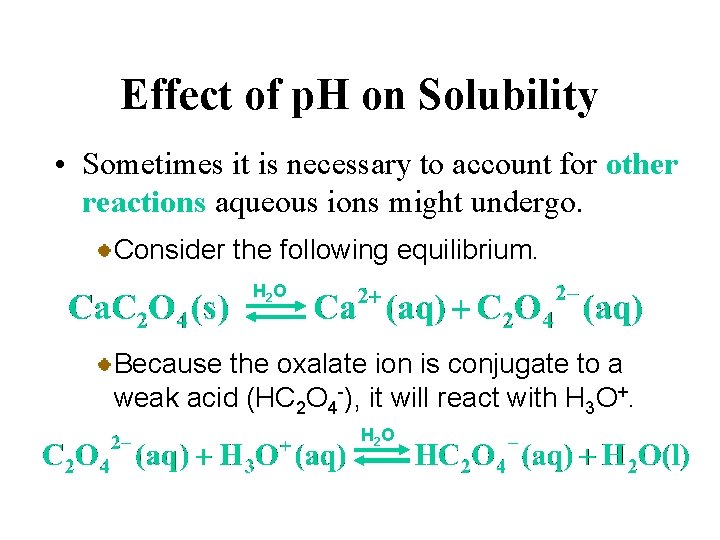
Effect of p. H on Solubility • Sometimes it is necessary to account for other reactions aqueous ions might undergo. Consider the following equilibrium. H 2 O Because the oxalate ion is conjugate to a weak acid (HC 2 O 4 -), it will react with H 3 O+. H 2 O
Effect of p. H on Solubility • Sometimes it is necessary to account for other reactions aqueous ions might undergo. According to Le Chatelier’s principle, as C 2 O 42 - ion is removed by the reaction with H 3 O+, more calcium oxalate dissolves. Therefore, you expect calcium oxalate to be more soluble in acidic solution (low p. H) than in pure water.
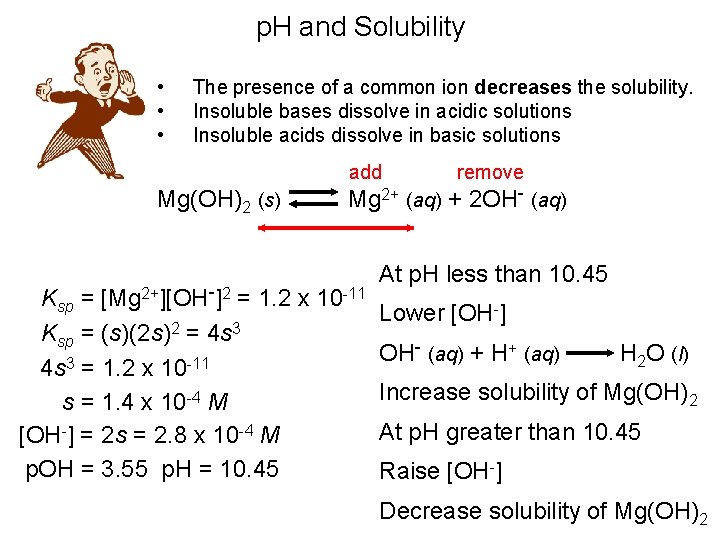
p. H and Solubility • • • The presence of a common ion decreases the solubility. Insoluble bases dissolve in acidic solutions Insoluble acids dissolve in basic solutions add Mg(OH)2 (s) remove Mg 2+ (aq) + 2 OH- (aq) Ksp = [Mg 2+][OH-]2 = 1. 2 x 10 -11 Ksp = (s)(2 s)2 = 4 s 3 = 1. 2 x 10 -11 s = 1. 4 x 10 -4 M [OH-] = 2 s = 2. 8 x 10 -4 M p. OH = 3. 55 p. H = 10. 45 At p. H less than 10. 45 Lower [OH-] OH- (aq) + H+ (aq) H 2 O (l) Increase solubility of Mg(OH)2 At p. H greater than 10. 45 Raise [OH-] Decrease solubility of Mg(OH)2
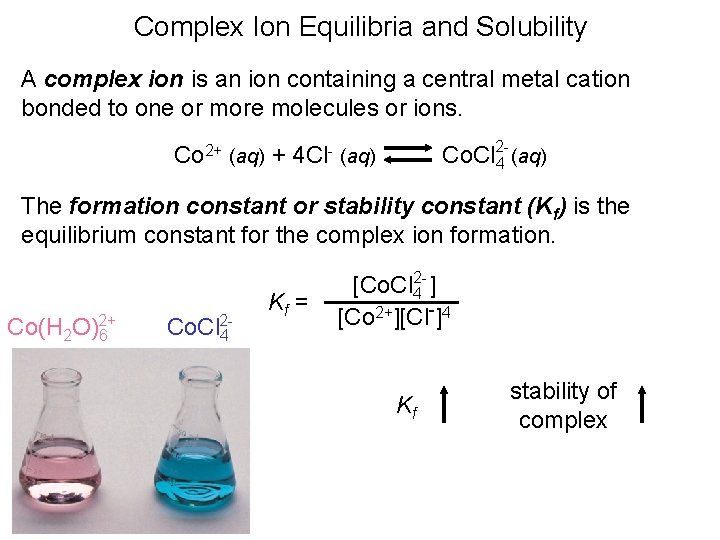
Complex Ion Equilibria and Solubility A complex ion is an ion containing a central metal cation bonded to one or more molecules or ions. Co. Cl 24 (aq) Co 2+ (aq) + 4 Cl- (aq) The formation constant or stability constant (Kf) is the equilibrium constant for the complex ion formation. Co(H 2 O)2+ 6 Co. Cl 24 Kf = [Co. Cl 42 - ] [Co 2+][Cl-]4 Kf stability of complex
Complex-Ion Equilibria • Many metal ions, especially transition metals, form coordinate covalent bonds with molecules or anions having a lone pair of electrons. This type of bond formation is essentially a Lewis acid-base reaction.
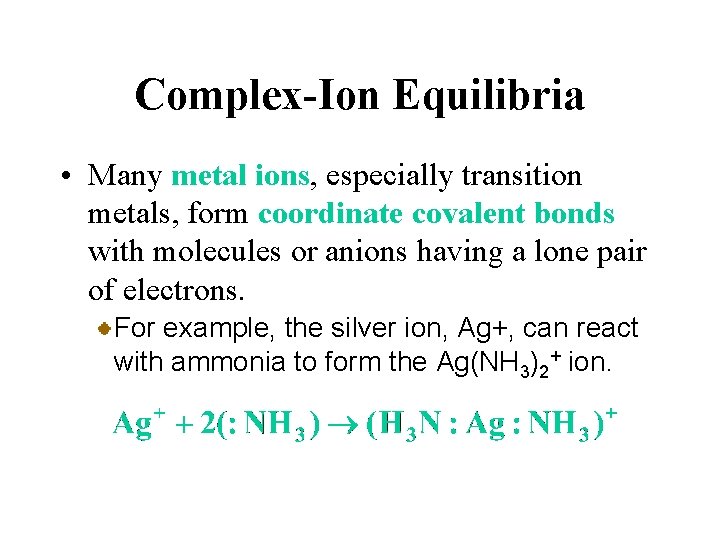
Complex-Ion Equilibria • Many metal ions, especially transition metals, form coordinate covalent bonds with molecules or anions having a lone pair of electrons. For example, the silver ion, Ag+, can react with ammonia to form the Ag(NH 3)2+ ion.
Complex-Ion Equilibria • A complex ion is an ion formed from a metal ion with a Lewis base attached to it by a coordinate covalent bond. A complex is defined as a compound containing complex ions. A ligand is a Lewis base (an electron pair donor) that bonds to a metal ion to form a complex ion.
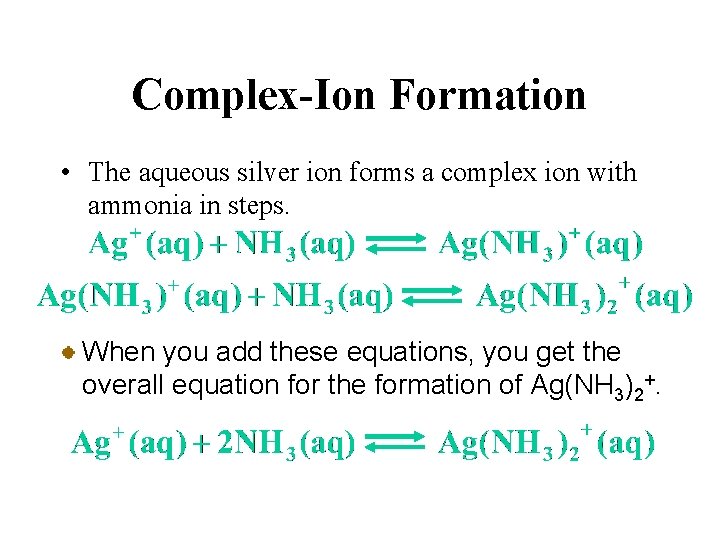
Complex-Ion Formation • The aqueous silver ion forms a complex ion with ammonia in steps. When you add these equations, you get the overall equation for the formation of Ag(NH 3)2+.
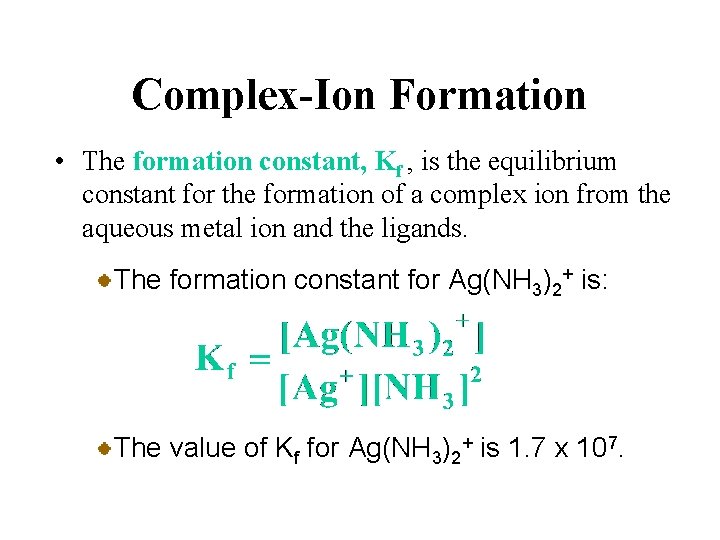
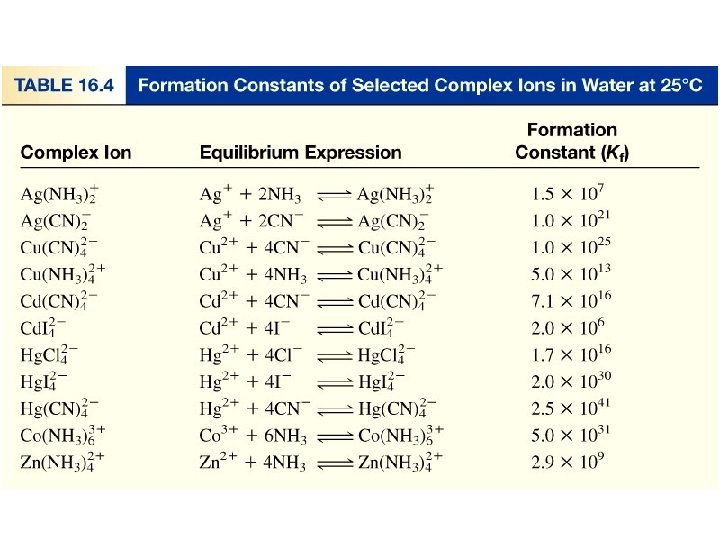
Complex-Ion Formation • The formation constant, Kf , is the equilibrium constant for the formation of a complex ion from the aqueous metal ion and the ligands. The formation constant for Ag(NH 3)2+ is: The value of Kf for Ag(NH 3)2+ is 1. 7 x 10⁷.
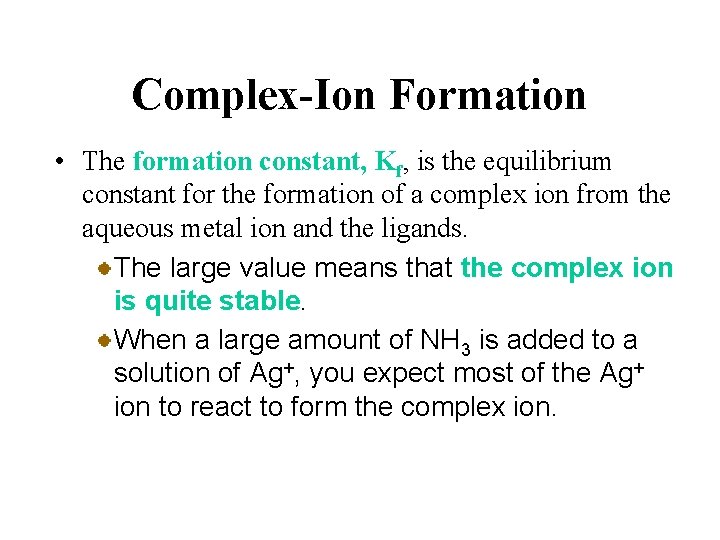
Complex-Ion Formation • The formation constant, Kf, is the equilibrium constant for the formation of a complex ion from the aqueous metal ion and the ligands. The large value means that the complex ion is quite stable. When a large amount of NH 3 is added to a solution of Ag+, you expect most of the Ag+ ion to react to form the complex ion.
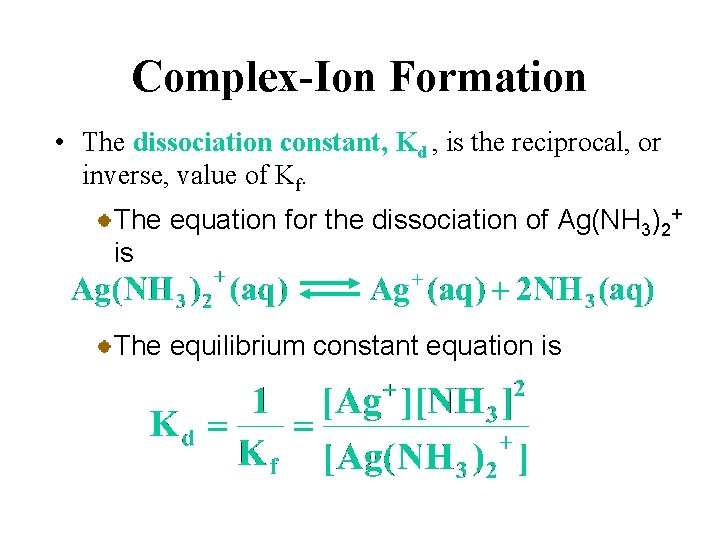
Complex-Ion Formation • The dissociation constant, Kd , is the reciprocal, or inverse, value of Kf. The equation for the dissociation of Ag(NH 3)2+ is The equilibrium constant equation is
Equilibrium Calculations with Kf • What is the concentration of Ag+(aq) ion in 0. 010 M Ag. NO 3 that is also 1. 00 M NH 3? The Kf for Ag(NH 3)2+ is 1. 7 x 10⁷. In 1. 0 L of solution, you initially have 0. 010 mol Ag+(aq) from Ag. NO 3. This reacts to give 0. 010 mol Ag(NH 3)2+, leaving (1. 00 - (2 x 0. 010)) = 0. 98 mol NH 3. You now look at the dissociation of Ag(NH 3)2+.
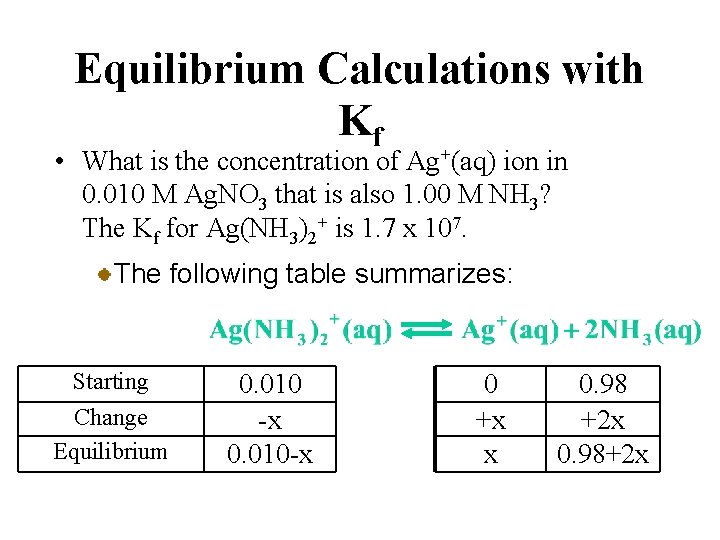
Equilibrium Calculations with Kf • What is the concentration of Ag+(aq) ion in 0. 010 M Ag. NO 3 that is also 1. 00 M NH 3? The Kf for Ag(NH 3)2+ is 1. 7 x 10⁷. The following table summarizes: Starting Change Equilibrium 0. 010 -x 0. 010 -x 0 +x x 0. 98 +2 x 0. 98+2 x
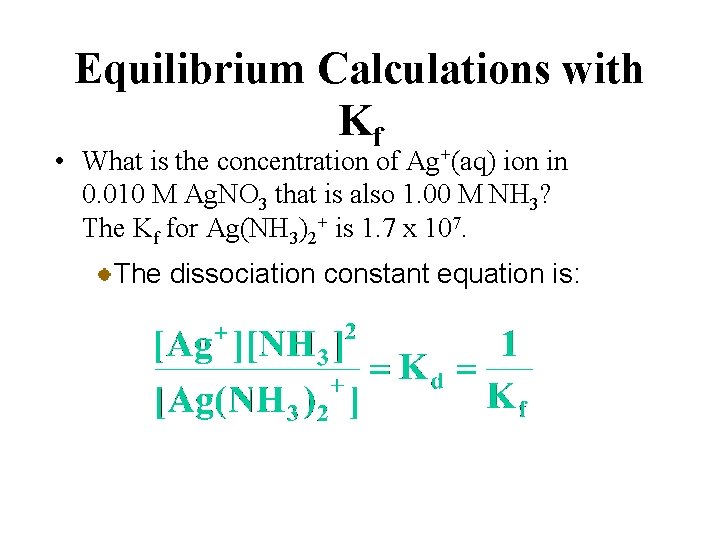
Equilibrium Calculations with Kf • What is the concentration of Ag+(aq) ion in 0. 010 M Ag. NO 3 that is also 1. 00 M NH 3? The Kf for Ag(NH 3)2+ is 1. 7 x 10⁷. The dissociation constant equation is:
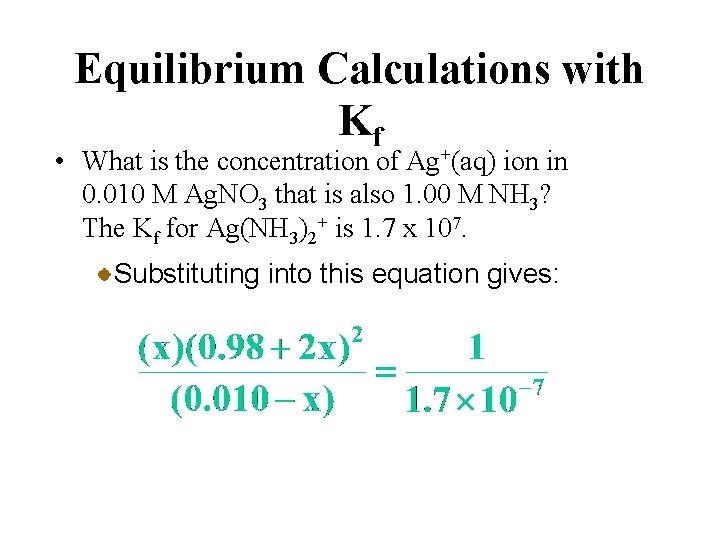
Equilibrium Calculations with Kf • What is the concentration of Ag+(aq) ion in 0. 010 M Ag. NO 3 that is also 1. 00 M NH 3? The Kf for Ag(NH 3)2+ is 1. 7 x 10⁷. Substituting into this equation gives:
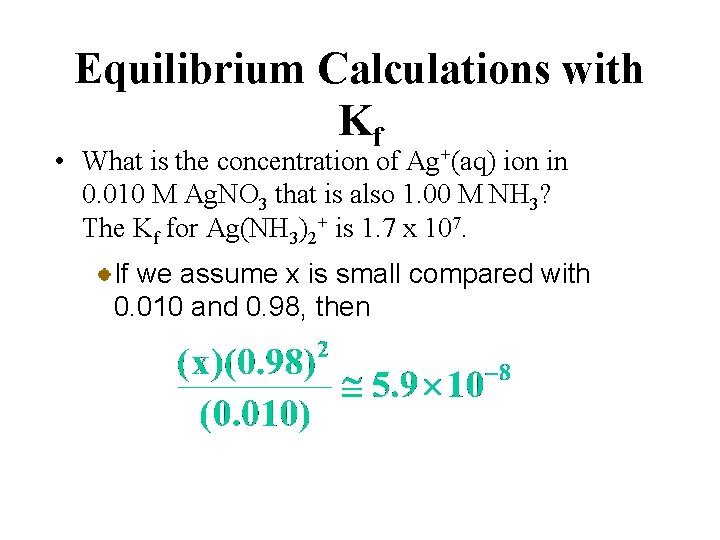
Equilibrium Calculations with Kf • What is the concentration of Ag+(aq) ion in 0. 010 M Ag. NO 3 that is also 1. 00 M NH 3? The Kf for Ag(NH 3)2+ is 1. 7 x 10⁷. If we assume x is small compared with 0. 010 and 0. 98, then
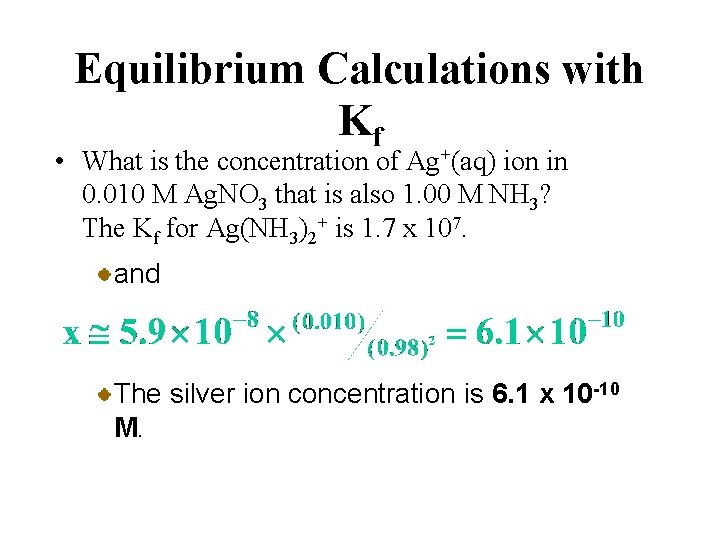
Equilibrium Calculations with Kf • What is the concentration of Ag+(aq) ion in 0. 010 M Ag. NO 3 that is also 1. 00 M NH 3? The Kf for Ag(NH 3)2+ is 1. 7 x 10⁷. and The silver ion concentration is 6. 1 x 10 -10 M.
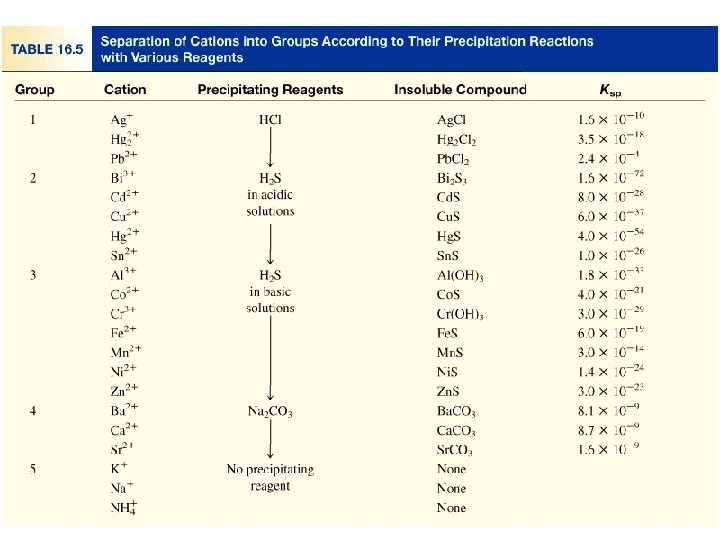
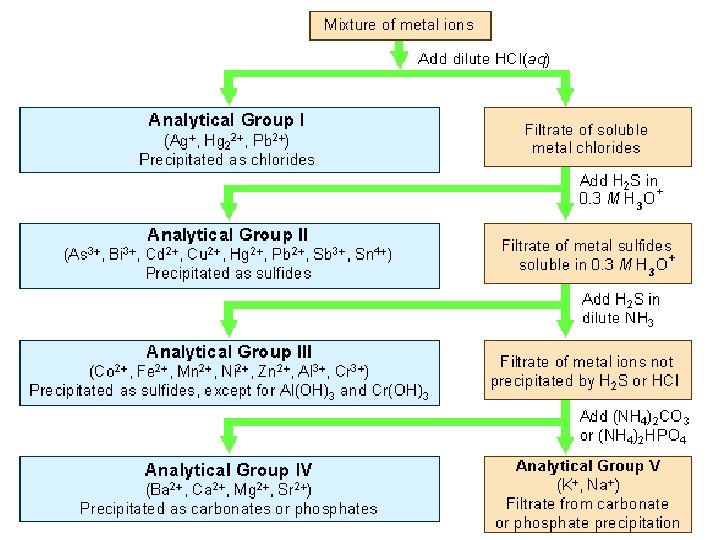
Qualitative Analysis • Qualitative analysis involves the determination of the identity of substances present in a mixture. In the qualitative analysis scheme for metal ions, a cation is usually detected by the presence of a characteristic precipitate.
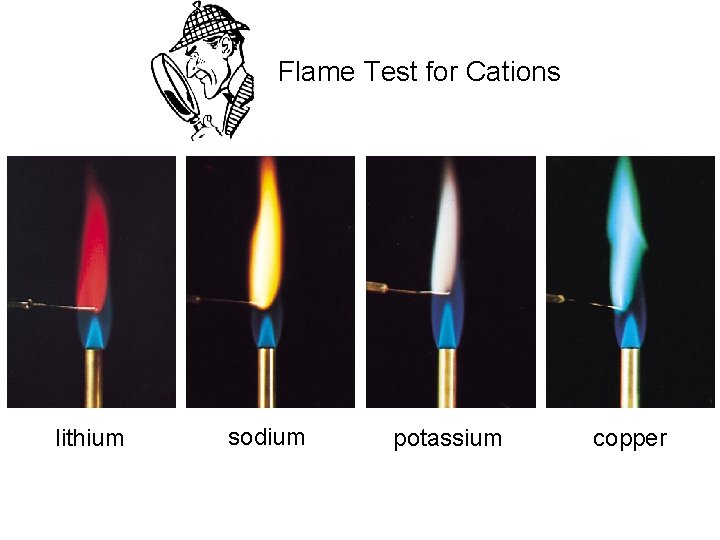
Flame Test for Cations lithium sodium potassium copper
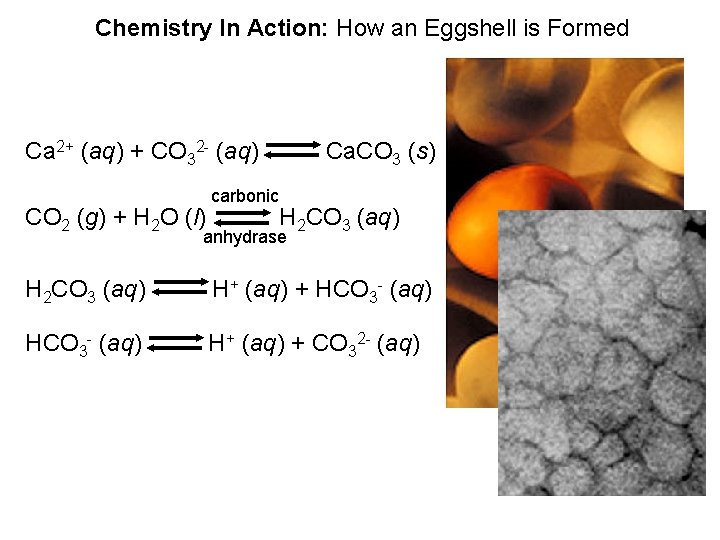
Chemistry In Action: How an Eggshell is Formed Ca 2+ (aq) + CO 32 - (aq) CO 2 (g) + H 2 O (l) carbonic Ca. CO 3 (s) H 2 CO 3 (aq) anhydrase H 2 CO 3 (aq) H+ (aq) + HCO 3 - (aq) H+ (aq) + CO 32 - (aq)

WORKED EXAMPLES
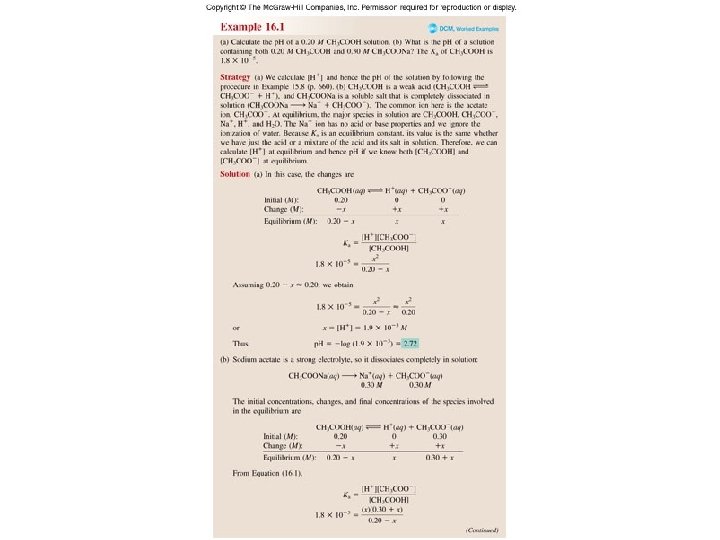
Worked Example 16. 1 a
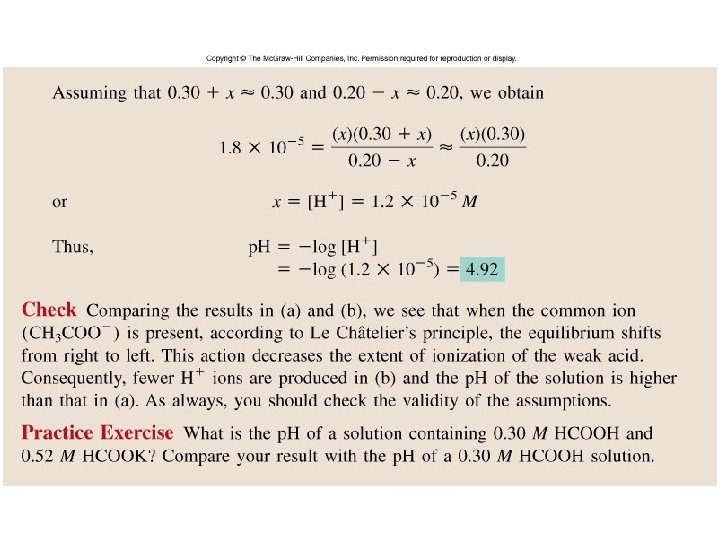
Worked Example 16. 1 b
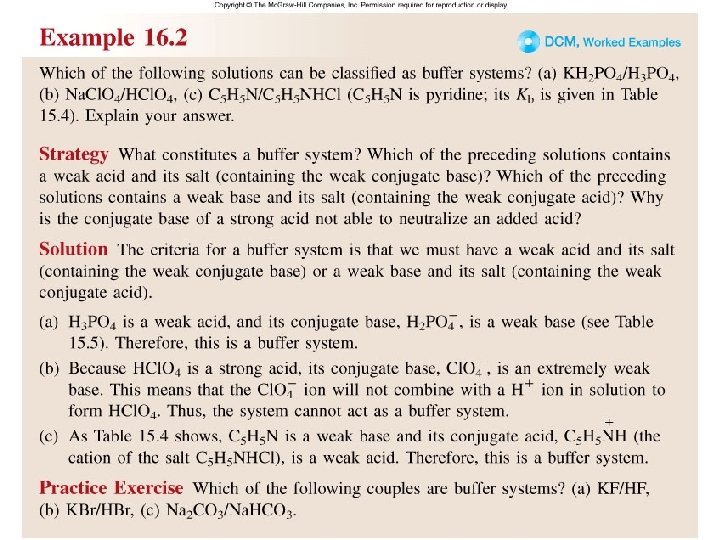
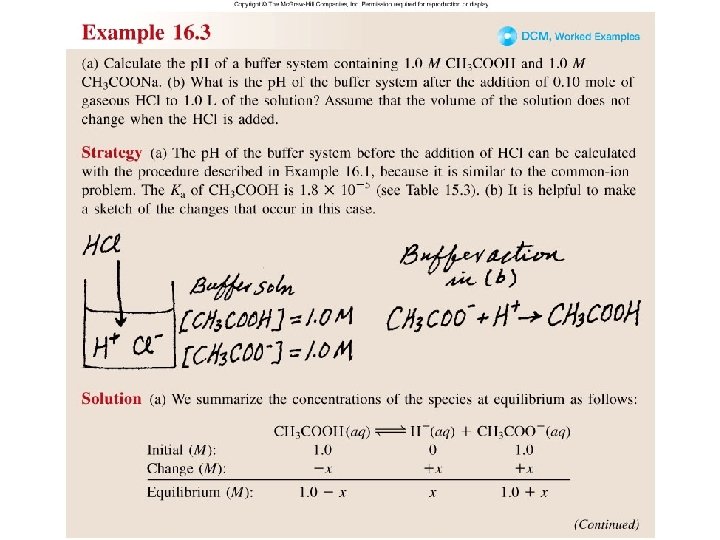
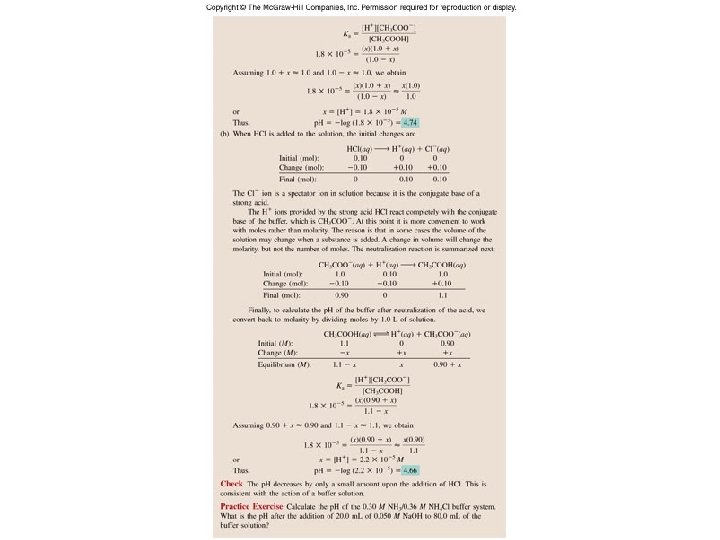
Worked Example 16. 3 b
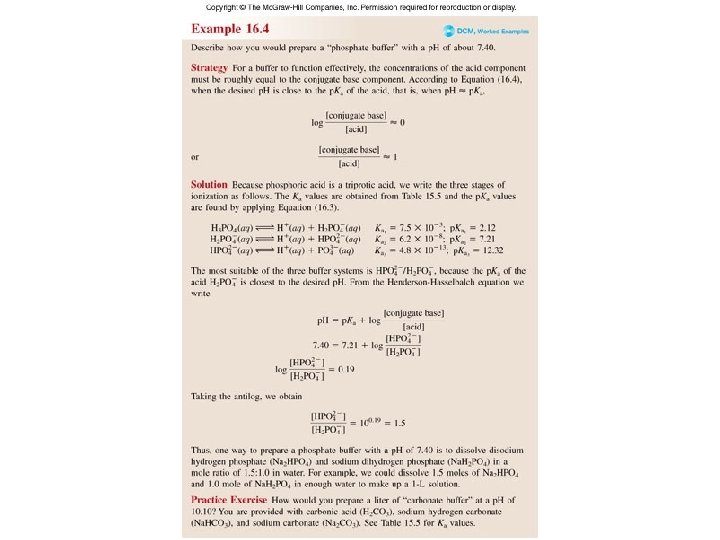
Worked Example 16. 4
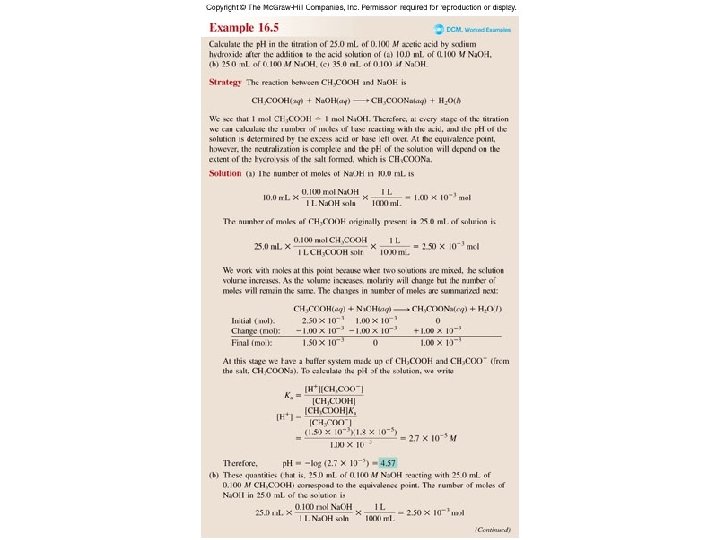
Worked Example 16. 5 a
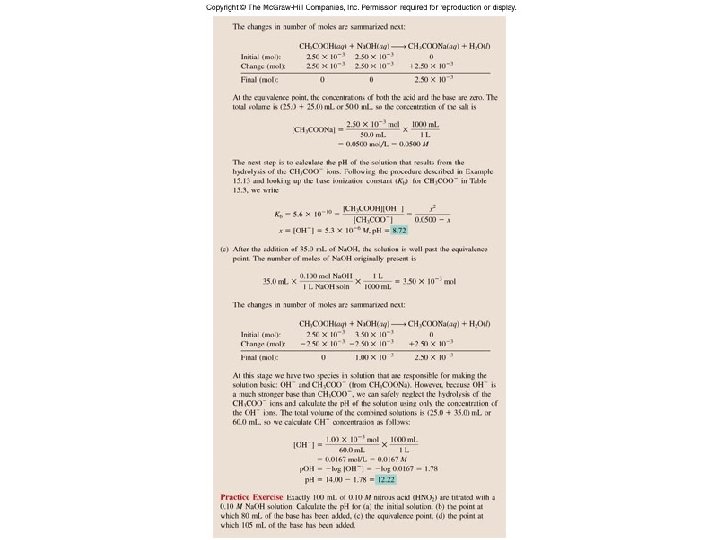
Worked Example 16. 5 b
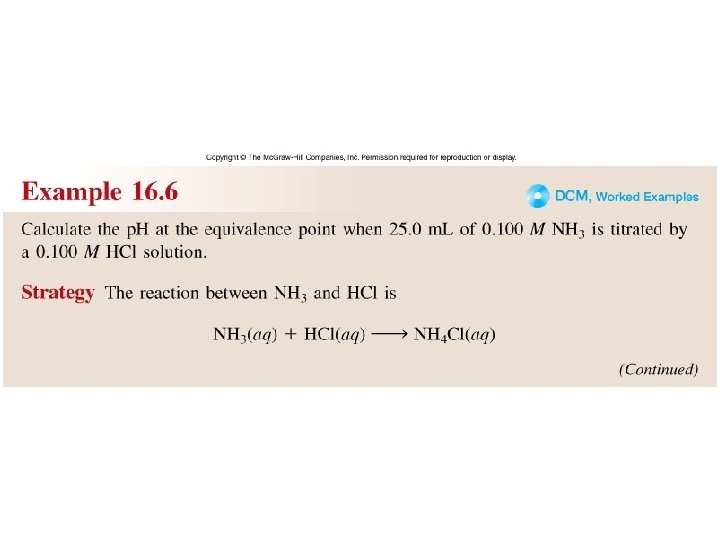
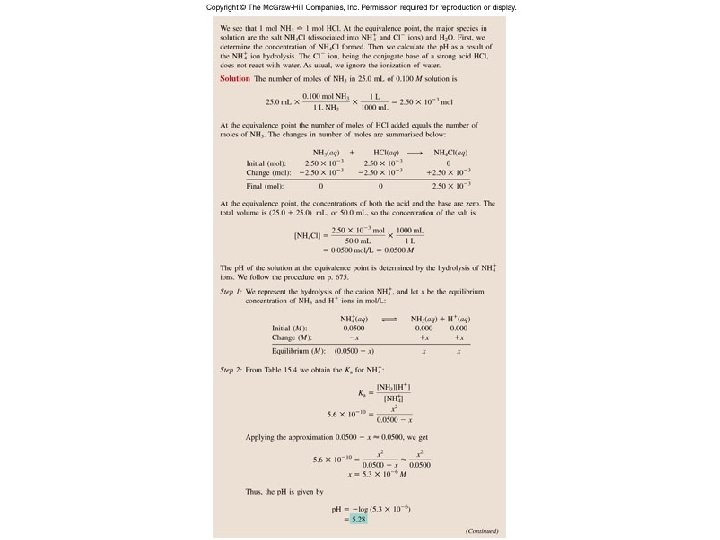
Worked Example 16. 6 b
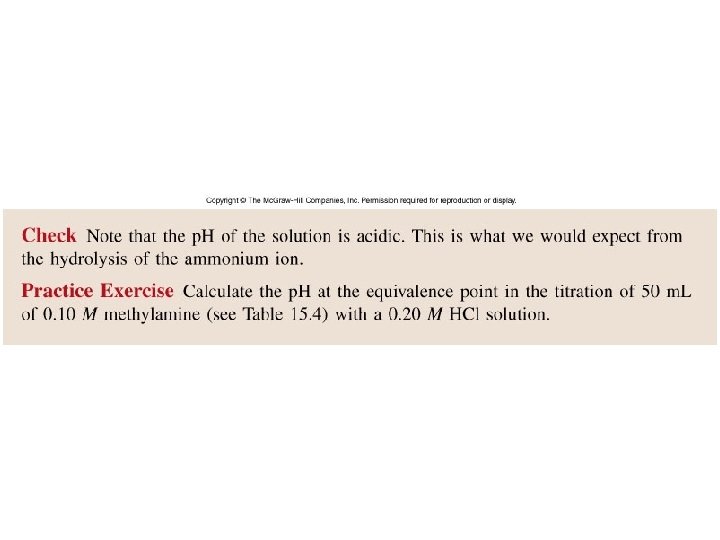
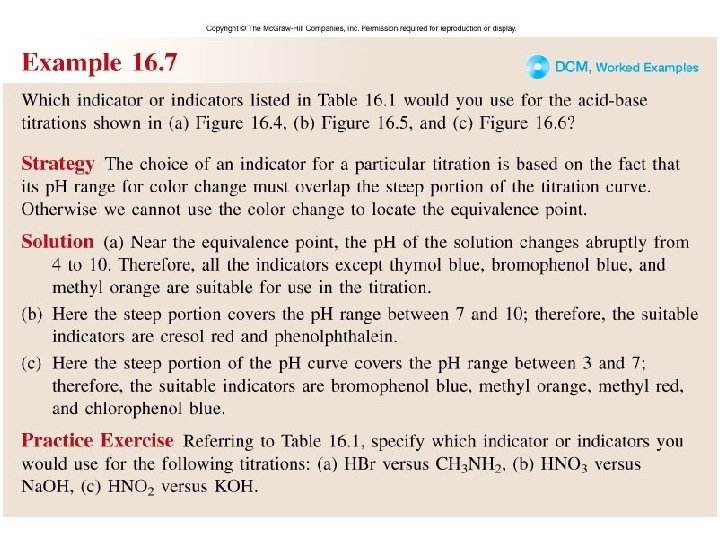
Worked Example 16. 7
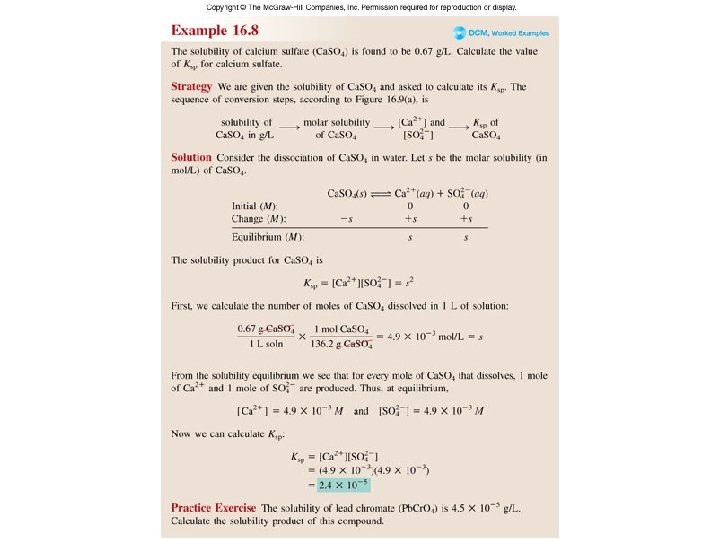
Worked Example 16. 8
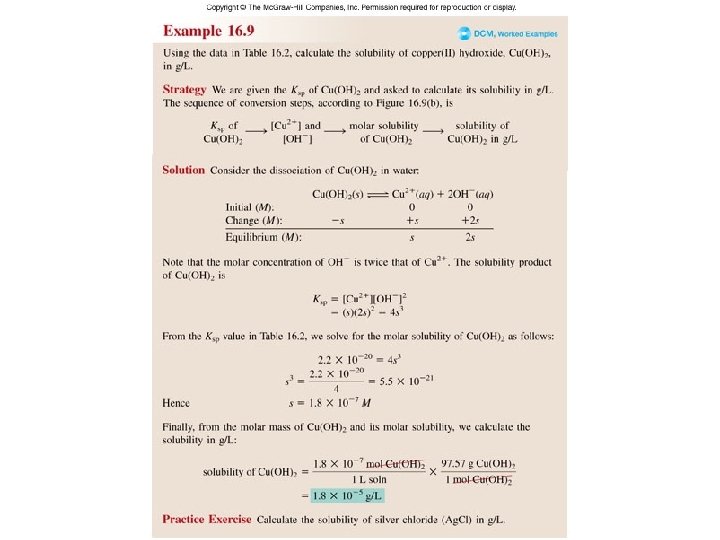
Worked Example 16. 9
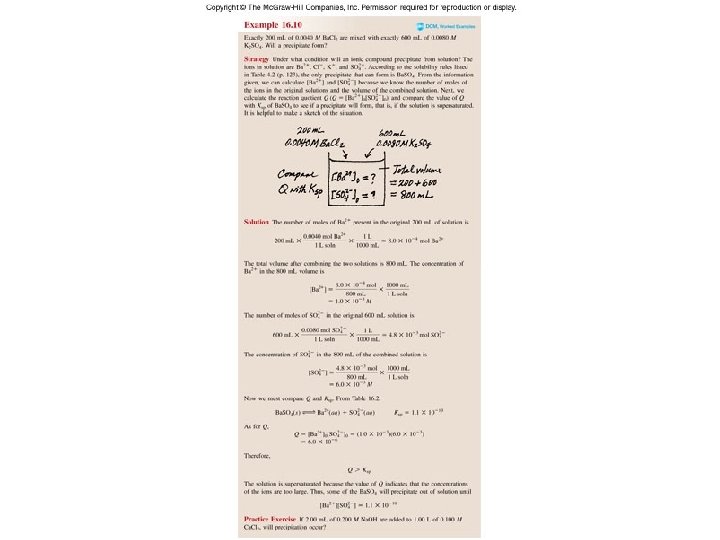
Worked Example 16. 10
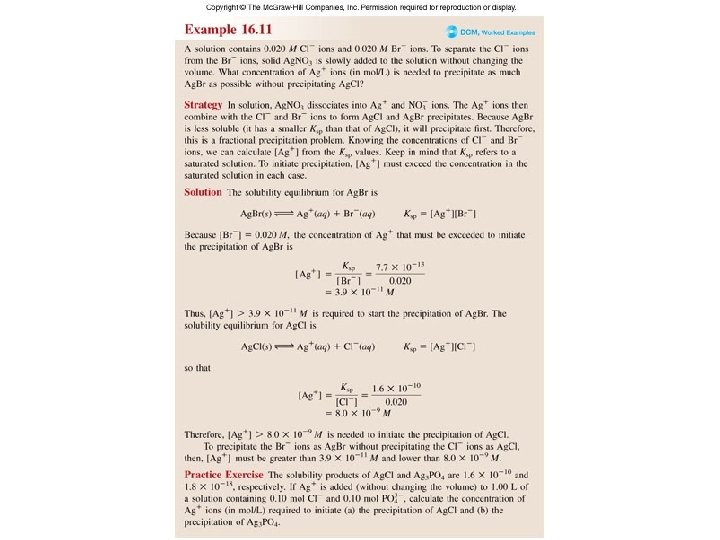
Worked Example 16. 11
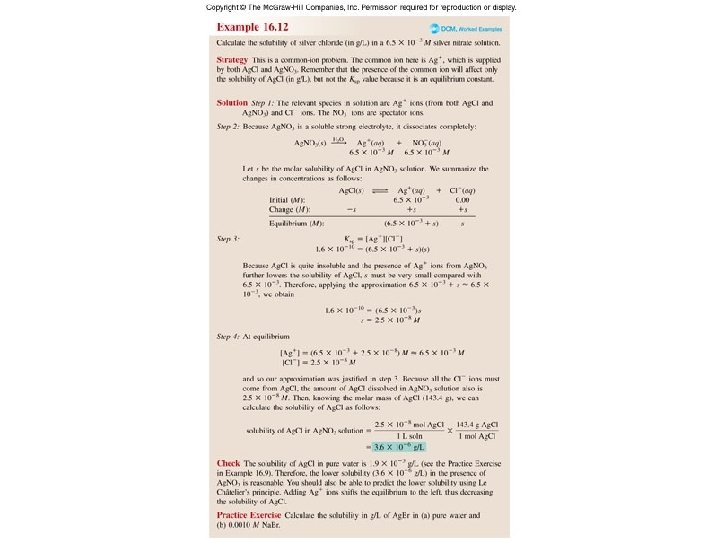
Worked Example 16. 12
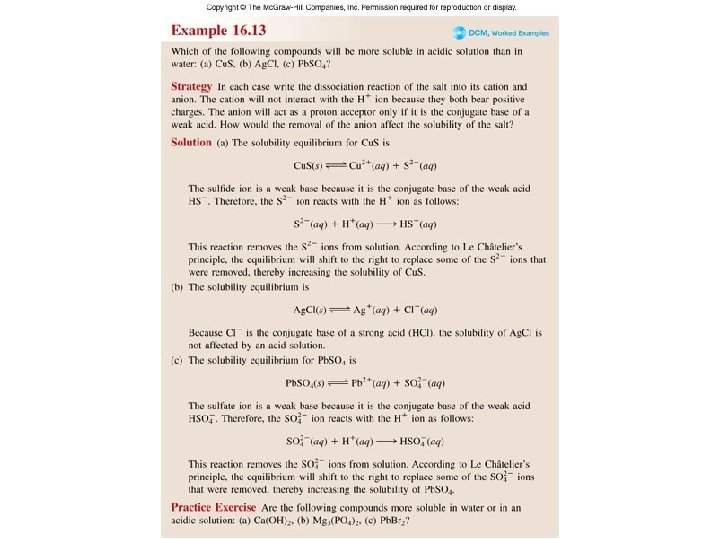
Worked Example 16. 13
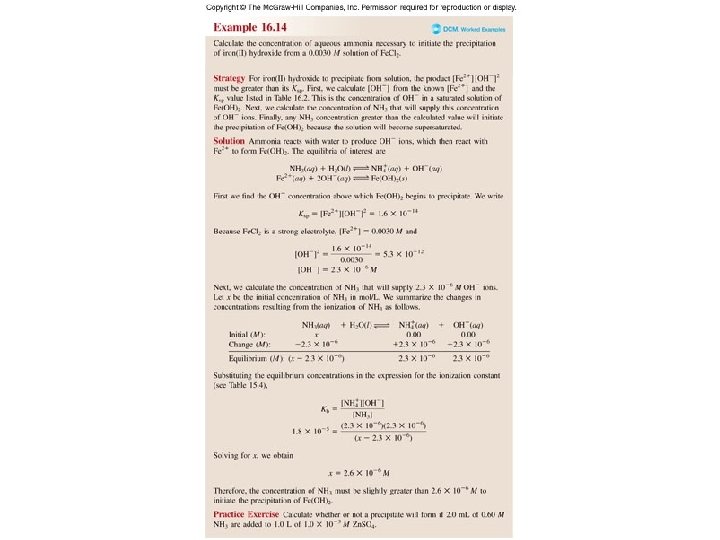
Worked Example 16. 14
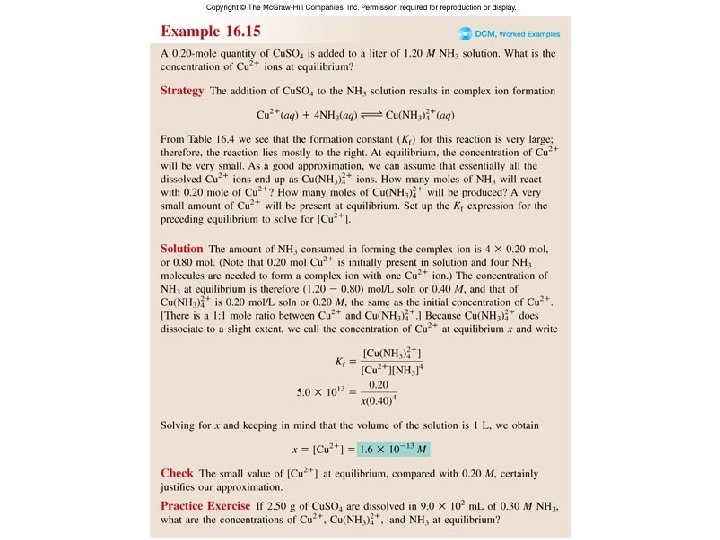
Worked Example 16. 15
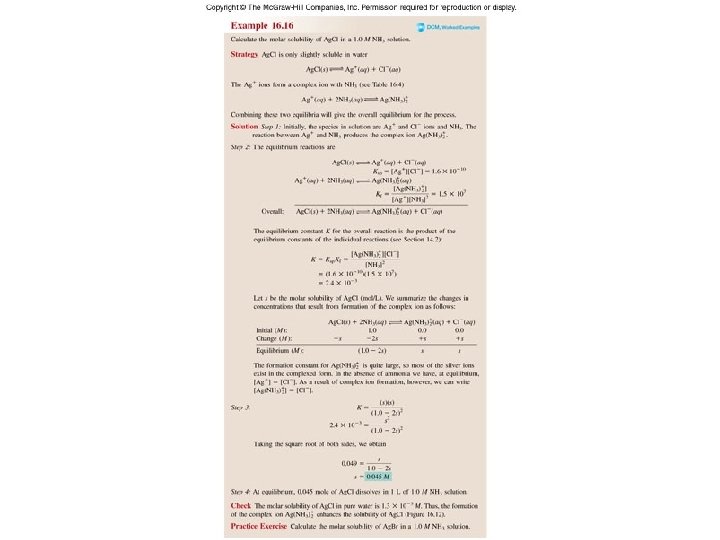
Worked Example 16. 16
- Slides: 140